
Plastic Antioxidant Market Size and Share
Market Overview
| Study Period | 2020 - 2031 |
|---|---|
| Market Size (2026) | USD 5.69 Billion |
| Market Size (2031) | USD 7.33 Billion |
| Growth Rate (2026 - 2031) | 5.18 % |
| Fastest Growing Market | Asia Pacific |
| Largest Market | Asia Pacific |
| Market Concentration | Medium |
Major Players *Disclaimer: Major Players sorted in no particular order Image © Mordor Intelligence. Reuse requires attribution under CC BY 4.0. | |
Plastic Antioxidant Market Analysis by Mordor Intelligence
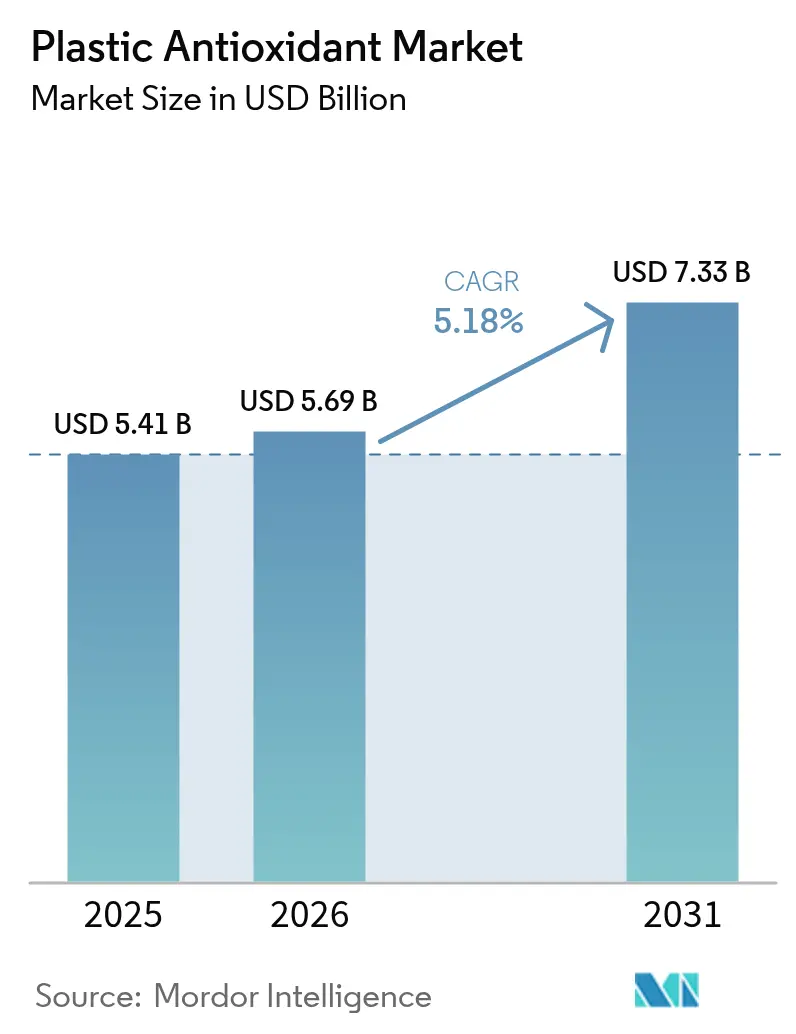
The Plastic Antioxidant Market size was valued at USD 5.41 billion in 2025 and estimated to grow from USD 5.69 billion in 2026 to reach USD 7.33 billion by 2031, at a CAGR of 5.18% during the forecast period (2026-2031). Heightened demand for lightweight, durable polymers in automotive, packaging, construction and electronics is reinforcing reliance on advanced stabilization chemistry. Regulatory moves toward circular-economy targets are accelerating uptake of high-performance antioxidant blends that allow recycled resins to match virgin-grade performance. Integrated feedstock strategies, such as chemically recycled benzene supply agreements, are giving leading producers cost and sustainability advantages. Accelerating Asian production capacity, especially in China and India, is reshaping global supply chains, while North American and European end users prioritize additive systems cleared for stringent food-contact and medical standards. Short-term margin pressure from volatile phenol and phosphorus prices is encouraging backward integration, portfolio rationalization and the launch of nonylphenol-free grades.
Key Report Takeaways
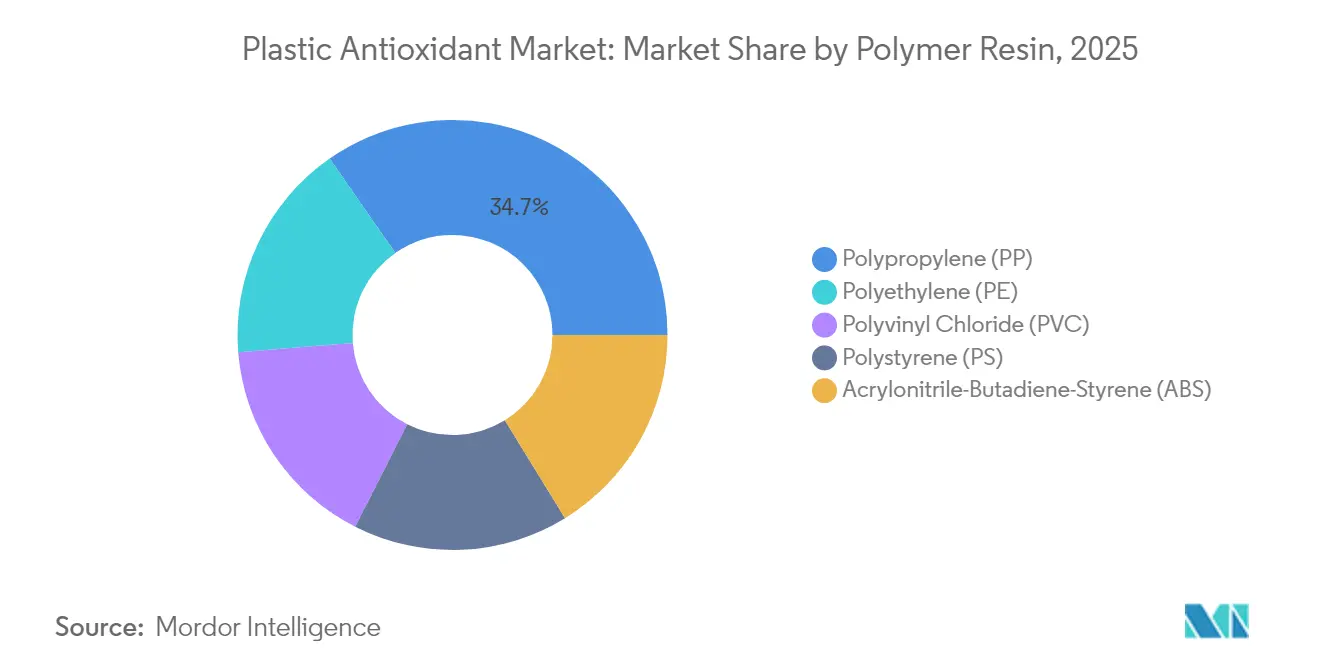
- By polymer resin, polypropylene led with 34.68% of plastic antioxidant market share in 2025; polyethylene is advancing at a 5.95% CAGR through 2031.
- By antioxidant type, phenolic additives captured 39.72% revenue share in 2025, while phosphite/phosphonite systems are projected to expand at a 6.18% CAGR to 2031.
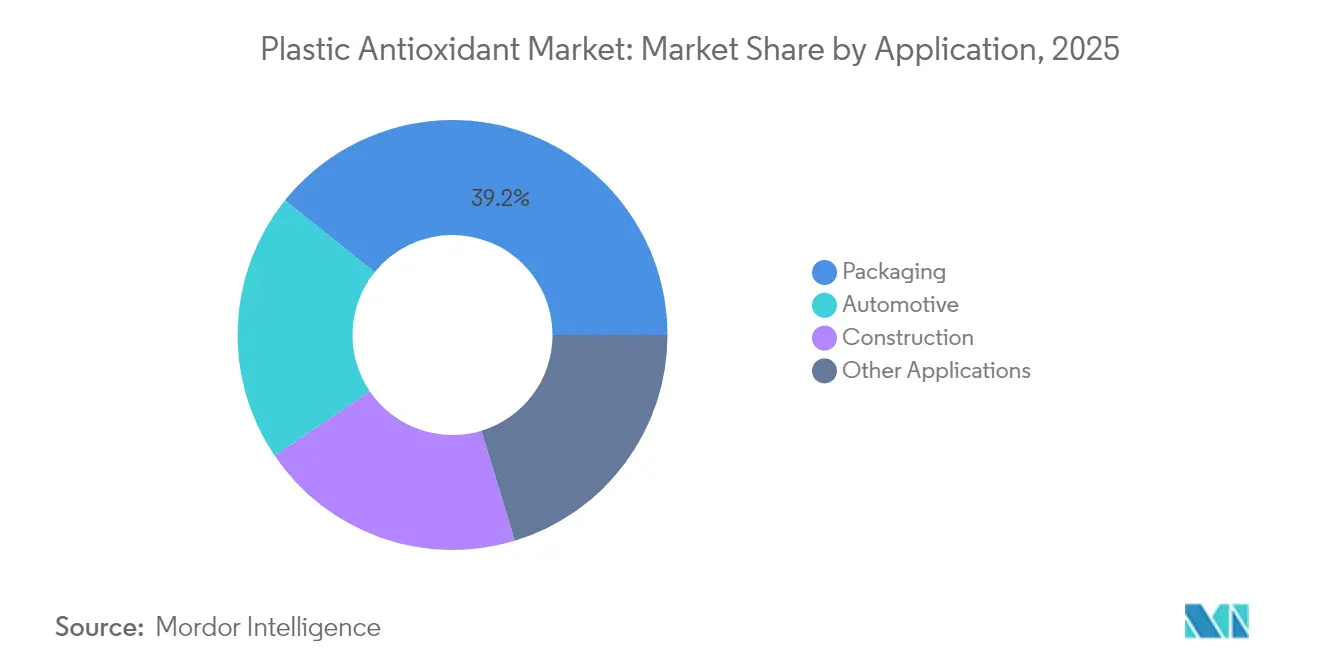
- By application, packaging accounted for 39.22% of the plastic antioxidant market size in 2025, whereas the automotive segment is set to grow at a 6.01% CAGR through 2031.
- By region, Asia-Pacific held 36.40% of 2025 revenue and is poised for the fastest growth at a 6.08% CAGR to 2031.
Note: Market size and forecast figures in this report are generated using Mordor Intelligence’s proprietary estimation framework, updated with the latest available data and insights as of 2026.
Market Trends and Insights
Drivers Impact Analysis of Plastic Antioxidant Market*
| Driver | (~) % Impact on CAGR Forecast | Geographic Relevance | Impact Timeline |
|---|---|---|---|
| Replacement of conventional materials by metals with plastics | +1.8% | Global, with strongest impact in Asia-Pacific and North America | Medium term (2-4 years) |
| Rising polypropylene demand in automotive & rigid packaging | +1.5% | Global, concentrated in automotive hubs (Germany, Japan, China, USA) | Short term (≤ 2 years) |
| Growth of recycled polyolefins requiring high-performance stabilizers | +1.2% | Europe and North America leading, Asia-Pacific following | Long term (≥ 4 years) |
| Longer service-life requirements for 3D-printed polymer parts | +0.8% | North America and Europe, expanding to Asia-Pacific | Medium term (2-4 years) |
| Surging photovoltaic back-sheet film capacity additions | +0.6% | Asia-Pacific dominant, with China leading installations | Short term (≤ 2 years) |
| Source: Mordor Intelligence | |||
Replacement of Conventional Materials by Metals with Plastics
Automakers now incorporate plastic components that represent 15% of vehicle weight, demanding antioxidants that withstand continuous heat, UV radiation and mechanical stress[1]. Sophisticated sterically hindered phenolic–phosphite blends have become customary for under-hood PP, delivering long-term thermal stability without compromising processing efficiency. Construction piping and insulation use similar systems to assure multi-decade service in aggressive outdoor environments. Rapid electric-vehicle adoption amplifies this trend because lighter parts lengthen driving range while facing higher operating temperatures. Consequently, integrated stabilizer packages tailored for metal-replacement grades are driving incremental demand throughout the plastic antioxidant market.
Rising Polypropylene Demand in Automotive & Rigid Packaging
Polypropylene components in engine compartments frequently face service temperatures above 120 °C, making tailored antioxidant packages indispensable. Dual systems combining Irganox 1010 with Irgafos 168 limit melt-flow decline during compounding and prolong part durability. Food-grade rigid packaging further tightens migration limits, encouraging nonylphenol-free phosphites that comply with evolving FDA and EU thresholds. The parallel push to incorporate recycled PP in bumper fascia and interior trim reinforces the need for restabilization, sustaining volume growth for value-added antioxidant solutions within the plastic antioxidant market.
Growth of Recycled Polyolefins Requiring High-Performance Stabilizers
Mechanical recycling exposes polymers to multiple heat histories that strip out legacy stabilizers and shorten molecular chains. Formulations such as BASF’s IrgaCycle restore viscosity and impact strength, enabling converters to place recyclate into higher-value packaging and consumer goods. Emerging European mandates for minimum recycled content magnify this requirement, lifting premium-grade antioxidant consumption. Suppliers able to couple processing-aid functionality with odor-neutralization are winning share among compounders pursuing closed-loop initiatives, further enlarging the plastic antioxidant market.
Longer Service-Life Requirements for 3D-Printed Polymer Parts
Laser-sintered polyamide powders experience prolonged exposure to 180 °C during build cycles, accelerating thermo-oxidative degradation. Incorporating hindered phenolic additives such as Irganox 1098 preserves mechanical integrity across multiple powder reuses, lowering material costs for service-grade prints. Medical device makers additionally explore biocompatible carrier systems that release antioxidants at controlled rates to arrest degradation in vivo. These developments broaden application breadth and underpin steady growth in the plastic antioxidant market.
Restraints Impact Analysis of Plastic Antioxidant Market*
| Restraint | (~) % Impact on CAGR Forecast | Geographic Relevance | Impact Timeline |
|---|---|---|---|
| Stringent global & regional regulations on plastic additives | -1.4% | Europe leading, North America following, Asia-Pacific adapting | Medium term (2-4 years) |
| Toxicity & migration concerns prompting additive-free polymers | -0.9% | Global, with strongest impact in food contact applications | Long term (≥ 4 years) |
| Volatile phosphorus & phenol feedstock prices | -0.7% | Global, with Asia-Pacific most affected by supply disruptions | Short term (≤ 2 years) |
| Source: Mordor Intelligence | |||
Stringent Global & Regional Regulations on Plastic Additives
The EU has proposed classifying TNPP as an SVHC, compelling formulators to eliminate nonylphenol moieties and redesign portfolios. Clariant’s PFAS-free antioxidant line exemplifies proactive compliance, but smaller suppliers face disproportionate testing costs. Divergent regional thresholds for migration into food pose additional burdens, prompting multinational converters to demand globally cleared antioxidant grades. Compliance complexity encourages consolidation, raising entry barriers yet tempering growth for the plastic antioxidant market.
Toxicity & Migration Concerns Prompting Additive-Free Polymers
Analytical studies reveal inner plastic packaging can contain 24 mg/kg of synthetic antioxidants that partially migrate into foods. Reactive stabilization chemistries, where antioxidant fragments are grafted onto polymer chains, are gaining traction because they curb leaching while sustaining protection. Brands in cosmetics and pharmaceuticals increasingly specify low-migration polyolefins, nudging research toward bio-based or covalently bound alternatives. These shifts could reduce volume growth but simultaneously open higher-margin niches in the plastic antioxidant industry.
*Our forecasts treat driver/restraint impacts as directional, not additive. The impact forecasts reflect baseline growth, mix effects, and variable interactions.
Plastic Antioxidant Market Segment Analysis
By Polymer Resin:
Polypropylene Dominance Drives Thermal Stability InnovationPolypropylene controlled a 34.68% plastic antioxidant market share in 2025, reflecting its central role in lightweight automotive and rigid-food packaging applications. Its high-temperature processing profile necessitates antioxidant packages that limit melt-flow decline and maintain color. Polyethylene is expanding at a 5.95% CAGR, supported by booming flexible packaging and the push to include recycled content. Novel PP compounds incorporating phenolic–phosphite blends now achieve endurance thresholds once reserved for engineering resins, cementing PP’s leadership within the plastic antioxidant market.
Demand for PVC in pipe, cable and geomembrane requires antioxidants that delay dehydrochlorination and maintain toughness over decades, particularly under pressure cycling and temperature extremes. PS and ABS benefit from primary–secondary antioxidant combinations that arrest thermal-oxidative chain scission during injection molding. Research into bio-derived stabilizers such as phenyl propionates suggests longer-term potential to reduce fossil-based ingredients, hinting at future differentiation across resin families within the plastic antioxidant market.

By Antioxidant Type:
Synergistic Combinations Enhance Protection EfficacyPhenolic additives delivered 39.72% revenue in 2025 by virtue of their free-radical scavenging efficiency. Secondary phosphite and phosphonite antioxidants are projected to outpace the base market at a 6.18% CAGR through 2031. Food-contact clearances for nonylphenol-free grades such as WESTON 705 and 705 T are accelerating migration-sensitive applications. Custom blends tuned to resin type, processing temperature and residence time are increasingly specified in supply contracts, stabilizing demand for multipurpose formulations across the plastic antioxidant market.
Advances in organophosphite chemistry focus on higher hydrolytic stability and lower color contribution, enabling processors to reduce loading yet sustain performance. Such efficiency gains cut additive costs per kilogram of compound and lower extractables, making phosphites central to premium packaging, wire and cable compounds, and e-mobility parts. Blends with hindered amines or UV absorbers provide total protection packages, allowing suppliers to upsell turnkey stabilizer systems rather than single molecules.
By Application:
Packaging Leadership Drives Food Safety InnovationPackaging secured 39.22% of 2025 sales as converters rely on antioxidants to extend shelf life, maintain clarity and prevent taste transfer. Recycled-content mandates are prompting line extensions that restore mechanical strength and optics in rPET and rPE films without exceeding migration limits. Meanwhile, the automotive segment’s 6.01% CAGR through 2031 stems from electric-vehicle adoption, which raises operating temperatures and heightens the need for durable polymers.
Construction remains a steady volume outlet because underground piping, insulation and geomembranes must resist oxidation during prolonged exposure to moisture and soil chemicals. Electronics and medical devices, though smaller, command premium antioxidant grades certified for biocompatibility or low ionic contamination. 3D printing represents an emerging application in which feedstocks loaded with antioxidants secure repeat powder reuse without compromising mechanical integrity, adding incremental volume to the plastic antioxidant market.
Geography Analysis
APAC Plastic Antioxidant Market
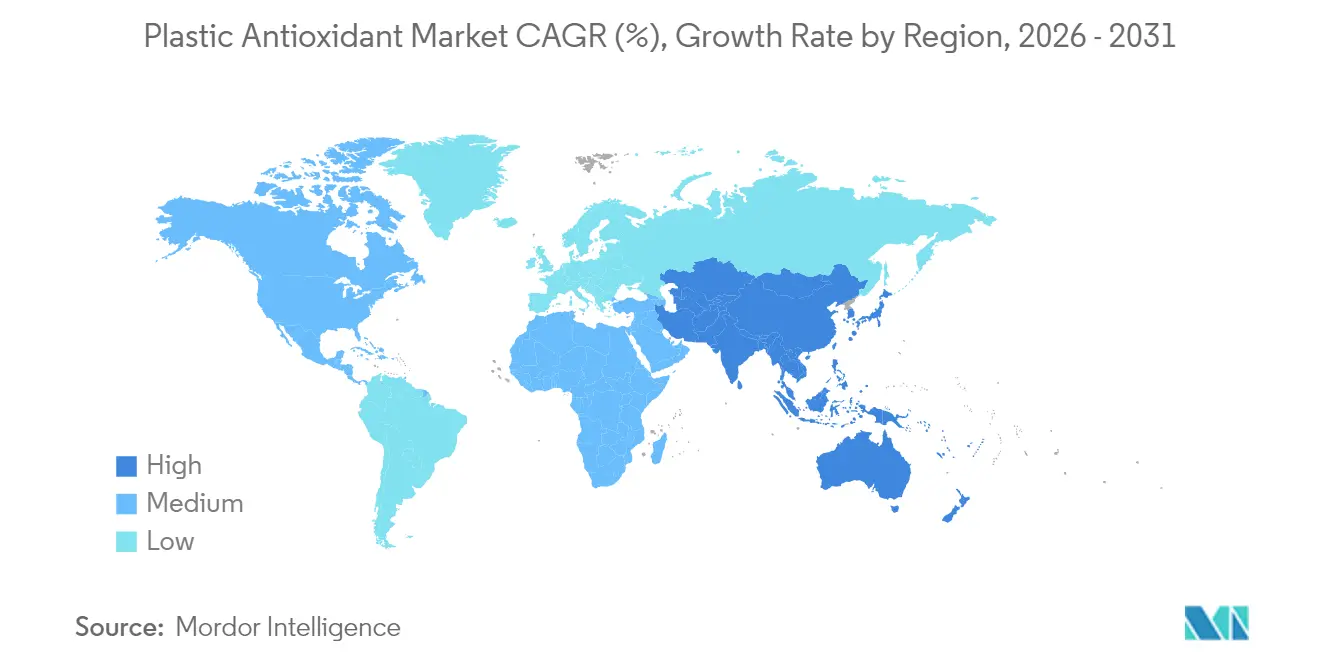
Asia-Pacific captured 36.40% revenue in 2025 and is advancing at a 6.08% CAGR to 2031, underpinned by expanding petrochemical hubs and surging local consumption in automotive and packaging. BASF and Evonik have both expanded Nanjing operations to shorten lead times and embed technical service close to customers. Regional OEMs appreciate on-the-ground formulation support that helps navigate shifting Chinese GB standards and India’s BIS approvals. Growing middle-class demand for packaged foods and appliances further lifts local antioxidant consumption, ensuring Asia-Pacific remains the keystone of the plastic antioxidant market.
North America Plastic Antioxidant Market
North America exhibits mature but resilient growth as stringent FDA food-contact regulations drive continuous reformulation of additives with superior toxicological profiles. Strong recycling initiatives encourage uptake of restabilization packages designed to raise recycled resin content in personal-care and household products. BASF’s long-term benzene feedstock deal with Encina illustrates strategic moves to secure low-carbon raw materials for antioxidant production. Rapid electric-vehicle assembly in the USA and Canada requires antioxidants capable of enduring thermal and electrical loads, supporting premium-grade demand.
Europe Plastic Antioxidant Market
Europe’s trajectory hinges on environmental policy leadership. REACH and the Single-Use Plastics Directive stimulate development of PFAS-free and low-migration antioxidant grades, lifting R&D intensity and driving differentiation in the plastic antioxidant market. Mandatory recycled-content thresholds in packaging accelerate adoption of high-performance stabilizers suited for contaminated feedstreams. Germany, France and Italy remain core demand centers owing to advanced automotive and food-processing sectors, while Eastern Europe grows as manufacturing relocates eastward. Nordic nations and Benelux promote bio-based stabilizers via green-public-procurement schemes, creating early-stage niches for innovative suppliers.
Regulatory Landscape
Regulation of plastic antioxidants is increasingly shaped by food-contact compliance and broader chemical-safety frameworks. In the European Union, Regulation (EU) No 10/2011 governs substances used in plastic food contact materials and is updated through amendments such as Commission Regulation (EU) 2026/245 (adopted 2 February 2026), which revises Annex I authorizations and conditions of use. The EU Chemicals Strategy for Sustainability (launched in 2020) also reinforces substitution and “safe and sustainable by design” directionality, increasing the priority for nonylphenol-free and low-migration stabilizer systems for packaging and medical-grade polymers.
Controls tied to plastics stewardship affect additive selection and handling practices as well. Regulation (EU) 2025/2365 (12 November 2025) introduces mandatory obligations to prevent plastic pellet losses across the supply chain, with large-enterprise certification requirements starting 17 December 2027. This influences how antioxidants are supplied, including lower-dust forms and closed handling systems. In the United States, oversight spans EPA under TSCA for chemical manufacturing and the FDA for food contact applications, where additive clearances and related restrictions (including phthalates allowed for specific food-contact uses, updated by FDA as of 24 June 2026) keep migration and toxicology dossiers central to qualifying antioxidant grades for packaging.
Value Chain Analysis
The plastic antioxidant value chain starts with upstream petrochemical and specialty chemical feedstocks, notably phenols and phosphorus derivatives for phenolic and phosphite/phosphonite systems. It then moves through synthesis, formulation, and finishing into the forms used by polymer processors. Producers supply neat molecules as well as tailored blends and masterbatches that are incorporated during compounding, extrusion, and injection molding for polypropylene, polyethylene, PVC, PS, and ABS applications.
Downstream, compounders and converters in packaging and automotive are key demand aggregators, and they increasingly specify additive packages that balance processing protection, long-term thermal stability, and low migration. Value creation is concentrated in formulation know-how, regulatory documentation, and application support, while logistics and handling matter more as customers adopt pellets, granules, and pre-blended masterbatches to reduce dust and improve dosing consistency on automated lines. Sustainability and traceability are also showing up in procurement, including SONGWON obtaining RSPO certification (MB Grade) for its SONGNOX 1076 phenolic antioxidant in January 2026 and moving to trial quantities in April 2026, which ties certified inputs to sellable stabilized polymer solutions. Recycling-driven demand reinforces the need for high-performance restabilization systems, because recycled polyolefins typically require higher antioxidant loadings and more robust blends to offset multiple heat histories and variable contamination.
Competitive Landscape
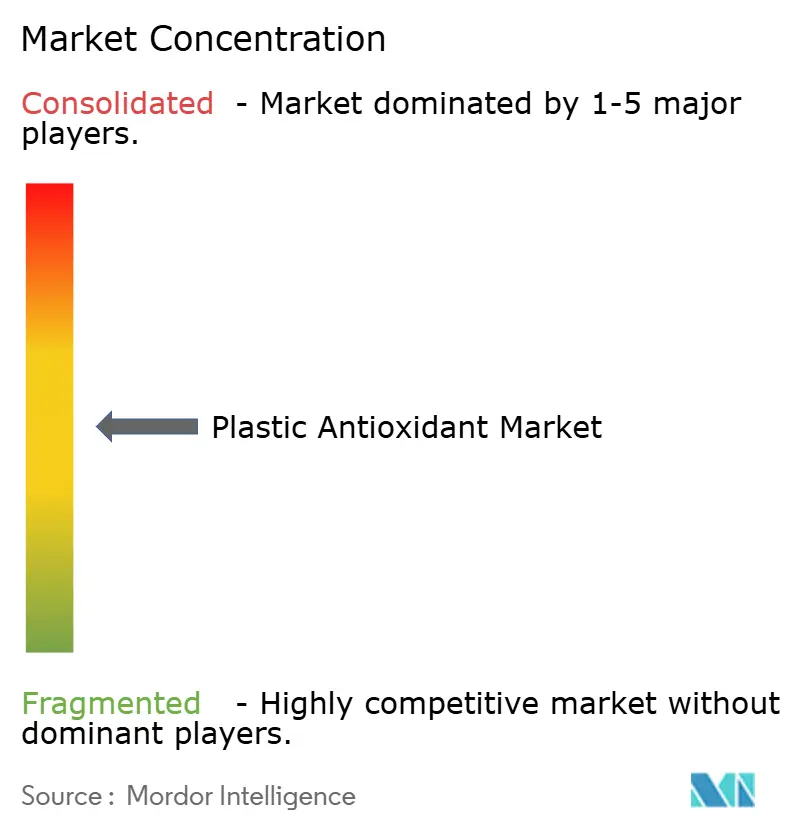
Global supply remains moderately fragmented. BASF, Clariant and Evonik anchor the tier-one group through backward-integrated raw material positions, multi-continent plants and application labs that customize formulations per customer and regulatory regime. Their portfolio depth, including phenolics, phosphites, thioesters and HALS, enables bundled sales, reinforcing customer stickiness in the plastic antioxidant market. Sustainability credentials, from mass-balance attribution to life-cycle-assessment data, serve as key differentiators in tender processes for multinational brand owners.
Medium-sized specialists such as SI Group and Addivant concentrate on niche high-purity stabilizers approved for medical and infant-care applications, competing through rapid regulatory filings and tailored blends. Asian challengers, led by Songwon and Dover Chemical’s Chinese joint ventures, leverage cost-effective manufacturing and rising domestic demand to chip away at incumbent shares, particularly in commodity phenolics. Intellectual-property disputes around novel phosphite synthesis methods underscore the strategic value of process know-how.
Plastic Antioxidant Industry Leaders
-
Clariant
-
BASF
-
ADEKA Corporation
-
SI Group Inc.
-
Songwon
- *Disclaimer: Major Players sorted in no particular order
Plastic Antioxidant Market Companies Covered in this Report
- 3V Sigma S.p.A.
- ADEKA Corporation
- Ampacet Corporation
- Astra Polymers
- Baerlocher GmbH
- BASF
- Clariant
- Dover Chemical Corporation
- Everspring Chemical Co., Ltd.
- Evonik Industries AG
- Milliken & Company
- Oxiris Chemicals S.A.
- SI Group Inc.
- Songwon
- Sumitomo Chemical Co., Ltd.
- Syensqo
- Synthomer plc
- Trigon Antioxidants Pvt. Ltd.
Market Opportunities and Future Outlook
A key whitespace sits where recycled-content adoption intersects with food-contact or other sensitive-use compliance. In these cases, converters look for antioxidant systems that restore performance in recycled polyolefins while controlling extractables and migration. One concrete commercialization signal is SI Group receiving FDA Food Contact Notification (FCN) 2326 in March 2024 for WESTON 705 and WESTON 705T phosphite antioxidants, expanding permissible use to include PET polymers. That widens the packaging resin coverage and supports reformulation away from higher-risk legacy chemistries. The same demand pull aligns with the market shift toward nonylphenol-free, low-odor, and low-dust delivery formats, including masterbatches and pellets, which simplify compliance and plant hygiene.
Sustainability-linked product differentiation is also opening procurement lanes for additive suppliers through certified or phenol-free portfolios and reinforced regional capacity. Clariant completed chemical commissioning of a second Nylostab S-EED production line at its Cangzhou, China facility in August 2025 and introduced AddWorks LXR 548 as a phenol-free antioxidant for polyolefins, supporting both supply continuity in Asia and reformulation programs tied to evolving chemical restrictions. Alongside this, SONGWONs RSPO-certified SONGNOX 1076 (certificate received January 2026) and subsequent market availability show how certification-backed inputs are becoming actionable requirements for brand-owner supply chains. On the technology front, academic work reported in Nature Communications in July 2026 on a catalyst-enabled antioxidation strategy to create intrinsically antioxidant polyolefins during polymerization points to a longer-term pathway that could complement traditional post-polymerization additive blending, particularly where leaching reduction is a priority.
Recent Industry Developments in Plastic Antioxidant Market
- July 2026: SONGWON launched a new antioxidant positioned around advancing sustainable polymer additives. The release adds fresh options for converters seeking performance stabilizers that align with tighter sustainability screens in packaging and durable goods, expanding SONGWONs addressable portfolio in premium-grade applications.
- August 2025: Clariant completed chemical commissioning of a second Nylostab S-EED production line at its Cangzhou, China, facility and introduced AddWorks LXR 548, a phenol-free antioxidant for polyolefins. The move strengthens local supply in Asia and supports customer reformulations aimed at reducing reliance on legacy chemistries under tighter additives scrutiny.
- March 2024: SI Group announced that the US FDA granted Food Contact Notification (FCN) 2326 for its phosphite antioxidants, WESTON 705 and WESTON 705T, expanding permissible use to include PET polymers. The clearance broadens the applications addressable by these grades in food-contact packaging and supports multi-resin additive qualification strategies for global converters.
Plastic Antioxidant Market Report Scope and Research Methodology
Market Definition and Coverage
This market covers antioxidant additives used in plastics to slow down degradation during compounding, processing, and the product use phase, reported in value terms for global demand and supply.
Scope exclusions: UV stabilizers, flame retardants, and non-plastics antioxidant uses (such as rubber) are not counted in this market sizing.
Segments Covered in This Report
- By Polymer Resin
- Polypropylene (PP)
- Polyethylene (PE)
- Polyvinyl Chloride (PVC)
- Polystyrene (PS)
- Acrylonitrile-Butadiene-Styrene (ABS)
- By Antioxidant Type
- Phenolic Antioxidants
- Phosphite and Phosphonite Antioxidants
- Antioxidant Blends
- By Application
- Packaging
- Construction
- Automotive
- Other Applications
- By Geography
- Asia-Pacific
- China
- India
- Japan
- South Korea
- ASEAN
- Rest of Asia-Pacific
- North America
- United States
- Canada
- Mexico
- Europe
- Germany
- United Kingdom
- France
- Italy
- Spain
- Russia
- Rest of Europe
- South America
- Brazil
- Argentina
- Rest of South America
- Middle East and Africa
- Saudi Arabia
- South Africa
- Rest of Middle East and Africa
- Asia-Pacific
Data Sources, Market Sizing, and Validation
Desk Research
Desk research was used to set clear market boundaries and build an initial demand pool for plastic antioxidants, and then to anchor the model with signals that can be verified over time. We refer to public sources such as UN Comtrade for polymer and chemical trade flows, national statistics offices for manufacturing and plastics output indicators, the World Bank for industrial production context and inflation indicators, and official chemicals and safety portals such as the European Chemicals Agency and the US FDA food contact resources to understand compliance-driven use in packaging.
In addition, annual reports, investor presentations, and product technical datasheets help us map typical applications, formulation positioning, and the way blends are sold into major resin systems. Select paid subscriptions are used only where they add structure, such as company financials and intelligence, patent databases to track formulation activity, and shipment-level import and export databases for directional cross-checks. The sources listed above are illustrative and not exhaustive, and other public documents and references were also reviewed for data collection, validation, and research clarification.
Primary Interviews and Surveys
Primary work is used to pressure test the desk view and close gaps that public data does not explain well, such as typical antioxidant loading ranges by resin and how blend pricing behaves across end uses. We speak with raw material suppliers, antioxidant formulators, polymer compounders, converters, and procurement and technical teams at end users, and coverage is balanced across APAC, EMEA, and the Americas so regional mix effects are captured.
Distribution of primary research fieldwork respondents
| Company type | Respondent position | Region |
|---|---|---|
| Top tier: 33% | CXOs: 14% | APAC: 51% |
| Mid tier: 53% | Functional/Unit leaders: 40% | EMEA: 30% |
| Smaller Players: 14% | Managers: 46% | Americas: 19% |
Market-Sizing & Forecasting
Sizing starts with a top-down demand reconstruction that links regional polymer processing activity to expected antioxidant consumption, and then converts that into value using price bands observed across common chemistries and blends. For each region, resin throughput trends and trade signals are aligned with typical stabilization needs for high-volume plastics, and the market total is then corroborated with selective bottom-up approximations like sampled supplier revenue cues, channel checks, and ASP-by-application sanity checks.
A small set of practical inputs is used as the main model drivers and is refreshed each cycle. Examples include regional resin production and conversion trends for PP, PE, PVC, PS, and ABS, packaging and construction activity indicators that move additive demand, typical antioxidant loading rates by resin and process severity, the mix shift toward antioxidant blends in higher performance applications, and movements in key phenolic and phosphorus-based feedstocks that influence realized ASPs. Where bottom-up visibility is uneven, gaps are handled using conservative coverage ratios that are reviewed with interview feedback before totals are finalized.
For forecasting, scenario analysis is used because adoption, pricing, and resin mix can move differently across cycles, and we need a simple way to stress test outcomes. The base case follows expected polymer demand growth and gradual mix progression, and then the downside and upside cases adjust for resin throughput softness, compliance-led formulation shifts, and feedstock-driven pricing changes that were highlighted by industry participants.
Data Validation & Update Cycle
Model outputs are checked against independent signals before sign-off, including whether implied antioxidant intensity per ton of plastics stays within realistic ranges and whether regional splits align with observed resin processing and trade patterns. When a variance is found, assumptions are revisited, outliers are traced back to a source or calculation step, and follow-up questions are sent to select respondents to confirm what changed.
A multi-step internal review is completed so inputs, formulas, and conversion factors remain consistent across regions and applications. Reports are refreshed annually, and interim updates are triggered when material events occur, such as sharp feedstock price shifts, major capacity changes, or regulatory moves that affect allowable chemistries. Before delivery, a final analyst pass is done so clients receive the latest updated view.
Mordor Intelligence's Plastic Antioxidant Market Size Compared With Other Published Estimates
Published market sizes for plastic antioxidants can differ even when the topic label looks the same, because the included product set, resin coverage, and the demand proxies used to build the model are not always consistent. Differences also show up when one estimate leans more on supplier commentary and another leans more on polymer demand indicators, which can lead to a different view of volumes and realized pricing.
Key gaps usually come from scope choices and how the value is constructed, including whether the estimate counts only antioxidants used in plastics processing or also adds adjacent stabilizers, whether blends are treated as a separate premium category across all end uses, and how price escalation is applied by region. Currency timing, the assumed resin mix, and refresh cadence for feedstock-linked ASP assumptions can also move the number by a visible margin.
Benchmark comparison
| Source | Market Size | Gaps in Research Methodology |
|---|---|---|
| Mordor Intelligence | USD 5.41 B (2025) | |
| Industry Research Publisher A | USD 5.90 B (2025) | Applies 2024 to 2025 price progression and mix premiums in a way that can lift value, particularly if antioxidant blends are extended across a wider resin and application pool. |
| Industry Research Publisher B | USD 5.90 B (2025) | Defines polymer stabilization additives more broadly in its segmentation, which can pull adjacent stabilizer categories into the total and change the counted demand pool. |
Resin processing growth cues and trade-flow checks for major polymer and additive intermediates are the evidence used to keep Mordor Intelligence anchored to plastics-only antioxidant consumption, with loading rates and blend premiums adjusted only when confirmed for specific resins and end uses. After that scope is held steady, the remaining spread is mainly explained by how fast ASPs are stepped up and how aggressively blend mix is assumed to shift across regions.
Key Questions Answered in the Report
Why is Asia-Pacific the largest regional market for plastic antioxidants?
Asia-Pacific combines expansive polymer manufacturing capacity with fast-growing automotive and packaging consumption, resulting in a 36.40% revenue share in 2025 and the fastest 6.08% CAGR outlook to 2031.
Which polymer drives the majority of antioxidant demand?
Polypropylene accounts for 34.68% of 2025 demand thanks to its broad use in automotive and rigid packaging that require robust thermal-oxidative stability.
How are regulations influencing antioxidant development?
EU REACH, FDA food-contact rules and national bans on nonylphenol derivatives are accelerating non-toxic, low-migration and PFAS-free antioxidant chemistries.
Which antioxidant types are growing fastest?
Phosphite and phosphonite secondary antioxidants are forecast at a 6.18% CAGR to 2031 because they synergize with phenolics to protect polymers during high-temperature processing.