
Green and Bio-based Plastic Additives Market Size and Share
Market Overview
| Study Period | 2021 - 2031 |
|---|---|
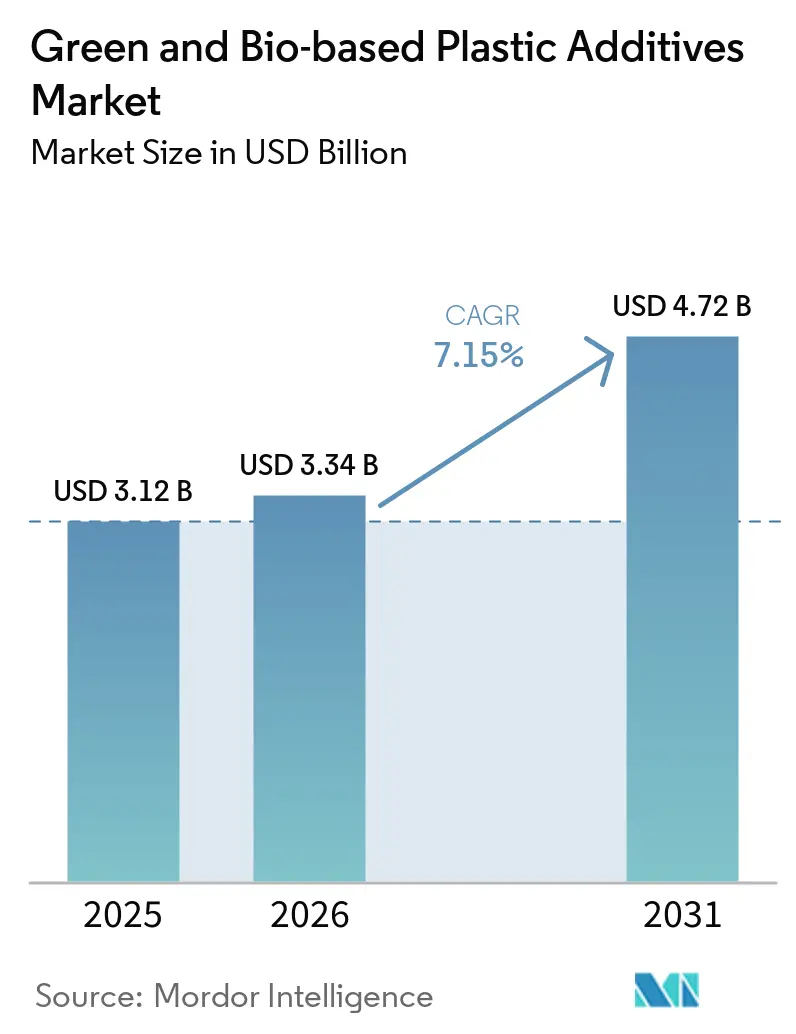
| Market Size (2026) | USD 3.34 Billion |
| Market Size (2031) | USD 4.72 Billion |
| Growth Rate (2026 - 2031) | 7.15 % |
| Fastest Growing Market | Asia-Pacific |
| Largest Market | Asia-Pacific |
| Market Concentration | Low |
Major Players *Disclaimer: Major Players sorted in no particular order Image © Mordor Intelligence. Reuse requires attribution under CC BY 4.0. | |
Green and Bio-based Plastic Additives Market Analysis by Mordor Intelligence
The Green and Bio-Based Plastic Additives Market size was valued at USD 3.12 billion in 2025 and is estimated to grow from USD 3.34 billion in 2026 to reach USD 4.72 billion by 2031, at a CAGR of 7.15% during the forecast period (2026-2031). Regulatory action in the United States and Europe is changing procurement requirements for plasticizers and flame retardants. The U.S. Environmental Protection Agency announced planned rulemaking on 5 phthalates in December 2025, while the European Union Packaging and Packaging Waste Regulation applies from August 12, 2026. These requirements are encouraging brand owners and processors to seek additives with renewable content and food-contact documentation. The green and bio-based plastic additives market is also benefiting from packaging, medical device, electronics, and textile applications, although feedstock costs and recycling compatibility continue to limit wider substitution. Producers are responding with certified biomass-balance products, application testing, and supply chain integration.
Key Report Takeaways
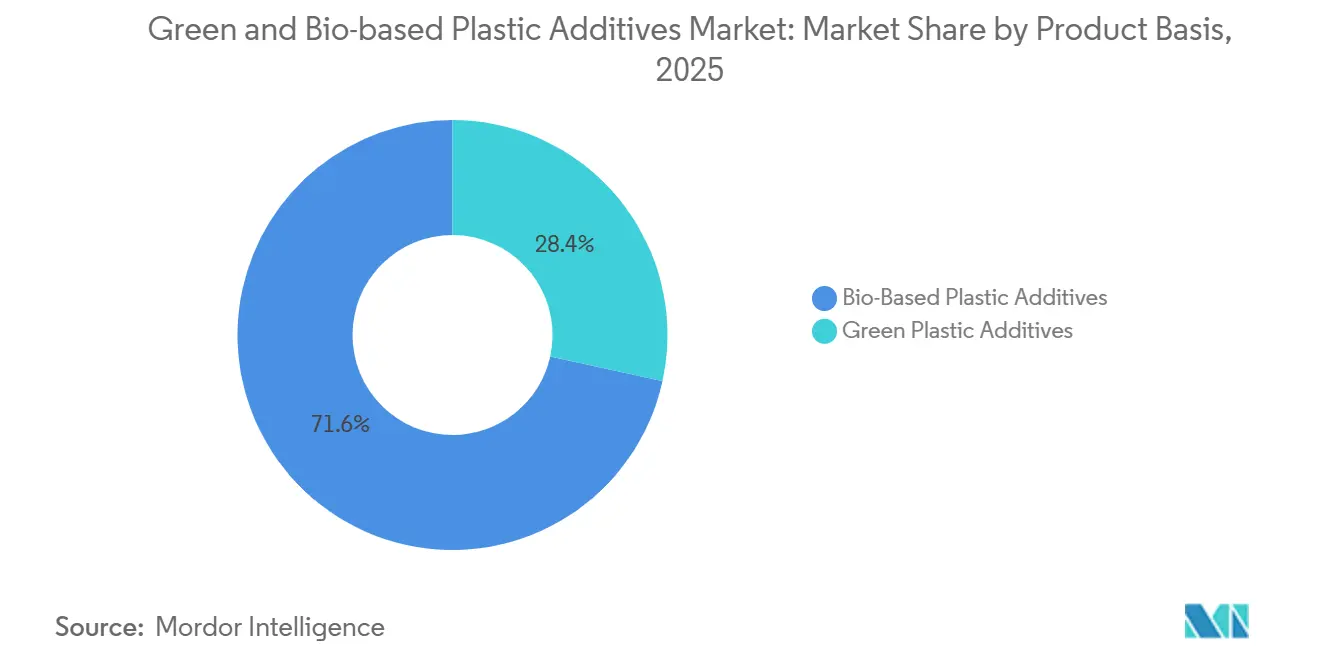
- By product basis, bio-based plastic additives held 71.56% of the green and bio-based plastic additives market share in 2025, while green plastic additives are projected to advance at a 7.93% CAGR through 2031.
- By functionality type, plasticizers held 37.17% of the green and bio-based plastic additives market share in 2025, while flame retardants are projected to advance at an 8.07% CAGR through 2031.
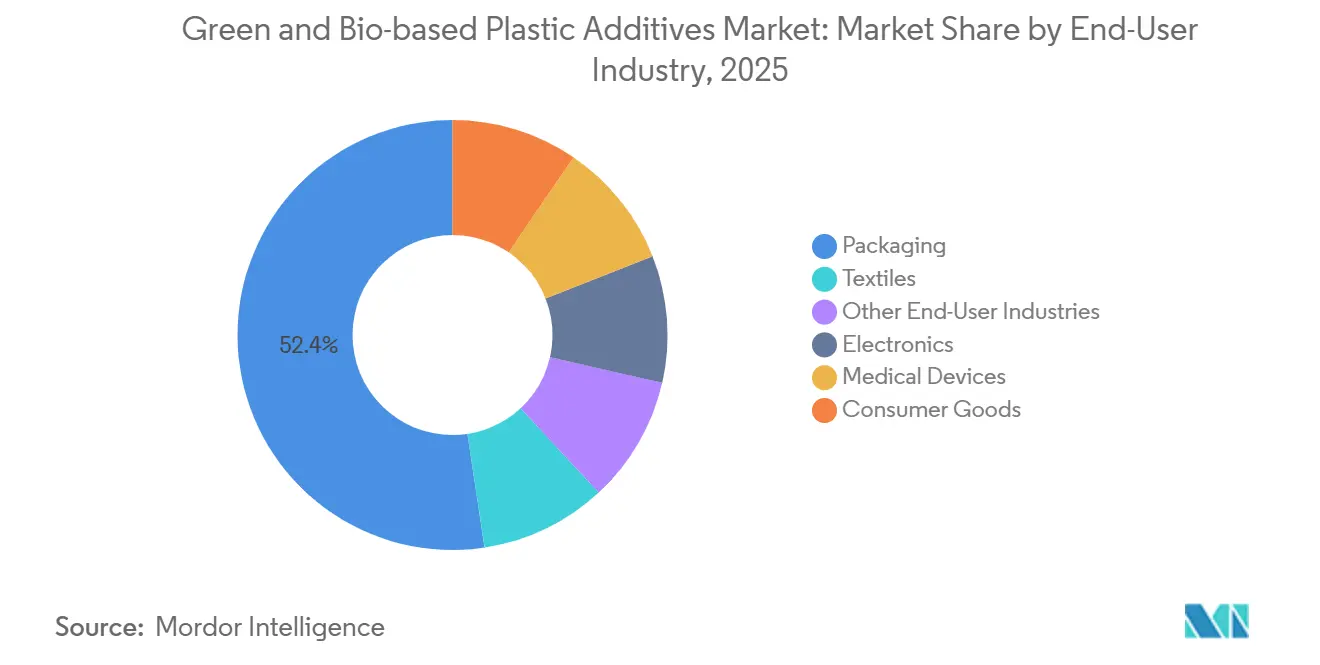
- By end-user industry, packaging accounted for 52.38% of the green and bio-based plastic additives market share in 2025, while medical devices are projected to advance at an 8.26% CAGR through 2031.
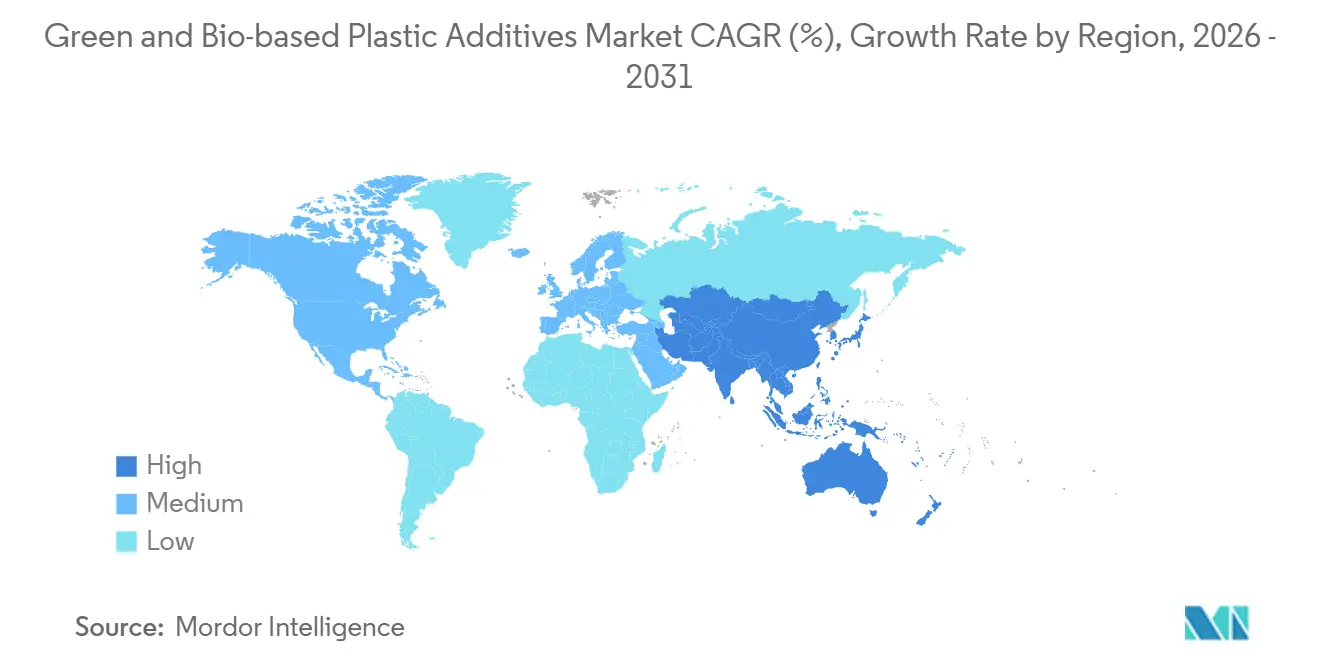
- By geography, Asia-Pacific accounted for 36.24% of the green and bio-based plastic additives market share in 2025 and is projected to advance at an 8.11% CAGR through 2031.
Note: Market size and forecast figures in this report are generated using Mordor Intelligence’s proprietary estimation framework, updated with the latest available data and insights as of January 2026.
Market Trends and Insights
Drivers Impact Analysis of Green and Bio-based Plastic Additives Market*
| Driver | (~) % Impact on CAGR Forecast | Geographic Relevance | Impact Timeline |
|---|---|---|---|
| Regulatory Substitution of Phthalates and Halogenated Chemistries | +2.0% | Global, with early gains in EU and North America | Medium-term (2–4 years) |
| Growth of Sustainable Food and E-Commerce Packaging | +1.5% | Asia-Pacific, North America, EU | Short-term (≤ 2 years) |
| Brand-Led Demand for Verified Renewable Content | +1.2% | North America & EU, spillover to APAC brand supply chains | Short-term (≤ 2 years) |
| Recycled-Content Processing and Circularity Requirements | +1.0% | EU core, spillover to North America | Medium-term (2–4 years) |
| Qualification of Bio-Based Additives in Medical Devices | +0.8% | North America, EU, APAC regulated markets | Long-term (≥ 4 years) |
| Source: Mordor Intelligence | |||
Regulatory Substitution of Phthalates and Halogenated Chemistries
Regulatory substitution is a central demand driver for the green and bio-based plastic additives market. On December 31, 2025, the U.S. Environmental Protection Agency announced its intent to regulate specific conditions of use for butyl benzyl phthalate, dibutyl phthalate, dicyclohexyl phthalate, diethylhexyl phthalate, and diisobutyl phthalate under the Toxic Substances Control Act[1]. The agency identified 10 conditions of use with unreasonable worker risk and 20 with environmental risk for diethylhexyl phthalate. In Europe, restrictions cover diethylhexyl phthalate, dibutyl phthalate, butyl benzyl phthalate, and diisobutyl phthalate at concentrations above 0.1% by weight in plasticized consumer articles. Germany also opened a January 2025 funding call for the development and industrial use of bio-based additives, including phthalate substitution. These actions increase the value of formulations that can meet performance and compliance requirements without restricted chemistries.
Growth of Sustainable Food and E-Commerce Packaging
Packaging is the largest end-user area in the green and bio-based plastic additives market, accounting for 52.38% of the market share in 2025. Food-contact packaging requirements place greater emphasis on purity, migration behavior, and documented material composition. The Packaging and Packaging Waste Regulation entered into force in February 2025 and applies from August 12, 2026, adding a stronger policy basis for circular packaging requirements across the European Union. Brand owners are also extending renewable-content expectations from resins to additive systems, which favors products supported by International Sustainability and Carbon Certification PLUS (ISCC PLUS), REDcert², or ASTM International (ASTM) D6866 documentation. BASF expanded its REDcert²-certified biomass-balance additives range for architectural coatings in July 2026, showing how certified products are being positioned as drop-in options rather than narrow specialty offerings. CLARIANT received European Commission approval in February 2026 and Food and Drug Administration authorization in May 2026 for Licocare RBW Vita rice bran wax additives in specified food-contact applications.
Recycled-Content Processing and Circularity Requirements
Recycled-content requirements are increasing the need for additive systems that perform reliably in mixed post-consumer recycling streams. The green and bio-based plastic additives market, therefore, faces a dual requirement, supporting renewable-content goals while preserving recyclate quality. The Association of Plastic Recyclers reported that 5 U.S. states had passed mandatory recycled-plastic-content packaging laws through August 2025[2]. Additives can affect processing stability, contamination risk, and properties in recycled polymers, so converters need application-specific evidence before changing formulations. Packaging rules in Europe reinforce this need because recycled-content obligations and food-contact safeguards must be met together. Producers that provide processing guidance, chain-of-custody documents, and recycling data can support circular applications and work with resin producers, recyclers, and converters during qualification.
Qualification of Bio-Based Additives in Medical Devices
Medical devices are projected to be the fastest-growing end-user segment in the green and bio-based plastic additives market at an 8.26% CAGR through 2031. ISO 10993-18, which covers chemical characterization for biological evaluation of medical devices, was added to the European Union Medical Device Regulation harmonized standards in March 2024. Medical polymer suppliers must therefore document the composition and biological suitability of plasticizers, stabilizers, and processing aids. A 2025 study in RSC Advances found that epoxidized soybean oil, acetyl tributyl citrate, tricresyl phosphate, and dioctyl phthalate showed different biocompatibility results in their test model. Americhem launched EcoLube MD, a perfluoroalkyl and polyfluoroalkyl substances (PFAS)-free internally lubricated medical compound qualified under ISO 10993-5 for cytotoxicity, in January 2025. Once a medical formulation is qualified, suppliers can benefit from extended customer relationships because later changes require further testing and documentation.
Restraints Impact Analysis of Green and Bio-based Plastic Additives Market*
| Restraint | (~) % Impact on CAGR Forecast | Geographic Relevance | Impact Timeline |
|---|---|---|---|
| Feedstock Availability and Price Volatility | -1.8% | Global, with acute exposure in EU and North America | Short-term (≤ 2 years) |
| Qualification Cycles and Performance Parity Requirements | -1.2% | Global, concentrated in regulated markets (EU, North America, APAC) | Long-term (≥ 4 years) |
| Additive Compatibility Constraints in Recycling Streams | -0.7% | EU core, spillover to North America | Medium-term (2–4 years) |
| Source: Mordor Intelligence | |||
Feedstock Availability and Price Volatility
Feedstock availability and price volatility remain a direct restraint on the green and bio-based plastic additives market. Animal fats, used cooking oil, and other renewable feedstocks are also used in fuel and chemical value chains, which create competition for supply. The need for stable sourcing is particularly relevant for oleochemical plasticizers and stabilizers that depend on vegetable or waste-derived oils. Cargill, Incorporated supports its Vikoflex bio-based plasticizer range with products that contain up to 100% bio-based organic carbon, illustrating the role of agricultural feedstock access in this field. Cost uncertainty can delay capacity additions or require longer-term supply agreements between additive producers and feedstock providers. It can also widen the price gap with fossil-derived alternatives when buyers have limited ability to pass higher costs through the supply chain.
Qualification Cycles, Performance Parity Requirements
Qualification cycles and performance requirements slow adoption in applications where additives influence safety, durability, or processing. Flame retardants are projected to grow at an 8.07% CAGR through 2031, but demanding electronics and structural applications still require reliable flame, smoke, and thermal performance. Oak Ridge National Laboratory described a bio-based, halogen-free flame-retardant approach that uses condensed-phase char formation and gas-phase combustion suppression. Changes to a formulation may require new testing under Underwriters Laboratories 94 and International Electrotechnical Commission 60695 standards. In recycling streams, additives can create further uncertainty when they are combined with mixed post-consumer materials. These technical requirements shape supplier selection in the green and bio-based plastic additives market.
*Our forecasts treat driver/restraint impacts as directional, not additive. The impact forecasts reflect baseline growth, mix effects, and variable interactions.
Green and Bio-based Plastic Additives Market Segment Analysis
By Product Basis:
Bio-Based Additives Lead While Green Plastic Additives Gain GroundBio-based plastic additives held 71.56% of the market revenue in 2025 and had longer commercial use across polyvinyl chloride, polyolefins, and biopolymers. ASTM D6866 testing gives buyers a method to document biogenic carbon content, which supports renewable-content claims. Cargill, Incorporated offers Vikoflex epoxidized ester plasticizers with up to 100% bio-based organic carbon. Suppliers with established processing data can offer converters more confidence when a formulation must meet defined performance requirements. These factors support their leading position in the green and bio-based plastic additives market.
Green plastic additives are projected to advance at a 7.93% CAGR through 2031. This category includes lower-toxicity, halogen-free, recyclate-compatible, and lower-carbon formulations, alongside materials with renewable content. Food-contact and medical buyers may prioritize renewable-carbon certification, while electronics and electric vehicle applications may place greater weight on halogen-free properties and low smoke density. BASF published a May 2026 patent for a bio-based semi-aromatic copolyamide composition containing 10% to 17% halogen-free flame retardant. The green and bio-based plastic additives market is moving toward products that can address both certification and performance requirements in one formulation.
By Functionality Type:
Plasticizers Anchor Demand While Flame Retardants AdvancePlasticizers held 37.17% of the market revenue in 2025. Flexible polyvinyl chloride applications, including flooring, cable insulation, and medical tubing, keep this category important to the green and bio-based plastic additives market. Phthalate restrictions are increasing demand for substitutes with documented migration and toxicology profiles. The need is especially clear in medical products where chemical characterization is part of the qualification process. Bio-derived plasticizers can reduce regulatory submission work when suppliers provide relevant test data, but adoption still depends on flexibility, migration resistance, and durability in each end use.
Flame retardants are projected to advance at an 8.07% CAGR through 2031. Demand comes from electric vehicle battery enclosures, 5G cable compounds, and construction polymers that require low-flame and low-smoke performance. LANXESS introduced Stabaxol L, a monomeric carbodiimide used to improve hydrolysis stability in sensitive biopolymers, at K 2025. Natural-fiber fillers and cellulose-based reinforcement are also being developed for rubber and thermoplastic compounds. Antimicrobial and antistatic agents remain specialized applications in the green and bio-based plastic additives market, and Corbion N.V. and BRAIN Biotech AG began a 2025 collaboration to develop bio-based antimicrobial compounds for food-contact packaging and healthcare applications.
By End-User Industry:
Packaging Leads Revenue, While Medical Devices ExpandPackaging held 52.38% of the market revenue in 2025. It remains the main demand base for the green and bio-based plastic additives market because films, rigid containers, and food-contact products use large quantities of additives. European requirements for packaging circularity and food-contact safety increase the need for authorized and traceable materials. CLARIANT's Licocare RBW Vita products received European Commission approval for use in PET, polylactic acid, and rigid polyvinyl chloride food-contact materials under specified conditions. Packaging converters favor options that preserve existing processing conditions and provide documentation for downstream customers.
Medical devices are projected to advance at an 8.26% CAGR through 2031. This segment values formulations with established biocompatibility evidence and stable long-term supply. BASF introduced Ultrason P 3010 BMB in March 2026, a biomass-balanced polyphenylsulfone grade using 20% attributed bio-circular feedstock for medical technology, drinking-water-contact, and electronics applications. Electronics uses halogen-free flame retardants, antistatic agents, and low-smoke stabilizers, while the textile and consumer goods industries use antimicrobial and ultraviolet stabilizer systems. The green and bio-based plastic additives market can serve these uses with formulations that balance functional performance with documented sustainability attributes.

Geography Analysis
APAC Green and Bio-based Plastic Additives Market
Asia-Pacific held 36.24% of the market revenue in 2025 and is projected to advance at an 8.11% CAGR through 2031. The green and bio-based plastic additives market in the region combines large plastics-processing capacity with changing requirements for hazardous additives, food-contact materials, and circular packaging. China is reducing hazardous materials in plastic products, while India is tightening specifications for phthalate-free children's products and plastic-waste management. Japan's Plastic Resource Circulation Act supports reformulation across packaging and electronics. South Korea applies migration limits for food-contact materials, which supports demand for additives with established migration profiles.
North America Green and Bio-based Plastic Additives Market
The green and bio-based plastic additives market in Asia-Pacific attracts supplier activity because customers need scale and compliance support. CLARIANT presented its Licocare RBW Vita portfolio and ongoing thermoplastic polyurethane development at CHINAPLAS 2026 in Shanghai. BASF presented Ultrason P 3010 BMB at the same event. In North America, planned U.S. rulemaking on 5 phthalates is expected to influence formulation decisions in construction, industrial, and consumer applications. BASF began commercial production of biomass-balance polyether polyols at Geismar, Louisiana, in March 2026 and introduced a biomass-balance spray polyurethane foam isocyanate product for North America in April 2026.
EMEA and South America Green and Bio-based Plastic Additives Market
Europe has demand shaped by the Packaging and Packaging Waste Regulation and restrictions on several phthalates. The green and bio-based plastic additives market in the region must meet circularity, food-contact, and traceability requirements at the same time. South America, the Middle East and Africa, and smaller European markets remain earlier-stage demand areas, although Brazil's biofuels policy supports feedstock development and Saudi Arabia is supporting specialty chemical investment near oleochemical feedstocks. Global brand specifications can create demand in these regions before local rules become equally stringent.
Competitive Landscape
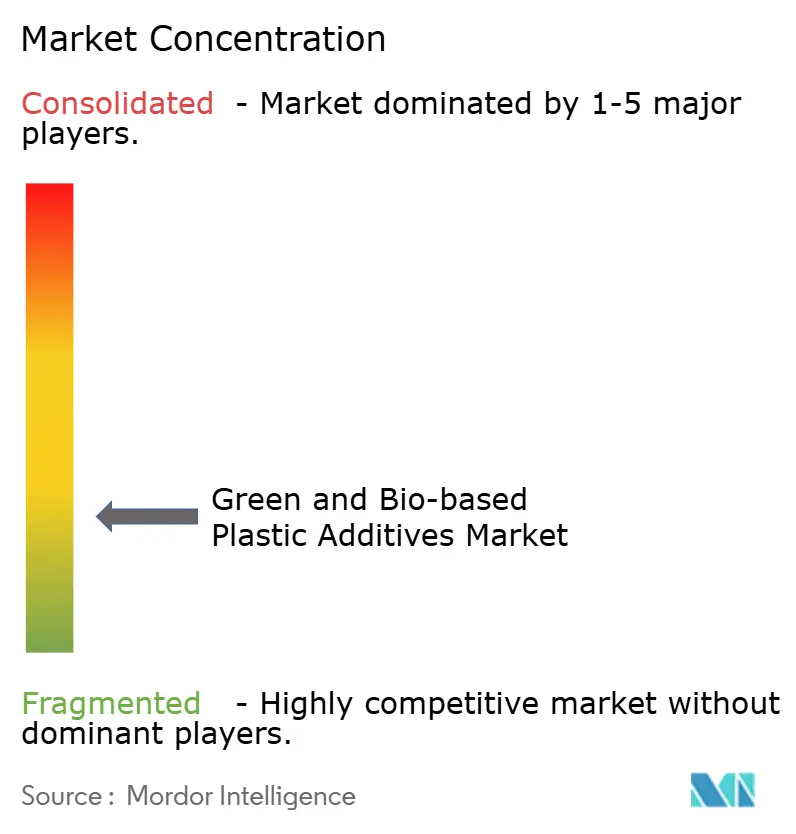
The green and bio-based plastic additives market is highly fragmented, with the top five players including BASF, CLARIANT, Emery Oleochemicals, Avient Corporation, and Evonik Industries AG. NatureWorks LLC, Corbion N.V., Emery Oleochemicals, Croda International Plc, and Matrìca S.p.A. compete in specialized biopolymer, oleochemical, and performance niches. The green and bio-based plastic additives market rewards suppliers that can link feedstock sourcing, product development, and customer qualification. ISCC PLUS and REDcert² documentation can differentiate products when buyers need credible renewable-content claims.
Biomass-balance portfolio extension is an important competitive approach in the green and bio-based plastic additives market. It allows established product families to use attributed renewable feedstocks while retaining a familiar product format for customers. LANXESS expanded its Scopeblue range with Vulkanox HS Scopeblue in February 2025 and Additin RC 2515 in October 2025. Vulkanox HS Scopeblue was made with more than 55% sustainable raw materials and had a product carbon footprint more than 30% lower than the conventional grade, while Additin RC 2515 used more than 80% sustainable raw materials and had a 34% lower product carbon footprint. BASF expanded its certified biomass-balance additives portfolio for architectural coatings in July 2026 with Dispex AA 4145 MB, Rheovis PU 1333 MB, and Rheovis HS 1169 MB.
The green and bio-based plastic additives market has opportunities in high-temperature flame retardants, processing aids for mechanical recycling, and medical-grade plasticizers. Cargill, Incorporated, introduced Incroflo P50 in October 2025 as an 86% bio-based polymeric processing aid for polyolefin extrusion that is free of halogens, silicone, and perfluoroalkyl and polyfluoroalkyl substances. Evonik Industries AG created its Innovation Factory in June 2026 to focus research and development on bio-based solutions, the energy transition, and the circular economy. Complete chain-of-custody and regulatory packages remain important entry requirements for regulated applications.
Green and Bio-based Plastic Additives Industry Leaders
-
Emery Oleochemicals
-
BASF
-
CLARIANT
-
Avient Corporation
-
Evonik Industries AG
- *Disclaimer: Major Players sorted in no particular order
Green and Bio-based Plastic Additives Market Companies Covered in this Report
- ADEKA CORPORATION
- Avient Corporation
- BASF
- Cargill, Incorporated
- CLARIANT
- Corbion N.V.
- Croda International Plc
- DIC Corporation
- Dow
- Emery Oleochemicals
- Evonik Industries AG
- LANXESS
- Matrìca S.p.A.
- NatureWorks LLC
- Solvay
Recent Industry Developments in Green and Bio-based Plastic Additives Market
- May 2026: CLARIANT secured FDA approval for its bio-based Licocare RBW additives for use in rigid polyvinyl chloride (PVC) food-contact applications, expanding their use as processing aids, lubricants, release agents, and slip additives. The approval supports demand for renewable plastic additives as formulators seek alternatives to fossil-based additives in food packaging and processing applications.
- April 2026: Evonik Industries AG showcased its specialty plastic additive portfolio at CHINAPLAS 2026, including solutions supporting plastics recycling, processing efficiency, and circularity. The focus on additive solutions for recycled plastics supports the shift toward more sustainable plastic formulations and circular-material applications.
Global Green and Bio-based Plastic Additives Market Report Scope
Green and bio-based plastic additives are additives derived from renewable, bio-based, or environmentally preferable sources that are incorporated into plastics to improve performance and reduce environmental impact. They can provide functional properties such as flexibility, antimicrobial protection, flame resistance, stabilization, and reinforcement.
The Green and Bio-Based Plastic Additives Market is segmented by product basis, functionality type, end-user industry, and geography. By product basis, the market is segmented into bio-based plastic additives and green plastic additives. By functionality type, the market is segmented into plasticizers, antimicrobial agents, antistatic agents, flame retardants, stabilizers, reinforcing agents, and other functionality types. By end-user industry, the market is segmented into packaging, electronics, medical devices, textiles, consumer goods, and other end-user industries. The report also covers the market size and forecasts for green and bio-based plastic additives across 15 countries. For each segment, the market sizing and forecasts have been done on the basis of value (USD).
Segmentation Overview
| Bio-Based Plastic Additives |
| Green Plastic Additives |
| Plasticizers |
| Antimicrobial Agents |
| Antistatic Agents |
| Flame Retardants |
| Stabilizers |
| Reinforcing Agents |
| Other Functionality Types |
| Packaging |
| Electronics |
| Medical Devices |
| Textiles |
| Consumer Goods |
| Other End-User Industries |
| Asia-Pacific | China |
| India | |
| Japan | |
| South Korea | |
| ASEAN Countries | |
| Rest of Asia-Pacific | |
| North America | United States |
| Canada | |
| Mexico | |
| Europe | Germany |
| United Kingdom | |
| France | |
| Italy | |
| NORDIC Countries | |
| Rest of Europe | |
| South America | Brazil |
| Argentina | |
| Rest of South America | |
| Middle East and Africa | Saudi Arabia |
| South Africa | |
| Rest of Middle East and Africa |
| By Product Basis | Bio-Based Plastic Additives | |
| Green Plastic Additives | ||
| By Functionality Type | Plasticizers | |
| Antimicrobial Agents | ||
| Antistatic Agents | ||
| Flame Retardants | ||
| Stabilizers | ||
| Reinforcing Agents | ||
| Other Functionality Types | ||
| By End-User Industry | Packaging | |
| Electronics | ||
| Medical Devices | ||
| Textiles | ||
| Consumer Goods | ||
| Other End-User Industries | ||
| By Geography | Asia-Pacific | China |
| India | ||
| Japan | ||
| South Korea | ||
| ASEAN Countries | ||
| Rest of Asia-Pacific | ||
| North America | United States | |
| Canada | ||
| Mexico | ||
| Europe | Germany | |
| United Kingdom | ||
| France | ||
| Italy | ||
| NORDIC Countries | ||
| Rest of Europe | ||
| South America | Brazil | |
| Argentina | ||
| Rest of South America | ||
| Middle East and Africa | Saudi Arabia | |
| South Africa | ||
| Rest of Middle East and Africa | ||
Key Questions Answered in the Report
What is the size of the green and bio-based plastic additives market?
The green and bio-based plastic additives market stands at USD 3.34 billion in 2026 and is projected to reach USD 4.72 billion by 2031.
What is driving demand for green and bio-based plastic additives?
Restrictions on selected phthalates, packaging requirements, renewable-content documentation, and medical-device qualification are supporting demand.
Which product basis led market demand in 2025?
Bio-based plastic additives held 71.56% of revenue in 2025, supported by their established use and renewable-carbon documentation.
Which application is growing fastest?
Medical devices are projected to advance at an 8.26% CAGR through 2031 because qualified formulations require documented biocompatibility and long approval cycles.