
Physical Vapor Deposition (PVD) Equipment Market Size and Share
Market Overview
| Study Period | 2020 - 2031 |
|---|---|
| Market Size (2026) | USD 27.65 Billion |
| Market Size (2031) | USD 43.22 Billion |
| Growth Rate (2026 - 2031) | 9.33 % |
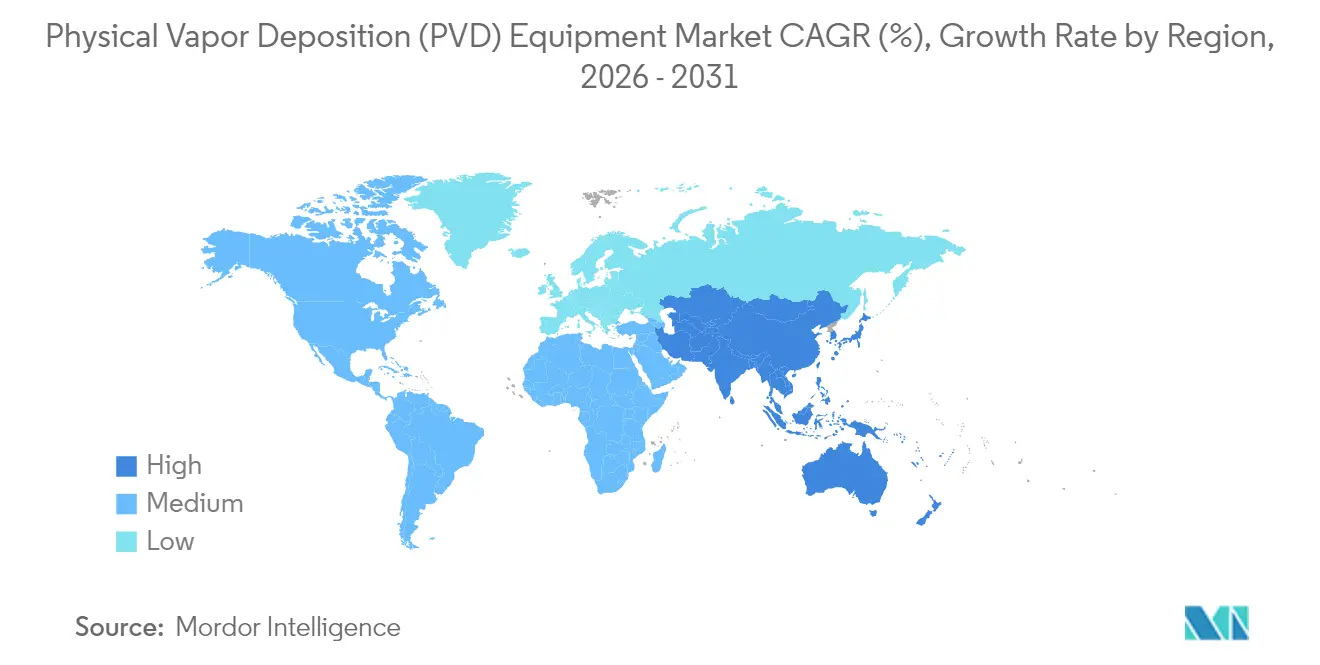
| Fastest Growing Market | Asia Pacific |
| Largest Market | Asia Pacific |
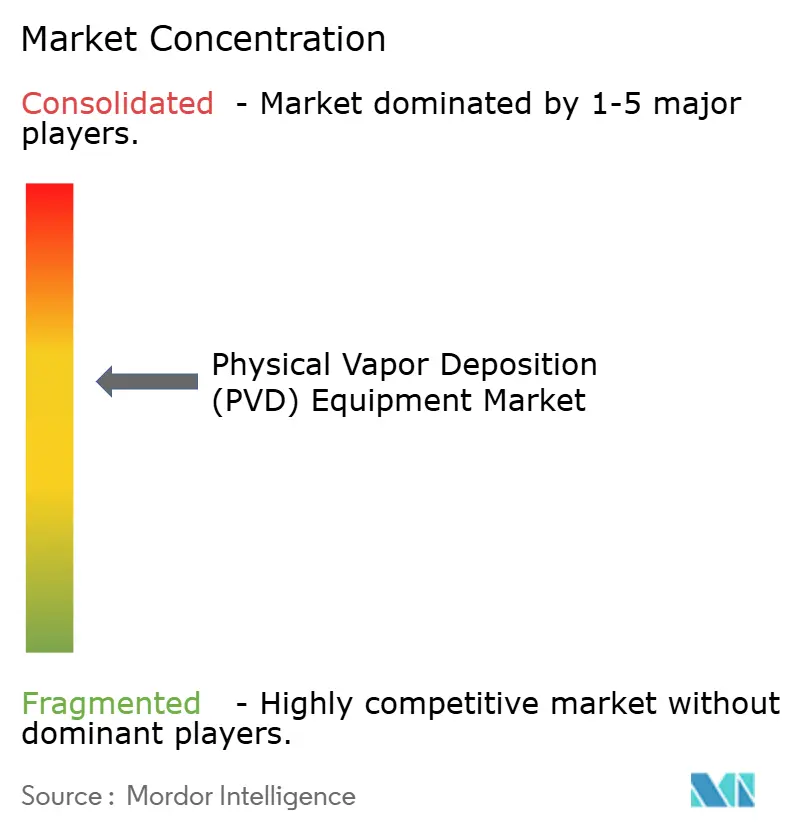
| Market Concentration | Medium |
Major Players
*Disclaimer: Major Players sorted in no particular order Image © Mordor Intelligence. Reuse requires attribution under CC BY 4.0. |
|
Physical Vapor Deposition (PVD) Equipment Market Analysis by Mordor Intelligence
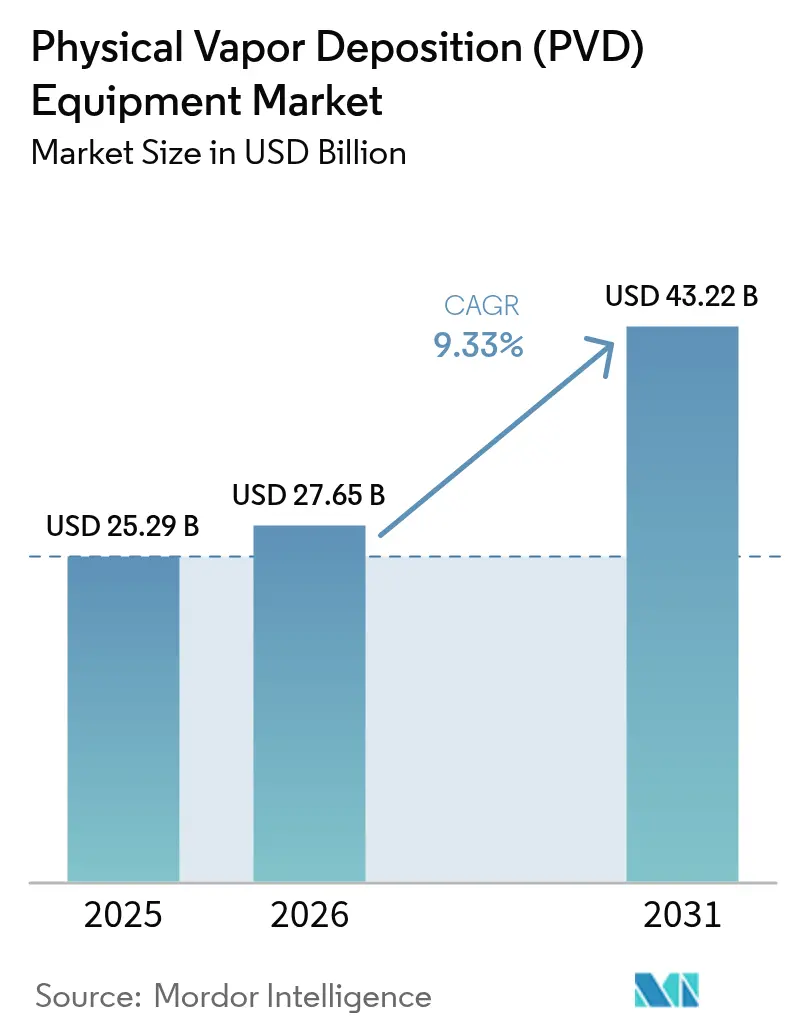
Physical Vapor Deposition Equipment Market size in 2026 is estimated at USD 27.65 billion, growing from 2025 value of USD 25.29 billion with 2031 projections showing USD 43.22 billion, growing at 9.33% CAGR over 2026-2031.
Strong demand for gate-all-around transistors below 3 nanometers, expanding use of biocompatible thin films in orthopaedic and cardiovascular implants, and durability mandates for electric-vehicle drivetrain parts form the backbone of near-term growth. Magnetron sputtering retains a production advantage for copper and tantalum interconnects, while ion plating is gaining ground in high-mix, decorative, and cutting-tool settings where dense, adherent films on complex shapes are critical. Semiconductor capital-expenditure waves in Taiwan, South Korea, the United States, and the European Union continue to funnel multi-chamber orders to tool vendors, and government incentives that localize equipment supply chains are shortening replacement cycles. At the same time, competition from atomic-layer deposition is sharpening performance benchmarks, pushing PVD suppliers toward cluster tools that integrate deposition, pre-clean, and anneal in a single vacuum transfer path.
Key Report Takeaways
- By deposition technique, magnetron sputtering is expected to lead with a 57.68% revenue share in 2025, while ion plating is forecast to expand at a 10.72% CAGR to 2031.
- By end user, microelectronics captured 42.05% of 2025 turnover, whereas cutting tools are projected to log the fastest 11.28% CAGR through 2031.
- By substrate material, metals held 48.61% of the physical vapor deposition (PVD) equipment market share in 2025, while plastics usage is expected to grow at 9.98% through 2031.
- By coating thickness, the 1–3-micron category accounted for 40.92% of the 2025 volume; however, sub-micron layers are poised to rise at a 10.12% CAGR through 2031.
- By geography, the Asia Pacific generated 37.88% of global revenue in 2025 and is projected to record a 9.97% CAGR through 2031.
Note: Market size and forecast figures in this report are generated using Mordor Intelligence’s proprietary estimation framework, updated with the latest available data and insights as of 2026.
Market Trends and Insights
Drivers Impact Analysis of Physical Vapor Deposition (PVD) Equipment Market*
| Driver | (~) % Impact on CAGR Forecast | Geographic Relevance | Impact Timeline |
|---|---|---|---|
| Rising Demand for Advanced Microelectronics and Semiconductor Scaling | +2.80% | Global, with concentration in Asia Pacific (Taiwan, South Korea, China) and North America | Medium term (2-4 years) |
| Growth of High-Performance Medical Implants Requiring Biocompatible Coatings | +1.20% | North America and Europe, expanding to Asia Pacific | Long term (≥ 4 years) |
| Increasing Adoption of Thin-Film Solar Modules | +1.50% | Asia Pacific (China, India), North America, Europe | Medium term (2-4 years) |
| Government Incentives for Onshore Semiconductor Equipment Manufacturing | +1.90% | North America (CHIPS Act), Europe (EU Chips Act), Asia Pacific (Japan, South Korea subsidies) | Short term (≤ 2 years) |
| Demand for Wear-Resistant Coatings in Electric Vehicle Drivetrain Components | +1.40% | Global, with early traction in Europe and China | Medium term (2-4 years) |
| Integration of PVD in Flexible Electronics Manufacturing | +0.90% | Asia Pacific (South Korea, China), spill-over to North America | Long term (≥ 4 years) |
| Source: Mordor Intelligence | |||
Rising Demand for Advanced Microelectronics and Semiconductor Scaling
Node migration to 2-nanometer gate-all-around transistors requires ultra-thin tantalum-nitride work-function layers deposited by magnetron sputtering at high throughput, driving multi-chamber demand in Taiwan, South Korea, and the United States.[1] Every new 40,000 wafer-per-month fab needs 25-30 sputter chambers for copper barrier, seed, and capping steps. Cluster integration that combines pre-clean, deposition, and anneal inside one vacuum envelope cuts particulate defects by 30% and is now a de-facto specification in 3 nanometre ramps.[2] Advanced packaging adds further pull, because hybrid-bonded chiplets and through-silicon vias require copper redistribution at 500 nanometers to 2 microns.
Memory producers are qualifying PVD tungsten for 300-layer 3D NAND, citing tighter step-coverage control than chemical vapor routes. Most importantly, local subsidies that favour domestic tool sourcing elevate regional suppliers and shorten purchasing cycles from four to three years in leading-edge fabs.
Government Incentives for Onshore Semiconductor Equipment Manufacturing
The United States CHIPS and Science Act released USD 39 billion in manufacturing grants and USD 11 billion in loans, stipulating that 30% of equipment spend must originate from U.S. vendors.[3] Intel alone earmarked more than 200 PVD chambers for Arizona, Ohio, and New Mexico lines. Europe’s EUR 43 billion (USD 47.7 billion) Chips Act channels EUR 30 billion (USD 33.3 billion) into Intel Magdeburg and supports TSMC’s Dresden joint venture, again with local-content clauses that lift orders for Veeco, Oerlikon, and Von Ardenne.[4] Japan, South Korea, and China run parallel subsidy programs that either cover 40% of capex or offer multi-year tax holidays on imported equipment, effectively lowering payback periods below five years.
As new fabs come online, the PVD equipment market enjoys synchronized demand in three continents, stabilizing order books against cyclical semiconductor downturns.
Increasing Adoption of Thin-Film Solar Modules
Cadmium-telluride and heterojunction solar lines deploy large-area magnetron sputtering for transparent conductive oxides, lifting PVD revenue per gigawatt to USD 15-20 million. Heterojunction shipments climbed from 8% in 2023 to 12% in 2024, each gigawatt requiring six to eight inline sputter coaters.
First Solar added 3.3 gigawatts of capacity in Ohio in 2024, while India’s USD 2.4 billion production-linked incentive scheme ties import duties to domestic equipment adoption. Perovskite-silicon tandem prototypes already specify nickel-oxide and indium-zinc-oxide PVD layers, and although mass production awaits IEC durability standards, early tool pilots suggest a 30% uptick in chamber count per square meter of output. These trends collectively boost non-semiconductor share of the PVD equipment market, smoothing revenue volatility tied to logic and memory nodes.
Demand for Wear-Resistant Coatings in Electric Vehicle Drivetrain Components
Torque-rich single-speed transmissions spin at 20,000 rpm and expose gears and bearings to higher Hertzian loads than combustion engines. Titanium-aluminium-nitride and chromium-nitride ion-plated layers cut friction and heat, enabling automakers to offer 300,000-kilometer powertrain warranties. Oerlikon’s coating centers reported 35% year-over-year revenue growth in 2024, supported by Volkswagen and Stellantis sourcing drivetrain parts in Europe and China. Diamond-like carbon layers, deposited via cathodic arc or filtered sputter, reduce dry-running coefficients of friction below 0.10 and support oil-less auxiliary pump architectures that raise battery-to-wheel efficiency by 2-3%.
Although no regulation prescribes surface treatments, warranty differentiation pushes tier-one suppliers to standardize on PVD, expanding aftermarket and refurbishment opportunities for regional coaters.
Restraints Impact Analysis of Physical Vapor Deposition (PVD) Equipment Market*
| Restraint | (~) % Impact on CAGR Forecast | Geographic Relevance | Impact Timeline |
|---|---|---|---|
| High Capital Investment | -1.60% | Global, acute in emerging markets and small-to-medium enterprises | Short term (≤ 2 years) |
| Competition from Alternative Deposition Technologies such as ALD and CVD | -1.10% | Global, concentrated in advanced semiconductor nodes | Medium term (2-4 years) |
| Supply Chain Vulnerabilities for High-Purity Target Materials | -0.70% | Global, with acute impact in North America and Europe | Medium term (2-4 years) |
| Stringent Environmental Regulations on Plasma Emissions | -0.50% | Europe and North America, expanding to Asia Pacific | Long term (≥ 4 years) |
| Source: Mordor Intelligence | |||
High Capital Investment
A state-of-the-art magnetron sputtering cluster for 300-millimeter wafers costs USD 3-5 million, while fully configured logic lines often install 20-30 chambers, pushing upfront outlays above USD 100 million before qualification. Service contracts, spare kits, and consumable targets add a further 15-20% to lifetime ownership. Smaller coaters in cutting-tool or decorative markets face USD 0.5-0.8 million ticket prices per cathodic-arc tool and must process 10,000-15,000 cycles to break even.
Although leasing and pay-per-wafer models lower entry barriers by 40%, they transfer utilization risk to financiers and raise per-part cost by roughly 10%. Consequently, new entrants gravitate toward modular single-chamber designs, limiting large-cluster penetration outside tier-one fabs.
Competition from Alternative Deposition Technologies Such as ALD and CVD
Atomic-layer deposition captured about 25% of thin-film equipment revenue in leading-edge fabs during 2024 because its self-limiting chemistries deliver uniformity inside 50:1 aspect-ratio features that sputter guns cannot reach. Hafnium-oxide high-k dielectrics under 2 nanometers now ship predominantly on ALD platforms supplied by Lam Research and Tokyo Electron. Chemical-vapor deposition maintains throughput advantages in bulk tungsten and silicon nitride.
Hybrid flows are emerging: TSMC’s N2 process employs ALD for gate dielectrics, PVD for seed layers, and electroplating for fill, meaning PVD retains metallization but loses oxide layers. Tight competition is forcing PVD vendors to integrate ALD modules within the same transfer platform or risk socket erosion in sub-3-nanometer nodes.
*Our forecasts treat driver/restraint impacts as directional, not additive. The impact forecasts reflect baseline growth, mix effects, and variable interactions.
Physical Vapor Deposition (PVD) Equipment Market Segment Analysis
By Deposition Technique:
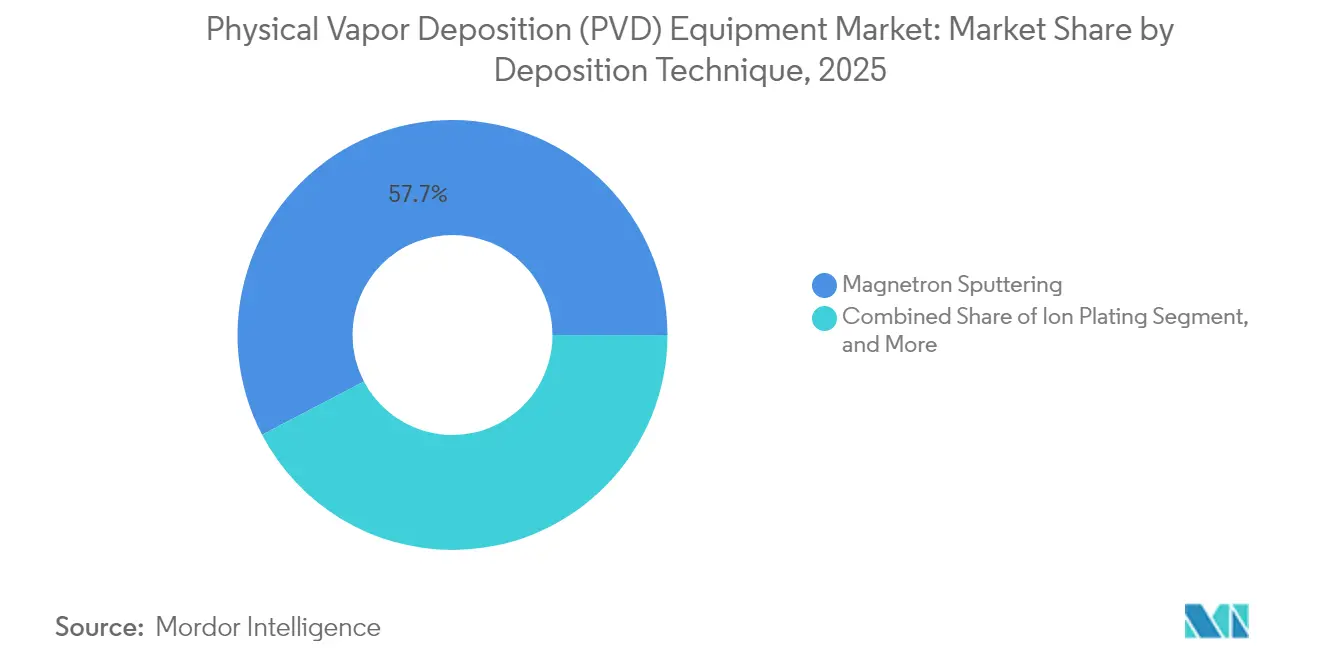
Magnetron Sputtering Anchors Interconnect MetallizationMagnetron sputtering delivered 57.68% of 2025 revenue because its low-energy ion bombardment spreads copper and tantalum films with <2% across-wafer non-uniformity, the tightest window tolerated in 300-millimeter back-end-of-line runs. The physical vapor deposition (PVD) equipment market size for magnetron tools is projected to rise at 8.42% CAGR, reinforced by logic and 3D NAND ramps that each consume 6-8 chambers per metallization loop. Ion plating, although currently below 15% share, is forecast to progress at 10.72% through 2031 as cutting-tool and decorative-hardware producers invest in dense columnar films that outperform electroplated chrome on adhesion and corrosion. Cost-of-ownership gains favour rotary cathodes and closed-loop plasma monitors that extend target life by 50% and slash scrap below 3%. Cathodic-arc and electron-beam PVD stay niche, serving extreme-hardness or low-temperature optics where particle contamination or polymer shrinkage is mission-critical. With SEMI standards agnostic to technique selection, buyers weigh throughput, consumables, and uptime, reinforcing magnetron dominance yet leaving whitespace for specialized approaches that address emerging flexible-electronics demands.
Ion-plating vendors now market hybrid chambers that flip between high-power impulse sputtering and DC glow to accommodate titanium-aluminium-nitride, zirconium-nitride, and diamond-like carbon in consecutive cycles. Such flexibility halves cleaning downtime and boosts revenue per floor area in coating centers. Meanwhile, Applied Materials’ fourteen-station Endura cluster locks customers into proprietary pre-clean, barrier, seed, and cap recipes, an ecosystem that secures pull-through consumables and inflates switching costs. Consequently, the physical vapor deposition (PVD) equipment market continues to reward integrated platform depth on one end and nimble single-chamber agility on the other.

By End User:
Microelectronics Dominates While Cutting Tools SurgeMicroelectronics secured 42.05% of 2025 turnover because foundries rely on PVD for copper dual-damascene, tantalum-nitride barriers, and aluminium bond pads. The PVD equipment market size for microelectronics could pass USD 26.6 billion by 2031, assuming node migrations and hybrid-bonded chiplets maintain current capex vectors. Cutting tools, however, are pacing fastest at 11.28% CAGR as aerospace and automotive machining shifts toward dry, high-speed protocols where titanium-aluminium-nitride triples insert life. Ion-plating site rollouts in Mexico, India, and Eastern Europe highlight geographic realignment of metal-cutting supply chains. Medical devices hold roughly 14% share, with FDA 510(k) filings showing over forty PVD-coated orthopaedics implants cleared in 2024 alone. Solar products contribute 11% of revenue, yet capacity expansions in Ohio, Malaysia, and Gujarat position thin-film PV to outgrow global module averages through 2028.
Regulatory processes shape adoption timelines differently across end users. Medical implants require 18-24 months of biocompatibility testing per new coating, while semiconductor purchase decisions compress into 6-9-month windows around node releases. Cutting-tool services face minimal accreditation and can commercialize recipes within weeks. As a result, revenue diversity stabilizes aggregate growth for the PVD equipment market, cushioning cyclical swings tied to silicon fabs.
By Substrate Material:
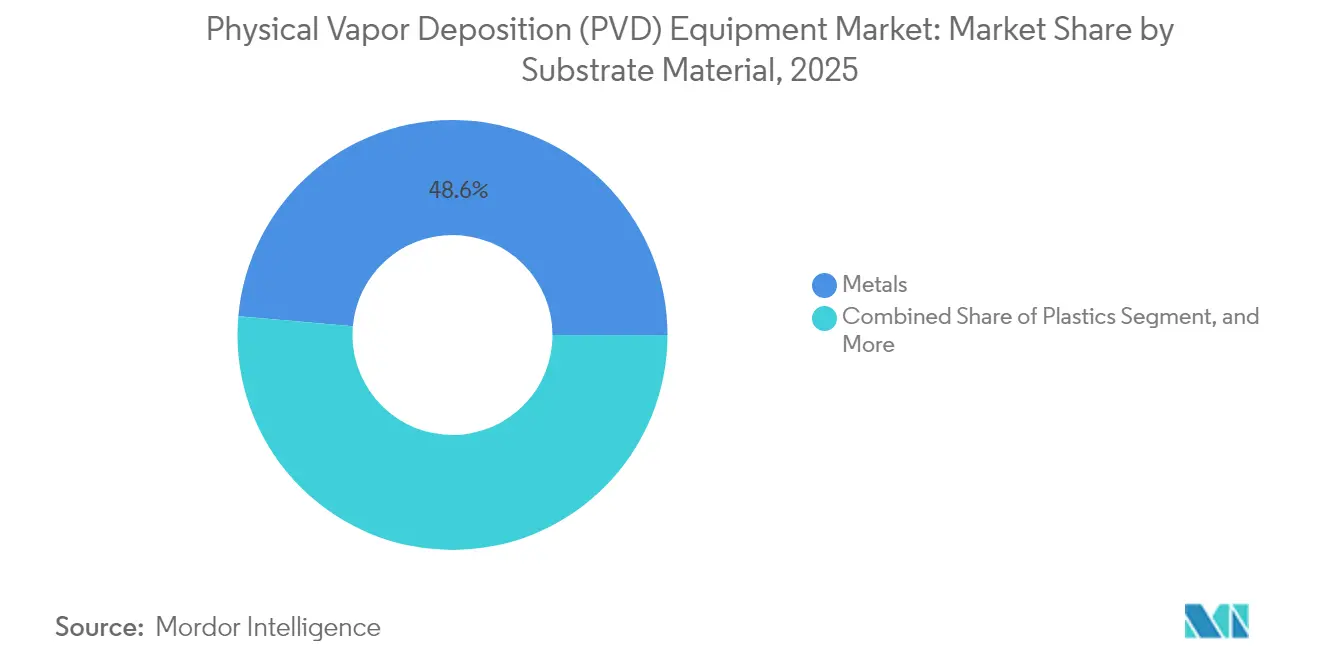
Metals Lead as Plastics Gain Presence in Flexible DisplaysMetals attracted 48.61% of 2025 billings since stainless-steel tooling, titanium implants, and aluminium trim are default workpieces for wear-resistant and decorative films. Plastics, led by polyethylene terephthalate and polyimide, are projected to expand at 9.98% CAGR because roll-to-roll coating lines now deposit aluminium-oxide and silicon-nitride moisture barriers for foldable-OLED encapsulation at temperatures below 80 °C. The PVD equipment market share for glass stands near 18%, propelled by low-emissivity architectural panes that reduce space-heating loads. Ceramic substrates, although below 10% share, anchor high-value dental crowns and zirconia cutting inserts, where PVD layers extend service life and lower revision rates.
Large-area sputter coaters exceed 3 meters in web width for architectural glass, driving unit values above USD 25 million and reinforcing European vendor strength. Conversely, plastics coating systems prioritize low thermal budget and line speed, pushing toolmakers to refine pulsed-DC power supplies that sustain dense plasma without substrate warpage. As foldable displays progress from smartphones to tablets and automotive interiors, plastics uptake is poised to narrow the metals gap inside the PVD equipment market.
By Coating Thickness:
Sub-Micron Films Accelerate in Advanced NodesCoatings between 1 and 3 microns retained 40.92% of 2025 volume because cutting-tool wear layers peak in this range. Yet sub-micron stacks are projected to clock a 10.12% CAGR, reflecting work-function metals and copper seeds under 50 nanometers in gate-all-around and hybrid-bond packaging lines. The PVD equipment market size for sub-micron applications grows in lockstep with 2 nanometer ramps that demand <1.5 nanometer tantalum-nitride blankets. Electron-beam optical coatings and flexible-display barriers also fall below 100 nanometers, boosting demand for high-precision quartz-crystal monitoring and in-situ spectroscopic control. Thicker 3–5-micron decorative films hold steady in watches and automotive trim, while >5-micron thermal barriers stay niche at roughly 11% share.
Tool vendors now advertise process windows delivering 1.8% thickness uniformity on 1-nanometer films, a capability that vaults cluster adoption and justifies premium pricing. Meanwhile, cutting-tool service centers fine-tune recipe stacks in 0.2 micron increments to balance edge sharpness and crater resistance, illustrating the tight interplay between film thickness and application performance.
Geography Analysis
APAC Physical Vapor Deposition (PVD) Equipment Market
Asia Pacific commanded 37.88% of 2025 sales and is positioned to log a 9.97% CAGR through 2031, underpinned by Taiwan Semiconductor Manufacturing Company’s USD 165 billion multiyear spend, Samsung Foundry’s Pyeongtaek and Hwaseong expansions, and the People’s Republic of China’s goal of 70% equipment self-reliance by decade-end. Japan’s METI subsidies reimburse up to 40% of qualifying capex, encouraging ULVAC and Tokyo Electron to localize sputter chamber components and shorten lead times. India’s USD 10 billion chip incentive accepted three 300-millimeter fab proposals, each projecting 25-30 PVD chambers and potentially adding USD 500 million in tool orders by 2028.
North America Physical Vapor Deposition (PVD) Equipment Market
North America held 27.74% share in 2025. The CHIPS Act funded Intel, TSMC, Samsung, and Micron, each stipulating domestic supply requirements that favour U.S. chamber and target plants. Intel’s Ohio campus alone plans over 200 PVD tools for 18A and 14A production, representing a USD 1 billion opportunity. Micron’s high-bandwidth-memory site in New York will consume tungsten and copper sputter modules for vertical DRAM stacks, while Canada’s compound-semiconductor cluster invests in electron-beam PVD for gallium-nitride RF devices.
Europe Physical Vapor Deposition (PVD) Equipment Market
Europe finished 2025 at 21.86% share. The European Union converted EUR 43 billion (USD 47.7 billion) of incentives into Intel Magdeburg, TSMC Dresden, and STMicroelectronics silicon-carbide expansions. German onshore-content rules define a 30% local-value floor, creating tailwinds for Oerlikon, Veeco, and Von Ardenne. France’s EUR 500 million (USD 555 million) advanced-packaging program adds pilot sputter loops for copper redistribution and hybrid bonding. Strict plasma-emission mandates in the region favour tools with built-in fluorinated-gas abatement, cementing competitive advantage for suppliers that bundle environmental compliance.
Regulatory Landscape
Trade and national-security controls remain the most material regulatory constraint for advanced-node PVD tools, shaping where cluster platforms and high-end submodules can be shipped and serviced. In the United States, the Department of Commerce, Bureau of Industry and Security (BIS) maintains license requirements and end-use restrictions covering advanced computing and semiconductor manufacturing items for destinations tied to Country Group D:5 and Macau, and May 2026 BIS guidance reiterated that license requirements can apply based on an entity's headquarters in these destinations, regardless of the entity's operating location.
Policy momentum also continued in 2026 through both administrative and legislative channels. A Federal Register update dated January 15, 2026 revised license review policy for advanced computing commodities, and H.R. 8170 introduced on April 2, 2026 proposed further export restrictions that explicitly scope semiconductor manufacturing equipment components, including those used in deposition toolchains. In Europe, the Netherlands has maintained strict export licensing for semiconductor manufacturing systems and specialized components, while the European Union has advanced supply-chain coordination via bodies such as the European Semiconductor Board to manage disruptions arising from third-country export restrictions.
Value Chain Analysis
The PVD equipment value chain starts with high-purity raw materials and precision parts, where sputtering targets and specialty metals (notably tantalum and other advanced-node materials) are critical inputs alongside vacuum components, RF/DC power delivery, magnets, gas delivery, and software controls. Upstream concentration in targets and select metallurgical capabilities can become a bottleneck for lead times and qualification, especially as fabs tighten particle and film uniformity specs for sub-3 nm and advanced packaging metallization. In May 2025, Materion acquired manufacturing assets for tantalum solutions from Konasol in Dangjin City, South Korea, underscoring how target supply localization and capacity additions are being used to support leading-edge semiconductor demand.
Midstream, equipment OEMs assemble single-chamber and multi-chamber cluster platforms and qualify them through process recipes and reliability programs, then ship tools directly to tier-one fabs and large coating centers, supported by field service, spares, and consumables pull-through. Platform modularity is a key value-chain lever, with systems such as ULVAC's ENTRON-EXX positioned to support multiple deposition steps across logic, DRAM, and NAND flows through configurable chamber modules. Downstream, buyers include semiconductor fabs (logic, memory, and advanced packaging), solar-line integrators, medical-device coaters, and cutting-tool service centers. Demand signals are increasingly shaped by supply-chain risk management, as SEMI benchmarking in 2025 highlighted geopolitical tensions and trade restrictions as the largest long-term threats to supply-chain stability.
Competitive Landscape
The physical vapor deposition (PVD) equipment market shows moderate concentration. The top five companies Applied Materials, ULVAC, Veeco Instruments, Tokyo Electron, and Lam Research captured roughly 55% of 2024 shipments through cluster portfolios that fuse sputter, etch, and metrology modules. Applied Materials shipped over 300 Endura chambers in 2024, commanding back-end metallization, while ULVAC’s rotary-cathode systems trimmed target usage by 40% and led Japan’s display lines. Veeco differentiated on ion-beam etch-plus-deposit hybrids that raise advanced-packaging throughput by 25%.
Below the top tier, specialists such as Angstrom Engineering, AJA International, and Denton Vacuum supply sub-USD 500,000 single-chamber tools to universities and pilot fabs in under six-month lead times. Service-oriented players Oerlikon Balzers and Platit manage more than 150 coating centers worldwide, leveraging ion-plating recipes that extend carbide tool life threefold. Chinese entrants like Shincron price 20% lower in automotive coatings, stoking price pressure in mature segments. Strategic differentiation hinges on process integration, smart sensors, and consumables lock-in: Applied Materials’ Sym3 Y embeds real-time thickness control that pulls scrap rates below 2%, justifying a 15% premium.
Hybrid PVD-ALD clusters are emerging as the next battleground at 3 nanometers and below, prompting cross-licensing deals between sputter and ALD specialists. Overall, technology breadth, service footprint, and ownership economics outweigh pure hardware specs.
Physical Vapor Deposition (PVD) Equipment Industry Leaders
-
Advanced Energy Industries Inc.
-
Angstrom Engineering Inc.
-
Veeco Instruments Inc.
-
Applied Materials Inc.
-
Platit AG
- *Disclaimer: Major Players sorted in no particular order
Physical Vapor Deposition (PVD) Equipment Market Companies Covered in this Report
- Advanced Energy Industries Inc.
- Angstrom Engineering Inc.
- Veeco Instruments Inc.
- Applied Materials Inc.
- Platit AG
- Mustang Vacuum Systems LLC
- Oerlikon Balzers Coating AG
- ULVAC Inc.
- Semicore Equipment Inc.
- AJA International Inc.
- IHI Corporation
- Shincron Co. Ltd.
- Kolzer Srl
- BCI Blosch AG
- Denton Vacuum LLC
- Bühler AG
- Intevac Inc.
- Kurt J. Lesker Company
- Kobelco Sputtering Systems Corp.
- Picosun Oy
Read Analysis of Physical Vapor Deposition (PVD) Equipment Companies
Market Opportunities and Future Outlook
Whitespace is forming around advanced packaging metallization and substrate diversification, where PVD tools tuned for HBM and glass substrates sit adjacent to front-end node scaling rather than competing directly with ALD in ultrathin dielectrics. In April 2026, Avaco Co., Ltd. began supplying PVD-based metal sputtering tools for advanced packaging applications including HBM and glass substrates to global customers, reinforcing demand for packaging-oriented sputter capability and process control beyond traditional wafer interconnect steps. This supports room for tool vendors and subsystem suppliers that can deliver low-particle, high-uniformity deposition with packaging-specific handling, as well as service providers that can qualify recipes across multiple substrate form factors.
Another opportunity is regional capacity build-out and localization of coating and equipment-support ecosystems, especially in Europe, where large-area and specialty coating demand intersects with onshore industrial programs. Polyteknik reported in March 2026 that construction of a new 3,510 square meter production facility and a 2,250 square meter office in Hjallerup, Denmark was progressing to expand PVD capability and cleanroom capacity, indicating active investment in European coating infrastructure that can translate into higher demand for process modules, upgrades, and localized service support. Yield and uptime improvement through sensor-rich control and virtual metrology also remains a practical adoption area for PVD owners facing film uniformity and maintenance variability; vendors that integrate closed-loop controls and diagnostics into cluster platforms have a pathway to monetizing upgrades and service contracts across both semiconductor and large-area sputter applications.
Recent Industry Developments in Physical Vapor Deposition (PVD) Equipment Market
- March 2026: Veeco Instruments announced orders for multiple Spector Ion Beam Sputtering (IBD) optical coating systems from a global optical communications laser manufacturer to support fabrication of indium-phosphide (InP) lasers. The bookings highlight continued capital allocation toward high-precision PVD-class deposition for datacom and AI infrastructure components, expanding demand beyond mainstream logic and memory metallization.
- January 2025: Oerlikon Balzers installed two additional ion-plating lines in Suzhou, China, targeting capacity of 2 million tool-coating cycles per year. The added throughput increases local availability of wear-resistant coatings for cutting tools and industrial parts, reinforcing service-center expansion as a complementary demand driver for ion-plating equipment and consumables.
- May 2024: Advanced Energy Industries launched the Ascent AMS II, a 60 kW fully water-cooled DC generator designed for PVD processes used in flat panel displays, glass, and solar coating. Higher-power, water-cooled power delivery supports larger-area sputter processes and process stability, strengthening the subsystem ecosystem that enables higher-throughput PVD lines in non-semiconductor end markets.
Physical Vapor Deposition (PVD) Equipment Market Report Scope and Research Methodology
Market Definition and Coverage
This market covers revenue from equipment systems used to deposit thin films through physical vapor deposition across industrial and electronics uses, counted at the point of equipment sale and aligned to installation demand across regions.
Scope exclusions: We exclude consumables, standalone coating materials, routine maintenance services, and downstream coated component value unless explicitly bundled with the equipment sale.
Segments Covered in This Report
-
By Deposition Technique
- Cathodic Arc Deposition
- Electron Beam PVD
- Magnetron Sputtering
- Ion Plating
- Other Deposition Techniques
-
By End User
- Microelectronics
- Medical Devices and Equipment
- Solar Products
- Cutting Tools
- Other End Users
-
By Substrate Material
- Metals
- Plastics
- Glass
- Ceramics
- Others Substrate Material
-
By Coating Thickness
- Below 1 Micron
- 1 - 3 Micron
- 3 - 5 Micron
- Above 5 Micron
-
By Geography
-
North America
- United States
- Canada
- Mexico
-
Europe
- Germany
- France
- United Kingdom
- Italy
- Spain
- Rest of Europe
-
Asia Pacific
- China
- Japan
- South Korea
- India
- Rest of Asia Pacific
-
Middle East
- Saudi Arabia
- United Arab Emirates
- Turkey
- Rest of Middle East
-
Africa
- South Africa
- Nigeria
- Rest of Africa
-
South America
- Brazil
- Argentina
- Rest of South America
-
North America
Data Sources, Market Sizing, and Validation
Desk Research
Desk work starts with public anchors that show where PVD equipment demand comes from and how fast the end markets are moving. We rely on sources such as World Semiconductor Trade Statistics (WSTS), SEMI publications, US International Trade Commission (USITC) trade data, OECD industry indicators, and patent databases for deposition-related filings. These inputs help map investment cycles, regional manufacturing shifts, and which deposition techniques are being adopted more widely.
We also review company filings, earnings notes, investor presentations, conference proceedings, and credible press coverage to understand order timing, capacity additions, and shipment patterns. In parallel, we reference paid subscriptions for company financials and for shipment-level import and export data to cross-check reported revenues and equipment movement between major manufacturing hubs. This desk source list is illustrative, and many other public references were also used to collect data, validate inputs, and clarify open questions.
Primary Interviews and Surveys
Primary work is used to translate broad demand signals into practical sizing assumptions, especially where public data does not separate PVD tools cleanly from adjacent deposition equipment. We spoke with stakeholders across equipment supply, component ecosystems, and major user industries to confirm typical system pricing, lead times, utilization behavior, and how procurement budgets are split by technique and end use. Because this is a global market, responses were balanced across APAC, EMEA, and the Americas so regional investment cycles are reflected in the final model.
Distribution of primary research fieldwork respondents
| Company type | Respondent position | Region |
|---|---|---|
| Top tier: 39% | CXOs: 13% | APAC: 48% |
| Mid tier: 41% | Functional/Unit leaders: 39% | EMEA: 30% |
| Smaller Players: 20% | Managers: 48% | Americas: 22% |
Market-Sizing & Forecasting
Sizing is built using a top-down approach where capital spending and manufacturing expansion signals from key PVD-using industries are reconstructed into a realistic equipment demand pool, and then split by deposition technique and end-use adoption patterns. Once that structure is set, we corroborate totals with selective bottom-up approximations, such as sampled system price ranges multiplied by expected tool volumes in active fab and coating capacity projects, followed by channel checks on ordering cadence.
A few practical inputs drive the model, including semiconductor and electronics capex cycles, the pace of capacity additions in high-growth manufacturing hubs, typical PVD system average selling prices by technique, utilization and replacement timing, and the mix shift toward advanced coatings in cutting tools and medical devices. When data is thin for smaller countries or niche applications, gaps are handled by using proxy indicators like import trends and installed base expansion, and then reviewed against expert feedback before locking assumptions.
For forecasting, scenario analysis is used to reflect different investment paths, and the scenarios are guided by what interviewees expect for capex timing, lead times, and pricing changes. The final forecast stays traceable so each year can be tied back to a small set of updated drivers instead of a long chain of hard-to-verify assumptions.
Data Validation & Update Cycle
Validation is done by triangulating the model outputs against independent signals, including trade movement of relevant equipment classes, public capex commentary, and directional demand changes in microelectronics, solar, and industrial coating uses. If a region shows a sudden jump that is not supported by these signals, the assumptions are revisited, and follow-up outreach is triggered to confirm whether it is a timing shift, a pricing change, or a scope mismatch.
Before sign-off, the model goes through multi-step analyst reviews where calculations, unit consistency, currency conversions, and year-on-year movement are checked for variance. The report is refreshed annually, and interim updates are made when there are material events that can alter capex, supply availability, or pricing. Right before delivery, we do a final data pass so the view reflects the latest public releases and verified market feedback.
Mordor Intelligence's Physical Vapor Deposition Pvd Equipment Market Size Versus Other Published Estimates
Published market values for PVD equipment can look far apart because each study defines the equipment boundary differently, groups regions differently, and selects a different baseline year as the main reference point. The time window also matters, since capex driven markets can shift based on ordering cycles and delivery timing.
Key gap drivers usually come down to scope and modeling choices that are easy to miss in a headline number. By tracking deposition-technique level adoption signals and refreshing cross-checks across capex indicators and trade flows, Mordor Intelligence keeps the total tied to equipment-only revenue and avoids mixing in coatings, materials, or long-term service streams that inflate totals. Currency timing and the handling of higher-value microelectronics demand versus broader industrial coating demand are also frequent reasons why two estimates for a nearby year do not match closely.
Benchmark comparison
| Source | Market Size | Gaps in Research Methodology |
|---|---|---|
| Mordor Intelligence | USD 27.65 B (2026) | |
| Industry Publisher A | USD 24.70 B (2024) | Uses an earlier base year and a broader segmentation frame that can pull in adjacent tool categories depending on how evaporation and sputtering systems are grouped, which shifts totals when translated into a single market number. |
| Research Portal B | USD 12.55 B (2024) | Reports a lower 2024 value that appears to reflect a narrower equipment definition and slower capex pass-through, with longer forecast windows that can smooth near-term demand spikes and reduce the current-year estimate. |
The spread in the table is mainly explained by the year used, what is counted as equipment versus adjacent revenue, and how quickly pricing and capex swings are allowed to flow through the model. When the scope boundaries and a few key variables are made explicit, the resulting market size becomes easier to reproduce and to use for planning decisions across regions and end users.
Key Questions Answered in the Report
What is the projected value of the physical vapor deposition PVD equipment market by 2031?
The physical vapor deposition (PVD) equipment market is forecast to reach USD 43.22 billion by 2031.
Which deposition technique currently dominates revenue?
Magnetron sputtering led with 57.68% revenue share in 2025.
Why is Asia Pacific growing fastest in PVD equipment demand?
Massive capital spending by TSMC, Samsung, and Chinese foundries, supported by regional subsidies, drives a 9.97% CAGR through 2031.
How do capital costs impact smaller PVD service providers?
Cluster tools can exceed USD 5 million, forcing smaller firms toward single-chamber systems or leasing models that shift utilization risk.
What role does PVD play in electric-vehicle drivetrains?
Ion-plated titanium-aluminum-nitride and chromium-nitride coatings extend gear and bearing life, enabling 300,000 kilometer warranties.
Is atomic-layer deposition replacing PVD in semiconductors?
ALD is gaining ground for ultrathin dielectrics, but PVD retains advantages in metallization due to lower copper resistivity and higher throughput.