
Photocatalytic Antimicrobial Paper Market Size and Share
Market Overview
| Study Period | 2019 - 2030 |
|---|---|
| Market Size (2025) | USD 378.56 Billion |
| Market Size (2030) | USD 496.17 Billion |
| Growth Rate (2025 - 2030) | 10.53 % |
| Fastest Growing Market | Asia Pacific |
| Largest Market | Europe |
| Market Concentration | Medium |
Major Players *Disclaimer: Major Players sorted in no particular order Image © Mordor Intelligence. Reuse requires attribution under CC BY 4.0. | |

Photocatalytic Antimicrobial Paper Market Analysis by Mordor Intelligence
The photocatalytic antimicrobial paper market size stands at USD 378.56 million in 2025 and is forecast to climb to USD 496.17 million by 2030, translating into a 10.53% CAGR over the period. Rising healthcare-associated infection (HAI) rates, regulatory pressure to replace chemical biocides, and the e-commerce boom collectively accelerate adoption. Titanium dioxide (TiO₂) retains technological leadership yet visible-light-activated systems gain momentum as end users demand efficacy under indoor lighting. Europe leads on the back of strict biocidal rules, whereas Asia-Pacific is the fastest-growing arena thanks to manufacturing cost advantages and expanding food processing capacity. End-use momentum remains strongest in food and beverage packaging, but commercial real-estate retrofits for healthier indoor air are emerging as a high-growth niche. Supply-side challenges most notably TiO₂ nano-impregnation costs continue to temper aggressive expansion plans, prompting manufacturers to pursue continuous coating lines and hybrid photocatalyst blends to raise efficiency and lower material intensity.
Key Report Takeaways
- By base paper material, cellulose captured 54.78% of the photocatalytic antimicrobial paper market share in 2024.
- By photocatalyst type, the photocatalytic antimicrobial paper market size for the ZnO segment is projected to expand at an 11.47% CAGR between 2025-2030.
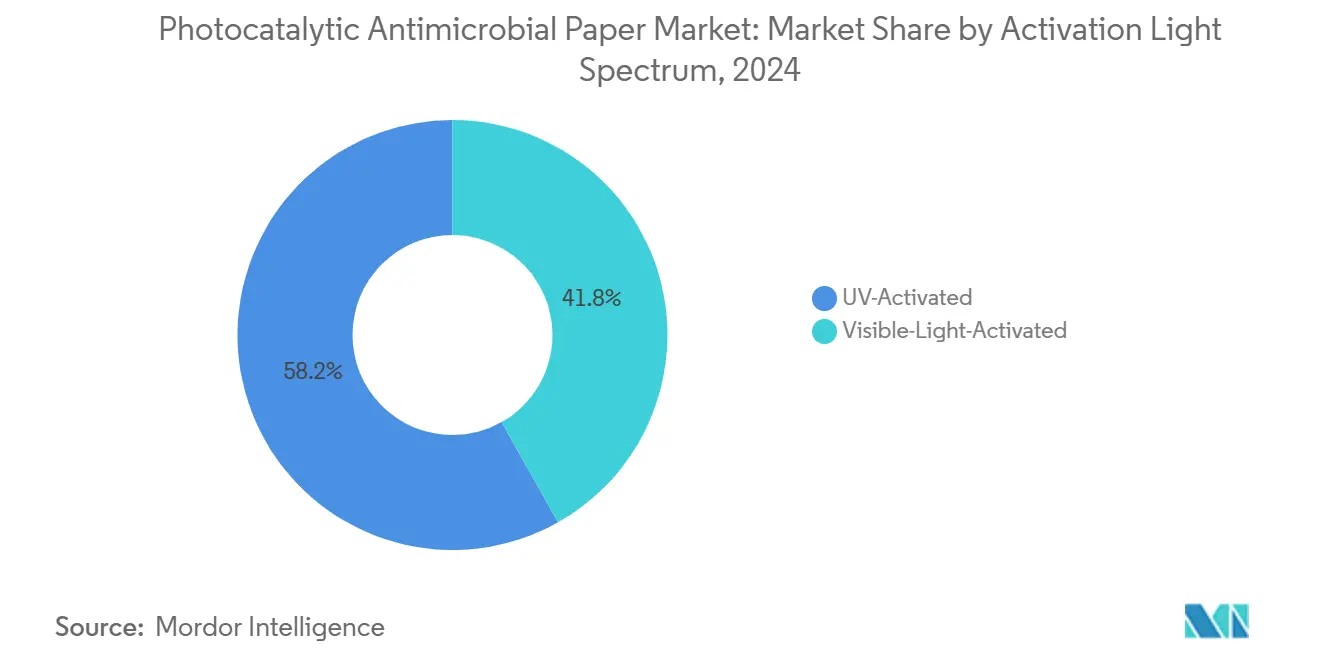
- By activation spectrum, ultraviolet systems accounted for 58.17% of the photocatalytic antimicrobial paper market share in 2024.
- By end-user industry, food and beverage dominated with 56.25% share of the photocatalytic antimicrobial paper market size in 2024.
- By geography, the photocatalytic antimicrobial paper market size for the Asia-Pacific region is projected to expand at an 11.94% CAGR between 2025-2030.
Note: Market size and forecast figures in this report are generated using Mordor Intelligence’s proprietary estimation framework, updated with the latest available data and insights as of January 2026.
Market Trends and Insights
Drivers Impact Analysis of Photocatalytic Antimicrobial Paper Market*
| Driver | % Impact on CAGR Forecast | Geographic Relevance | Impact Timeline |
|---|---|---|---|
| Rising demand for food and beverage packaging with built-in antimicrobial functionality | +2.1% | Global (North America & EU core) | Medium term (2-4 years) |
| Growing concern over healthcare-associated infections driving sterile medical packaging | +1.8% | Global (developed markets) | Short term (≤ 2 years) |
| Regulatory push to phase-out chemical biocides in packaging materials | +1.5% | Europe & North America, expanding to APAC | Long term (≥ 4 years) |
| E-commerce growth amplifying shelf-life demands on packaged goods | +1.3% | Global, led by APAC and North America | Medium term (2-4 years) |
| Integration with smart packaging sensors requiring contamination-free substrates | +1.0% | Developed markets, expanding globally | Long term (≥ 4 years) |
| Adoption in HVAC filtration media for indoor-air retrofits | +0.9% | Global, concentrated in commercial buildings | Medium term (2-4 years) |
| Source: Mordor Intelligence | |||
Rising Demand for Food and Beverage Packaging with Built-in Antimicrobial Functionality
Food makers are replacing chemical preservatives with materials that deliver continuous antimicrobial action while satisfying sustainability targets. Conducting polymer coatings containing AgNPs achieved 90% bacterial inhibition and extended strawberry shelf life by 40%, demonstrating the efficacy of integrated photocatalysts.[1]Abdelqader El Guerraf, “Smart Conducting Polymer Innovations for Sustainable and Safe Food Packaging Technologies,” Comprehensive Reviews in Food Science and Food Safety, onlinelibrary.wiley.com Nanocellulose composites further strengthen barrier properties, curbing biofilm formation in processing lines. Life-cycle studies indicate a 30% smaller carbon footprint when photocatalytic layers are paired with biodegradable substrates, an outcome resonating with circular-economy policies. Brand owners view such packaging as a route to premium positioning because it safeguards freshness without additives. Consequently, the photocatalytic antimicrobial paper market is rapidly securing supply-chain agreements with global fruit exporters and ready-meal producers.
Growing Concern over Healthcare-Associated Infections Driving Sterile Medical Packaging
HAIs account for millions of cases yearly and the WHO warns that, without decisive prevention, deaths could climb to 3.5 million annually by 2050. Photocatalytic antimicrobial paper delivers self-sterilizing surfaces during storage of devices and surgical kits. Multilevel antimicrobial polymers produced an 80.37% cut in viable bacteria and an 87.31% reduction in MRSA when applied to bedding surfaces. Because the mechanism is physical oxidation rather than leachable chemicals, the material mitigates migration worries in drug and implant packaging. Hospitals adopting such wrap solutions report fewer re-sterilization cycles, trimming operating-room turnaround time. These performance benefits elevate demand and improve the overall photocatalytic antimicrobial paper market outlook.
Regulatory Push to Phase-out Chemical Biocides in Packaging Materials
The UK’s ban on 63 biocidal actives under the Biocidal Products Regulation became effective in February 2024. Similarly, the European Chemicals Agency requires every biocidal article to secure authorization before sale. Parallel initiatives such as Washington State’s Safer Products program target PFAS and other persistent chemicals in food contact layers. Photocatalysis offers compliance because antimicrobial activity arises from reactive oxygen species rather than residual chemicals. As brand owners restructure portfolios to stay ahead of regulation, the photocatalytic antimicrobial paper market gains a competitive edge.
Integration with Smart Packaging Sensors Requiring Contamination-Free Substrates
Internet-of-Things (IoT) platforms require substrates free from chemical residues that could corrode electronic traces. Photocatalytic papers meet this prerequisite because they avoid migrating biocides. Fullerene-functionalized hydrogels exhibit turn-on fluorescence upon bacterial contact, creating dual antimicrobial and sensing roles. The combination of low-noise electrical backgrounds and pathogen-triggered signals supports blockchain-ready traceability. Sensor makers thus treat photocatalytic antimicrobial paper as a reference platform, expanding its specification base in premium supply chains.
Restraints Impact Analysis of Photocatalytic Antimicrobial Paper Market*
| Restraint | % Impact on CAGR Forecast | Geographic Relevance | Impact Timeline |
|---|---|---|---|
| High cost of TiO₂ nano-impregnation processes | -1.4% | Global (developing markets most affected) | Short term (≤ 2 years) |
| Photocatalyst efficiency degradation under indoor low-light conditions | -1.1% | Global (indoor applications) | Medium term (2-4 years) |
| Regulatory concerns over nanoparticle migration into food contact layers | -0.9% | Developed markets | Long term (≥ 4 years) |
| Limited commercial-scale manufacturing capacity | -0.8% | Global (few specialized facilities) | Medium term (2-4 years) |
| Source: Mordor Intelligence | |||
High Cost of TiO₂ Nano-Impregnation Processes
Hydrothermal synthesis, controlled atmospheres, and multi-step coating drive TiO₂ integration costs beyond the reach of some converters.[2]Yuguang Lv, “Research Progress on the Synthesis of Nanostructured Photocatalysts,” Nanomaterials, mdpi.com Dual Z-scheme heterojunctions, though performance-enhancing, add impregnation steps such as seed pre-loading that raise capex. Bias-enhanced electrolytic photocatalysis has shown promise in trimming dosage by boosting surface kinetics.Until automated coaters and continuous roll-to-roll lines mature, procurement teams remain price-sensitive, capping velocity in the photocatalytic antimicrobial paper market.
Photocatalyst Efficiency Degradation under Indoor Low-light Conditions
Traditional UV-dependent systems falter under office-grade lux. Studies reveal that UV-C fixtures can even yield secondary pollutants, prompting quicker transition to visible-light catalysts. CeO₂-modified AgCl boosts reaction rates by 5.43-fold in seawater and 9.17-fold in DI water, evidencing significant visible-light gains. Black g-C₃N₄ reaches 89% tetracycline degradation through a photothermal lift in ambient illumination. Upconversion particles that shift blue photons into germicidal UV-C further extend efficacy windows. The photocatalytic antimicrobial paper market must scale these solutions to ensure consistent performance in retail and office settings.
*Our forecasts treat driver/restraint impacts as directional, not additive. The impact forecasts reflect baseline growth, mix effects, and variable interactions.
Photocatalytic Antimicrobial Paper Market Segment Analysis
By Base Paper Material:
Cellulose Holds the Lion’s Share While Recycled Fiber Gains GroundCellulose foundations controlled 54.78% of the photocatalytic antimicrobial paper market in 2024, reflecting decades of process familiarity and a porous morphology that aids catalyst anchoring. Integrating TiO₂ within nanofibrillated cellulose substrates delivers mechanical robustness and maintains reactivity during multiple wet-dry cycles.[3]Julien Bras, “Nanocellulose in Functional Packaging,” Cellulose-Reinforced Nanofibre Composites, sciencedirect.comRecycled fiber is rising at an 11.62% CAGR, underpinned by extended producer-responsibility laws that reward post-consumer content. Although de-inking residues and variable furnish quality complicate impregnation, refinements in dispersion chemistry are closing the performance gap. Consequently, the photocatalytic antimicrobial paper market size for recycled fiber is projected to expand sharply between 2025 and 2030.
Manufacturers are also incorporating graphene flakes within cellulose matrices to elevate tensile strength and add electrical conductivity for sensor integration. Hybrid structures that laminate a thin plastic contact layer to a rigid cellulose board decrease polymer tonnage yet maintain barrier integrity. Such architectures align with brand promises on recycled content while still meeting functional benchmarks. The push toward circularity will therefore keep recycled fiber on a steep ascent even as premium applications continue to rely on virgin cellulose.




By Photocatalyst Type:
TiO₂ Dominates but ZnO AcceleratesTiO₂ commanded 61.32% of photocatalytic antimicrobial paper market share in 2024, its supremacy built on regulatory familiarity, high quantum yield, and relative abundance. Bias-enhanced electro-photocatalysis cuts energy inputs and debottlenecks saltwater use cases, lifting the photocatalytic antimicrobial paper market size for TiO₂-based grades in marine packaging. Still, ZnO systems are moving at an 11.47% CAGR, prized for wider band-gap tunability and robust visible-light activity. Trials show ZnO-doped flexographic inks boosting print opacity by 28.5% and adding counterfeit-proof luminescence.
Graphitic carbon nitride sits in niche deployments requiring stable performance under fluorescent lamps, whereas hybrid composites such as Bi₂O₃-TiO₂/powdered activated carbon reach 99% dye degradation with multi-cycle stability. Suppliers are racing to industrialize such blends, yet slurry homogeneity and reactive-surface preservation remain industrialization hurdles. Nonetheless, competitive benchmarking indicates that ZnO will continue to siphon share from TiO₂, and hybrid stacks will grab premium slots in the photocatalytic antimicrobial paper industry.
By Activation Light Spectrum:
Visible-Light Catalysts Headline GrowthUltraviolet-triggered grades represented 58.17% of segment revenues in 2024, favored by food plants and sterile pack rooms equipped with germicidal lamps. However, the visible-light cohort is expanding at 11.81% CAGR as buyers demand efficacy under ambient LEDs. CeO₂/AgCl composites post degradation rates 9.17 times higher than AgCl alone, validating the performance leap in indoor conditions. Upconversion materials doped with Pr³⁺ convert blue photons into UV-C, allowing antimicrobial action within the second biological window, a capability sought by healthcare packagers to reduce lamp installation costs.
Black g-C₃N₄ also excels in typical warehouse lighting, achieving 89% antibiotic degradation while offering photothermal benefits that raise surface temperature for faster moisture evaporation. Manufacturers invest in surface functionalization to prevent catalyst agglomeration, a key requirement to scale visible-light sheets. The trajectory suggests that visible-light activation will eclipse UV in new capacity additions, underpinning future revenue distribution in the photocatalytic antimicrobial paper market.
By End User Industry:
Food & Beverage Leads; Commercial Buildings OutpaceFood and beverage players absorbed 56.25% of 2024 demand, anchored by stringent hygiene codes and consumer pushback against synthetic additives. Shelf-life extensions of five days for fish and 40% for strawberries validate return-on-investment for cold chain operators. Nonetheless, commercial buildings are racing ahead at an 11.75% CAGR as employers retrofit HVAC systems to lift occupancy confidence. Plasma-photocatalysis filters housed in cardboard frames report 60% microbial load reductions, earning green-building credits .
Medical-device sterilization wraps and pharma blister backers remain crucial yet smaller niches, drawing strength from validated bioburden results and non-migration credentials. E-commerce retailers deploy smart labels paired with photocatalytic papers to ensure freshness visibility during shipping surges. Together, these diversified tailwinds reinforce double-digit expansion prospects for the photocatalytic antimicrobial paper market.
Geography Analysis
Europe Photocatalytic Antimicrobial Paper Market
Europe retained 30.56% of global revenues in 2024, cementing leadership through tight biocidal oversight and advanced specialty paper mills. Germany and France anchor R&D clusters focused on visible-light catalysts, while the UK’s prohibition of 63 biocides accelerates conversion projects. Capital support, exemplified by Stora Enso’s EUR 435 million EIB loan, underwrites large-scale plant upgrades aimed at high-efficiency coating lines. Regulatory certainty therefore continues to lock buyers into photocatalytic formats, reinforcing Europe’s prime seat in the photocatalytic antimicrobial paper market.
APAC Photocatalytic Antimicrobial Paper Market
Asia-Pacific is advancing at an 11.94% CAGR through 2030, powered by lower unit costs and soaring domestic food demand. Chinese mills scale continuous TiO₂ impregnation lines, narrowing quality gaps with European peers. Japanese conglomerates under VISION 2030 accelerate bio-based chemistry transitions and feedstock decarbonization. India’s e-commerce surge, combined with stricter food safety norms, fosters rapid prototype testing with local converters. Although regulatory harmonization is ongoing, regional standard-setting bodies are drafting guidelines, creating a clearer path for scaled procurement that will lift the photocatalytic antimicrobial paper market size across ASEAN hubs.
The Americas Photocatalytic Antimicrobial Paper Market
North America maintains steady gains fueled by FDA oversight and heightened HAI mitigation initiatives across hospitals. The United States steers development budgets toward smart packaging, and Canadian mills leverage abundant timber reserves alongside carbon-pricing incentives to launch cellulose-based photocatalytic grades. Mexico’s rising meat-export sector seeks antibacterial wraps to meet importer residue limits, thus extending the geographic reach of the photocatalytic antimicrobial paper market. South American nations, led by Brazil’s processed meat exporters, are piloting ZnO-enhanced papers to comply with EU entry rules, indicating latent upside once regional capacities materialize.


Competitive Landscape
The market is moderately fragmented: top five suppliers collectively control near-mid-40% share, with regional paper majors occupying the bulk. Japanese vertically integrated groups Nippon Paper Industries, Mitsubishi Paper Mills, and Oji Holdings exploit in-house pulp and coating competencies to roll out TiO₂-based offerings matched to domestic hygiene labels. European contenders such as Stora Enso and Mondi position products around sustainability scoring systems, leveraging lifecycle assessments that highlight chemical-free antimicrobial mechanisms. U.S. innovators concentrate on smart-pack sensor coupling, co-developing conductive graphene inks with ZnO particles for dual antimicrobial and data-logging functions.
Strategic collaborations dominate growth plays. Paper mills sign multi-year take-or-pay deals with nanoparticle formulators, sharing coating-line retrofitting expenses in exchange for exclusivity in certain regions. Start-ups focusing on visible-light upconversion nanoparticles license IP to established converters, accelerating commercial readiness. M&A activity remains selective but rising recent private-equity interest targets mid-cap firms possessing both coating capacity and niche healthcare customer lists.
R&D competition focuses on stability under ambient lighting, nanoparticle immobilization, and process yield. Patent filings referencing bias-enhanced electro-photocatalysis and self-healing coatings have surged since 2023, indicating a race to safeguard differentiated performance. Capacity bottlenecks persist, yet new capital programs in Europe and Asia suggest throughput relief from 2026 onward. Overall, competitive intensity is pivoting from cost leadership toward multipurpose functionality and regulatory assurance, trends that will define positioning within the photocatalytic antimicrobial paper market.
Photocatalytic Antimicrobial Paper Industry Leaders
Nippon Paper Industries Co., Ltd.
Mitsubishi Paper Mills Ltd.
Oji Holdings Corporation
Stora Enso Oyj
Mondi plc
- *Disclaimer: Major Players sorted in no particular order

Photocatalytic Antimicrobial Paper Market Companies Covered in this Report
- Nippon Paper Industries Co., Ltd.
- Mitsubishi Paper Mills Ltd.
- Oji Holdings Corporation
- Daio Paper Corporation
- Stora Enso Oyj
- Mondi plc
- Ahlstrom-Munksjö Oyj
- Sappi Limited
- Voith Group
- Kimberly-Clark Professional
- Parx Materials N.V.
- Nano4Life Cyprus Ltd.
- Panion Technology Corp.
- Shanghai Hongfeng Paper Co., Ltd.
- Kruger Inc.
- Paperlogic Inc.

Recent Industry Developments in Photocatalytic Antimicrobial Paper Market
- January 2025: Mitsui Chemicals completed its VISION 2030 sustainability transition, prioritizing bio-based materials and circular-economy milestones.
- November 2024: World Health Organization published a report outlining the potential to prevent 821,000 annual deaths via enhanced infection-prevention measures.
- October 2024: Washington State Department of Ecology issued draft Safer Products documentation targeting PFAS reductions in packaging.
- September 2024: UK Health and Safety Executive enforced non-approval of 63 active biocidal substances, reshaping antimicrobial material choices.


Global Photocatalytic Antimicrobial Paper Market Report Scope
| Cellulose-based |
| Synthetic Fiber |
| Recycled Fiber |
| Titanium Dioxide (TiO₂) |
| Zinc Oxide (ZnO) |
| Graphitic Carbon Nitride (g-C₃N₄) |
| Hybrid Composites |
| UV-Activated |
| Visible-Light-Activated |
| Food and Beverage |
| Pharmaceuticals and Medical |
| Commercial Buildings |
| Retail and E-commerce |
| Others |
| North America | United States | |
| Canada | ||
| Mexico | ||
| South America | Brazil | |
| Argentina | ||
| Rest of South America | ||
| Europe | Germany | |
| France | ||
| United Kingdom | ||
| Italy | ||
| Spain | ||
| Russia | ||
| Rest of Europe | ||
| Asia-Pacific | China | |
| Japan | ||
| South Korea | ||
| India | ||
| Australia | ||
| Thailand | ||
| Rest of Asia-Pacific | ||
| Middle East and Africa | Middle East | GCC |
| Turkey | ||
| Rest of Middle East | ||
| Africa | South Africa | |
| Nigeria | ||
| Rest of Africa | ||
| By Base Paper Material | Cellulose-based | ||
| Synthetic Fiber | |||
| Recycled Fiber | |||
| By Photocatalyst Type | Titanium Dioxide (TiO₂) | ||
| Zinc Oxide (ZnO) | |||
| Graphitic Carbon Nitride (g-C₃N₄) | |||
| Hybrid Composites | |||
| By Activation Light Spectrum | UV-Activated | ||
| Visible-Light-Activated | |||
| By End User Industry | Food and Beverage | ||
| Pharmaceuticals and Medical | |||
| Commercial Buildings | |||
| Retail and E-commerce | |||
| Others | |||
| By Geography | North America | United States | |
| Canada | |||
| Mexico | |||
| South America | Brazil | ||
| Argentina | |||
| Rest of South America | |||
| Europe | Germany | ||
| France | |||
| United Kingdom | |||
| Italy | |||
| Spain | |||
| Russia | |||
| Rest of Europe | |||
| Asia-Pacific | China | ||
| Japan | |||
| South Korea | |||
| India | |||
| Australia | |||
| Thailand | |||
| Rest of Asia-Pacific | |||
| Middle East and Africa | Middle East | GCC | |
| Turkey | |||
| Rest of Middle East | |||
| Africa | South Africa | ||
| Nigeria | |||
| Rest of Africa | |||


Key Questions Answered in the Report
What is the current value of the photocatalytic antimicrobial paper market?
The market is valued at USD 378.56 million in 2025 and is forecast to reach USD 496.17 million by 2030.
Which region grows fastest in photocatalytic antimicrobial paper adoption?
Asia-Pacific leads with an 11.94% CAGR thanks to competitive manufacturing costs and rising food-safety standards.
Why are visible-light catalysts gaining traction?
They maintain antimicrobial performance under indoor LED lighting, overcoming the limitations of UV-dependent systems.
What is the biggest restraint to widespread market rollout?
High TiO₂ nano-impregnation costs and limited commercial-scale coating capacity are the main hurdles.
Which end-user segment is expanding most quickly?
Commercial buildings are clocking an 11.75% CAGR as owners retrofit HVAC systems to improve indoor-air hygiene.
How does photocatalytic antimicrobial paper comply with tightening biocide regulations?
Its antimicrobial action is driven by physical reactive oxygen generation rather than controlled-substance leaching, thereby sidestepping chemical-residue restrictions.
Page last updated on:


 Your data is secure and never sold or shared.


