
Philippines Telecom MNO Market Analysis by Mordor Intelligence
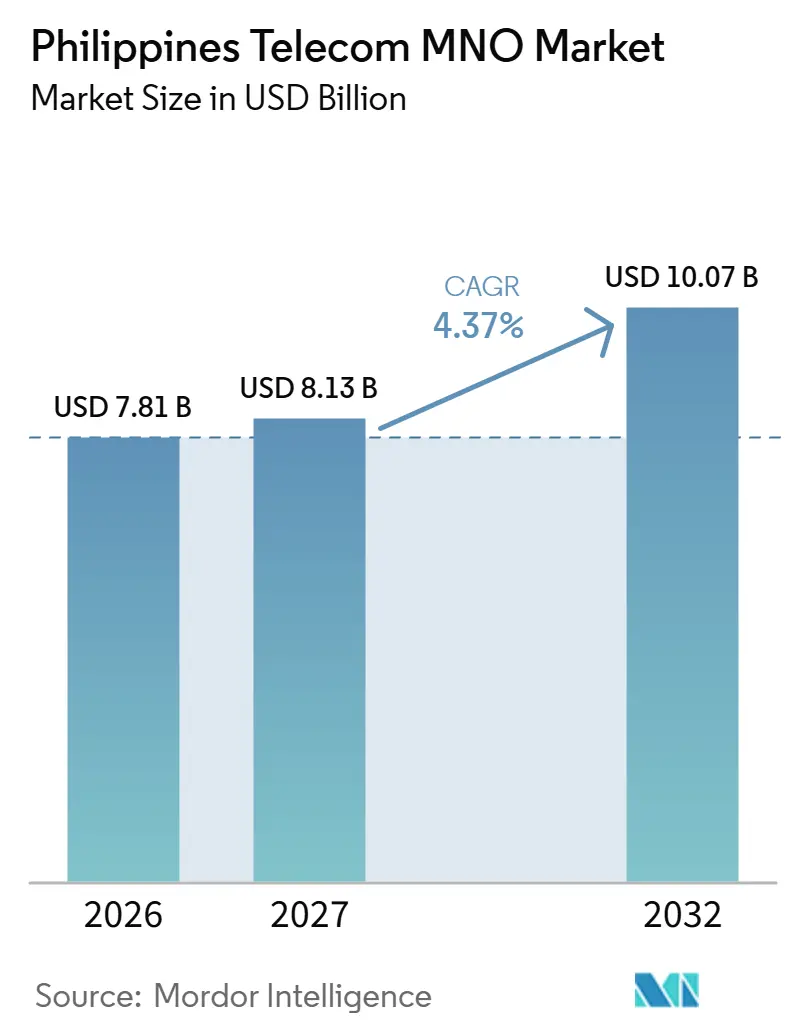
The Philippines telecom MNO market size is projected to expand from USD 7.81 billion in 2026 and USD 8.13 billion in 2027 to USD 10.07 billion by 2032, registering a CAGR of 4.37% between 2027 and 2032.
Mobile video, gaming and enterprise digitalization increase the importance of usable data capacity in the Philippines, while 5G coverage gives operators a wider platform for demand. Higher consumption does not automatically lift subscriber monetization, so expansion needs relevant service offers alongside additional capacity. Tower reform can improve investment planning, but capital intensity and weak rural unit economics constrain how quickly demand becomes profitable network reach. Competition consequently rewards operators that turn network capacity into dependable service experience at a manageable capital burden.
Key Report Takeaways
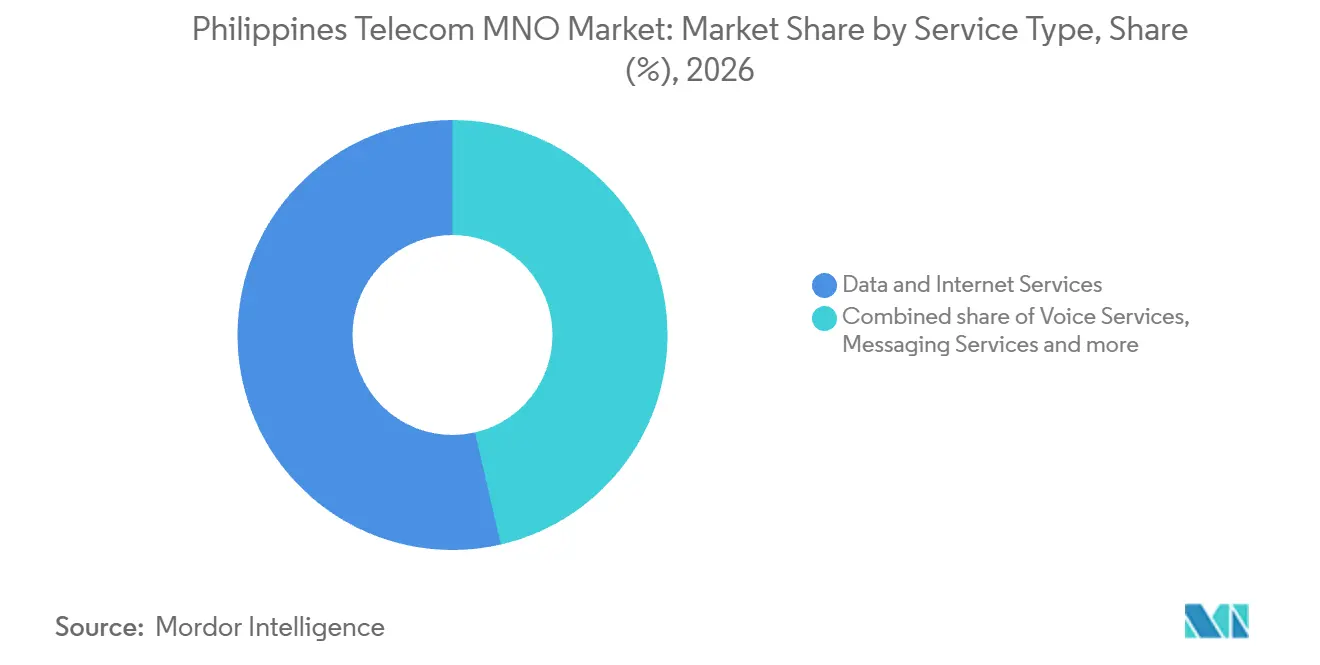
- Across service types, data and internet services held a 53.61% Philippines telecom MNO market share in 2026, while IoT and M2M services are forecast to grow fastest at a CAGR of 4.5% between 2027 and 2032.
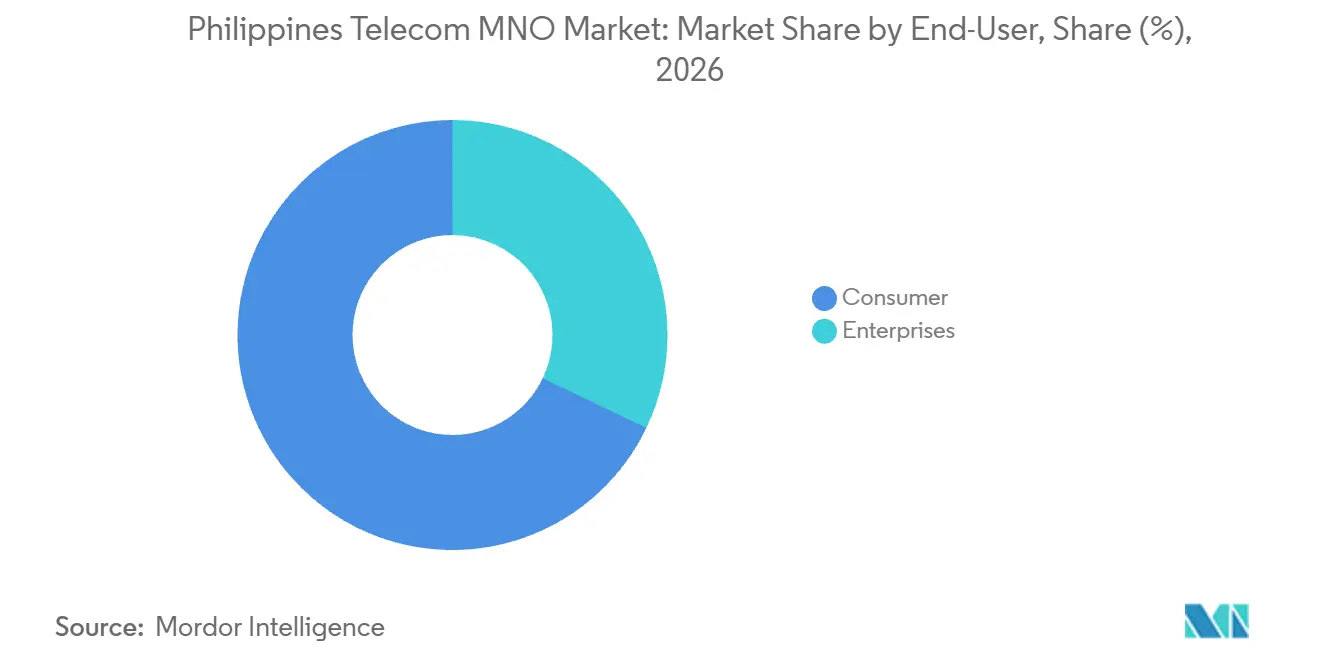
- Among end users, the consumer segment accounted for a 67.89% share of the Philippines telecom MNO market size in 2026, and enterprises are projected to be the fastest-growing segment at a CAGR of 4.62% between 2027 and 2032.
Note: Market numbers in this report are based on Mordor Intelligence's proprietary estimation framework, which combines nine months of actuals with Q4 projections for base year 2026.
Philippines Telecom MNO Market Trends and Insights
Drivers Impact Analysis*
| Driver | (~) % Impact on CAGR Forecast | Geographic Relevance | Impact Timeline |
|---|---|---|---|
| Rising mobile-data consumption from video and gaming boom | +1.8% | Nationwide | Short term (≤ 2 years) |
| Accelerated 5G roll-out and device affordability | +1.5% | Nationwide | Medium term (2-4 years) |
| Government common-tower and spectrum-reform programs | +1.2% | Nationwide | Medium term (2-4 years) |
| Enterprise digital-transformation and IoT connectivity demand | +1% | Nationwide | Medium term (2-4 years) |
| Fin-tech super-apps (e.g., GCash) lifting stickiness and ARPU | +0.5% | Nationwide | Short term (≤ 2 years) |
| Typhoon-resilient network requirements driving densification | +0.4% | Nationwide | Long term (≥ 4 years) |
| Source: Mordor Intelligence | |||
Rising mobile-data consumption from video and gaming boom
A growing audience that also uses more data intensifies the capacity required to support mobile entertainment. Globe's mobile-data user base grew 5% year on year to 39.6 million in the first half of 2026. Its mobile-data traffic reached 3,723 petabytes, up from 3,187 petabytes in the first half of 2025. Average monthly usage also rose from 15 GB to 17 GB per subscriber over the same comparison. Globe linked higher consumption to several digital services, including video streaming, gaming, AI applications, e-commerce, digital payments and productivity services. For the operator, broader participation and greater individual use create a recurring data-service opportunity that requires capacity to keep pace with both sources of demand.
Accelerated 5G roll-out and device affordability
Coverage and handset access need to work together for a 5G footprint to become paying demand. The GSMA's February 2026 Philippines roadmap reported commercial 5G coverage at around 80% of the country's population.[1] In its 2025 results release, PLDT linked wider affordable 5G handset availability and Smart's network optimization to the shift toward faster, more reliable connectivity. PLDT reported 12.5 million 5G-capable individual devices at end-June 2026, up 30% year over year and representing 21% of individual devices in its Wireless Consumer business. The same GSMA roadmap reported an Opensignal measure of 5G availability at 46% of the time, a separate measure from population coverage. PLDT's limited 5G device penetration and the separate availability measure point to demand opportunities in handset migration and consistent network access, alongside wider coverage.
Government common-tower and spectrum-reform programs
Longer infrastructure tenure can improve the investment case for shared sites before any additional spectrum is assigned. In 2025, the Department of Information and Communications Technology (DICT) extended shared telecommunications tower-license terms from 5 years to 15 years.[2] For mobile operators using shared sites, a longer licensed life reduces renewal uncertainty within the period over which they plan coverage investments. The Konektadong Pinoy Act became law in 2025 and requires a spectrum-management framework promoting competition, technological adaptability and efficient spectrum use among registered data transmission participants. In March 2026, DICT sought stakeholder input for that framework, with submissions due March 27. Site tenure was the more immediate investment lever, because DICT was seeking input on the spectrum framework in March 2026.
Enterprise digital-transformation and IoT connectivity demand
Enterprise digitalization turns connectivity into a facility-level service requirement that extends beyond the sale of individual connections. In December 2025, PLDT Enterprise partnered with the Civil Aviation Authority of the Philippines to enhance digital infrastructure and connectivity across 16 airports. Under that agreement, PLDT's corporate arm was to provide dedicated internet access using its fiber network, structured connectivity and network distribution equipment. The specified combination ties network access to the facilities and equipment through which an enterprise uses it. For a connectivity provider, serving multiple airports can extend demand from access lines to the equipment that distributes service within each facility. Such agreements broaden the revenue opportunity per institutional account, conditional on delivering the agreed connections and equipment.
Restraints Impact Analysis*
| Restraint | (~) % Impact on CAGR Forecast | Geographic Relevance | Impact Timeline |
|---|---|---|---|
| Heavy 5G / fiber capex burden on operators | -0.9% | Nationwide | Medium term (2-4 years) |
| Low rural ARPU limiting ROI | -0.6% | Nationwide | Long term (≥ 4 years) |
| SIM Registration Act-driven prepaid deactivations | -0.3% | Nationwide | Short term (≤ 2 years) |
| Climate-related outages raising opex and churn risk | -0.2% | Metro Manila and Rizal | Short term (≤ 2 years) |
| Source: Mordor Intelligence | |||
Heavy 5G / fiber capex burden on operators
Network expansion must compete for funding even when an operator brings its capital spending under tighter control. PLDT's consolidated capital expenditures equaled 28% of its service revenues in 2025.[3] That ratio makes the cash required to sustain and expand infrastructure commercially significant alongside revenue generation. It also means that demand growth alone cannot settle which capacity additions can be funded or how quickly they can proceed. PLDT said capex discipline and successful vendor negotiations contributed to its lower capital expenditures in 2025. Even with that response, committing capital before the associated services generate returns creates a funding requirement that can limit the pace of additional network deployment.
Low rural ARPU limiting ROI
Where a rural cell site's potential subscriber base is small, construction costs must be recovered from fewer paying connections. A connection can add demand without contributing enough revenue to cover its share of maintaining the site. Lower revenue per connection would raise the subscriber count needed to support that infrastructure, linking subscriber yield to site economics. For a remote extension, the relevant return is the revenue available within the site's service area against its construction and recurring costs. An operator can therefore face a technically feasible coverage project whose investment burden local receipts cannot sustain.
*Our forecasts treat driver/restraint impacts as directional, not additive. The impact forecasts reflect baseline growth, mix effects, and variable interactions.
Segment Analysis
By Overall Telecom Revenue and ARPU: Monetization Depends on More Than Traffic
Overall telecom revenue depends on the value earned from subscriber relationships as well as the amount of connectivity delivered. PLDT reported that Smart Communications maintained stable average revenue per user in 2025, supported by continued 5G adoption and higher data consumption. Stable subscriber monetization alongside greater use means that additional traffic does not necessarily produce a higher average return from each connection. Traffic growth can increase capacity requirements even when average subscriber revenue holds steady, putting the cost of carrying each connection's usage under pressure.
In its 2025 results release, PLDT said Smart's core modernization program, then underway, was strengthening network analytics and targeting capabilities, enabling more personalized offers and better marketing efficiency. Those capabilities connect the network investment decision with the way services are presented to different subscriber needs. More precise targeting can help an operator shape a relevant offer without assuming that all users will respond to the same access package. With ARPU stable while 5G adoption and data use rose, revenue growth would require more paying relationships unless targeted offers also lifted per-user spending.
By Service Type: Data Scale Supports a Shift Toward Managed Connectivity
Data and internet services accounted for a 53.61% share of the Philippines telecom MNO market size in 2026, making it the largest segment. In the first half of 2026, Globe Telecom reported that mobile data accounted for 89% of its mobile revenue. That operating mix places data-service delivery at the center of the operator's revenue exposure, giving network performance a direct commercial role within its mobile business. An investment that supports data use can therefore protect a substantial existing service relationship as well as create capacity for additional consumption.
IoT and M2M services are forecast to be the fastest-growing segment, registering a CAGR of 4.5% between 2027 and 2032. In February 2026, Globe Business and Aeris announced a strategic partnership to launch an IoT Accelerator platform in the Philippines, with commercial availability targeted for Q3 2026. The announcement described a platform designed to give enterprise customers a single place to manage IoT connectivity, with automotive manufacturers among the intended users. That proposition shifts the service focus from an isolated connection to the management of connectivity within a coordinated enterprise program. Its commercial weight rests on enterprises adopting a single platform to manage their IoT device programs.

By End-User: Consumer Scale and Enterprise Service Expansion Diverge
The consumer segment represented a 67.89% Philippines telecom MNO market share in 2026, making it the largest segment. Globe Telecom reported 67.7 million mobile subscribers in the first half of 2026. At year-end 2025, prepaid customers represented approximately 96% of PLDT Group's wireless subscribers. A prepaid-heavy base creates repeated service-purchase decisions without securing a continuing payment commitment at registration. The operator's commercial exposure therefore extends beyond winning a SIM activation to retaining the next paid service purchase.
Enterprises are forecast to be the fastest-growing segment, registering a CAGR of 4.62% between 2027 and 2032. Globe Business corporate data revenue reached a first-half record, rising 15% year over year in the first half of 2026. The corporate data category includes connectivity and associated ICT services, giving an operator scope to develop a broader service role within an enterprise account. Delivering that scope can require coordination across connectivity and ICT capabilities, making account execution part of the revenue opportunity. This creates room to compete for a larger corporate service budget through associated ICT work, rather than relying solely on additional access connections.
Geography Analysis
Metro Manila and key cities in the Visayas and Mindanao provide settings where operators can build service propositions on extensive 5G footprints. In the first half of 2026, Globe's capital spending funded 878 new 5G sites, expanding 5G coverage to more than 98% of Metro Manila and major urban areas. The operator also reported 98.2% outdoor 5G coverage in key cities in the Visayas and Mindanao in the first half of 2025. With urban reach that extensive, further investment can improve usable capacity and service consistency within the footprint as well as extend its boundaries.
In Davao City, Globe reported new cell sites live in 8 growth areas, including Catalunan Grande, Talomo and Ladislawa Buhangin. The upgrades were intended to deliver faster, more reliable internet for homes, schools and small businesses, tying household and institutional uses to the same local expansion. Neighborhood-level siting ties each addition to the rising connectivity needs Globe cited for those areas. The commercial test is whether use across those neighborhoods sustains the added local capacity.
Cebu adds a service-continuity dimension to the geographic comparison because an earthquake disrupted telecom services there in 2025. As of October 6, 2025, Globe and DITO had fully restored their services in Cebu. Smart had restored 98% of its services in the island province as of that date. Uneven recovery after the same disruption makes operator-level restoration capability relevant to customers' access to a functioning network within one location. Restoration performance determines how much of a nominal footprint customers can use, a distinction coverage figures alone do not capture.
Regulatory Framework and Outlook
The comparison of selected jurisdictions covers the Philippines and Cebu through national service-entry and construction-permitting rules. The perspective is that of an MNO investing in covered data-transmission infrastructure, so operating authorization and site construction are assessed as distinct investment conditions. Executive Order No. 32 binds covered national agencies and local government units, retaining building permits issued by the Office of the Building Official, conditional clearances and constitutional and existing-law requirements. The Konektadong Pinoy Act directs DICT, coordinating with NTC and the Philippine Competition Commission and consulting stakeholders, to develop a spectrum framework within one year of the implementing rules' effectivity.
Regulatory Table
| Decision factor | Philippines | Cebu |
|---|---|---|
| Primary authority | National Telecommunications Commission | Office of the Building Official for building permits under Executive Order No. 32 |
| Key instruments or direction | Konektadong Pinoy Act registration and spectrum-authorization requirements | Executive Order No. 32 permit limits and conditional clearances |
| Commercial effect | Register covered data-transmission businesses and secure NTC authorization when using spectrum | Building permit, homeowner and community clearances, applicable agency clearances and retained legal requirements |
| Current policy attractiveness | Medium | Medium |
| Future direction of policy attractiveness | No change | No change |
| Source: Mordor Intelligence | ||
National attractiveness is Medium because open network participation coexists with registration and spectrum-authorization duties. The March 27, 2026, input deadline concerned draft spectrum terms, leaving existing registration and authorization duties as the basis for the national No change judgment. For Cebu, Medium balances national permit limits against the retained building permit, conditional clearances and constitutional and existing-law requirements. Continuing nationwide adoption of the July 2023 national framework in 2026 supports the No change judgment for Cebu.
Value Chain Stages
The value chain comparison separates securing sites, financing passive infrastructure and delivering mobile services because each activity captures a different revenue stream. Globe completed tower-asset sales in February and March 2025 and continued to use leased sites under its sale-and-leaseback program. This arrangement separates ownership of physical infrastructure from the operator's continuing service relationship with subscribers. For the lessee, usable capacity depends on coordinating site access with service activation, even after ownership and financing have transferred.
Value Chain Analysis Table
| Primary activity | Key participants | Value capture | Bottleneck | Resilience response |
|---|---|---|---|---|
| Site acquisition | Site-acquisition vendors such as Huawei, ZTE and Nokia - Huaxin | Site-acquisition service fees | Coordinating acquisition work across territories | Allocate acquisition workstreams by territory and track site readiness |
| Passive tower ownership and hosting | Tower buyers and lessors such as MIESCOR Infrastructure Development Corporation, Phil-Tower Consortium, Inc. and Unity Digital Infrastructure | Site leasing payments | Funding infrastructure before lease receipts recover its cost | Align financing and lease commitments with infrastructure tenure |
| Mobile service delivery | Mobile network operators such as DITO Telecommunity | Mobile connectivity service fees | Converting site availability into service-ready capacity | Link service activation milestones to site-readiness checks |
| Source: Mordor Intelligence | ||||
Value capture changes at each handoff, from acquisition work to infrastructure leasing and ultimately subscriber service delivery. The sale-and-leaseback structure can release operator capital while creating a continuing obligation to coordinate with the infrastructure owner. A site secured by an acquisition vendor is therefore an intermediate asset in the delivery process, and its commercial value depends on the later steps being completed. The structural opportunity is to make those handoffs reliable enough that capital released from ownership can support service expansion.
Competitive Landscape
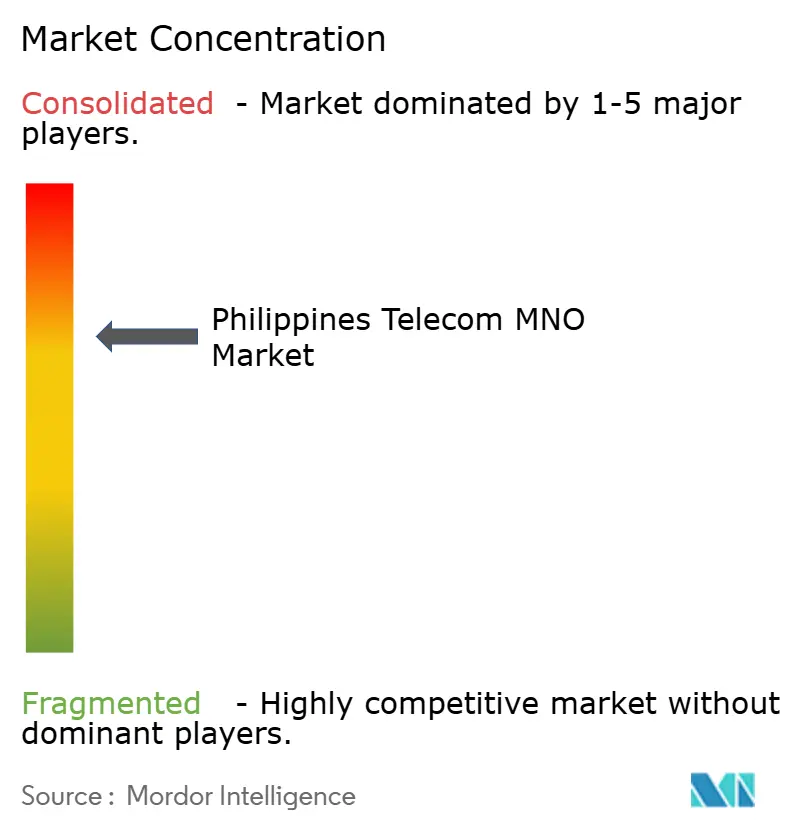
Competition has a concentrated core around Globe Telecom, Smart Communications and DITO Telecommunity, with operator scale and service delivery shaping the contest. DITO served more than 16.63 million mobile subscribers and about 470,000 fixed-wireless subscribers in the Philippines as of March 2026. At June 30, 2026, PLDT, which owns Smart Communications, reported 60.09 million mobile subscribers, including mobile broadband subscribers. Its prepaid counts were 21.74 million for Smart and 35.95 million for TNT. Against that established mobile scale, DITO's separate fixed-wireless business provides an additional route to customers while its smaller reported mobile base competes for connections.
In Opensignal's July 2026 awards, Smart led gaming, voice experience and 5G upload speed, while DITO led reliability, download speed and time on network. Smart and DITO each won 8 categories and shared the video and 5G video awards, while Globe won 2 categories, consistent quality and coverage. In the first half of 2026, Globe's capital expenditures rose 39% year over year, with 91% allocated to data-related projects. That allocation concentrates its investment response on data infrastructure, where additional spending must translate into an experience customers can use. For Globe, the commercial test is converting data investment into service improvements that challenge rivals' measured experience strengths.
Service execution also faces a regulatory test that can affect how operators prioritize network work. The National Telecommunications Commission's (NTC) September 2026 revalidation found no measurable improvement in DITO, Globe and Smart mobile broadband service in Metro Manila versus first- and second-quarter 2026 tests. DITO's July 2026 reliability and download-speed awards concern national experience categories, while the regulator compared local mobile broadband performance over time. Investment justified by national differentiation therefore needs a separate case for improving the Metro Manila locations under regulatory scrutiny.
Philippines Telecom MNO Industry Leaders
-
Globe Telecom
-
Smart Communications
-
DITO Telecommunity
- *Disclaimer: Major Players sorted in no particular order
Key Opportunities for Market Participants
The opportunity comparison assesses 3 ways to expand mobile-service revenue through infrastructure access, coverage extension and regional enterprise connectivity. Each route addresses a different deployment problem, so the buyer and technical conditions should determine the offer. Access-based expansion depends on the feasibility of using another provider's infrastructure, whereas satellite and enterprise IoT propositions require a service matched to the intended deployment. The practical opening is to sell a defined connectivity function with its delivery requirements built into the proposition.
Market Opportunities Table
| Opportunity | Why now | Buyer / lead segment | Recommended play | Main barrier | Likely beneficiaries |
|---|---|---|---|---|---|
| Mobile-network expansion using shared infrastructure | The 2025 implementing rules require fair and nondiscriminatory access to listed infrastructure, subject to technical feasibility | Access-seeking data transmission participants | Prepare technically specified access requests for eligible infrastructure | Making the requested integration technically feasible | Access-seeking MNOs and infrastructure providers |
| Satellite coverage-extension services | Globe commercially launched Starlink direct-to-cell service in June 2026 | Consumers outside Globe's terrestrial coverage | Offer connectivity extensions for compatible devices in suitable outdoor locations | Compatible devices and an unobstructed view of the sky | Globe Telecom and Starlink |
| Regional enterprise IoT connectivity | Bridge Alliance, Thales and 4 member operators, including Globe, deployed an Asia Pacific enterprise eSIM network in July 2026 | Enterprises developing regional IoT programs | Offer Philippine connectivity within a regional IoT service proposition | Integrating device and connectivity management across operators | Globe Telecom, Thales and participating operators |
| Source: Mordor Intelligence | |||||
The central opening is to monetize suitable locations beyond Globe's terrestrial footprint through a satellite service designed for compatible devices. The device and sky-view requirements should shape which deployments are offered the service, rather than becoming issues discovered after activation. This makes location-level qualification part of the revenue opportunity, with expansion tied to places where the link can actually function.
Recent Industry Developments
- Sep 2026: The National Telecommunications Commission's revalidation found no measurable improvement in DITO, Globe and Smart mobile broadband service in Metro Manila versus first- and second-quarter 2026 tests.
- Aug 2026: Globe Telecom reported first-half 2026 capital expenditures up 39% year over year, with 91% allocated to data-related projects.
- Jul 2026: Bridge Alliance, Thales and 4 member operators, including Globe Telecom, deployed an Asia Pacific enterprise eSIM network for IoT, ready to support enterprise deployments.
Research Methodology Framework and Report Scope
Market Definition and Coverage
The Philippines Telecom MNO Market measures annual service revenue earned by mobile network operators for communication, connectivity, and related services provided in the Philippines. It covers services supplied to consumer, enterprise, and wholesale customers.
Scope exclusions: Handsets and network equipment sold separately from telecom service, tower-only leasing revenues, and pure software IT services that do not generate telecom service revenue are excluded.
Segmentation Overview
- By Overall Telecom Revenue and ARPU
- By Service Type
- Voice Services
- Data and Internet Services
- Messaging Services
- IoT and M2M Services
- OTT and PayTV Services
- Other Services (VAS, Roaming and International Services, Enterprise and Wholesale Services, etc.)
- By End-User
- Enterprises
- Consumer
Data Sources, Market Sizing, and Validation
Desk Research
Sources such as the Department of Information and Communications Technology's National Digital Connectivity Plan, the World Bank's Philippines connectivity results, the GSMA's Philippine 5G roadmap, and the International Telecommunication Union's ICT indicators help frame access, usage, infrastructure and spectrum conditions. These sources provide independent context for interpreting mobile subscription, broadband, coverage, affordability and policy signals alongside operator service revenues.
PLDT's FY2025 results release, annual filings and investor materials can help distinguish mobile, fixed wireless, enterprise data and ICT, and non-service revenue, while reputable Philippine business press can cross-check the timing and detail of company or policy announcements. These sources are not exhaustive, and further sources inform collection, validation and clarification.
Primary Interviews and Surveys
Primary research engages Philippine MNO commercial, finance, network-planning and enterprise-sales leaders, enterprise connectivity buyers and telecom specialists to test how published disclosures map to service categories and to check subscriber, ARPU, data-use, 5G and IoT assumptions. A structured survey engages Philippine operator and enterprise stakeholders to assess the importance and timing of those same demand and service-mix indicators. When sources disagree or a revenue line is not reported, analysts record the definition and period, use bounded assumptions only where public evidence supports them, and triangulate the interpretation across filings, regulatory materials and respondent evidence.
Distribution of primary research fieldwork respondents
| Company type | Respondent position | Region |
|---|---|---|
| Top tier: 35% | CXOs: 20% | |
| Mid tier: 45% | Functional/Unit leaders: 35% | |
| Smaller Players: 20% | Managers: 45% |
Market-Sizing & Forecasting
The analyst first builds a Philippines-wide annual MNO service-revenue series from operator disclosures and sector indicators, then projects the total through 2032 with multivariate regression where aligned historical observations support it and scenario analysis where the history is sparse. Active subscriptions and ARPU anchor retail revenue, while data use and 5G coverage inform the timing of shifts among voice, data and related services, and enterprise connectivity and IoT demand inform business and M2M service growth. Service-type and end-user shares are derived from reported operator revenue breakdowns and other source-supported segment evidence, with overlapping or unreported lines checked against the market definition to avoid double counting. Selective bottom-up checks compare sampled connections multiplied by disclosed ARPU and operator service-revenue roll-ups with the top-down total, keeping unsupported detail as a range rather than filling gaps with invented inputs. Interviews with Philippine planning, commercial and finance specialists and enterprise buyers check variable directions and segment-level forecast assumptions.
Data Validation & Update Cycle
Analysts triangulate the market total and segment trends across operator disclosures, regulatory and statistical indicators, and independent demand signals, then check units, currency, year alignment, arithmetic and segment-share sums. They investigate unusual changes or source variance, document the resolution, conduct a multi-step analyst review before sign-off, and re-contact relevant respondents when a filing revision, material policy or network event, or unresolved definition conflict could change an input. The model is refreshed annually, updated between cycles for material events, and given a fresh source and calculation review before delivery.
Mordor Intelligence's Philippines Telecom Market Size Versus Other Published Estimates
Published estimates can differ in the transactions and products they count and the inputs used to model demand. The Philippines Telecom MNO Market measures annual service revenue earned by mobile network operators for communication, connectivity, and related services provided in the Philippines.
Key Gap Drivers include the study's defined coverage and market-specific modeling choices. Selective bottom-up checks compare sampled connections multiplied by disclosed ARPU and operator service-revenue roll-ups with the top-down total, keeping unsupported detail as a range rather than filling gaps with invented inputs.
Benchmark comparison
| Source | Market Size | Gaps in Research Methodology |
|---|---|---|
| Mordor Intelligence | USD 8.13 B (2027) | |
| Global Research Firm A | USD 4 B (2025) | At its 2025 base, this estimate is 50.8% below this report's 2027 value of USD 8.13 B, 2 years later. Its reported total covers mobile-services revenue, a narrower pool than the MNO service categories included in this report. |
| Global Research Firm B | USD 7.5 B (2026) | At its 2026 base, this estimate is 7.7% below this report's 2027 value of USD 8.13 B, 1 year later. Its 2026 observation predates this report's 2027 value. |
Mordor Intelligence's analysts triangulate the market total and segment trends across operator disclosures, regulatory and statistical indicators, and independent demand signals, then check units, currency, year alignment, arithmetic and segment-share sums.
Key Questions Answered in the Report
What is the Philippines telecom MNO market size and growth outlook?
The size is projected at USD 8.13 billion in 2027 and USD 10.07 billion by 2032, with a CAGR of 4.37% between 2027 and 2032.
Which factors support Philippine mobile-service demand?
Video and gaming use, 5G access and enterprise digitalization support demand. Globe's mobile-data user base grew 5% year over year to 39.6 million in the first half of 2026.
Which mobile-service category leads revenue?
Data and internet services led with a 53.61% share of total MNO market value in 2026.
Which companies are the major mobile operators?
Globe Telecom, Smart Communications and DITO Telecommunity form the competitive core.
What is the main investment challenge for mobile operators?
Network funding is a central challenge, with PLDT's consolidated capital expenditures equaling 28% of its service revenues in 2025.
How extensive is Globe's 5G coverage in Philippine cities?
Globe reported 5G coverage of more than 98% in Metro Manila and major urban areas in the first half of 2026.