
Patient-controlled Analgesia Pumps Market Size and Share
Market Overview
| Study Period | 2020 - 2031 |
|---|---|
| Market Size (2026) | USD 518.66 Million |
| Market Size (2031) | USD 678.19 Million |
| Growth Rate (2026 - 2031) | 5.51 % |
| Fastest Growing Market | Asia Pacific |
| Largest Market | North America |
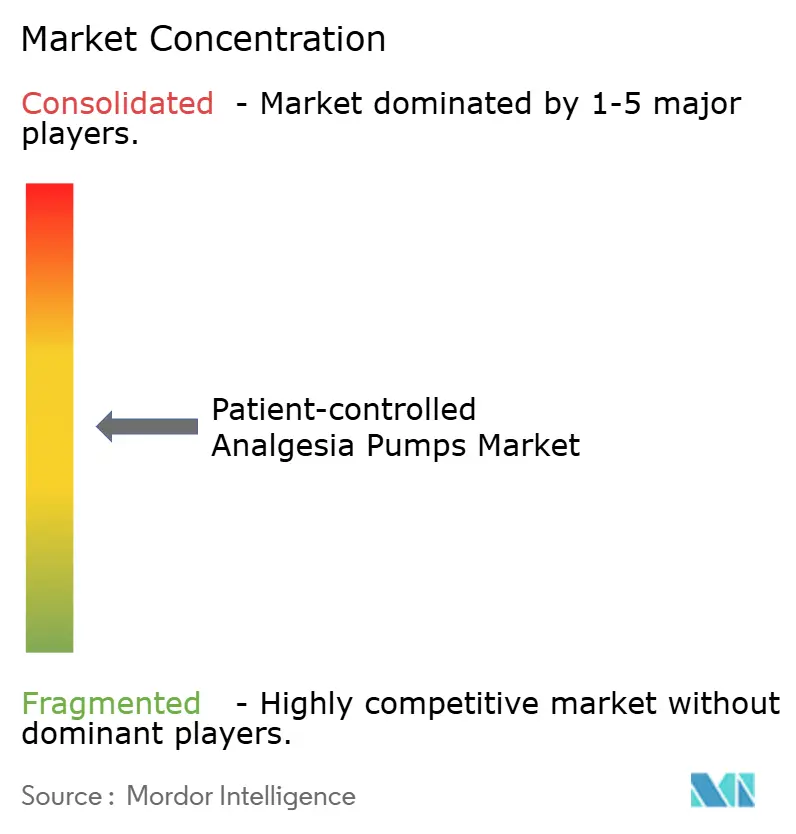
| Market Concentration | Medium |
Major Players *Disclaimer: Major Players sorted in no particular order Image © Mordor Intelligence. Reuse requires attribution under CC BY 4.0. | |
Patient-controlled Analgesia Pumps Market Analysis by Mordor Intelligence
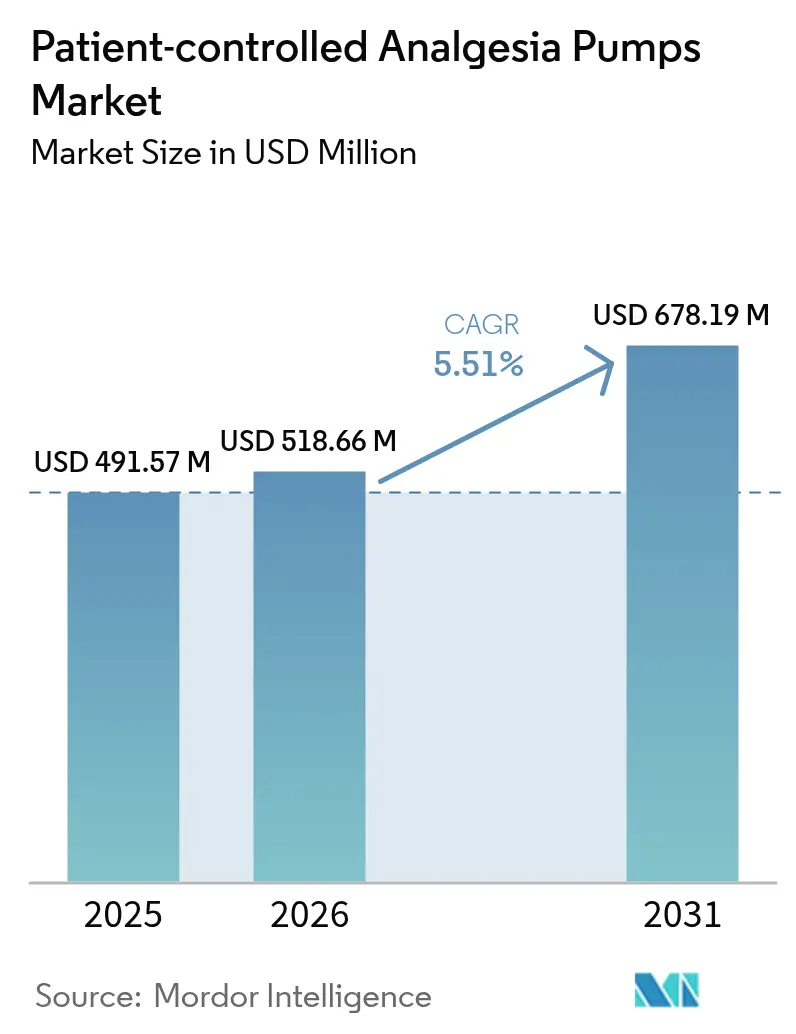
The patient controlled analgesic pumps market size is expected to grow from USD 491.57 million in 2025 to USD 518.66 million in 2026 and is forecast to reach USD 678.19 million by 2031 at 5.51% CAGR over 2026-2031. The upward trajectory reflects the transition from inpatient to outpatient and home-based care, the growing need for precision pain control, and a technology shift toward smart pumps that cut infusion-related drug errors by up to 80% Hospitals continue to anchor early adoption, yet reimbursement reforms under the NOPAIN Act are tilting demand toward the home-care channel. Regulatory recalls have simultaneously accelerated replacement cycles, driving demand for next-generation connected pumps with dose-error reduction software and cybersecurity upgrades. Product innovation remains intense as manufacturers press interoperability, advanced analytics, and wearable form factors to differentiate in a moderately fragmented arena. As a result, the patient controlled analgesic pumps market increasingly sits at the center of the broader infusion equipment ecosystem and is poised to benefit from the rising global chronic pain burden.
Key Report Takeaways
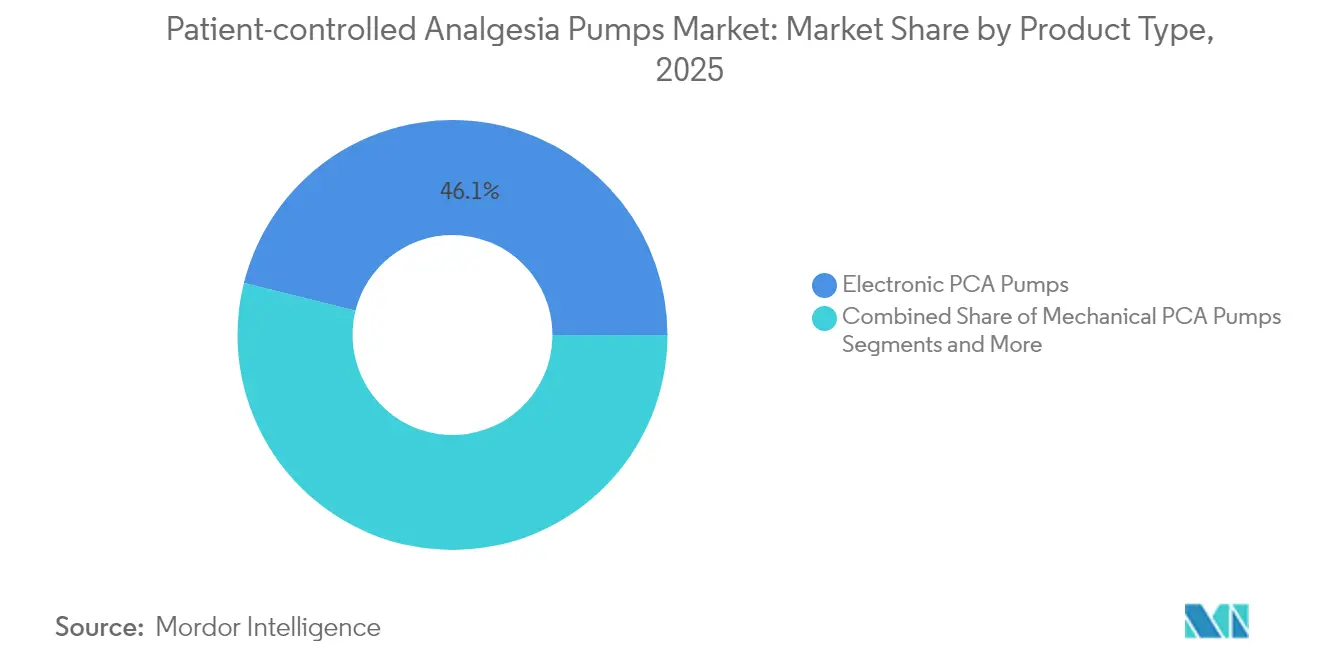
- By product type, electronic PCA pumps led with 46.12% of patient controlled analgesic pumps market share in 2025, while wearable and single-use pumps are forecast to expand at a 6.14% CAGR through 2031.
- By technology, intravenous delivery maintained 54.78% share of the patient controlled analgesic pumps market size in 2025; subcutaneous systems are growing the fastest at 6.65% CAGR.
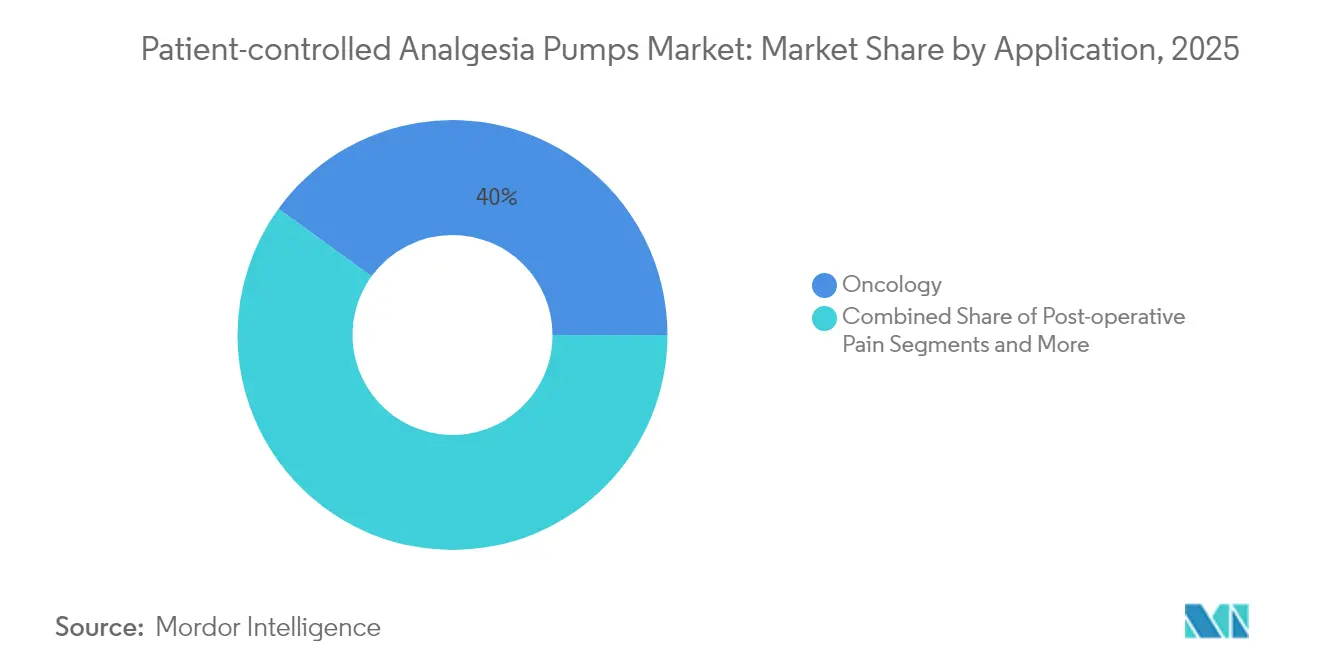
- By application, oncology captured 40.02% revenue share in 2025; diabetes-related pain management is projected to grow at a 6.86% CAGR to 2031.
- By end user, hospitals held 31.96% share in 2025, whereas home care settings are climbing at a 7.02% CAGR through 2031.
- By geography, North America accounted for 42.08% of the patient controlled analgesic pumps market in 2025; Asia-Pacific is the fastest-growing region at 7.29% CAGR.
Note: Market size and forecast figures in this report are generated using Mordor Intelligence’s proprietary estimation framework, updated with the latest available data and insights as of 2026.
Market Trends and Insights
Drivers Impact Analysis of Patient-controlled Analgesia Pumps Market*
| Driver | ( ~ )% Impact on CAGR Forecast | Geographic Relevance | Impact Timeline |
|---|---|---|---|
| Smart PCA pumps with advanced safety features | +1.2% | North America, EU, Global roll-out | Medium term (2-4 years) |
| Rising prevalence of chronic pain & cancer | +1.0% | Global; highest in aging economies | Long term (≥ 4 years) |
| Growing volume of surgical procedures | +0.8% | Asia-Pacific, Global | Medium term (2-4 years) |
| Growth of home & ambulatory pain management | +0.9% | North America, EU, Asia-Pacific | Medium term (2-4 years) |
| EHR-integrated dose-error reduction software | +0.6% | North America, EU | Short term (≤ 2 years) |
| Wearable single-use PCA devices | +0.7% | Developed markets first | Medium term (2-4 years) |
| Source: Mordor Intelligence | |||
Smart PCA Pumps With Advanced Safety Features
Smart pumps embed drug libraries and dose-error reduction systems that intercepted nearly 37,000 deviations in a single ICU study, underscoring their preventive value [1]. Baxter’s Novum IQ platform, cleared by the FDA in 2024, exemplifies the market shift toward bi-directional EHR interoperability that pre-populates pump settings and feeds actual delivery data back into clinical records [2]. Evidence indicates that smart interoperability can reduce medication administration errors by 15.4%–90.5%. Consequently, healthcare systems weigh quantifiable safety outcomes over interface features when selecting vendors, reinforcing demand in the patient controlled analgesic pumps market.
Rising Prevalence Of Chronic Pain & Cancer
Cancer incidence is climbing in an aging world, driving long-term reliance on PCA modalities that preserve quality of life. Intrathecal pumps show high efficacy in refractory oncology pain. Diabetic peripheral neuropathy affects up to 40% of diabetics, with subcutaneous hydromorphone PCA titrating pain four times faster than oral opioids. These epidemiological forces create durable volume growth for the patient controlled analgesic pumps market.
Growing Volume Of Surgical Procedures
Enhanced-recovery protocols now embed PCA as standard, cutting nursing workload and shortening postoperative stays. Electronic pumps outperform elastomeric devices under temperature swings, pushing hospitals to upgrade fleets. Rising surgical throughput in Asia-Pacific adds incremental unit demand, sustaining the patient controlled analgesic pumps market expansion.
Growth Of Home & Ambulatory Pain Management
Separate Medicare reimbursement of up to USD 2,284.98 per non-opioid pump under the NOPAIN Act removes a key economic hurdle for home infusion. Portable pumps such as ON-Q and ambIT allow earlier discharge without sacrificing analgesia. Adoption requires robust patient training and connected monitoring, giving a competitive edge to vendors offering complete home-care ecosystems within the patient controlled analgesic pumps market.
EHR-Integrated Dose-Error Reduction Software
Closed-loop medication management lowers transcription errors, with one multi-hospital study seeing a 16% error reduction after EHR-pump integration. Barcode medication administration drove pump start-up compliance from 15.3% to 45.8%. Facilities now rank seamless integration among top purchasing criteria, reinforcing demand for advanced systems in the patient controlled analgesic pumps market.
Restraints Impact Analysis of Patient-controlled Analgesia Pumps Market*
| Restraint | ( ~ )% Impact on CAGR Forecast | Geographic Relevance | Impact Timeline |
|---|---|---|---|
| Stringent regulation & frequent recalls | -0.8% | FDA, EU MDR regions | Short term (≤ 2 years) |
| Medication errors from poor patient education | -0.5% | Global; higher in home care | Medium term (2-4 years) |
| Cybersecurity risks in connected pumps | -0.4% | Developed markets | Short term (≤ 2 years) |
| Semiconductor & battery supply shortages | -0.6% | Global supply chains | Medium term (2-4 years) |
| Source: Mordor Intelligence | |||
Stringent Regulation & Frequent Recalls
Class I recalls covering 52,328 Nimbus pumps in 2024 illustrate the cost of non-compliance, with six injuries and one death reported [3]. Warning letters to ICU Medical and Fresenius Kabi underscore rigorous oversight across design, manufacturing, and post-market surveillance. These events raise compliance spending and elongate development cycles, tempering near-term growth in the patient controlled analgesic pumps market.
Medication Errors From Poor Patient Education
Among 82,698 surgical patients, PCA device errors occurred in 0.19%, with 63% causing adverse outcomes. Home infusion magnifies user-error risk, obliging vendors to invest in intuitive interfaces and robust training support. Persistent education gaps may slow home-care penetration in segments of the patient controlled analgesic pumps market.
Cybersecurity Risks In Connected Pumps
The U.S. Cybersecurity and Infrastructure Security Agency flagged vulnerabilities in BD Alaris software that could allow unauthorized access to dose settings. Hospitals now demand validated cybersecurity architectures, putting pressure on legacy platforms and adding unforeseen cost layers to the patient controlled analgesic pumps market.
*Our forecasts treat driver/restraint impacts as directional, not additive. The impact forecasts reflect baseline growth, mix effects, and variable interactions.
Patient-controlled Analgesia Pumps Market Segment Analysis
By Product Type:
Electronic Precision Sustains Leadership While Wearables Propel GrowthThe patient controlled analgesic pumps market size for electronic pumps stood at USD 226.67 million in 2025, equal to 46.12% share, reaffirming provider preference for programmable accuracy. Smart logic maintains flow consistency despite ambient changes, a benefit absent in elastomeric systems. Improving battery life, color touchscreens, and network connectivity strengthen electronic incumbency. At the same time, wearable single-use devices, though representing a smaller baseline, are expanding at 6.14% CAGR. They cater to ambulatory and home scenarios where light weight and disposability trump advanced programmability. Mechanical elastomeric pumps remain fixtures in cost-sensitive settings, while implantable models serve refractory chronic pain. Accessories and disposables supply recurring revenue that offsets capital-equipment cyclicality, improving vendor resilience within the patient controlled analgesic pumps market.
Competitive strategies now hinge on broad product families that let facilities standardize on a single vendor. B. Braun’s Perfusor PCA Syringe Pump couples KeyGuard narcotic security with weight-based dosing, illustrating incremental innovation. Meanwhile, startups emphasize wearable convenience, amplifying segment diversification. Collectively, these dynamics make product breadth and service wraparounds decisive factors for share capture across the patient controlled analgesic pumps market.

By Technology:
IV Supremacy Faces Subcutaneous MomentumIntravenous systems generated 54.78% of patient controlled analgesic pumps market share in 2025, driven by broad surgical and critical care use. Clinicians value rapid onset and dose titration, attributes well documented in postoperative pain literature. Yet subcutaneous devices are scaling fastest at 6.65% CAGR, aided by lower infection risk and suitability for home use. Successful hydromorphone titration within 5.5 hours underscores clinical appeal. Epidural and transdermal approaches occupy specialized niches, supported by microneedle advances that promise non-invasive delivery. Vendors winning in this space focus on formulation science and patient comfort, steadily shifting technology mix within the patient controlled analgesic pumps market.
By Application:
Oncology Holds the Lead as Diabetes SurgesOncology account for 40.02% of the patient controlled analgesic pumps market in 2025, reflecting the high analgesic demand in cancer care. Intrathecal drug delivery offers relief where systemic regimens fail, reinforcing device relevance. Diabetes-related pain is climbing at a 6.86% CAGR on rising neuropathy prevalence. Clinicians increasingly adopt PCA for flexible dosing, boosting overall device throughput in the patient controlled analgesic pumps market. Post-operative needs remain foundational, while pediatric pain and chronic non-cancer applications add incremental volume. Manufacturers supplying pathology-specific protocols and clinical evidence strengthen competitive positioning.
By End User:
Hospital Control Shifts Toward Home CareHospitals contributed 31.96% of patient controlled analgesic pumps market size in 2025, underpinned by complex cases, central pharmacies, and IT infrastructure. The home-care segment, however, is expanding fastest at 7.02% CAGR, buoyed by NOPAIN Act reimbursement and patient preference for self-care. Ambulatory surgical centers and pain clinics also escalate demand as outpatient procedures and chronic pain programs grow. Vendors integrating remote monitoring, cloud dashboards, and 24/7 support gain traction with non-hospital buyers across the patient controlled analgesic pumps market.
Geography Analysis
North America Patient-controlled Analgesia Pumps Market
North America led the patient controlled analgesic pumps market with 42.08% revenue share in 2025, propelled by advanced health systems, clear reimbursement, and early smart-pump adoption. The NOPAIN Act encourages shift to non-opioid devices and home settings, feeding domestic uptake through at least 2027. Canada mirrors U.S. trends at smaller scale, while Mexico’s ongoing hospital upgrades fuel mid-single-digit gains. These dynamics keep North America at the technological frontier of the patient controlled analgesic pumps market.
APAC Patient-controlled Analgesia Pumps Market
Asia-Pacific represents the fastest expansion at 7.29% CAGR to 2031. Rising surgical volumes, wider cancer screening, and escalating chronic disease rates underpin device demand. Terumo’s Rika platform, with 98 U.S. installations as of August 2024, showcases Japanese engineering now targeting 20-25% share through multiphase rollout. China’s public hospital modernization and India’s private sector growth together anchor regional momentum. Yet diverse regulatory regimes require localized strategies, making strong distributor networks critical for capturing growth in the patient controlled analgesic pumps market.
EMEA and South America Patient-controlled Analgesia Pumps Market
Europe maintains material presence thanks to robust quality standards and social insurance coverage. Germany, France, and the United Kingdom serve as innovation hubs, whereas Southern and Eastern Europe trail in adoption pace. National health systems weigh cost-effectiveness heavily, setting a high bar for value demonstration. South America and Middle East & Africa contribute limited volume but hold long-term promise as infrastructure matures, creating a multi-speed map for the patient controlled analgesic pumps market.

Regulatory Landscape
In the United States, patient-controlled analgesia (PCA) infusion pumps are regulated by the FDA as Class II devices under 21 CFR 880.5725 (product code MEA). Alternate controller enabled (ACE) infusion pumps fall under 21 CFR 880.5730, with additional performance and hazard-alarm documentation expectations for systems designed to interoperate with external controllers. These classifications shape premarket submission requirements and increase scrutiny around software, alarms, and use-error controls as PCA platforms add connectivity and dose-error reduction capabilities.
In Europe, PCA pumps marketed as active devices for administering medicinal products must align with Regulation (EU) 2017/745 (MDR). For certain Class IIb administration devices, conformity assessment follows higher-touch pathways under the Article 54 clinical evaluation consultation procedure. Device design and verification are also anchored by widely adopted safety standards such as IEC 60601-2-24 for essential performance of infusion pumps. Documentation and labeling practices are evolving as well, including Commission Implementing Regulation (EU) 2025/1234 (effective June 2025), which permits electronic instructions for use for professional-use medical devices. This is influencing how manufacturers manage updates, translations, and field communications.
Value Chain Analysis
The value chain begins with upstream suppliers of electronics (microcontrollers, sensors, memory), power components (batteries/chargers), plastics and elastomers, tubing and connectors, and contract manufacturers that assemble electromechanical sub-systems and housings. OEMs then integrate pump hardware with embedded software, drug libraries, alarms, and increasingly connectivity layers that support interoperability and cybersecurity hardening, followed by verification and validation to meet regulator expectations. Quality systems, post-market surveillance, and field actions, including recalls, are part of day-to-day operations, with compliance burdens rising as pumps shift toward networked deployments.
Downstream, distribution flows through group purchasing organizations, hospital and IDN procurement, and specialized channels serving ambulatory surgical centers, pain clinics, and home-care providers. In these settings, training and service logistics carry outsized weight. Service networks, software updates, accessories, and disposables provide recurring revenue and improve customer lock-in, while supply risks persist for semiconductors, batteries, and niche components such as displays. FDA attention to broader medical device supply chain vulnerabilities, including calls in early 2025 to strengthen shortage-reporting mechanisms under Section 506J of the CARES Act, also reinforces the need for resiliency planning across critical infusion-device categories.
Competitive Landscape
The patient controlled analgesic pumps market is moderately fragmented. Baxter International, ICU Medical, and BD anchor the top tier, leveraging scale, service, and regulatory muscle. Mid-sized specialists such as Micrel Medical and Epic Medical compete through niche innovations, while technology entrants push connectivity and analytics. FDA recalls in 2024 sent a compliance shockwave that elevated quality management as a decisive differentiator. Smart pump platforms demonstrating up to 90.5% error reduction and EMR interoperability yield measurable cost avoidance for providers, shifting competition toward outcomes rather than price.
Strategic moves illustrate differing playbooks. Baxter secured FDA clearance for Novum IQ syringe pumps with bi-directional EMR links in 2024. Terumo scales global footprint by exporting its Rika syringe system on the back of established cardiology relationships. B. Braun refreshes its Perfusor line with KeyGuard access controls to address opioid diversion concerns. Partnerships with EHR vendors, cybersecurity certification, and remote support platforms now headline investment priorities as vendors fight for sticky, long-term contracts across the patient controlled analgesic pumps market.
Moderate consolidation is likely as regulatory pressure inflates compliance costs and smaller players struggle to keep pace. Yet open interfaces and cloud-based analytics lower entry barriers for software-centric innovators, sustaining competitive churn and continuous differentiation in the patient controlled analgesic pumps market.
Patient-controlled Analgesia Pumps Industry Leaders
-
B. Braun SE
-
BD (Becton Dickinson, and Company)
-
Baxter
-
Fresenius SE & Co. KGaA
-
ICU Medical, Inc (Smiths Medical)
- *Disclaimer: Major Players sorted in no particular order
Patient-controlled Analgesia Pumps Market Companies Covered in this Report
- Baxter
- Beckton Dickinson
- ICU Medical
- Fresenius
- B. Braun
- Terumo
- Abbott Laboratories
- Micrel Medical Devices
- Medtronic
- Mindray
- Ace Medical Co., Ltd.
- JMS Co., Ltd.
- Nipro
- Avante Health Solutions
- Flextronics Medical (Viant)
- Epic Medical
- TandemLife (LivaNova)
- Insightra Medical
- Promedica Bioelectronics
- Woo Young Medical
Read Analysis of Patient-controlled Analgesia Pumps Companies
Market Opportunities and Future Outlook
Policy-driven reimbursement is creating clearer whitespace for PCA and related pain-infusion platforms that meet qualifying criteria for non-opioid pain management pathways in outpatient settings. CMS implemented NOPAIN Act provisions in the 2026 OPPS and ASC Payment System Final Rule, including separate Medicare payment for qualifying non-opioid pain management devices through December 31, 2027, and confirming specific pump platforms, including ICU Medical CADD-Solis and Eitan Medical Sapphire, as qualifying products. Avanos also reported CMS confirmation that ON-Q elastomeric and ambit electronic infusion pumps remain eligible for separate Medicare payment in 2026, reinforcing vendor incentives to align product configurations, labeling, and clinical pathways to reimbursement eligibility.
Technology differentiation continues to move toward connected, workflow-integrated systems that reduce documentation friction and strengthen safety controls. Recent product and program activity supports this direction, including Eitan Medicals April 2026 U.S. launch of the Avoset Pain Management System for regional anesthesia workflows. The platform combines programmable intermittent bolus, PCA, and continuous basal rate in a single device. On the provider side, clinical validation for wireless analgesia management is expanding, including the prospective randomized trial initiated at Shenzhen Second Peoples Hospital. The study evaluates a doctor-nurse-patient integrated PCA management model built on a wireless analgesia management system, emphasizing remote monitoring, standardized protocols, and data-driven pain assessment across hospital and step-down care.
Recent Industry Developments in Patient-controlled Analgesia Pumps Market
- May 2026: BD partnered with Wellstar Health System to integrate Pyxis Pro medication dispensing technologies with Alaris infusion systems, which include PCA therapy modules. The integration strengthens end-to-end medication management connectivity across dispensing, infusion, and documentation workflows. It also supports IDN-scale standardization of safer infusion practices.
- April 2026: Eitan Medical introduced the Avoset Pain Management System to the United States regional anesthesia market, combining programmable intermittent bolus, patient-controlled analgesia, and continuous basal rate in one device. This expands competitive options for post-surgical pain programs looking for portable, programmable platforms aligned with ambulatory and step-down care pathways.
- February 2026: The FDA posted a Class 2 recall for the BD Alaris Pump Module model 8100 due to a software issue involving daylight savings time adjustments. The action reinforces ongoing regulatory scrutiny on infusion pump software reliability. It can also accelerate replacement evaluations and software-update requirements in installed PCA-capable fleets.
Patient-controlled Analgesia Pumps Market Report Scope and Research Methodology
Market Definition and Coverage
This market covers patient-controlled analgesia (PCA) pumps and related accessories used to deliver prescribed pain medication through controlled dosing, where the patient can request an approved bolus under clinician-set limits.
Scope exclusions: We exclude drugs, disposable syringes and tubing sold as general infusion consumables, and services such as installation, training, and maintenance.
Segments Covered in This Report
- By Product Type
- Electronic PCA Pumps
- Mechanical PCA Pumps
- Wearable / Single-use PCA Pumps
- Implantable / Intrathecal PCA Systems
- Pump Accessories & Disposables
- By Technology
- Intravenous PCA
- Epidural PCA
- Subcutaneous PCA
- Transdermal / Alternative Routes
- By Application
- Oncology
- Post-operative Pain
- Chronic Non-cancer Pain
- Diabetes-related Pain
- Pediatrics & Neonatology
- Palliative & End-of-life Care
- By End User
- Hospitals
- Ambulatory Surgical Centers
- Home-care Settings
- Pain Clinics & Specialty Centers
- By Geography
- North America
- United States
- Canada
- Mexico
- Europe
- Germany
- United Kingdom
- France
- Italy
- Spain
- Rest of Europe
- Asia-Pacific
- China
- Japan
- India
- Australia
- South Korea
- Rest of Asia-Pacific
- Middle East & Africa
- GCC
- South Africa
- Rest of Middle East & Africa
- South America
- Brazil
- Argentina
- Rest of South America
- North America
Data Sources, Market Sizing, and Validation
Desk Research
Desk work was used to build the first version of the market map and to anchor the model with externally visible signals. We relied on public sources such as the US FDA device databases, US Centers for Medicare and Medicaid Services coverage and payment updates, CDC care setting statistics where relevant, and OECD health expenditure tables to understand procedure settings and adoption context.
To translate that context into sizing inputs, we also used company annual reports and investor decks, hospital procurement notices and tenders where available, and reputable medical journals discussing post-operative pain control and infusion safety (including dose error reduction features). For cross-checking import exposure in selected countries, an import and export shipment-level database was referenced to sense-check trade flows tied to infusion equipment categories. This desk list is not exhaustive, and many other public sources were also used for data collection, validation, and clarification.
Primary Interviews and Surveys
Primary work focused on validating how PCA pumps are purchased, used, and replaced across hospitals, ambulatory surgical centers, and home-care pathways, and then confirming what typically drives pricing and mix changes. We spoke with a spread of device-side roles, clinical users, and procurement stakeholders across major geographies so gaps from desk inputs, such as utilization patterns and accessory attachment rates, could be filled and checked.
Distribution of primary research fieldwork respondents
| Company type | Respondent position | Region |
|---|---|---|
| Top tier: 38% | CXOs: 12% | APAC: 38% |
| Mid tier: 42% | Functional/Unit leaders: 36% | EMEA: 35% |
| Smaller Players: 20% | Managers: 52% | Americas: 27% |
Market-Sizing & Forecasting
Sizing starts with a top-down build where procedure and care-setting indicators are translated into a PCA-addressable demand pool, and then adjusted by typical use protocols and device availability by region. The model is shaped using practical inputs such as post-surgical case volumes in high-use specialties, the share of cases managed with PCA versus alternative pain control methods, average pump utilization days per unit per year, replacement cycles tied to fleet age, and the attachment rate of PCA-specific accessories.
Those totals are then corroborated using selective bottom-up approximations, such as roll-ups from a sample of supplier revenues, channel conversations on unit volumes, and an ASP-by-route check (IV versus epidural and other routes) to keep pricing realistic. When company disclosures are not cleanly split for PCA, gaps are handled by using product-mix cues from catalogs and interviews, followed by conservative allocation and a sensitivity check.
For forecasting, we used scenario analysis supported by variable-level views from experts, because adoption is shaped by policy shifts, outpatient growth, and safety-driven upgrades rather than a single smooth trend. The forward view tests changes in ambulatory surgery share, smart pump feature penetration, and price movement from inflation and mix, and then the most defensible case is selected after cross-checks.
Data Validation & Update Cycle
Outputs are validated through triangulation across independent signals, so the final totals do not rely on any single dataset. We run variance checks by region and setting, compare implied unit volumes against reasonable installed-base turnover, and then review any outliers back to the assumption level before sign-off.
The review process is done in steps, with a second analyst checking the logic, inputs, and arithmetic, followed by a final read-through focused on consistency across sections. Reports are refreshed annually, and interim updates are triggered when material events occur, such as major regulatory changes, product recalls, or sharp pricing moves. Before delivery, a fresh validation pass is completed so clients receive the latest updated view.
Mordor Intelligence's Patient Controlled Analgesia Pumps Market Size Versus Other Published Estimates
Published market numbers for PCA pumps can look far apart, even when the topic sounds identical, because each publisher draws the line differently on what counts and which year they anchor to. Differences also come from how pricing is converted to USD, how accessories are treated, and whether hospital-only demand is mixed with home-care growth signals.
The biggest gap drivers here tend to be the inclusion of pump accessories, the choice of base year (some use 2025 while others start at 2026), and the way adoption is linked to procedures and care settings instead of only shipment-based assumptions. When ASPs are projected using a straight CAGR without checking route mix (IV versus epidural and other routes) or smart pump upgrades, the value can drift upward quickly, and the spread becomes more visible.
Benchmark comparison
| Source | Market Size | Gaps in Research Methodology |
|---|---|---|
| Mordor Intelligence | USD 518.66 M (2026) | |
| Healthcare Publisher A | USD 484.40 M (2025) | Uses a 2025 base year and a longer forecast window, and the sizing description is less explicit on accessory revenue inclusion and route-level mix checks, which can shift the starting value. |
| Industry Analyst Group B | USD 490.91 M (2025) | Anchors to 2025 and applies broader application buckets, and it is not always clear whether accessory attachment rates are modeled consistently by end user, which can compress early-year market value. |
The table shows that base-year choice and what gets counted around accessories explain most of the spread, rather than a disagreement that demand exists. By tying demand to care-setting procedure volumes and then applying accessory attachment and route mix checks, the value lands at a different starting point in 2026, a modeling choice applied by Mordor Intelligence near the end of the build.
Key Questions Answered in the Report
What is the current Patient-controlled Analgesia Pumps Market size?
The patient controlled analgesic pumps market stands at USD 518.66 million in 2026 and is on track to reach USD 678.19 million by 2031.
Who are the key players in Patient-controlled Analgesia Pumps Market?
B. Braun SE, BD (Becton Dickinson, and Company), Baxter, Fresenius SE & Co. KGaA and ICU Medical, Inc (Smiths Medical) are the major companies operating in the Patient-controlled Analgesia Pumps Market.
Which is the fastest growing region in Patient-controlled Analgesia Pumps Market?
Asia-Pacific is projected to post the highest CAGR at 7.29% thanks to rapid surgical volume growth and expanding healthcare infrastructure.
How are regulatory recalls influencing the market?
Frequent FDA recalls raise compliance costs, shorten replacement cycles, and favor vendors with robust quality systems.