
Paint Protection Films Market Size and Share
Market Overview
| Study Period | 2020 - 2031 |
|---|---|
| Market Size (2026) | USD 525.17 Million |
| Market Size (2031) | USD 683.63 Million |
| Growth Rate (2026 - 2031) | 5.41 % |
| Fastest Growing Market | Asia Pacific |
| Largest Market | Asia Pacific |
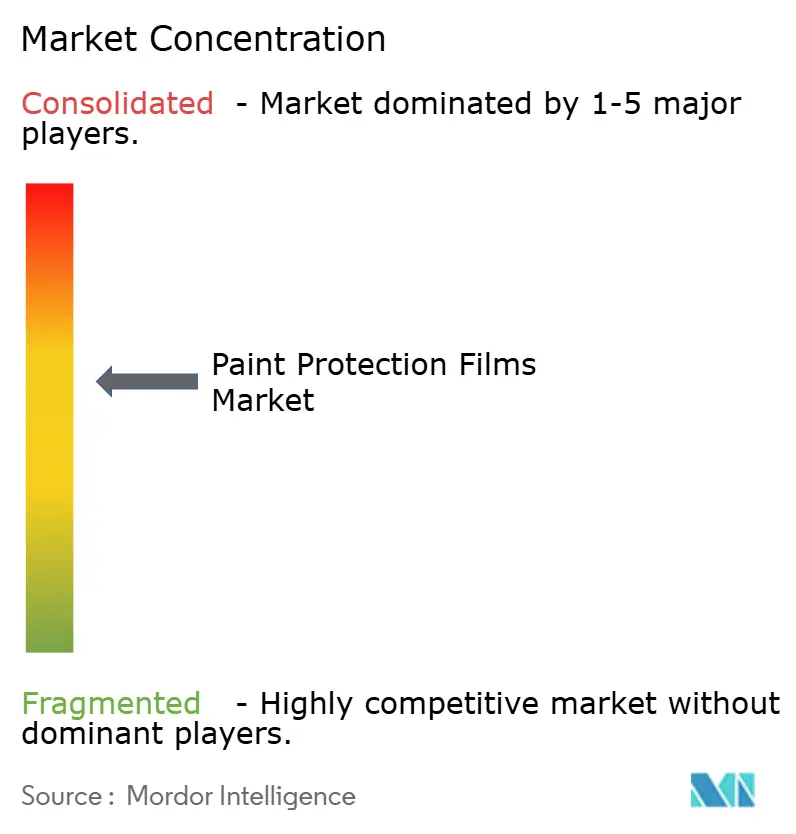
| Market Concentration | Medium |
Major Players *Disclaimer: Major Players sorted in no particular order Image © Mordor Intelligence. Reuse requires attribution under CC BY 4.0. | |
Paint Protection Films Market Analysis by Mordor Intelligence
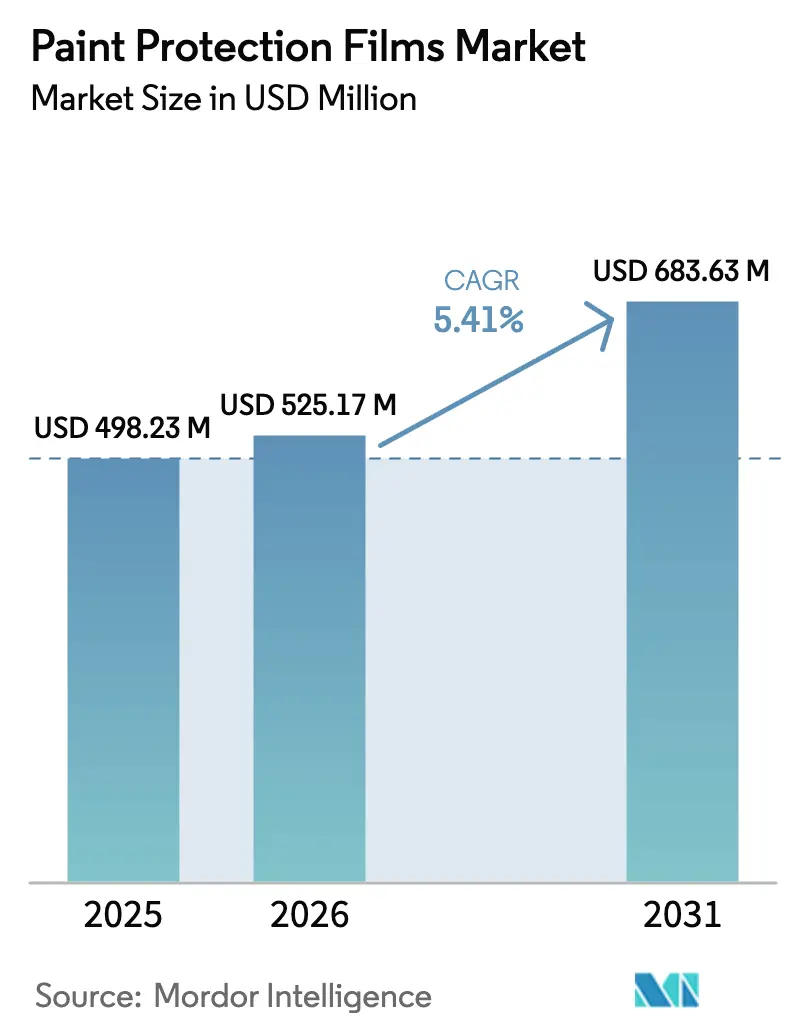
Paint Protection Films market size in 2026 is estimated at USD 525.17 million, growing from 2025 value of USD 498.23 million with 2031 projections showing USD 683.63 million, growing at 5.41% CAGR over 2026-2031. This rate outpaces pre-pandemic aftermarket growth because electric vehicle output is accelerating, vehicle owners are holding onto their cars longer, and protective wraps are increasingly transitioning from a luxury accessory to a cost-saving necessity. Nearly every major automotive brand now offers factory-installed panels that reduce repainting expenses over a 7- to 10-year ownership span. Thermoplastic polyurethane dominates because it self-heals scratches at room temperature, while polyvinyl chloride remains a value choice in price-sensitive regions. OEM programs, such as Tesla’s, drive volume into production lines, squeezing independent installers while raising overall demand. The Asia-Pacific region leads as both a TPU importer and a final-assembly hub, while growth in North America and Europe depends on wider OEM adoption and continued consumer enthusiasm for resale value.
Key Report Takeaways
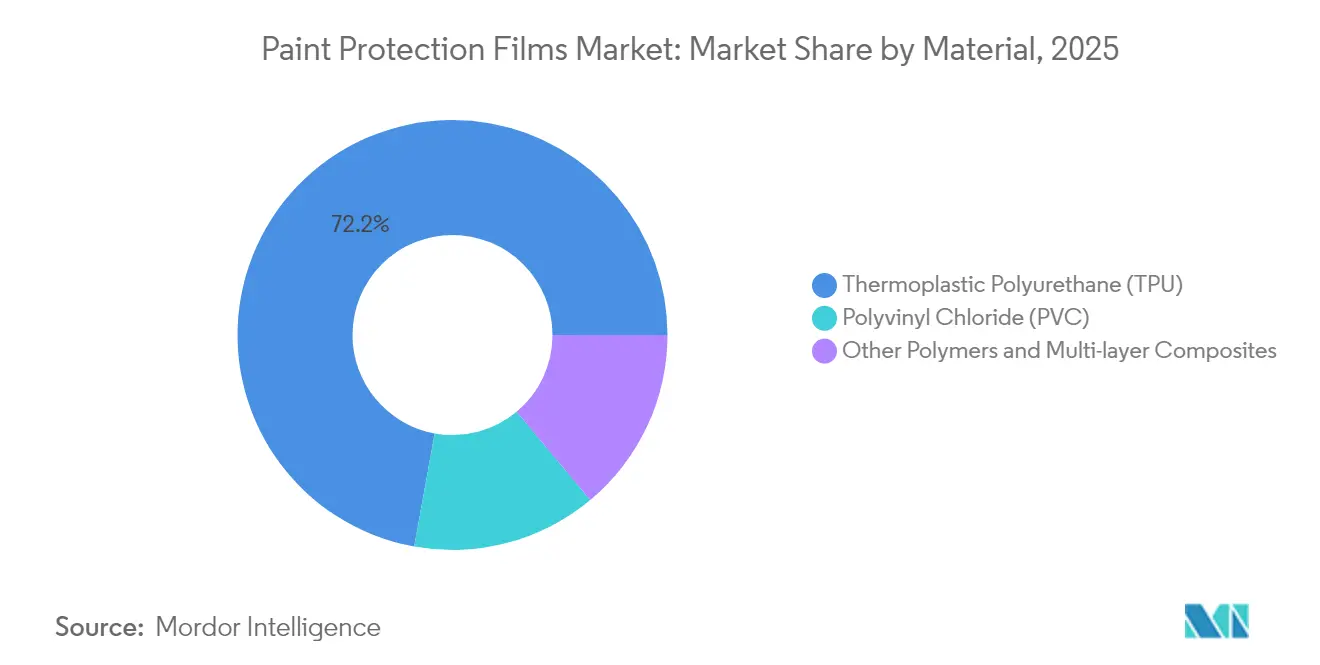
- By material, thermoplastic polyurethane captured 72.15% of the paint protection films market share in 2025 and is projected to grow at a 5.95% CAGR through 2031.
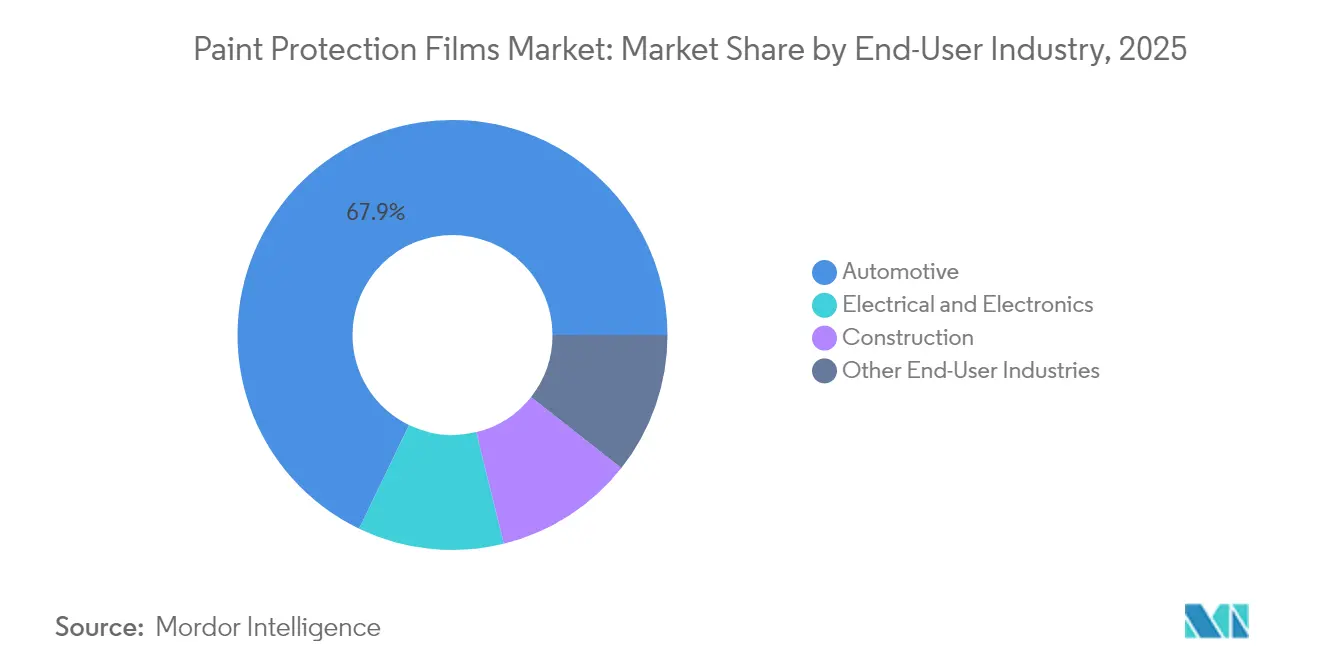
- By end-user industry, the automotive sector contributed 67.85% of the paint protection films market size in 2025, whereas the electrical and electronics sector is expanding at a 5.82% CAGR through 2031.
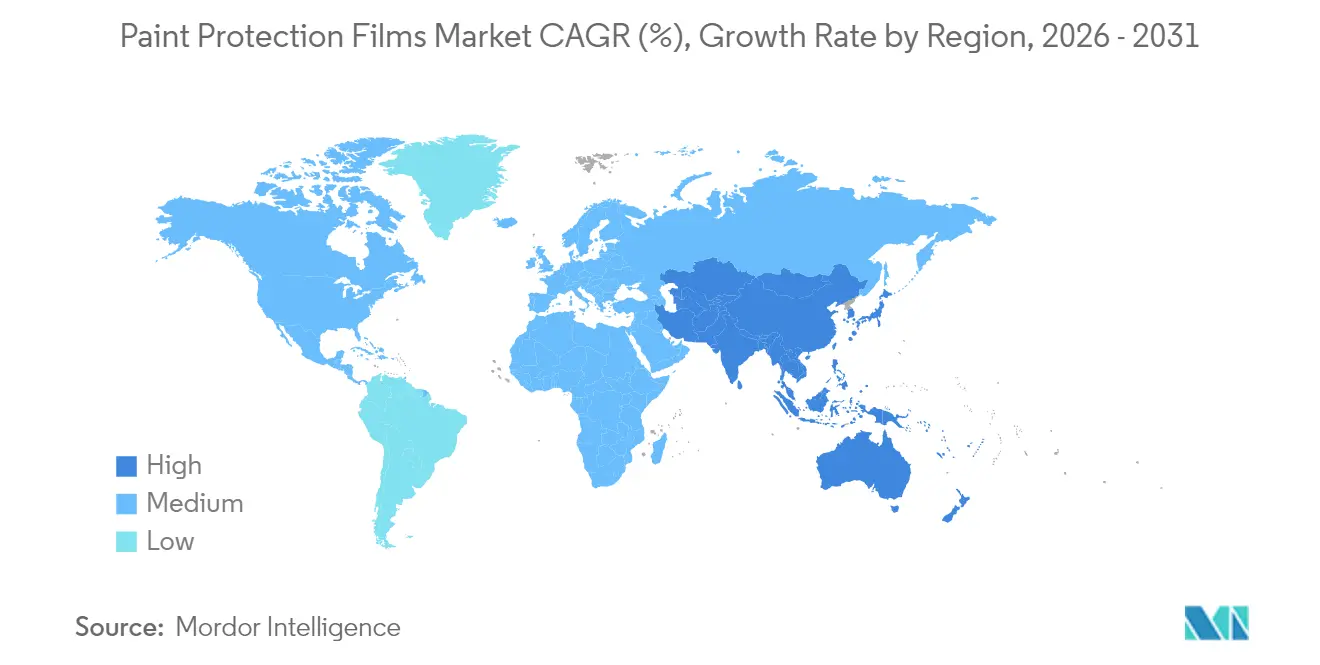
- By geography, the Asia-Pacific region held 46.10% of the revenue in 2025 and is projected to advance at a 5.56% CAGR through 2031.
Note: Market size and forecast figures in this report are generated using Mordor Intelligence’s proprietary estimation framework, updated with the latest available data and insights as of 2026.
Market Trends and Insights
Drivers Impact Analysis of Paint Protection Films Market*
| Drivers | (~) % Impact on CAGR Forecast | Geographic Relevance | Impact Timeline |
|---|---|---|---|
| Luxury and electric vehicle production boom fuels OEM/aftermarket demand | +1.5% | Global, with concentration in North America, China, and Europe | Medium term (2-4 years) |
| Advancements in self-healing TPU chemistry | +1.0% | Global, led by Asia-Pacific manufacturing and North American research and development | Long term (≥ 4 years) |
| Growing consumer focus on vehicle aesthetics and resale value | +0.9% | Global, strongest in developed markets with high vehicle ownership | Medium term (2-4 years) |
| Factory-installed PPF options led by EV brands | +0.8% | North America and Asia-Pacific, early adoption in Europe | Short term (≤ 2 years) |
| AI-guided cutting/AR tools slashing installer time and cost | +0.6% | North America and Europe, gradual spread to Asia-Pacific | Medium term (2-4 years) |
| Source: Mordor Intelligence | |||
Luxury and Electric Vehicle Production Boom Fuels OEM/Aftermarket Demand
Record luxury and electric-vehicle launches channel high-value paint finishes onto platforms where buyers expect premium add-ons. Programs with Tesla and Rivian integrate wraps before delivery, cutting manual labor and widening accessibility to consumers who rarely visit aftermarket shops. A growing fleet of high-mileage electric taxis also favors films that prevent stone-chip repaint costs. As the average age of U.S. vehicles rose, owners saw clearer payback on long-life wraps. Luxury brands in China added certified TPU panels, helping the paint protection films market expand beyond niche enthusiasts. Overall, high-priced vehicle segments now act as the gateway for mainstream adoption.
Advancements in Self-Healing TPU Chemistry
Room-temperature self-repair polymers now heal micro-scratches within seconds rather than minutes, reducing user maintenance. Academic breakthroughs utilizing disulfide and imine bonds validated the rapid reformation of bonds, while commercial launches, such as Avery Dennison Supreme PPF Xtreme, translated lab results into ten-year warranties[1]. Polycaprolactone-rich polyols underpin the chemistry, delivering elasticity across a temperature range of –40 °C to 90 °C and resisting yellowing. These innovations enhance pricing power and extend replacement intervals, driving premium tiers in the paint protection films market.
Growing Consumer Focus on Vehicle Aesthetics and Resale Value
A UK study found that verified paint protection lifted used-car trade-in offers[2]. This resale upside resonates as buyers keep vehicles longer and prioritize appearance during private sales. Younger drivers associate wraps with personalization, helping to sustain aftermarket channel strength even as OEM programs grow. Ride-hailing fleets apply partial wraps to doors, rocker panels, and bumpers, extending service life and compressing downtime. Awareness campaigns now emphasize durability rather than gloss alone, helping consumers distinguish between films and ceramic coatings.
Factory-Installed PPF Options Led by EV Brands
Electric-vehicle makers prefer matte, satin, or multicoat metallic paints, which can cost thousands of dollars to repair. Therefore, wrapping during final assembly helps lower warranty repaint expenses. Tesla installs XPEL Ultimate Plus under controlled robotics, reducing cycle time to under two hours and integrating coverage into the basic vehicle warranty. FAW-Volkswagen certified BASF’s RODIM TPU, signaling that Asian and European factories are adopting similar lines. OEM integration secures high-volume contracts for large converters and obliges smaller installers to shift their focus toward customization and rapid service.
Restraints Impact Analysis of Paint Protection Films Market*
| Restraints | (~) % Impact on CAGR Forecast | Geographic Relevance | Impact Timeline |
|---|---|---|---|
| Substitute products (ceramic coatings, waxing) | -0.7% | Global, strongest in price-sensitive markets | Medium term (2-4 years) |
| High professional installation cost | -0.6% | Global, most acute in emerging markets | Long term (≥ 4 years) |
| TPU price volatility from 2025 tariff hikes | -0.5% | Asia-Pacific and North America supply chains | Short term (≤ 2 years) |
| Source: Mordor Intelligence | |||
Substitute Products (Ceramic Coatings, Waxing)
Ceramic coatings cost less than full-vehicle wrapping, tempting budget-minded buyers and diluting entry-level demand. Yet coatings lack impact absorption and self-healing, so fleets and high-mileage users still prefer films. Periodic recoating every two to five years erodes the price gap over time. In South America and parts of Southeast Asia, do-it-yourself wax remains culturally popular, prolonging the use of substitutes and limiting penetration for the paint protection films market.
High Professional Installation Cost
Partial panels trim outlay but expose unprotected seams. Quality varies significantly, and inferior workmanship can cause edge lifting, tarnishing the brand's perception. AI plotters and augmented-reality guides now cut templates and align panels within millimeter tolerances, thereby lowering errors; however, adoption lags where wages are low. Without scaling skilled labor, many emerging markets will likely trail behind developed regions, despite the latent demand for the paint protection films market.
*Our forecasts treat driver/restraint impacts as directional, not additive. The impact forecasts reflect baseline growth, mix effects, and variable interactions.
Paint Protection Films Market Segment Analysis
By Material:
TPU Extends Lead Through Self-Healing PerformanceThermoplastic polyurethane captured 72.15% of the paint protection film market share in 2025 and is forecasted to rise at a 5.95% CAGR through 2031. Premium polycaprolactone TPU grades offer sustained impact resistance across temperature extremes and rapidly reform micro-scratches, differentiating them from polyvinyl chloride. Some installers still offer PVC at a lower cost, but its tendency to yellow and crack limits uptake in harsh climates. Investments by Covestro in Taiwan and Germany increase global TPU capacity, yet recent Indian anti-dumping duties on Chinese resin raise regional costs. Composite innovations, such as PVDF-PMMA laminates, extend durability to facades and aircraft interiors, thereby broadening the addressable market size for paint protection films.
Covestro’s German line, set for 2025, is expected to augment Desmopan UP output to meet automotive and electronics demand, indicating a long-term bullish outlook. At the same time, U.S. automotive tariffs risk increasing landed costs if waivers are not extended. Resin volatility encourages converters to dual-source materials and explore hybrid films that strike a balance between cost and self-healing functionality.

By End-User Industry:
Automotive Dominates While Electronics AcceleratesAutomotive applications accounted for 67.85% of the paint protection films market size in 2025, as body panels and high-impact zones continue to be core revenue streams. OEM installations shift revenue upstream, but dealerships and aftermarket shops still thrive on customization, color-change wraps, and partial kits. The segment moves toward robot-assisted booths that wrap multiple panels per shift, standardizing quality at scale. Electrical and electronics devices are projected to post a 5.82% CAGR outlook through 2031, driven by infotainment screens, instrument clusters, and consumer tablets that require anti-fingerprint clarity. As cabin displays grow to sport 20-inch or wider diagonals, protective TPU layers safeguard optical surfaces against scratches and static. Construction, aerospace, and marine comprise small yet rising niches, adopting multi-layer composites with fire retardance or ultraviolet stability.
Geography Analysis
APAC Paint Protection Films Market
Asia-Pacific generated 46.10% of 2025 revenue and will expand at a 5.56% CAGR through 2031. China is both the largest TPU importer and a leading PPF exporter, hosting high-capacity converters that supply regional automakers and smartphone assemblers. India’s anti-dumping duties on Chinese TPU raise domestic feedstock costs yet encourage local resin investment. Japan’s mature aftermarket enjoys high awareness, but a shrinking vehicle parc restrains absolute growth. South Korean electronics majors create stable demand for display wraps, while Thailand and Vietnam attract new PPF coating lines amid supply chain diversification.
North America Paint Protection Films Market
North America contributes a significant portion of the global value. Tesla and Rivian’s factory-installed options lift orders for ISO 9001-certified converters, while independent installers pivot to special-finish wraps and rapid-fit services. U.S. tariffs enacted in 2025 may inflate imported TPU prices, but domestic resin capacity moderates the risk. Canada mirrors U.S. tastes, with a premium vehicle share and harsh winter road debris reinforcing the adoption of wrap. Mexico is emerging as a lower-cost production node, although installer networks are concentrated around Monterrey and Mexico City.
Europe Paint Protection Films Market
In Europe, Germany, the United Kingdom, and France are the major contributors. REACH restrictions on legacy UV absorbers prompt formulators to shift toward next-generation stabilizers, increasing compliance costs while enhancing environmental credentials. Euro 7 regulations could extend average vehicle life, indirectly supporting demand as owners aim to protect higher-priced models. OEM wrap adoption remains nascent but is advancing as premium German brands test in-plant lines.
MEA and South America Paint Protection Films Market
Brazil’s recovering economy is spurring luxury-vehicle protection among wealthy buyers, although high import tariffs and a fledgling installer density limit its wider reach. The Gulf Cooperation Council states embrace films for heat and sand abrasion control, and wealthy owners routinely wrap vehicles shortly after purchase. South Africa experiences sporadic demand, primarily in urban centers, which is hindered by currency volatility.
Value Chain Analysis
The paint protection films (PPF) value chain begins with petrochemical and polymer inputs, notably TPU and PVC, along with additives such as UV stabilizers and slip agents. Film manufacturing then combines TPU extrusion or casting with coating and lamination steps, including self-healing topcoats, clear coats, and pressure-sensitive adhesive layers.
Converters and brand owners slit and kit films to match vehicle patterns, using software-driven template libraries and plotter ecosystems to reduce waste and labor time. Quality assurance is tied to end-market requirements for optical clarity and accelerated weathering, as well as regional standards that OEMs and large installers use as procurement references. Downstream, the market splits between (i) OEM or dealership attachment programs, where films are applied in-plant or near-plant under controlled processes, and (ii) the aftermarket, which depends on certified installer networks, training, and warranty administration. XPEL's May 2026 announcement of an approximately USD 110 million manufacturing and supply chain investment, including expansion of its San Antonio operations and acquisition of a manufacturing facility in China, highlights this push for deeper integration to improve service levels and tighten control over lead times, while increasing expectations for smaller converters that rely on third-party film supply and more fragmented regional distribution.
Competitive Landscape
The paint protection films market is moderately consolidated. Scaling strategies define competition. Regional challengers leverage lower manufacturing costs to secure a domestic market share, but often lack a global dealer footprint. OEM contracts exert rising influence. Winning bids require consistent optical clarity, color stability, and robotic lay-down compatibility. Patent filings cluster around room-temperature self-healing and multi-layer architectures that integrate PVDF topcoats or flame-retardant cores. As material science advances, converters with in-house research and development gain an edge in negotiating premium supply agreements. Technology divides installers. North American and European shops invest in AI plotters and AR glasses to reduce labor hours, whereas price-focused markets rely on low-wage manual labor. This disparity reinforces a two-tier structure where premium channels deliver consistent outcomes and budget players compete on cost. Over time, software subscriptions may become table stakes, cementing lead positions for globally branded suppliers.
Paint Protection Films Industry Leaders
-
3M
-
Eastman Chemical Company
-
XPEL, Inc.
-
AVERY DENNISON CORPORATION
-
Saint-Gobain
- *Disclaimer: Major Players sorted in no particular order
Paint Protection Films Market Companies Covered in this Report
- 3M
- ARGOTEC
- AVERY DENNISON CORPORATION
- BASF
- Eastman Chemical Company
- FlexiShield
- GARWARE PPF
- Hexis S.A.S.
- KDX Film
- Madico
- NIPSEA Group
- ORAFOL Europe GmbH
- Reflek Technologies Corporation
- RENOLIT SE
- Saint-Gobain
- Sangbo Corp. (IVIOS)
- Sharpline Converting Inc
- STEK Automotive Inc.
- XPEL, Inc.
- Ziebart International Corporation
Market Opportunities and Future Outlook
Opportunities remain in broadening PPF beyond partial front-end kits toward wider surface coverage and more standardized OEM and dealer add-on bundles. Dealer-facing evidence supports this direction, with a dealership survey citing that PPF can add up to 15% to a vehicle's resale value, and a large share of surveyed dealers recommending full-body application, which strengthens the case for higher-coverage installation packages. Suppliers and installer networks can use this demand signal to build repeatable, high-throughput workflows, focusing on template accuracy, faster laydown, and consistent edge finishing to make full-vehicle installs more accessible outside luxury-only buyers.
On the product side, demand centers on higher-performance aliphatic TPU films, commonly 8-10 mil for high-impact zones, alongside feature stacking such as hydrophobic topcoats and faster self-healing behavior, while still meeting the optical and durability requirements used by OEMs and professional installers. Procurement references such as transparency targets and accelerated UV aging protocols, for example SAE J2527, raise the compliance burden for new entrants, but they also differentiate suppliers that can document long-life performance and warranty outcomes. Investment activity aimed at manufacturing capacity and shorter supply chains, including XPEL's 2026 manufacturing expansion and China facility acquisition, points to continued emphasis on availability and consistency for growth in OEM and dealer channels across Asia-Pacific and North America.
Recent Industry Developments in Paint Protection Films Market
- May 2026: XPEL announces approximately $110 million manufacturing and supply chain investment, including expansion of San Antonio operations and acquisition of a manufacturing facility in China. The investment strengthens global manufacturing footprint and supply chain for protective film products. The expansion supports capacity growth and potential margin expansion in line with 2026 demand.
- May 2026: XPEL reports First Quarter 2026 revenue of $117.4 million, up 13.1% YoY. The revenue growth signals rising demand for paint protection films. The result supports valuation and investment case and complements expansion plans.
- April 2026: 3M expanded its certified Pro Shop installer network in Canada with new locations in Calgary, Edmonton, and Vancouver. The expansion broadens installer reach and service access. The move strengthens premium channel positioning and increases Canada PPF penetration.
Paint Protection Films Market Report Scope and Research Methodology
Market Definition and Coverage
This market covers paint protection films (clear or tinted protective layers) sold for safeguarding painted exterior surfaces from chips, scratches, and weathering, across OEM fitment and aftermarket installations. The sizing is captured in value terms, in USD, across major regions.
Scope exclusions: decorative wraps and color-change vinyl films that are primarily purchased for styling, rather than paint protection, are excluded.
Segments Covered in This Report
- By Material
- Thermoplastic Polyurethane (TPU)
- Polyvinyl Chloride (PVC)
- Other Polymers and Multi-layer Composites
- By End-User Industry
- Automotive
- Electrical and Electronics
- Construction
- Other End-User Industries
- By Geography
- Asia-Pacific
- China
- India
- Japan
- South Korea
- ASEAN Countries
- Rest of Asia-Pacific
- North America
- United States
- Canada
- Mexico
- Europe
- Germany
- United Kingdom
- France
- Italy
- Russia
- Rest of Europe
- South America
- Brazil
- Argentina
- Rest of South America
- Middle-East and Africa
- Saudi Arabia
- South Africa
- Rest of Middle-East and Africa
- Asia-Pacific
Data Sources, Market Sizing, and Validation
Desk Research
Desk research started with mapping the demand pool for passenger cars and light commercial vehicles, since most PPF demand is still driven by vehicle parc and new registrations. We relied on public datasets such as national transport and vehicle registration statistics, customs and tariff-line trade data for polymer films and adhesives, and inflation and currency series from official statistical agencies.
To keep material and performance assumptions anchored, we also reviewed sources such as peer-reviewed polymers and coatings journals, along with standards and guidance published by organizations such as ISO and SAE, and releases from regional automotive and chemical industry associations. This was complemented with company annual reports, investor presentations, and publicly available product technical data sheets, plus a paid subscription used for company financials and patent mapping to sanity check innovation and expansion signals. The sources listed here are illustrative only, and additional public and subscription sources were also used to collect, validate, and clarify the data.
Primary Interviews and Surveys
Primary work focused on validating how PPF demand is created at the installer level and how it shifts by vehicle age, city density, and consumer spending cycles. We spoke with a balanced mix of film converters, distributors, installers, and automotive service decision-makers. The discussions helped confirm the typical application mix (full body versus partial panels), pricing bands, and the adoption triggers that show up differently by region.
Distribution of primary research fieldwork respondents
| Company type | Respondent position | Region |
|---|---|---|
| Top tier: 25% | CXOs: 14% | APAC: 41% |
| Mid tier: 59% | Functional/Unit leaders: 30% | EMEA: 36% |
| Smaller Players: 16% | Managers: 56% | Americas: 23% |
Market-Sizing & Forecasting
The core build uses a top-down approach where vehicle parc and new registrations are converted into an addressable protection area, then adjusted using installation penetration rates and typical coverage patterns by vehicle type and region. To keep the totals practical, we corroborated the output with selective bottom-up checks, such as sampled installer throughput, channel feedback on film roll consumption, and ASP ranges for common packages that were converted into revenue bands.
Key inputs in the model included new vehicle sales and in-use vehicle parc, the split of OEM-fit versus aftermarket installations, average coverage area per job (partial front, full front, full body), material mix trends (TPU versus PVC and other polymers), and raw material cost direction that feeds into pricing. For forecasting, scenario analysis was used to reflect different adoption paths linked to vehicle ownership duration, repair and repaint cost trends, and the share of premium trims that increase the likelihood of PPF selection. Where local data was thin, regional proxies were used and then tightened using interview feedback before the final totals were locked.
Data Validation & Update Cycle
Outputs were checked through multiple passes so the numbers remain consistent with external signals such as vehicle parc movement, import trends for key film inputs, and installer pricing behavior discussed in interviews. If a region showed an unusual jump, the assumptions behind penetration, coverage area, and ASP progression were reviewed again and then re-tested with follow-up calls.
Before sign-off, the model is reviewed by another analyst to confirm that steps are traceable and that the math behaves as expected across regions and years. Reports are refreshed annually, and interim updates are made when material events occur, such as sharp raw material swings or major shifts in automotive production. Right before delivery, a final check is completed so clients receive the latest updated view.
Mordor Intelligence's Paint Protection Films Market Size Compared With Other Published Estimates
Published market sizes for paint protection films can look far apart because groups do not always count the same end uses, and they also treat OEM programs and installer revenue differently. Another common reason is timing, since even a one-year base shift changes the effect of inflation, FX conversion, and the ramp of higher priced TPU films.
Vehicle parc trends, installation coverage patterns, and price checks from installer and distributor discussions are the evidence that keeps Mordor Intelligence tied to a repeatable demand pool for automotive PPF, which is then expanded only where non-automotive use is clearly sold as PPF. When other studies broaden the boundary to include adjacent surface films or apply faster ASP step-ups without enough channel validation, their totals can rise higher even if real installation volumes do not.
Benchmark comparison
| Source | Market Size | Gaps in Research Methodology |
|---|---|---|
| Mordor Intelligence | USD 525.17 M (2026) | |
| Trade Journal A | USD 524.20 M (2024) | Uses a different base year and may include a wider set of protective films sold into automotive care channels, which can blur true PPF-only revenue when converted to USD. |
| Global Consultancy B | USD 496.80 M (2024) | Appears to apply conservative penetration assumptions for premium coverage packages and may undercount OEM-fit adoption, which can reduce the implied installed area and revenue. |
Taken together, the spread is mainly explained by base-year timing and how strictly PPF is separated from adjacent film categories, plus how penetration and ASP are advanced year to year. Our approach stays transparent because each region is built from vehicle and installation signals, then cross-checked using practical pricing and coverage inputs that can be repeated and reviewed.
Key Questions Answered in the Report
What is the size of the paint protection films market in 2026?
The paint protection film market size is expected to reach USD 525.17 million by 2026.
What CAGR is forecast for paint protection films between 2026 and 2031?
A 5.41% CAGR is projected for the 2026–2031 period.
Which material leads in paint protection films?
Thermoplastic polyurethane holds 72.15% share, driven by self-healing performance.
Which region is the biggest consumer of paint protection films?
The Asia-Pacific region accounted for 46.10% of the revenue in 2025 and remains the largest regional market.
Why are OEM installations growing in paint protection films?
Electric-vehicle brands adopt factory wrapping to protect complex paint finishes and cut warranty repaint costs.
What restrains wider adoption of paint protection films?
High professional installation costs and competition from lower-priced ceramic coatings temper mass-market uptake.