OBGYN EHR Market Size and Share
Market Overview
| Study Period | 2020 - 2031 |
|---|---|
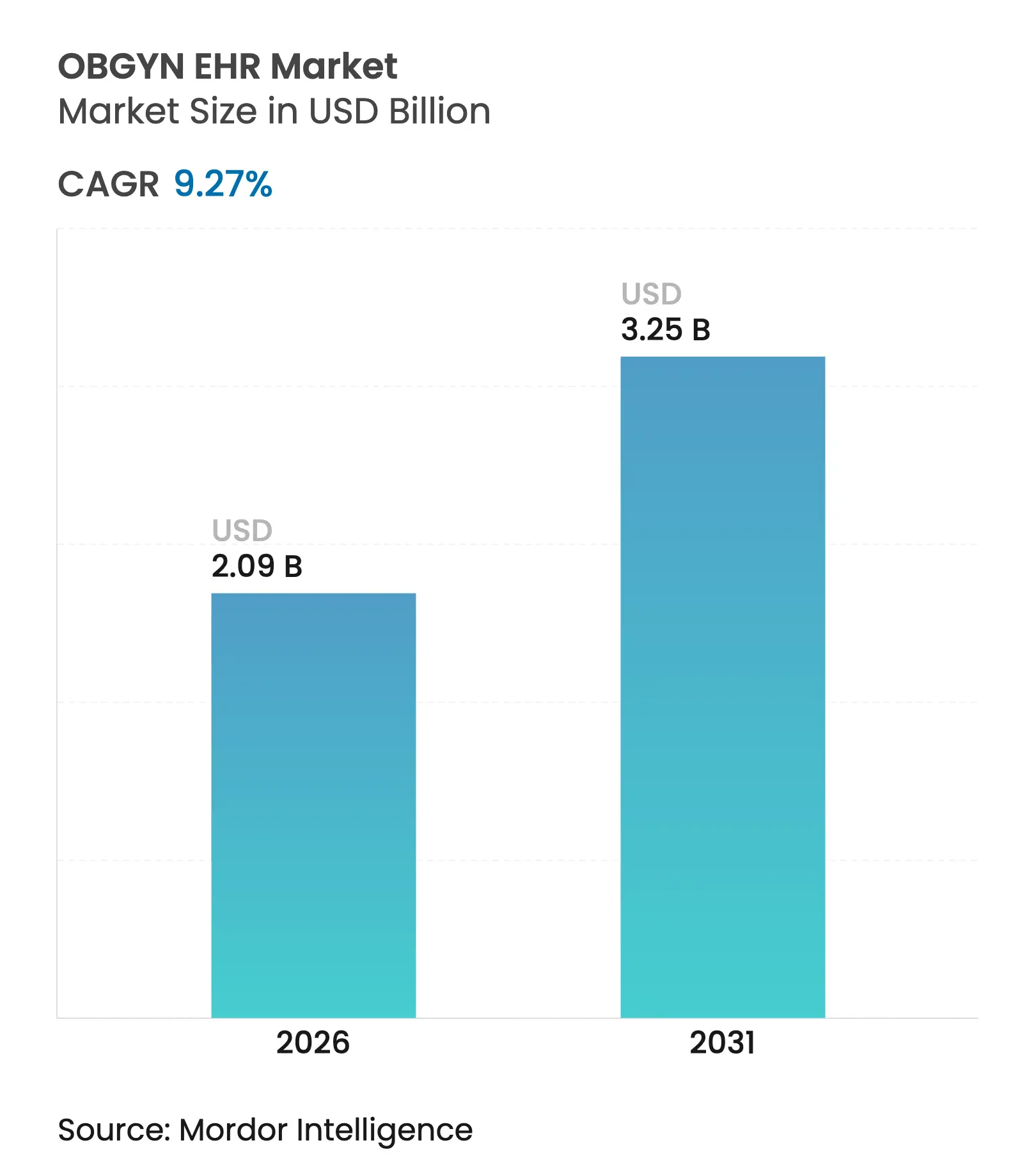
| Market Size (2026) | USD 2.09 Billion |
| Market Size (2031) | USD 3.25 Billion |
| Growth Rate (2026 - 2031) | 9.27 % CAGR |
| Fastest Growing Market | Asia Pacific |
| Largest Market | North America |
| Market Concentration | Medium |
Major Players *Disclaimer: Major Players sorted in no particular order. Image © Mordor Intelligence. Reuse requires attribution under CC BY 4.0. |

OBGYN EHR Market Analysis by Mordor Intelligence
The OBGYN EHR market size is expected to grow from USD 1.91 billion in 2025 to USD 2.09 billion in 2026 and is forecast to reach USD 3.25 billion by 2031 at 9.27% CAGR over 2026-2031. Growth is propelled by regulatory incentives that reward precise maternal-health reporting, rapid uptake of cloud deployment, and wider tele-obstetric reimbursement frameworks. Cloud platforms shorten implementation times, lower capital outlays, and streamline remote prenatal monitoring, while AI-enabled decision support further improves risk detection and documentation efficiency. Vendors that embed specialty-specific workflows now outpace generalist platforms, and emerging subscription models extend access to smaller practices.
Key Report Takeaways
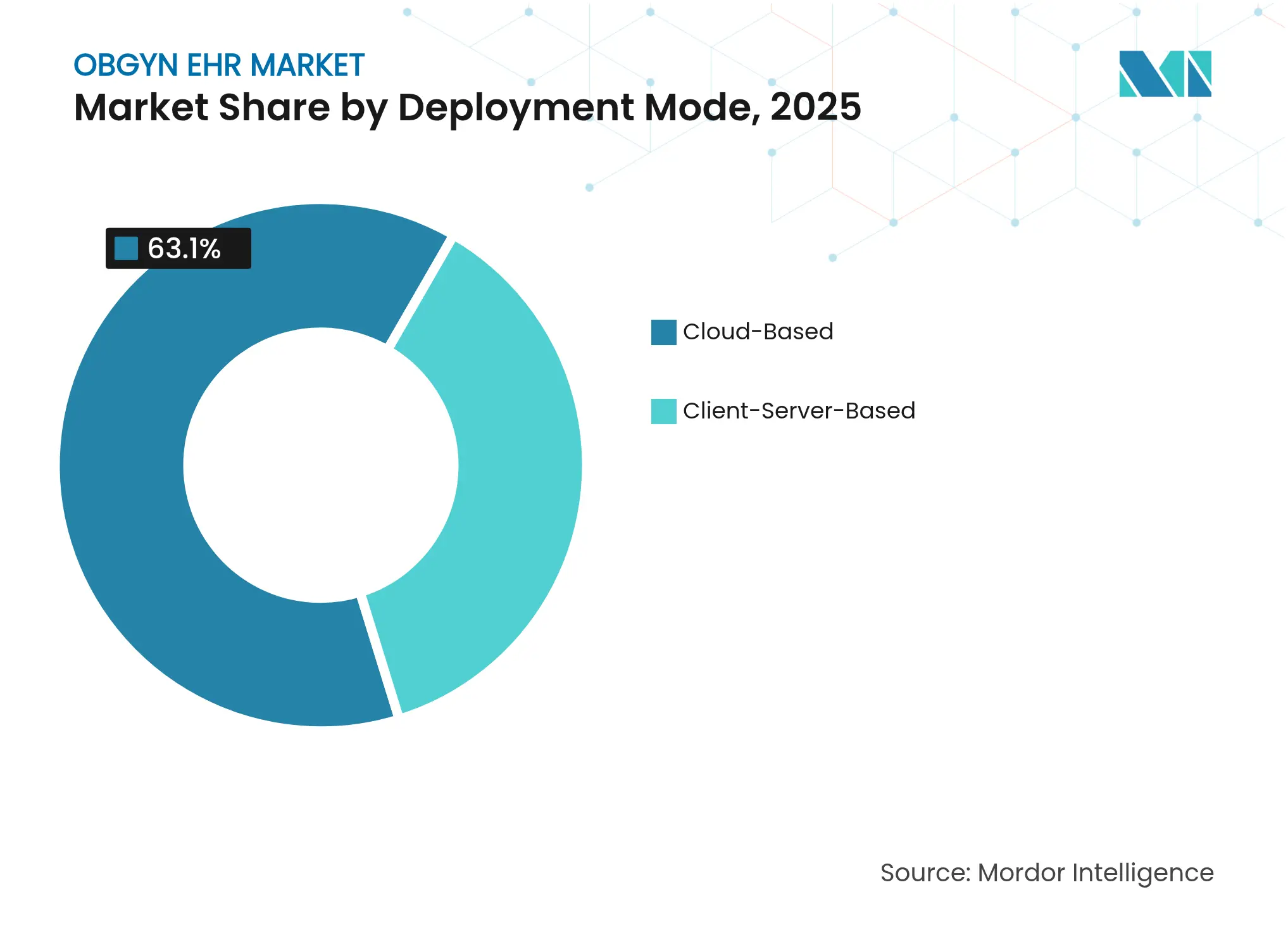
- By deployment mode, cloud-based systems captured 63.10% of the OBGYN EHR market share in 2025 and are expanding at a 9.65% CAGR through 2031.
- By application, clinical documentation led with 42.05% of the OBGYN EHR market size in 2025, while workflow management is projected to grow at 9.82% CAGR to 2031.
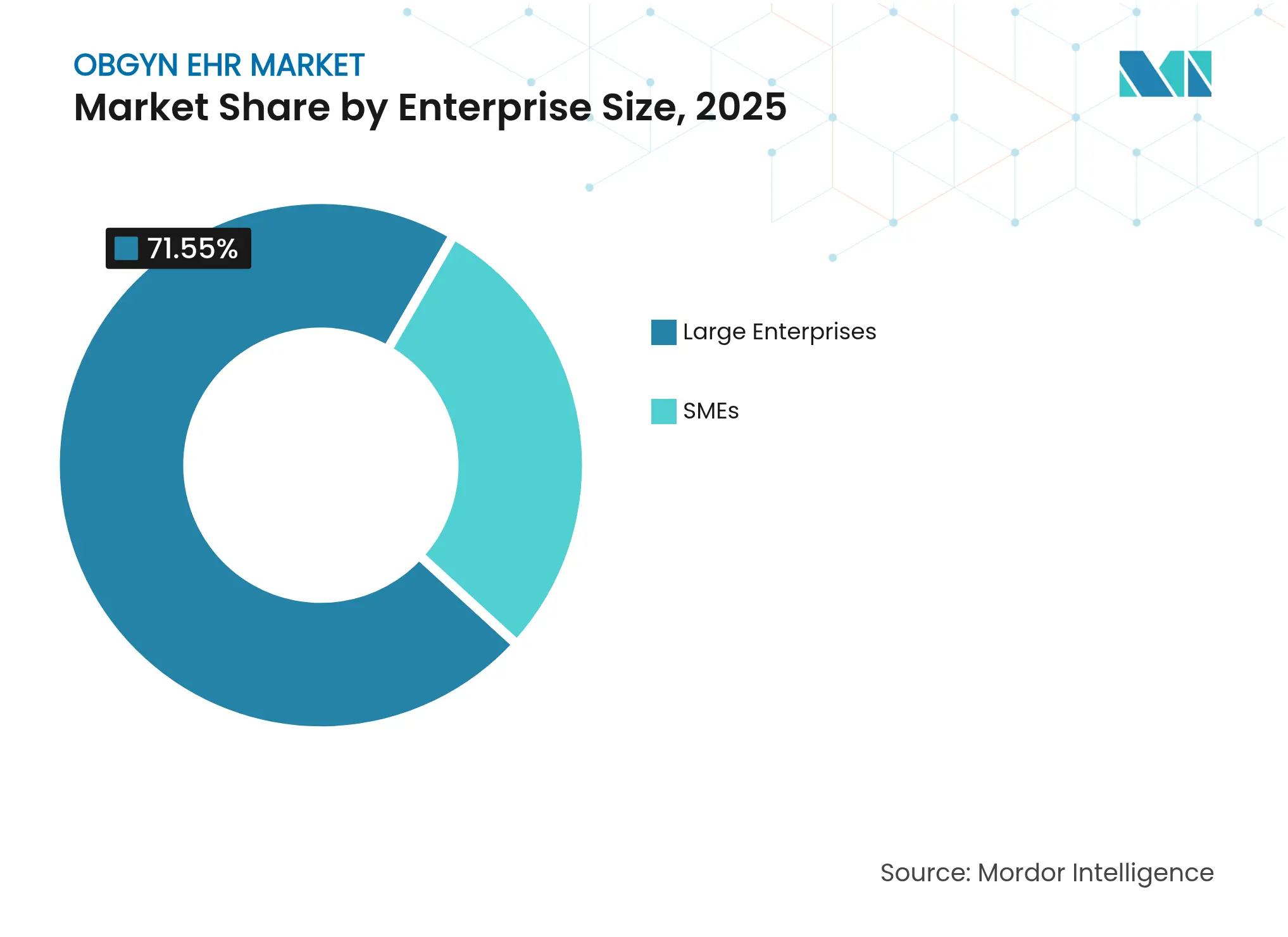
- By enterprise size, large enterprises controlled 71.55% of 2025 revenue, yet small and medium enterprises show the strongest momentum at 9.7% CAGR.
- By end-user, hospitals held 46.95% revenue share in 2025, whereas clinics and physician offices are forecast to post a 9.5% CAGR through 2031.
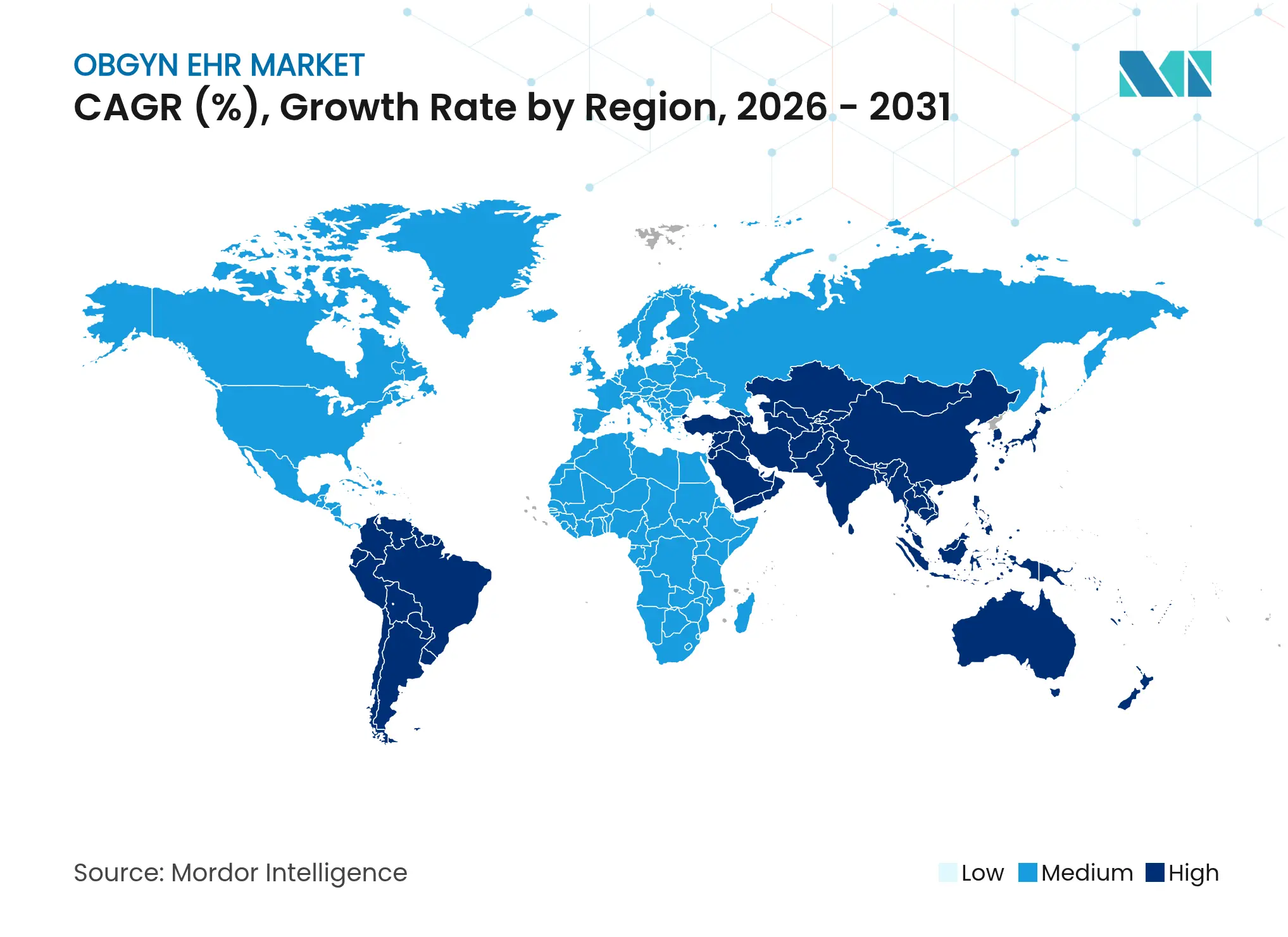
- By geography, North America maintained 41.60% revenue share in 2025; Asia-Pacific is the fastest-growing region at 11.22% CAGR.
Note: Market size and forecast figures in this report are generated using Mordor Intelligence's proprietary estimation framework, updated with the latest available data and insights as of 2026.
Global OBGYN EHR Market Trends and Insights
Drivers Impact Analysis
| Driver | (~) % Impact on CAGR Forecast | Geographic Relevance | Impact Timeline |
|---|---|---|---|
Rising Demand for Specialty-Specific EHRs Under
Value-Based Care
|
+1.8%
|
Global with early adoption in North America & Europe
|
Medium term (2-4 years)
|
Increasing Adoption of Cloud Deployment for Remote
Prenatal Care
| +1.5% | Global, accelerated in APAC & emerging markets | Short term (≤ 2 years) |
Regulatory Incentives for Maternal-Health Data
Interoperability
| +1.2% | North America & EU regulatory frameworks | Long term (≥ 4 years) |
AI-Driven Predictive Analytics for High-Risk Pregnancies
| +1.0% | North America, Europe, select APAC | Medium term (2-4 years) |
Expansion of Tele-Obstetric Reimbursement Frameworks
| +0.9% | North America with gradual global reach | Medium term (2-4 years) |
Investment Surge in Women’s Digital-Health Start-Ups
Integrating with EHRs
| +0.7% | North America & Europe | Short term (≤ 2 years) |
| Source: Mordor Intelligence | |||
Rising Demand for Specialty-Specific EHRs Under Value-Based Care
Obstetric and gynecologic providers see measure-driven reimbursement as a catalyst for adopting purpose-built platforms that automate gestational age calculations, maternal morbidity tracking, and pregnancy-quality metrics. CMS ties bonus payments to demonstrable perinatal outcomes in the CY 2025 Medicare Physician Fee Schedule. ONC’s USCDI+ Maternal Health data[1] classes further standardize obstetric information exchange, giving specialty vendors a compliance edge. Practices, therefore, favor systems that natively capture pregnancy-specific measures instead of retrofitting generic templates.
Increasing Adoption of Cloud Deployment for Remote Prenatal Care
Cloud architectures synchronize fetal-monitor readings and patient-reported vitals to clinician dashboards in real time. Remote visits gained permanent reimbursement status in CMS’s 2025 schedule, solidifying tele-obstetric workflows. Providers report 30–40% lower total cost of ownership compared with client-server-based installations, freeing capital for patient engagement tools. Scalability also supports multi-location groups seeking uniform prenatal protocols.
Regulatory Incentives for Maternal-Health Data Interoperability
The 21st Century Cures Act prohibits information blocking, compelling vendors to open APIs that share pregnancy data across care teams. New obstetrical safety standards in the 2025 Hospital Outpatient Prospective Payment System[2] require automatic quality reporting from EHRs. HL7 FHIR implementation guides focused on pregnancy encourage standardized exchange, rewarding compliant platforms.
AI-Driven Predictive Analytics for High-Risk Pregnancies
Cedars-Sinai validates machine-learning models[3] that flag preeclampsia earlier than legacy scoring tools. Epic embeds more than 100 AI features, including maternal-risk stratifiers, showing how large platforms leverage data scale to recreate specialty value. Practices note 15–20% time savings in documentation alongside improved diagnostic precision.
Restraints Impact Analysis
| Restraint | (~) % Impact on CAGR Forecast | Geographic Relevance | Impact Timeline |
|---|---|---|---|
High Implementation Costs & Delayed ROI
|
-1.4%
|
Global, heavier on SMEs & rural sites
|
Medium term (2-4 years)
|
Data-Privacy & Cybersecurity Concerns Around
Reproductive Data
| -1.1% | North America post-Dobbs, global privacy rules | Long term (≥ 4 years) |
Fragmented Prenatal-Device Integration Standards
| -0.8% | Global, larger drag in emerging markets | Medium term (2-4 years) |
Political Restrictions on Reproductive-Health Data Sharing
| -0.6% | North America state variations | Long term (≥ 4 years) |
| Source: Mordor Intelligence | |||
High Implementation Costs & Delayed ROI
Total ownership often exceeds USD 100,000 per provider once licensing, workflow redesign, and training are tallied, extending payback periods to five years for small practices. Overruns averaging 20–30% stem from unforeseen interface work and prolonged adoption curves, prompting many independents to join larger systems to access capital and IT expertise.
Data-Privacy & Cybersecurity Concerns Around Reproductive Data
Following the Dobbs ruling, clinicians fear subpoenas for reproductive records. The April 2024 HIPAA rule seeks to block such disclosures, but ongoing legal challenges create ambiguity. Some patients, therefore, avoid digital portals, while providers demand granular consent controls that limit data sharing by jurisdiction. Vendors investing in advanced consent engines gain trust advantages but must also harden defenses against ransomware aimed at sensitive maternal information.
Segment Analysis
By Deployment Mode: Cloud Architecture Drives Remote Care Innovation
Cloud systems dominated the 2025 landscape with 63.10% of the OBGYN EHR market share in 2025 and a 9.65% CAGR outlook, anchored by pay-as-you-go pricing and seamless multi-device connectivity. This adoption wave accelerated during pandemic lockdowns, when obstetric providers needed immediate telehealth and remote-monitoring capability. Modern platforms integrate wearables, video, and AI in unified workspaces that cut infrastructure spending by up to 40%. Client-server-based installations persist inside large academic hospitals that must retain legacy interfaces or meet strict data-sovereignty statutes, but their incremental upgrades trail cloud momentum.
Migrating to software-as-a-service allows practices of every size to standardize prenatal protocols, run analytics across sites, and receive continuous feature updates without downtime. Vendors bundle disaster recovery and 24/7 patch management, lowering cybersecurity risk compared with self-hosted stacks. The OBGYN EHR market, therefore, aligns cloud roadmaps to clinical ambitions such as omnichannel scheduling and longitudinal maternal registries.
Note: Segment shares of all individual segments available upon report purchase
By Application: Documentation Efficiency Meets Workflow Automation
Clinical documentation held 42.05% of the OBGYN EHR market size in 2025 because obstetric encounters demand longitudinal data capture on vitals, fetal growth, and maternal labs at every visit. Dictation and ambient voice tools now auto-generate progress notes, freeing clinicians to focus on patient counseling. Workflow management, the fastest-growing application at 9.82% CAGR, orchestrates task routing, care-path triggers, and discharge planning, reducing staff hand-offs and error rates.
Coding and billing remain essential but are increasingly embedded inside broader revenue-cycle modules that post claims in near real time. Advanced scheduling engines apply AI to optimize provider availability against gestational timelines, cutting no-show rates and balancing labor induction slots. As automation expands, the OBGYN EHR market interlinks documentation and workflows, generating predictive task lists and compliance alerts that boost operating margin.
By Enterprise Size: SME Growth Challenges Large Enterprises’ Dominance
Large enterprises commanded 71.55% of the OBGYN EHR market share in 2025, owing to deep IT budgets and bespoke integration capacity. They pursue full-suite deployments that embed obstetrics inside network-wide platforms, ensuring unified patient records across inpatient and outpatient touchpoints. Yet, small and medium enterprises are projected to grow at 9.7% CAGR as cloud subscriptions remove hefty hardware outlays and deliver pre-configured templates.
Specialty vendors emphasize rapid go-live programs under 90 days, templated order sets, and concierge onboarding, aligning with limited SME staffing. Satisfaction scores reaching higher scores for focused platforms underscore how tailored workflows trump generic modules in lean practices. Consequently, the OBGYN EHR market sees democratization, where feature parity becomes feasible for clinics with fewer than five physicians.
Note: Segment shares of all individual segments available upon report purchase
By End-User: Hospital Leadership Faces Clinic Competition
Hospitals accounted for 46.95% of the OBGYN EHR market share in 2025 because high-risk pregnancies and surgical deliveries require OR, pharmacy, and blood-bank connectivity. Massive inpatient datasets also fuel AI algorithms that predict maternal hemorrhage or neonatal distress, sustaining demand for enterprise-scale systems. Clinics and physician offices, however, lead growth at 9.5% CAGR as payers steer routine prenatal services to lower-cost sites and as wearable integration supports home-based monitoring.
Ambulatory surgical centers and freestanding maternity centers seek EHR modules that accommodate birthing-suite workflows and newborn registration without bloated acute-care functionality. Interoperability with hospital systems remains critical for emergency transfer scenarios, driving the OBGYN EHR market toward shared care-team communication tools and standardized referral summaries.
Geography Analysis
North America retained the most prominent regional position with 41.60% of the OBGYN EHR market share in 2025 and a 8.9% CAGR outlook till 2031. U.S. federal quality-reporting mandates, combined with payer incentives for maternal-safety bundles, continue to spur platform replacements. Canada invests in interoperable maternity records through provincial digital-health programmes, while Mexico’s private hospitals adopt specialty modules to differentiate obstetric service lines.
Asia-Pacific is the growth frontrunner with an 11.22% CAGR to 2031. Government-led digital-health blueprints in India, China, and Indonesia prioritized maternal mortality reduction, allocating grants for cloud EHR rollouts in rural antenatal clinics. Rising middle-class demand for premium birthing experiences fuels private-hospital investments in AI-enabled monitoring and tele-obstetric outreach.
Europe advances at 9.25% CAGR, underpinned by eHealth expansion funds and EU-wide interoperability targets. GDPR compliance shapes vendor selection, privileging offerings with native consent management and data-minimization features. Local champions such as Dedalus win tenders by localizing prenatal screening forms and integrating national registries. Middle East & Africa and South America chart 10.66% and 10.41% CAGRs respectively, building from low installed bases. Gulf states pilot cloud platforms across public maternity hospitals, while Brazil’s SUS modernization programme mandates electronic prenatal cards. Donor-funded projects in Kenya and Ghana deploy mobile EHRs to remote health posts, illustrating leap-frog adoption that bypasses legacy servers. The varied maturity levels push vendors to offer modular, language-localized OBGYN EHR market solutions.

Competitive Landscape
Market Concentration
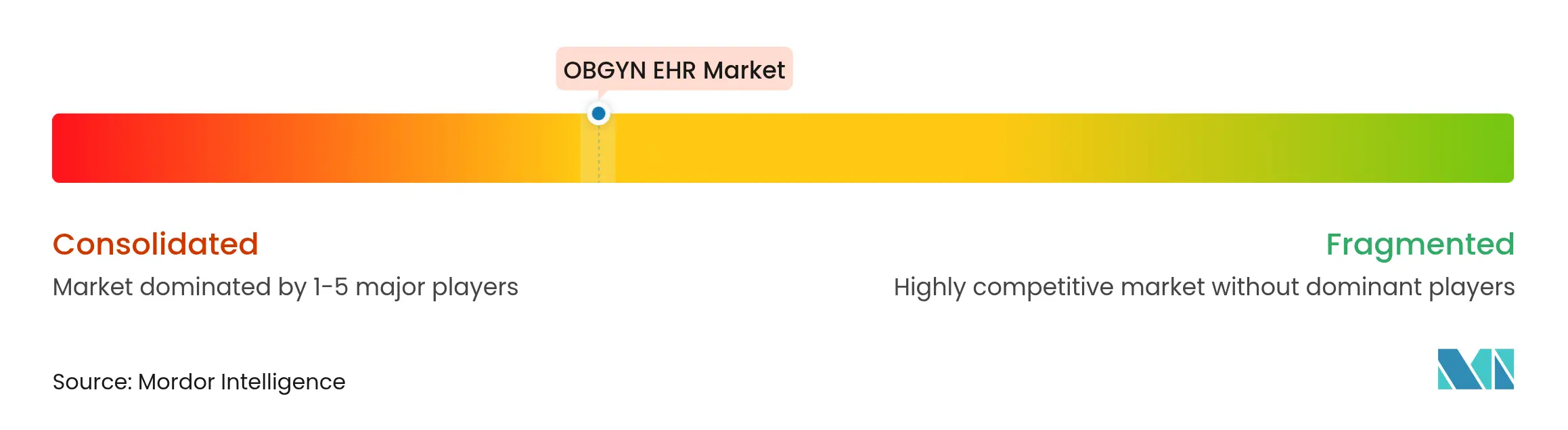
Epic Systems deepened its leadership by adding 176 hospitals in 2024, translating cross-setting continuity and AI investments into superior clinical adoption. Its embedded decision-support tools drive physician loyalty and create switching barriers. Oracle Health lost 74 hospitals amid protracted Cerner integration work, pivoting toward voice-driven AI to regain differentiation but facing execution hurdles.
Specialty-first vendors such as ModMed thrive by aligning every screen with OB workflows, winning top user rankings for ease of use and client support. Their cloud-native cores let updates ship weekly, keeping pace with guideline changes. Ambience Healthcare illustrates a partner-eco-system route, embedding ambient documentation inside athenahealth installs to lift note accuracy and coding completeness across 100 specialties.
Investment in women’s-health startups accelerates product innovation on the periphery. Midi Health secured USD 14 million to extend virtual midlife care into EHR worklists, and Tinto integrates postpartum mental-health assessments within discharge templates. The OBGYN EHR market therefore balances incumbent scale advantages against agile niche entrants that command clinician mind-share through hyper-specialization and consumer-style usability.
OBGYN EHR Industry Leaders

*Disclaimer: Major Players sorted in no particular order
Recent Industry Developments
- March 2025: Epic Systems unveiled a healthcare-specific ERP suite spanning workforce and supply-chain modules, aiming to cross-sell into its existing OBGYN client base.
- January 2025: Ambience Healthcare joined athenahealth’s Marketplace Program to deliver AI-assisted documentation and care-coordination across 100 specialties.
- November 2024: CMS finalized the CY 2025 Hospital Outpatient Prospective Payment System rule, embedding new obstetrical safety standards that hinge on automated EHR quality reporting.
- April 2024: The U.S. Department of Health and Human Services issued final HIPAA amendments strengthening privacy protections for reproductive-health information.
Table of Contents for OBGYN EHR Industry Report
1. Introduction
- 1.1 Study Assumptions & Market Definition
- 1.2 Scope of the Study
2. Research Methodology
3. Executive Summary
4. Market Landscape
- 4.1 Market Overview
- 4.2 Market Drivers
- 4.2.1 Rising Demand for Specialty-Specific EHRs Under Value-Based Care
- 4.2.2 Increasing Adoption of Cloud Deployment for Remote Prenatal Care
- 4.2.3 Regulatory Incentives For Maternal-Health Data Interoperability
- 4.2.4 AI-Driven Predictive Analytics for High-Risk Pregnancies
- 4.2.5 Expansion of Tele-Obstetric Reimbursement Frameworks
- 4.2.6 Investment Surge in Women's Digital-Health Start-Ups Integrating with EHRs
- 4.3 Market Restraints
- 4.3.1 High Implementation Costs & Delayed ROI
- 4.3.2 Data-Privacy & Cybersecurity Concerns Around Reproductive Data
- 4.3.3 Fragmented Prenatal-Device Integration Standards
- 4.3.4 Political Restrictions on Reproductive-Health Data Sharing
- 4.4 Supply Chain Analysis
- 4.5 Regulatory Landscape
- 4.6 Technological Outlook
- 4.7 Porter's Five Forces Analysis
- 4.7.1 Threat of New Entrants
- 4.7.2 Bargaining Power of Buyers/Consumers
- 4.7.3 Bargaining Power of Suppliers
- 4.7.4 Threat of Substitute Products
- 4.7.5 Intensity of Competitive Rivalry
5. Market Size & Growth Forecasts (Value)
- 5.1 By Deployment Mode
- 5.1.1 Client-Server-Based
- 5.1.2 Cloud-Based
- 5.2 By Application
- 5.2.1 Billing
- 5.2.2 Clinical Documentation
- 5.2.3 Scheduling
- 5.2.4 Workflow Management
- 5.2.5 Other Applications
- 5.3 By Enterprise Size
- 5.3.1 Large Enterprises
- 5.3.2 SMEs
- 5.4 By End-User
- 5.4.1 Hospitals
- 5.4.2 Clinics & Physician Offices
- 5.4.3 Ambulatory Surgical Centers
- 5.4.4 Maternity Centers
- 5.5 By Geography
- 5.5.1 North America
- 5.5.1.1 United States
- 5.5.1.2 Canada
- 5.5.1.3 Mexico
- 5.5.2 Europe
- 5.5.2.1 Germany
- 5.5.2.2 United Kingdom
- 5.5.2.3 France
- 5.5.2.4 Italy
- 5.5.2.5 Spain
- 5.5.2.6 Rest of Europe
- 5.5.3 Asia-Pacific
- 5.5.3.1 China
- 5.5.3.2 India
- 5.5.3.3 Japan
- 5.5.3.4 Australia
- 5.5.3.5 South Korea
- 5.5.3.6 Rest of Asia-Pacific
- 5.5.4 Middle East and Africa
- 5.5.4.1 GCC
- 5.5.4.2 South Africa
- 5.5.4.3 Rest of Middle East and Africa
- 5.5.5 South America
- 5.5.5.1 Brazil
- 5.5.5.2 Argentina
- 5.5.5.3 Rest of South America
6. Competitive Landscape
- 6.1 Market Concentration
- 6.2 Competitive Benchmarking
- 6.3 Market Share Analysis
- 6.4 Company Profiles (includes Global level Overview, Market level overview, Core Segments, Financials as available, Strategic Information, Market Rank/Share for key companies, Products & Services, and Recent Developments)
- 6.4.1 AdvancedMD Inc.
- 6.4.2 Athenahealth Inc.
- 6.4.3 ChartLogic Inc.
- 6.4.4 CompuGroup Medical SE & Co. KGaA
- 6.4.5 Computer Programs and Systems, Inc.
- 6.4.6 CureMD Healthcare
- 6.4.7 DrChrono Inc.
- 6.4.8 eClinicalWorks LLC
- 6.4.9 Epic Systems Corporation
- 6.4.10 Greenway Health LLC
- 6.4.11 Medical Information Technology, Inc.
- 6.4.12 Modernizing Medicine Inc.
- 6.4.13 N. Harris Computer Corporation
- 6.4.14 NextGen Healthcare, Inc.
- 6.4.15 Oracle Corporation
- 6.4.16 Tebra Technologies, Inc
- 6.4.17 Veradigm Inc.
- 6.4.18 WRS Health
7. Market Opportunities & Future Outlook
- 7.1 White-space & Unmet-need Assessment
Global OBGYN EHR Market Report Scope
As per the scope of the report, OBGYN EHR software is electronic health record software specifically designed for obstetrics and gynecology practices to streamline patient management, record-keeping, and billing processes. This software allows healthcare providers to access patient information easily and efficiently, improving overall patient care and workflow.
The OBGYN electronic medical records (EHR) market is segmented by component, application, and geography. By component, the market is segmented into client server-based EHR and cloud-based EHR. By application, the market is segmented into scheduling, billing, clinical documentation, workflow management, and other applications (patient engagement and reporting dashboards). By geography, the market is segmented into North America, Europe, Asia-Pacific, the Middle East and Africa, and South America. The market report also covers the estimated market sizes and trends for 17 countries across the major regions globally. The report offers market sizes and forecasts in value (USD) for the above segments.
| By Deployment Mode | Client-Server-Based | |
| Cloud-Based | ||
| By Application | Billing | |
| Clinical Documentation | ||
| Scheduling | ||
| Workflow Management | ||
| Other Applications | ||
| By Enterprise Size | Large Enterprises | |
| SMEs | ||
| By End-User | Hospitals | |
| Clinics & Physician Offices | ||
| Ambulatory Surgical Centers | ||
| Maternity Centers | ||
| By Geography | North America | United States |
| Canada | ||
| Mexico | ||
| Europe | Germany | |
| United Kingdom | ||
| France | ||
| Italy | ||
| Spain | ||
| Rest of Europe | ||
| Asia-Pacific | China | |
| India | ||
| Japan | ||
| Australia | ||
| South Korea | ||
| Rest of Asia-Pacific | ||
| Middle East and Africa | GCC | |
| South Africa | ||
| Rest of Middle East and Africa | ||
| South America | Brazil | |
| Argentina | ||
| Rest of South America | ||

