
E-pharmacy Market Size and Share
Market Overview
| Study Period | 2020 - 2031 |
|---|---|
| Market Size (2026) | USD 125.52 Billion |
| Market Size (2031) | USD 310.38 Billion |
| Growth Rate (2026 - 2031) | 19.85 % |
| Fastest Growing Market | Asia Pacific |
| Largest Market | North America |
| Market Concentration | Medium |
Major Players *Disclaimer: Major Players sorted in no particular order Image © Mordor Intelligence. Reuse requires attribution under CC BY 4.0. | |
E-pharmacy Market Analysis by Mordor Intelligence
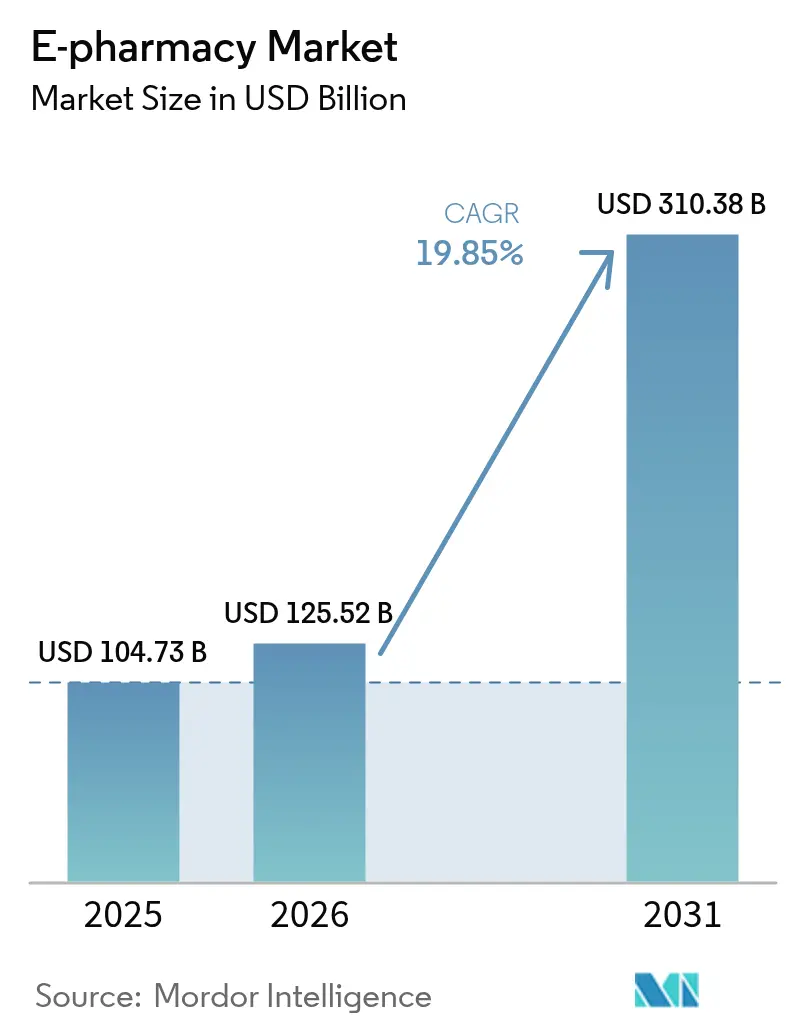
The E-pharmacy Market size is expected to increase from USD 104.73 billion in 2025 to USD 125.52 billion in 2026 and reach USD 310.38 billion by 2031, growing at a CAGR of 19.85% over 2026-2031.
Electronic-prescription mandates, pharmacy-desert expansion, and logistics investments are accelerating digital drug dispensing, while direct-to-consumer models from manufacturers threaten traditional intermediaries. Same-day delivery is becoming table stakes as Amazon Pharmacy rolls out service to 4,500 U.S. cities and towns in 2026, exploiting 2,100 planned brick-and-mortar closures by rival chains. Asia-Pacific platforms add further momentum by embedding one-click pharmacy storefronts inside super-apps, capturing smartphone-first audiences and leapfrogging legacy workflows. Cold-chain advances are widening the therapy mix to include biologics and GLP-1 agonists, lifting average basket values. However, fragmented global regulation and a surge in rogue websites temper growth, adding compliance costs and reputational risk.
Key Report Takeaways
- By drug type, prescription drugs led with a 71.62% E-pharmacy market share in 2025, while over-the-counter items are forecast to post a 21.54% CAGR through 2031.
- By product type, cold and flu remedies accounted for 24.85% of the E-pharmacy market in 2025, but vitamins and dietary supplements will grow at a 22.32% CAGR through 2031.
- By therapeutic area, diabetes accounted for 31.65% of revenue in 2025, and gastrointestinal disorders are set to grow at a 22.67% CAGR through 2031.
- By platform, mobile accounted for 58.54% of 2025 revenue and is expanding at a 22.76% CAGR to 2031.
- By geography, North America commanded 42.65% of 2025 revenue, while Asia-Pacific is projected to grow at a 20.54% CAGR through 2031.
Note: Market size and forecast figures in this report are generated using Mordor Intelligence’s proprietary estimation framework, updated with the latest available data and insights as of 2026.
Market Trends and Insights
Drivers Impact Analysis of E-pharmacy Market*
| Driver | (~) % Impact on CAGR Forecast | Geographic Relevance | Impact Timeline |
|---|---|---|---|
| Government Mandates for Electronic Prescriptions | +3.2% | North America & EU, spill-over to APAC | Medium term (2-4 years) |
| Growing Geriatric Population and Chronic Disease Burden | +4.5% | Global, with highest intensity in North America, Europe, and East Asia | Long term (≥ 4 years) |
| Strategic Collaborations Among Payers, PBMs, and E-Pharmacies | +2.8% | North America core, expanding to EU and select APAC markets | Short term (≤ 2 years) |
| Investments in Advanced Fulfilment and Same-Day Logistics | +3.1% | North America and urban APAC hubs (China, India, Japan) | Short term (≤ 2 years) |
| Integration with Digital Health and Remote Monitoring Platforms | +2.9% | Global, led by North America and Western Europe | Medium term (2-4 years) |
| Expansion of Direct-to-Consumer Distribution by Drug Manufacturers | +2.4% | North America and Europe, early pilots in APAC | Medium term (2-4 years) |
| Source: Mordor Intelligence | |||
Government Mandates for Electronic Prescriptions
New rules such as the U.S. HTI-4 standardize NCPDP SCRIPT and real-time benefit checks by 2027, removing paper friction and favoring platforms that already run certified APIs. Greece took a similar all-digital stance for public reimbursement in 2024, while the EU targets cross-border exchange in 2025. These mandates compress prescription hand-off times and cut abandonment at the counter, but require independents to fund costly software upgrades. The compliance floor therefore tilts share toward scaled players that can amortize integration costs, deepening consolidation in the E-pharmacy market.
Growing Geriatric Population and Chronic Disease Burden
The world’s 60-plus cohort will reach 1.4 billion by 2030, driving medication volume for diabetes, cardiovascular, and respiratory disorders[1]. Automated refill reminders and home shipping solve mobility barriers, lifting adherence and reducing hospital readmissions that payers track under value-based care models. LillyDirect’s home insulin delivery exemplifies the convergence of specialty therapy, telehealth, and E-pharmacy fulfillment. These dynamics lock in recurring revenue and reinforce the E-pharmacy market as a clinical partner rather than just a distribution node.
Strategic Collaborations Among Payers, PBMs, and E-Pharmacies
Express Scripts and Kroger Health linked 2,200 store pharmacies to 85 million covered lives in 2024, creating omnichannel steering power. CVS Health merged Oak Street Health clinics with its dispensing arm, while the FTC lawsuit against the big three PBMs subjects rebate tactics to antitrust review. Preferred-network dynamics make or break smaller entrants, underscoring why vertical integration reshapes the E-pharmacy market more than price alone.
Investments in Advanced Fulfillment and Same-Day Logistics
Amazon Pharmacy delivers prescriptions on the day of order in 20 cities and will scale to 4,500 localities by the end of 2026. Walmart trials 30-minute delivery from dark-store setups, converting real estate into micro-fulfillment nodes. These investments answer pharmacy-desert gaps created by 2,100 store closures at CVS and Walgreens. Cold-chain expansion unlocks biologics but inflates per-order costs by up to 50%, pushing platforms toward insulated packaging and IoT temperature tracking.
Restraints Impact Analysis of E-pharmacy Market*
| Restraints Impact Analysis | (~) % Impact on CAGR Forecast | Geographic Relevance | Impact Timeline |
|---|---|---|---|
| Fragmented International Regulatory Framework | -2.1% | Global, highest friction in EU and emerging Asia-Pacific | Long term (≥4 years) |
| Proliferation of Illegitimate Online Pharmacies | -1.8% | Global, concentrated on unregulated platforms | Medium term (2-4 years) |
| High Cold-Chain and Compliance Costs | -2.3% | North America, Europe, urban Asia-Pacific hubs | Short term (≤2 years) |
| Complex Reimbursement and Pricing Controls | -2.0% | North America and Europe, spill-over to select Asia-Pacific markets | Long term (≥4 years) |
| Source: Mordor Intelligence | |||
Fragmented International Regulatory Framework
EU cross-border dispensing requires manual re-verification in many states because only 12 of 27 countries exchanged e-prescriptions by mid-2024. India obliges separate state licences, a factor in PharmEasy’s valuation crash to USD 458 million in 2024. In the United States, just 53 websites carried NABP’s VIPPS seal in 2024[2]. These mismatches add onboarding time, duplicate audits, and legal risk, trimming the E-pharmacy market growth trajectory.
Proliferation of Illegitimate Online Pharmacies
Operation Pangea XVII shut 500 domains and seized 1,900 counterfeit parcels in 2024, yet new sites appear within days. Search ads still drive consumers to non-certified sellers, with 40% of 2024 ad clicks landing on rogue operators. Authentic platforms shoulder additional serialization and audit costs to reassure payers, increasing overhead by up to 8% and narrowing margins across the E-pharmacy market.
*Our forecasts treat driver/restraint impacts as directional, not additive. The impact forecasts reflect baseline growth, mix effects, and variable interactions.
E-pharmacy Market Segment Analysis
By Drug Type:
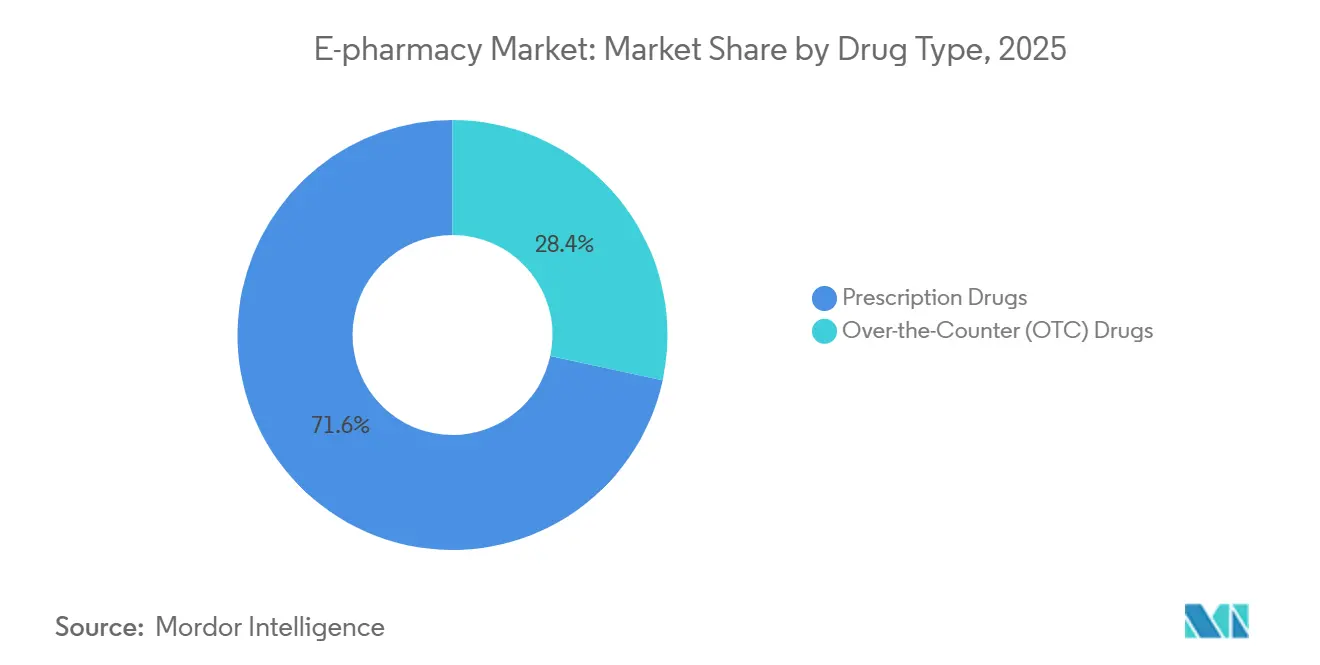
OTC Gains Ground as Switch Rules AccelerateOver-the-counter medicines will rise at a 21.54% CAGR through 2031, outstripping prescription growth even though Rx products owned 71.62% E-pharmacy market share in 2025. The ACNU rule trims switch timelines to 18 months, prompting manufacturers to pursue statins and PPIs for consumer use. Subscription bundles inside apps lower refill friction and reinforce brand loyalty. Nevertheless, high-priced biologics keep prescription revenue dominant, especially for specialty indications, maintaining the revenue core of the E-pharmacy market.
The E-pharmacy market size captured by OTC products will climb steadily as self-care trends align with digitized guidance tools. Price sensitivity persists because insurers seldom cover non-prescription items, nudging shoppers toward generics. Rx drugs, while slower growing, remain essential for chronic conditions that demand clinical oversight and benefit from real-time benefit checks introduced under HTI-4.

By Product Type:
Wellness Supplements Outpace Traditional CategoriesCold and flu remedies held 24.85% of 2025 product share, but vitamins and dietary supplements will chart a 22.32% CAGR through 2031 as consumers pivot to preventive wellness[3]. Amazon owns 73% of online supplement sales and leverages recommendations plus Prime shipping to lock in monthly subscriptions, a dynamic that deepens its stake in the E-pharmacy market.
E-commerce guidelines now compel visible NSF or USP testing badges, raising compliance thresholds that favor larger sellers. Wellness stack baskets—immune vitamins, probiotics, plant-based proteins—boost average order value and reduce seasonality. The E-pharmacy market size for supplements will therefore widen faster than legacy OTC categories tied to episodic illness.
By Therapeutic Area:
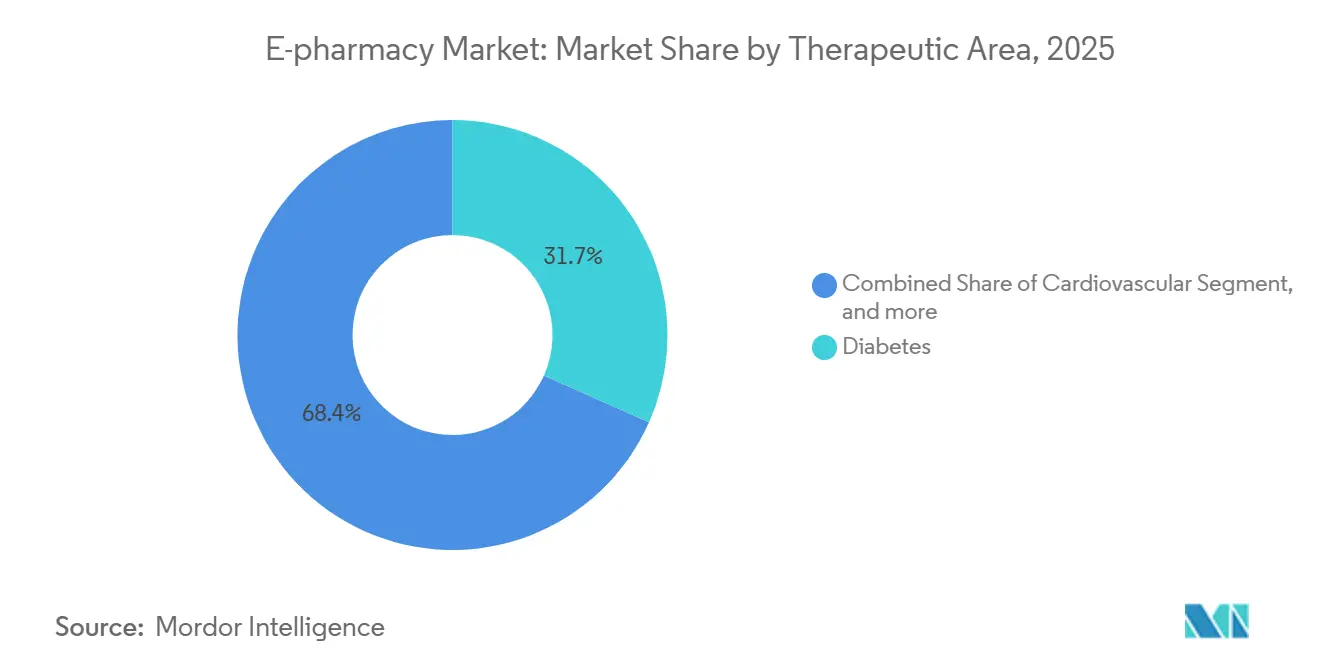
Diabetes Dominates, GI Disorders SurgeDiabetes accounted for 31.65% of 2025 revenue, driven by costly CGM sensors and GLP-1 injectables. Direct shipping through LillyDirect shortens refill cycles and captures data that informs dose titration algorithms. Gastrointestinal drugs will post the highest CAGR of 22.67%, buoyed by biologic adoption for IBD, which aligns with cold-chain-ready E-pharmacy infrastructure.
Cardiovascular and respiratory therapies remain volume leaders but face price compression from generics, limiting their contribution to growth in the E-pharmacy market. Oncology, mental health, and pain therapies carry stricter online controls, keeping penetration comparatively low until DEA accreditation processes mature.
By Platform:
Mobile Apps Take the LeadMobile accounted for 58.54% of 2025 revenue and is growing at a 22.76% CAGR, reflecting global smartphone ubiquity and the convenience of biometric login and push reminders. Desktop retains loyalty among older patients who handle insurance paperwork on larger screens but will trail growth.
WeChat mini-programs in China and MedAdvisor’s Australian app exhibit the localized flavor of app-based fulfillment. Voice ordering and smartwatch prompts remain niche, yet they illustrate how the E-pharmacy market is evolving toward ambient, context-aware medicine management.
Geography Analysis
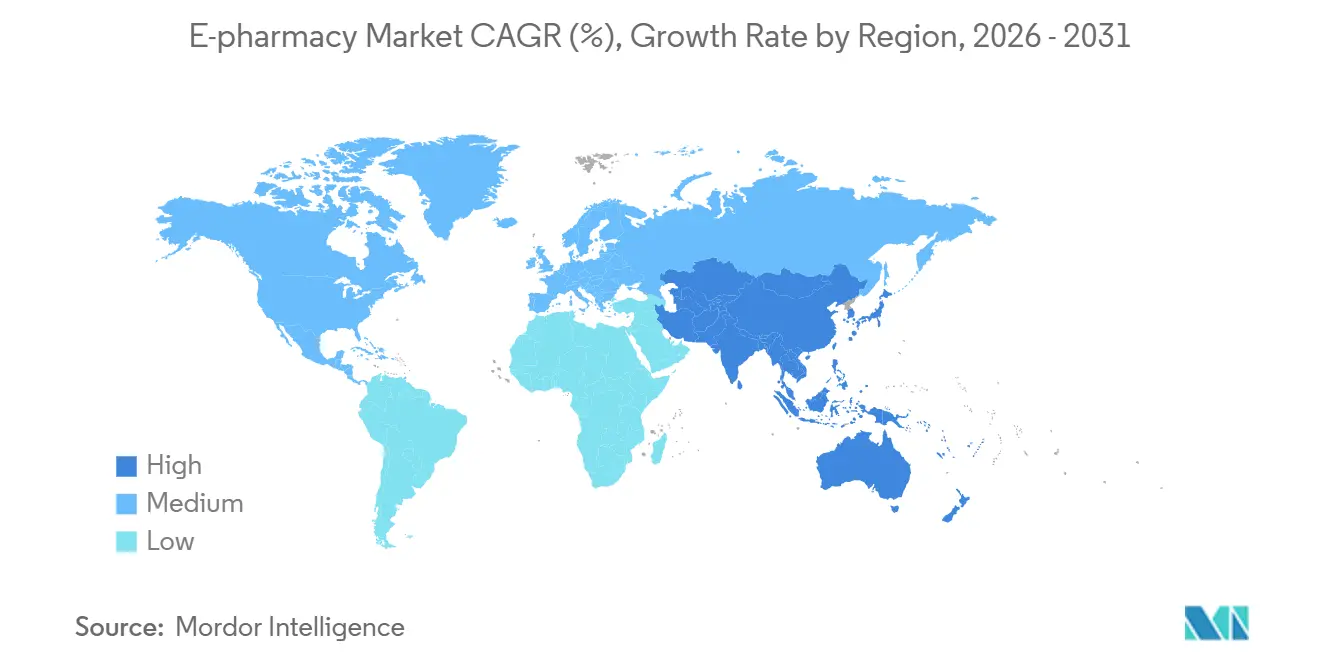
North America E-pharmacy Market
North America accounted for 42.65% of 2025 revenue, driven by USD 1,300 per capita drug spend and abundant insurance coverage. Store closures by CVS, Walgreens, and Rite Aid between 2024-2027 create access gaps that Amazon Pharmacy and Optum Rx fill with same-day logistics. U.S. HTI-4 standards remove prescribing friction, and VIPPS accreditation differentiates legitimate sites. Canada and Mexico lag amid fragmented rules, though cross-border Canadian imports remain a consumer workaround.
APAC E-pharmacy Market
Asia-Pacific is the fastest-growing region, with a 20.54% CAGR through 2031. China’s 600 million digital health users fuel Alibaba Health’s USD 2.3 billion 2024 revenue and JD Health’s USD 4.8 billion 2023 revenue. India wrestles with multi-state licences, driving consolidation as Tata 1mg and Apollo Pharmacy blend online and offline assets. Japan’s older demographic and strict pharmacist consultations temper growth, whereas Australia’s MedAdvisor shows adherence gains that insurers reward.
EMEA and South America E-pharmacy Market
Europe holds a 25% share but faces cross-border hurdles. Only a minority of EU states exchange e-prescriptions seamlessly, constraining DocMorris, which posted a CHF 84.8 million loss in H1 2024. Greece mandated full e-prescribing in 2024, offering a template for Southern Europe. The U.K.’s NHS App connects to brick-and-mortar fulfillment, limiting pure-play upside. Gulf states and South Africa pursue digital pilots, while Brazil and Argentina move slowly due to logistics and regulatory uncertainty.
Regulatory Landscape
E-pharmacy regulation remains jurisdiction-specific, combining pharmacy licensure with rules for e-prescriptions, controlled substances, and consumer protection against falsified medicines. In April 2026, the Pharmacy Council of Nigeria launched the Electronic Pharmacy Regulations 2026, updating earlier rules and explicitly bringing e-pharmacy aggregators and prescription handling under a defined compliance framework, alongside requirements around pharmacist oversight and operational controls for online drug services.
In mature markets, controlled-drug dispensing online is tightly governed. In the United States, online pharmacy registration and recordkeeping obligations are governed by DEA rules (including 21 CFR 1301.19 and 21 CFR 1304.40 as reflected in March 2026 eCFR snapshots), while the European Medicines Agency has advanced digitization of regulated product information through the electronic Product Information (ePI) Implementation Guide v1.0.0 (May 2025). Taken together, these anchors support a compliance stack built around identity verification, secure transmission of prescriptions, and traceability, helping distinguish accredited platforms from rogue websites.
Value Chain Analysis
The e-pharmacy value chain connects manufacturers and brand owners, wholesalers and distribution partners, digitally enabled dispensing entities (pure-play e-pharmacies and omnichannel chains), and last-mile logistics providers, while payments, PBMs/payers (where applicable), and telehealth/EHR integrations shape demand capture. Differentiation increasingly comes from orchestration layers such as order management systems, real-time inventory visibility, and patient-facing digital workflows (refills, adherence prompts, and benefit checks), with compliance overlays (GMP/GDP/GSP, licensure, and anti-counterfeit controls) adding process steps for onboarding and fulfillment.
Fulfillment and distribution remain the operational bottlenecks and investment hubs, especially for cold-chain and higher-acuity therapies. Recent proof points include CVS Pharmacy commissioning advanced automation at a distribution center in Hainesport, New Jersey (June 2026) to increase throughput, and McKesson selecting Moore, Oklahoma for a 330,000-square-foot automated regional distribution center (June 2026) to strengthen supply reliability. Platform-side marketplace expansion also brings in new intermediaries, as seen in Farmacias del Ahorro deploying Kibo Order Management System (July 2026) to manage multi-seller fulfillment, and BIG CARING Group unveiling an automation-driven distribution center in Klang, Malaysia (April 2026) to improve inbound and outbound efficiency.
Competitive Landscape
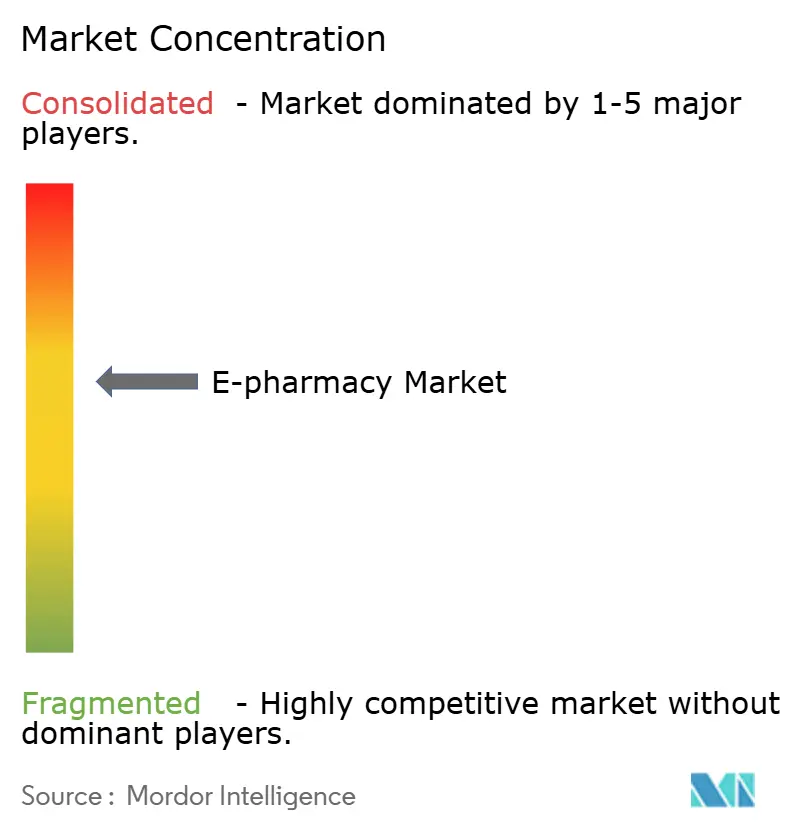
The top ten firms accounted for roughly 55% of 2025 revenue, indicating a moderately concentrated market. In North America, CVS Health, Cigna-Express Scripts, and UnitedHealth dominate through vertically integrated insurance and PBM arms that steer prescription flow. Amazon Pharmacy counters with transparent pricing and nationwide same-day service, forcing incumbents to accelerate digital offerings.
In China, Alibaba Health and JD Health wield super-app distribution advantages beyond Western reach, embedding pharmacy within payments and social media. India remains fragmented yet ripe for consolidation, as funding scarcity puts pressure on smaller platforms. Europe lacks a pan-regional giant due to regulatory heterogeneity, though DocMorris remains the largest single player despite restructuring losses.
Specialty niches open white-space for Alto Pharmacy and Capsule, which provide high-touch services for complex biologics. Manufacturer portals such as LillyDirect and Novo Nordisk’s pilots bypass retailers altogether, signaling a future where branded E-pharmacy experiences coexist with multi-brand marketplaces. Technology moats center on telemedicine APIs, real-time benefit verification, and AI adherence prompts, while NABP VIPPS and EU GDPR compliance form trust and privacy barriers.
E-pharmacy Industry Leaders
-
Walgreens Boots Alliance
-
CVS Health Corporation
-
Cigna Corporation (Express Scripts Holdings)
-
Amazon Pharmacy (PillPack)
-
DocMorris / Redcare Pharmacy
- *Disclaimer: Major Players sorted in no particular order
E-pharmacy Market Companies Covered in this Report
- Alibaba Health Information Tech
- Alto Pharmacy
- Amazon Pharmacy (PillPack)
- Apollo Pharmacy
- Axelia Solutions (PharmEasy)
- Capsule Corp.
- Chemist Warehouse Group
- Cigna Corporation (Express Scripts)
- CVS Health
- DocMorris
- Flipkart Health+
- GoodRx Holdings Inc.
- JD Health International
- Netmeds
- NowRx
- Optum
- Phoenix Group (Germany)
- Tata 1mg
- The Kroger
- Walgreens Boots Alliance
Market Opportunities and Future Outlook
Same-day and accelerated delivery coverage creates a clear whitespace for platforms that can pair dense last-mile networks with compliant dispensing and cold-chain readiness. In February 2026, Amazon Pharmacy announced it will expand same-day medication delivery to nearly 4,500 US cities and towns by year-end, adding nearly 2,000 communities and expanding service into states such as Idaho and Massachusetts. That operational benchmark elevates the value of speed and service reliability and supports continued investment in micro-fulfillment, routing, and temperature-controlled packaging for higher-value therapies.
Interoperability and standards-based integration remain under-monetized areas across regions, especially where pharmacy data exchange lags broader digital health adoption. In March 2026, the Sequoia Project published pharmacy-care interoperability use cases, pointing to gaps tied to chronic disease management and transitions of care that rely on cleaner data exchange between pharmacies, health information exchanges, and clinical systems. In the United Kingdom, Community Pharmacy England and the Community Pharmacy IT Group continued work in 2026 on next-generation Electronic Prescription Service modernization toward FHIR-based architecture, which is intended to support more consistent digital prescription workflows and downstream services such as medication management and adherence programs that can be embedded into e-pharmacy platforms.
Recent Industry Developments in E-pharmacy Market
- June 2026: CVS Pharmacy announced participation in the CMS Medicare GLP-1 Bridge program effective July 1, 2026, alongside new GLP-1 support services designed to improve affordability and continuity on therapy. The program links retail and digital pharmacy workflows to a public benefit pathway for high-demand chronic-care and weight-management medications, increasing the importance of navigation, prior authorization support, and patient education as part of the dispensing experience.
- October 2025: CVS Pharmacy completed the acquisition of select Rite Aid and Bartell Drugs assets, including 63 stores and prescription files for 626 pharmacies. Integrating these assets expands local fulfillment reach and prescription volume capture, strengthening omnichannel capacity that can be routed into digital refill, delivery, and patient-engagement programs.
- January 2024: Eli Lilly launched LillyDirect to support direct-to-patient access for select medicines, including home delivery options paired with telehealth pathways. The launch signaled manufacturers commitment to direct-to-consumer distribution, reshaping channel dynamics by shifting portions of patient acquisition, data capture, and refill behavior away from traditional retail intermediaries.
E-pharmacy Market Report Scope and Research Methodology
Market Definition and Coverage
This market covers the value of medicines and related pharmacy items sold through digital pharmacy channels where ordering happens online and fulfillment is delivered to the customer, including prescription and over-the-counter purchasing.
Scope exclusions: We exclude offline pharmacy-only sales, and we do not count pure teleconsultation fees that are not tied to an e-pharmacy order.
Segments Covered in This Report
- By Drug Type
- Prescription Drugs
- Over-The-Counter (OTC) Drugs
- By Product Type
- Skin Care
- Dental
- Cold & Flu
- Vitamins & Dietary Supplements
- Weight Management
- Other Product Types
- By Therapeutic Area
- Diabetes
- Cardiovascular
- Respiratory
- Gastrointestinal
- Other Therapeutic Areas
- By Platform
- Mobile Users
- Desktop Users
- Geography
- North America
- United States
- Canada
- Mexico
- Europe
- Germany
- United Kingdom
- France
- Italy
- Spain
- Rest of Europe
- Asia-Pacific
- China
- Japan
- India
- Australia
- South Korea
- Rest of Asia-Pacific
- Middle East & Africa
- GCC
- South Africa
- Rest of Middle East & Africa
- South America
- Brazil
- Argentina
- Rest of South America
- North America
Data Sources, Market Sizing, and Validation
Desk Research
Desk research was used to set the market boundaries and build the first demand and supply picture for online pharmacy activity. We relied on public sources such as the US FDA and other national medicines regulators for rules around prescription dispensing, and the US Census Bureau and other national statistics offices for e-commerce and household spending signals.
To avoid guessing volumes, we also reviewed sources such as the World Health Organization for health system context, the World Bank for digital access indicators, and customs and trade statistics portals to infer cross-border shipment direction where it was relevant. Alongside these, we used company annual reports, investor presentations, earnings call transcripts, and reputable press coverage to understand channel mix shifts and major operational changes. Select paid database subscriptions were used for company financials and patent screening. The list above is illustrative because many other sources were also reviewed for data collection, validation, and clarification.
Primary Interviews and Surveys
Primary work focused on interviews and structured surveys with stakeholders across the e-pharmacy value chain, including digital pharmacy operators, logistics partners, pharmacists, and selected buyers on the payer and provider side. Respondent input was used to confirm how prescription versus OTC ordering behaves by region, how delivery models affect average order values, and which regulatory steps most often slow down adoption. Where variance stayed high, we adjusted assumptions accordingly.
Distribution of primary research fieldwork respondents
| Company type | Respondent position | Region |
|---|---|---|
| Top tier: 27% | CXOs: 12% | APAC: 44% |
| Mid tier: 58% | Functional/Unit leaders: 36% | EMEA: 34% |
| Smaller Players: 15% | Managers: 52% | Americas: 22% |
Market-Sizing & Forecasting
Our core model starts with a top-down demand pool build that uses digital commerce penetration and pharmacy spending signals to estimate how much medication purchasing can realistically shift online in each region. Once that ceiling is set, the yearly market value is calculated by applying adoption and reorder patterns across prescription and OTC baskets, and then the totals are cross-checked using selective bottom-up approximations from sampled average selling price per order multiplied by estimated active users and order frequency.
A few practical inputs that drive outcomes in this market include online pharmacy user penetration, prescription share versus OTC share, average order value by basket type, delivery and fulfillment cost pass-through that affects pricing, chronic condition prevalence that supports repeat orders, and the pace of e-prescribing and digital identity rollout where it changes ordering friction. When data gaps appear for smaller countries, we use ratios from similar markets first, then correct them using interview feedback on channel availability and typical order sizes.
Forecasting uses scenario analysis supported by light multivariate regression, where adoption, internet access, and regulatory ease indicators are the main drivers. Expert review is used to keep ranges realistic. The forecast is then stress-tested with short checks, such as whether implied order volumes grow faster than what fulfillment capacity and last-mile expansion could reasonably support in the period.
Data Validation & Update Cycle
Outputs are validated by triangulating multiple signals, so the market totals are checked against independent indicators such as e-commerce health retail growth, prescription dispensing trend direction, and reported digital channel mix from public filings. When an outlier appears, we re-check inputs for unit consistency, currency conversion timing, and step-by-step math. If the gap still looks material, we repeat assumption tests with follow-up calls.
Before sign-off, a second analyst reviews key calculations and confirms the definition has been applied consistently across regions and years. Reports are refreshed annually, and interim updates are triggered when material policy changes, major route-to-market shifts, or visible demand shocks occur. Right before delivery, we run a fresh pass to include the latest public updates that can change near-term sizing.
Mordor Intelligence's Epharmacy Market Size Compared Against Other Published Estimates
Published values for e-pharmacy do not always line up, even when the topic sounds the same, because included transactions, time periods, and pricing assumptions can be handled differently. The benchmark table makes this visible by showing three 2025 values that move in the same direction but still spread out in absolute size, which is common in fast-growing digital health channels.
The gap usually comes from what each publisher counts as e-pharmacy revenue, and how quickly prices and adoption are allowed to move year to year. The table points to a higher outside estimate that likely folds in adjacent online healthcare retail and broader marketplace sales, and it also shows a lower estimate that may reflect more conservative uptake in regulated prescription fulfillment. In Mordor Intelligence's model, the 2025 total is tied to online pharmacy ordering and delivered fulfillment for prescription and OTC baskets, and it is validated with region-level adoption checks before the final roll-up.
Benchmark comparison
| Source | Market Size | Gaps in Research Methodology |
|---|---|---|
| Mordor Intelligence | USD 104.73 B (2025) | |
| Global Consultancy A | USD 150.70 B (2025) | This figure appears to use a wider channel scope, where some non-pharmacy online health retail and broader marketplace sales are likely included, which lifts the 2025 value above a strict e-pharmacy definition. |
| Industry Analyst Brief B | USD 106.41 B (2025) | This estimate is close in year, but differences can come from currency timing and how prescription verification friction is modeled, especially if adoption is smoothed over a longer horizon with fewer near-term step-ups. |
Taken together, the spread is mainly explained by scope choices and by how adoption and pricing are paced across prescription and OTC ordering. Our approach keeps the steps traceable to clear demand indicators, practical adoption inputs, and repeatable cross-checks, which makes the final number easier to audit and update when market conditions change.
Key Questions Answered in the Report
How large will online drug sales become by 2031?
The E-pharmacy market is projected to reach USD 310.38 billion by 2031, growing at a 19.85% CAGR from 2026.
Which product category will grow the fastest online?
Vitamins and dietary supplements are on track for a 22.32% CAGR through 2031 as wellness spending shifts to digital channels.
Why is Asia-Pacific the quickest growing region?
Smartphone ubiquity, super-app integrations, and supportive digitization policies push Asia-Pacific to a 20.54% CAGR through 2031.
What role do electronic-prescription mandates play?
Mandates such as HTI-4 in the United States force all prescribers onto digital rails by 2027, reducing friction and expanding the e-pharmacy customer base.
How are manufacturers disrupting traditional pharmacy channels?
Platforms such as LillyDirect ship insulin and other therapies straight to patients, bypassing retail stores and PBMs to capture higher margins and adherence data.
Are counterfeit medicines a serious online risk?
Yes, with only 53 U.S. sites VIPPS-certified in 2024, enforcement actions like Operation Pangea XVII highlight ongoing challenges against illegitimate sellers.