
Market Overview
| Study Period | 2021 - 2031 |
|---|---|
| Forecast Data Period | 2026 - 2031 |
| Historical Data Period | 2021 - 2024 |
| Growth Rate | 1.98 % |
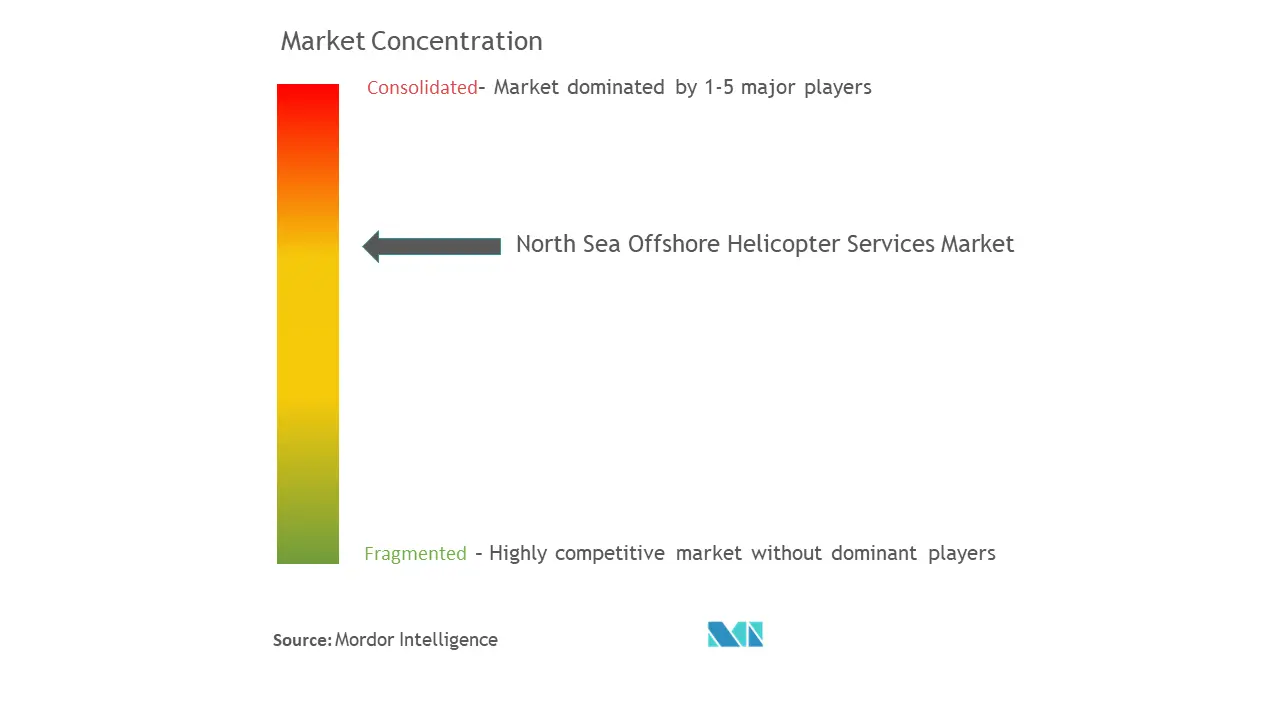
| Market Concentration | Medium |
Major Players *Disclaimer: Major Players sorted in no particular order Image © Mordor Intelligence. Reuse requires attribution under CC BY 4.0. | |
North Sea Offshore Helicopter Services Market Analysis by Mordor Intelligence
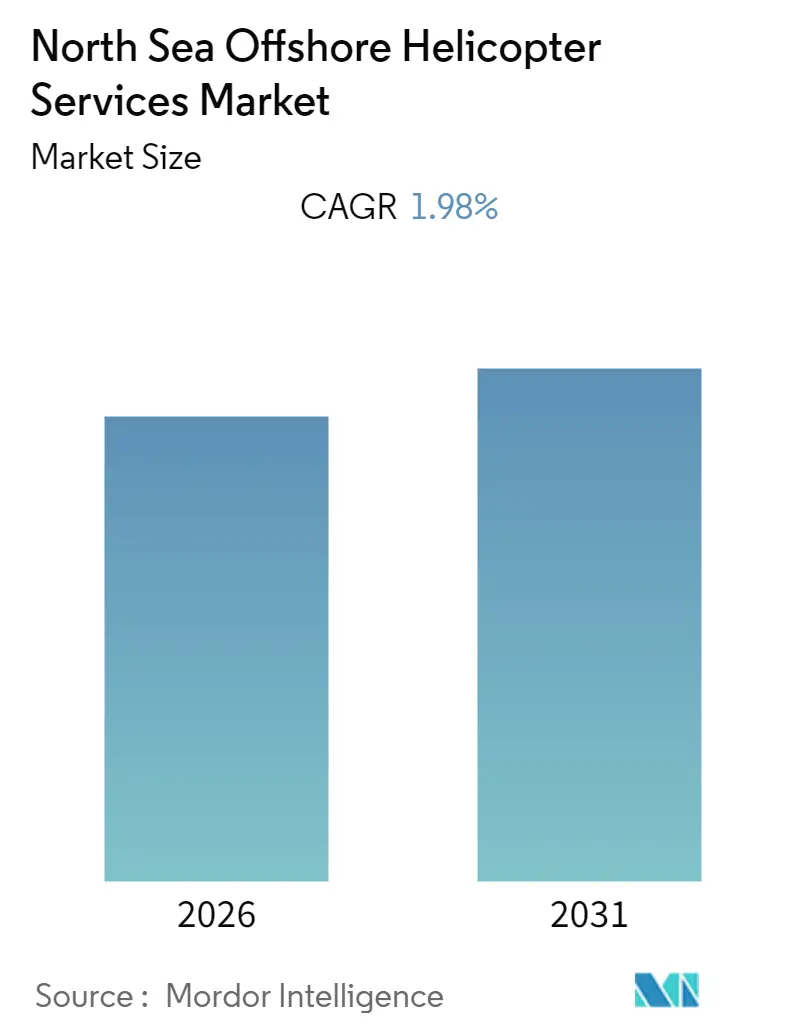
The North Sea Offshore Helicopter Services Market size is expected to register a CAGR of 1.98% during the forecast period.
- The offshore wind farm segment is anticipated to grow with a high CAGR during the forecast period, leading to increased demand for helicopter services for new installation and maintenance of existing wind farms. Thus increased investment in offshore wind farms is likely to drive the market during the forecast period.
- New discoveries of oil fields in the north sea region and private companies investing in oil & gas exploration and production are anticipated to drive the market.
- The United Kingdom is expected to be leading country in helicopter services market, owing to the presence of higher number of ongoing projects during the forecast period.
Note: Market size and forecast figures in this report are generated using Mordor Intelligence’s proprietary estimation framework, updated with the latest available data and insights as of 2026.
Market Trends and Insights
Increase in Number of Offshore Wind Farms
- The North sea region is considered one of the leading regions in the world for offshore wind energy project development. This can be ascribed to the region's advantages, including relatively shallow waters, favourable wind patterns, and easy access to ports and energy-consuming industries.
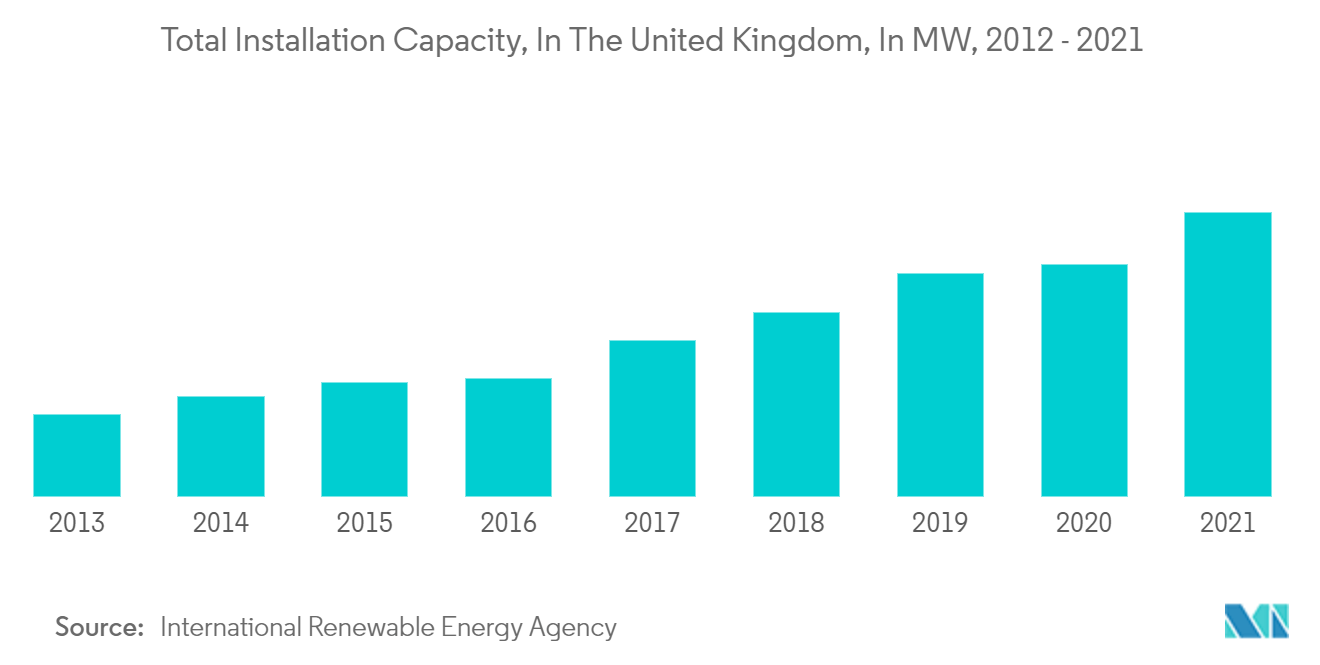
- In 2012, in the North Sea region, the total cumulative installation of offshore wind energy projects was around 4.5 GW which has significantly increased in the last decade and reached 27.8GW in 2021.
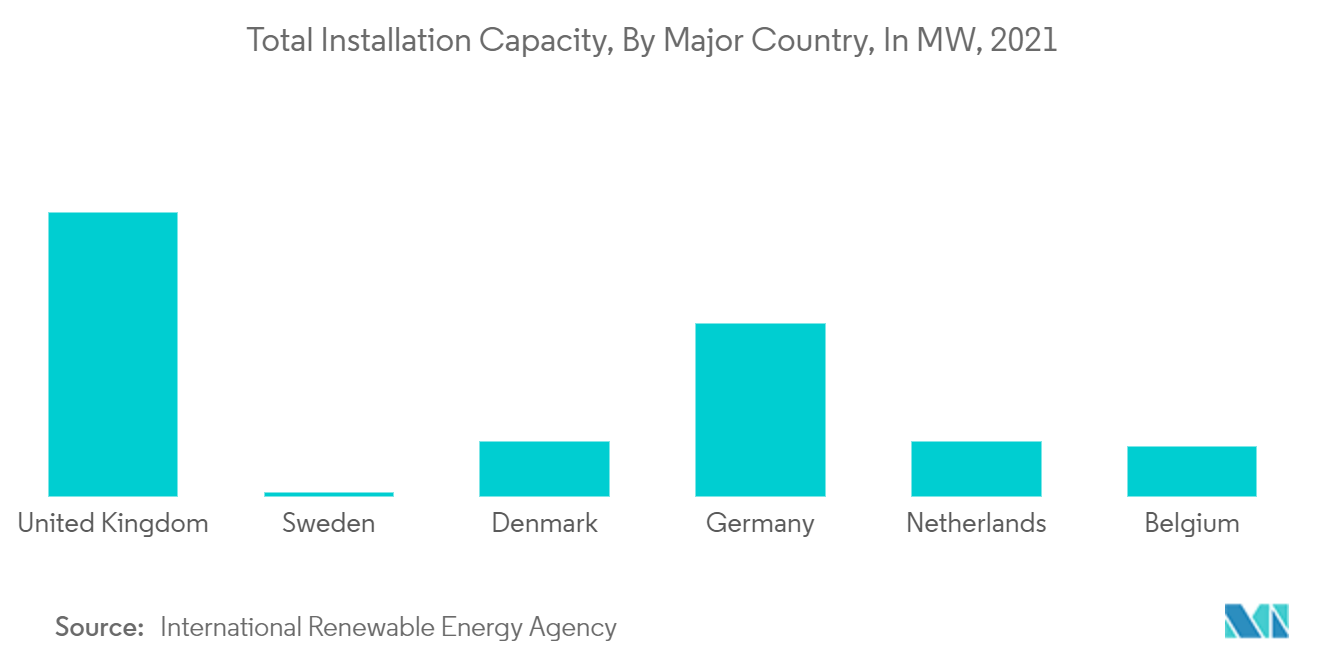
- The countries such as Belgium, Denmark, Germany, the Netherlands, and United Kingdom are the leading countries in the region to install offshore wind farms. In 2021, in Belgium, the total offshore wind energy capacity was around 2,262 MW; in Denmark, it was about 2,306; in Germany, it was about 7,747 MW; in the Netherlands was 2,460 MW, and the United was around 12,700 MW.
- In 2022, the four major countries in the North Sea region Germany, Belgium, the Netherlands and Denmark, aim to develop 150 GW of offshore wind capacity in the North Sea to achieve the European Union's net-zero emission and lower dependency on Russian energy.
- In 2022, the Netherlands Enterprise Agency designed the North Sea Agreement to facilitate the offshore wind project in the North Sea region. This agreement details the government's plans to explore the space for 20 GW to 40 GW offshore wind capacity by 2027.
- Furthermore, private companies are also investing in the North Sea region in offshore energy projects; for instance, in 2022, BP plc. is committed to investing USD 22.52 billion in offshore wind farms by 2030. BP plc., in partnership with EnBW, aims to develop an offshore farm with a capacity of 3 GW.
- This development in offshore wind farms would lead to a rise in the requirement for offshore helicopter services. Resulting in driving the Offshore Helicopter Services market during the forecast period
The United Kingdom to Dominate the Market
- The United Kingdom is the leading offshore energy producer in Europe and the second largest producer in the world after China. In 2012, in the United Kingdom, the total offshore energy installation capacity was 2,995 MW, and it reached 12,700 MW in 2021. In terms of global offshore wind energy installation, The United kingdom contributed around 23% in 2021.
- The United Kingdom government considers offshore wind projects a significant opportunity for economic growth for the country's development. Thus it has developed government policies and programs to support the offshore wind energy sector.
- Furthermore, the United Kingdom has set ambitious climate targets to achieve, which include net-zero emissions by 2050, and offshore wind farms could play a vital role in achieving their environmental goals. Hence, the government provides financial support, funding, and tax benefits.
- Moreover, the United Kingdom and various private companies are investing in offshore wind projects in the United Kingdom; for instance, in January 2022, the United Kingdom aims to fund a floating offshore wind project. The total investment is anticipated to be around GBP 60 million.
- Furthermore, the United Kingdom is the leading country in European offshore oil & gas activity. Moreover, the government has more than 200 oil and gas fields operating in the Nor; these fields are responsible for the supply of approximately half of The United Kingdom's gas needs.
- Furthermore, companies are investing in the oil & gas industry, particularly in the North Sea. For instance, in July 2022, United Oil & Gas discovered an oil & gas field which would need an investment of around USD 545 million in the near future. According to the company, the field is expected to have 6 million barrels of oil equivalent to oil & gas reserves. Further, the company aims to develop the field in 2024 and the first production by 2025.
- All these offshore investments in the wind and oil & gas industry are expected to propel the demand for helicopter services in the North Sea region. Hence increased investment by the United Kingdom in offshore activity is expected to drive the North Sea Offshore Helicopter Services Market in the forecast period.
Regulatory Landscape
Offshore helicopter services in the North Sea operate under the European safety framework for air operations, anchored by EASA requirements for helicopter offshore operations and implemented through national competent authorities. In the United Kingdom, the Civil Aviation Authority (CAA) framework includes SPA-HOFO (Specific Approval for Helicopter Offshore Operations), in force since 1 July 2018, which sets out operator compliance expectations across areas such as risk assessment, operating minima, crew competence, and equipment fit for offshore and hostile environments.
Safety oversight and rule evolution continue to shape the operating environment, with the UK CAA offshore helicopter safety workstream (including its Offshore Helicopter Review progress reporting) and EASA rulemaking activity influencing requirements around ditching survivability, emergency equipment, and operational limitations. For operators serving oil and gas and offshore wind customers across the region, these requirements feed into ongoing compliance costs and standardization pressure.
Value Chain Analysis
The value chain starts with helicopter OEMs such as Airbus and Leonardo supplying airframes, followed by offshore mission configuration, including hoist capability, communications and avionics, and safety equipment aligned to hostile-environment operations. The availability and reliability of these aircraft in practice depend on certified maintenance, repair, and overhaul capability, particularly EASA Part-145 maintenance stations and specialist repair networks for components such as avionics and composite or rotor systems.
Service providers (including Bristow Group and regional operators) then contract with offshore oil and gas producers and offshore wind developers or operators for crew transport, hoist support, and adjacent missions such as search and rescue where applicable. Operations are delivered through North Sea bases and logistics hubs where flight operations, safety management, training, and spares support are integrated to meet customer uptime requirements and regulator-driven offshore standards.
Competitive Landscape
The North Sea Offshore Helicopter Services Market market is moderately competitive. Some of the key players in the market include Bristow Group Inc., NSEG, Heli Service International GmbH, WIKING Helikopter Service GmbH, and The British International Helicopter.
North Sea Offshore Helicopter Services Industry Leaders
-
Bristow Group Inc.
-
NSEG
-
Heli Service International GmbH
-
WIKING Helikopter Service GmbH
-
The British International Helicopter
- *Disclaimer: Major Players sorted in no particular order
North Sea Offshore Helicopter Services Market Companies Covered in this Report
- Service Providers
- Helicopter Manufacturers
Read Analysis of North Sea Offshore Helicopter Services Companies
Market Opportunities and Future Outlook
Offshore wind installation and operations and maintenance activity across North Sea countries keeps expanding the addressable mission set beyond traditional oil and gas crew change, including routine technician transfers, hoist support, and time-critical logistics to offshore substations and platforms. The scale-up in installed offshore wind capacity across major North Sea markets, along with programs such as the Netherlands Enterprise Agency North Sea Agreement (targeting 20 GW to 40 GW of offshore wind capacity space by 2027), supports additional helicopter tasking around construction windows and long-term maintenance cycles.
On the oil and gas side, offshore activity and field development and decommissioning sustain demand for passenger transport and emergency preparedness services. This is especially relevant where distance to shore and weather constraints increase the value of dedicated offshore-capable fleets and SAR integration. Major contract awards in Norway in 2026, including Equinor and Vaar Energi contracting S-92 transport and SAR capacity, point to active procurement for long-duration offshore flight services and reinforce opportunities around fleet availability, compliance-ready safety equipment, and training infrastructure located close to operating bases such as Aberdeen and Bergen.
Recent Industry Developments in North Sea Offshore Helicopter Services Market
- March 2026: Bristow Group Inc. secures a contract with Equinor for two S-92 offshore transport helicopters to operate from Bergen Airport (Flesland) with an option for two additional one-year extensions; effective May 1, 2026. The arrangement expands offshore transport capacity on Norwegian oil and gas fields. It also supports Barents/Norway market presence and safety and compliance upgrades through fleet growth.
- February 2026: Bristow awarded a three-year contract by Equinor and Var Energi for two S-92 passenger transport helicopters and one S-92 SAR helicopter based in Hammerfest; effective Sept 1, 2026; estimated value NOK 1.9 billion. The contract reinforces long term capacity in the Norwegian Barents Sea. It strengthens market leadership in North Sea operations through investments in the SAR and transport fleet and localized training.
- November 2024: Bristow announces the introduction of an AW139 full flight simulator in Aberdeen, scheduled to begin operation in 2026, alongside adding four AW189 helicopters to its fleet by 2025 2026 to support contractual demands. The upgrade advances fleet modernization and training capacity. It enhances safety, training, and capacity to meet growing North Sea energy projects.
North Sea Offshore Helicopter Services Market Report Scope and Research Methodology
Market Definition and Coverage
This market measures the revenue earned from helicopter flights that move people and essential light cargo between North Sea onshore bases and offshore energy assets, plus safety-critical standby tasks linked to those operations.
Scope exclusions: We exclude offshore fixed-wing transport, vessel-based crew transfer, and pure military missions that are not contracted to support offshore energy activity.
Segments Covered in This Report
- Type
- Light Helicopters
- Medium and Heavy Helicopters
- End-user Industry
- Oil and Gas Industry
- Offshore Wind Industry
- Other End-user Industries
- Geography
- The United Kingdom
- Norway
- Denmark
- Germany
- the Netherlands
- Belgium
- France
Data Sources, Market Sizing, and Validation
Desk Research
Desk work started by mapping offshore energy activity in the North Sea and translating that activity into likely helicopter demand. Public sources were used to anchor the demand signals, including UK Civil Aviation Authority statistics, the Norwegian Civil Aviation Authority, Eurocontrol network updates, EASA safety publications, and government energy bodies that publish offshore oil and gas production and licensing information.
We also reviewed national statistics portals and customs trade releases where they helped explain offshore activity and supply conditions, then followed with operator fleet disclosures, annual reports, and investor presentations. Airport and heliport traffic releases, contract notices, and reputable trade press were used to time capacity changes and major contract shifts. Where needed, paid subscriptions for company financials and intelligence, news and financials, and contract and tender tracking were used to cross-check contract starts, extensions, and pricing direction. These examples are not exhaustive, and many other sources were used for data collection, validation, and clarification.
Primary Interviews and Surveys
We use interviews and surveys with helicopter operators, offshore energy logistics managers, aviation safety specialists, fleet planners, and procurement professionals across the North Sea countries covered by the study. Respondent input helps clarify flight activity, aircraft utilization, contract pricing, fleet replacement timing, and offshore wind demand, while also identifying gaps in published records before the final North Sea model is agreed.
Distribution of primary research fieldwork respondents
| Company type | Respondent position |
|---|---|
| Top tier: 28% | CXOs: 18% |
| Mid tier: 47% | Functional/Unit leaders: 32% |
| Smaller Players: 25% | Managers: 50% |
Market-Sizing & Forecasting
Sizing uses a top-down rebuild of demand, where offshore oil and gas activity and offshore wind build and maintenance schedules are converted into rotations, flight frequency, and flying hours from key onshore bases. Those totals are priced using common contract structures, then adjusted for helicopter class mix and the share of standby and SAR-related flying that is bundled into agreements.
To keep the model practical, we focused on inputs that can be checked and explained simply, such as active platform and wind farm counts, offshore worker movement patterns, helicopter fleet size and availability, utilization by season, average stage length, and inflation and currency effects on day rates. Results were corroborated with selective bottom-up approximations, including sampled contract rate cards, operator revenue splits, and flight activity channel checks, and gaps were handled by applying conservative utilization ranges that were confirmed during interviews.
For forecasting, we used scenario analysis around upstream spending and offshore wind project timing, and we tempered the yearly path so single contract awards do not overstate the long-run trend. Assumptions on utilization and pricing were re-tested with experts to ensure the final outlook stays tied to operating limits and realistic demand.
Data Validation & Update Cycle
Validation is done by comparing outputs with independent signals, including aviation traffic statistics, fleet and base-level capacity changes, and public offshore project milestones. Any unusual movements are reviewed, and the underlying drivers are re-checked before sign-off, with re-contact triggered when a contract, safety rule, or fleet event can materially change service delivery.
The report is refreshed annually, and interim updates are made when major events occur, such as large contract renewals, aircraft groundings, or sharp shifts in offshore activity. Before delivery, an analyst performs a fresh pass across key assumptions and recent news so clients receive the latest updated view.
Mordor Intelligence's North Sea Offshore Helicopter Services Market Estimate Compared With Other Published Estimates
Different publishers can land on different values because they do not always count the same set of services, and they may also use different years, currencies, and pricing assumptions. In this market, the biggest swings usually come from whether standby and emergency-related flying is included, how oil and gas versus offshore wind demand is weighted, and how operators active across multiple basins are allocated back to the North Sea.
The main gap comes from bundling, where Mordor Intelligence counts only North Sea contracted offshore helicopter service revenue tied to energy operations, and it keeps non-North Sea flying and broader onshore aviation revenue out even if the operator is the same. Other estimates can also drift when they assume a quick utilization rebound, apply a single day-rate uplift without checking helicopter class mix, or convert currencies using a timing that does not match the contract year.
Benchmark comparison
| Source | Market Size | Gaps in Research Methodology |
|---|---|---|
| Mordor Intelligence | USD 0.92 B (2025) | |
| Industry Data Publisher A | USD 2.75 B (2025) | May include a wider service bundle such as full EMS and SAR operations plus broader offshore logistics activity, and it can also blend totals across offshore basins rather than isolating only North Sea contract revenue. |
| Global Research Publisher B | USD 2.42 B (2026) | Uses a later starting year and can group ad-hoc charter and non-energy standby work together with core crew-transport contracts, which lifts the total when utilization assumptions are applied across the full bundle. |
Across the three figures, the spread is mainly explained by scope and year alignment, not by a disagreement that demand exists. By tying the build to offshore energy activity, fleet capacity, and contract-style pricing, and then re-checking outliers, the resulting number stays traceable to clear variables and repeatable steps.
Key Questions Answered in the Report
What is the current North Sea Offshore Helicopter Services Market size?
The North Sea Offshore Helicopter Services Market is projected to register a CAGR of 1.98% during the forecast period (2026-2031)
Who are the key players in North Sea Offshore Helicopter Services Market?
Bristow Group Inc., NSEG, Heli Service International GmbH, WIKING Helikopter Service GmbH and The British International Helicopter are the major companies operating in the North Sea Offshore Helicopter Services Market.
What years does this North Sea Offshore Helicopter Services Market cover?
The report covers the North Sea Offshore Helicopter Services Market historical market size for years: 2020, 2021, 2022, 2023, 2024 and 2025. The report also forecasts the North Sea Offshore Helicopter Services Market size for years: 2026, 2027, 2028, 2029, 2030 and 2031.