
Market Overview
| Study Period | 2021 - 2031 |
|---|---|
| Forecast Data Period | 2026 - 2031 |
| Base Year Market Size (2025) | USD 16.52 Billion |
| Market Size (2026) | USD 17.19 Billion |
| Market Size (2031) | USD 21.66 Billion |
| Growth Rate (2026 - 2031) | 4.74 % |
| Market Concentration | Medium |
Major Players *Disclaimer: Major Players sorted in no particular order Image © Mordor Intelligence. Reuse requires attribution under CC BY 4.0. | |
North America Starch Derivatives Market Analysis by Mordor Intelligence
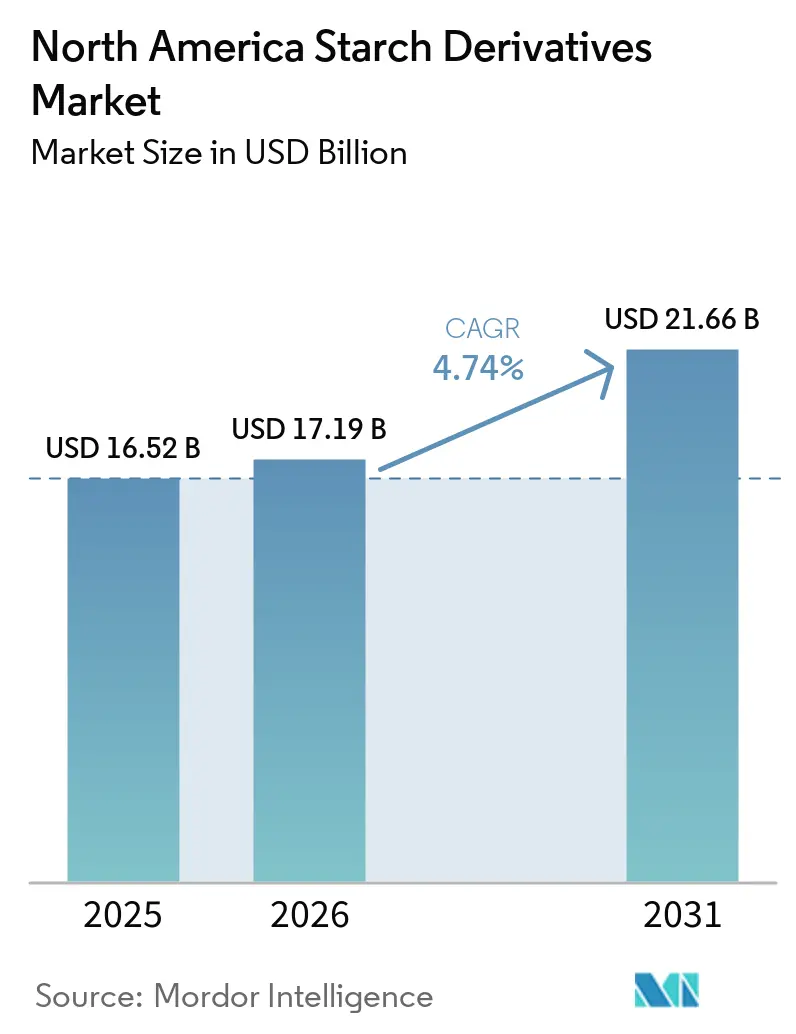
The North America starch derivatives market was USD 16.52 billion in 2025 and is projected to reach USD 17.19 billion by 2026 and USD 21.66 billion by 2031, at a CAGR of 4.74% between 2026 and 2031. The North America starch derivatives market is mature, with demand across food and beverage processing, pharmaceuticals, personal care, and animal nutrition. Growth is shifting toward specialty derivatives because food manufacturers are reformulating products, buyers are seeking more functional ingredients, and conventional commodity products have limited room for margin improvement. Commodity starch demand weakened in late 2025 as structural overcapacity placed pressure on this part of the portfolio, which has increased the importance of specialty products for margins. Competitive strategies therefore center on application-specific products, better processing capability, reliable access to agricultural feedstocks, and the ability to serve customers with tightly defined formulation requirements across food, pharmaceutical, personal care, and animal nutrition applications where consistency, compliance, and formulation support can influence supplier selection and long-term commercial relationships throughout the region and adjacent supply chains. Tight grain availability can raise input costs, making hedging, supply resilience, careful procurement, and vertical integration important for processors [1].
Key Report Takeaways
- By type, glucose syrups held a 34.51% share in 2025, while cyclodextrin is forecast to expand at a 6.81% CAGR through 2031.
- By source, maize held a 78.24% share in 2025, while tapioca is forecast to expand at a 6.27% CAGR through 2031.
- By form, powder held a 69.38% share in 2025, while liquid is forecast to expand at a 5.54% CAGR through 2031.
- By application, food and beverage held a 67.17% share in 2025, while pharmaceuticals are forecast to expand at a 6.59% CAGR through 2031.
- By geography, the United States held an 84.75% share in 2025, while Mexico is forecast to expand at a 6.52% CAGR through 2031.
Note: Market size and forecast figures in this report are generated using Mordor Intelligence’s proprietary estimation framework, updated with the latest available data and insights as of January 2026.
Market Trends and Insights
Drivers Impact Analysis of North America Starch Derivatives Market*
| Driver | (~) % Impact on CAGR Forecast | Geographic Relevance | Impact Timeline |
|---|---|---|---|
| Growing Use of Cyclodextrins in Flavor Protection | +0.5% | US core demand, spill-over to Canada and Mexico | Medium term (2-4 years) |
| Expanding Applications in Pharmaceutical Drug Delivery Systems | +0.6% | US dominant, Canada emerging | Long term (≥ 4 years) |
| Growing Demand for Freeze-Thaw Stable Food Ingredients | +0.5% | US and Canada (frozen food hubs); Mexico growing | Medium term (2-4 years) |
| Growing Use of Dextrins in Cosmetic Formulations | +0.4% | Global with North America as premium-innovation hub | Medium term (2-4 years) |
| Technological Advancements in Enzymatic Starch Conversion | +0.5% | US industrial scale, Canada and Mexico gradual adoption | Long term (≥ 4 years) |
| Increasing Adoption of Tapioca-Based Specialty Derivatives | +0.4% | US clean-label demand driven; Mexico import-dependent | Short term (≤ 2 years) |
| Source: Mordor Intelligence | |||
Growing Use of Cyclodextrins in Flavor Protection
Cyclodextrins are cyclic oligosaccharides produced from starch through enzymatic conversion. Their hydrophobic cavity and hydrophilic exterior allow them to encapsulate volatile flavor compounds. This can help protect flavors from heat, light, and oxidation while extending shelf life and maintaining a more consistent sensory profile during storage. Hydroxypropyl beta cyclodextrin is widely used for food flavor and fragrance applications, and controlled release is a key performance benefit. Cyclodextrin metal-organic frameworks are edible and biodegradable, and they can improve the mechanical and active release properties of food packaging films. As food producers lower salt and sugar levels, cyclodextrin complexes can support flavor intensity without requiring higher flavor loading in reformulated foods and beverages.
Expanding Applications in Pharmaceutical Drug Delivery Systems
Native starch, sodium starch glycolate, and pregelatinized starch are approved for use as disintegrants, binders, and fillers in regulated food applications under 21 CFR 172.892 [2]. Modified starch systems are also moving beyond conventional tablet excipients into controlled release and targeted delivery applications that require more precise release performance. A 2025 review describes starch nanoparticles as biocompatible and biodegradable insulin carriers that can protect drugs from gastrointestinal degradation and support pH-responsive and glucose-sensitive delivery. Pharmaceutical-grade derivatives can command higher margins than food-grade equivalents, encouraging wet millers to improve processing capabilities, quality systems, and application support. Enzymatic acetylation, cross-linking, and carboxymethylation can give starches colon-specific release profiles that expand their role in drug delivery. Compliance with FDA requirements and US Pharmacopeia monographs remains essential for suppliers serving pharmaceutical customers.
Growing Demand for Freeze-Thaw Stable Food Ingredients
Ready meals, frozen bakery products, and convenience foods require starch derivatives that maintain texture through repeated freezing and thawing. Ice crystal growth during freezing and starch rearrangement during thawing can cause syneresis and structural damage. Chemical modification can introduce phosphate groups or spatial networks that improve stability. Enzymatic modification can create highly branched short cluster structures that provide similar benefits. Branching enzymes can produce modified corn starch with lower retrogradation, stronger gel structure, and better water-holding capacity. This supports the use of maize-derived modified starches in frozen foods while reducing the need for chemical cross-linking agents and helping manufacturers meet clean label requirements.
Technological Advancements in Enzymatic Starch Conversion
Conventional starch processing requires liquefaction and saccharification at elevated temperatures. Raw starch-degrading enzymes can hydrolyze starch granules at lower temperatures without prior gelatinization. Recent research has focused on protein engineering and genetic modification to improve enzyme efficiency, thermostability, and product yield [3]. Lower temperature conversion can reduce energy requirements and permit processing of heat-sensitive substrates. It can also support specialty derivatives from high-amylose and waxy starch varieties for pharmaceutical and functional food uses, where heat sensitivity can otherwise limit processing choices.
Restraints Impact Analysis of North America Starch Derivatives Market*
| Restraints | (~) % Impact on CAGR Forecast | Geographic Relevance | Impact Timeline |
|---|---|---|---|
| Volatility in Maize and Wheat Prices | -0.6% | US and Canada (corn belt processors); Mexico import-reliant | Short term (≤ 2 years) |
| Stringent Food Safety and Labeling Regulations | -0.4% | US and Canada dominant; COFEPRIS-regulated Mexico | Medium term (2-4 years) |
| Competition From Alternative Natural Sweetening Ingredients | -0.5% | US (HFCS and glucose syrup erosion in beverages) | Short to medium term |
| High Capital Investment in Processing Infrastructure | -0.3% | US dominant; barriers to entry across the region | Long term (≥ 4 years) |
| Source: Mordor Intelligence | |||
Volatility in Maize and Wheat Prices
Maize and wheat underpin a significant volume of the regional starch derivatives supply base. This makes changes in grain prices a direct factor in processor margins. The maize stock-to-use ratio reached 22% in 2025, its lowest level since 2013- 2014, which reduced the available supply buffer. Tight wheat ending stocks and exposure to trade disruptions can also intensify price movements. Corn wet mills are purpose-built facilities with capital cycles of 20 to 30 years, which limits the ability to change feedstocks quickly. Price volatility affects margins and makes long-term pricing discussions more difficult for pharmaceutical and specialty food customers that depend on predictable formula costs and stable deliveries.
Stringent Food Safety and Labeling Regulations
North American rules for starch derivatives have become more specific, especially for modified food starches. Under 21 CFR 172.892, modified food starch is a regulated food additive and requires appropriate labeling. Wheat starch requires allergen disclosure under the Food Allergen Labeling and Consumer Protection Act, including the terms modified wheat starch or Contains Wheat. The FDA set January 1, 2028, as the uniform compliance date for food labeling regulations published between 2025 and 2026. Manufacturers of clean label ingredients must meet requirements for consumer food products and pharmaceutical-grade products, which can require separate documentation, testing, and label review. In Mexico, changing nutritional content and advertising standards are increasing compliance requirements for food processors.
*Our forecasts treat driver/restraint impacts as directional, not additive. The impact forecasts reflect baseline growth, mix effects, and variable interactions.
North America Starch Derivatives Market Segment Analysis
By Type:
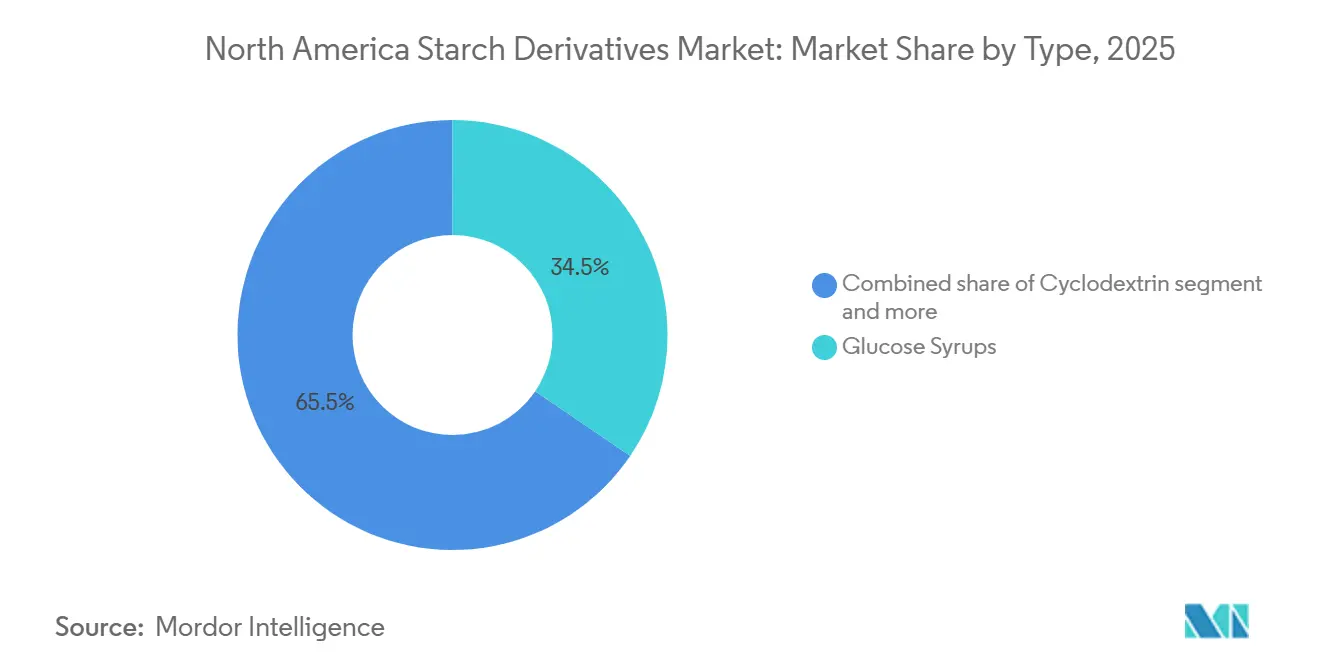
Specialty Derivatives Outpace the Legacy Sweetener BaseGlucose syrups commanded 34.51% of the North America starch derivatives market share in 2025, while cyclodextrin is forecast to grow at a 6.81% CAGR through 2031. Glucose syrups remain important in confectionery, bakery, and industrial fermentation because they combine viscosity and fermentability at established cost levels. Cyclodextrin benefits from demand in flavor stabilization, pharmaceutical excipients, and active packaging, allowing suppliers to address several end-use chains with related technical capabilities. High fructose corn syrup faces demand pressure in beverage applications as manufacturers favor less processed sweetener options. This change has reduced the appeal of older-generation sweeteners within the North America starch derivatives industry.
Maltodextrin remains relevant as a texturizer, carrier, and bulking agent in sports nutrition, dairy alternatives, and pharmaceutical granulation, where formulation consistency and handling properties are important. Dextrins are used in industrial adhesives, cosmetic film formation, and pharmaceutical binding. Personal care formulators are increasingly considering plant-derived materials in place of synthetic polymers. Declining high fructose corn syrup demand can leave processing capacity available for enzymatic conversion into higher value derivatives. This makes portfolio allocation a central decision for major processors in the North America starch derivatives market. Suppliers with application specific products are better placed to serve pharmaceutical, packaging, and functional food customers.

By Source:
Maize Dominance Masks a Structural Tapioca ShiftMaize held 78.24% of the North America starch derivatives market size in 2025, while tapioca is projected to expand at a 6.27% CAGR through 2031. Maize benefits from decades of investment in United States corn wet milling infrastructure. Its broad availability supports large-volume production of glucose syrups, maltodextrin, high fructose corn syrup, and modified starches. Tapioca is gaining use because it offers freeze-thaw stability, a neutral flavor profile, and clean label suitability. It also supports allergen-free declarations that are increasingly important in bakery and dairy alternative products.
Wheat starch remains useful in bakery and pharmaceutical applications where its pasting behavior and protein co-extraction economics provide advantages. Its allergen designation creates labeling challenges for clean label products. Potato starch serves sauces, soups, and frozen foods where viscosity and transparent gel properties are needed. Limited domestic cultivation restricts its scale in North America. Tapioca remains import-dependent because United States cassava cultivation is negligible. This dependence is leading buyers to use dual sourcing and inventory buffers across the North America starch derivatives industry, especially where clean label specifications restrict alternative material choices.
By Form:
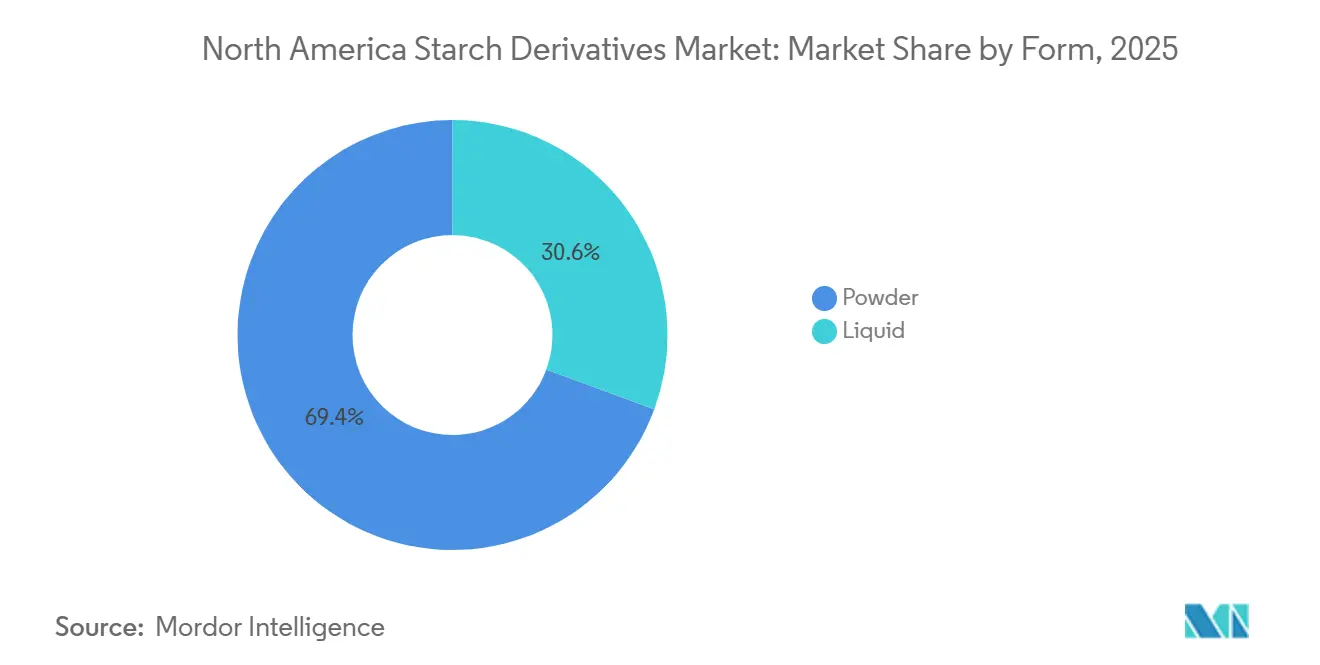
Powder's Processing Advantage Yields Ground to Liquid ConveniencePowder held 69.38% of segment value in 2025, while liquid starch derivatives are forecast to grow at a 5.54% CAGR through 2031. Powder formats do not require refrigeration and can have longer shelf lives. They are also well suited to dry blending and batching operations in food and pharmaceutical manufacturing, where storage flexibility and precise dosing support established plant routines. Liquid formats reduce handling steps and dissolving time in beverage manufacturing, industrial fermentation, and continuous food processing. The North America starch derivatives market is therefore seeing liquid demand rise in settings that can support continuous process infrastructure.
The movement toward liquid formats is particularly relevant to glucose syrup and maltodextrin uses in high-volume beverage and dairy plants. Large plants can spread the handling costs of liquid ingredients across substantial production volumes. Spray-dried cyclodextrin powder is gaining use as a carrier for water-insoluble drug compounds in pharmaceutical applications. This niche can command higher prices than commodity powder. Tapioca-based powder remains preferred for gluten-free bakery and plant-based dairy because it provides viscosity, stability, and freeze-thaw performance. Powder will remain important where storage, transport, dry processing requirements, and long supply chains shape ingredient choices for manufacturers and distributors.
By Application:
Pharmaceutical Demand Elevates the Value CeilingFood and beverage accounted for 67.17% of application value in 2025, while pharmaceutical starch derivatives are forecast to grow at a 6.59% CAGR through 2031. Food and beverage demand includes bakery, confectionery, and beverages. Starches improve texture, moisture retention, shelf life, binding, gelling, crystallization control, stabilization, and mouthfeel across products with different manufacturing conditions and consumer expectations. Pharmaceutical use is growing as producers adopt advanced nanoparticle and controlled release systems. The North America starch derivatives market offers higher value opportunities to suppliers with pharmaceutical manufacturing credentials.
Corn, potato, rice, and wheat-based excipients provide distinct pharmaceutical functions, and modification methods can extend their role in colon-specific and sustained-release delivery. Personal care and cosmetics remain smaller but higher-margin applications. Starch can function as an absorbent, film former, and plant-derived alternative to synthetic polymers in skincare, haircare, and makeup. Animal feed provides stable demand by using by-product streams from starch processing. This base demand helps support the economics of large-scale wet milling by providing an outlet for by-product streams from primary starch processing. The application mix is moving toward products that require technical support, compliance capability, and tailored functional performance.
Geography Analysis
United States Starch Derivatives Market
The United States held 84.75% of the North America starch derivatives market share in 2025. Its position is supported by Corn Belt feedstock supply, dense food and beverage manufacturing, pharmaceutical production, clean label ingredient development, and large established customer networks. Major wet milling networks operated by ADM, Cargill, Ingredion, and Primient have been built through decades of capital investment. These networks create high barriers to replication and support regional production of glucose syrups, maltodextrin, high fructose corn syrup, and specialty cyclodextrin grades for domestic and regional customers. The North America starch derivatives market relies on the United States as a price-setting and product innovation center.
Canada Starch Derivatives Market
Canada is the second largest geography in the region and has steady demand for specialty starch derivatives. Bakery, packaged snacks, and nutritional supplements support this demand. Manufacturers are increasing use of tapioca starch in clean label reformulation as retailers seek allergen-free ingredient declarations and food producers work to simplify ingredient statements. Ontario and Quebec support pharmaceutical manufacturing demand for starch excipients. The Food and Drug Act and Health Canada's Food Directorate set the framework for permissible food and pharmaceutical starch derivatives. Canada's premium oriented consumer base supports value growth in specialty and functional categories, where product differentiation can matter more than commodity volume growth.
Mexico Starch Derivatives Market
Mexico is projected to lead regional growth at a 6.52% CAGR through 2031. Urbanization, convenience food demand, and Mexico's role as a food processing and export hub support this outlook, particularly in production networks linked to the United States and Canada. Mexico had a population above 131 million in 2025. Specialized starch derivative imports were USD 6.9 million in November 2025, compared with USD 1.3 million in exports, indicating reliance on external suppliers for specialty modified starches and cyclodextrins, according to the Government of Mexico. Starches and enzymes are identified as solutions for processors pursuing sustainability related food production goals, according to USDA. Rest of North America remains a smaller and stable contributor with demand from specialty food processors and agricultural feed applications.
Competitive Landscape
The North America starch derivatives market has a moderately fragmented structure. Archer Daniels Midland Company, Cargill, Incorporated, and Ingredion Incorporated form the leading group through corn wet milling scale, integrated supply chains, and the ability to serve both commodity and specialized customer requirements. Their operations connect feedstock origination, starch conversion, and specialty ingredient production. Primient, Grain Processing Corporation, Roquette Frères, and Tate and Lyle PLC compete in functional and specialty categories. Companies are responding to weaker commodity demand by increasing their focus on operational efficiency, innovation, customized formulations, and products with higher technical specifications.
Pharmaceutical excipients and clean label food ingredients are important opportunity areas because demand is growing faster than supply capability in some product groups, particularly where certifications and specialized processing are required. Ingredion announced a USD 50 million investment in its Cedar Rapids, Iowa facility in February 2025 to expand industrial starch capacity for packaging and papermaking applications. The project includes 3 industrial buildings and a starch flash dryer, and it is expected to raise corn processing capacity by as much as 50%. These investments strengthen access to differentiated starch products and reinforce the value of reliable supply capacity.
Technology is becoming a more important basis of competition in specialty products as customers seek reliable performance, lower process risk, and ingredients matched to specific applications. Proprietary enzymes, precision spray drying, and digital process control can help companies develop differentiated formulations. Compliance with FDA requirements and US Pharmacopeia monographs limits entry into pharmaceutical grade applications. ADM invested more than USD 16 million in its Boone County, Kentucky facility in July 2026 to expand naturally derived color production capacity, adding 14,000 square feet of manufacturing space. This project builds on an earlier USD 26 million investment at the adjacent Erlanger site and supports food and beverage reformulation work. Established processors retain advantages because they combine plant scale, technical resources, compliance capabilities, established sourcing networks, and experience supporting complex customer formulations.
North America Starch Derivatives Industry Leaders
-
Archer Daniels Midland Company
-
Cargill, Incorporated
-
Ingredion Incorporated
-
Tate & Lyle PLC
-
Roquette Frères S.A.
- *Disclaimer: Major Players sorted in no particular order

North America Starch Derivatives Market Companies Covered in this Report
- Archer Daniels Midland Company
- Cargill, Incorporated
- Ingredion Incorporated
- Primient
- Grain Processing Corporation
- Roquette Frères S.A.
- Tate & Lyle PLC
- Matsutani Chemical Industry Co., Ltd.
- Wacker Chemie AG
- Emsland Group
- AGRANA Beteiligungs-AG
- Südzucker AG
- Tereos S.A.
- Royal Avebe
- KMC
- MEGGLE GmbH & Co. KG
- Crespel & Deiters GmbH & Co. KG
- Sunar Group
- Baolingbao Biology Co., Ltd.
- Gujarat Ambuja Exports Limited
Recent Industry Developments in North America Starch Derivatives Market
- July 2026: ADM invested over USD 16 million in its Boone County, Kentucky facility to expand naturally derived color production capacity, adding 14,000 square feet of manufacturing space. The project builds on an earlier USD 26 million investment at the adjacent Erlanger facility and creates a growing innovation cluster in Northern Kentucky focused on food and beverage reformulation, directly relevant to starch-derived carrier and co-ingredient demand.
- March 2026: Roquette opened a starch and polyol pilot center at its Lianyungang, China, plant, spanning more than 1,000 square meters. The facility integrates physicochemical analysis, laboratory-scale research, and pilot-scale industrial transformation to address purity requirements, cost challenges, and process stability in specialty starch production.
- January 2026: ADM announced a USD 26 million investment in its Erlanger, Kentucky campus to strengthen capabilities for food and beverage reformulation demand, including a 3,600-square-foot expansion and digitalization upgrades. The investment follows a USD 15 million deployment at the same site in 2025 and positions Erlanger as ADM's primary innovation center for taste, flavor, and color co-creation with food and beverage customers.
North America Starch Derivatives Market Report Scope
The North America Starch Derivatives Market is Segmented by Type (Glucose Syrups, High Fructose Corn Syrup (HFCS), Maltodextrin, Cyclodextrin, Dextrins, and Other Types), by Source (Maize, Wheat, Potato, Tapioca, and Other Sources), by Form (Powder and Liquid), by Application (Food and Beverage, Animal Feed, Pharmaceutical, Personal Care and Cosmetics, and Other Applications), and by Geography (United States, Canada, Mexico, and Rest of North America). The Market Forecasts are Provided in Terms of Value (USD).
Segmentation Overview
By Type
| Glucose Syrups |
| High Fructose Corn Syrup (HFCS) |
| Maltodextrin |
| Cyclodextrin |
| Dextrins |
| Other Types |
By Source
| Maize |
| Wheat |
| Potato |
| Tapioca |
| Other Sources |
By Form
| Powder |
| Liquid |
By Application
| Food and Beverage | Bakery |
| Confectionery | |
| Beverage | |
| Other Food and Beverage | |
| Pharmaceutical | |
| Personal Care and Cosmetics | |
| Animal Feed | |
| Other Application |
By Geography
| United States |
| Canada |
| Mexico |
| Rest of North America |
| By Type | Glucose Syrups | |
| High Fructose Corn Syrup (HFCS) | ||
| Maltodextrin | ||
| Cyclodextrin | ||
| Dextrins | ||
| Other Types | ||
| By Source | Maize | |
| Wheat | ||
| Potato | ||
| Tapioca | ||
| Other Sources | ||
| By Form | Powder | |
| Liquid | ||
| By Application | Food and Beverage | Bakery |
| Confectionery | ||
| Beverage | ||
| Other Food and Beverage | ||
| Pharmaceutical | ||
| Personal Care and Cosmetics | ||
| Animal Feed | ||
| Other Application | ||
| By Geography | United States | |
| Canada | ||
| Mexico | ||
| Rest of North America | ||
Key Questions Answered in the Report
What is the forecast growth rate for North America starch derivatives?
The sector is projected to grow at a 4.74% CAGR from 2026 to 2031, rising from USD 16.52 billion in 2025 to USD 21.66 billion by 2031.
Which product type is growing fastest in North America?
Cyclodextrin is the fastest growing type, with a projected CAGR of 6.81% through 2031, supported by flavor protection, drug delivery, and packaging uses.
Why are tapioca-based starch derivatives gaining demand?
Tapioca is forecast to grow at a 6.27% CAGR through 2031 because it supports allergen free, non-GMO, clean label, and freeze thaw stable formulations.
Which country leads regional demand?
The United States leads with 84.75% share in 2025 because it has large corn wet milling capacity, food manufacturing, and pharmaceutical production.