
Market Overview
| Study Period | 2020 - 2031 |
|---|---|
| Forecast Data Period | 2026 - 2031 |
| Base Year Market Size (2025) | USD 40.60 Billion |
| Market Size (2026) | USD 41.77 Billion |
| Market Size (2031) | USD 47.94 Billion |
| Growth Rate (2026 - 2031) | 2.79 % |
| Market Concentration | Medium |
Major Players *Disclaimer: Major Players sorted in no particular order Image © Mordor Intelligence. Reuse requires attribution under CC BY 4.0. | |
North America Process Automation Market Analysis by Mordor Intelligence
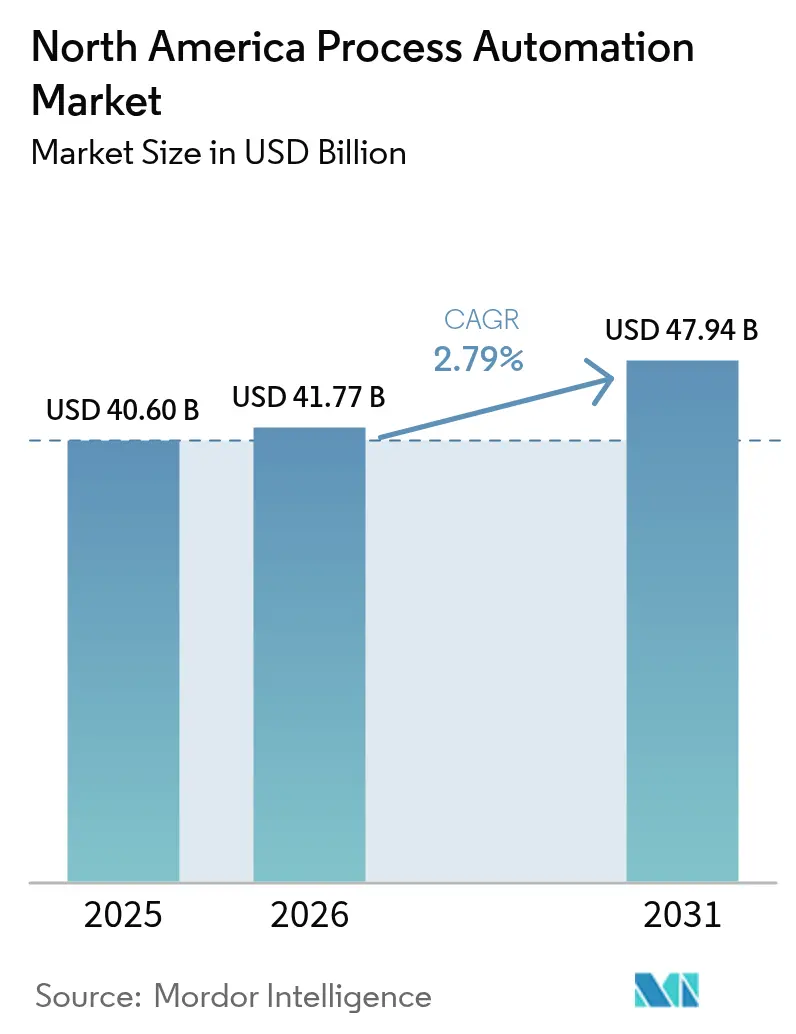
The North America process automation market size is projected to expand from USD 40.60 billion in 2025 and USD 41.77 billion in 2026 to USD 47.94 billion by 2031, registering a CAGR of 2.79% between 2026 to 2031. Real-time optimization, carbon-pricing exposure, and tightening safety regulations are prompting refiners, chemical makers, and pharmaceutical plants to phase out legacy distributed control systems and adopt edge-enabled, cybersecurity-hardened architectures. Operators are shifting budgets toward data-driven energy-efficiency projects because federal and provincial carbon levies reward every percentage point of natural-gas savings. Wireless instrumentation is gaining ground in hazardous zones where trenching costs and hot-work permits inflate the price of new cabling, while protocol-agnostic middleware is opening brownfield facilities to multi-vendor software solutions. Competitive dynamics are intensifying as cloud hyperscalers enter the automation value chain with managed historians and machine-learning services that bypass proprietary hardware.
Key Report Takeaways
- By communication protocol, wired communication captured 61.19% of the North America process automation market share in 2025 while wireless alternatives are forecast to grow at a 3.11% CAGR through 2031.
- By system type, hardware represented 58.43% of revenue in 2025 but software is projected to post the fastest expansion at a 3.56% CAGR to 2031.
- By component, hardware generated 52.71% of 2025 spending, whereas services are expected to advance at the fastest 3.24% CAGR through 2031.
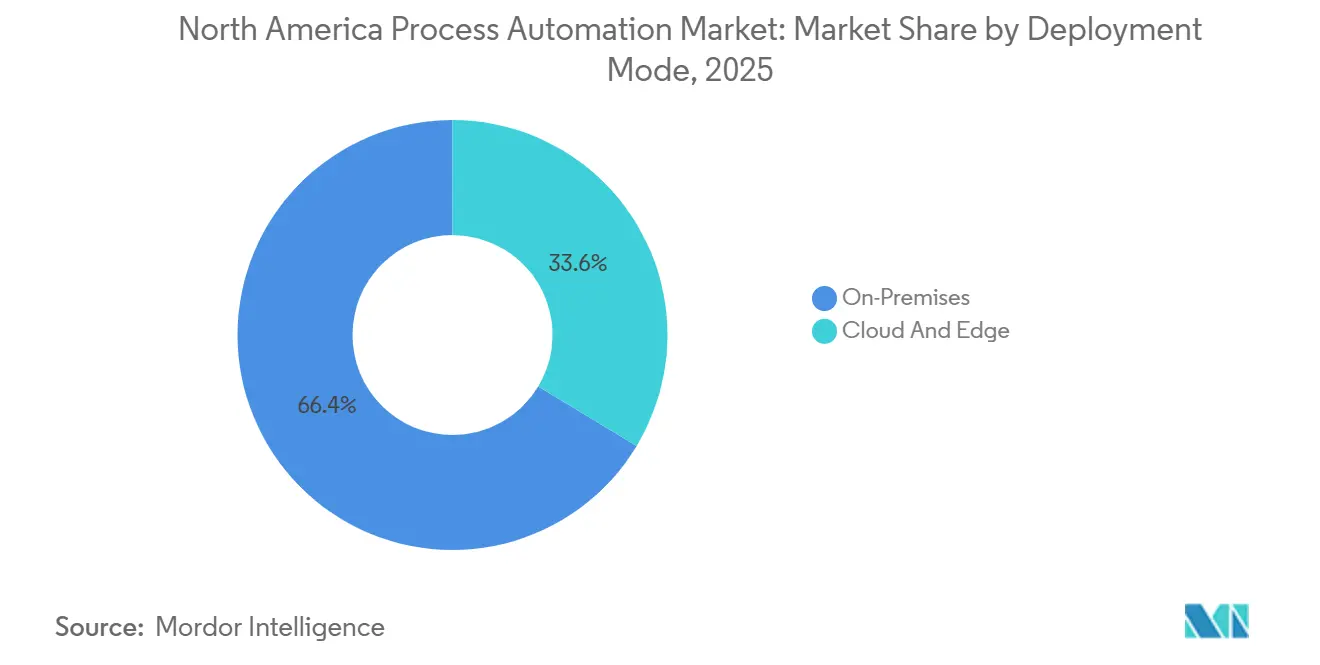
- By deployment mode, on-premises deployments held 66.37% of spending in 2025 while cloud and edge architectures are projected to increase at a 3.85% CAGR over the forecast period.
- By end-user industry, oil and gas led with 21.55% revenue share in 2025 whereas pharmaceutical manufacturing is poised to deliver the quickest rise at a 4.53% CAGR through 2031.
- By geography, the United States commanded 78.68% of regional revenue in 2025 while Mexico is projected to register the strongest growth at a 4.62% CAGR to 2031.
Note: Market size and forecast figures in this report are generated using Mordor Intelligence’s proprietary estimation framework, updated with the latest available data and insights as of 2026.
Market Trends and Insights
Drivers Impact Analysis of North America Process Automation Market*
| Driver | (~) % Impact on CAGR Forecast | Geographic Relevance | Impact Timeline |
|---|---|---|---|
| Rising Focus on Energy-Efficiency and OpEx Reduction | +0.80% | United States (Gulf Coast, Midwest), Canada (Alberta oil sands) | Medium term (2-4 years) |
| Heightened Demand for Safety-Instrumented Systems | +0.60% | United States (Texas, Louisiana refineries), Canada (petrochemical hubs) | Short term (≤ 2 years) |
| Proliferation of Industrial IoT Platforms | +0.50% | United States (manufacturing belt), Mexico (nearshoring corridors) | Medium term (2-4 years) |
| Shift Toward Predictive and Prescriptive Maintenance Analytics | +0.40% | United States, Canada | Medium term (2-4 years) |
| Carbon-Intensity Penalties Accelerating Digital Process Control | +0.50% | Canada (federal carbon tax zones), United States (California, Northeast states) | Long term (≥ 4 years) |
| Demand for Fenceless Cobots in Hybrid Process Lines | +0.20% | United States (food and beverage, pharmaceutical packaging) | Long term (≥ 4 years) |
| Source: Mordor Intelligence | |||
Rising Focus on Energy-Efficiency and OpEx Reduction
Process manufacturers are recasting automation as an emissions-cutting tool. The U.S. Department of Energy’s 2024 Industrial Decarbonization Roadmap outlines a 10%-15% reduction target for industrial energy intensity by 2030, prioritizing advanced process control and real-time optimization for chemical and refining assets.[1] Canadian oil-sands operators face a legislated carbon price of CAD 170 per tonne by 2030, prompting the rollout of edge analytics that adjust combustion-air ratios and feedwater chemistry inside steam generators, trimming natural-gas use by up to 5% per barrel of synthetic crude.[2] Payback periods under 18 months have been documented at Gulf Coast facilities that fine-tune distillation and heat-exchanger networks through multivariable controllers. These early wins are steering 2026 capital budgets toward digital debottlenecking rather than pure capacity expansions.
Heightened Demand for Safety-Instrumented Systems
A string of refinery and chemical-plant incidents in 2024-2025 elevated regulatory scrutiny. The U.S. Chemical Safety and Hazard Investigation Board linked several fires to inadequate safety-integrity-level verification, spurring retrofits of pneumatic trip systems with smart positioners that enable online diagnostics.[3] Compliance with OSHA Process Safety Management now requires documented proof tests, driving purchases of integrated safety controllers that interface with existing DCS networks through secure OPC-UA gateways. Vendors report double-digit order growth for safety PLCs as pharmaceutical and food processors adopt the same architectures to satisfy sterile-fill and allergen-control mandates.
Proliferation of Industrial IoT Platforms
Industrial IoT deployments have moved from pilot to production. Microsoft and Siemens offer Azure-based templates that funnel data from wellhead controllers and pipeline SCADA systems to cloud historians without bespoke coding.[4] Edge gateways handle latency-sensitive analytics locally, achieving sub-100 ms loop response while maintaining cloud scalability. Mexican tier-one automotive suppliers in Nuevo León are using such edge-to-cloud stacks to synchronize stamping presses with continuous coating lines, shortening model changeovers and supporting nearshoring strategies.
Shift Toward Predictive and Prescriptive Maintenance Analytics
Predictive maintenance now combines wireless vibration, thermal, and process data with machine-learning models that rank corrective actions by economic impact. At a major Texas refinery, wireless sensors on 1,200 rotating assets generated early warnings six weeks before traditional threshold alarms, allowing maintenance during low-margin windows. Prescriptive software then simulated energy penalties linked to deferring heat-exchanger cleaning, quantifying the trade-off for planners. The convergence of OT data diodes with IT analytics is widening the adoption curve despite cybersecurity constraints imposed by federal pipeline-security directives.
Restraints Impact Analysis of North America Process Automation Market*
| Restraint | (~) % Impact on CAGR Forecast | Geographic Relevance | Impact Timeline |
|---|---|---|---|
| High Upfront CapEx and Integration Complexity | -0.50% | United States (brownfield refineries, chemical plants), Canada (oil sands) | Short term (≤ 2 years) |
| Brown-Field Interoperability Challenges | -0.40% | United States (Gulf Coast, Midwest), Canada (Alberta) | Medium term (2-4 years) |
| Operational Cybersecurity Talent Deficit | -0.30% | United States, Canada | Medium term (2-4 years) |
| Long-Term Service-Contract Lock-Ins Limiting Vendor Switch | -0.20% | United States, Canada | Long term (≥ 4 years) |
| Source: Mordor Intelligence | |||
High Upfront CapEx and Integration Complexity
Comprehensive migrations from proprietary DCS platforms can exceed USD 50 million per site, a sum that clashes with payback horizons demanded by corporate finance teams. An American Fuel and Petrochemical Manufacturers survey found that 62% of refineries defer cloud historians because of cutover risks and the need for dual operations during commissioning. Brownfield plants often rely on legacy fieldbus networks that necessitate costly protocol converters when interfacing with modern edge devices, stretching project timelines to seven years when tackled in phased turnarounds.
Operational Cybersecurity Talent Deficit
The Industrial Control Systems Cyber Emergency Response Team recorded a 40% vacancy rate for engineers certified on IEC 62443 in 2025, forcing operators to outsource managed security services that lengthen vendor lock-ins. A ransomware incident at a Midwest chemical plant revealed that attackers exploited historian servers bridging IT and OT networks, illustrating the skills gap in segmentation and patch management. Competition for talent from finance and telecom sectors inflates salary premiums and strains operational budgets, slowing digital-transformation roadmaps.
*Our forecasts treat driver/restraint impacts as directional, not additive. The impact forecasts reflect baseline growth, mix effects, and variable interactions.
North America Process Automation Market Segment Analysis
By Communication Protocol:
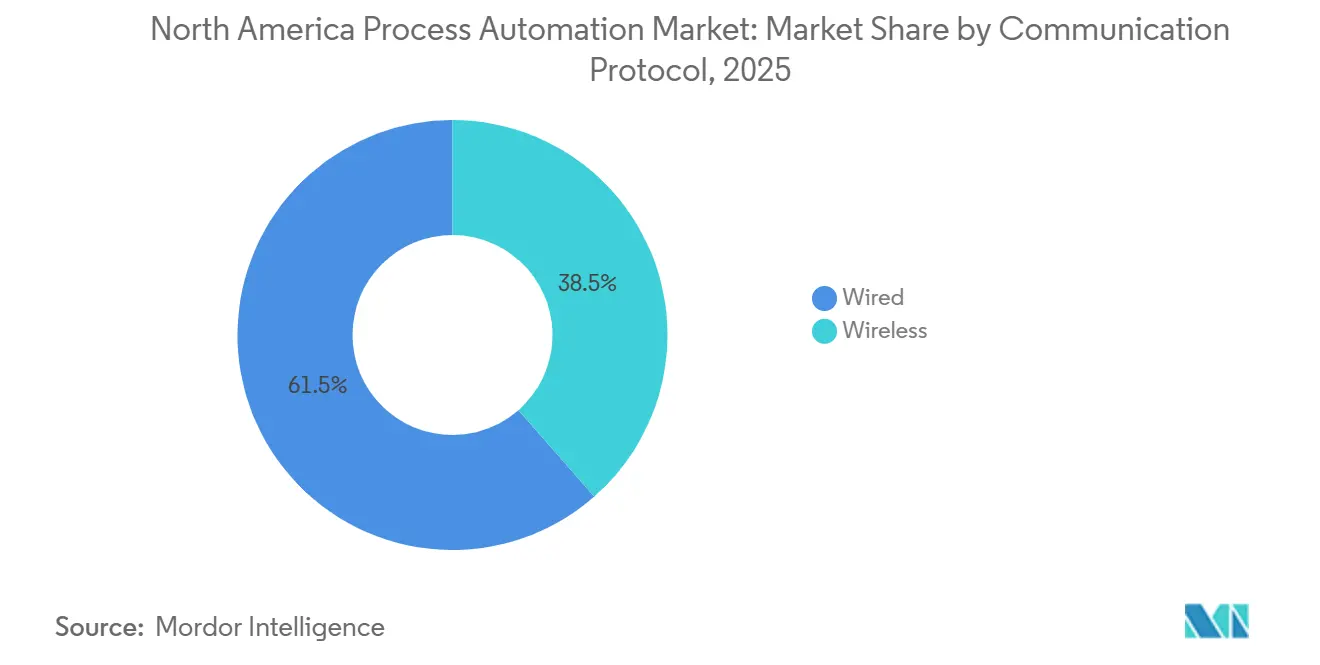
Wireless Gains in Hazardous ZonesWired networks held 61.19% of North America process automation market share in 2025. Their dominance stems from entrenched HART, PROFIBUS, and Foundation Fieldbus loops that anchor safety-critical interlocks and high-speed controls. WirelessHART and ISA100.11a devices, however, are forecast to expand at a 3.11% CAGR as intrinsic-safety-certified transmitters allow deployment inside Class I Division 1 areas, eliminating conduit runs that can cost USD 3,000 per meter. Shell’s Norco refinery used 400 wireless transmitters to cut installation labour by 60% while maintaining 99.5% packet reliability. In parallel, edge gateways normalize wired and wireless data so that predictive algorithms detect sensor drift regardless of medium. Regulatory updates to NFPA 70 have formalized this coexistence by permitting wireless devices where risk assessments validate signal integrity.
Wired links remain indispensable for emergency shutdown valves, burner-management systems, and compressor anti-surge controls because IEC 61511 demands deterministic latency. Consequently, the North America process automation market retains a hybrid topology in which wireless augments, rather than replaces, critical hardwired loops. Project teams now model radio-frequency propagation in 3-D digital twins to pre-empt interference before issuing hot-work permits.
By System Type:
Software Outpaces Hardware GrowthHardware generated 58.43% of 2025 revenue, yet software is projected to register the leading 3.56% CAGR through 2031. Open-standard controllers running on commercial off-the-shelf hardware are eroding the pricing power of proprietary DCS cabinets. Subscription-based advanced process control suites mean operators can unlock new functionality without capital projects, a trend exemplified by pulp and paper mills that deploy multivariable controllers to shave 6% off steam demand. Meanwhile, North America process automation market size for manufacturing execution systems is rising as pharmaceutical firms embrace electronic batch records to comply with FDA data-integrity guidance.
Cyber-hardened SCADA upgrades form a brisk replacement cycle because many midstream pipeline systems still run on unsupported operating systems vulnerable to ransomware. Vendors now package SCADA kernels inside virtual machines hosted on hardened Linux, slashing patch windows and supporting rapid disaster recovery. Smart sensors with embedded diagnostics lengthen calibration intervals, reinforcing the shift from capital equipment toward digital lifecycle services.
By Component:
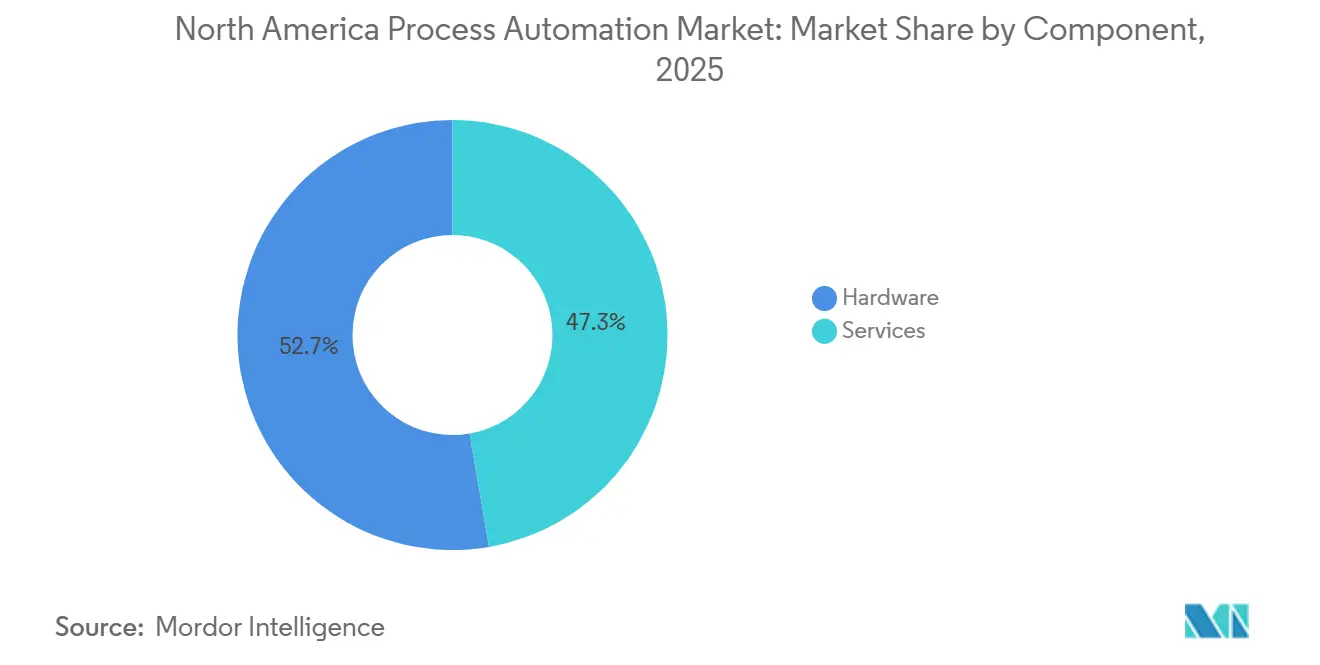
Services Surge on Lifecycle ManagementHardware accounted for 52.71% of 2025 component spend, yet services are forecast to climb at a 3.24% CAGR, the fastest within the North America process automation market. Scarcity of in-house engineers able to integrate cloud APIs, edge containers, and legacy I/O has elevated demand for vendor-led lifecycle agreements that guarantee uptime or energy savings. Emerson, for example, prices its Plantweb Optics program on a monthly monitored-asset basis, converting a traditional CAPEX sale into an OPEX subscription. Cybersecurity services are the fastest-growing slice following Transportation Security Administration directives that mandate continuous vulnerability assessments for pipeline SCADA.
Software components are moving from perpetual licenses to consumption-based arrangements that align fees with value realized. AspenTech’s 2024 pivot to a subscription model initially faced resistance, yet customers now appreciate the ability to scale licenses during turnarounds and receive algorithm updates without fresh validation cycles. Hardware suppliers facing low-cost Asian entrants are bundling analytics to preserve margins, blending the hardware-software boundary.
By Deployment Mode:
Cloud Gains Despite Latency ConcernsOn-premises deployment held 66.37% of 2025 outlays, reflecting ingrained risk aversion toward internet connectivity in control rooms. Cloud and edge solutions, however, are projected to advance at a 3.85% CAGR as hyperscalers certify infrastructure for regulated industries. Chevron’s hybrid architecture streams time-compressed summaries from wellhead edge nodes to Azure-hosted models that optimize artificial-lift parameters, trimming local server footprints by 70% while upholding sub-second safety-loop response.
FDA-aligned audit trails delivered by validated cloud instances are warming pharmaceutical executives to off-prem historians. Subscription fees and data-egress costs remain watchpoints, so many operators adopt edge devices that host containerized analytics locally and forward only aggregated KPIs.
By End-User Industry:
Pharmaceutical Leads GrowthOil and gas delivered 21.55% of 2025 revenue, but pharmaceutical plants are projected to log the fastest 4.53% CAGR as FDA continuous-manufacturing guidance rewards closed-loop control. Pfizer’s Kalamazoo line maintains tablet weight within 2% relative standard deviation using inline spectroscopy tied to feedback loops, a precision unattainable in batch mode.
Moderna’s mRNA vaccine facilities employ automated bioreactor controls that adjust flow rates based on real-time analytics, accelerating scale-up. Chemical complexes on the U.S. Gulf Coast continue to invest heavily in advanced control to squeeze yield gains from megaproject crackers, while water utilities adopt batch-recipe management software to meet nutrient-discharge caps.
Geography Analysis
United States Process Automation Market
The United States contributed 78.68% of North America process automation market size in 2025. Gulf Coast refineries concentrate distributed control systems more densely than any other region worldwide, and recent ransomware incidents have elevated cybersecurity modernization to a board-level priority. Northeast pharmaceutical corridors are adopting continuous-manufacturing lines that eliminate end-product batch testing, bolstering demand for process analytical technology. The U.S. market is projected to rise at a measured 2.5% CAGR through 2031 as operators balance brownfield constraints against carbon-pricing incentives.
Canada Process Automation Market
Canada’s share is smaller, yet its oil-sands projects represent some of the most automation-intensive facilities in the world. Carbon levies that reached CAD 80 per tonne in 2024 and escalate annually have unlocked budgets for advanced control, predictive maintenance, and emissions monitoring. Suncor and Canadian Natural Resources have earmarked more than CAD 2 billion for digitalization between 2024-2026, targeting 5% cuts in steam-to-oil ratios. Growth is tempered, however, by reinvestment discipline and a narrower industrial base beyond hydrocarbons.
Mexico Process Automation Market
Mexico is forecast to expand at a 4.62% CAGR, the fastest national pace, fuelled by nearshoring of automotive, electronics, and aerospace supply chains. Tesla, BMW, and Samsung plants in Nuevo León, San Luis Potosí, and Querétaro are installing high-precision PLCs, HMIs, and manufacturing-execution software to meet North American content rules under USMCA. Government infrastructure plans and technical-college partnerships aim to relieve skills shortages, while grid-stability upgrades underpin the reliability demanded by electric-vehicle battery-cell lines.
Regulatory Landscape
Process automation deployments in North America are shaped by safety, cybersecurity, and emerging AI governance requirements that affect OT and IT convergence. In the United States, OSHA Process Safety Management and functional safety practice aligned to IEC 61511 continue to drive proof-testing, safety-instrumented system upgrades, and secure connectivity to legacy DCS and SCADA environments. Federal attention to AI policy also adds a compliance lens for automation software that embeds machine learning.
In 2026, policy signals on AI and cyber risk management became more explicit. The White House released a National Policy Framework for AI legislative recommendations on March 20, 2026, and a related June 5, 2026 Federal Register action on promoting advanced AI innovation and security, which reinforces the need for consistent governance for AI-enabled systems used in industrial operations. In Canada, implementation work around the Critical Cyber Systems Protection Act (CCSPA) under Bill C-8 (as discussed in 2026 legal and policy guidance) and provincial privacy requirements such as Quebec Law 25, including privacy impact assessments for higher-risk automated systems, raise compliance expectations for connected industrial data flows. Standards updates also matter for hybrid plants adopting robotics and collaborative automation, including CSA Z434-2026 (aligned with updated ISO 10218 parts), which provides a current anchor for robot and robot cell safety in Canadian facilities.
Competitive Landscape
The North America process automation market exhibits moderate concentration. ABB, Siemens, Schneider Electric, Rockwell Automation, and Emerson leverage multi-decade installed bases and long-term service contracts that raise switching costs by roughly 30% of replacement CAPEX. Software layers are less consolidated: AspenTech, AVEVA, and a cohort of edge-analytics start-ups provide protocol-agnostic applications that slot atop any controller, eroding proprietary moats. Siemens acquired Brightly Software in 2024 to deepen asset-performance management services, turning one-off sales into recurring revenue.
Rockwell Automation’s collabouration with Microsoft embeds Azure machine-learning inside FactoryTalk, letting customers analyze historian data without migrating from Logix controllers. ABB’s USD 180 million Louisiana petrochemical contract showcases demand for distributed control tightly coupled with edge analytics, while Emerson’s USD 300 million Austin expansion adds a cybersecurity operations center to support IEC 62443 compliance.
White-space opportunities are opening in hybrid process-discrete environments such as continuous-tableting or flexible beverage packaging, where Beckhoff and B&R offer PC-based control that unifies motion, vision, and logic on a single platform. Hyperscalers AWS, Microsoft, and Google Cloud now market managed historians and anomaly detection as a service, threatening to commoditize traditional value propositions anchored in proprietary integration expertise. Vendors able to deliver pre-validated architectures for FDA 21 CFR Part 11 or IEC 61511 slash project lead times by a year, conferring a competitive edge in highly regulated segments.
North America Process Automation Industry Leaders
-
ABB Ltd.
-
Siemens AG
-
Schneider Electric SE
-
General Electric Company
-
Rockwell Automation, Inc.
- *Disclaimer: Major Players sorted in no particular order

North America Process Automation Market Companies Covered in this Report
- Abb Ltd.
- Siemens Ag
- Schneider Electric Se
- General Electric Company
- Rockwell Automation, Inc.
- Emerson Electric Co.
- Mitsubishi Electric Corporation
- Honeywell International Inc.
- Omron Corporation
- Fuji Electric Co., Ltd.
- Delta Electronics, Inc.
- Yokogawa Electric Corporation
- Phoenix Contact Gmbh & Co. Kg
- Bosch Rexroth Ag
- Beckhoff Automation Gmbh & Co. Kg
- Festo Se & Co. Kg
- Endress+Hauser Group Services Ag
- Aspen Technology, Inc.
- Aveva Group Plc
- Azbil Corporation
Market Opportunities and Future Outlook
Modernization programs in North America are creating whitespace where operators want measurable outcomes without full rip-and-replace migrations, particularly in brownfield refineries, chemicals, pipelines, and regulated pharma. The market already shows a shift toward software and services layered over existing assets, including protocol-agnostic middleware, secure OPC-UA gateways, and managed lifecycle agreements that help address the IEC 62443 skills gap highlighted in 2025. With on-premises deployments still holding 66.37% of 2025 spending, the path forward is more often hybrid, keeping deterministic safety loops local while moving historians and analytics to certified environments.
A second opportunity track is the build-out of power and digital infrastructure that increases demand for automation-ready electrical equipment, reliability engineering, and energy management across industrial sites. Schneider Electric’s 2026 Industrial Automation Modernization as a Service offer, pairing EcoStruxure Automation Expert with HPE hybrid infrastructure, targets the integration complexity that typically slows phased upgrades. ABB’s expanded scope on large energy and data infrastructure projects, including supplying power infrastructure and medium-voltage UPS technology for Applied Digitals 300 MW Polaris Forge 2 campus in North Dakota, also points to pull-through for controls, monitoring, and service contracts tied to high-availability facilities. In Canada, rising carbon costs and tightening cyber and privacy expectations continue to justify projects that combine energy optimization, emissions monitoring, and secure remote operations, especially in oil sands and other automation-intensive assets.
Recent Industry Developments in North America Process Automation Market
- July 2026: ABB expanded its partnership with Applied Digital to supply power infrastructure for the 300 MW Polaris Forge 2 data center campus in North Dakota, including medium-voltage static UPS technology. The deal supports ABB's position in high-availability power and monitoring systems that sit adjacent to process-grade automation and industrial controls, and it increases demand for integrated commissioning and lifecycle services tied to large-scale infrastructure.
- June 2026: Schneider Electric launched Industrial Automation Modernization as a Service built on HPE infrastructure, combining EcoStruxure Automation Expert with HPE SimpliVity hybrid cloud. Packaging modernization as a service lowers the barrier for brownfield plants that face multi-year cutovers and high upfront CapEx, while accelerating adoption of software-defined, interoperable architectures in regulated and uptime-sensitive environments.
- May 2026: Siemens announced a $1 billion cumulative investment in U.S. manufacturing over the past five years, targeting additional capacity and workforce development. The investment supports regional supply chain resilience for industrial automation and electrification equipment, helping shorten lead times for control hardware and enabling faster execution of modernization programs across North American process industries.
North America Process Automation Market Report Scope and Research Methodology
Market Definition and Coverage
For this study, the market covers revenue generated from process automation hardware, software, and related services used to monitor, control, and optimize industrial processes across North America, mainly in continuous and batch production environments.
Scope exclusions: We exclude discrete factory automation lines that are not tied to process industries, along with general IT services that are not directly linked to automation systems.
Segments Covered in This Report
- By Communication Protocol
- Wired
- Wireless
- By System Type
- Hardware
- Scada
- Distributed Control System (Dcs)
- Programmable Logic Controller (Plc)
- Human-Machine Interface (Hmi)
- Process Safety Systems
- Valves And Actuators
- Electric Motors
- Sensors And Transmitters
- Software
- Advanced Process Control (Arc, Mvc, Inferential)
- Data Analytics And Reporting
- Manufacturing Execution Systems (Mes)
- Other Software
- Hardware
- By Component
- Hardware
- Software
- Services
- By Deployment Mode
- On-Premises
- Cloud And Edge
- By End-User Industry
- Oil And Gas
- Chemical And Petrochemical
- Power And Utilities
- Water And Wastewater
- Food And Beverage
- Pulp And Paper
- Pharmaceutical
- Other End-User Industry
- By Country
- United States
- Canada
- Mexico
Data Sources, Market Sizing, and Validation
Desk Research
Desk research was used to set a clean scope and to build the first demand and supply signals for North America, before assumptions were tested through interviews. We reviewed public sources such as U.S. Census Bureau manufacturing statistics, the U.S. Energy Information Administration, the Federal Reserve industrial production series, the USGS for materials and output indicators, and trade data published by the U.S. International Trade Commission.
To connect these macro signals to automation spend, we also relied on company annual reports, earnings call transcripts, investor presentations, and association websites that describe industrial controls and instrumentation adoption. We referenced paid database subscriptions for company financials and intelligence, and for patent activity checks, since those signals help confirm product and offering focus over time. The desk sources listed here are illustrative only, and we also used additional public references to complete data collection, validation, and clarification.
Primary Interviews and Surveys
Primary work was used to pressure test the model and translate broad indicators into realistic penetration, pricing, and replacement-cycle assumptions. We spoke with automation suppliers, system integrators, plant engineering teams, and procurement roles across the United States, Canada, and Mexico. Where the input ranges did not reconcile with the model outputs, we re-contacted the same respondent groups to narrow the assumptions.
Distribution of primary research fieldwork respondents
| Company type | Respondent position |
|---|---|
| Top tier: 38% | CXOs: 18% |
| Mid tier: 41% | Functional/Unit leaders: 36% |
| Smaller Players: 21% | Managers: 46% |
Market-Sizing & Forecasting
Sizing started with a top-down approach, where industrial production and process-industry activity in North America were translated into an addressable automation spend pool, then split across hardware, software, and services based on observed end-user adoption patterns. To keep totals realistic, we corroborated results with selective bottom-up approximations, including sampled price-per-unit checks for key hardware, discussions of typical project mix, and revenue sanity checks against a shortlist of visible suppliers and integrators.
Several market-specific inputs were used to shape the model, including plant capacity additions in oil and gas and chemicals, utility generation and water infrastructure investment signals, replacement cycles for control systems, the share of wireless versus wired communications, and the pace of cloud and edge deployment in industrial sites. When data was missing at the sub-segment level, we used proxy indicators, such as end-user capex patterns and installed-base refresh assumptions, then reviewed the outputs with subject-matter input. Forecasts used scenario analysis that links these drivers to spend sensitivity, and were adjusted based on consensus ranges from interviews for pricing progression and rollout timing.
Data Validation & Update Cycle
Validation was done through triangulation across independent signals, and then through variance checks at multiple levels, including the overall market, component splits, and country rollups. Outliers were investigated by revisiting assumptions, rechecking the input series, and re-contacting sources when a mismatch looked structural rather than timing-related.
Before sign-off, the model and narrative are reviewed step-by-step to keep calculations, units, and currency treatment consistent. Reports are refreshed annually, with interim updates triggered when material events occur that can shift near-term demand, such as major industrial capex changes or policy updates. Immediately before delivery, we complete a final freshness pass so clients receive the most current view.
Mordor Intelligence's North America Process Automation Market Market Estimate Compared With Other Published Estimates
It is normal to see different market sizes published for process automation because the term can be defined in more than one direction, and not every study aligns on the same year, geography split, and revenue components. Differences also show up when one publisher leans more on broad industrial indicators and another places more weight on supplier-side reporting.
Some published numbers expand scope into adjacent instrumentation groupings or broader digital automation themes, which increases the counted revenue pool. For Mordor Intelligence, totals are limited to process automation hardware, software, and services mapped to process-industry use cases across the United States, Canada, and Mexico, and then checked against adoption and replacement-cycle signals before the final number is released.
Benchmark comparison
| Source | Market Size | Gaps in Research Methodology |
|---|---|---|
| Mordor Intelligence | USD 40.60 B (2025) | |
| Industry Research Group A | USD 34.20 B (2024) | Uses an earlier base year and appears to blend process automation with broader digital automation themes, which changes what gets counted under software and services. |
| Global Research Group B | USD 30.10 B (2024) | Frames the market as process automation plus instrumentation, and the mix emphasis on field instruments and valves can shift the total depending on how projects are allocated to automation versus instrumentation spend. |
The spread in the table is mainly explained by scope and timing choices, and then by how software and services are treated versus hardware-heavy project definitions. By keeping the counted revenue tied to clear process-industry demand drivers and by re-checking key assumptions through interviews, the final output stays easier to reproduce and simpler to audit year over year.
Key Questions Answered in the Report
How fast is the North America process automation market expected to grow through 2031?
It is forecast to expand from USD 41.77 billion in 2026 to USD 47.94 billion by 2031 at a 2.79% CAGR.
Which segment is projected to grow fastest in the coming years?
Software, covering advanced process control, analytics, and MES, is expected to post a 3.56% CAGR through 2031.
Why are wireless protocols gaining share despite wired dominance?
Wireless devices slash installation costs in hazardous areas and enable temporary monitoring during turnarounds while edge gateways handle data reliability.
What is driving pharmaceutical investment in automation?
FDA continuous-manufacturing guidance and serialization rules reward real-time process control and electronic batch records, pushing a 4.53% CAGR.
How are carbon taxes influencing Canadian automation spending?
Rising levies up to CAD 170 per tonne by 2030 motivate oil-sands operators to digitize steam generation and extraction loops to cut fuel intensity.
What role do cloud providers play in the automation landscape?
Hyperscalers offer managed historians and AI services that reduce on-site servers, though many operators retain edge devices for latency-critical loops.