
North America Healthcare Services Market Size and Share
Market Overview
| Study Period | 2020 - 2031 |
|---|---|
| Forecast Data Period | 2026 - 2031 |
| Base Year Market Size (2025) | USD 3.74 Trillion |
| Market Size (2026) | USD 4.04 Trillion |
| Market Size (2031) | USD 6.14 Trillion |
| Growth Rate (2026 - 2031) | 8.73 % |
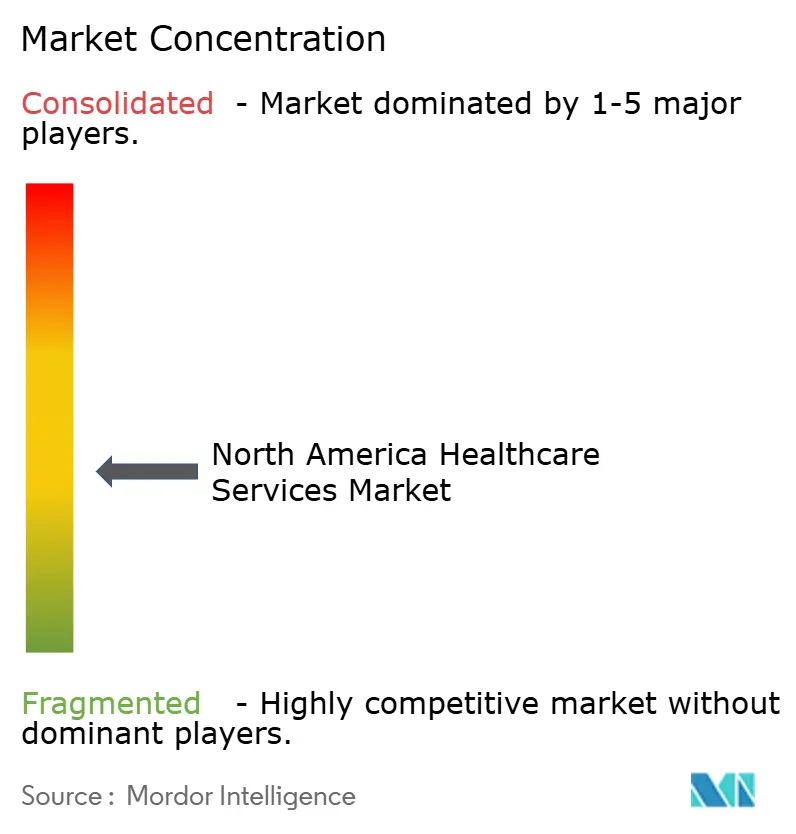
| Market Concentration | Medium |
Major Players *Disclaimer: Major Players sorted in no particular order Image © Mordor Intelligence. Reuse requires attribution under CC BY 4.0. | |
North America Healthcare Services Market Analysis by Mordor Intelligence
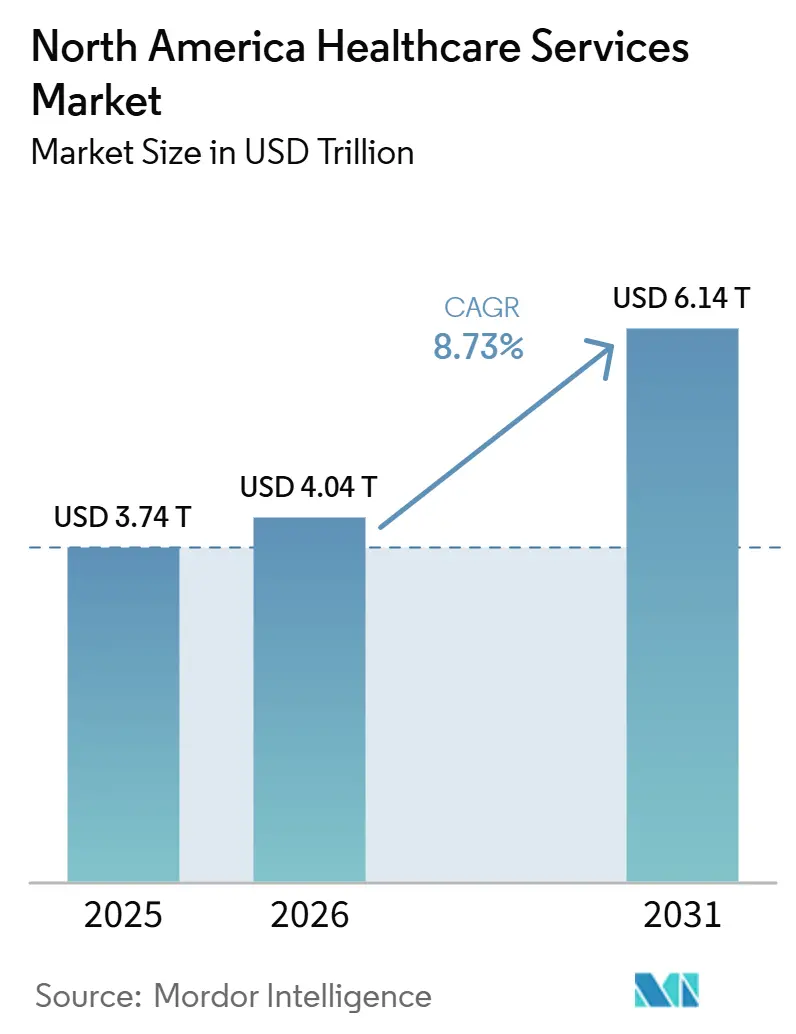
The North America Healthcare Services Market size is expected to increase from USD 3.74 trillion in 2025 to USD 4.04 trillion in 2026 and reach USD 6.14 trillion by 2031, growing at a CAGR of 8.73% over 2026-2031.
The North America healthcare services market is moving steadily from inpatient facilities toward outpatient, ambulatory, and home-based care as payers press for lower-cost settings and patients choose more convenient access. Aging populations and chronic disease demand continue to widen the need for long-duration care, and Medicare spending passed USD 1.2 trillion in 2025, with nearly USD 19 trillion expected over the next decade. The United States still carries most regional spending, and 90% of the country’s USD 5.3 trillion annual health expenditure went toward people with chronic and mental health conditions. The North America healthcare services market is also being reshaped by vertical integration, as large payers, provider networks, and retail health platforms expand across care delivery and digital operations. Productivity gains from AI and automation could support this shift, but staffing shortages, cybersecurity pressure, and reimbursement reform continue to limit how fast the market can scale.
Key Report Takeaways
- By service type, outpatient services led with 38.13% revenue share in 2025, while home healthcare services are forecast to expand at 8.85% CAGR through 2031.
- By service delivery, private healthcare services held 58.38% of the North America healthcare services market share in 2025, while public healthcare services recorded the highest projected CAGR at 10.42% through 2031.
- By end user, geriatric care accounted for 43.16% share of the North America healthcare services market size in 2025 and is advancing at 9.83% CAGR through 2031.
- By geography, the United States captured 83.12% share of the North America healthcare services market size in 2025, while Mexico is projected to grow fastest at 10.98% CAGR through 2031.
Note: Market size and forecast figures in this report are generated using Mordor Intelligence’s proprietary estimation framework, updated with the latest available data and insights as of January 2026.
Market Trends and Insights
Drivers Impact Analysis of North America Healthcare Services Market*
| Driver | (~) % Impact on CAGR Forecast | Geographic Relevance | Impact Timeline |
|---|---|---|---|
| Rising Demand for Outpatient and Ambulatory Care | +2.0% | United States national, urban Canada spillover | Short term (≤ 2 years) |
| Aging Population and Chronic Disease Burden | +1.8% | United States and Canada, with emphasis on suburban and semi-urban markets | Long term (≥ 4 years) |
| Expansion of Hospital-at-Home and Home Health Models | +1.4% | United States primarily, Canada under provincial programs | Medium term (2-4 years) |
| Payer Push Toward Site-of-Care Optimization | +1.1% | United States national, with concentration in Texas, Florida, and California | Short term (≤ 2 years) to Medium term (2-4 years) |
| AI-Enabled Care Navigation and Operational Efficiency | +0.8% | United States led, with growing interest in Canada and Mexico private providers | Medium term (2-4 years) |
| Cross-Border Care and Medical Tourism in Mexico | +0.4% | Mexico border states and the United States border corridor | Short term (≤ 2 years) |
| Source: Mordor Intelligence | |||
Rising Demand for Outpatient and Ambulatory Care
The North America healthcare services market is getting a direct push from Medicare’s site-neutral payment reform in 2026. CMS finalizes a 60% rate reduction for drug administration at off-campus hospital outpatient departments, which reduces the appeal of high-cost hospital-based settings. This change is moving elective, diagnostic, and specialty procedures toward ambulatory surgery centers and freestanding clinics. Commercial insurers are extending the same logic, and Blue Cross Blue Shield of Wyoming launches CarePath in August 2026 for total knee procedures.[1] Providers with established outpatient networks are better placed to absorb this shift, while hospital systems that still depend on hospital-based outpatient revenue face margin pressure.
Aging Population and Chronic Disease Burden
The North American healthcare services market continues to grow on the back of older populations and more chronic diseases. The U.S. median age reached 39.4 in 2025, up from 39.2 in 2024, and this older age mix will keep raising demand for ongoing treatment.[2] This demand fits poorly with care models that were built around episodic acute treatment rather than continuous management. Humana expands its senior-focused delivery footprint in Q1 2026 by adding 54 CenterWell Senior Primary Care centers and 59,000 patients through the MaxHealth acquisition. Canada faces the same pressure, and Ontario Health projects 3.1 million residents living with major illness by 2040.
Expansion of Hospital-at-Home and Home Health Models
The North America healthcare services market is also benefiting from the wider acceptance of hospital-at-home and home health delivery. The 2026 policy framework reduces reimbursement uncertainty and gives health systems a clearer base for multiyear investment in acute care delivered at home. Tampa General Hospital reports a 70% improvement in 30-day readmission rates and 30% to 40% higher patient experience scores for its at-home model. Cleveland Clinic introduced Hospital Care at Home in Ohio in March 2026, starting with Fairview and Avon hospitals. As more providers validate patient outcomes and patient experience, the case for scaling home-based acute care becomes stronger across the region.
AI-Enabled Care Navigation and Operational Efficiency
The North America healthcare services market is starting to see AI influence cost structures rather than only clinical workflows. Research published in 2026 estimates that broader AI adoption across U.S. healthcare could unlock USD 200 billion to USD 360 billion in annual savings. This matters because administrative complexity and fragmented navigation remain major cost centers across the region. Larger health systems and payer-linked delivery networks are better positioned to finance AI rollouts across contact centers, documentation, and care coordination. The operational upside is real, but the near-term advantage still favors scaled organizations that can spread deployment costs across many service lines.
Restraints Impact Analysis of North America Healthcare Services Market*
| Restraint | (~) % Impact on CAGR Forecast | Geographic Relevance | Impact Timeline |
|---|---|---|---|
| Clinician Shortages and Burnout | -1.3% | United States national, with rural areas particularly acute, and Canada rural and remote markets | Long term (≥ 4 years) |
| Reimbursement Compression and Payment Uncertainty | -1.0% | United States national, with sharpest exposure in hospital outpatient departments | Medium term (2-4 years) |
| High Labor, Compliance, and Facility Operating Costs | -0.8% | United States national, with greatest pressure in high-cost urban markets | Short term (≤ 2 years) to Long term (≥ 4 years) |
| Cybersecurity and Data Interoperability Gaps | -0.6% | United States primarily, and Canada’s connecting provincial systems | Medium term (2-4 years) |
| Source: Mordor Intelligence | |||
Clinician Shortages and Burnout
The North America healthcare services market continues to face a labor ceiling that technology cannot fully offset. HRSA projects a shortage of 270,000 registered nurses by 2028, with additional shortages in licensed practical nurses and primary care physicians. Physician burnout improved in 2025, but it still remains high at 41.9%. Nursing pressure worsens, and Cross Country Healthcare’s 2026 survey shows burnout rising to 67% and concerns over short staffing rising to 61%. Canada is also pulling in U.S.-trained nurses, which may ease provincial shortages there but can tighten supply for U.S. providers.
Reimbursement Compression and Payment Uncertainty
The North America healthcare services market is also constrained by revenue uncertainty across public and private payment channels. Medicare Advantage now covers 51% of Medicare beneficiaries, and CMS is projected to spend 14% more per enrollee in 2026 than for comparable traditional Medicare beneficiaries, equal to USD 76 billion in added annual spending. Providers do not receive the benefit of that higher spending directly because payers are responding with tighter prior authorization and utilization controls. At the same time, site-neutral payment changes lower reimbursement in hospital outpatient settings and weaken returns on older facility-heavy models. The North America healthcare services market will keep rewarding providers that diversify across outpatient care, value-based contracts, and payer partnerships, while less diversified systems remain more exposed to payment pressure.
*Our forecasts treat driver/restraint impacts as directional, not additive. The impact forecasts reflect baseline growth, mix effects, and variable interactions.
North America Healthcare Services Market Segment Analysis
By Service Type:
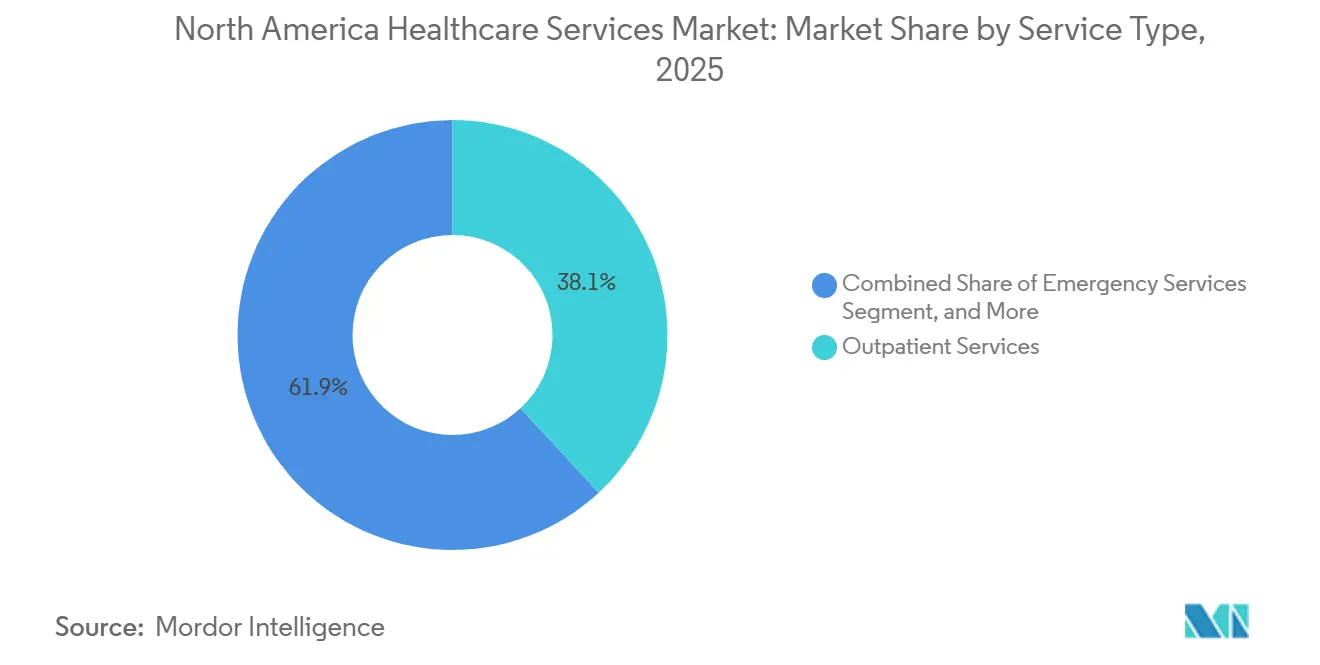
Home Healthcare Accelerates Beyond Hospital WallsOutpatient services held 38.13% share of the North America healthcare services market size in 2025, while home healthcare services are projected to grow fastest at 8.85% CAGR from 2026 to 2031. That split shows how the North America healthcare services market is shifting care away from hospital stays and toward lower-acuity settings. The 2026 policy backdrop gives providers more confidence to build home-based acute care programs and related support infrastructure. Diagnostic services are also benefiting as decentralized testing networks widen community access. Rehabilitation services are tracking higher recovery needs linked to musculoskeletal and neurological conditions in older patients.
Inpatient services still account for substantial facility revenue in the North America healthcare services market, but they face pressure from site-neutral payment reform, hospital-at-home alternatives, and labor inflation. Long-term care services are seeing stronger demand from aging patients, yet staffing shortages make delivery harder to scale. Primary care services are being redesigned around easier access, and CVS Health is expanding small pharmacy-focused primary care locations in 2026. Emergency services continue to experience heavy utilization when patients cannot access timely primary care, which keeps pressure on the region’s highest-cost care setting.

By Service Delivery:
Private Sector Dominance Faces a Public CounterwavePrivate healthcare services held 58.38% of the North America healthcare services market share in 2025, while public healthcare services are forecast to grow fastest at 10.42% CAGR through 2031. The current balance still reflects the scale of U.S. commercial insurance and employer-sponsored care. Growth in public delivery is tied to Medicaid expansion effects in the United States and to continued provincial investment in Canada. Humana’s state-based contracts add 50,000 Medicaid members across Michigan, Illinois, and South Carolina in Q1 2026, which shows how public program growth is feeding care demand.
Mexico adds another layer to the North America healthcare services market, because public access gaps and wait times keep redirecting many middle-income patients toward private facilities and cross-border options. That setting allows private providers to serve both domestic demand and international patients seeking lower-cost elective procedures. The North America healthcare services industry, therefore, shows two distinct paths here, with public systems expanding access while private systems capture faster discretionary and international flows. This dual-track model supports growth in private hospitals even as public institutions remain central for formal sector coverage and large-scale service access.
By End User:
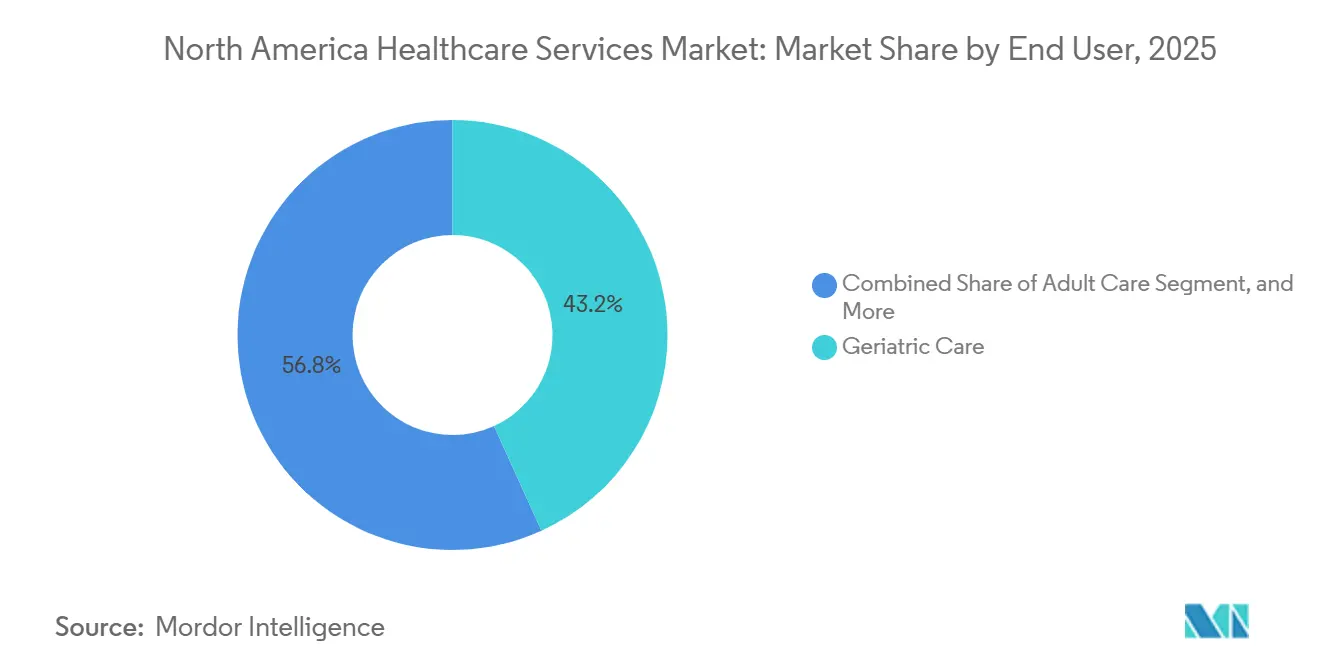
Geriatric Care Anchors Volume and GrowthGeriatric care accounted for 43.16% share of the North America healthcare services market size in 2025 and is projected to expand at 9.83% CAGR through 2031. The North America healthcare services market is seeing this segment lead both current spending and future growth because older patients use more skilled nursing, home health, and hospice services. Medicare categories tied closely to older adults are expected to grow faster than inpatient hospital services over time. Humana strengthens this part of care delivery in Q1 2026 by adding 54 CenterWell Senior Primary Care centers and 59,000 patients through MaxHealth. That combination keeps senior-focused primary care and post-acute models at the center of capital allocation.
Adult Care remains a major utilization base in the North America healthcare services market because the working-age population is managing more metabolic, behavioral health, and musculoskeletal conditions. Pediatric Care is smaller, but access gaps in pediatric behavioral health are pushing systems and payers to build more specialized outpatient and virtual capacity. The North America healthcare services industry is therefore expanding not only in volume, but also in how it routes different age groups to more tailored care settings. That pattern supports broader use of navigation tools and integrated primary care models across adult, family, and senior cohorts.
Geography Analysis
United States Healthcare Services Market
The United States held 83.12% of the North America healthcare services market share in 2025, which keeps it at the center of regional demand. Medicare spending reached USD 1.2 trillion in 2025, and Part B outpatient spending at USD 584 billion exceeded Part A inpatient spending at USD 444 billion. That spending mix shows how strongly the North America healthcare services market in the United States has moved toward ambulatory and community-based delivery. HCA Healthcare reports record approved capital projects of USD 7 billion and guides 2026 capital expenditure at USD 5 billion to USD 5.5 billion, with emphasis on outpatient expansion, freestanding emergency rooms, and ambulatory surgery centers. Cybersecurity compliance is also rising in importance, and HHS OCR settled four ransomware-related HIPAA Security Rule investigations in April 2026.
Canada Healthcare Services Market
Canada remains the second-largest country market in the North America healthcare services market and continues to rely on a universal public insurance structure. This framework keeps most delivery in public systems, while private operators remain more active in specialty, elective, and diagnostic niches. Workforce strain is intensifying, and British Columbia approved 1,028 U.S.-trained nurse applications from April 2025 through January 2026. Ontario Health projects 3.1 million residents living with major illness by 2040, which points to stronger demand for home-based care and digital capacity extensions.
Mexico Healthcare Services Market
Mexico is projected to expand fastest at 10.98% CAGR from 2026 to 2031 in the North America healthcare services market. Baja California receives 4.5 million healthcare visitors each year, and medical tourism generates USD 2 billion in annual regional activity. Tijuana accounts for more than 66% of Baja California health tourism activity and is building depth in robotic surgery as well as dental and cosmetic procedures. These flows strengthen private hospital investment along the border corridor and raise Mexico’s profile for cost-sensitive U.S. and Canadian patients. Quality certification remains a key differentiator for hospitals that want to attract international patients and employer-backed cross-border care arrangements.
Competitive Landscape
The North America healthcare services market has a moderately concentrated top tier, led by UnitedHealth Group, HCA Healthcare, CVS Health, Humana, and CommonSpirit Health, but it remains fragmented across local providers and specialized service lines. The main competitive pattern is vertical integration between financing, care delivery, pharmacy, and data. CVS Health moves further in this direction in June 2026 through its partnership with Mass General Brigham to bring primary care services to 37 pharmacies in Massachusetts. Humana is following a similar path, and its MaxHealth acquisition adds 54 CenterWell Senior Primary Care centers and 59,000 patients in Q1 2026. This means the North America healthcare services market increasingly rewards organizations that can manage patient relationships across multiple settings rather than only inside hospitals.
Capital deployment is also shifting toward outpatient, home-based, and tech-enabled capacity in the North America healthcare services market. HCA Healthcare plans USD 5 billion to USD 5.5 billion of capital spending in 2026 and keeps approved projects at a record USD 7 billion, with a clear focus on outpatient networks and freestanding assets. Cleveland Clinic and Tampa General Hospital are expanding hospital-at-home models in 2026, which shows that leading systems are treating home-based acute care as a long-term operating platform rather than a pilot. The result is a competitive field where scale matters, but the form of scale is changing from bed count alone to broader control over sites of care. This shift is spreading across acute care, primary care, and chronic disease management.
Technology and compliance are becoming harder to separate from competition in the North America healthcare services market. CVS Health expands its collaboration with Salesforce in May 2026 to deploy Agentforce Health AI across call center operations for millions of members and providers. DaVita raises its 2026 volume outlook and reports the highest aggregate savings rate in CMS’s CKCC program, which shows how operational efficiency and value-based care execution can strengthen positioning. Smaller independent practices and narrowly focused operators face a tougher path because they must fund digital, labor, and compliance needs without the same revenue base as diversified systems.
North America Healthcare Services Industry Leaders
-
CVS Health
-
Labcorp Holdings Inc.
-
McKesson Corporation
-
The Cigna Group
-
UnitedHealth Group
- *Disclaimer: Major Players sorted in no particular order
North America Healthcare Services Market Companies Covered in this Report
- Amedisys
- Ascension
- Cardinal Health
- CommonSpirit Health
- CVS Health
- DaVita
- Enhabit, Inc.
- Fresenius Medical Care AG and Co. KGaA
- HCA Healthcare, Inc.
- Humana Inc.
- Kaiser Permanente
- Labcorp Holdings Inc.
- Mckesson
- Optum
- Quest Diagnostics
- Surgery Partners, Inc.
- Tenet Healthcare
- The Cigna Group
- United Health Group
- Universal Health Services
Recent Industry Developments in North America Healthcare Services Market
- June 2026: CVS Health and Mass General Brigham moved closer to a partnership bringing primary care services to 37 pharmacies across Massachusetts. The Massachusetts Health Policy Commission completed its nine-month review, estimating the collaboration will drive USD 40 million in additional annual healthcare spending in the state, illustrating the scale and cost implications of the payer-provider convergence reshaping primary care access.
- May 2026: CVS Health expanded its collaboration with Salesforce to deploy Agentforce Health AI across call center operations for millions of CVS Health members and providers, representing Salesforce’s largest Agentforce deployment to date across regulated industries. The platform integrates humans, data, and AI agents to personalize the member call center experience.
- April 2026: The HHS Office for Civil Rights settled four HIPAA Security Rule ransomware investigations, bringing its total completed ransomware investigation count to 19. The settlements reinforce OCR’s enforcement posture on cybersecurity governance across covered entities and their business associates.
- March 2026: Cleveland Clinic introduced Hospital Care At Home in Ohio, starting with Fairview and Avon hospitals, offering hospital-level acute medical care to patients in their homes as a patient-centered care expansion in the Northeast Ohio market.
North America Healthcare Services Market Report Scope
The North America Healthcare Services Market refers to the industry comprising organizations and professionals that provide medical, preventive, diagnostic, therapeutic, rehabilitative, and long-term care services to patients across the United States, Canada, and Mexico. The market includes a broad range of healthcare providers such as hospitals, physician practices, outpatient care centers, diagnostic laboratories, home healthcare agencies, nursing care facilities, ambulatory surgical centers, and telehealth service providers. It encompasses services delivered through public and private healthcare systems to support disease prevention, diagnosis, treatment, and ongoing patient care. Market growth is driven by factors such as the rising prevalence of chronic diseases, an aging population, increasing healthcare expenditure, technological advancements in digital health, expanding access to healthcare services, and the growing adoption of value-based care models.
The North America Healthcare Services Market is segmented based on service type, service delivery, end user, and country. By service type, the market is categorized into inpatient services, outpatient services, emergency services, primary care services, long-term care services, home healthcare services, diagnostic services, and rehabilitation services. Based on service delivery, the market is divided into public healthcare services and private healthcare services. By end user, the market is segmented into adult care, geriatric care, and pediatric care, reflecting the diverse healthcare needs of different population groups. Geographically, the market is analyzed across the United States, Canada, and Mexico.
Segmentation Overview
| Inpatient Services |
| Outpatient Services |
| Emergency Services |
| Primary Care Services |
| Long-Term Care Services |
| Home Healthcare Services |
| Diagnostic Services |
| Rehabilitation Services |
| Public Healthcare Services |
| Private Healthcare Services |
| Adult Care |
| Geriatric Care |
| Pediatric Care |
| United States |
| Canada |
| Mexico |
| By Service Type | Inpatient Services |
| Outpatient Services | |
| Emergency Services | |
| Primary Care Services | |
| Long-Term Care Services | |
| Home Healthcare Services | |
| Diagnostic Services | |
| Rehabilitation Services | |
| By Service Delivery | Public Healthcare Services |
| Private Healthcare Services | |
| By End User | Adult Care |
| Geriatric Care | |
| Pediatric Care | |
| By Country | United States |
| Canada | |
| Mexico |
Key Questions Answered in the Report
What is the 2031 outlook for North America healthcare services?
The sector is projected to reach USD 6.14 trillion by 2031 from USD 4.04 trillion in 2026, with an 8.73% CAGR over 2026 to 2031.
Which service area is growing fastest across North America?
Home healthcare services are projected to grow fastest, with an 8.85% CAGR through 2031, supported by stronger reimbursement support and wider provider adoption.
Why is outpatient care gaining share in the region?
Site-neutral payment reform, payer cost pressure, and patient preference for more convenient settings are moving more procedures into ambulatory and freestanding facilities.
Which end-user group drives the most spending?
Geriatric care led with 43.16% share in 2025 and is also the fastest-growing end-user segment at 9.83% CAGR through 2031.
Which country is expanding fastest in the region?
Mexico is projected to grow fastest at 10.98% CAGR through 2031, supported by cross-border care demand and private hospital expansion in border markets.
What are the main constraints on provider growth?
Labor shortages, burnout, cybersecurity pressure, and reimbursement compression remain the main barriers, even as demand and care decentralization continue to rise.