
North America Financial Advisory Services Market Size and Share
Market Overview
| Study Period | 2020 - 2031 |
|---|---|
| Forecast Data Period | 2026 - 2031 |
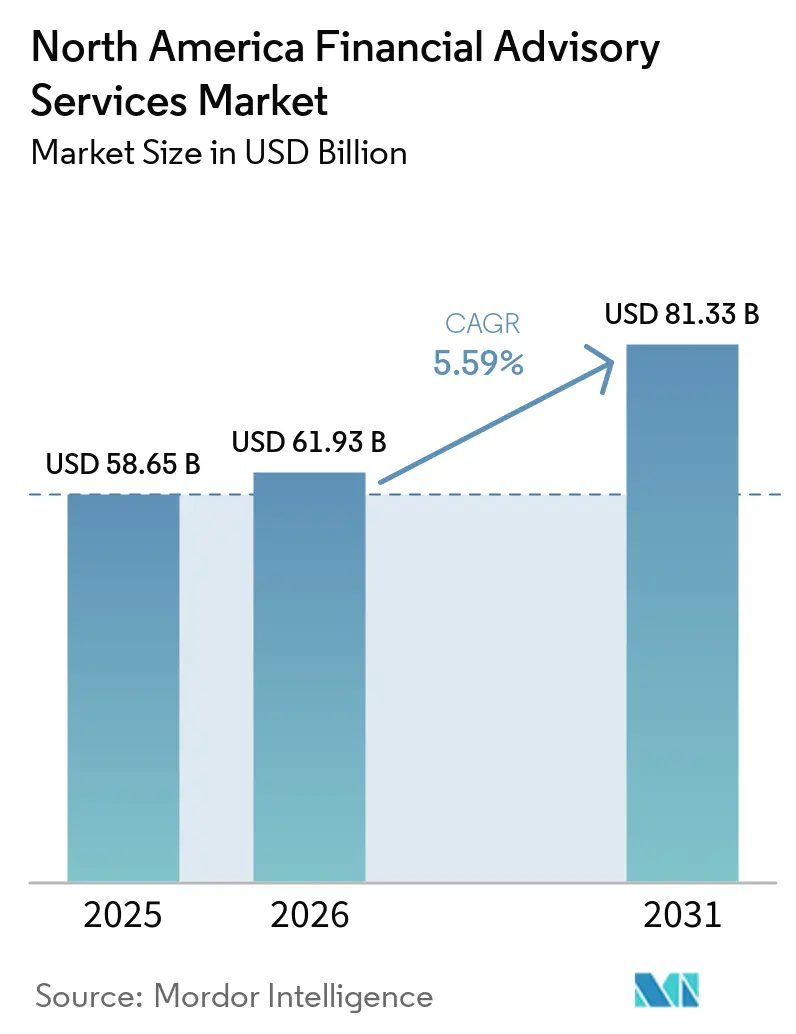
| Base Year Market Size (2025) | USD 58.65 Billion |
| Market Size (2026) | USD 61.93 Billion |
| Market Size (2031) | USD 81.33 Billion |
| Growth Rate (2026 - 2031) | 5.59 % |
| Market Concentration | Medium |
Major Players *Disclaimer: Major Players sorted in no particular order Image © Mordor Intelligence. Reuse requires attribution under CC BY 4.0. | |
North America Financial Advisory Services Market Analysis by Mordor Intelligence
The North America financial advisory market size is expected to grow from USD 58.65 billion in 2025 to USD 61.93 billion in 2026 and is forecast to reach USD 81.33 billion by 2031 at 5.59% CAGR over 2026-2031. Client expectations, regulatory tightening, and rapid technology adoption combine to lift revenue potential even as price pressure increases. Digital platforms widen access to advice, while a historic wealth transfer forces firms to rebuild service models for younger, tech-centric investors[1]. Private-equity-funded consolidation brings economy-of-scale advantages in compliance, cybersecurity, and analytics, yet specialist boutiques continue to win mandates in complex cross-border, ESG, and alternative-asset domains. Fee compression remains a challenge as custodians slash ETF prices and robo platforms scale, prompting advisers to shift the conversation from basis points to holistic value. Overall, the North America financial advisory market illustrates a two-track structure: large platforms dominate mainstream households, while focused experts capture niche, high-margin segments.
Key Report Takeaways
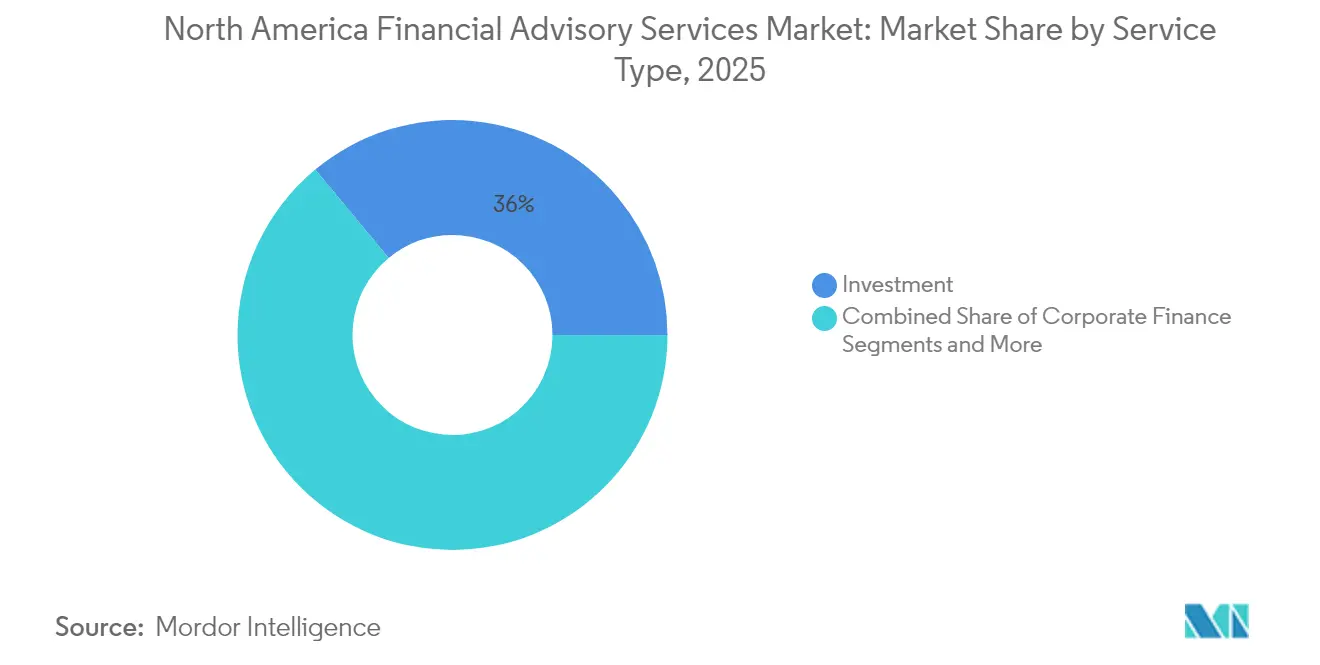
- By service type, investment services led with a 36.02% share in the North America financial advisory market in 2025 and are forecasted to grow at a 6.95% CAGR through 2031, consolidating their role at the heart of the North America financial advisory market.
- By organization size, large enterprises held 65.62% of the North America financial advisory market share in 2025, while SMEs are projected to expand at a 6.25% CAGR as digital tools narrow the scale gap.
- By industry vertical, the BFSI segment accounted for 29.55% of the North America financial advisory market size in 2025, whereas IT & Telecommunication is projected to advance at a 6.45% CAGR.
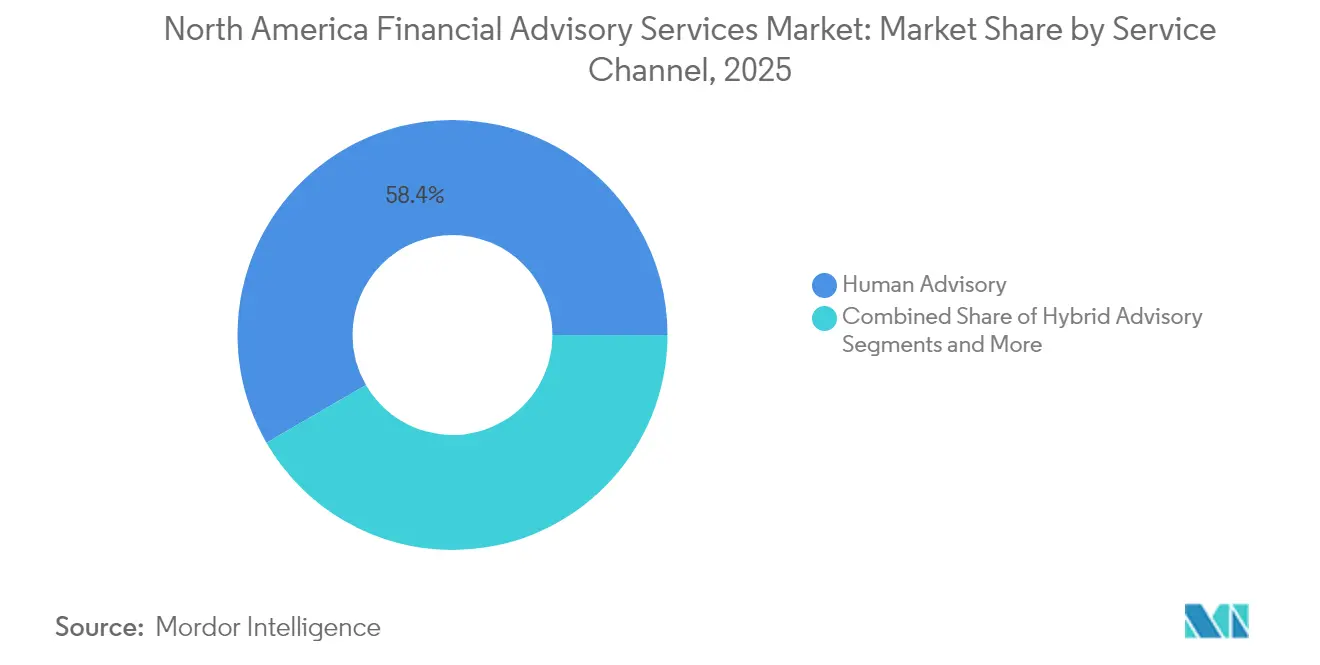
- By service channel, human advisory retained 58.35% share of the North America financial advisory market in 2025, yet robo-advisory is rising at a 9.84% CAGR through 2031.
- By delivery mode, on-site consulting commanded 71.60% of the North America financial advisory market size in 2025, while remote consulting is expected to climb at a 8.90% CAGR.
- By country, the United States captured 87.40% share of the North America financial advisory market in 2025, yet Mexico is forecasted to post the fastest 6.40% CAGR, opening diversification avenues.
Note: Market size and forecast figures in this report are generated using Mordor Intelligence’s proprietary estimation framework, updated with the latest available data and insights as of 2026.
Worldwide, activity is shaped by contributions from multiple regions, with North america representing one of the more structurally developed among them. The global report on financial advisory services market by Mordor Intelligence reflects how these regional layers combine into a single system.
Market Trends and Insights
Drivers Impact Analysis of North America Financial Advisory Services Market*
| Driver | (~) % Impact on CAGR Forecast | Geographic Relevance | Impact Timeline |
|---|---|---|---|
| Rising adoption of robo- and AI-enabled advisory tools | +1.2% | USA leading, Canada moderate, Mexico emerging | Medium term (2-4 years) |
| Accelerating HNWI population and investable assets | +0.9% | Region-wide, metro clustering | Long term (≥ 4 years) |
| Surge in PE-backed mid-market M&A deal volume | +0.8% | USA dominant, Canada spillover | Short term (≤ 2 years) |
| Regulatory shift toward fiduciary duty | +0.6% | USA primary, Canada alignment | Medium term (2-4 years) |
| ESG-linked mandates reshaping propositions | +0.5% | Global, North America leadership | Long term (≥ 4 years) |
| Generational wealth transfer to digital investors | +0.7% | Regional wealth centers | Long term (≥ 4 years) |
| Source: Mordor Intelligence | |||
Rising Adoption of Robo- & AI-Enabled Advisory Tools
Robo services now manage multi-hundred-billion portfolios, with Vanguard at USD 206.6 billion and Schwab at USD 65.8 billion. Agentic AI engines already automate personalized advice for numerous households, promising significant value for the banking sector each year. Although 96% of advisers believe generative AI will transform service, only 41% currently scale deployments, giving early adopters a cost advantage. Platforms such as Range have raised USD 28 million to deliver AI-guided wealth plans for affluent clients, signaling investor confidence in digital-first models[2]. The strategic imperative across the North America financial advisory market is to blend human empathy with machine efficiency.
Accelerating HNWI Population & Investable Assets
North America added a record number of high-net-worth individuals in 2025, outpacing every other region. More than half now demand ESG filters, and an even larger share plan to increase ESG allocations within two years. Ultra-wealthy households prioritize private equity, sustainable funds, and concierge-style services that carry premium fees. Wealth concentration lifts revenue per client, but younger heirs prefer tech-centric, purpose-driven advice, pressuring legacy engagement formats. Advisors successful in the North America financial advisory market, therefore, integrate family-office, tax, and digital delivery capabilities.
Surge in PE-Backed Mid-Market M&A Deal Volume
Private equity continues to reshape the competitive map, highlighted by LPL Financial’s USD 2.7 billion purchase of Commonwealth and Focus Financial’s combination of Buckingham Strategic Wealth with The Colony Group. Deal flow is propelled by recurring revenue and fragmented supply that invite roll-up strategies. Yet frequent ownership changes test client patience, so acquirers must balance financial engineering with cultural continuity to protect retention across the North America financial advisory market[3].
Regulatory Shift Toward Fiduciary Duty (SEC Reg-BI)
SEC Regulation Best Interest imposes disclosure, care, conflict, and compliance obligations that elevate operating costs but reward transparent models. Firms demonstrating superior fiduciary alignment gain trust in a landscape where 80% of heirs plan to work with professionals’ post-inheritance. State-level cybersecurity proposals add further compliance layers, advancing providers with robust systems.
Restraints Impact Analysis of North America Financial Advisory Services Market*
| Restraint | (~) % Impact on CAGR Forecast | Geographic Relevance | Impact Timeline |
|---|---|---|---|
| Fee compression from passive and digital competitors | -0.8% | USA primary, Canada moderate | Medium term (2-4 years) |
| Escalating compliance and audit-trail costs | -0.6% | Region-wide | Short term (≤ 2 years) |
| Aging advisor workforce and talent pipeline gaps | -0.9% | USA and Canada | Long term (≥ 4 years) |
| Rising cyber-risk undermining client trust | -0.4% | Global, elevated in North America | Short term (≤ 2 years) |
| Source: Mordor Intelligence | |||
Fee Compression from Passive & Digital Competitors
Schwab’s June 2025 decision to slash ETF fees by up to 50% underscores accelerating price competition. Passive investing’s share of U.S. fund assets continues to climb, forcing advisers to defend pricing through holistic planning and alternative-asset access. Hybrid fee structures combining flat retainers and outcome-based incentives gain traction across the North America financial advisory market.
Aging Advisor Workforce & Talent Pipeline Gaps
Close to 40% of U.S. advisers are within a decade of retirement, and recent annual headcount growth stands at just 0.3%. Only 2,579 new advisers entered the profession in 2024, and attrition remains high, widening the supply gap. Remote collaboration tools help older advisers extend careers, but firms still need structured mentorship and AI-assisted onboarding to safeguard capacity across the North America financial advisory market.
*Our forecasts treat driver/restraint impacts as directional, not additive. The impact forecasts reflect baseline growth, mix effects, and variable interactions.
North America Financial Advisory Services Market Segment Analysis
By Service Type:
Investment Services Drive GrowthInvestment services held the largest share at 36.02% in the North America financial advisory market in 2025 and are projected to expand at 6.95% CAGR through 2031, anchoring the North America financial advisory market. Multi-asset mandates now include private equity feeders, ESG overlays, and direct-indexing portfolios attractive to digital-native investors. The North America financial advisory market size for investment services is projected to swell as rising alternative allocations demand tailored structuring.
Corporate finance advisory remains resilient on mid-market M&A and succession deals, while accounting and tax advice scales with cross-border complexity. Other services- estate planning, philanthropy, and concierge support- grow fastest as wealthy families seek comprehensive stewardship. Advisers coupling investment depth and lifestyle capabilities therefore secure a higher wallet share in the North America financial advisory market.

By Organization Size:
SME Growth Challenges, Enterprise DominanceLarge enterprises controlled 65.62% of the North America financial advisory market in 2025, wielding deep compliance and technology budgets that defend mass-affluent franchises. Yet SMEs are expected to outpace at 6.25% CAGR, aided by cloud tools and AI-based productivity that minimize scale disadvantages. The North America financial advisory market size tied to SMEs is set to widen as boutique firms carve niches in ESG consulting and crypto tax planning.
Personalized engagement, transparent pricing, and quick innovation cycles bolster SME appeal among younger investors. However, mid-sized firms face a squeeze: they must either specialize or merge upward to keep pace with widening compliance and cybersecurity demands in the North America financial advisory market.
By Industry Vertical:
Technology Sector Wealth Creation Drives GrowthBFSI accounted for 29.55% of the North America financial advisory market in 2025, driven by complex regulatory needs and large asset pools, while IT & Telecommunication is poised for the fastest 6.45% CAGR thanks to option-rich liquidity events and cryptocurrency holdings. Advisers versed in equity-compensation strategies and token taxation stand out.
Manufacturing and retail owners prioritize succession and retirement planning, whereas healthcare executives lean on advisers for biotech windfalls and charitable trusts. Public-sector mandates add low-volatility revenue streams. Deep vertical expertise yields higher retention and pricing power within the North America financial advisory market.
By Service Channel:
Digital Transformation AcceleratesHuman advice held a 58.35% share in the North America financial advisory market in 2025, reinforcing that empathy drives complex financial decisions. Yet, robo platforms are set to grow 9.84% per year through 2031. Hybrid delivery models dominate new client wins, blending algorithmic rebalancing with scenario coaching in the North America financial advisory market.
Custodians integrate planning dashboards into mobile banking apps, turning day-to-day cash movement into holistic advice moments. Competition has shifted toward speed, data visualization, and embedded ESG scoring rather than raw investment alpha. AI chatbots answer routine queries instantly and escalate nuanced issues, elevating adviser productivity across the North America financial advisory market.
By Delivery Mode:
Remote Capabilities Enable Market ExpansionOn-site engagements controlled 71.60% of the North America financial advisory market share in 2025, but remote consulting is projected to escalate at 8.90% CAGR as clients accept video, shared screens, and digital signatures. The North America financial advisory market benefits as firms serve cross-border households without opening extra branches.
Cyber-risk awareness drives investment in end-to-end encryption and biometric log-ins, helping maintain trust and regulatory compliance. Advisers who toggle seamlessly between in-person and virtual modes strengthen loyalty, particularly among bi-national families who prize flexible scheduling in the North America financial advisory market.
Geography Analysis
United States Financial Advisory Services Market
The United States accounted for 87.40% of the North America financial advisory market in 2025, supported by deep capital markets, dense adviser networks, and robust fiduciary frameworks. A looming talent shortfall, however, threatens capacity as veteran advisers exit faster than replacements enter. Fee-based contracts continue to expand, illustrating the North America financial advisory market’s resilience despite compliance costs.
Canada Financial Advisory Services Market
Canada offers steady growth within a consolidated banking system where six institutions hold a significant share of assets. Title protection for financial planners and a consumer-driven banking framework modernize the competitive landscape. HNWI inflows to Toronto, Vancouver, Montreal, and Calgary sustain premium demand. Cross-border estate and tax planning remains a lucrative niche in the North America financial advisory market.
Mexico Financial Advisory Services Market
Mexico is set for the fastest 6.40% CAGR, propelled by fintech expansion and regulatory modernization. The economy expanded 0.2% in Q1 2025 despite U.S. softness, signaling resilience. Search funds and new private-equity vehicles broaden advisory addressable markets, while heightened tax transparency boosts cross-border structuring opportunities.
Mordor Intelligence provides coverage of the financial advisory services market across other key regional markets, including Europe, each with their regulatory frameworks and demand patterns.
Regulatory Landscape
The North America financial advisory services market operates under an increasingly demanding supervisory environment led by the US Securities and Exchange Commission (SEC) and FINRA, with AML expectations from the Financial Crimes Enforcement Network (FinCEN). A key step-change for advisory operating models is FinCEN's final rule extending AML/CFT program requirements to certain investment advisers, effective January 1, 2026, adding new obligations around customer due diligence, suspicious activity monitoring, and control documentation.
In 2026, regulators also sharpened attention on conflicts, technology, and cyber risks that affect advice delivery, disclosures, and recordkeeping. The SEC Division of Examinations set 2026 priorities that emphasize fiduciary duty and the impact of technology on compliance programs, and on June 9, 2026, the SEC issued a Risk Alert highlighting deficiencies in investment adviser economic conflict-of-interest disclosures and related controls. FINRA's 2026 Annual Regulatory Oversight Report (published December 26, 2025) further underscored cyber-enabled fraud and GenAI risks, reinforcing demand for auditable advice processes, surveillance, and governance across human, hybrid, and robo channels.
Value Chain Analysis
Service delivery in the North America financial advisory services market typically starts with client acquisition and discovery (goals, risk profiling, and data gathering), followed by financial planning and portfolio construction, then execution and custody through broker-dealers, custodians, fund platforms, and banking partners. Ongoing portfolio monitoring, reporting, and periodic plan refresh cycles form the recurring backbone, while adjacent specialists support tax, estate planning, cross-border structuring, and alternatives access depending on the mandate.
Across the chain, regulated entities increasingly rely on a technology and assurance layer that includes compliance tools, cybersecurity controls, data aggregation, and documentation management to satisfy SEC, FINRA, and FinCEN expectations. Large advisory and professional services networks such as Deloitte, PwC, EY, and KPMG often sit as an intermediary tier for regulated clients, combining regulatory change management, policy and control design, and process automation, including AI-enabled monitoring and testing, with third-party risk governance. This shifts value toward firms that can integrate subject-matter expertise with scalable platforms to standardize evidence trails across on-site and remote delivery.
Competitive Landscape
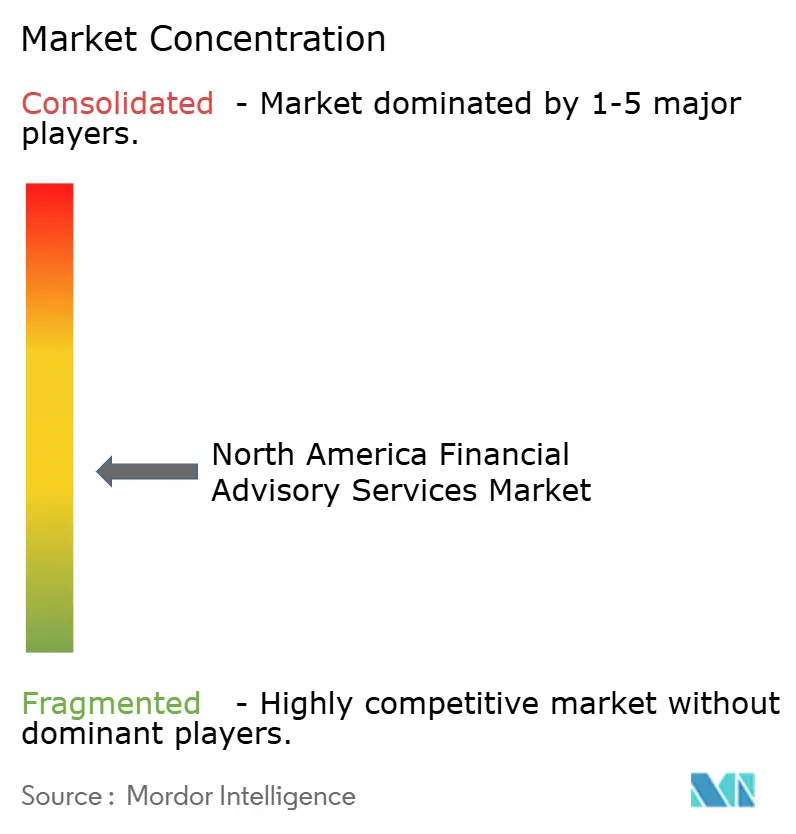
The North America financial advisory market shows moderate concentration as PE-backed aggregators, banks, and asset-manager affiliates buy scale through acquisition. LPL’s integration of Atria Wealth Solutions, adding 2,400 advisers and USD 100 billion in client assets, typifies the roll-up thesis. Charles Schwab’s fee cuts aim to defend custodial dominance by tightening the price floor for ETFs.
Technology-first challengers raise meaningful capital; Range, for example, has secured USD 40 million to automate planning for HNW clients. These players operate at materially lower cost-to-serve and target digitally native households. Concurrently, specialist boutiques command loyalty among ultra-wealthy families by offering customized, high-touch services that large platforms struggle to replicate.
Mid-sized firms that cannot match scale economics or deep specialization face strategic pressure to merge or sell. The resulting barbell market forces participants to pick between industrial-grade efficiency and expert-led intimacy within the North America financial advisory market.
North America Financial Advisory Services Industry Leaders
-
Deloitte
-
PwC
-
Ernst & Young
-
KPMG
-
McKinsey & Company
- *Disclaimer: Major Players sorted in no particular order
North America Financial Advisory Services Market Companies Covered in this Report
- Deloitte
- PwC
- Ernst & Young
- KPMG
- McKinsey & Company
- Bain & Company
- Boston Consulting Group
- BlackRock
- Vanguard
- Fidelity Investments
- State Street Global Advisors
- J.P. Morgan Asset Management
- Lazard
- Houlihan Lokey
- Evercore
- Grant Thornton
- BDO
- RBC Capital Markets
- Kroll
- Piper Sandler
Read Analysis of North America Financial Advisory Services Companies
Market Opportunities and Future Outlook
A practical opportunity sits at the intersection of higher compliance burden and fee pressure: tech-enabled compliance and managed services that reduce per-account cost-to-serve while strengthening auditability across advice channels. The FinCEN AML/CFT requirements that became effective January 1, 2026 expand the scope of controls that many investment advisers must operationalize, creating whitespace for advisory providers and enablers that can package AML program design, monitoring workflows, documentation mapping, and ongoing testing into repeatable offerings.
Another opportunity is platformizing fiduciary and conflicts management as regulators spotlight disclosure quality and supervisory controls. The SEC's June 9, 2026 Risk Alert on investment adviser economic conflicts of interest, alongside the SEC's 2026 examination priorities and FINRA's emphasis on cyber-enabled fraud and GenAI risks (2026 Annual Regulatory Oversight Report published December 26, 2025), pushes firms to modernize governance, recordkeeping, and surveillance. Major professional services networks are also investing in AI at scale. For example, EY's May 2026 initiative with Microsoft and KPMG's June 2026 expansion of its Microsoft relationship indicate an active shift toward enterprise-grade AI toolchains that can be adapted to advice operations, compliance monitoring, and client communications.
Recent Industry Developments in North America Financial Advisory Services Market
- July 2026: Kroll acquired ABC economics, a Berlin-based economics and competition advisory firm, to strengthen global economic and econometric capabilities. The acquisition expands Kroll's advisory footprint, enabling deeper cross-border analysis for clients. This move signals a focus on rigorous economic insights to support strategic decision making.
- June 2026: KPMG expanded global relationship with Microsoft to deploy Agent 365 and extend Microsoft 365 Copilot access to 276,000 professionals. The collaboration broadens AI-enabled productivity for large advisory teams. It strengthens service delivery and could influence fee structures in the North America advisory market.
- May 2026: EY announced a US$1 billion+ initiative with Microsoft to scale enterprise AI across five years. The investment accelerates AI integration across enterprise advisory services. It reshapes competitive dynamics in North America advisory by signaling aggressive AI-driven transformation.
North America Financial Advisory Services Market Report Scope and Research Methodology
Market Definition and Coverage
For this study, the market covers revenues earned from financial advisory engagements delivered to clients in North America, where advice is the core paid output and is billed through fees, retainers, or deal-linked advisory charges.
Scope exclusions: We exclude pure product distribution margins, standalone brokerage execution fees, and back-office outsourcing that does not include advisory judgment.
Segments Covered in This Report
- By Service Type
- Corporate Finance
- Accounting And Tax Advisory
- Investment
- Other Services
- By Organization Size
- Large Enterprises
- Small & Medium-sized Enterprises (SMEs)
- By Industry Vertical
- Banking, Financial Services, Insurance (BFSI)
- IT & Telecommunication
- Manufacturing
- Retail And E-Commerce
- Public Sector
- Healthcare And Pharmaceuticals
- Other Industry Verticals
- By Service Channel
- Human Advisory
- Hybrid Advisory
- Robo-Advisory
- By Delivery Mode
- On-site Consulting
- Remote / Virtual Consulting
- By Country
- USA
- Canada
- Mexico
Data Sources, Market Sizing, and Validation
Desk Research
Desk research was used to set the market boundaries and to anchor the model to public financial and capital-market activity in the United States, Canada, and Mexico. We relied on sources such as the US SEC and Canadian securities regulators for regulatory context, the US Bureau of Labor Statistics and Statistics Canada for employment and wage signals, and the Federal Reserve for household balance-sheet and wealth indicators.
To translate those signals into addressable revenue pools, we reviewed public filings and investor decks of listed advisory-led firms, industry association publications, and business press coverage on advisory fee trends and M&A activity. Where available, we complemented this with paid subscriptions for company financials and news screening, plus patent databases to track enabling digital-advice features and workflow tools. These desk sources are not exhaustive, and additional public and paid references were used to collect, cross-check, and clarify data points.
Primary Interviews and Surveys
We speak with financial advisers, practice leaders, corporate finance specialists, accounting and tax professionals, and digital advice specialists operating in the United States, Canada, and Mexico. Interviews and surveys clarify fee levels, client demand, service mix, channel use, and changes in corporate advisory activity within North America. Respondents also help address gaps in public data and test the assumptions used in the final model.
Distribution of primary research fieldwork respondents
| Company type | Respondent position |
|---|---|
| Top tier: 30% | CXOs: 15% |
| Mid tier: 45% | Functional/Unit leaders: 30% |
| Smaller Players: 25% | Managers: 55% |
Market-Sizing & Forecasting
Sizing starts with a top-down build where advisory revenue is reconstructed from region-level financial activity and capacity signals, then narrowed to an advisory-only share based on engagement mix and billing practices. The output is corroborated using selective bottom-up checks, such as sampled revenue-per-adviser benchmarks from public filings, channel checks on typical retainer ranges, and a cross-check against observed deal volumes in M&A and capital-raising advisory.
Key model inputs include wealth and assets trends (household and institutional), adviser headcount and productivity ranges, fee-rate progression by mandate type, the split between recurring planning fees and transaction-linked fees, and the pace of regulatory and compliance cost pass-through. Where company disclosures are incomplete, gaps are handled through peer-based ratios and sensitivity bands that are then tightened after primary validation. For forecasting, we used scenario analysis tied to macro drivers like interest-rate paths, capital-market issuance cycles, and M&A appetite, and the scenario weights were adjusted using expert consensus from interviews so the final curve stays realistic.
Data Validation & Update Cycle
Checks are run at multiple levels so the totals do not drift away from real market signals. We compare modeled revenues against independent indicators such as adviser workforce trends, reported fee-rate ranges, and major deal-activity series, and then investigate outliers that show unusual jumps by country or service type.
Before sign-off, the work goes through stepwise analyst review, including assumption replay and variance checks versus prior editions. If new regulatory moves, major acquisitions, or sharp shifts in capital-market activity occur, we trigger targeted re-validation calls and update the inputs. The report is refreshed annually, and a final pre-delivery pass is completed so clients receive the latest view available at the time of release.
Mordor Intelligence's North America Financial Advisory Services Market Size Compared With Other Published Estimates
Different published estimates can disagree even when they use the same region name, because advisory can be counted as a narrow fee-for-advice line item or as a broader professional-services bundle. Differences also show up in how firms treat transaction-linked fees, how they normalize currency and inflation, and how often assumptions are refreshed.
Some external figures fold in wider consulting or outsourced service lines that sit near advisory, and they use blended pricing to smooth volatility in deal years. In Mordor Intelligence, the number is limited to advisory revenues earned in the United States, Canada, and Mexico, and it counts transaction-linked fees only when the advisory service is the paid deliverable, not the financing or product spread.
Benchmark comparison
| Source | Market Size | Gaps in Research Methodology |
|---|---|---|
| Mordor Intelligence | USD 58.65 B (2025) | |
| Industry Association A | USD 54.10 B (2025) | Uses a narrower definition centered on retail wealth advice, excludes most corporate finance and restructuring advisory fees, and applies conservative fee-rate assumptions. |
| Global Consultancy B | USD 66.80 B (2025) | Expands scope to include adjacent consulting and managed-service revenue tied to financial institutions, and applies a higher transaction-fee capture rate in active capital-market years. |
The spread in the table mainly comes from what is counted as advisory and how deal-linked fees are treated in the same year. By keeping scope rules explicit and tying the model to observable capacity, fee structures, and activity indicators, the estimate stays traceable and repeatable when users revisit assumptions or update inputs.
Key Questions Answered in the Report
What is the current size of the North America financial advisory market?
The market totals USD 61.93 billion in 2026 and is forecast to reach USD 81.33 billion by 2031.
Which service type grows fastest in the North America financial advisory market?
Investment services lead growth with a 6.95% CAGR through 2031 while already holding the largest revenue share.
How quickly is robo advice expanding?
Robo platforms in the North America financial advisory market are projected to grow at a 9.84% CAGR, far ahead of human-only channels.
Why is Mexico the fastest-growing geography?
Fintech expansion, regulatory modernization, and steady GDP growth propel Mexico to a 6.40% CAGR.
What drives fee compression in advisory services?
Aggressive ETF price cuts and the rise of low-cost digital competitors push traditional advisers to compete on comprehensive planning rather than standalone investment fees.
How is private equity reshaping the competitive landscape?
PE-backed consolidators acquire independent firms for scale but must balance financial returns with client retention to sustain long-term value.