
Market Overview
| Study Period | 2019 - 2031 |
|---|---|
| Forecast Data Period | 2026 - 2031 |
| Base Year Market Size (2025) | USD 193.21 Million |
| Market Size (2026) | USD 201.38 Million |
| Market Size (2031) | USD 247.73 Million |
| Growth Rate (2026 - 2031) | 4.23 % |
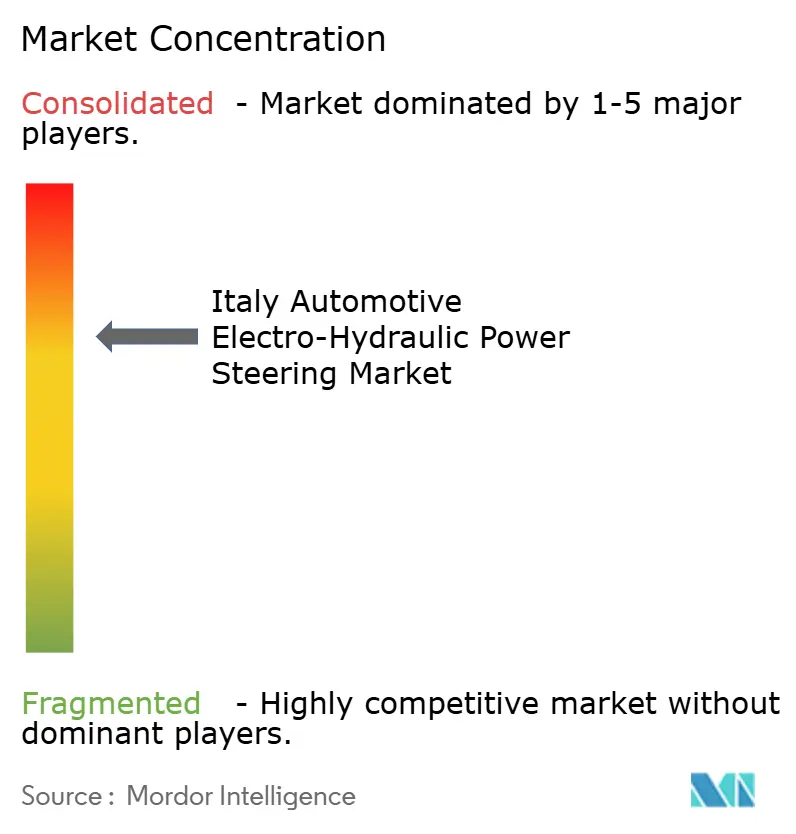
| Market Concentration | Medium |
Major Players *Disclaimer: Major Players sorted in no particular order Image © Mordor Intelligence. Reuse requires attribution under CC BY 4.0. | |
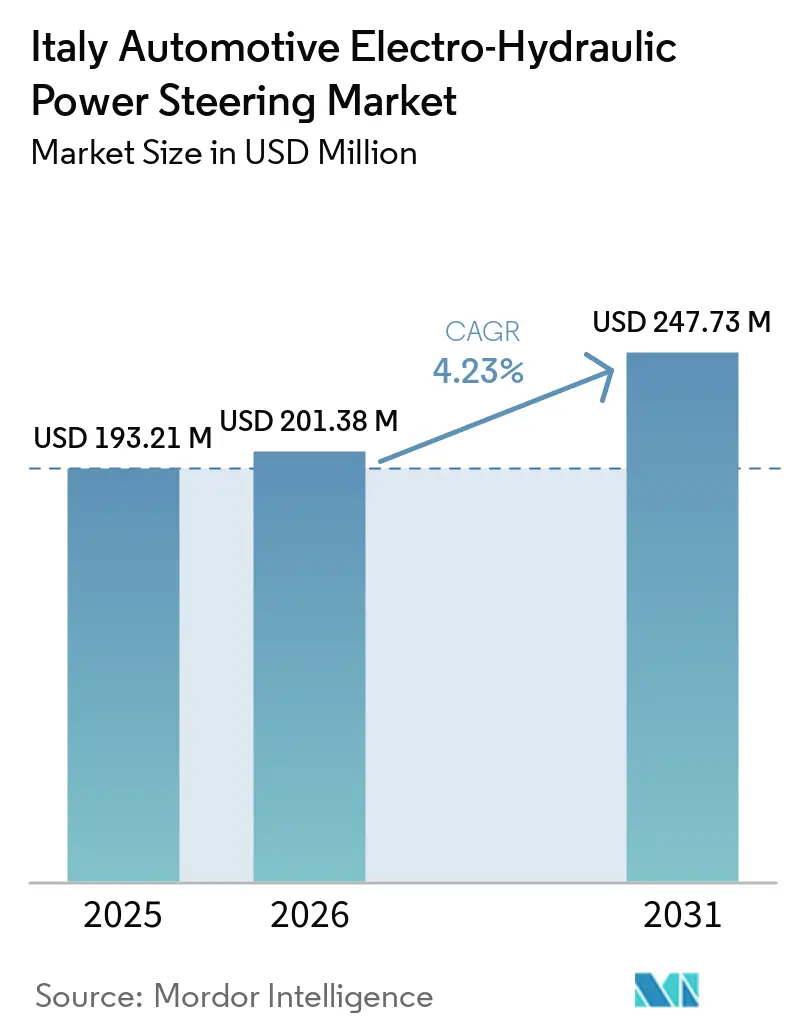
Italy Automotive Electro-Hydraulic Power Steering Market Analysis by Mordor Intelligence
The Italy automotive electro-hydraulic power steering market size is projected to expand from USD 193.2 million in 2025 to USD 201.4 million in 2026, and to USD 247.7 million by 2031, registering a CAGR of 4.2% between 2026 and 2031. Hybrid powertrains support demand by providing hydraulic assistance when an engine-driven pump is unavailable. Italy’s passenger-car mix is shifting toward fully electric power steering in smaller vehicles, thereby limiting demand in the city-car category. Commercial fleets, buses, and heavier hybrid platforms retain stronger requirements for hydraulic capacity, redundancy, and controlled steering assistance. Suppliers are therefore concentrating on electronic control, sensor content, and OEM integration while building aftermarket service capability for an aging installed base. Production volatility remains an important constraint because local OEM fitment is tied closely to Italian vehicle output.
Key Report Takeaways
- By vehicle type, passenger cars held a 62.22% share in 2025, while light commercial vehicles are forecast to grow at a 7.42% CAGR through 2031.
- By component type, steering column and rack interface components accounted for 32.51% of the Italian electro-hydraulic power steering market in 2025, while sensors and torque modules are projected to grow at a 7.22% CAGR through 2031.
- By technology, Advanced EHPS captured a 55.65% share in 2025 and is expected to grow at a 6.23% CAGR through 2031.
- By sales channel, OEM supply accounted for 90.19% of the Italian electro-hydraulic power steering market in 2025, while aftermarket replacement is forecast to expand at a 6.88% CAGR through 2031.
Note: Market size and forecast figures in this report are generated using Mordor Intelligence’s proprietary estimation framework, updated with the latest available data and insights as of January 2026.
Italy Automotive Electro-Hydraulic Power Steering Market Trends and Insights
Drivers Impact Analysis*
| Driver | (~) % Impact on CAGR Forecast | Geographic Relevance | Impact Timeline |
|---|---|---|---|
| EV and Hybrid Platform Compatibility | +1.2% | National, concentrated in northern production clusters including Turin and Emilia-Romagna | Medium term (2-4 years) |
| Stricter CO2 and Fuel-Efficiency Compliance | +0.9% | EU-wide mandate, with execution risk concentrated in Italy and Germany | Short term (≤ 2 years) |
| ADAS-Ready Steering Assistance | +0.7% | National, with early gains in Lombardy and Piedmont OEM integration hubs | Medium term (2-4 years) |
| Fleet Renewal and Commercial Vehicle Maneuverability | +0.6% | National, concentrated in urban transit networks including Rome, Milan, and Naples | Short term (≤ 2 years) |
| EHPS Retrofitability Across Legacy Platforms | +0.4% | National, strongest in Veneto and Emilia-Romagna aftermarket clusters | Long term (≥ 4 years) |
| Regionalization of Italian Automotive Component Engineering | +0.3% | Northern Italy production triangle, with spillover to central Italy | Long term (≥ 4 years) |
| Source: Mordor Intelligence | |||
EV and Hybrid Platform Compatibility
Italy’s hybrid vehicle mix supports demand for the Italian electro-hydraulic power steering market. Hybrid systems can operate for extended periods without an engine-driven hydraulic pump. EHPS can provide hydraulic assist in those conditions on platforms that require higher steering loads. Hybrid-electric vehicles accounted for 44.1% of Italian new-car sales in H1 2025, establishing a large base for compatible steering fitment and future service demand. Plug-in hybrid registrations rose 86.6% in Italy in 2025 and increased 84.3% in the first half of 2026, supporting the shift toward electrified platforms [1]. This mix makes powertrain choice more important to EHPS demand than overall new-vehicle volume alone.
Stricter CO₂ and Fuel Efficiency Compliance
EU emissions regulation gives manufacturers a defined transition period to comply with fleet emissions rules. The regulation retains the carbon dioxide emissions target for passenger cars, keeping pressure on manufacturers to offer hybrid and other lower-emission powertrains. The European Commission’s automotive package also maintains the long-term direction toward a substantial reduction in tailpipe emissions. Commercial vehicle operators can also assess steering efficiency when comparing operating costs.
ADAS Ready Steering Assistance
Steering systems must increasingly exchange electronic commands with driver-assistance functions. Italy adopted a circular relating to Supplement 3 to the 01 series of amendments to UN Regulation No. 157 in April 2025 [2]. These approval frameworks raise the technical requirements for steering on vehicles equipped for more advanced automated functions. EHPS can combine hydraulic support with electronic control, unlike conventional hydraulic steering. ZF presented a commercial-vehicle safety architecture in Milan that combined ADAS, braking, and steering functions. This approach expands the role of controlled steering functions in commercial applications. It also increases the value of sensors, controllers, and calibration within the Italian electro-hydraulic power steering market.
Fleet Renewal and Commercial Vehicle Maneuverability
Italy committed funding under the National Recovery and Resilience Plan to renew its public bus fleet. The program supports electric and hybrid public transport vehicles, which require suitable steering architectures. Consip is expected to issue a major tender for electric buses. Italy is also expected to introduce incentives for CNG, hybrid, and electric freight vehicles above specified weight thresholds through the relevant decree. Commercial applications prioritize high rack load capacity and fail-safe operation, supporting the continued use of EHPS. These procurements create a more visible demand pipeline for buses and freight vehicles than for smaller passenger cars.
Restraints Impact Analysis*
| Restraint | (~) % Impact on CAGR Forecast | Geographic Relevance | Impact Timeline |
|---|---|---|---|
| EPS Migration in Compact Passenger Cars | -1.4% | National, concentrated in Turin and Cassino production zones | Short term (≤ 2 years) |
| Higher System and Calibration Cost | -0.6% | National, with greatest sensitivity among SME vehicle fleets | Medium term (2-4 years) |
| Italian Vehicle-Production Volatility | -0.5% | National, concentrated in single-OEM dependency on Stellantis | Short term (≤ 2 years) |
| Limited Local Scale for High-Voltage and Software Validation | -0.4% | Northern Italy Research and Development clusters in Turin, Milan, and Bologna | Long term (≥ 4 years) |
| Source: Mordor Intelligence | |||
EPS Migration in Compact Passenger Cars
Compact passenger vehicles are shifting toward column-mounted EPS. EPS is lighter, does not use hydraulic fluid, and is less costly to calibrate for lower rack-load applications. This makes EHPS less viable for the small-vehicle platforms that remain important in Italy. JTEKT introduced its Syncusteer steer-by-wire brand in 2026, indicating continued movement beyond established EPS designs in passenger vehicles. Nexteer began series production of its steer-by-wire system in April 2026 after ASIL D certification, creating another benchmark for next-generation passenger steering. The transition reduces EHPS fitment rates in city-car and subcompact vehicle lines.
Higher System and Calibration Cost
EHPS carries a higher installed cost than conventional hydraulic steering. The system requires an electric motor, an integrated electronic control unit, and wiring for driver-assistance interfaces. ADAS-capable systems also require functional safety validation in line with relevant automotive safety standards. These requirements create a cost burden for smaller fleet operators and independent repair networks. Knorr-Bremse received a major commission to develop EPS systems for series production, highlighting the level of investment required for modern steering development. This cost structure can limit independent aftermarket adoption, even as OEM-linked replacement activity expands.
*Our forecasts treat driver/restraint impacts as directional, not additive. The impact forecasts reflect baseline growth, mix effects, and variable interactions.
Segment Analysis
By Vehicle Type: LCVs Gain Ground as Electrified Fleets Expand
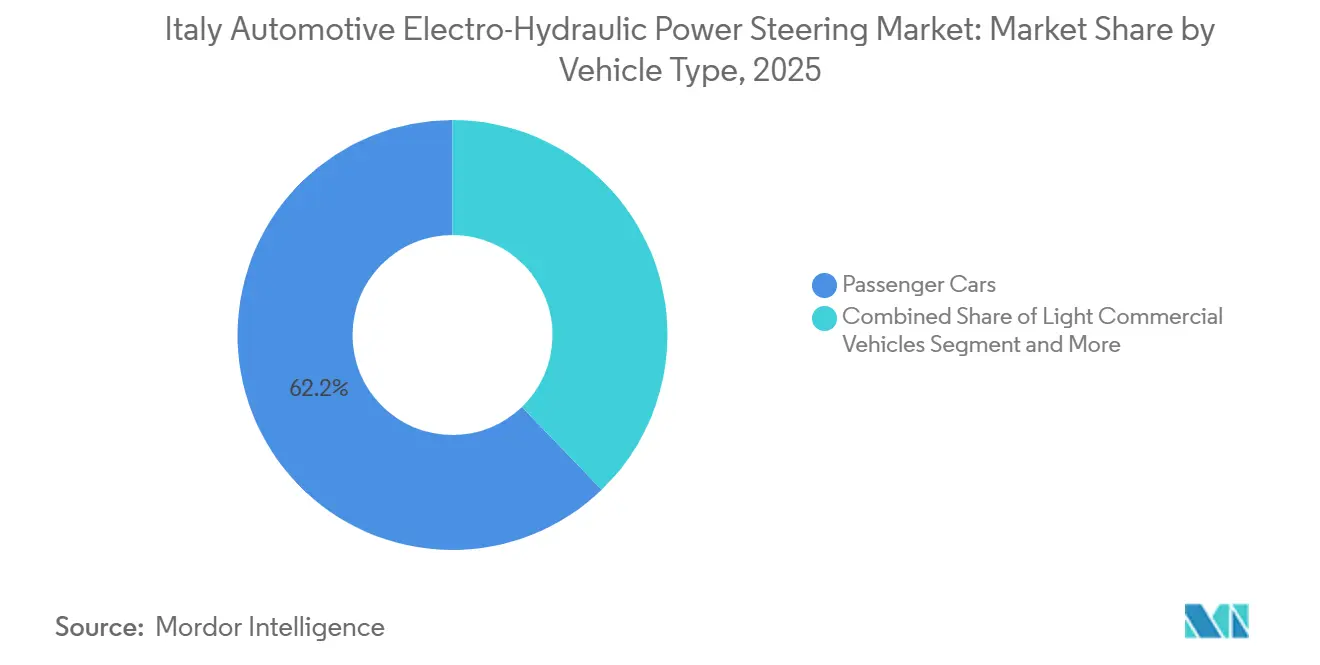
Passenger cars accounted for 62.22% of the Italian electro-hydraulic power steering market share in 2025. Their position reflects the large Italian hybrid-vehicle mix, although EPS migration limits demand in the city-car and subcompact ranges. Medium and heavy commercial vehicles, buses, and coaches benefit from fleet electrification policies and public procurement. Off-road equipment continues to require hydraulic steering under heavy loads and demanding operating conditions. A recent AGCO patent covers an electro-hydraulic steering system with a variable steering ratio for agricultural vehicles. This activity indicates that specialized equipment remains relevant to the Italian electro-hydraulic power steering market, even as passenger car applications evolve.
Light commercial vehicles are the fastest-growing vehicle type in the Italian electro-hydraulic power steering market, with a forecast CAGR of 7.42% through 2031. Fleet decarbonization funding supports electric and hybrid van platforms that require steering assistance during low engine load or electric operation. Stellantis began production of the Cargo Box BEV at its Atessa plant. Stellantis Pro One and Iveco Group also agreed to supply a range of battery-electric van models, with a commercial launch planned in the near term. Italy's incentive framework for heavier commercial vehicles reinforces demand in commercial weight classes. The Italian electro-hydraulic power steering market benefits from hydraulic assistance remaining practical for heavier van applications.

By Component Type: Sensors and Torque Modules Drive System Intelligence Upgrade
Steering column and rack interface components led with 32.51% of the Italian electro-hydraulic power steering market in 2025. These components remain the structural mounting and load-bearing base for the system. Electric motors and hydraulic pumps benefit from standardization across vehicle platform families. ECU and controller content rise as manufacturers place speed-sensitive and ADAS-compatible logic within the steering unit. Reservoirs, hoses, and related parts continue to support both original fitment and replacement demand. Bosch announced new commercial-vehicle workshop products and diagnostic solutions in 2026, reflecting continuing service support for steering systems.
Sensors and torque modules are the fastest-growing component category, with a 7.22% CAGR through 2031. Their growth reflects greater use of real-time torque feedback, variable-assist control, and interfaces for driver-assistance functions. Advanced control requirements are driving demand for electronic sensing components in both new fitment and retrofit applications. Active disturbance rejection control can improve the precision of EHPS angle tracking under dynamic loads. This supports investment in more responsive steering control systems. Higher electronic content is shifting part of the system's value from mechanical assemblies toward sensors and control functions.
By Technology: Advanced EHPS Consolidates Its Leading Position
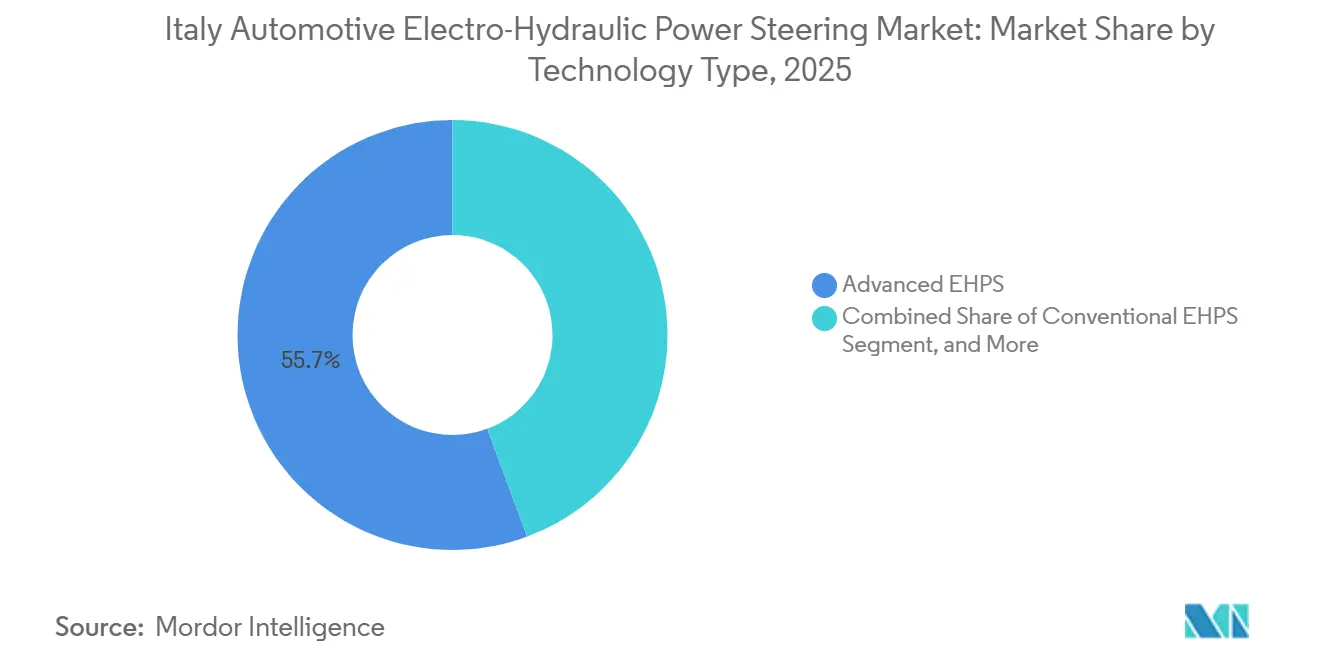
Advanced EHPS held 55.65% of the Italian electro-hydraulic power steering market in 2025 and is forecast to grow at a 6.23% CAGR through 2031. It combines hydraulic fail-safe behavior with variable electronic assistance and support for ADAS integration. This combination suits commercial vehicles and higher-load hybrid platforms. Advanced EHPS also provides a step between conventional hydraulic systems and full steer-by-wire designs.
Conventional EHPS continues to serve legacy replacement needs and off-road applications with limited electronic requirements. Compact EHPS is relevant to smaller commercial vehicles, where packaging favors integrated pump-and-motor units. Rack-assist and pinion-assist configurations address vehicle-specific steering feel and ADAS calibration needs. The shift from conventional to advanced formats increases diagnostic and calibration requirements for workshops. thyssenkrupp Presta and L&T Technology Services recently established a software development partnership for ADAS-grade and steer-by-wire steering software, reflecting the growing importance of software capability in steering system development.
By Sales Channel: Aftermarket Accelerates as Legacy Parc Matures
OEM supply accounted for 90.19% of the Italian electro-hydraulic power steering market in 2025. The channel remains dominant because modern EHPS requires precise fitment and established supply agreements between vehicle manufacturers and Tier 1 suppliers. Aftermarket replacement is forecast to grow at a 6.88% CAGR through 2031. Early EHPS units fitted to mild-hybrid vehicles are reaching the point where pumps, motors, and sensors may require replacement. This creates demand that is not fully tied to current vehicle production. It also raises the importance of product availability and service capability.
Aftermarket demand is dispersed more widely than OEM supply. OEM activity is concentrated around northern Italian assembly facilities, while replacement demand reaches independent workshops across southern Italy and the islands. Older commercial fleets and slower renewal cycles support this geographic spread. Bosch’s 2026 commercial-vehicle workshop update shows that global suppliers continue to refresh aftermarket support. Modern EHPS requires diagnostic tools and calibration knowledge, favoring trained service networks. The channel offers suppliers a route to balance uneven local OEM production with recurring parts demand.
Geography Analysis
Northern Italy accounts for the principal concentration of the Italian electro-hydraulic power steering market because it contains the main automotive production and engineering clusters. Piedmont includes Turin-based vehicle operations and steering-related engineering activity. Emilia-Romagna is home to performance-vehicle manufacturers and a dense supplier base. Lombardy contributes engineering, logistics, and service capabilities. These regions also host much of the country’s chassis and steering research capacity.
Italian automotive production fell 19.8% in 2025, leaving passenger-car output at 238,000 units according to preliminary ANFIA figures[3]. This decline demonstrated the exposure of OEM demand to a limited group of domestic producers. First-quarter 2026 Italian vehicle output rose 9.5% year over year to 120,366 units, providing some support for the northern and Abruzzo supply corridors. Italy’s plug-in hybrid registrations increased by 84.3% in the first half of 2026. This hybrid mix gives the Italian electro-hydraulic power steering market a more compatible platform profile than markets with deeper battery-electric adoption. Southern Italy and the islands retain a larger replacement opportunity because fleet renewal is slower and the vehicle base is older.
Public transport adds a separate regional demand layer to the Italian electro-hydraulic power steering market size. The PNRR commitment and the Consip electric-bus tender support procurement across Rome, Milan, Naples, Turin, Palermo, and Bologna. The 2025 Italian bus market recorded more than 4,100 new registrations, with electric buses accounting for 30% of the total. These programs create bus-specific steering demand in major urban networks. Freight incentives further extend commercial-vehicle activity outside the main passenger-car production regions.
Competitive Landscape
JTEKT, ZF, Robert Bosch, and Nexteer Automotive hold leading system-level positions in the Italian electro-hydraulic power steering market. Supply of motors, pumps, and sensors is more fragmented than the complete system supply. Leading suppliers compete through system integration, calibration capability, and service depth. Their product strategies increasingly link steering with ADAS, braking, and active chassis functions. This reduces the relevance of component price alone in OEM platform decisions.
ZF presented its 360° safety concept for commercial vehicles in 2026, integrating steering, braking, and ADAS functions in a coordinated architecture. Nexteer began series production of its steer-by-wire system in April 2026, setting a competitive reference point for passenger-platform transitions. JTEKT also introduced the Syncusteer steer-by-wire name in 2026. These developments show that suppliers are preparing for steering architectures that extend beyond EHPS. However, EHPS retains a role where hydraulic capacity, redundancy, and cost remain decisive.
A Knorr-Bremse patent issued in February 2026 covers an EHPS pump apparatus with integrated power electronics. The filing shows continued engineering work on smaller and more integrated EHPS subsystems. Italy also offers an opportunity in calibration software, workshop training, and managed aftermarket parts availability. The local supplier base faces uncertainty when vehicle output changes sharply or when major chassis companies restructure. Suppliers with OEM relationships and broad service networks are better positioned to manage these conditions in the Italy electro-hydraulic power steering market.
Italy Automotive Electro-Hydraulic Power Steering Industry Leaders
-
JTEKT Corporation
-
Nexteer Automotive Group Limited
-
Robert Bosch GmbH
-
ZF Friedrichshafen AG
-
NSK Ltd.
- *Disclaimer: Major Players sorted in no particular order
Recent Industry Developments
- July 2026: Robert Bosch GmbH launched new commercial vehicle steering components at Automechanika Frankfurt 2026, including its Servotwin EHPS system, which combines Servocom hydraulic steering with electric assistance for ADAS-capable rear-axle steering functions. The components are commercially available and target OEM and workshop channels across Europe.
- May 2026: ZF Friedrichshafen AG presented the TraXon 2 Hybrid, CeTrax 2 dual central drive, and a 360° safety concept integrating ADAS, braking, and steering for commercial vehicles at Transpotec Logitec in Milan. This was the first showcase of this integrated architecture at an Italian commercial vehicle event.
Italy Automotive Electro-Hydraulic Power Steering Market Report Scope
The Italian electro-hydraulic power steering market is segmented by vehicle type (passenger cars, LCVs, m&hcvs, buses, and off-road), component type (steering column and rack interface, electric motor, hydraulic pump, sensors and torque modules, ecu, and reservoirs and hoses), technology (conventional, advanced, compact, and rack-assist ehps), and sales channel (OEM supply, aftermarket replacement). The market forecasts are in terms of value (USD).
By Vehicle Type
| Passenger Cars | Light Commercial Vehicles | |
| Medium and Heavy Commercial Vehicles | ||
| Buses and Coaches | ||
| Off-Road Vehicles | Agricultural Equipment | |
| Construction Equipment | ||
| Mining Equipment | ||
| Material-Handling Equipment | ||
| Forestry and Utility Off-Road Equipment | ||
| Recreational Off-Road Vehicles | ||
| By Component Type | Steering Column and Rack Interface | |
| Electric Motor | ||
| Hydraulic Pump | ||
| Sensors and Torque Modules | ||
| Electronic Control Unit and Controllers | ||
| Reservoirs, Hoses, and Other Components | ||
| By Technology | Conventional EHPS | |
| Advanced EHPS | ||
| Compact EHPS | ||
| Rack-Assist and Pinion-Assist EHPS | ||
| By Sales Channel | OEM Supply | |
| Aftermarket Replacement | ||
| By Vehicle Type | Passenger Cars | Light Commercial Vehicles | |
| Medium and Heavy Commercial Vehicles | |||
| Buses and Coaches | |||
| Off-Road Vehicles | Agricultural Equipment | ||
| Construction Equipment | |||
| Mining Equipment | |||
| Material-Handling Equipment | |||
| Forestry and Utility Off-Road Equipment | |||
| Recreational Off-Road Vehicles | |||
| By Component Type | Steering Column and Rack Interface | ||
| Electric Motor | |||
| Hydraulic Pump | |||
| Sensors and Torque Modules | |||
| Electronic Control Unit and Controllers | |||
| Reservoirs, Hoses, and Other Components | |||
| By Technology | Conventional EHPS | ||
| Advanced EHPS | |||
| Compact EHPS | |||
| Rack-Assist and Pinion-Assist EHPS | |||
| By Sales Channel | OEM Supply | ||
| Aftermarket Replacement | |||
Key Questions Answered in the Report
What is the forecast growth rate for electro-hydraulic power steering in Italy?
The sector is forecast to grow at a 4.23% CAGR from 2026 to 2031, reaching USD 247.73 million by 2031.
Which vehicle category is growing fastest for EHPS applications in Italy?
Light commercial vehicles are forecast to grow at a 7.42% CAGR through 2031, supported by electric and hybrid fleet activity.
Why do hybrid vehicles support EHPS demand?
Hybrid vehicles may operate without an engine-driven hydraulic pump, while EHPS can still provide hydraulic steering assistance.
How important is the aftermarket for EHPS suppliers?
OEM supply dominated with 90.19% in 2025, but aftermarket replacement is forecast to grow at a faster 6.88% CAGR.
What is the main constraint on EHPS adoption in passenger cars?
Smaller cars are moving toward EPS and steer-by-wire systems, which reduces EHPS fitment in city-car and subcompact platforms.