
Market Overview
| Study Period | 2021 - 2031 |
|---|---|
| Forecast Data Period | 2026 - 2031 |
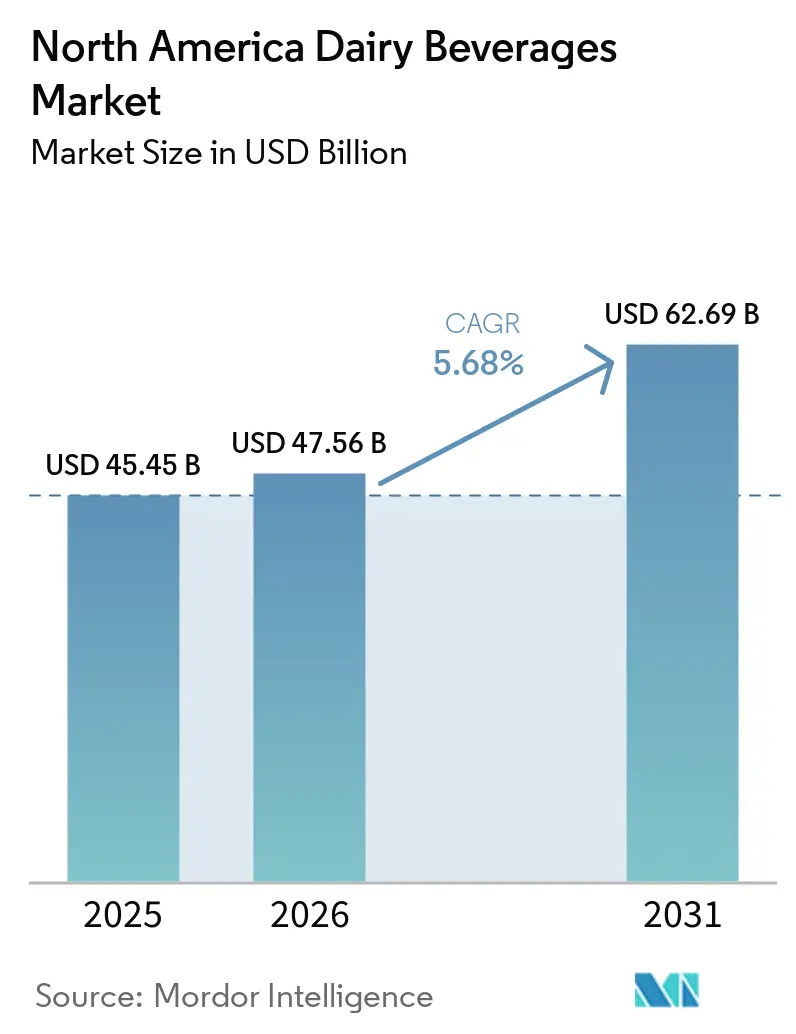
| Base Year Market Size (2025) | USD 45.45 Billion |
| Market Size (2026) | USD 47.56 Billion |
| Market Size (2031) | USD 62.69 Billion |
| Growth Rate (2026 - 2031) | 5.68 % |
| Market Concentration | Low |
Major Players *Disclaimer: Major Players sorted in no particular order Image © Mordor Intelligence. Reuse requires attribution under CC BY 4.0. | |
North America Dairy Beverages Market Analysis by Mordor Intelligence
The North America dairy beverages market size is valued at USD 47.56 billion in 2026, up from USD 45.45 billion in 2025, and is projected to reach USD 62.69 billion by 2031, growing at a CAGR of 5.68% during the forecast period. The North America dairy beverages market is moving toward products that offer more protein, less sugar, lactose-free formulations, and probiotic benefits. This shift gives processors a reason to invest in products with higher retail value instead of relying on conventional fluid milk alone. Protein is an important purchase consideration for U.S. consumers, and the International Food Information Council found that high-protein diets remained the most cited eating pattern in its 2025 survey[1]. The North America dairy beverages market also faces pressure from lactose sensitivity and plant-based substitutes, which makes product formulation and clear positioning more important. Capacity investments by fairlife and Chobani indicate that large suppliers expect continued demand for high-protein and ready-to-drink formats.
Key Report Takeaways
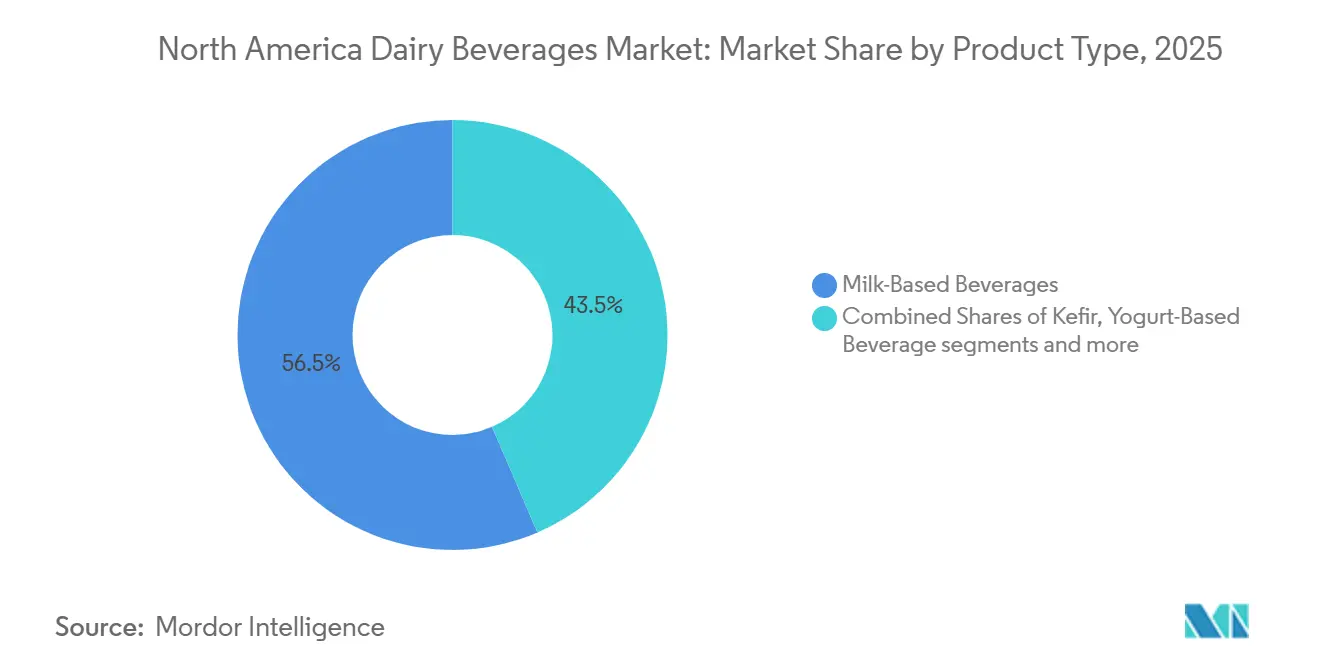
- By product type, milk-based beverages held 56.47% of the North America dairy beverages market share in 2025, while yogurt-based beverages are forecast to expand at a 6.78% CAGR through 2031.
- By category, unflavored dairy beverages held 54.38% of the North America dairy beverages market share in 2025, while flavored dairy beverages are forecast to grow at a 6.57% CAGR through 2031.
- By fat content, whole or fat dairy beverages held 53.47% of the North America dairy beverages market share in 2025, while low-fat dairy beverages are forecast to grow at a 6.53% CAGR through 2031.
- By packaging type, bottles held 64.52% of the North America dairy beverages market share in 2025, while cartons are forecast to grow at a 7.11% CAGR through 2031.
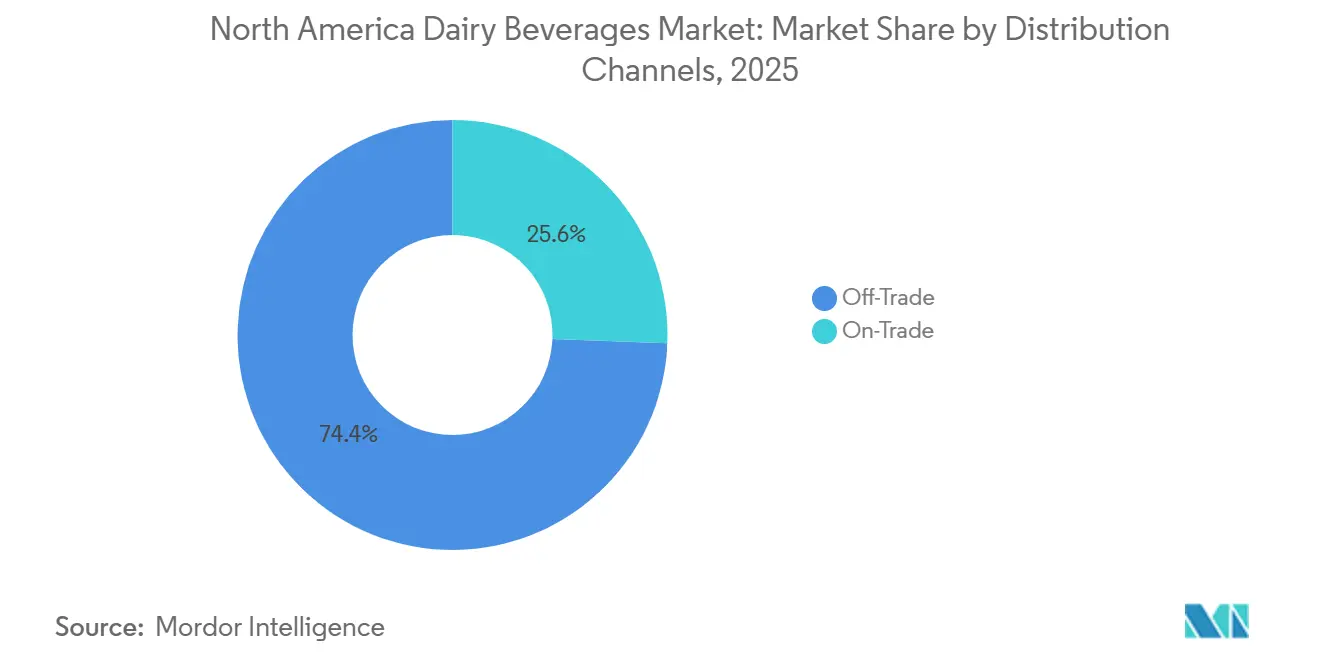
- By distribution channel, off-trade channels held 74.38% of the North America dairy beverages market share in 2025, while on-trade channels are forecast to grow at a 6.83% CAGR through 2031.
- By geography, the United States held 72.43% of the North America dairy beverages market share in 2025, while Canada is forecast to grow at a 7.21% CAGR through 2031.
Note: Market size and forecast figures in this report are generated using Mordor Intelligence’s proprietary estimation framework, updated with the latest available data and insights as of January 2026.
Market Trends and Insights
Drivers Impact Analysis of North America Dairy Beverages Market*
| Driver | (~) % Impact on CAGR Forecasts | Geographic Relevance | Impact Timeline |
|---|---|---|---|
| Product innovation in reduced-sugar, low-fat, and specialty dairy drinks | +1.3% | United States, Canada | Short term (≤ 2 years) |
| Growing demand for protein-rich and nutritionally fortified dairy beverages | +1.1% | United States, Canada | Medium term (2-4 years) |
| Increasing demand for premium and clean-label dairy beverages | +0.9% | United States, Canada, Mexico | Medium term (2-4 years) |
| Rising consumer demand for convenient, ready-to-drink dairy beverages | +0.8% | United States, Canada | Short term (≤ 2 years) |
| Rising consumption of dairy beverages in foodservice and quick-service restaurants | +0.7% | United States | Medium term (2-4 years) |
| Increasing demand for probiotic and gut health-focused dairy beverages | +0.5% | United States | Medium term (2-4 years) |
| Source: Mordor Intelligence | |||
Growing Demand for Protein-Rich and Nutritionally Fortified Dairy Beverages
Protein is shaping new product development across the North America dairy beverages market. The International Food Information Council reported that more than 1 in 3 Americans increased protein intake during the prior year, while a good source of protein became the leading consumer definition of healthy food. This preference allows refrigerated dairy brands to compete more directly with shelf-stable protein shakes. Danone North America launched Oikos Protein Shakes in May 2025 and launched Oikos Fusion in August 2025. Oikos Fusion provides 23 grams of protein and 5 grams of prebiotic fiber in a 7-ounce bottle, with a lactose-free cultured dairy formulation intended for consumers using GLP-1 medications. The product launches show that manufacturers are serving consumers who seek smaller portions with measurable nutrition benefits.
Product Innovation in Reduced-Sugar, Low-Fat, and Specialty Dairy Drinks
Ultrafiltration gives producers a practical route to higher protein, lower lactose, and reduced sugar in a single product. This supports the North America dairy beverages market because it lets brands add value while still using familiar dairy ingredients. Dairy Farmers of America launched Kemps Protein+ Milk in May 2026 with 13 grams of protein per serving and 50% less sugar than regular milk. Its Alta Dena Protein and Meadow Gold Protein brands each offer 15 grams of protein per serving, which Dairy Farmers of America stated was 87% more than standard milk. These products raise the risk that conventional milk loses shelf space within the dairy aisle. Producers therefore need assortment plans that support premium formats without eroding the role of their standard products.
Increasing Demand for Probiotic and Gut Health-Focused Dairy Beverages
Probiotic drinks give the North America dairy beverages market another path beyond conventional milk consumption. Yogurt drinks and kefir can appeal to consumers who want fermented foods, protein, and convenient portions. Lifeway Foods committed USD 45 million to a four-phase expansion of its Waukesha, Wisconsin facility to support higher kefir output. The company stated that the investment is designed to double overall production output by the end of 2026. This capacity action reflects the importance of fermentation expertise and supply reliability in probiotic dairy beverages. It also creates a higher barrier for new brands that lack established production systems for cultured dairy.
Rising Consumer Demand for Convenient, Ready-to-Drink Dairy Beverages
Ready-to-drink products serve consumers who use beverages as snacks, meal supplements, or portable nutrition. This creates opportunities for the North America dairy beverages market in convenience retail, foodservice, and retail coolers. Chobani announced a USD 567 million multi-phase expansion of its La Colombe facility in Norton Shores, Michigan in March 2026. The expansion is expected to add 340 jobs and increase the company’s Michigan milk sourcing from 30 million pounds to 615 million pounds annually. The project shows that blended dairy and coffee formats require dedicated capacity as their distribution expands. Brands without strong formulations or retail access may find it harder to protect pricing in this format.
Restraints Impact Analysis of North America Dairy Beverages Market*
| Restraint | (~) % Impact on CAGR Forecasts | Geographic Relevance | Impact Timeline |
|---|---|---|---|
| Rising incidence of lactose intolerance and dairy sensitivities | -1.2% | United States, Canada | Medium term (2-4 years) |
| Growing consumer preference for plant-based beverage alternatives | -0.8% | United States, Canada | Medium term (2-4 years) |
| Fluctuations in raw milk prices and dairy production costs | -0.7% | United States, Canada | Short term (≤ 2 years) |
| Concerns regarding added sugar and calorie conten | -0.5% | United States | Medium term (2-4 years) |
| Source: Mordor Intelligence | |||
Growing Consumer Preference for Plant-Based Beverage Alternatives
Plant-based beverages remain a substitute risk for dairy producers, especially among consumers who avoid lactose or prefer non-dairy diets. This pressure encourages dairy companies to offer lactose-free products and stronger nutrition messaging. The North America dairy beverages market must also compete for consumption occasions rather than only for shelf placement. Danone North America has activity in both dairy and plant-based products, which gives it a broader portfolio than dairy-only producers. The presence of companies with dual portfolios can limit the loss of consumer occasions within their own brand systems. Producers without adjacent offerings depend more heavily on innovation in dairy-specific benefits.
Fluctuations in Raw Milk Prices and Dairy Production Costs
Milk supply conditions affect processor margins, procurement decisions, and the location of new capacity. USDA Economic Research Service projected the U.S. all-milk price at USD 19.85 per hundredweight in 2026 and USD 19.80 per hundredweight in 2027 in its August 2026 outlook[2]. Lower raw milk prices can support short-term processor economics, but they may also reduce incentives for farm-level supply investment. The North America dairy beverages market has to balance lower input costs against the need for reliable long-term milk supply. Premium, differentiated products provide more protection than commodity beverages when input conditions change. Processors that source across several regions can also manage supply costs through more flexible procurement.
*Our forecasts treat driver/restraint impacts as directional, not additive. The impact forecasts reflect baseline growth, mix effects, and variable interactions.
North America Dairy Beverages Market Segment Analysis
By Product Type:
Protein and Probiotic Formats Support Value GrowthMilk-based beverages held 56.47% of the North America dairy beverages market share in 2025. They remain important in household purchasing, foodservice, and institutional channels. The North America dairy beverages market size for this segment benefits from familiar consumption habits and established distribution. Competition within milk-based beverages is moving toward ultra-filtered, lactose-free, and protein-fortified products. Dairy Farmers of America expanded this direction through Kemps Protein+, Alta Dena Protein, and Meadow Gold Protein. These products use the same dairy supply base while offering stronger nutrition claims and higher retail value.
Yogurt-based beverages are forecast to grow at a 6.78% CAGR through 2031. The segment includes products that combine cultured dairy, probiotic positioning, and portable packaging. Yogurt drinks can address consumer interest in digestive health while remaining part of the refrigerated dairy set. The growth profile also reflects the role of smaller portion sizes in nutrition-focused occasions. Lifeway’s expansion program shows that kefir producers are building supply capacity to serve more demand. Other functional dairy shots and blended dairy-fruit drinks remain smaller formats, but they provide room for targeted new offerings.



By Category:
Flavored Products Expand Premium Purchase OccasionsUnflavored dairy beverages held 54.38% of the North America dairy beverages market share in 2025. Household milk routines and institutional purchasing support this position. The segment is also changing internally as ultra-filtered and A2 products gain space within traditional white milk. These products offer choices for consumers looking for protein, reduced lactose, or other functional attributes. Their expansion means unflavored products are not limited to commodity milk. A broad product range helps retailers retain consumers who might otherwise switch to non-dairy alternatives.
Flavored dairy beverages are forecast to expand at a 6.57% CAGR through 2031. Seasonal and limited-edition products can bring consumers into the category beyond their routine purchases. Prairie Farms launched Pumpkin Spice and Chocolate Peanut Butter Cup flavored milks in new quart cartons in September 2026. The launch shows how familiar flavors can support seasonal retail engagement. Product quality remains important because flavored products face scrutiny around sugar, ingredients, and nutritional value. Natural colors, real fruit ingredients, and the absence of artificial sweeteners can help companies differentiate these beverages.
By Fat Content:
Whole Milk Retains Scale While Low-Fat Gains Functional DemandWhole or fat dairy beverages held 53.47% of the North America dairy beverages market share in 2025. This segment benefits from consumer interest in less processed and more satisfying dairy choices. Whole-milk formats also remain useful for brands that want a richer taste profile. Protein-focused yogurt drinks can extend this proposition when they pair dairy fat with high protein content. These offerings give brands a way to serve consumers looking for nutrition and taste in the same product. Established household use continues to underpin demand in the segment.
Low-fat dairy beverages are forecast to grow at a 6.53% CAGR through 2031. Their performance reflects the overlap between lower-fat claims and protein-fortified formulations. Ultra-filtration can produce beverages with less sugar and more protein while maintaining a familiar dairy taste. This makes low-fat products relevant to consumers seeking practical nutrition options. Skimmed and non-fat products face a different position because fat-free claims alone do not create enough differentiation. Producers are responding by adding protein or probiotic benefits to reduce price-based competition.
By Packaging Type:
Bottles Support Ready-to-Drink Use While Cartons GainBottles held 64.52% of the North America dairy beverages market share in 2026. Single-serve bottles suit ready-to-drink protein shakes, flavored milks, and cultured beverages. Their portability is useful in convenience stores, foodservice, and on-the-go occasions. Bottles also give brands visible space for nutritional claims and product information. These characteristics make the format suitable for premium beverages with detailed ingredient or protein messaging. The package remains closely linked to the convenience proposition of the North America dairy beverages market.
Cartons are forecast to grow at a 7.11% CAGR through 2031. Aseptic cartons can support ambient distribution for selected dairy formats and provide alternatives to conventional packaging. Lactalis and Tetra Pak introduced an aseptic carton made from certified recycled polymers sourced from used drink cartons in January 2025. SIG also stated that its Terra Alu-free full-barrier carton uses more than 80% paper and can reduce the carbon footprint of multi-serve aseptic cartons by up to 61% when combined with forest-based polymers. Such packaging changes can support company sustainability plans and differentiate shelf presentation. Pouches and cans remain smaller options for foodservice portions and promotional programs.
By Distribution Channel:
Retail Leads Volume and Foodservice Adds GrowthOff-trade channels held 74.38% of the North America dairy beverages market share in 2025. Supermarkets and hypermarkets remain the primary route for household dairy purchases. Online retail provides another channel for organic, functional, and subscription-based products. Convenience stores are also gaining importance for protein shakes, flavored milk, and kefir drinks. These channels allow brands to meet consumers in routine grocery trips and in immediate-consumption occasions. Retail distribution remains central to volume in the North America dairy beverages market.
On-trade channels are forecast to grow at a 6.83% CAGR through 2031. Restaurants and quick-service chains are using more beverage formats to support traffic and higher average checks. Dairy-based protein products and cold foam applications give operators ways to add nutrition and flavor to menus. This can return dairy beverages to foodservice occasions where plant-based options have also grown. Chobani’s Norton Shores expansion reflects the manufacturing needs created by wider distribution of ready-to-drink dairy and coffee beverages. Strong operator relationships and dependable cold-chain delivery are important for brands that want to expand in this channel.

Geography Analysis
United States Dairy Beverages Market
The United States held 72.43% of the North America dairy beverages market share in 2025. Its large processing base, established dairy consumption, and strong investment pipeline support this position. The Coca-Cola Company broke ground on a USD 650 million fairlife expansion in Coopersville, Michigan in August 2026. The company also marked the ramp-up of a separate USD 650 million fairlife facility in Monroe County, New York. Chobani announced a USD 1.2 billion manufacturing and warehouse campus in Allentown, Pennsylvania, in September 2026.
Canada Dairy Beverages Market
The U.S. market also needs products that respond to lactose sensitivity. The National Institute of Diabetes and Digestive and Kidney Diseases states that lactose malabsorption affects an estimated 36% of people in the United States[3]. This supports interest in lactose-free, ultra-filtered, and cultured products. Canada is forecast to grow at a 7.21% CAGR through 2031, making it the fastest-growing geography in the North America dairy beverages market. Agropur announced a CAD 1 billion investment plan for its Bedford, Nova Scotia, and Beauceville, Quebec facilities in 2026, which was stated as approximately USD 735 million in the supplied material. The plan includes modernization and expanded dairy ingredient capacity.
Mexico Dairy Beverages Market
Canada’s dairy supply management system supports structured milk pricing and quality standards. Its consumer base also supports demand for lactose-free and fermented products. Mexico and the rest of North America represent the remaining share of the North America dairy beverages market. Mexico has demand for flavored milk and drinkable yogurt, supported by a young and increasingly urban population. Grupo LALA participates in flavored milk and yogurt drink formats in Mexico. LICONSA’s fortified milk program supports base dairy consumption among lower-income households. Cross-border distribution gives U.S. and Mexican processors a way to build demand for higher-value dairy formats across the rest of the region.
Competitive Landscape
Market Concentration
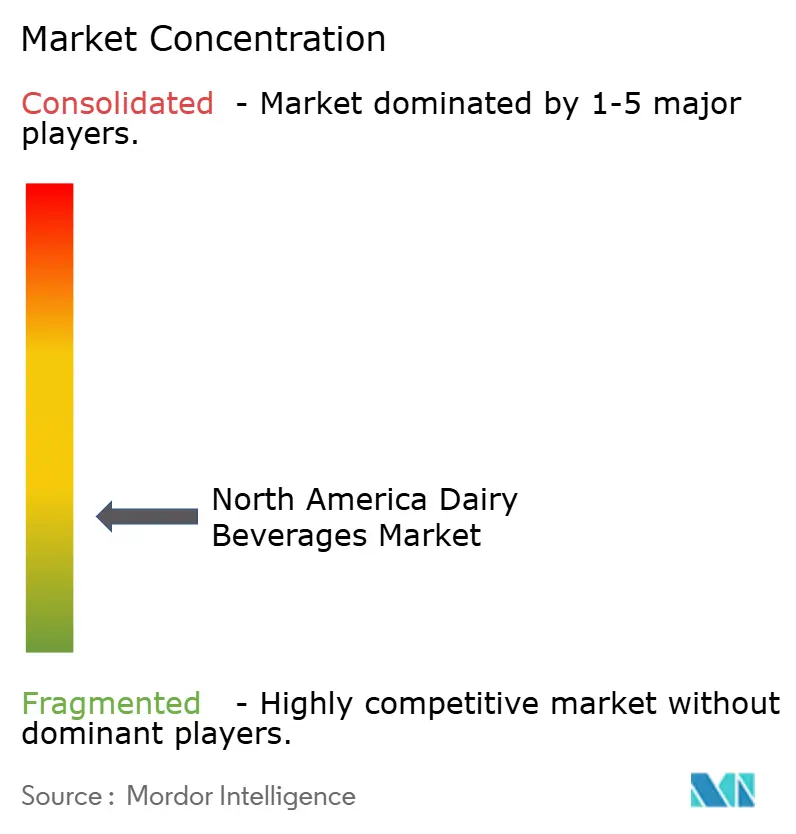
The North America dairy beverages market has a low concentration profile. Farmer-owned cooperatives, large consumer packaged goods companies, regional processors, and specialty brands compete across conventional and premium dairy formats. No single supplier has a dominant position across all products and geographies. The resulting competition increases the importance of distribution, product formulation, and manufacturing access. fairlife reported annual retail sales of USD 4 billion in the supplied material. Its USD 650 million Coopersville facility expansion adds production capacity for its portfolio.
Chobani’s September 2026 Allentown investment is another major strategic move in the North America dairy beverages market. The company announced a USD 1.2 billion investment over 5 years in a 1.5 million-square-foot manufacturing and warehouse campus. The supplied material states that the facility is expected to source more than 3 billion pounds of Pennsylvania milk annually at full capacity. Chobani also expanded its La Colombe ready-to-drink coffee plant in Michigan through a USD 567 million multi-phase program. These actions show that capacity and distribution are becoming as important as product development. They also create scale advantages for companies that can finance large production projects.
Agropur announced USD 130 million of investments in South Dakota and Wisconsin in February 2026 to expand whey processing and use dairy co-streams in higher-value ingredients. Lifeway Foods has also invested in capacity for kefir production, reinforcing its focus on fermented dairy. Danone North America introduced Oikos Fusion with a patented whey, leucine, and vitamin D blend. Such moves show how protein, fermentation, and targeted nutrition are shaping competitive differentiation. Opportunities remain in functional yogurt drinks, ambient kefir, and products designed for smaller, nutrient-dense consumption occasions. The competitive balance will depend on whether brands can combine clear benefits with reliable supply and distribution.
North America Dairy Beverages Industry Leaders
-
Chobani, LLC
-
Dairy Farmers of America Inc.
-
Lifeway Foods, Inc.
-
Groupe Lactalis
-
Nestlé S.A.
- *Disclaimer: Major Players sorted in no particular order
North America Dairy Beverages Market Companies Covered in this Report
- Agropur Dairy Cooperative
- Chobani, LLC
- Dairy Farmers of America Inc.
- Danone North America
- fairlife, LLC
- Groupe Lactalis
- Lifeway Foods, Inc.
- Organic Valley
- Prairie Farms Dairy, Inc.
- Saputo Inc.
- Nestlé USA
- The Coca-Cola Company
- The Hain Celestial Group, Inc.
- The Kraft Heinz Company
- Califia Farms, LLC
- Oatly Group AB
- Ripple Foods, PBC
- WhiteWave Foods Company
- Grupo LALA, S.A.B. de C.V.
- Land O’Lakes, Inc.
Recent Industry Developments in North America Dairy Beverages Market
- September 2026: Chobani announced a USD 1.2 billion investment over five years in a 1.5-million-square-foot manufacturing and warehouse campus in Allentown, Pennsylvania. The facility is expected to source more than 3 billion pounds of Pennsylvania milk annually at full capacity and create 900 jobs, representing the largest-ever private investment in Pennsylvania’s agriculture sector.
- September 2026: Prairie Farms introduced limited-edition packaging for its seasonal flavored milks. Pumpkin Spice Milk offers a seasonal pumpkin spice flavor, while Chocolate Peanut Butter Cup Milk combines chocolate and peanut butter flavors.
- July 2026: Maola introduced three limited-time flavored milk varieties for the 2026–2027 school year. The beverages contain 8 grams of protein and 13 essential nutrients per carton, with 7 grams of added sugar.
North America Dairy Beverages Market Report Scope
The North America dairy beverages market report provides a comprehensive analysis of the market based on product type, category, fat content, packaging type, distribution channel, and geography. By product type, the market is segmented into milk-based beverages, yogurt-based beverages, kefir, and others. Based on category, the market is divided into flavored and unflavored dairy beverages. By fat content, the market covers whole-fat, low-fat, and skimmed or non-fat products. Based on packaging type, the market includes cartons, bottles, pouches, cans, and other packaging formats. By distribution channel, the market is categorized into off-trade and on-trade channels. Off-trade distribution includes supermarkets and hypermarkets, convenience stores, specialty stores, online retail, and other channels such as vending and institutional sales. Geographically, the report covers the United States, Mexico, Canada, and the rest of North America.
Segmentation Overview
By Product Type
| Milk-Based Beverages |
| Yogurt-Based Beverages |
| Kefir |
| Others |
By Category
| Unflavored |
| Flavored |
By Fat Content
| Whole/Fat |
| Low-fat |
| Skimmed/Non-fat |
By Packaging Type
| Cartons |
| Bottles |
| Pouches |
| Cans |
| Others |
By Distribution Channels
| Off-Trade | Supermarkets/Hypermarkets |
| Convenience Stores | |
| Specialty Stores | |
| Online Retail | |
| Others (Vending, Institutional) | |
| On-Trade |
By Geography
| United States |
| Mexico |
| Canada |
| Rest of North America |
| By Product Type | Milk-Based Beverages | |
| Yogurt-Based Beverages | ||
| Kefir | ||
| Others | ||
| By Category | Unflavored | |
| Flavored | ||
| By Fat Content | Whole/Fat | |
| Low-fat | ||
| Skimmed/Non-fat | ||
| By Packaging Type | Cartons | |
| Bottles | ||
| Pouches | ||
| Cans | ||
| Others | ||
| By Distribution Channels | Off-Trade | Supermarkets/Hypermarkets |
| Convenience Stores | ||
| Specialty Stores | ||
| Online Retail | ||
| Others (Vending, Institutional) | ||
| On-Trade | ||
| By Geography | United States | |
| Mexico | ||
| Canada | ||
| Rest of North America | ||
Key Questions Answered in the Report
What is the size of the North America dairy beverages market?
The North America dairy beverages market size is USD 47.56 billion in 2026 and is projected to reach USD 62.69 billion by 2031 at a 5.68% CAGR.
Which product type leads dairy beverage sales in North America?
Milk-based beverages lead with 56.47% share in 2025, supported by household, foodservice, and institutional use.
Which dairy beverage product type is growing the fastest?
Yogurt-based beverages are forecast to grow at a 6.78% CAGR through 2031, supported by interest in probiotic and portable dairy products.
Which country has the largest dairy beverages sales in North America?
The United States holds 72.43% share in 2025, supported by processing capacity, retail reach, and investments from fairlife and Chobani.