
Market Overview
| Study Period | 2019 - 2030 |
|---|---|
| Forecast Data Period | 2025 - 2030 |
| Historical Data Period | 2019 - 2023 |
| Market Size (2025) | USD 22.42 Billion |
| Market Size (2030) | USD 29.14 Billion |
| Growth Rate (2025 - 2030) | 5.38 % |
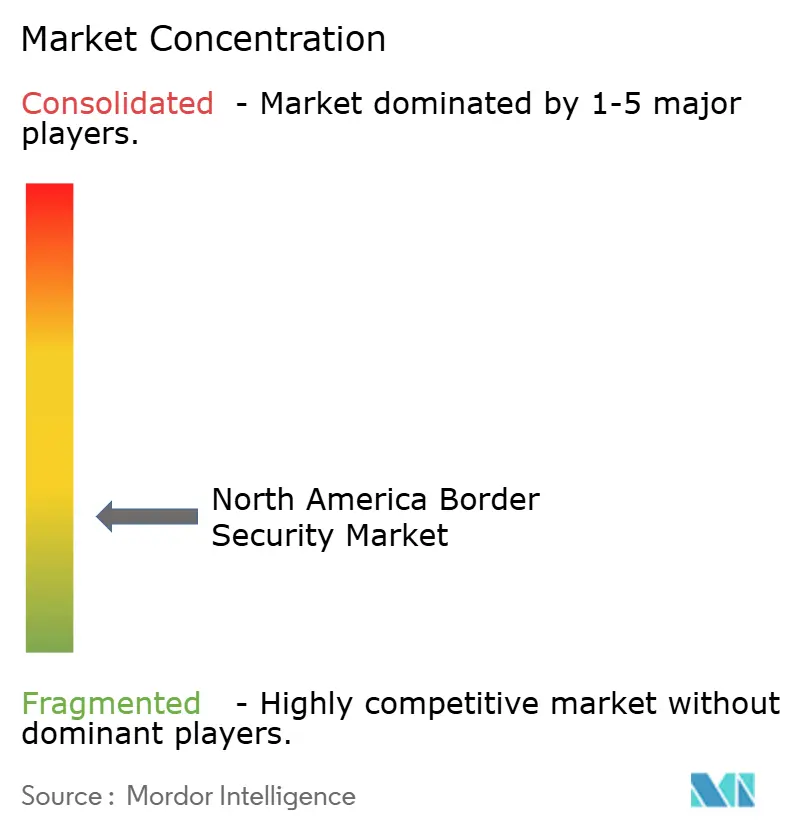
| Market Concentration | Low |
Major Players *Disclaimer: Major Players sorted in no particular order Image © Mordor Intelligence. Reuse requires attribution under CC BY 4.0. | |
North America Border Security Market Analysis by Mordor Intelligence
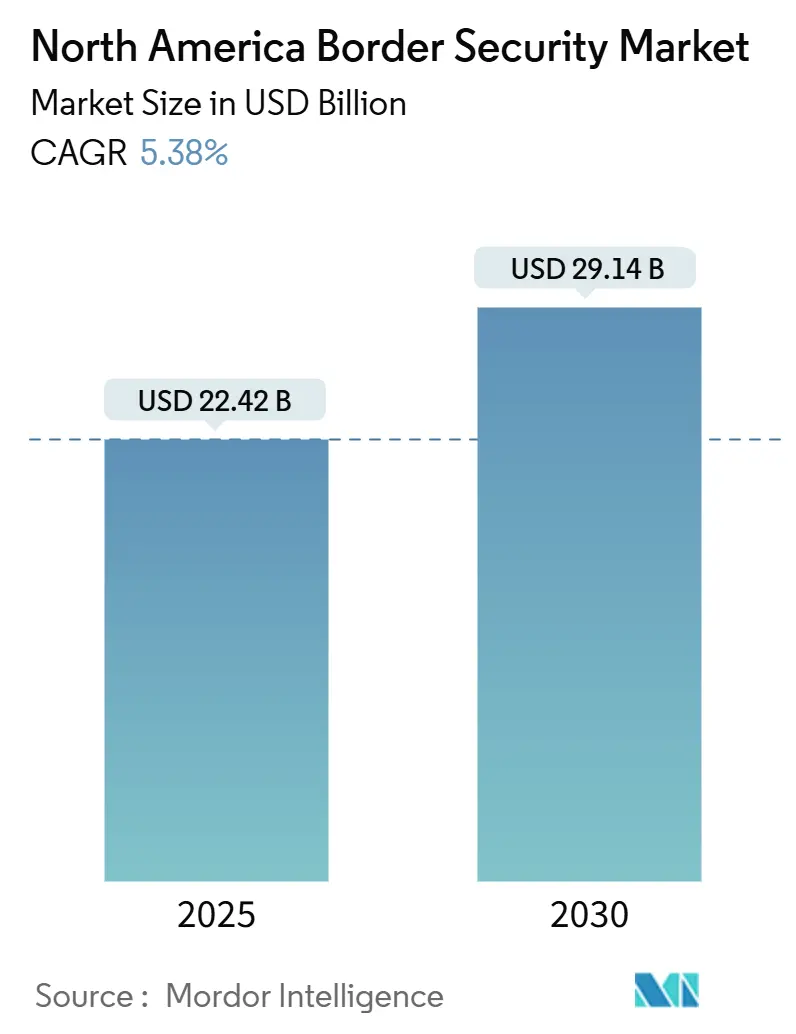
The North America Border Security Market size is estimated at USD 22.42 billion in 2025, and is expected to reach USD 29.14 billion by 2030, at a CAGR of 5.38% during the forecast period (2025-2030).
Although North America witnessed fewer territorial conflicts, the United States is still investing in the development of advanced border security systems, such as perimeter breach detectors and coastal security systems, to limit the influx of illegal immigrants, trafficking, drug smuggling, and terrorism. The increase in defense spending in the region is driving the market for surveillance aircraft, UAVs, coastal patrol boats, and aerostats. These are essential assets for border security, and they are continually upgraded with advanced detection and imaging technologies to enhance performance.
Several combined initiatives, such as the North American Aerospace Defense Command (NORAD) and the International Boundary Commission (IBC), have been undertaken to enhance cooperation and collaboration in technological developments. The deployment of biometric and biographical information-sharing solutions, underground sensors, machine learning algorithms, thermal imaging cameras, drones, etc., to identify understaffed border checkpoints is propelling the market's growth. Moreover, the development and adoption of advanced technologies, such as sensor-based detectors, advanced laser systems, shared intelligence networks, and artificial intelligence (AI), are propelling the growth of the border security security market in North America.
North America Border Security Market Trends and Insights
Land Platform to Dominate Market Share During the Forecast Period
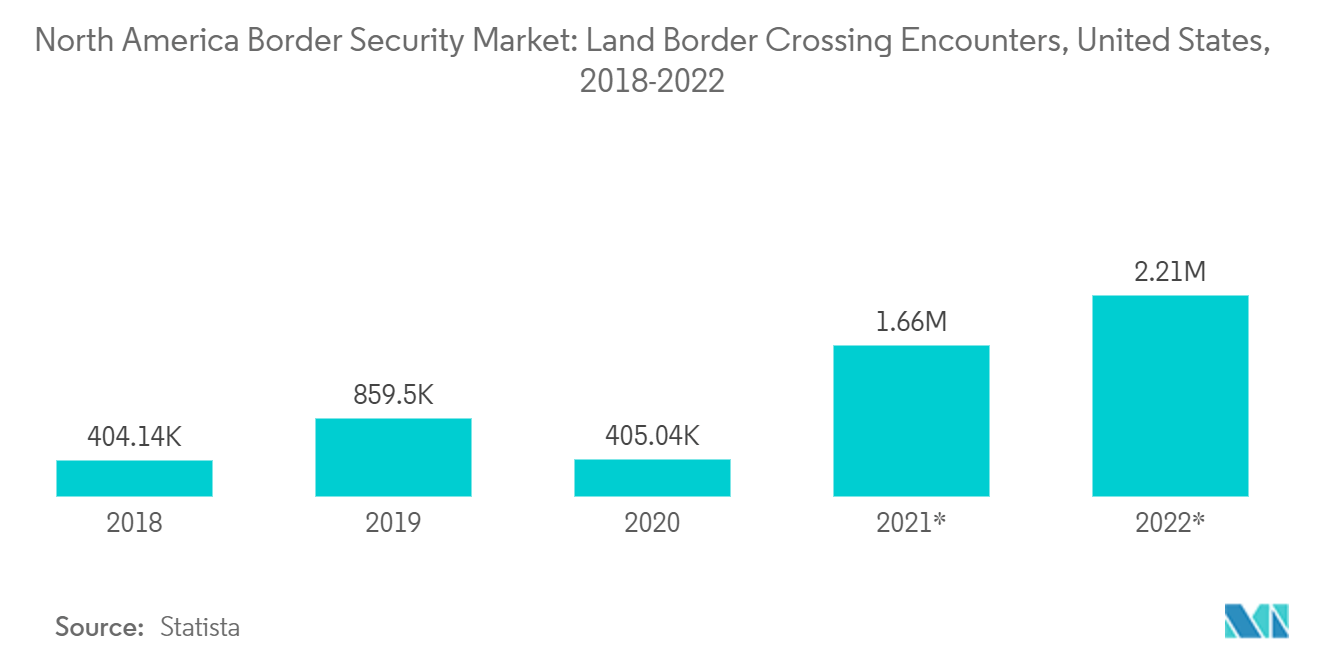
The land segment holds the largest market share in the North American border security market, primarily due to its critical role in addressing various security challenges related to illegal immigration, smuggling, and other cross-border threats. Land-based border security solutions encompass a diverse range of technologies and infrastructure, including physical barriers, surveillance systems, and advanced sensors.
The vast and varied topography of North America's land borders, shared between the US and Canada and the US-Mexico border, necessitates a comprehensive and adaptable approach to security. Governments in the region have prioritized investments in advanced technologies, including ground-based radar systems, infrared cameras, and integrated command and control centers. The need for real-time monitoring and rapid response capabilities further drives the demand for land-based border security solutions. Enhanced situational awareness and the ability to deploy resources effectively contribute to the prominence of the land segment in the overall market, reflecting a strategic focus on securing terrestrial borders in North America.
In June 2021, the Canada Border Services Agency invited 15 companies to submit proposals as it attempts to establish an Office for Biometrics and Identity Management to develop and implement a strategy for biometrics in addressing border issues. In 2021, Canada’s government earmarked USD 542 million in investment in facial recognition and other technologies by the Canadian Border Services Agency (CBSA) in its 2021 annual budget. Similarly, in February 2022, the US General Services Administration sanctioned USD 187 million in funding for the design and construction of the ALCAN Border Station. The new station will consolidate primary and secondary inspection areas, shielding US Customs and Border Protection personnel from extreme weather.


United States is Anticipated to Dominate the Market During the Forecast Period
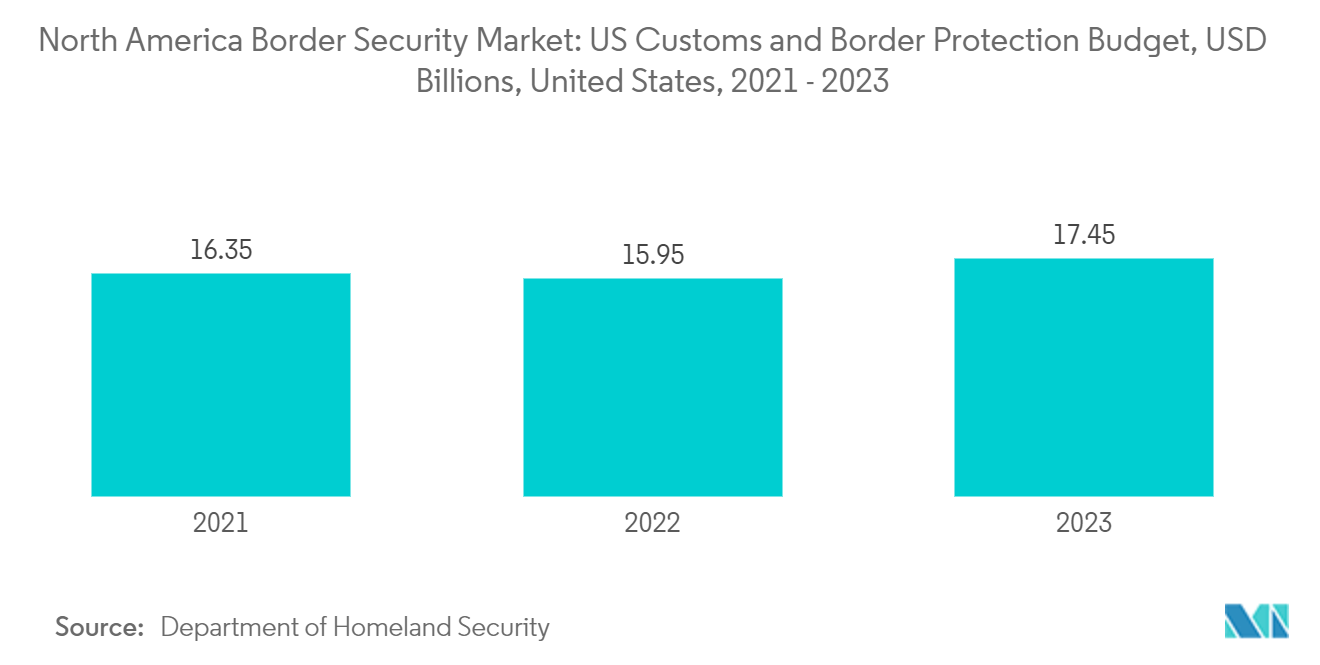
The US has the largest defense budget in the world, and a significant portion of that is spent on developing border security solutions. The US has increased its spending on technological research and development. The rapid deployment of advanced systems for coastal patrol and surveillance is significantly driving the growth of the country's market. The US Coast Guard is developing new laser technology and enhancing its existing ones. The Coast Guard - Hailing Acoustic Laser-Light Tactical System (CG-HALLTS) is a tripod-mounted device with highly focused acoustic capabilities, enabling communication over long distances. It can also serve as an eye-safe dazzling laser for suspect boats, ships, and vessels.
The US is currently operating several drone surveillance missions along its border with Mexico to curb the illegal entry of immigrants, smugglers, and traffickers. Drones and UAVs are presently being used with sensors and AI to perform operations, such as aerial-based thermal imaging and facial recognition. Opto-electronics and thermal imaging technology are also witnessing developments in areas such as weatherproof operations, which are significantly propelling the growth of the border security security market in the US.
For instance, in April 2021, Leidos Holdings Inc. was awarded a USD 480 million contract by US Customs and Border Protection (CBP) to provide multi-energy portal (MEP) systems for nonintrusive inspections of commercial vehicles at land and sea entry ports. The award includes a base period of five years and options of up to 10 years if exercised. The MEP systems will be deployed to existing vehicle inspection sites across the US. Under this contract, Leidos will integrate and deploy its vehicle and cargo inspection system, MEP, with a low-energy backscatter and high-energy transmission cargo inspection system.
Competitive Landscape
The North American border security market is fragmented. Some prominent players in the market are Elbit Systems Ltd., BAE Systems plc, Northrop Grumman Corporation, General Dynamics Corporation, and Teledyne FLIR LLC. The players in the market have developed expertise in specific platform-based security systems and cater to the needs of different agencies responsible for air, land, and maritime security in the region.
Players are investing heavily in technological developments to meet the growing, sophisticated needs of defense and security agencies. Players' primary revenue generation strategy is winning long-term contracts and deals from security agencies and authorities. For instance, in October 2022, Microsoft received a USD 1.2 million contract to work on the ArriveCan mobile application. The ArriveCan application was initially developed as a means for travelers to upload mandatory health information documents and COVID-19-related information, but has since become an optional way for users to answer customs and immigration questions.
North America Border Security Industry Leaders
Northrop Grumman Corporation
General Dynamics Corporation
Elbit Systems Ltd.
Teledyne FLIR LLC
BAE Systems plc
- *Disclaimer: Major Players sorted in no particular order

Recent Industry Developments
- March 2023: The U.S. Customs and Border Protection (CBP) awarded a contract worth $380 million to Accenture Federal Services for IT infrastructure operations and modernization. According to the contract, Accenture will work at CBP’s headquarters and at each of the other agencies’ divisions, offices, regional locations, and data centers.
- October 2023: Kharon signed a contract with the US CBP, which will provide CBP enforcement officers and investigators with access to Kharon's global risk analytics platform. Kharon’s insights and analytic tools are utilized by companies and financial institutions for risk management of regulatory and geopolitical security threats, in particular, KYC, sanctions compliance, supply chain security, and forced labor.


North America Border Security Market Report Scope
The border security market encompasses solutions, technologies, and services designed to safeguard and control national borders. This includes preventing illegal crossings, detecting and responding to security threats, and enhancing overall border management. The market typically involves technologies like surveillance systems, biometric identification, communication tools, and physical barriers to ensure the security and integrity of a country's borders. The report covers the latest trends, technological advancements, and recent developments, and provides an in-depth analysis of various aspects of the market. It also gives a country-wise analysis.
The North America border security market is segmented by platform type and country. The market is segmented based on platform type into land, air, and sea. The report also covers the market sizes and forecasts for two countries across the region. For each segment, the market sizing has been done based on value (USD).
Platform
| Land |
| Air |
| Sea |
Geography
| United States |
| Canada |
| Platform | Land |
| Air | |
| Sea | |
| Geography | United States |
| Canada |


Key Questions Answered in the Report
How big is the North America Border Security Market?
The North America Border Security Market size is expected to reach USD 22.42 billion in 2025 and grow at a CAGR of 5.38% to reach USD 29.14 billion by 2030.
What is the current North America Border Security Market size?
In 2025, the North America Border Security Market size is expected to reach USD 22.42 billion.
Who are the key players in North America Border Security Market?
Northrop Grumman Corporation, General Dynamics Corporation, Elbit Systems Ltd., Teledyne FLIR LLC and BAE Systems plc are the major companies operating in the North America Border Systems Market.
What years does this North America Border Security Market cover, and what was the market size in 2024?
In 2024, the North America Border Security Market size was estimated at USD 21.21 billion. The report covers the North America Border Systems Market historical market size for years: 2019, 2020, 2021, 2022, 2023 and 2024. The report also forecasts the North America Border Systems Market size for years: 2025, 2026, 2027, 2028, 2029 and 2030.
Page last updated on:





