
Market Overview
| Study Period | 2021 - 2031 |
|---|---|
| Forecast Data Period | 2026 - 2031 |
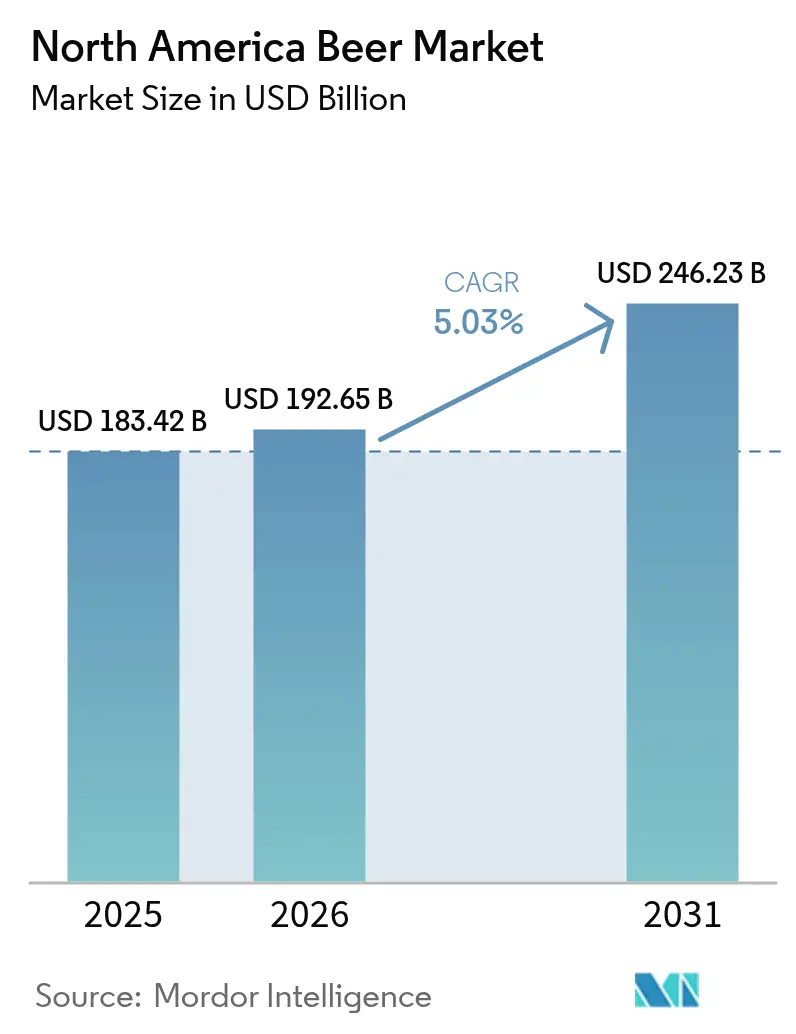
| Base Year Market Size (2025) | USD 183.42 Billion |
| Market Size (2026) | USD 192.65 Billion |
| Market Size (2031) | USD 246.23 Billion |
| Growth Rate (2026 - 2031) | 5.03 % |
| Market Concentration | Medium |
Major Players *Disclaimer: Major Players sorted in no particular order Image © Mordor Intelligence. Reuse requires attribution under CC BY 4.0. | |
North America Beer Market Analysis by Mordor Intelligence
The North American beer market size is expected to grow from USD 183.42 billion in 2025 to USD 192.65 billion in 2026 and is forecast to reach USD 246.23 billion by 2031 at 5.03% CAGR over 2026-2031. Consumers are trading down in volume yet trading up in value as premium, low-alcohol, and non-alcoholic offerings build momentum. Craft brewers continue to influence flavor experimentation, while multinational groups accelerate portfolio rationalization to protect margins. E-commerce penetration deepens brand access, and investments in aluminum can infrastructure support sustainability targets. Upstream, shrinking barley acreage and water stress weigh on input costs, nudging brewers toward alternative grains and higher hedging activity.
Key Report Takeaways
- By type, Lager led with 61.92% of the North American beer market share in 2025; Ale is projected to register a 6.08% CAGR through 2031.
- By category, Standard accounted for 56.15% of the North American beer market share in 2025, while Premium is set to expand at a 6.74% CAGR to 2031.
- By packaging, Cans commanded a 55.02% share in 2025 and are on track for a 6.37% CAGR, the highest across formats.
- By distribution, Off-Trade captured 71.55% sales in 2025; On-Trade is recovering fastest with a 6.86% CAGR forecast.
- By geography, the United States held 77.85% of the 2025 share, whereas Mexico is expected to grow at a 7.05% CAGR.
Note: Market size and forecast figures in this report are generated using Mordor Intelligence’s proprietary estimation framework, updated with the latest available data and insights as of 2026.
Market Trends and Insights
Drivers Impact Analysis of North America Beer Market*
| Drivers | (~)% Impact on CAGR Forecast | Geographic Relevance | Impact Timeline |
|---|---|---|---|
| Growth in craft beer segment | +0.8% | United States, Canada | Medium term (2-4 years) |
| Innovations in flavors and brewing techniques | +0.6% | North America | Medium term (2-4 years) |
| Expansion of low-alcohol and non-alcoholic beer | +1.2% | Global, strongest in North America | Long term (≥ 4 years) |
| Popularity of ready-to-drink (RTD) and flavored malt beverages | +0.9% | North America, Mexico | Short term (≤ 2 years) |
| Increasing E-commerce and direct-to-consumer sales | +0.7% | United States, Canada | Medium term (2-4 years) |
| Sustainability initiatives in packaging and brewing | +0.5% | North America | Long term (≥ 4 years) |
| Source: Mordor Intelligence | |||
Growth in Craft Beer Segment
In North America, the craft beer segment, while navigating a broader market contraction, is still at the forefront of innovation and premiumization, albeit at a more tempered pace than in years past. The industry witnessed a phase of rationalization, marked by 399 brewery closures juxtaposed with 335 new openings. This trend underscores a maturing market, emphasizing the imperative for operational efficiency amidst intensifying competition. In response, craft brewers are streamlining their portfolios, zeroing in on top-selling products, and diversifying into non-beer beverages, all to tap into a wider consumer appetite. This strategic shift not only elevates craft beer's status as a premium category, but also allows it to command superior margins, aligning with the changing consumer preference for quality over sheer volume.
Innovations in Flavors and Brewing Techniques
Technological advancements in hop extraction and flavor consistency are revolutionizing brewing capabilities by addressing persistent challenges related to ingredient variability and production efficiency. Abstrax Hops introduced Quantum Brite in February 2024, a water-soluble hop extract that eliminates the need for hop removal, reduces beer loss, and claims 100% utilization rates. Additionally, their Omni Hop Profiles utilize terpene-driven recreations to deliver consistent flavors year after year, regardless of harvest variability. These innovations allow brewers to achieve precise flavor profiles while cutting costs and minimizing waste, which is particularly beneficial given the ongoing volatility in hop prices. This technology enables smaller craft brewers to compete with larger operations by providing access to consistent, high-quality flavor compounds that were previously difficult to source or replicate. Advanced botanical analysis, which identifies over 500 compounds in hop profiles, creates opportunities for customization and flavor banking. This allows brewers to develop unique signature tastes, helping their products stand out in competitive market segments.
Expansion of Low-Alcohol and Non-Alcoholic Beer
In 2024, non-alcoholic beer became the fastest-growing segment in the beer category, achieving a year-over-year sales increase of approximately 30%. This growth was primarily driven by health-conscious consumers and the growing "sober-curious" movement, particularly among younger demographics. Over a 12-week period, Molson Coors' non-alcoholic brands recorded an impressive 89% growth. Notably, Blue Moon Non-Alcoholic entered the top 10 non-alcoholic brews by dollar share within its first year of launch. Advancements in brewing techniques have enabled the segment to closely replicate traditional beer flavors while retaining the social and cultural aspects of beer consumption. Major brewers are heavily investing in this expanding category. For example, Peroni Nastro Azzurro 0.0% achieved 83.5% dollar sales growth over a 52-week period, supported by lifestyle marketing efforts such as Formula 1 sponsorships. This growth aligns with a broader consumer trend toward mindful drinking, extending beyond traditional Dry January campaigns and driving consistent, year-round demand for premium non-alcoholic alternatives that sustain brand equity and profit margins.
Popularity of Ready-to-Drink (RTD) and Flavored Malt Beverages
RTD cocktails and flavored malt beverages are capturing market share from traditional beer by offering convenience, variety, and appeal to consumers seeking alternatives to standard beer profiles. The segment benefits from crossover appeal, attracting both beer drinkers seeking variety and spirits consumers preferring lower-alcohol options with consistent quality and portability. Anheuser-Busch's USD 16 million investment in its Los Angeles brewery specifically targeted expanded packaging capabilities for "beyond beer" brands including Cutwater and NÜTRL, demonstrating major brewers' commitment to diversifying their portfolios. The category's growth is supported by improved distribution networks and retail placement, with RTD products increasingly positioned alongside traditional beer rather than in separate spirits sections. Innovation in flavor profiles, packaging formats, and alcohol content optimization creates opportunities for premium pricing while addressing consumer demand for authentic cocktail experiences in convenient formats.
Restraints Impact Analysis of North America Beer Market*
| Restraints | (~) % Impact on CAGR Forecast | Geographic Relevance | Impact Timeline |
|---|---|---|---|
| Stringent and complex regulatory/tax environment | -0.9% | North America, strongest in Canada | Short term (≤ 2 years) |
| Rising Consumption of Alternative Beverages | -1.4% | United States, Canada | Medium term (2-4 years) |
| Trade barriers and cross-border tariffs | -0.6% | US-Mexico, US-Canada borders | Short term (≤ 2 years) |
| Barley Yield Volatility due to Water Scarcity | -0.8% | US Plains states, Western Canada | Long term (≥ 4 years) |
| Source: Mordor Intelligence | |||
Stringent and Complex Regulatory/Tax Environment
Beer producers in North America face increasing tax burdens and regulatory complexities. In April 2024, Canada introduced a 4.7% federal beer tax hike, marking the largest increase in nearly 40 years. Beer Canada[1] estimates this tax hike will cost taxpayers approximately CAD 40 million during the 2025-26 fiscal year. Currently, taxes make up about 46% of retail beer prices in Canada. The regulatory landscape is further complicated by proposed federal labeling mandates, such as TTB's[2]"Alcohol Facts" requirements, which mandate per-serving disclosures of alcohol content, calories, and nutrients. With a five-year compliance period, these mandates impose significant costs for label redesign and supply chain adjustments. Additionally, state-level variations in distribution rules, licensing, and packaging regulations add another layer of complexity. Producers must navigate multiple compliance frameworks, increasing operational costs and restricting market access. These combined regulatory pressures limit pricing flexibility and reduce profitability, particularly for smaller craft brewers who lack the scale to efficiently manage these challenges.
Rising Consumption of Alternative Beverages
Consumer preferences are shifting significantly, posing a structural threat to the traditional beer market. Younger demographics, especially Gen Z and millennials, are leading this shift, favoring hard seltzers, non-alcoholic formats, and other alternative alcoholic and non-alcoholic beverages. According to the International Bottled Water Association[3] data from 2024, 20.31% of people consumed soft drinks in the United States. These groups are increasingly drawn to "sober-curious" trends, opting for drinks they view as healthier, more convenient, or simply more varied. This trend isn't just about consumers swapping one drink for another. Many of these alternative beverages are sidestepping the usual beer distribution channels and retail partnerships, presenting challenges for established beer supply chains. Furthermore, while traditional brewing relies on malt barley, many of these new beverages are turning to fermented sugar. This shift not only changes the demand for raw materials but also threatens the economic viability of traditional brewing, exerting long-term pressures on the entire beer ecosystem.
*Our forecasts treat driver/restraint impacts as directional, not additive. The impact forecasts reflect baseline growth, mix effects, and variable interactions.
North America Beer Market Segment Analysis
By Type:
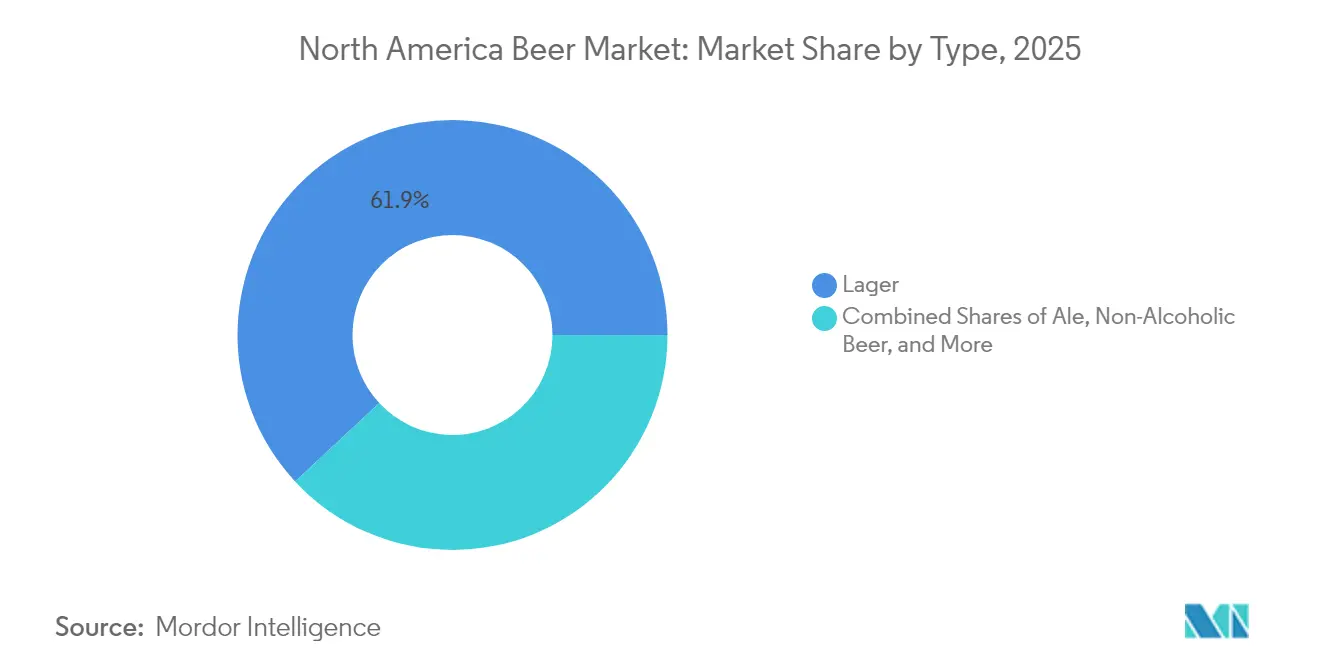
Lager Dominance Faces Ale InnovationIn 2025, Lager holds a commanding 61.92% market share, while Ale, growing at a 6.08% CAGR through 2031, stands out as the fastest-growing type. This trend highlights increasing consumer interest in complex flavor profiles and the appeal of craft brewing. The Lager segment thrives on established consumer preferences, efficient production methods, and strong brand recognition driven by major brewers. In contrast, Ale's growth is propelled by the expansion of craft breweries and premiumization trends, which yield higher margins. Stout and Porter cater to niche markets with loyal consumers, benefiting from seasonal demand and food pairing opportunities. Pilsner, with its crisp and accessible flavor, continues to attract both traditional and emerging consumer groups, ensuring stable performance.
Non-Alcoholic Beer emerges as the most dynamic growth segment, leveraging advanced brewing techniques to closely replicate traditional beer characteristics while addressing the needs of health-conscious consumers. New Holland Brewing's collaboration with Dungeons & Dragons to launch limited-edition Dragon's Milk products illustrates how traditional beer types can evolve through strategic partnerships and premium positioning. The 'Others' category includes hybrid products and experimental styles that blur traditional boundaries, creating opportunities for differentiation and premium pricing. Innovations such as Abstrax Hops' Quantum Brite system in hop extraction are transforming the industry by delivering consistent flavor across beer types, reducing production costs, and minimizing waste, thereby supporting both traditional and innovative brewing approaches.

By Category:
Premium Acceleration Amid Standard StabilityIn 2025, Standard beer holds a 56.15% market share, ensuring stable volumes and offering affordable price points that attract a broad consumer base. Meanwhile, the Premium segment is experiencing strong growth, with a 6.74% CAGR. This growth is driven by consumers' willingness to pay more for perceived quality, distinctive flavors, and engaging brand experiences. The Premium segment's expansion is further supported by the influence of craft brewing, the prestige associated with imported beers, and the appeal of limited-edition releases, which cater to consumers seeking unique and exclusive products. In contrast, the Standard category remains the market's cornerstone, consistently providing quality and value that appeal to cost-conscious consumers and those seeking high-volume consumption.
The Premium segment's growth is driven by a strategic emphasis on high-quality ingredients, artisanal production methods, and compelling brand storytelling that justifies premium pricing. Tilray's acquisition of craft breweries from Molson Coors highlights this focus on premium positioning, with the company aiming to rise from the ninth to the fifth-largest craft beer player in the U.S., prioritizing revenue growth over volume expansion. The distinction between categories is becoming increasingly blurred: Standard brands are introducing premium extensions, while Premium brands are offering more accessible options, creating a dynamic and fluid competitive landscape. Digital marketing and direct-to-consumer channels are particularly advantageous for the Premium segment, enabling targeted messaging and fostering relationships that enhance margins and build brand loyalty.
By Packaging Type:
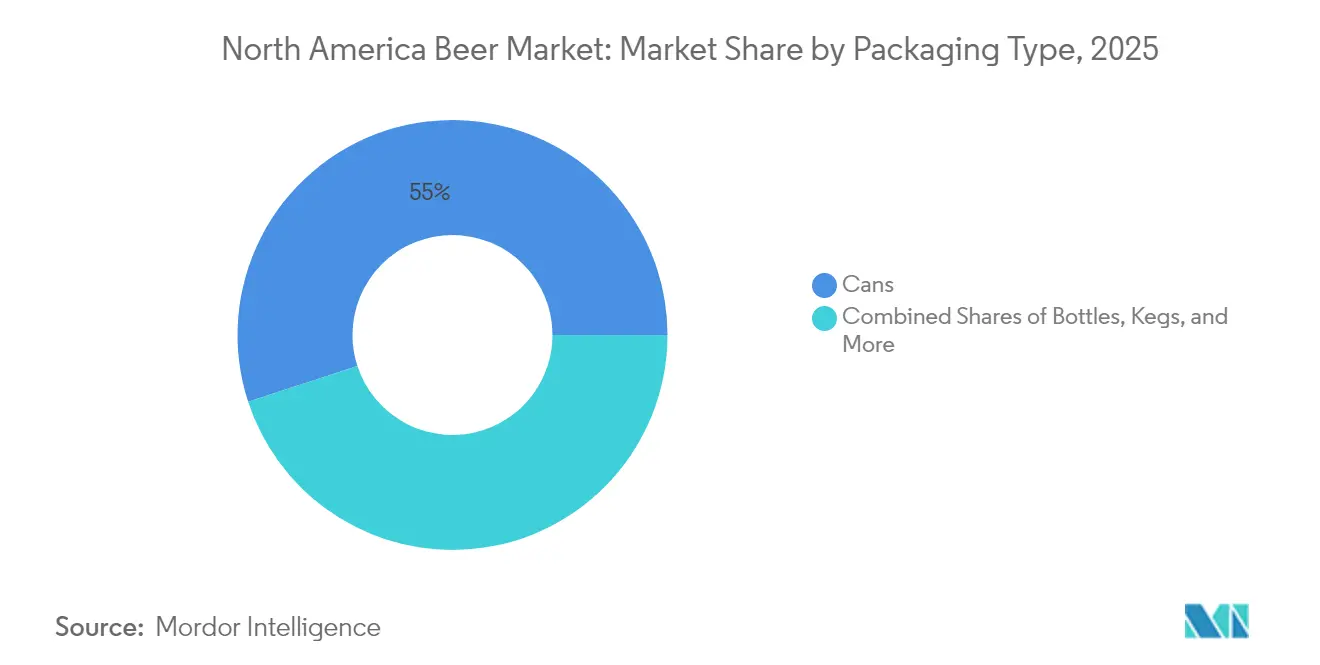
Cans Lead Innovation and SustainabilityIn 2025, cans hold a leading 55.02% market share and are expected to grow at a 6.37% CAGR through 2031. This growth is driven by their sustainability benefits, consumer convenience, and superior ability to protect beer quality throughout the supply chain. Aluminum cans, with their infinite recyclability, outperform glass bottles not only in recyclability but also in shielding beer from light and oxygen, which can degrade quality. On the other hand, bottles maintain a significant market presence due to their premium positioning and traditional consumer appeal. This is particularly evident in on-premise settings, where glass packaging is associated with quality and authenticity.
Kegs serve the on-premise sector efficiently, especially in high-volume venues. However, they face challenges from the increasing adoption of canned beer in bars and restaurants, which prioritize operational flexibility and waste reduction. Reflecting this shift, Molson Coors has committed USD 85 million to eliminate plastic six-pack rings from its North American brands by the end of 2025. This initiative highlights how packaging innovation can drive both sustainability and competitive advantage, particularly for Coors Light. The 'Others' category is expanding, including emerging packaging formats such as larger cans and innovative closures. These formats enhance the consumer experience while ensuring product integrity. Supporting this evolution, Sidel has introduced its EvoFILL Can Compact technology, capable of processing up to 40,000 cans per hour with a filling accuracy of ±1 ml, demonstrating how advancements in packaging equipment contribute to market growth and operational efficiency.
By Distribution Channels:
Off-Trade Dominance with On-Trade RecoveryIn 2025, Off-Trade channels hold a dominant 71.55% market share, highlighting a consumer preference for home consumption, competitive pricing, and convenient shopping — trends that emerged during the pandemic and have continued amid economic uncertainties. Within the Off-Trade segment, Specialty/Liquor Stores provide curated selections and expert advice, particularly benefiting the craft and premium beer categories. On the other hand, Other Off-Trade Channels, such as grocery and convenience stores, offer extensive market reach and encourage impulse purchases. The dominance of Off-Trade is further reinforced by the growth of e-commerce, exemplified by AB InBev's BEES platform, which processed 20 million orders in Q3 2024, generating a gross merchandising value of over USD 5.5 billion, as reported by Consumer Goods Technology.
On-Trade channels, meanwhile, are growing at a faster rate, with a projected CAGR of 6.86% through 2031. This growth is driven by the recovery of the hospitality sector, premiumization trends favoring on-premise consumption, and experiential dining that emphasizes beer pairings and exploration. The On-Trade channel benefits from higher profit margins, opportunities for brand building, and consumers' willingness to pay premium prices for curated experiences and social interactions. For instance, Redhook Brewery's partnership with the University of Washington's NIL collective to launch Montlake Gameday Gold Lager illustrates how On-Trade strategies can foster community connections and brand loyalty, extending beyond traditional retail relationships, as noted by Tilray Brands. Additionally, digital integration is increasingly blurring the lines between channels; tools like QR codes and mobile ordering enable seamless transitions from on-premise discovery to off-premise purchases, creating omnichannel experiences that enhance consumer engagement and boost sales conversions.
Geography Analysis
United States Beer Market
The United States maintains overwhelming market dominance with 77.85% share in 2025, supported by extensive distribution infrastructure, diverse consumer preferences, and established brewing capacity, yet faces structural challenges from declining beer consumption and increasing competition from alternative beverages. Mexico emerges as the fastest-growing geography at 7.05% CAGR through 2031, driven by Grupo Modelo's USD 3.6 billion investment program for 2025-2027 that focuses on brewery modernization, circular economy initiatives, and expanded production capacity.
Mexico and Canada Beer Market
The Mexican market benefits from beer's position as the country's largest agro-food export at USD 6.163 billion in 2023, with Grupo Modelo representing approximately 1% of Mexico's GDP, demonstrating the industry's economic significance and growth potential. Canada provides market stability through established brewing traditions and regulatory frameworks, while facing headwinds from significant tax increases and trade tensions that could affect cross-border beer flows. The 4.7% federal beer tax increase in April 2024 represents the largest single federal alcohol tax hike in approximately 40 years, creating cost pressures that may constrain consumption growth.
North American Borders Beer Market
Rest of North America encompasses smaller markets that benefit from regional preferences and niche positioning, though their limited scale restricts their impact on overall market dynamics. Trade relationships across North American borders face potential disruption from proposed tariffs, with industry stakeholders warning that 25% tariffs on Mexican and Canadian imports could substantially raise consumer prices and trigger retaliatory measures that would harm the entire regional beer ecosystem.
Regulatory Landscape
Beer in North America is governed by alcohol-specific rules alongside state or provincial differences in licensing, distribution, taxation, and labeling. In the United States, the Alcohol and Tobacco Tax and Trade Bureau (TTB) administers malt beverage labeling requirements under the Federal Alcohol Administration Act, including mandatory label elements such as brand name, class/type, net contents, and producer information, with alcohol content required in specific circumstances (for example, when derived from flavors or other additives). In Canada, the Canadian Food Inspection Agency (CFIA) enforces compositional and labeling requirements for beer under the Food and Drug Regulations, with specific emphasis on allergen, gluten source, and added sulphites declarations.
A key near-term compliance driver is nutrition-style labeling. On January 17, 2025, the TTB published a proposal (Notice No. 237) for an "Alcohol Facts" statement for malt beverages, which would add per-serving disclosures such as serving size, servings per container, ABV, alcohol fluid ounces, calories, and macronutrients; the proposal also references a multi-year compliance period tied to publication of a final rule. Canada maintains flexibility on ingredient innovation while enforcing safety-related disclosures. Prepackaged beer generally does not require an ingredient list unless voluntarily provided, but allergen, gluten, and sulphite information must be declared when applicable, which shapes formulation decisions and label artwork for brewers selling nationally across provinces.
Value Chain Analysis
The North America beer value chain starts with agricultural and industrial inputs (barley and other grains, hops and extracts, yeast, water, and processing aids) and moves through brewing and fermentation, packaging (aluminum cans, glass bottles, kegs, labels, and secondary packaging), and distribution, either cold-chain or ambient depending on format. Scale players typically optimize brewing networks and packaging lines around high-throughput SKUs, while craft brewers often run more flexible production, use differentiated ingredients, and outsource steps where it improves economics. Input volatility, including aluminum and packaging materials, as well as climate-linked stress on barley and water availability, raises procurement risk and encourages hedging, alternative grain trials, and supplier diversification.
Distribution is still shaped by regulated channels, particularly the U.S. three-tier system where independent wholesalers play a central role in moving product to retail and on-trade accounts. Logistics and returnable-asset management are increasingly handled by specialist partners. Examples include Tilray Brands moving to MicroStar Logistics for outsourced keg management (February 2024), New Belgium expanding its MicroStar partnership to include Bell's brands (May 2024) and using MicroStar as it assumed U.S. production of Kirin Ichiban and Kirin Light (September 2024), and Stone Brewing partnering with Flock Freight on a Shared Truckload model to reduce shipping costs and emissions (November 2025). On packaging supply, localized sourcing agreements such as Ardagh Glass Packaging supplying Stevens Point Brewery from its Burlington, Wisconsin facility (March 2024) reflect efforts to reduce lead times, improve supply assurance, and manage transportation costs.
Competitive Landscape
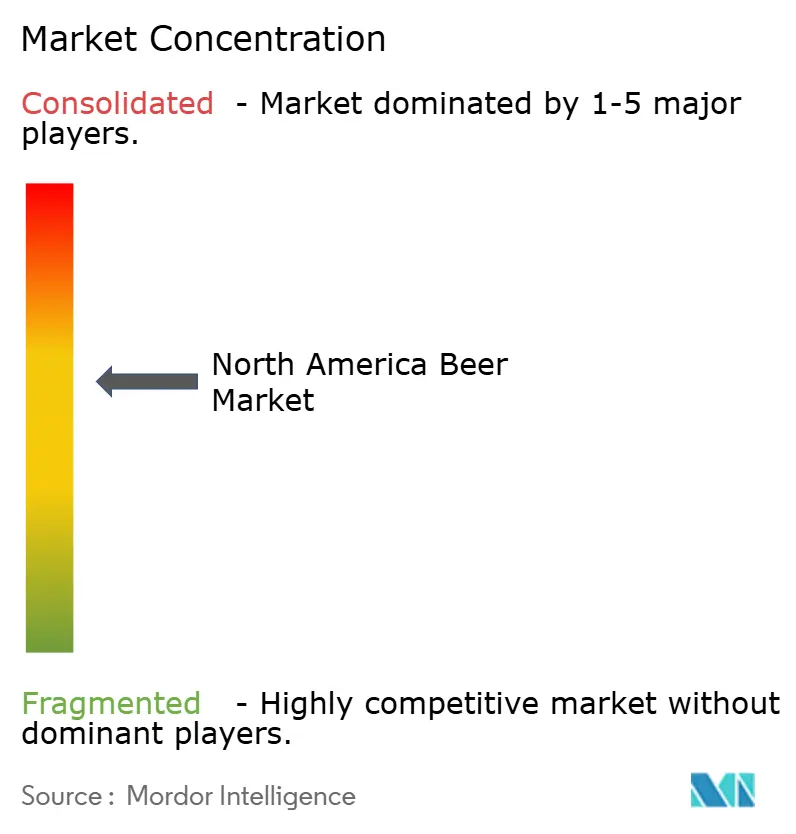
The North American beer Market exhibits moderate concentration with a market intensity, indicating significant consolidation opportunities remain as major players pursue portfolio optimization and operational efficiency gains. Strategic realignments accelerated through 2024-2025, with notable transactions including Tilray's acquisition of four craft breweries from Molson Coors, AB InBev's new contract brewing agreement with Pabst, and multiple regional craft brewery partnerships that demonstrate industry efforts to balance scale advantages with local market expertise.
Competition increasingly centers on premiumization strategies, sustainability initiatives, and digital transformation capabilities that enable direct consumer relationships and operational efficiency. Technology adoption emerges as a critical competitive differentiator, with AB InBev's BEES platform achieving over 90% revenue penetration in select markets and generating over USD 5.5 billion in quarterly gross merchandising value, while packaging innovations like Four Peaks Brewing's adoption of CIRT recycling technology create consumer engagement opportunities and environmental benefits.
White-space opportunities exist in non-alcoholic beer segments, direct-to-consumer channels, and cross-category products that blur traditional beverage boundaries. Emerging disruptors leverage specialized positioning, community connections, and agile operations to compete effectively against larger incumbents, while established players respond through acquisition strategies and innovation investments that maintain market position while accessing new growth vectors.
North America Beer Industry Leaders
-
Constellation Brands
-
Anheuser-Busch InBev
-
Boston Beer Company
-
Heineken NV
-
Carlsberg Group
- *Disclaimer: Major Players sorted in no particular order
North America Beer Market Companies Covered in this Report
- Anheuser-Busch InBev
- Molson Coors Beverage Company
- Heineken Holding N.V.
- Constellation Brands Inc.
- Boston Beer Company
- Diageo Plc
- Carlsberg Group
- Grupo Modelo
- Pabst Brewing Company
- FIFCO USA
- Suntory Beverage & Food Ltd.
- D.G. Yuengling & Son Inc.
- Stone Brewing Co.
- Brooklyn Brewery
- Sierra Nevada Brewing Co.
- Royal Unibrew
- Goose Island Beer Company
- Amsterdam Brewery Co. Ltd.
- New Belgium Brewing Company
Market Opportunities and Future Outlook
Capacity and manufacturing modernization around winning SKUs and formats are creating whitespace for equipment suppliers, packaging partners, and co-manufacturing arrangements. Anheuser-Busch announced USD 600 million across 2025 and 2026 to upgrade U.S. manufacturing, improve technology systems, and expand workforce technical training. Additional site investments include USD 30 million in Jacksonville (January 2026) and targeted upgrades in Williamsburg, Virginia (USD 5.8 million) and Columbus, Ohio (USD 5 million) in May 2026 to expand Michelob ULTRA and Michelob ULTRA Zero production. These actions support higher utilization in canning and packaging lines and broaden demand for automation, QA, and plant digitalization, raising the operating bar for regional and craft brewers competing for shelf space.
Premium, low-alcohol, and non-alcoholic adjacencies are also widening room for portfolio expansion by beer-led players and retailers, supported by deal activity and measurable segment momentum. Constellation Brands signed a definitive agreement in March 2026 to acquire the remaining interest in HOPWTR, adding a non-alcoholic, moderation-positioned brand to its portfolio, while non-alcoholic beer posted around 30% year-over-year sales growth in 2024 in the broader beer category context. In parallel, decarbonization and resource efficiency programs are increasing retrofit demand: New Belgium worked with Grundfos in April 2026 to implement intelligent, high-efficiency cooling pumps at its Fort Collins facility, illustrating how utilities optimization, water stewardship, and predictive maintenance tools translate into near-term operating cost and sustainability improvements across brewing sites.
Recent Industry Developments in North America Beer Market
- March 2026: Constellation Brands announced a definitive agreement to acquire the remaining interest in HOPWTR, a non-alcoholic brand positioned around moderation with functional ingredients. The deal extends a major beer portfolio owner further into alcohol-adjacent, off-trade friendly beverages that compete for the same consumption occasions as beer.
- August 2025: BrewDog USA launched BrewDog IPA as a new Headliner beer, positioned around bright tropical and citrus notes with a clean bitterness profile. The introduction adds another rotating innovation point for craft-style shelves, supporting premium mix and trial in a segment where brewers are tightening portfolios around faster-turning SKUs.
- May 2024: The Boston Beer Company launched Samuel Adams American Light, a light craft lager designed for everyday drinking occasions. The release underscores continued competitive focus on accessible lagers that defend volume in off-trade channels while maintaining brand-led premium cues.
North America Beer Market Report Scope and Research Methodology
Market Definition and Coverage
This market covers the value of beer sold across North America, including mainstream and craft offerings, measured as revenue generated through on-trade and off-trade channels within the region.
Scope exclusions: This sizing excludes adjacent alcoholic drinks like cider, spirits, and wine, and it also excludes brewery equipment and raw material sales.
Segments Covered in This Report
- By Type
- Lager
- Ale
- Non-Alcoholic Beer
- Others
- By Category
- Standard
- Premium
- By Packaging Type
- Cans
- Bottles
- Kegs
- Others
- By Distribution Channels
- On-Trade
- Off-Trade
- Specialty/Liquor Stores
- Other Off-Trade Channels
- Geography
- United States
- Canada
- Mexico
- Rest of North America
Data Sources, Market Sizing, and Validation
Desk Research
Desk work starts with assembling a clean fact base on beer production, trade, and consumption patterns in the United States, Canada, and Mexico, because these anchors keep the demand pool realistic before pricing adjustments are applied. Public and official sources, such as the Alcohol and Tobacco Tax and Trade Bureau (TTB), USITC trade data, the US Census Bureau, Statistics Canada, and Mexico INEGI, are used to ground variables like shipments, imports, and category mix.
We also review company annual reports, investor decks, association releases, and reputable news coverage to understand packaging shifts, channel mix changes, and premiumization signals that can move average prices. Where needed, paid subscription sources for company financials and intelligence, paid news and financials feeds, and an import and export shipment-level database are used to cross-check the timing of volume changes versus reported revenue direction. These are illustrative examples, and many other sources were also consulted for data collection, validation, and research clarification.
Primary Interviews and Surveys
Primary work is used to pressure-test the desk assumptions with brewers, distributors, retailers, and channel specialists who can comment on realized pricing, mix changes (premium vs standard), and on-trade recovery patterns. For a region-level market like North America, inputs were checked across the United States, Canada, and Mexico so local tax, channel, and packaging differences do not get averaged too early.
Distribution of primary research fieldwork respondents
| Company type | Respondent position |
|---|---|
| Top tier: 28% | CXOs: 16% |
| Mid tier: 53% | Functional/Unit leaders: 25% |
| Smaller Players: 19% | Managers: 59% |
Market-Sizing & Forecasting
The model is built using a top-down approach where production, trade, and apparent consumption signals are used to reconstruct the yearly demand pool for beer in North America, and then value is derived by applying a price structure that reflects channel and packaging mix. After that, we corroborate totals with selective bottom-up checks, such as sampled price-by-pack calculations, channel checks on on-trade versus off-trade split, and limited supplier roll-ups where financial disclosure allows.
Key inputs include beer volume trends by country, packaging mix (cans, bottles, kegs), category mix (standard vs premium), on-trade versus off-trade share, and tax or duty-linked shifts that influence retail pricing. For forecasting, scenario analysis is used so expected growth can be flexed based on changes in on-trade traffic, premiumization pace, and raw material cost pass-through, which are then aligned to what industry respondents expect for the next few years. When a bottom-up cross-check has gaps for smaller participants, we fill them using ratio-based proxies tied to country volumes and observed channel pricing so the model stays traceable and repeatable.
Data Validation & Update Cycle
Outputs are checked against independent signals like alcohol beverage spending trends, reported shipment direction, and channel share movements, and then any sharp variances are reviewed before sign-off. If pricing or mix creates an outlier, the assumptions are reworked, and we re-contact a small set of interviewees to confirm whether the change is real or timing-driven.
The report is refreshed annually, and interim updates are made when material events occur, such as major tax changes, rapid on-trade swings, or a step change in premium pricing. Before delivery, a final analyst pass is done so the numbers reflect the latest available public data and the most current interview-backed assumptions.
Mordor Intelligence's North America Beer Market Size Compared With Other Published Estimates
Published market sizes for North America beer often differ even when the topic sounds the same, because the definition of revenue, pricing timing, and which channels are fully counted can shift the total by several billion dollars. In practice, the split between on-trade and off-trade, the way premium and standard mixes are priced, and how currency timing is handled tend to be the main drivers.
A common gap comes from how average selling prices are updated through the year and how quickly outlier movements are validated before being carried into forecasts. By rechecking price and mix assumptions at the year boundary and re-validating unusual jumps with fresh channel inputs, Mordor Intelligence reduces drift that can appear when older price points or single-source mix shares are left unchanged.
Benchmark comparison
| Source | Market Size | Gaps in Research Methodology |
|---|---|---|
| Mordor Intelligence | USD 183.42 B (2025) | |
| Global Consultancy A | USD 177.83 B (2024) | The estimate is anchored on a different base year, which can understate the effect of recent premium price resets and on-trade recovery, and it may apply a simpler price progression across pack types. |
| Industry Publisher B | USD 196.00 B (2025) | The higher total is consistent with a broader pricing ladder or a more aggressive mix shift into premium and specialty beers, and it can also reflect different currency timing and retail price treatment across countries. |
Seen together, the spread mainly reflects timing and pricing choices rather than a disagreement that beer demand exists in the region. When scope boundaries are kept tight to beer only, prices are updated in line with channel mix, and unusual year-on-year moves are rechecked, the result is a practical market number that can be reproduced and tracked over time.
Key Questions Answered in the Report
What is the current value of the North America beer market?
The market is valued at USD 192.65 billion in 2026.
How fast is premium beer growing within North America?
Premium category revenue is projected to climb at a 6.74% CAGR through 2031.
Which packaging format is expanding quickest?
Aluminum cans are forecast for a 6.37% CAGR, backed by sustainability and convenience benefits.
How are brewers addressing carbon reduction?
Strategies include CO₂ capture, aluminum recycling, and elimination of plastic six-pack rings.