
Market Overview
| Study Period | 2019 - 2031 |
|---|---|
| Forecast Data Period | 2026 - 2031 |
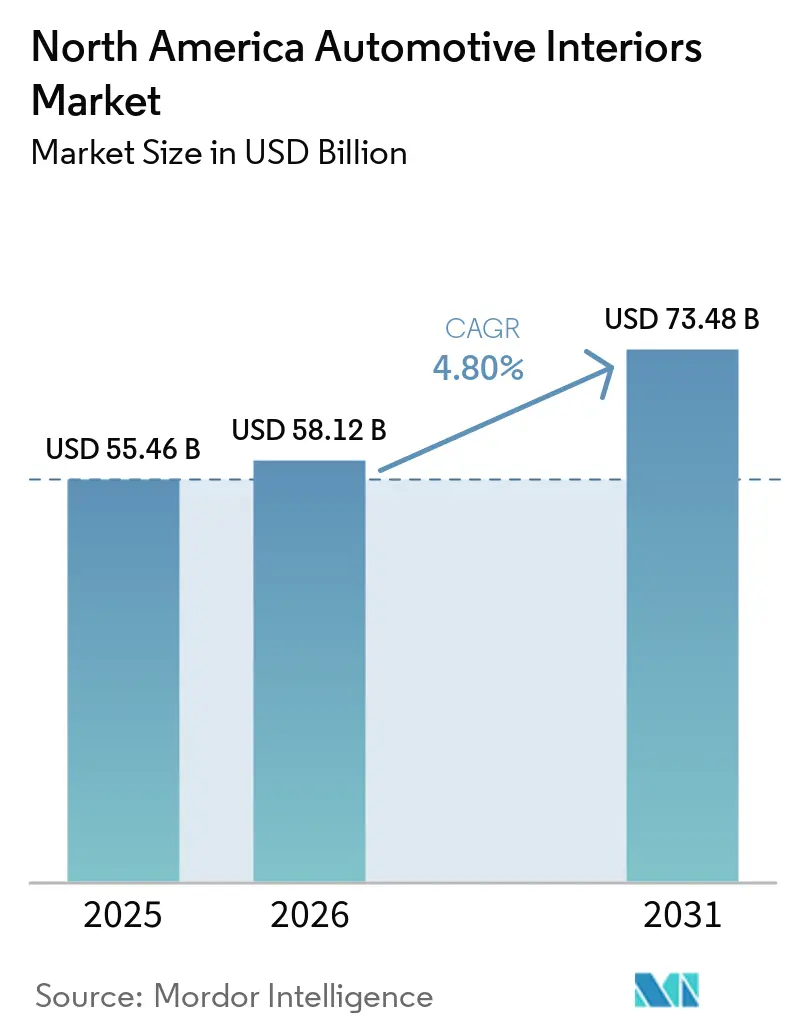
| Base Year Market Size (2025) | USD 55.46 Billion |
| Market Size (2026) | USD 58.12 Billion |
| Market Size (2031) | USD 73.48 Billion |
| Growth Rate (2026 - 2031) | 4.80 % |
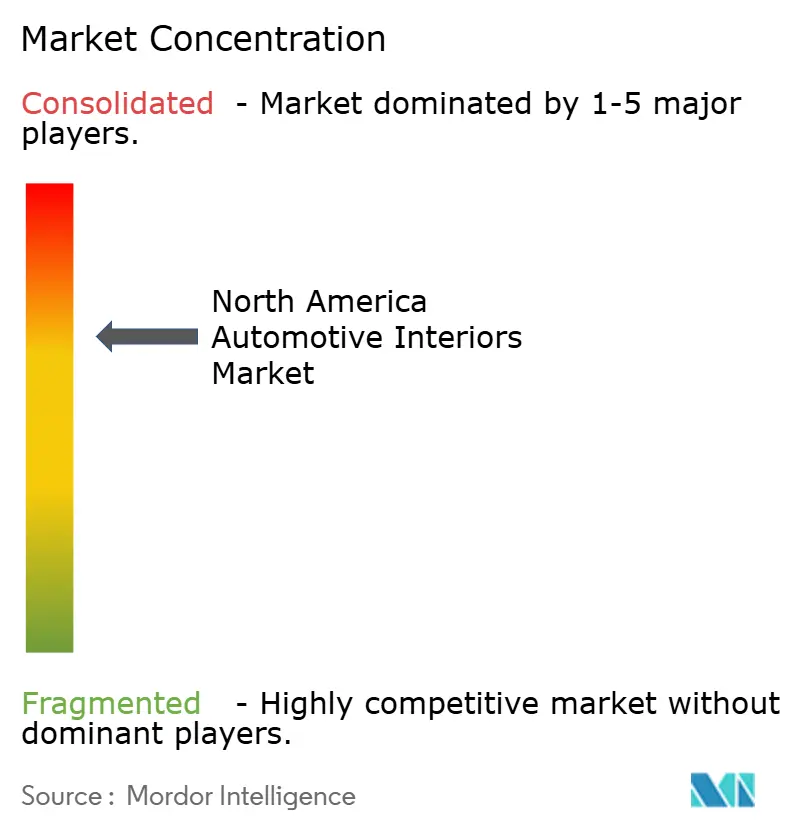
| Market Concentration | Medium |
Major Players *Disclaimer: Major Players sorted in no particular order Image © Mordor Intelligence. Reuse requires attribution under CC BY 4.0. | |
North America Automotive Interiors Market Analysis by Mordor Intelligence
The North American automotive interiors market size was valued at USD 55.46 billion in 2025, is estimated at USD 58.12 billion in 2026, and is projected to reach USD 73.48 billion by 2031, growing at a CAGR of 4.80% from 2026 to 2031. Continued electrification, over-the-air feature monetization, and occupant-monitoring mandates are reshaping cabin architectures, resulting in higher content value per vehicle and fresh revenue streams for both automakers and suppliers. OEMs are blending premium comfort displays, lightweight, sustainable materials, and advanced HVAC modules to differentiate trims while meeting increasingly stringent emissions rules. At the same time, labor cost pressures arising from the UAW agreement are accelerating plant automation, while tier-one companies are increasingly adopting vertical integration to mitigate raw material price fluctuations. Together, these factors support steady yet transformative growth in the North American automotive interior market.
Key Report Takeaways
- By propulsion type, internal-combustion platforms commanded 74.22% of the North America automotive interior market share in 2025, while electric-vehicle interiors are projected to grow at the fastest 8.29% CAGR through 2031.
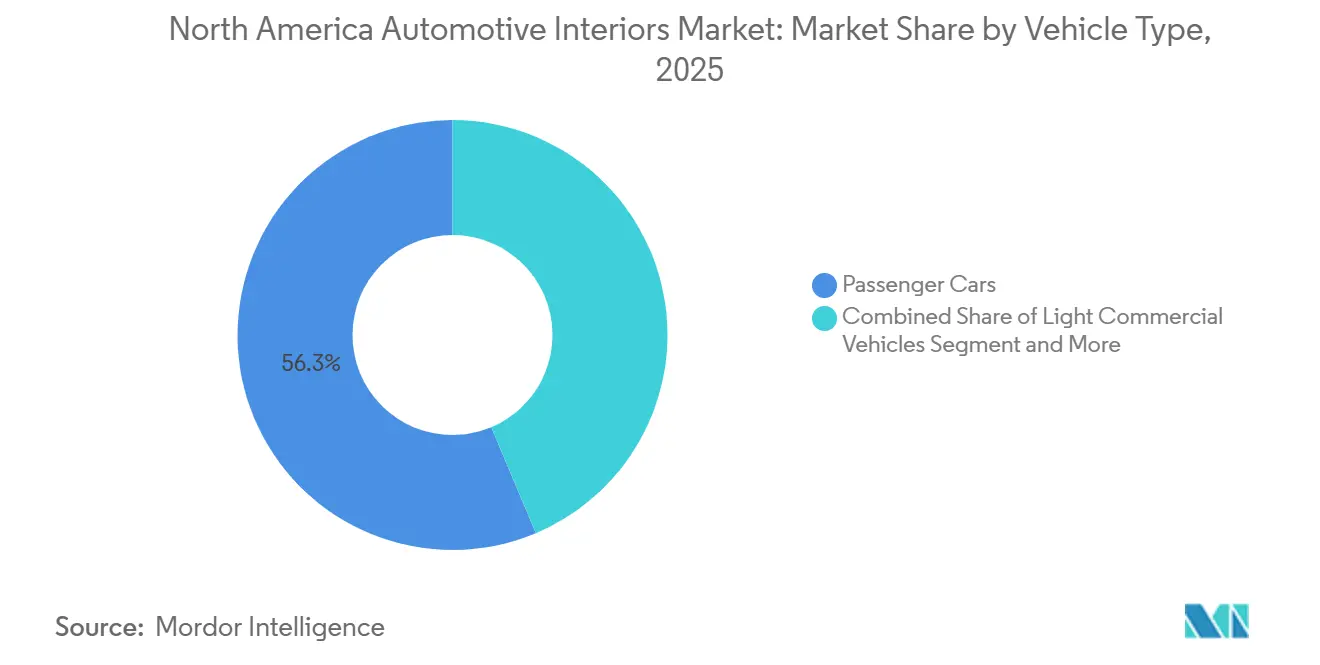
- By vehicle type, passenger cars accounted for the largest 56.34% revenue share in 2025, whereas light commercial vehicles are expected to advance at a 5.12% CAGR through 2031.
- By component, seating systems accounted for 40.29% of the North American automotive interior market size in 2025. Still, driver and occupant-monitoring systems are expected to register the highest CAGR, at 5.09%, during the forecast period.
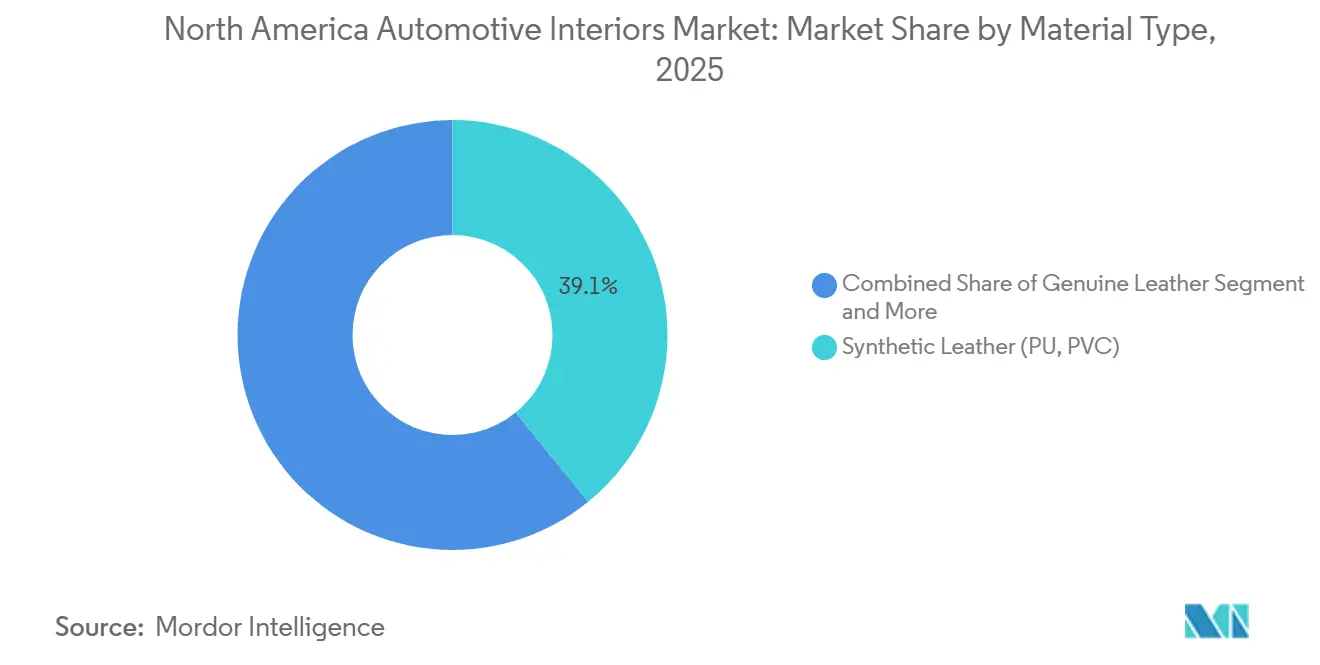
- By material, synthetic leather dominated with a 39.13% share in 2025, yet natural and recycled materials are forecast to expand at a leading 5.66% CAGR over 2026–2031.
- By sales channel, the OEM route commanded 73.63% share in 2025, while the aftermarket is poised for the quickest 5.16% CAGR through 2031.
- By country, the United States captured a dominant 78.67% market share in 2025, whereas Canada is projected to post the strongest 5.58% CAGR through 2031.
Note: Market size and forecast figures in this report are generated using Mordor Intelligence’s proprietary estimation framework, updated with the latest available data and insights as of January 2026.
Market Trends and Insights
Drivers Impact Analysis of North America Automotive Interiors Market*
| Driver | (~) % Impact on CAGR Forecast | Geographic Relevance | Impact Timeline |
|---|---|---|---|
| EV-Centric Cabin Redesigns and Packaging Freedom | +1.2% | California, Pacific Northwest, Ontario EV corridors | Long term (≥ 4 years) |
| Premium-Comfort and Infotainment Demand Surge | +0.9% | United States luxury clusters, large Canadian metros | Medium term (2–4 years) |
| Advanced Safety and Regulatory Integration | +0.8% | NHTSA and Transport Canada aligned markets | Short term (≤ 2 years) |
| Lightweight and Sustainable-Materials Adoption | +0.7% | OEM programs across United States and Canada | Long term (≥ 4 years) |
| Cabin Thermoregulation for EV Range | +0.6% | Northern United States, Canada | Medium term (2–4 years) |
| Seat-Subscription Revenue Models | +0.4% | Premium brands in United States, early urban Canadian uptake | Medium term (2–4 years) |
| Source: Mordor Intelligence | |||
EV-Centric Cabin Redesigns and Packaging Freedom
Battery-electric skateboard platforms eliminate driveshafts and transmission tunnels, enabling designers to create flat floors, swiveling seats, and modular consoles. Some electric vehicles feature front passenger seats that rotate during low-speed autonomous driving modes, a feature not feasible on traditional ICE chassis. Other models use battery packs to lower the floor, increasing headroom without raising the roofline. Gear tunnels can convert unused underbody space into secure storage, while button-free dashboards reduce component requirements. These examples demonstrate how electrification enables OEMs to deliver premium cabin experiences without requiring distinct body-in-white tooling cycles.
Premium-Comfort and Infotainment Demand Surge
Larger display surfaces and immersive lighting packages have shifted from niche options to mainstream expectations. BMW’s panoramic 31-inch iDrive interface delivers gesture-controlled navigation and entertainment, helping premium trims defend pricing power. Mercedes-Benz responds with its OLED-based Hyperscreen, which merges three panels under a single glass pane, simplifying wiring and cut-outs while enhancing perceived quality. Continental’s Emotional Cockpit leverages eye-tracking cameras to tailor layout brightness, and the underlying software stack is being licensed to new entrants seeking rapid differentiation [1]. Qualcomm’s Snapdragon Cockpit consolidates cluster, infotainment, and rear-seat entertainment on a single system-on-chip, reducing 12 kg of harness weight and enabling post-sale feature activations. Collectively, these platforms turn interiors from cost centers into upgradeable revenue engines.
Advanced Safety and Regulatory Integration
In response to a new NHTSA mandate, all vehicles will be equipped with rear-seat reminder systems, accelerating the adoption of technologies such as cameras, radar, and time-of-flight sensors. Some manufacturers have embedded cabin radars that detect micro-breathing movements, alerting drivers to distraction and reducing the risk of heatstroke in children left in vehicles. Infrared driver-monitoring cameras have been developed to deactivate Level 2 Advanced Driver Assistance Systems (ADAS) if the driver averts their gaze for an extended period, thereby improving road safety and reducing liability risks for Original Equipment Manufacturers (OEMs). Radar modules positioned behind door trims can detect occupant movement without visible lenses. Time-of-flight arrays are also being utilized to adjust airbag deployment force, improving safety outcomes in low-speed collisions. While these technologies add to the bill of materials, many in the industry view this as a worthwhile investment against potential liability.
Lightweight and Sustainable-Materials Adoption
OEMs, in their quest to meet Scope 3 carbon-cutting goals, are increasingly turning to bio-attributed polymers, natural fibers, and compounds rich in recyclates. BASF's biomass-balanced Ultramid significantly reduces CO₂ emissions compared to its fossil-based polyamide counterpart, all while meeting the stiffness requirements for instrument panels [2]. Covestro's bio polyurethane foam, composed of plant-derived polyols, successfully meets flammability standards. For instance, the Cadillac Lyriq's 33-inch curved display for the screen-orientation point, and the Ford F-150 Lightning's recycled-content interior trim for the natural-fiber point. FORVIA's NAFILean-R, a natural-fiber composite already integrated into Stellantis door panels, reduces weight and is fully recyclable. These strategic material transitions help brands enhance their sustainability image among environmentally conscious consumers.
Restraints Impact Analysis of North America Automotive Interiors Market*
| Restraint | (~) % Impact on CAGR Forecast | Geographic Relevance | Impact Timeline |
|---|---|---|---|
| Raw-Material Price Volatility | –0.6% | U.S. polyurethane and leather supply hubs, Mexican maquiladoras | Short term (≤ 2 years) |
| Semiconductor and Display Shortages | –0.5% | North American just-in-time production clusters | Medium term (2–4 years) |
| VOC / Chemical-Emission Compliance Costs | –0.3% | U.S. EPA Tier 3, California CARB territories | Long term (≥ 4 years) |
| UAW Contract Rigidity Limiting Rapid Interior Redesigns | –0.4% | North America | Medium term (2–4 years) |
| Source: Mordor Intelligence | |||
Raw-Material Price Volatility (Plastics, Leather, Foam)
Polyurethane foam and automotive hides have experienced significant price increases, putting pressure on tier-one margins. Contract structures with annual cost-down clauses hinder the immediate pass-through of costs. In response, major suppliers like Lear have pursued acquisitions of foam compounders to secure feedstock and stabilize prices. Meanwhile, smaller firms, lacking vertical integration, are relying on lower-grade substitutes. However, these substitutes face the risk of rejection by OEMs, further emphasizing the ongoing consolidation trends in the industry.
Semiconductor and Display Shortages
In 2025, despite regional fabrication ramp-ups, lead times for automotive microcontrollers remained lengthy. TSMC's Arizona facility prioritized higher-margin smartphone clients, resulting in cockpit suppliers being allocated. In response, several OEMs discreetly developed analog-gauge clusters as substitutes for digital displays. This move, while safeguarding build schedules, added complexity to logistics.
*Our forecasts treat driver/restraint impacts as directional, not additive. The impact forecasts reflect baseline growth, mix effects, and variable interactions.
North America Automotive Interiors Market Segment Analysis
By Vehicle Type:
Fleet Electrification Drives LCV GrowthPassenger cars retained a 56.34% revenue share in 2025; however, electrification mandates targeting urban logistics hubs are expected to lift light commercial vehicles to a 5.12% CAGR. Amazon's order of Rivian electric delivery vans (EDVs) drives increased demand for rugged driver-monitoring cameras and washable upholstery in vehicle cockpits, enhancing interior features compared to traditional cargo vans.
Modular delivery vans with clip-in panel architectures reduce repair downtime and improve lifecycle cost efficiency. Some carriers have standardized the inclusion of antimicrobial fabrics and HEPA filters, reflecting health-focused requirements that became more prominent during the pandemic. Certain electric vans include factory-installed bulkheads with integrated HVAC ducts, removing the need for aftermarket conversions that could void the warranty. In the medium- and heavy-duty vehicle segments, conservative interior designs and longer replacement cycles result in slower growth compared to the broader North American automotive interior market.

By Propulsion Type:
Electrification Reshapes Interior EconomicsElectric-vehicle cabins are forecast to grow at an 8.29% CAGR, more than double the overall North America automotive interior market rate, while internal-combustion models still delivered 74.22% of 2025 revenue. As flat floors, gear tunnels, and swiveling seats become standard, EV makers can command higher sticker prices. Ford’s E-Transit has replaced the traditional transmission tunnel with a spacious storage cubby and a vertical infotainment screen, gaining additional space without compromising on crash performance. GM’s BrightDrop Zevo 600 has prioritized the needs of parcel fleets by installing a tablet dock on the bulkhead and omitting the glovebox. Rivian’s R1T has ingeniously integrated a camp-kitchen module into its gear tunnel, transforming an otherwise unused space into a standout feature. Škoda’s Vision 7S concept has taken screen orientation to the next level, rotating its 14-inch display to portrait mode for navigation, underscoring the premium value of screen positioning. These innovative layouts not only enhance vehicle functionality but also bolster the North American automotive interior market.
Thermal modules designed to extend range are now gaining significant attention. Denso’s heat pump in the 2026 bZ4X, Valeo’s grid-driven pre-conditioning, and Gentherm’s micro-climate seating are all designed to boost winter range – a feature heavily promoted in northern states and Canada. Recognizing their value, OEMs are treating these systems as essential differentiators, securing multiyear exclusive deals with suppliers to ensure stable revenue streams.
By Component Type:
Sensors Eclipse Traditional TrimSeating still represented the most significant component share, at 40.29% in 2025; however, driver- and occupant-monitoring modules are expected to outpace this at a 5.09% CAGR. Adient transforms its CNXMotion seat into a subscription model, offering massage routines for a monthly fee.
Lear’s E-Systems enhances efficiency by integrating heating, cooling, and sensing into a single harness. Faurecia’s Cocoon seat, equipped with shape-memory technology, dynamically adjusts the bolster pressure to enhance user comfort. ZF’s smart seat, in conjunction with ESC software, customizes lateral support based on cornering dynamics, showcasing improved collaboration between the chassis and cabin teams. While large panoramic touchscreens, RGB ambient lighting strips, and monomaterial trim panels are gaining popularity, sensor suites are emerging as the most promising segment in North America's automotive interior market.
By Material Type:
Circularity Gains GroundSynthetic leather maintained a 39.13% share in 2025 with steady growth, but natural and recycled content are on a faster 5.66% curve. Polestar's WoodTex pine veneer, championing forest stewardship, reduces dashboard weight. BMW's adoption of regenerated Econyl carpet significantly decreases the use of virgin polymer. Volkswagen's ArtVelours Eco fabric, made with recycled PET, meets the durability standards required by ride-hailing fleets. Volvo's Nordico bio textile has become the standard upholstery in the EX90, completely replacing animal hides. While genuine leather still dominates high-end luxury trims, it faces growing scrutiny over water usage and animal welfare concerns. In response, plastics suppliers are turning to mass-balance certified polyolefins, seamlessly integrating them into existing molds. This approach reduces costs and accelerates adoption throughout North America's automotive interior sector.
By Sales Channel:
Digital Aftermarket AcceleratesOEM channels held 73.63% of 2025 revenue, but a 5.16% CAGR for the aftermarket shows how e-commerce disrupts dealership accessory pricing. Katzkin delivers color-matched seat cover kits, which local installers can quickly fit, bypassing dealer markups. WeatherTech laser-cuts liners tailored for every 2026 EV floor, ensuring protection for vegan carpets, while Covercraft enables buyers to customize stitching hues and embroidered logos online. Husky Liners offers fleet managers antimicrobial mats designed for durability in multi-driver environments. Although OEMs offer factory bundles, their limited configurator color options leave room for agile web-native suppliers. As a result, personal customization is expected to remain a key driver of growth in North America's automotive interior market.
Geography Analysis
United States Automotive Interiors Market
The United States accounted for 78.67% of North America's automotive interior market share in 2025. Buoyed by significant production volumes from the Detroit Three and strong EV outputs from Tesla's Fremont and Austin plants, the U.S. automotive landscape is witnessing notable shifts. The content value per U.S. vehicle has increased, driven by the adoption of advanced features like panoramic displays and ventilated seats in mid-tier trims. Meanwhile, Honda and Nissan's newly forged sourcing alliance enhances their influence over tier-one suppliers. However, challenges persist as rising labor costs and stricter environmental regulations are expected to increase production expenses, particularly for low-emission materials.
Canada Automotive Interiors Market
Canada, though with a smaller base, is projected to post the region’s fastest CAGR at 5.58% through 2031. Stellantis recently inaugurated its Windsor battery plant, establishing Ontario as a key hub for flat-floor trim and heat-pump HVAC modules[3]. Honda's retooling in Alliston will source cockpit modules from Magna's nearby Concord site, ensuring a consistent supply for Canadian tier-one suppliers. Demand for antimicrobial fabrics and modular consoles is also supported by GM's CAMI BrightDrop facility. Transport Canada’s alignment with NHTSA's occupant-monitoring regulations reduces regulatory fragmentation, benefiting suppliers operating across both countries.
Mexico Automotive Interiors Market
North America, led by Mexico, remains a critical player in the automotive interior market and is poised for continued growth. Grupo Antolin's Mexican plants efficiently deliver headliners and consoles to U.S. assembly lines. Yanfeng's facility in Toluca highlights the cost-effectiveness of maquiladora operations by integrating injection molding and final assembly. However, USMCA requirements for regional content are shifting resin and textile sourcing back to the U.S. and Canada, slightly reducing Mexico's raw material advantages. Despite this, wage differences ensure Mexico remains a competitive location for labor-intensive trim sewing, reinforcing its central role in North America's automotive interior market supply chains.
Competitive Landscape
The top suppliers—Adient, Lear, Magna, Faurecia, and Yanfeng—account for a significant share of the sector's revenue, indicating a moderate concentration. Adient's acquisition of a foam compounder secures feedstock at transfer pricing while mitigating risks associated with polyurethane volatility. Lear's E-Systems technology streamlines final-line installation processes, helping secure major contracts for electric vehicles. Faurecia's Cocoon seat combines shape-memory foam with smartphone controls, enabling regular feature updates and enhancing monetization opportunities. Yanfeng and Magna continue to focus on cockpit module integration, utilizing just-in-time delivery to optimize OEM inventory management.
Emerging players are leveraging specific technological advancements to gain a competitive edge. Gentherm's ClimateSense micro-climate seating has secured exclusive contracts with premium automotive brands, offering enhanced efficiency for electric vehicles. Continental's eye-tracking Emotional Cockpit has been licensed to new entrants in the electric vehicle market, establishing a profitable software royalty model. Sensor and algorithm providers, such as Smart Eye and Tobii, deliver flexible driver-attention solutions that enable OEMs to integrate standard cameras and reduce material costs. In response to an NHTSA rulemaking on rear-seat reminder systems, suppliers are preparing to equip vehicles with occupant-detection sensing technologies. This development presents a significant market opportunity that could reshape the automotive interior landscape in North America.
North America Automotive Interiors Industry Leaders
-
Adient plc
-
Lear Corporation
-
Magna International, Inc.
-
Yanfeng Automotive Interior Systems
-
FORVIA (formerly Faurecia SE)
- *Disclaimer: Major Players sorted in no particular order
North America Automotive Interiors Market Companies Covered in this Report
- Adient plc
- Lear Corporation
- Magna International Inc.
- FORVIA (formerly Faurecia SE)
- Yanfeng Automotive Interior Systems
- Toyota Boshoku Corporation
- Grupo Antolin
- International Automotive Components (IAC)
- Visteon Corporation
- Continental AG
- Gentherm Incorporated
- Johnson Controls
- Hyosung TNC (Seat Fabrics)
- Sage Automotive Interiors
- NHK Spring Co., Ltd.
- Denso Corporation (Cockpit electronics)
- Panasonic Automotive Systems
- ZF Friedrichshafen AG
- Grammer AG
Read Analysis of North America Automotive Interiors Companies
Recent Industry Developments in North America Automotive Interiors Market
- August 2026: Adient and Dow announced the launch of SPECFLEX REN, a next-generation polyurethane seating solution that uses ISCC PLUS-certified bio-attributed feedstocks. Compared with fossil-based alternatives, the solution helps reduce the product's carbon footprint. Through this collaboration, Dow and Adient aim to enable seating solutions that lower carbon usage while maintaining premium performance standards and supporting major OEMs’ sustainability goals.
- March 2026: Panasonic Automotive Systems announced that its new in-vehicle infotainment (IVI) system debuted in the 2026 Toyota RAV4. The RAV4 infotainment system features a large, high-definition 12.9-inch display that integrates navigation and temperature controls into a single user interface. It also includes wireless smartphone connectivity through Apple CarPlay and Android Auto, as well as support for digital radio and Bluetooth audio.
North America Automotive Interiors Market Report Scope
The North America Automotive Interior Market Report is Segmented by Vehicle Type (Passenger Cars, Light Commercial Vehicles, and More), Propulsion Type (Internal Combustion Engine and More), Component Type (Instrument Panels, Infotainment, and More), Material Type (Synthetic Leather, Genuine Leather, and More), Sales Channel (OEM and Aftermarket), and Country. The Market Forecasts are Provided in Terms of Value (USD).
Segmentation Overview
By Vehicle Type
| Passenger Cars |
| Light Commercial Vehicles |
| Medium and Heavy Commercial Vehicles |
By Propulsion Type
| Internal-Combustion Engine (ICE) |
| Electric Vehicle (EV) |
By Component Type
| Instrument Panels and Cockpit Modules |
| Infotainment and Connected Displays |
| Seating Systems |
| Interior Lighting (Ambient, Functional) |
| Door and Body Trim Panels |
| HVAC and Thermal Comfort |
| Upholstery and Surface Materials |
| Driver / Occupant Monitoring Systems |
| Other Components |
By Material Type
| Synthetic Leather (PU, PVC) |
| Genuine Leather |
| Fabrics and Textiles |
| Plastics and Composites |
| Natural and Recycled Materials |
By Sales Channel
| OEM |
| Aftermarket |
By Country
| United States |
| Canada |
| Rest of North America |
| By Vehicle Type | Passenger Cars |
| Light Commercial Vehicles | |
| Medium and Heavy Commercial Vehicles | |
| By Propulsion Type | Internal-Combustion Engine (ICE) |
| Electric Vehicle (EV) | |
| By Component Type | Instrument Panels and Cockpit Modules |
| Infotainment and Connected Displays | |
| Seating Systems | |
| Interior Lighting (Ambient, Functional) | |
| Door and Body Trim Panels | |
| HVAC and Thermal Comfort | |
| Upholstery and Surface Materials | |
| Driver / Occupant Monitoring Systems | |
| Other Components | |
| By Material Type | Synthetic Leather (PU, PVC) |
| Genuine Leather | |
| Fabrics and Textiles | |
| Plastics and Composites | |
| Natural and Recycled Materials | |
| By Sales Channel | OEM |
| Aftermarket | |
| By Country | United States |
| Canada | |
| Rest of North America |
Key Questions Answered in the Report
What is the current value of the North America automotive interiors market?
The North America automotive interiors market size is USD 55.46 billion in 2025.
How fast will electric-vehicle interiors grow in the region?
Electric-vehicle interiors are projected to post an 8.29% CAGR between 2026 and 2031, roughly double the overall market pace.
Why are driver-monitoring systems in higher demand?
An impending NHTSA rule for 2027 models and insurance-telematics programs are accelerating integration of cameras and radar for occupant detection.
What factor is pressuring supplier margins despite steady demand?
Raw-material price swings, especially in polyurethane foam and leather, are compressing tier-one profitability and spurring vertical integration.
Which material category is gaining popularity for sustainability goals?
Natural and recycled materials are expanding at a 4.61% CAGR as OEMs adopt bio-attributed polymers and recycled textiles.