
Market Overview
| Study Period | 2021 - 2031 |
|---|---|
| Forecast Data Period | 2026 - 2031 |
| Base Year Market Size (2025) | USD 490.41 Million |
| Market Size (2026) | USD 521.94 Million |
| Market Size (2031) | USD 712.77 Million |
| Growth Rate (2026 - 2031) | 6.43 % |
| Market Concentration | Medium |
Major Players
*Disclaimer: Major Players sorted in no particular order Image © Mordor Intelligence. Reuse requires attribution under CC BY 4.0. |
|
North America Aromatherapy Diffuser Market Analysis by Mordor Intelligence
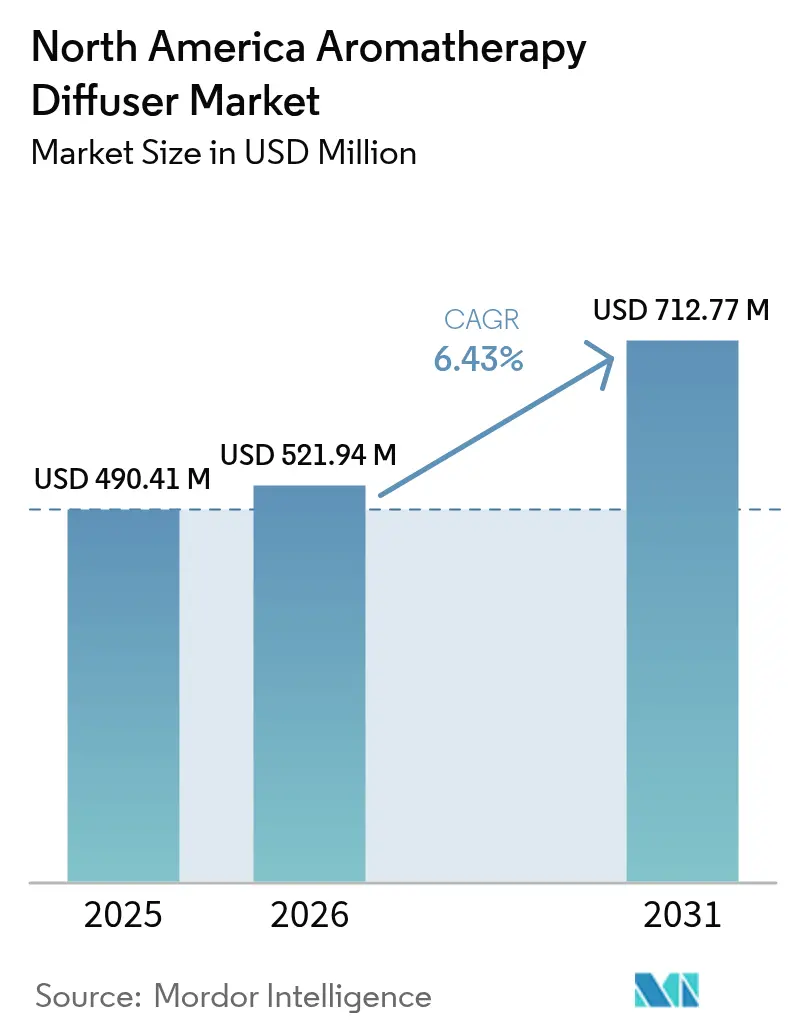
The North America essential oil diffuser market size was valued at USD 490.41 million in 2025 and estimated to grow from USD 521.94 million in 2026 to reach USD 712.77 million by 2031, at a CAGR of 6.43% during the forecast period (2026-2031). The market growth is driven by increased focus on mental health and self-care, creating demand for natural stress-relief and mood-enhancement through aromatherapy diffusers. Consumers integrate these devices into their wellness routines to create peaceful home environments. The market benefits from technological developments, including smart diffusers with app integration, timers, and voice control capabilities, which align with smart home adoption. The growth of wellness tourism and spa chains in North America increases demand, as diffusers are essential in creating therapeutic environments. Product developments, including cordless, rechargeable ultrasonic diffusers and waterless nebulizers, provide consumers with improved convenience, mobility, and diffusion performance. The market also expands due to consumer demand for natural and sustainable products, prompting manufacturers to develop eco-friendly diffusers and pure essential oils.
Key Report Takeaways
- By product type, ultrasonic captured 63.02% of the North America essential oil diffuser market share in 2025, while nebulizer devices are projected to post a 6.88% CAGR to 2031.
- By distribution channel, specialty stores held 35.22% share of the North America essential oil diffuser market size in 2025, whereas online retail is forecast to expand at 7.02% CAGR through 2031.
- By geography, the United States dominated with 75.65% revenue share in 2025, and Mexico is advancing at a 7.15% CAGR to 2031.
Note: Market size and forecast figures in this report are generated using Mordor Intelligence’s proprietary estimation framework, updated with the latest available data and insights as of 2026.
North America Aromatherapy Diffuser Market Trends and Insights
Drivers Impact Analysis*
| Driver | (~) % Impact on CAGR Forecast | Geographic Relevance | Impact Timeline |
|---|---|---|---|
| Proliferation of smart-home IoT-enabled diffusers | +1.5% | United States and Canada lead, Mexico emerging | Medium term (2-4 years) |
| Product and technology innovation | +1.2% | United States core, Canada secondary, Mexico growing | Long term (≥ 4 years) |
| Growing consumer emphasis on mental health and self-care | +0.8% | United States and Canada mature, Mexico rapid adoption | Short term (≤ 2 years) |
| Expansion of wellness tourism and spa chains | +0.6% | United States established, Mexico fastest growth, Canada steady | Medium term (2-4 years) |
| Growing demand for natural and sustainable fragrance diffusers | +0.4% | United States and Canada mature demand, Mexico emerging consciousness | Long term (≥ 4 years) |
| Growing demand for personalized wellness solutions | +0.3% | United States leads adoption, Canada follows, Mexico early stage | Medium term (2-4 years) |
| Source: Mordor Intelligence | |||


Proliferation of Smart-Home IoT-Enabled Diffusers
The growth of the North American aromatherapy diffuser market is driven by the increasing adoption of smart-home IoT-enabled diffusers. These devices enhance the aromatherapy experience by integrating with mobile apps and smart home systems, offering users improved control and customization options. For instance, companies like Pura Scents, Inc. exemplify this trend with their innovative Pura 4 smart home fragrance diffuser. This product incorporates a suite of smart features, including automatic vial detection, which recognizes the inserted fragrance vial without manual scanning, and adaptive diffusion technology that adjusts scent intensity based on room temperature to ensure a consistent and efficient aroma distribution. The integration of smart technology expands the market beyond traditional wellness consumers to include technology-focused customers seeking connected home devices. This market expansion supports higher product pricing and increased industry revenue. As consumers prioritize home comfort, personalization, and digital convenience, the demand for IoT-enabled diffusers continues to influence product development and market competition in the aromatherapy diffuser industry.
Product and Technology Innovation
Technological advancements and product innovations serve as fundamental growth drivers in the aromatherapy diffuser market. Manufacturing companies allocate substantial resources toward developing sophisticated diffuser models with enhanced functionalities to address consumer requirements for operational efficiency, customization capabilities, and technological integration. In April 2024, Saje Natural Wellness introduced the Aroma (Be) Free, a cordless, rechargeable ultrasonic diffuser that efficiently converts water and pure essential oils into a fine, cool mist. This product emphasizes operational mobility and safety protocols, enabling implementation across diverse environments. Market expansion is facilitated by technological integrations, including application-based controls, programmable timing mechanisms, and voice-activated functions, enabling users to regulate diffusion parameters and operational schedules. Contemporary diffuser systems incorporate resource-optimization features, including waterless operations and energy-efficient mechanisms to minimize consumption. These environmental sustainability features attract consumers who prioritize both therapeutic benefits and ecological responsibility.
Growing Consumer Emphasis on Mental Health and Self-care
The growing emphasis on mental health and self-care is driving the North American aromatherapy diffuser market. The increased awareness of mental wellness, stress management, and holistic health practices has increased demand for natural therapeutic solutions like aromatherapy. Consumers use essential oils and diffusers to help reduce anxiety, enhance mood, improve sleep quality, and decrease depressive symptoms. The broader acceptance of mental health discussions and wellness practices has led consumers to adopt personalized health routines that include aromatherapy diffusers in homes and professional settings. These devices provide users with an accessible method to support relaxation and mental clarity as part of their daily wellness routines. This trend aligns with the growing focus on preventive care and natural interventions. According to the Centers for Disease Control and Prevention (CDC) in 2023, depression affected 13.1% of adolescents and adults aged 12 and older, indicating significant mental health challenges across the population [1]Source: Centers for Disease Control and Prevention (CDC), "Depression Prevalence in Adolescents and Adults", www.cdc.gov. As a result, aromatherapy has become a common complementary approach for mental and emotional well-being.
Expansion of Wellness Tourism and Spa Chains
The growth of wellness tourism and spa chains drives the North American aromatherapy diffuser market expansion. According to the International Spa Association, the United States spa industry recorded 182 million visitors in 2023. This high visitor count reflects increased demand for wellness services focused on relaxation, mental health, and holistic self-care, where aromatherapy diffusers are essential components. Spas and wellness centers incorporate diffusers in their treatment areas to create calming environments that maximize the therapeutic effects of essential oils. The rise in wellness tourism strengthens this demand as travelers seek natural healing experiences combined with comfort. The increasing number of spa visits promotes product adoption in commercial wellness facilities and increases consumer awareness for home use, expanding the market. The spa industry continues to invest in wellness technologies, including ultrasonic and nebulizing diffusers, to enhance service offerings and meet consumer demands for personalized relaxation experiences. The growth in spa visits and revenue creates expansion opportunities for spa chains while improving the quality of wellness services.
Restraints Impact Analysis*
| Restraint | (~) % Impact on CAGR Forecast | Geographic Relevance | Impact Timeline |
|---|---|---|---|
| High competition from substitutes | -0.9% | All North America, particularly price-sensitive Mexico | Short term (≤ 2 years) |
| High initial cost of premium diffuser models limiting affordability | -0.7% | Mexico most affected, moderate impact in United States & Canada | Medium term (2-4 years) |
| Safety concerns regarding use around children and pets | -0.5% | United States and Canada strict enforcement, Mexico developing standards | Short term (≤ 2 years) |
| Regulatory challenges with therapeutic claims on essential oils | -0.6% | United States strictest FDA oversight, Canada similar, Mexico less stringent | Medium term (2-4 years) |
| Source: Mordor Intelligence | |||
High Competition from Substitutes
The North American aromatherapy diffuser market faces significant competition from substitute products. Candles, room sprays, and plug-in air fresheners provide immediate fragrance solutions at lower prices, creating downward pricing pressure on diffuser manufacturers and restricting market penetration among cost-conscious consumers. These alternatives are readily available across retail channels, including supermarkets, convenience stores, and e-commerce platforms. The competitive environment intensifies as fragrance companies develop aromatherapy-inspired products that deliver similar benefits to essential oils without requiring specialized equipment. Additionally, HVAC system-integrated scenting solutions compete with portable diffusers by offering building-wide coverage and centralized control. The increasing adoption of Heating, Ventilation, and Air Conditioning (HVAC) scenting technology serves environments requiring large-scale scent dispersion, capturing market share from the traditional portable diffuser segment.
High Initial Cost of Premium Diffuser Models Limiting Affordability
The high initial cost of premium diffuser models constrains the North American aromatherapy diffuser market growth. Premium diffusers, including ultrasonic and nebulizing types, incorporate advanced features and high-quality materials, resulting in elevated prices. While these devices deliver enhanced therapeutic benefits and quiet operation, their cost restricts accessibility for price-sensitive consumers. The total cost of ownership increases further due to essential oils, replacement components, and maintenance requirements. The market has developed two distinct segments: premium products targeting affluent consumers and mass-market alternatives. This market segmentation limits the widespread adoption of premium devices and affects overall market growth. Manufacturers must balance product innovation with cost-effectiveness to expand their consumer base while demonstrating the value of premium features, such as therapeutic effectiveness and design quality, to justify higher prices.
*Our forecasts treat driver/restraint impacts as directional, not additive. The impact forecasts reflect baseline growth, mix effects, and variable interactions.
Segment Analysis
By Product Type: Ultrasonic Dominance Faces Nebulizer Innovation
Ultrasonic diffusers hold a dominant 63.02% share in the North America aromatherapy diffuser market in 2025. This market leadership stems from their water vapor-based diffusion method, which safely disperses essential oils into the air. The technology appeals to consumers due to its gentle approach that preserves essential oil properties without heat-induced alterations. Ultrasonic diffusers operate quietly, making them suitable for both residential and professional settings. Their competitive pricing compared to nebulizing models has enabled broad market penetration across various consumer segments, including wellness enthusiasts and first-time buyers.
Nebulizer technology is experiencing rapid growth in the North America aromatherapy diffuser market, with a projected CAGR of 6.88% through 2031. These devices deliver concentrated essential oil diffusion without water or heat, maintaining the oils' therapeutic properties. The technology's ability to atomize pure essential oils directly into the air provides immediate and intense aromatherapy benefits. This effectiveness has gained particular traction among wellness practitioners, spas, and consumers seeking specific therapeutic outcomes. Recent improvements in design have reduced operational noise and enhanced aesthetic appeal, expanding the consumer base for nebulizing diffusers.



By Distribution Channel: Specialty Stores Navigate Digital Disruption
Specialty stores hold a 35.22% market share in the North America aromatherapy diffuser market in 2025. These stores provide a comprehensive shopping experience with a diverse selection of premium and niche diffuser products, supported by expert guidance and customized recommendations. The store's stock quality includes ultrasonic, nebulizer, and evaporative diffusers, attracting customers seeking reliable aromatherapy solutions. Their trained staff and product demonstrations help build customer confidence, leading to increased sales and customer retention. These stores particularly appeal to wellness enthusiasts and professional buyers who require specific features in their diffusers, including advanced functions, design elements, or therapeutic benefits.
Online retail channels in the North American aromatherapy diffuser market are projected to grow at a CAGR of 7.02% through 2031. This growth stems from consumers' increasing preference for the accessibility, product range, and competitive prices available through e-commerce platforms. Online retailers offer extensive selections of ultrasonic, nebulizer, and evaporative diffusers, complemented by comprehensive product information and customer reviews. The digital platform enables consumers to evaluate products and access unique brands unavailable in traditional retail stores. This approach particularly resonates with millennial and Gen Z consumers. According to the International Telecommunication Union (ITU) data in 2023, Canada's internet usage rate of 94% indicates significant potential for e-commerce expansion . This high internet penetration supports the growth of online shopping as a distribution channel, allowing aromatherapy diffuser brands to expand their market reach effectively.

Geography Analysis
The United States holds 75.65% market share in the North American aromatherapy diffuser market in 2025. This dominance stems from high consumer awareness of essential oil benefits, established wellness practices, and robust demand across residential and commercial segments, including spas, wellness centers, hotels, and healthcare facilities. The market features technological advancement in ultrasonic and nebulizer diffusers, which users prefer for their efficiency, simplicity, and ability to maintain essential oil properties. A comprehensive retail network of specialty stores and online platforms ensures broad product accessibility.
Canada maintains a significant position in the North American aromatherapy diffuser market. The market growth reflects increasing consumer adoption of natural wellness products, driven by interest in holistic health practices and stress management solutions. The country's robust retail infrastructure and high internet penetration facilitate distribution through specialty stores and online platforms. Canadian consumers show a preference for premium and environmentally conscious diffuser options, aligning with national health and sustainability priorities.
Mexico demonstrates the highest growth rate in the North American aromatherapy diffuser market, with a projected CAGR of 7.15% through 2031. This expansion corresponds with increased household adoption of essential oils for relaxation, stress management, and air purification, driving demand for ultrasonic and nebulizer diffusers. According to the Observatory of Economic Complexity (OEC), Mexico imported essential oils worth USD120 million in 2023, ranking as the 15th largest global importer . This import volume indicates substantial market potential and highlights Mexico's importance in the North American aromatherapy diffuser market.
Regulatory Landscape
In the United States, aromatherapy diffuser marketing and labeling sit at the intersection of consumer product safety and claim substantiation. The FDA frames aromatherapy products as cosmetics when positioned for fragrance or beautifying purposes, while products promoted with disease treatment or therapeutic claims can be regulated as drugs, which increases the compliance bar for claims made alongside diffuser and oil use.
Product safety enforcement for diffuser hardware is driven by recognized electrical and mechanical safety expectations, with recall activity shaping compliance priorities. The US Consumer Product Safety Commission (CPSC) oversees consumer product safety and has issued diffuser-related recalls, including a May 2025 recall involving detachable covers on smart home fragrance diffusers due to a magnet ingestion hazard. In parallel, standards such as UL 283 (Air Fresheners and Deodorizers) provide a safety framework for appliances, covering fire, electric shock, and injury risks. In Canada, Health Canada expects electrical products that plug into an outlet to meet national safety standards and bear certification marks (for example, CSA or cUL), influencing design, testing, and import requirements across North America.
Competitive Landscape
Top Companies in North America Aromatherapy Diffuser Market
The North American essential oil diffuser market shows moderate fragmentation, with established multi-level marketing companies competing against emerging technology-focused brands and traditional consumer goods manufacturers. Young Living maintains market leadership through its extensive distributor network and vertically integrated supply chain, including essential oil distillation facilities, enabling strict quality control. doTERRA utilizes direct sales strategies and digital marketing to maintain consumer engagement and market presence. The market has seen increased competition as Newell Brands and S.C. Johnson entered with mass-market strategies, intensifying pressure on direct sales and niche players.
Companies are developing IoT-enabled diffusers that integrate with smart home ecosystems, allowing remote control through apps and voice assistants. The market has expanded to include subscription-based models for essential oil delivery, which provide consistent revenue and improve customer retention through convenience and personalization. This combination of smart technology and subscription services drives innovation and helps brands differentiate themselves in the market. Companies that effectively integrate technology gain competitive advantages, creating pressure for traditional manufacturers to adapt.
The North American aromatherapy diffuser market demonstrates an evolving industry where traditional marketing approaches operate alongside technological innovations. The market's competitive dynamics reflect both changing consumer preferences and increased interest in wellness products. Companies achieve success through product quality, technological innovation, distribution networks, and brand-building strategies that align with consumer lifestyles and preferences.
North America Aromatherapy Diffuser Industry Leaders
-
Young Living Essential Oils
-
doTERRA International LLC
-
Newell Brands Inc.
-
S. C. Johnson & Son, Inc. (Glade)
-
NOW Foods
- *Disclaimer: Major Players sorted in no particular order


Market Opportunities and Future Outlook
Opportunities are concentrated in connected, higher-control diffusion formats, particularly where smart-home adoption is shifting demand toward app-controlled scheduling, timers, and remote operation. Recent product activity supports this direction: Organic Aromas introduced smart nebulizing diffusers with Bluetooth app control and rechargeable operation in February 2026, pointing to momentum for waterless, programmable diffusion that supports premiumization in nebulizers.
Commercial and managed scenting use cases create room for vendors offering fleet management, usage analytics, and consistent performance across multiple rooms or locations. Saintdeland’s April 2026 release of the SDL308, positioned around cloud and IoT management for commercial environments, indicates growing supplier focus on professional installations where maintenance, uptime, and standardized scent delivery matter. Safety engineering also appears to be a differentiator as CPSC recall actions keep oversight visible, which encourages product designs that reduce physical hazards and improve electrical safety validation in smart and portable formats.
Recent Industry Developments
- June 2026: dōTERRA announced deeper engagement with third-party ethical sourcing frameworks through UEBT membership and FairWild-linked work across multiple botanicals and origins. The announcement strengthens essential oil supply governance that supports diffuser usage, supporting brand differentiation around traceability and responsible sourcing while reducing reputational and supply continuity risks.
- January 2026: Newell Brands relaunched Chesapeake Bay Fragrance with a refreshed brand identity and an expanded home fragrance portfolio that included reed diffusers, distributed via Amazon.com and Yankee Candle retail outlets. Adding reed diffusers broadens non-heat fragrance formats and increases competitive pressure on passive diffuser products in mass and specialty retail.
- November 2024: Element Brooklyn launched a new line of reed diffusers in two fragrances, Jardín Azteca and Campfire Stereo, positioned around multi-month scent longevity. The launch reflects ongoing product line expansion in premium and niche home fragrance, increasing assortment depth that competes with electric and ultrasonic diffuser use cases.


Research Methodology Framework and Report Scope
Market Definition and Coverage
This market covers the value of aromatherapy diffusers sold across North America. In practice, these devices disperse essential oils for home, office, or similar indoor use, and sales are counted at selling prices through common retail channels.
Scope exclusions: We exclude essential oils and refills, candles, reed diffusers that do not use a diffuser device, and non-aromatherapy air fresheners.
Segmentation Overview
-
By Product Type
- Ultrasonic
- Nebulizer
- Others
-
By Distribution Channel
- Supermarkets/Hypermarkets
- Convenience Stores
- Specialty Stores
- Online Retail Stores
- Other Distribution Channels
-
By Geography
- United States
- Canada
- Mexico
- Rest of North America
Data Sources, Market Sizing, and Validation
Desk Research
Desk research starts with setting a device boundary so aromatherapy diffusers are not mixed with adjacent home fragrance items. For this, we refer to public sources such as the US Census Bureau retail trade data, US International Trade Commission trade statistics for relevant product codes, Statistics Canada tables, and Mexico INEGI releases for consumer and retail indicators.
We also review US Customs and Border Protection guidance for trade classification context, published safety and emissions guidance from government bodies where applicable, and peer reviewed papers that discuss essential oil diffusion and indoor air considerations. Company filings, investor presentations, and reputable press coverage help us track product launches, channel shifts toward e-commerce, and typical price tiers for ultrasonic and nebulizing devices. For cross-checks on company scale and product mix, we may reference paid subscriptions that provide company financials and intelligence, shipment-level import-export views, and patent databases. The sources listed here are illustrative, and we use additional public documents and datasets for clarification and validation.
Primary Interviews and Surveys
Primary work is used to pressure test desk assumptions and to fill gaps on what is actually selling by device type, price band, and channel, especially for online-led demand. We speak with brand and channel stakeholders, distributors, and category managers, then validate with supply-side participants such as contract manufacturers and component-oriented contacts who track diffuser builds. When results did not align across the United States, Canada, and Mexico, we revisited the questions until one set of assumptions could be defended consistently.
Distribution of primary research fieldwork respondents
| Company type | Respondent position |
|---|---|
| Top tier: 25% | CXOs: 15% |
| Mid tier: 58% | Functional/Unit leaders: 36% |
| Smaller Players: 17% | Managers: 49% |
Market-Sizing & Forecasting
For sizing, we start with a top-down build where retail and trade indicators are used to reconstruct the addressable device spend for aromatherapy diffusers in North America. We then filter that pool using category-mix insights from interviews. Once that first cut is formed, we check it with selective bottom-up approximations, such as sampled average selling price ranges by device type multiplied by observed unit movement patterns in key channels.
Inputs that matter in this market include the split of ultrasonic versus nebulizing units, the online share versus store-based sales, average selling price progression by feature set (timers, app control, lighting), replacement and gifting seasonality, and the spread of wellness-driven usage in homes and small commercial settings. Where bottom-up signals are incomplete, we use conservative fill rates that reflect what distributors and channel contacts say is realistic, then rebalance to keep totals consistent by country and channel. Forecasts are run using scenario analysis, varying demand drivers such as e-commerce penetration, pricing drift, and adoption of smart diffusers within ranges that industry contacts consider practical.
Data Validation & Update Cycle
Validation is done in layers so the model does not rely on one data stream. We compare outputs against independent signals like retail trend lines, import patterns for finished devices, and common pricing bands, then investigate any sharp jumps before sign-off. If a variance cannot be explained by a clear market event, we return to the assumptions and re-contact selected interviewees to confirm what changed.
The report is refreshed annually, and interim updates are made when material shifts occur, such as a channel disruption or a price shock in popular device types. Before delivery, an analyst runs a fresh pass on key inputs and checks the year labels and currency conversions so clients receive the latest updated view.
Mordor Intelligence's North America Aromatherapy Diffuser Market Size Compared With Other Published Estimates
Published market sizes for aromatherapy diffusers can look different even when the same region is being discussed. The category boundary and pricing basis are not always treated the same way, and that affects totals.
The anchor year, channel coverage (especially online), and how product types are grouped can shift the number up or down. By refreshing channel splits, country weights, and feature-led ASP movement each year, Mordor Intelligence keeps the total tied to diffuser devices sold across the United States, Canada, and Mexico, while avoiding counting oils and refills that sit next to devices in many retail datasets. Some sources widen the basket to broader air care products or passive fragrance items, and others use aggressive price uplift assumptions without checking whether premium features are moving beyond niche online assortments into mass channels. Differences also show up when currency timing is handled inconsistently or when older inputs are carried forward after a meaningful change in online sales mix.
Benchmark comparison
| Source | Market Size | Gaps in Research Methodology |
|---|---|---|
| Mordor Intelligence | USD 490.41 M (2025) | |
| Industry Association A | USD 540.00 M (2025) | Uses a wider basket that can blend diffuser devices with adjacent fragrance accessories, and it applies a higher blended ASP that is not consistently checked across online and offline channels. |
| Trade Journal B | USD 430.00 M (2025) | Leans more on store-based sell-through and can undercount online-led sales and smart-feature premium models, which pulls down captured value for the region. |
The spread across sources mainly comes from what is included as a diffuser, how prices are averaged across device types, and how online demand is captured. When those items are set out clearly and checked against independent signals, the resulting number stays easier to reproduce and interpret for planning.


Key Questions Answered in the Report
How large is the North America essential oil diffuser market in 2026?
The North America essential oil diffuser market size is USD 521.94 million in 2026.
What growth rate is forecast through 2031?
The market is projected to register a 6.43% CAGR between 2026 and 2031.
Which diffuser technology is growing the fastest?
Nebulizer models are pacing the field at a 6.88% CAGR because they are waterless and offer stronger scent concentration.
Which sales channel is expanding quickest?
Online retail is advancing at 7.02% CAGR, boosted by subscriptions and direct-to-consumer models.
Page last updated on:


 Your data is secure and never sold or shared.


