
Market Overview
| Study Period | 2021 - 2031 |
|---|---|
| Market Size (2026) | USD 1.75 Billion |
| Market Size (2031) | USD 2.49 Billion |
| Growth Rate (2026 - 2031) | 7.33 % |
| Fastest Growing Market | Asia Pacific |
| Largest Market | Europe |
| Market Concentration | Medium |
Major Players
*Disclaimer: Major Players sorted in no particular order Image © Mordor Intelligence. Reuse requires attribution under CC BY 4.0. |
|
Aromatherapy Diffuser Market Analysis by Mordor Intelligence
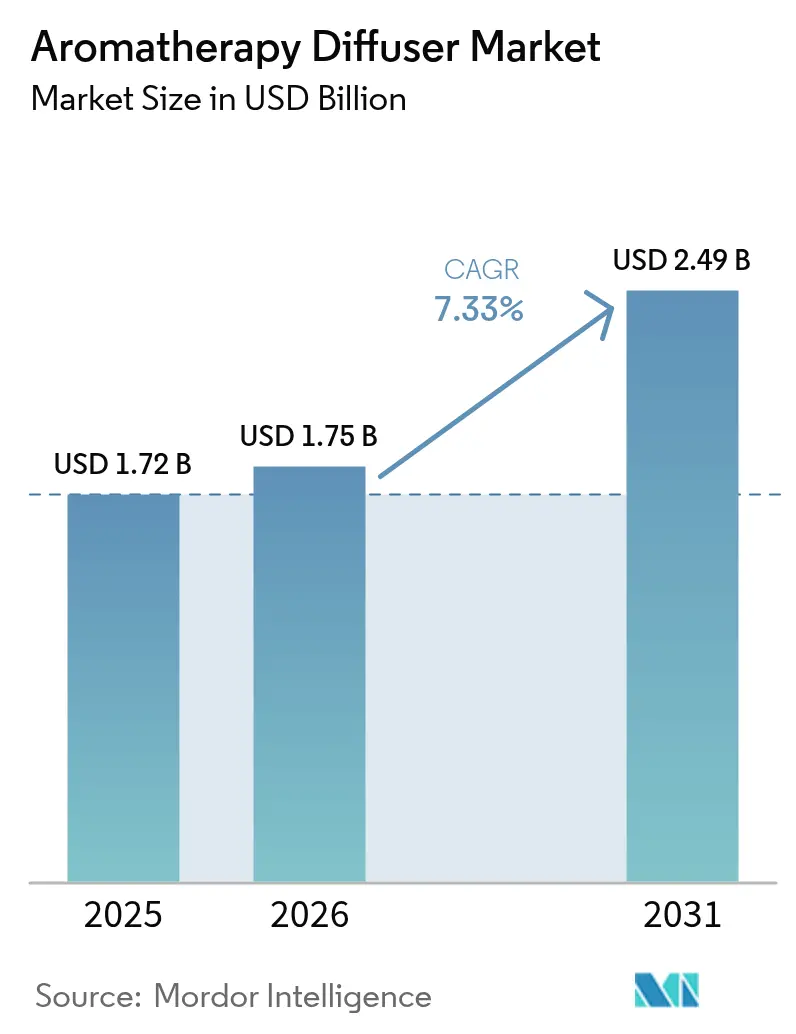
The aromatherapy diffusers market size is expected to increase from USD 1.72 billion in 2025 to USD 1.75 billion in 2026 and reach USD 2.49 billion by 2031, growing at a CAGR of 7.33% over 2026-2031. As the market for aromatherapy diffusers evolves, there's a noticeable shift from merely decorative home fragrances to a focus on therapeutic scent delivery. This change is evident as automotive manufacturers integrate digital scent modules into vehicles, and employers outfit offices with scents to mitigate stress-related absenteeism. Innovations like subscription-based refill models, IoT connectivity, and AI-driven scent matching are not only enhancing customer engagement but also extending their lifetime value. Furthermore, government wellness initiatives in countries like China, India, and the UAE are amplifying institutional demand for these products. However, the landscape isn't without challenges. Stricter regulations on volatile organic compounds (VOCs) in the EU, coupled with the U.S. FDA's heightened scrutiny on therapeutic claims, are compelling manufacturers to reformulate their oils. This shift has led to increased investments in certifications, benefiting vertically integrated brands that can ensure a traceable supply of raw materials. While the competitive landscape is moderately intense, new direct-to-consumer players are making waves. By introducing biodegradable capsules and emphasizing smart-home integration, they're positioning themselves as formidable challengers to established multilevel marketing giants, especially in the market's high-volume channels. Yet, the industry grapples with challenges. Climate-induced fluctuations in the harvests of key ingredients like lavender, sandalwood, and vetiver are squeezing profit margins. In response, there's a swift pivot towards regional sourcing in countries like Egypt and India, aiming to localize the supply chain.
Key Report Takeaways
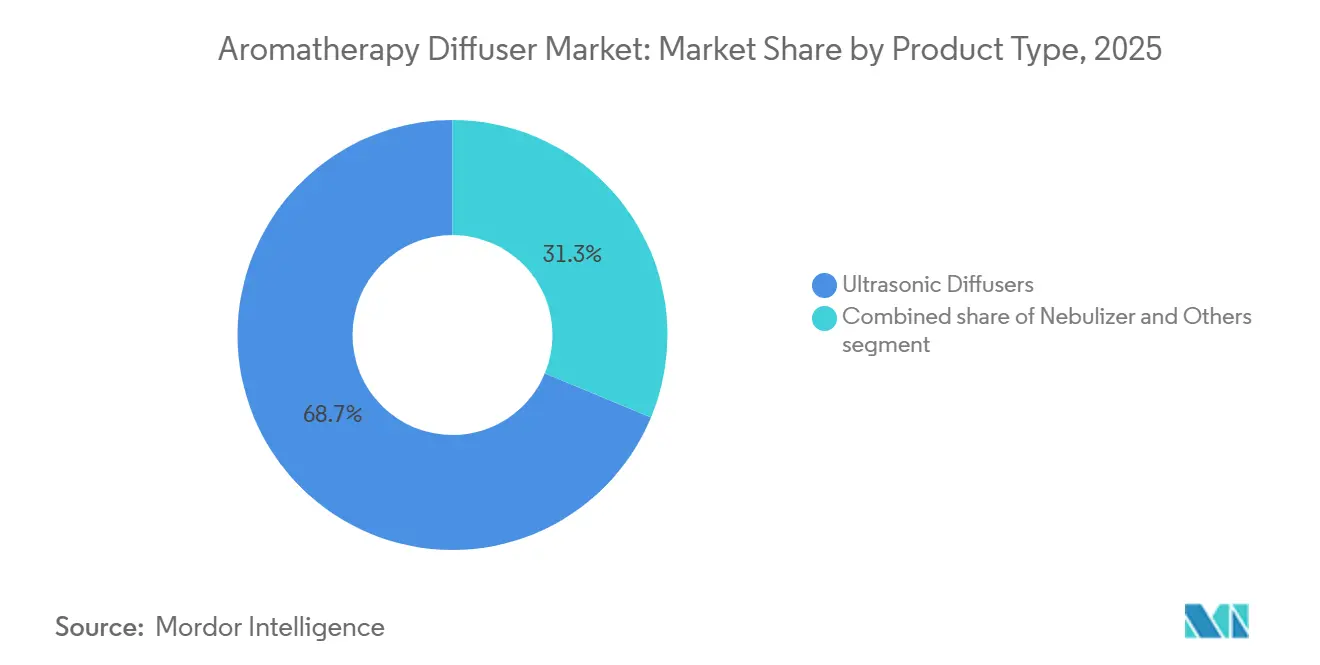
- By product type, ultrasonic diffusers led with 68.74% of the 2025 aromatherapy diffusers market share, while nebulizers are projected to expand at a 7.55% CAGR through 2031.
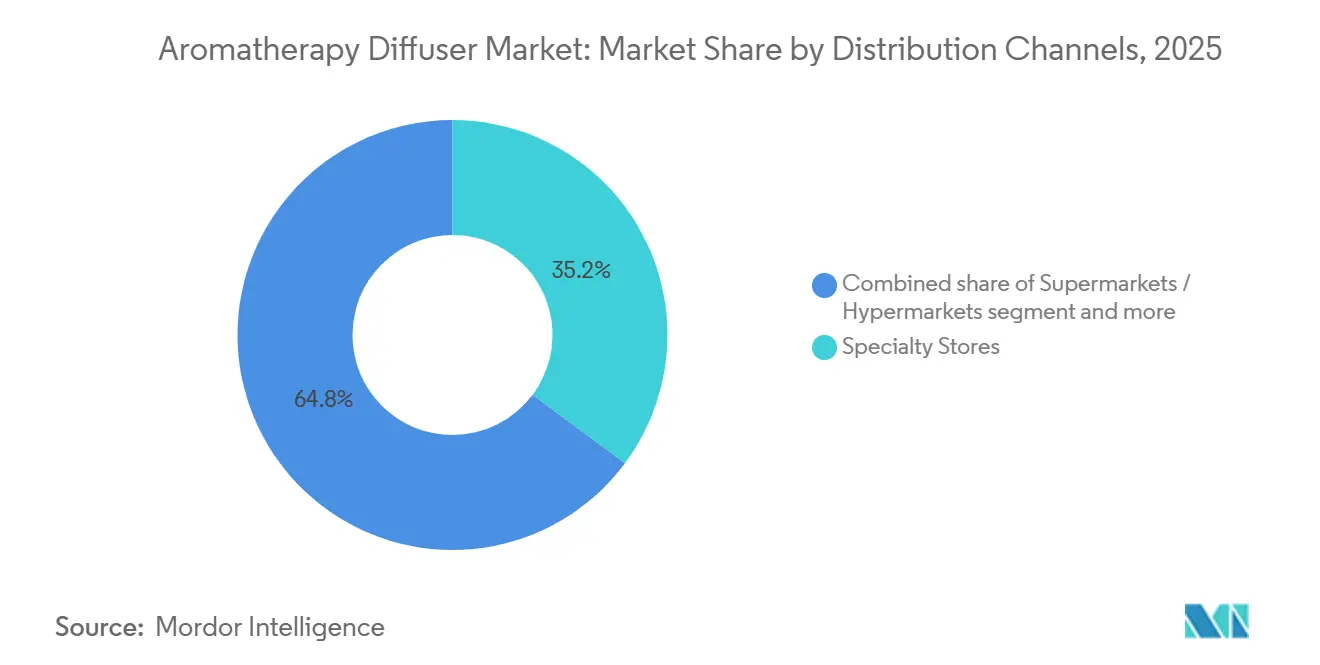
- By distribution channel, specialty stores held 33.88% share of the 2025 aromatherapy diffusers market size, yet online retail is advancing at a 9.11% CAGR to 2031.
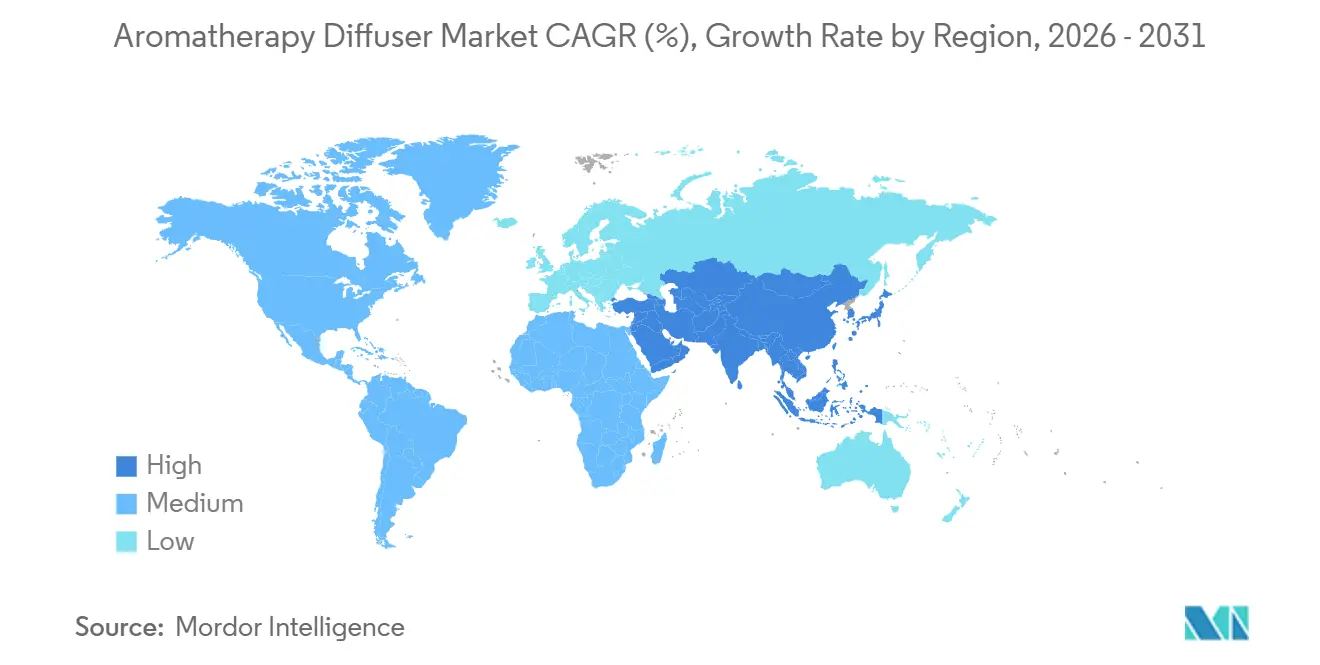
- By region, Europe commanded 31.27% revenue share in 2025, whereas Asia-Pacific is forecast to grow at an 8.12% CAGR between 2026-2031.
Note: Market size and forecast figures in this report are generated using Mordor Intelligence’s proprietary estimation framework, updated with the latest available data and insights as of 2026.
Market Trends and Insights
Drivers Impact Analysis of Aromatherapy Diffuser Market*
| Driver | (~) % Impact on CAGR Forecast | Geographic Relevance | Impact Timeline |
|---|---|---|---|
| Rising consumer focus on mental wellness and self-care | +1.5% | Global, with concentration in North America and Europe | Medium term (2-4 years) |
| Expansion of wellness tourism and spa chains | +1.2% | Global, led by Asia-Pacific luxury resorts and Middle East hospitality | Medium term (2-4 years) |
| Adoption in corporate well-being programs | +0.8% | North America and Europe, with pilot expansion in Asia-Pacific | Short term (≤ 2 years) |
| Smart-home IoT integration enables subscription aroma services | +1.0% | North America and Europe, early adoption in urban Asia-Pacific | Medium term (2-4 years) |
| Water-free nebulizing tech lowers maintenance risk | +0.9% | Global, with premium-tier adoption in North America and Europe | Long term (≥ 4 years) |
| Automotive OEM collaboration for in-cabin personalization | +0.6% | North America and Europe, with China EV manufacturers exploring integration | Long term (≥ 4 years) |
| Source: Mordor Intelligence | |||
Rising consumer focus on mental wellness and self-care
In 2025, the World Health Organization revealed that 4% of the global population grapples with mental depression. This includes 5.7% of adults (broken down to 4.6% men and 6.9% women) and 5.9% of those aged 70 and above, totaling around 332 million individuals worldwide[1]Source: World Health Organization, "Depressive disorder," who.int. A 2025 clinical study validated the efficacy of lavender inhalation in reducing cortisol levels. This scientific backing has legitimized daily aromatherapy practices, elevating diffusers to the status of reimbursable wellness devices. Brands are now seamlessly integrating scent programs with mental health applications. They've embedded diffusers into digital cognitive-behavioral therapy workflows, a move that's gained traction with universities and senior living operators. Premium vendors distinguish themselves from the flood of sub-USD 20 ultrasonic devices on e-commerce platforms by emphasizing ISO 4730-certified purity and evidence-based marketing. Meanwhile, institutional channels are leaning towards multi-year service contracts, bundling hardware with analytics dashboards that monitor scent usage in relation to stress metrics. Vendors who fail to secure clinical validation face the looming threat of commoditization and shrinking profit margins, especially with the aggressive expansion of Amazon's private label.
Expansion of wellness tourism and spa chains
In 2024, Pan Pacific Hotels rolled out custom Jo Malone fragrances across its Asia-Pacific locations, using signature scents as memory anchors to enhance repeat bookings. The Global Wellness Institute reported wellness tourism spending hit USD 894 billion in 2024, underscoring its significance in the global tourism landscape[2]Source: Global Wellness Institute, " Wellness Tourism," globalwellnessinstitute.org. Highlighting the UAE's ascent as a wellness hub, the country unveiled the USD 545 million Therme Dubai resort. In 2024, JW Marriott introduced organic botanicals from California, available for purchase at checkout, prompting diffuser manufacturers to create hotel-grade units designed for round-the-clock use without clogging. As the UAE's wellness tourism revenue surged by 18% in 2025, resorts in the Middle East began infusing oud and bakhoor into cold-air nebulizers. The demand for continuous operation has heightened the emphasis on reliability testing. Meanwhile, stricter fire safety regulations have phased out open-flame devices, hastening the shift from ultrasonic to nebulizer technology in the hospitality sector. Suppliers, bound by white-label contracts, commit to refilling multiple properties, ensuring a steady revenue stream.
Adoption in corporate well-being programs
In a 2025 study, peppermint diffusion boosted call-center accuracy by 9% and reduced fatigue by 12%. This evidence, from the University of Northumbria, has swayed Fortune 500 procurement teams to recognize the tangible productivity benefits of aromatherapy. Buyers prioritize silent operations and VOC levels that meet the WELL Building Standard. They invest between USD 30-80 per workstation, with minimal ongoing costs primarily for oils. Vendors that link scent cycles to absenteeism through usage analytics are securing pilot rollouts, with potential scalability to thousands of desks. These analytics provide actionable insights, enabling companies to correlate aromatherapy usage with employee well-being and operational efficiency. While procurement inertia poses challenges, the swift payback periods of diffusers make them more appealing than pricier ergonomic solutions. Additionally, subscription refill contracts not only stabilize revenue but also foster vendor lock-in across offices with multiple sites, ensuring consistent product usage and long-term partnerships.
Smart-home IoT integration enables subscription aroma services
Connected diffusers are evolving from mere hardware purchases into integral components of a subscription-based ecosystem. This shift is underscored by a striking 40% subscription attachment rate for Wi-Fi models, in stark contrast to a mere 8% for standalone units. Exuud, a company backed by Estée Lauder, has introduced the Soliqaire capsule system. This innovative system not only schedules scents based on the time of day but also auto-reorders through an app, effectively turning the aromatherapy diffusers market into a realm of recurring software-driven revenue. Meanwhile, venture capital is pouring into AI-driven devices that tailor blends using data from sleep trackers. However, this innovation isn't without its challenges; regulators are raising alarms over privacy concerns tied to behavioral telemetry. To navigate these waters, manufacturers are urged to encrypt usage logs and ensure compliance with regulations like GDPR and CCPA, as lapses could lead to fines that might negate their subscription revenue gains.
Restraints Impact Analysis of Aromatherapy Diffuser Market*
| Restraint | (~) % Impact on CAGR Forecast | Geographic Relevance | Impact Timeline |
|---|---|---|---|
| Essential-oil toxicity and child/pet safety concerns | -0.7% | Global, with heightened regulatory focus in North America and Europe | Short term (≤ 2 years) |
| Proliferation of counterfeit low-cost devices | -0.5% | Global, concentrated in Asia-Pacific manufacturing hubs and cross-border e-commerce | Medium term (2-4 years) |
| Regulatory caps on indoor VOC emissions | -0.6% | Europe and North America, with emerging standards in Asia-Pacific | Medium term (2-4 years) |
| Volatile supply of sustainable eco-friendly casings | -0.4% | Global, with supply-chain concentration in Asia-Pacific | Long term (≥ 4 years) |
| Source: Mordor Intelligence | |||
Essential-oil toxicity and child/pet safety concerns
Warnings have been issued by government health authorities, including Western Australia's Department of Health, which cautioned that even a mere 2 mL of eucalyptus oil poses significant toxicity risks to infants[3]Source: Western Australia's Department of Health, "Essential Oils- Health warning," healthywa.wa.gov.au. In response, the U.S. Consumer Product Safety Commission has mandated child-lock reservoirs and warnings about infant exposure. This regulation, aimed at enhancing child safety, has led to an increase in tooling costs by USD 0.50-1.20 per unit for manufacturers. Furthermore, veterinary journals have established a link between phenols and terpenes found in cinnamon and clove oils and liver toxicity in felines, which can result in severe health complications or fatalities in cats. This revelation has spurred advocacy groups to call for safety data tailored to specific species to ensure comprehensive risk assessments. Brands that are reformulating their products to steer clear of these high-risk compounds and are actively seeking RIFM certification are effectively mitigating their liability and enhancing consumer trust. In contrast, generic disclaimers leave low-cost sellers vulnerable to lawsuits under product-liability statutes, potentially leading to financial and reputational damage.
Proliferation of counterfeit low-cost devices
In 2024, U.S. Customs seized aromatherapy products that made up 31% of counterfeit beauty goods in shipments, as per U.S. Customs and Border Protection. Many of these products lacked electrical-safety marks, posing potential safety hazards, and contained adulterated oils, which could compromise consumer health. Counterfeiters are taking advantage of the USD 800 de minimis threshold, a loophole that allows them to relist on online marketplaces after being flagged, making it challenging to curb their activities effectively. The 2024 Modernization of Cosmetics Regulation Act requires facility registration and adverse-event reporting to enhance product safety and accountability. However, enforcement efforts are hindered by resource limitations, leaving gaps in regulatory oversight. In response, legitimate brands are advocating for mandatory UL/CE certification to ensure product quality and safety standards. While compliance with these certifications would increase their costs by 8-12%, it could help mitigate the race-to-the-bottom price competition that continues to depress the aromatherapy diffusers market.
*Our forecasts treat driver/restraint impacts as directional, not additive. The impact forecasts reflect baseline growth, mix effects, and variable interactions.
Aromatherapy Diffuser Market Segment Analysis
By Product Type:
Nebulizers Gain Ground Despite Ultrasonic DominanceIn 2025, ultrasonic diffusers dominated the aromatherapy diffuser market, seizing a substantial 68.74% share. Their widespread appeal stems from their affordability, ease of use, and the familiar humidifying mist they produce, resonating well with everyday consumers. However, these diffusers come with challenges: they tend to dilute essential oils and require regular cleaning to prevent mold buildup. Yet, the balance of functionality and cost-effectiveness keeps them favored among the masses. With continuous improvements in design and connectivity, their leadership position in the market appears secure. Manufacturers are also focusing on introducing compact and portable models to cater to on-the-go consumers.
Nebulizing diffusers, however, chart a different course. They're projected to grow at an impressive CAGR of 7.55% through 2031, making them the market's fastest-growing segment. Dispensing pure, concentrated aromas without water, these diffusers are the go-to choice for therapists, spas, and the hospitality industry, thanks to their potent scent output. With a diffusion intensity up to five times greater than their ultrasonic counterparts, they're particularly suited for clinical and professional environments. Innovations such as interval-pulsing technology, which can extend oil life by approximately 40%, enhance their cost-effectiveness. When combined with premium branding and subscription oil models, these features bolster their allure in the upscale market. Additionally, the growing consumer preference for luxury wellness products is further driving their adoption.



By Distribution Channel:
Online Retail Disrupts Specialty-Store IncumbentsIn 2025, specialty outlets dominated the distribution landscape, seizing 33.88% of the aromatherapy diffuser market's revenue. These outlets engage consumers through tactile sampling, personalized consultations, and curated brand experiences, bolstering trust and confidence in their products. Yet, as consumers increasingly prioritize convenience and price transparency, the stronghold of these specialty stores is waning. Many brands, while still valuing these outlets for their experiential engagement and premium positioning, are now pairing them with digital channels for fulfillment. This blended strategy not only helps companies maintain their brand identity but also broadens their market reach. Additionally, specialty outlets are increasingly focusing on exclusive product launches to retain customer interest and loyalty.
E-commerce is emerging as the dominant force, projected to grow at a robust 9.11% CAGR through 2031. Online platforms are harnessing AI-driven scent quizzes, tailored pricing, and auto-reorder features, leading to subscription rates that outpace traditional retail. With the allure of customer reviews, expedited delivery options like Prime shipping, and regular discounts, sales of budget ultrasonic models have surged, often exceeding 30,000 units monthly. While this swift expansion tightens margins in the mid-priced segment, it enhances consumer access and boosts repeat purchases. Consequently, digital retail is solidifying its status as the primary growth driver, relegating physical stores to branding and showcase roles. Furthermore, the integration of augmented reality (AR) tools is enhancing the online shopping experience, allowing customers to visualize products in their spaces before purchase.
Geography Analysis
Europe Aromatherapy Diffuser Market
In 2025, Europe accounted for 31.27% of the aromatherapy diffusers market, driven by stringent VOC regulations favoring low-solvent essential oils and a well-established spa culture in Germany, France, and the UK. These regulations have encouraged the use of eco-friendly and health-conscious products, aligning with consumer preferences in the region. Post-Brexit, the dual CE and UKCA certifications have increased compliance costs, but they also bolster the market's high-quality image by ensuring product safety and reliability. While growth has decelerated as market penetration reaches its zenith, urban centers in Eastern Europe are still welcoming entry-level ultrasonic diffusers, providing opportunities for manufacturers to tap into emerging markets.
APAC Aromatherapy Diffuser Market
Asia-Pacific is set to witness an 8.12% CAGR growth rate through 2031, fueled by e-commerce's ability to navigate fragmented retail landscapes, government-supported aromatherapy crop farming in India, and China's supremacy in diffuser component production. The region's growing middle class and increasing disposable incomes are further driving demand for aromatherapy products. Moreover, senior-care facilities in Japan are adopting diffusers, referencing clinical evidence that highlights their efficacy in reducing dementia-related agitation, thus underscoring the institutional credibility of the trend. This integration into healthcare settings adds a new dimension to the market's growth potential in the region.
North America, MEA and LATAM Aromatherapy Diffuser Market
In North America, a robust USD 450 per-capita wellness expenditure, coupled with corporate wellness budgets, has led to the widespread adoption of diffusers as a tool for stress alleviation. The increasing focus on mental health and well-being in workplaces has further accelerated this trend. Meanwhile, the Middle East is witnessing a surge, driven by luxury resorts that emphasize signature scent branding to enhance guest experiences and differentiate their offerings. In Latin America, an urban middle class that's yet to be fully tapped is turning to affordable ultrasonic diffusers, primarily through MercadoLibre, as e-commerce platforms make these products more accessible. Africa's market is still in its infancy; while South Africa's spa tourism has shown promise, broader growth is constrained by limited disposable incomes and a lack of widespread awareness about aromatherapy benefits.

Regulatory Landscape
Product compliance for aromatherapy diffusers increasingly spans electrical safety, chemical safety, and marketing-claim oversight. On the electrical side, IEC 60335-2-101:2024 sets specific safety requirements for household vaporizers (including aroma diffusers), while UL 283 (2025 revision) provides a US-facing safety framework for electric air fresheners and deodorizers (up to 250V), covering hazards such as fire, shock, and explosion. In the United States, the Consumer Product Safety Commission (CPSC) moved compliance administration toward tighter documentation through its January 2025 final rule updating certificate of compliance processes and enabling electronic certificate filing with US Customs and Border Protection.
In Europe, the General Product Safety Regulation (EU) 2023/988 (GPSR) is a central horizontal product-safety regime for consumer scenting devices, with industry guidance in 2026 highlighting its role as the safety net for fragrance diffusers sold to consumers. For essential oils and fragrance mixtures, EU chemical rules (REACH/CLP) remain important for classification and labeling, and industry standards such as IFRA concentration limits influence formulation choices. Because claim language can shift products across regulatory buckets, updated 2026 guidance on essential-oil classification emphasizes the need to manage intended-use statements and therapeutic claims to avoid triggering more stringent regimes beyond general consumer product compliance.
Competitive Landscape
The aromatherapy diffusers market is moderately fragmented. Multilevel-marketing giants doTERRA and Young Living, along with NOW Health Group and Plant Therapy, command significant shares, though none dominate. To secure their oil supply, incumbents are vertically integrating. A case in point is Young Living’s acquisition in January 2025 of USDA-certified Nature’s Ultra, which not only added CBD-infused SKUs but also enhanced their lab-testing capabilities, ensuring better quality control and product differentiation in a competitive market.
Technology innovators are now challenging these established players. For instance, Exuud’s biodegradable-capsule Soliqaire system, which has the backing of Estée Lauder, and AERON’s USB FlashScent nebulizer, are introducing smart-home and portable solutions. These innovations effectively lock users into proprietary refills, creating a recurring revenue model for the companies. Furthermore, partnerships with hospitality giants like Pan Pacific and JW Marriott have led to multi-year diffusion contracts. These contracts bundle hardware, oils, and maintenance services, boosting customer lifetime value by ensuring consistent usage and brand loyalty. However, these partnerships require significant initial capital investment to seed devices, which could pose financial challenges for smaller players.
As retailers increasingly demand documentation to mitigate liability, compliance with IEC household-appliance safety standards and ISO essential-oil purity has become essential. This heightened scrutiny raises barriers for Chinese entrants who compete primarily on price, as they may struggle to meet these stringent requirements without incurring additional costs. Consequently, the market is witnessing a shift toward quality-focused offerings, with established players leveraging compliance as a competitive advantage.
Aromatherapy Diffuser Industry Leaders
-
doTERRA International, LLC
-
Newell Brands
-
Plant Therapy, LLC
-
Saje Natural Wellness
-
Young Living Essential Oils
- *Disclaimer: Major Players sorted in no particular order

Aromatherapy Diffuser Market Companies Covered in this Report
- doTERRA Holdings, LLC
- Young Living Essential Oils LC
- NOW Health Group, Inc.
- Plant Therapy, LLC
- Saje Natural Wellness Inc.
- Stadler Form AG
- Vitruvi, Inc.
- VicTsing Inc.
- Pure Enrichment, LLC
- Shenzhen Donglian Technology Co., Ltd.
- Ryohin Keikaku Co., Ltd.
- Frontier Co-op, Inc.
- Reckitt Benckiser Group
- Stadler Form AG
- Organic Aromas
- Nexlux
- InnoGear
- Asakuki
- URPOWER
- Homasy
- InnoGear
- Pilgrim Collection

Market Opportunities and Future Outlook
Commercial and institutional deployments create room for vendors that can package hardware, oils, and compliance documentation into service-style offerings. Corporate well-being programs increasingly specify indoor-air and materials requirements such as the WELL Building Standard, which raises demand for quieter devices, controlled diffusion cycles, and documentation of VOC and ingredient safety. In hospitality and wellness tourism, hotel-grade reliability needs and ongoing refill logistics support bundled contracts, and named hotel rollouts such as Pan Pacific Hotels using custom Jo Malone fragrances across Asia-Pacific illustrate how signature-scent programs translate into repeatable, multi-site requirements that diffuser suppliers can standardize.
Smart-home integration continues to shift competition from one-time device sales toward recurring refill and software value, reflected in current market behavior where connected diffuser models show higher subscription attachment than standalone units. Technology roadmaps that focus on low-power connectivity and authenticated cartridge systems (for example, semiconductor reference designs aimed at connected household aroma diffusers) support differentiation around app scheduling, auto-reorder, and tamper-resistant refills. At the same time, compliance-driven buying in Europe under the GPSR, alongside updated UL 283 and IEC vaporizer safety requirements, tends to favor brands that can provide traceability, safety files, and clearer claim management across regions, which also helps reduce leakage from counterfeit and non-compliant devices on cross-border e-commerce channels.
Recent Industry Developments in Aromatherapy Diffuser Market
- April 2026: doTERRA marked its 18th anniversary with a promotional sale across its wellness portfolio. While the activity is commercial in nature, the scale of direct-to-consumer activation supports customer retention and pull-through for essential oils used with branded diffusers, reinforcing demand across the installed base.
- May 2025: Aroma Amplifier introduced an eco-friendly, cordless aromatherapy diffuser positioned around natural home-wellness use. Cordless designs broaden placement options in homes and small offices, and the sustainability-led positioning aligns with retailer and consumer scrutiny around materials and chemical exposure.
- October 2024: Xiaomi launched the Mijia Smart Aroma Diffuser Set with HyperOS integration and a long battery-life design. This type of smart-home-linked product adds competitive pressure on feature sets such as app control, automation, and portability, and it accelerates mainstream consumer expectations for connected operation beyond basic ultrasonic diffusion.


Aromatherapy Diffuser Market Report Scope and Research Methodology
Market Definition and Coverage
This market covers the value generated from sales of aromatherapy diffusers that disperse essential oils into indoor air for fragrance and wellness use across households and commercial settings.
Scope exclusions: We exclude essential oils, replacement wicks and pads, candles, room sprays, and humidifiers that are not marketed and sold as aromatherapy diffusers.
Segments Covered in This Report
-
By Product Type
- Ultrasonic
- Nebulizer
- Others
-
By Distribution Channel
- Supermarkets/Hypermarkets
- Convenience Stores
- Specialty Stores
- Online Retail Stores
- Others
-
By Geography
-
North America
- United States
- Canada
- Mexico
- Rest of North America
-
South America
- Brazil
- Argentina
- Colombia
- Chile
- Rest of South America
-
Europe
- United Kingdom
- Germany
- France
- Italy
- Spain
- Russia
- Sweden
- Belgium
- Poland
- Netherlands
- Rest of Europe
-
Asia-Pacific
- China
- Japan
- India
- Thailand
- Singapore
- Indonesia
- South Korea
- Australia
- New Zealand
- Rest of Asia-Pacific
-
Middle East and Africa
- United Arab Emirates
- South Africa
- Saudi Arabia
- Nigeria
- Egypt
- Morocco
- Turkey
- Rest of Middle East and Africa
-
North America
Data Sources, Market Sizing, and Validation
Desk Research
Desk research helped set the market boundary and compile baseline numbers that can be checked later. We used public sources such as UN Comtrade for trade flows, the US International Trade Commission data tools for import and export trends, and Eurostat for regional retail and household indicators. We also reviewed US Census Bureau releases for consumer spending direction, and referenced safety and compliance inputs such as the US Consumer Product Safety Commission and EU product compliance notes, since these factors can affect whether products are sold as aromatherapy diffusers.
On the company side, we reviewed annual reports, investor presentations, and product catalogs to understand pricing bands and how diffusers are positioned versus adjacent home fragrance items. We also relied on paid subscriptions for company financials and intelligence, plus shipment-level import and export databases, to sanity-check the scale of major brands using more than one signal. The list of sources is not exhaustive, and we used additional public documents and datasets to collect, validate, and clarify the analysis.
Primary Interviews and Surveys
Primary interviews and surveys were used to pressure-test the desk findings and to close gaps that are hard to see in public data, such as channel mix shifts and typical price movement by diffuser type. We spoke with manufacturers, distributors, large retailers, and selected subject matter experts across APAC, EMEA, and the Americas, then rechecked the main assumptions when responses showed wide variance.
Distribution of primary research fieldwork respondents
| Company type | Respondent position | Region |
|---|---|---|
| Top tier: 33% | CXOs: 16% | APAC: 49% |
| Mid tier: 50% | Functional/Unit leaders: 30% | EMEA: 31% |
| Smaller Players: 17% | Managers: 54% | Americas: 20% |
Market-Sizing & Forecasting
The sizing model starts with a top-down approach, reconstructing category demand using household and commercial usage signals, retail channel development, and trade and production direction for small home fragrance appliances. After the demand pool is defined, we corroborate it with selective bottom-up approximations, such as sampled average selling price (ASP) by diffuser type multiplied by estimated unit volumes in key channels, then adjusting where gaps appear.
Inputs used in the model include the share shift between ultrasonic and nebulizer units, online versus offline channel growth, typical ASP ranges by capacity and material, seasonality around gifting periods, and region-level uptake of wellness and home fragrance routines. When country-level data was thin, we applied a proxy approach by linking penetration and pricing to similar consumer appliance categories, then validating the direction through channel checks.
For forecasting, scenario analysis was used so that adoption and pricing can move differently under optimistic and conservative consumer spending conditions, aligned to what interviewees indicated they expect. Assumptions were kept simple and traceable, and when required, currency conversion was applied using consistent year-average rates to avoid artificial spikes.
Data Validation & Update Cycle
Model outputs are checked against independent signals such as trade direction, retail channel indicators, and price tracking from catalogs and major marketplaces, and then the main drivers are revisited when implied volumes look unrealistic. Variance checks are performed by region and by product type so that unusually high growth is explained by a real shift in adoption, channel access, or pricing, not by an input error.
Before sign-off, the workbook undergoes multi-step analyst review, and we re-contact sources when feedback conflicts with the modeled trend or when a large assumption changes. The report is refreshed annually, and interim updates are made when material events occur, including major regulatory changes, supply disruptions, or sharp inflation in key components. Right before delivery, a final pass is completed so the latest updated view is reflected in the published results.
Mordor Intelligence's Aromatherapy Diffuser Market Sizing Compared With Other Published Estimates
Published market sizes for aromatherapy diffusers often vary because firms do not always count the same products, regions, and channels, and they can use different base years for the calculation. In this market, the biggest swings usually come from whether adjacent home fragrance devices are bundled in, and whether the estimate is built from unit demand signals or mainly from revenue reported by a set of brands.
Key gaps also come from pricing logic, since ASPs can move quickly when online promotions increase or when premium materials gain share. Another driver is refresh timing, since even a few quarters of higher e-commerce share can lift the value total, especially in APAC where growth has been faster.
Benchmark comparison
| Source | Market Size | Gaps in Research Methodology |
|---|---|---|
| Mordor Intelligence | USD 1.72 B (2025) | |
| Global Consultancy A | USD 1.87 B (2024) | Uses a different base year and is typically broader on application reporting, which can pull in aroma device sales outside the diffuser-only boundary and lift the value total. |
| Industry Publisher B | USD 2.11 B (2025) | Higher total likely reflects a wider product basket that can include adjacent home fragrance or air-care devices, and a faster ASP escalation assumption that is not always cross-checked against channel mix shifts. |
The benchmark table shows a clear spread around the 2025 level, and in Mordor Intelligence's model the value is counted only for dedicated aromatherapy diffusers (ultrasonic, nebulizer, and other diffuser formats) sold through tracked retail and online channels, rather than folding in broader home fragrance devices. When scope and ASP steps are kept explicit, and then rechecked with trade, channel, and interview feedback, the resulting number is easier to follow and repeat year to year.


Key Questions Answered in the Report
How large will the aromatherapy diffusers market be by 2031?
The aromatherapy diffusers market size is forecast to reach USD 2.49 billion by 2031.
Which product type is growing fastest in aromatherapy diffusion?
Nebulizing diffusers are projected to expand at a 7.55% CAGR through 2031 as buyers seek water-free, high-potency scent delivery.
Why is Asia-Pacific considered the most attractive region for future growth?
Urbanization, e-commerce penetration, and government-backed wellness programs push Asia-Pacific aromatherapy diffuser sales at an 8.12% CAGR.
What share did ultrasonic diffusers hold recently?
Ultrasonic units captured 68.74% of aromatherapy diffusers market share in 2025, reflecting their low price and humidification benefits.
Page last updated on:





