
Next Generation Firewall Market Size and Share
Market Overview
| Study Period | 2020 - 2031 |
|---|---|
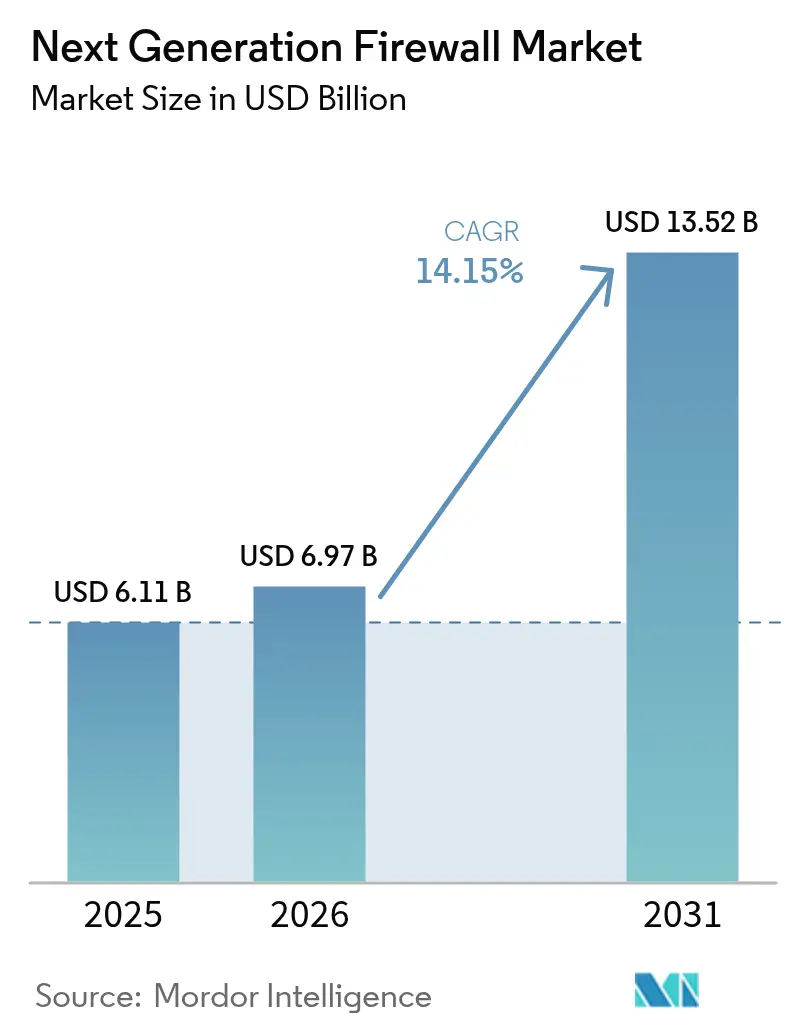
| Market Size (2026) | USD 6.97 Billion |
| Market Size (2031) | USD 13.52 Billion |
| Growth Rate (2026 - 2031) | 14.15 % |
| Fastest Growing Market | Asia Pacific |
| Largest Market | North America |
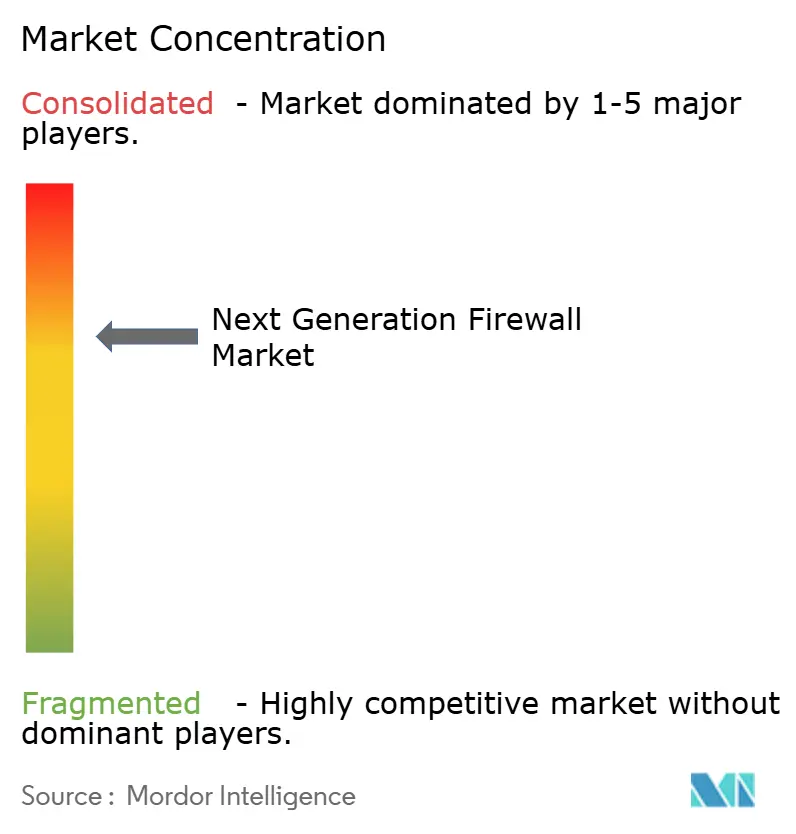
| Market Concentration | Medium |
Major Players *Disclaimer: Major Players sorted in no particular order Image © Mordor Intelligence. Reuse requires attribution under CC BY 4.0. | |
Next Generation Firewall Market Analysis by Mordor Intelligence
next generation firewall market size in 2026 is estimated at USD 6.97 billion, growing from 2025 value of USD 6.11 billion with 2031 projections showing USD 13.52 billion, growing at 14.15% CAGR over 2026-2031. Heightened adoption stems from the move to zero-trust architectures, wider cloud workload distribution, and embedded AI-threat analytics that cut false positives by up to 71%[1]Fortinet, “FortiGate 700G Series Launch,” fortinet.com. Hardware appliances still dominate, yet virtual and cloud-native deployments are scaling quickly as enterprises pursue software-defined security for hybrid environments. North America leads with a 36% revenue share, while Asia-Pacific is expanding the fastest as governments roll out sovereign-cloud mandates and regional data-residency laws. Demand is concentrated in IT-Telecom (46% share) and BFSI, where stricter compliance regimes and high-value digital assets push institutions toward real-time threat prevention. Vendors able to combine ASIC-level performance, AI-driven detection, and unified policy management are best placed to capture emerging opportunities in the next generation firewall market.
Key Report Takeaways
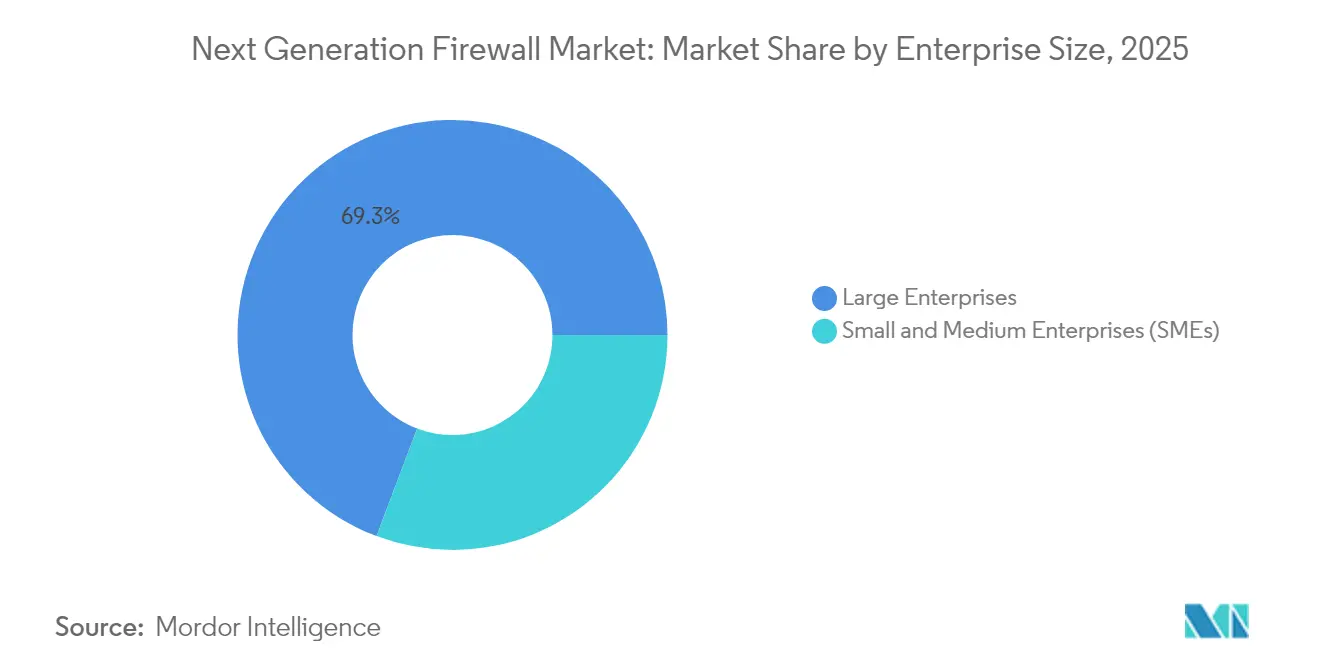
- By enterprise size, large enterprises held 69.25% of the next generation firewall market share in 2025, whereas SMEs are projected to grow at a 16.05% CAGR through 2031.
- By solution type, hardware appliances commanded 54.35% of the next generation firewall market size in 2025, while virtual and cloud-based firewalls are slated to advance at a 15.1% CAGR to 2031.
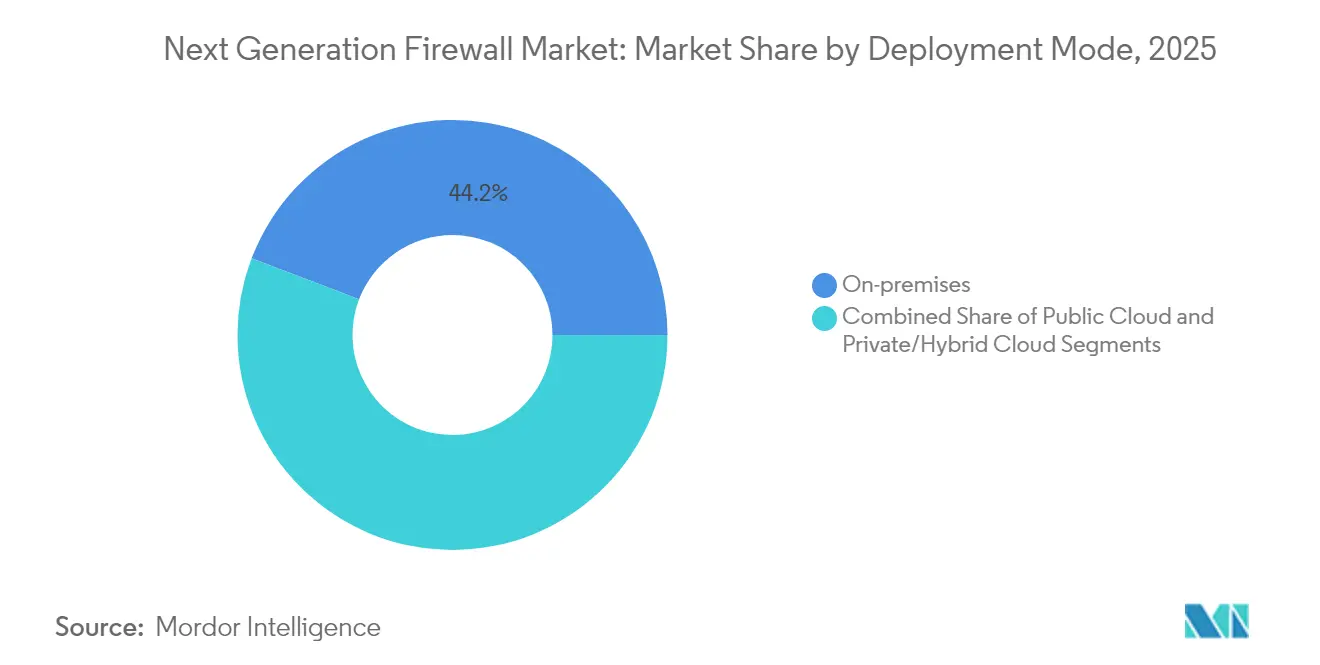
- By deployment mode, on-premises installations represented 44.20% of the market in 2025; private and hybrid cloud deployments are forecast to expand at a 16.2% CAGR over the same period.
- By end-user industry, IT and Telecom led with 45.35% revenue share in 2025; BFSI is the fastest-growing vertical, registering a 15.7% CAGR to 2031.
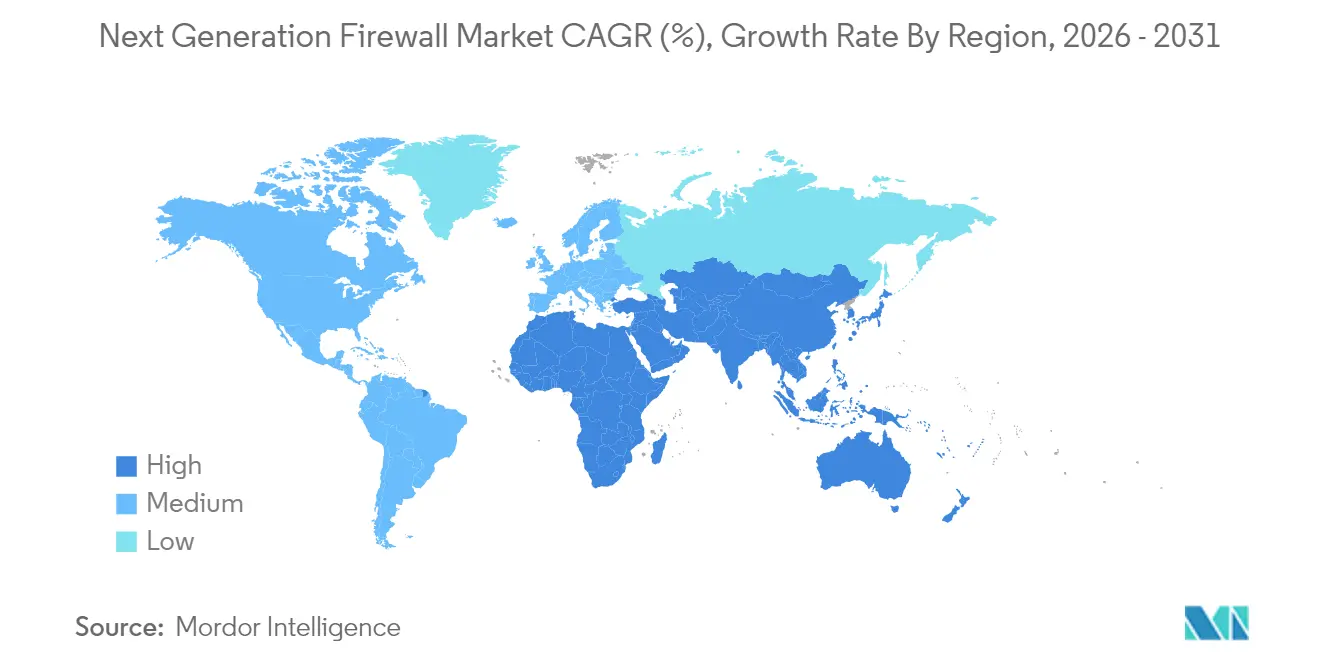
- By geography, North America accounted for 35.60% of global revenue in 2025, whereas Asia-Pacific is anticipated to post the highest regional CAGR of 15.95% to 2031.
- Fortinet, Palo Alto Networks, Cisco, and Check Point collectively controlled about 70% of worldwide shipments in 2024.
Note: Market size and forecast figures in this report are generated using Mordor Intelligence’s proprietary estimation framework, updated with the latest available data and insights as of 2026.
Market Trends and Insights
Drivers Impact Analysis of Next Generation Firewall Market*
| Driver | (~) % Impact on CAGR Forecast | Geographic Relevance | Impact Timeline |
|---|---|---|---|
| Accelerated cloud migration demands inline L7-aware security | +3.8% | Global; early uptake in North America and Europe | Medium term (2-4 years) |
| Hybrid work proliferation expanding attack surface | +2.9% | Global; pronounced in service-oriented economies | Short term (≤ 2 years) |
| Mandatory zero-trust roll-outs in regulated sectors | +3.2% | North America, Europe, advanced APAC markets | Medium term (2-4 years) |
| AI-driven real-time threat-intel feeds in NGFWs | +2.5% | Global; concentrated in enterprise deployments | Medium term (2-4 years) |
| Sovereign-cloud initiatives boosting regional spend | +1.7% | APAC, Europe, Middle East | Long term (≥ 4 years) |
| Source: Mordor Intelligence | |||
Accelerated cloud migration demands inline L7-aware security
Sixty-eight percent of enterprise workloads now run in public, private, or hybrid clouds, exposing east-west traffic that legacy firewalls cannot inspect. Cloud-native NGFWs equipped with application-aware inspection shorten average threat detection time by 63% and cut security incidents by 47% compared with perimeter-only controls[2]Fortinet, “FortiGate 700G Series Launch,” fortinet.com. Deep visibility across microservices lets security teams retain uniform policies as 72% of enterprises boost cloud budgets in 2025, firmly positioning NGFWs as the control plane for distributed architectures.
Hybrid-work proliferation expanding attack surface
Remote access endpoints grew sharply when hybrid work became permanent, with 42% of devices now unmanaged. NGFWs that embed zero-trust network access validate every connection and have driven a 54% year-on-year booking increase for SonicWall’s Cloud Secure Edge. Identity-aware policies prevent credential abuse, addressing the 37% rise in such attacks since 2023, and equip firms to secure staff who move between corporate and home networks.
Mandatory zero-trust architecture roll-outs in regulated sectors
Government directives underscore continuous verification: the U.S. Department of Defense targets full zero-trust implementation by 2027 and designates NGFWs as enforcement points. Sixty percent of enterprises cite regulatory pressure as the main trigger for upgrades. When AI analytics assist policy decisions, detection improves by 43% and false positives fall 37%, validating the synergy between AI and zero-trust models[3]U.S. General Services Administration, “Application of Zero Trust Principles in Federal Agencies,” gsa.gov.
AI-driven threat intelligence transforms detection capabilities
Static rule sets are yielding to adaptive AI engines that recognize unknown malware in real time. Fortinet’s FortiGuard services reduce mean-time-to-detect by 78%, while Check Point blocks 99.9% of new malware within 24 hours of discovery. Automated updates also shrink incident response times by 42%, ensuring that defenses keep pace as adversaries weaponize AI.
Restraints Impact Analysis of Next Generation Firewall Market*
| Restraint | (~) % Impact on CAGR Forecast | Geographic Relevance | Impact Timeline |
|---|---|---|---|
| Capital-intensive ASIC road-map limits SMB price declines | −1.2% | Global; sharper effect in emerging markets | Medium term (2-4 years) |
| Shortage of DPI talent raises service costs | −0.9% | Global; acute in developing regions | Short term (≤ 2 years) |
| Fragmented data-residency laws slow SaaS NGFW uptake | −0.8% | Europe, APAC, Middle East | Medium term (2-4 years) |
| Open-source eBPF firewalls erode entry-level revenues | −0.7% | Global; primarily SMB segment | Long term (≥ 4 years) |
| Source: Mordor Intelligence | |||
Capital-intensive ASIC road-map limits SMB-grade price declines
High-performance SSL/TLS decryption drives vendors toward custom silicon. Fortinet’s SP5 processor gives 7× higher firewall throughput while consuming far less power, yet the research and development outlay keeps entry-level pricing elevated, with 43% of small businesses citing cost as the chief barrier. Although ASICs improve energy efficiency—FortiGate 70G needs 62× fewer watts per Gbps than rivals—the upfront spend remains daunting for budget-constrained buyers.
Shortage of deep-packet-inspection talent raises service costs
Advanced DPI features demand scarce skills. Sixty-eight percent of firms struggle to hire NGFW specialists, and compensation premiums inflate total cost of ownership. To bridge the gap, many enterprises rely on managed security service providers; SonicWall’s Managed Protection Suite offers 24/7 oversight, but recurring fees temper adoption, especially in cost-sensitive segments.
*Our forecasts treat driver/restraint impacts as directional, not additive. The impact forecasts reflect baseline growth, mix effects, and variable interactions.
Next Generation Firewall Market Segment Analysis
By Enterprise Size:
Demand bifurcates between high-end performance and managed simplicityLarge enterprises contributed 69.25% of 2025 revenue as their sizable budgets allowed deployment of multi-gigabit appliances inspecting encrypted traffic without latency. They continue to favor on-appliance ASIC acceleration paired with centralized policy orchestration. In contrast, SMEs are forecast to post a 16.05% CAGR to 2031, propelled by consumption-based subscriptions and managed services that lower capital hurdles. Flexible licensing and turnkey management let resource-limited teams gain enterprise-grade controls while outsourcing complexity. As a result, the next generation firewall market captures two distinct value propositions: uncompromising throughput for global multinationals and simplified, service-led offerings for smaller firms.
Regulatory obligations also shape spending patterns. Larger organizations confront stringent audit trails and must demonstrate granular control across data centers, branches, and subsidiaries. Smaller companies, meanwhile, gravitate toward consolidated platforms that integrate SD-WAN, IPS, and zero-trust access in a single stack, avoiding “tool sprawl.” The widening availability of pay-as-you-go virtual firewalls is expected to keep the next generation firewall market accessible to new adopters, especially across developing economies where capital intensity is a concern.



By Solution Type:
Hardware remains core as cloud-native gains legitimacyHardware appliances retained 54.35% share in 2025, reflecting trusted performance characteristics within on-premises data centers. ASIC-laden flagships such as the FortiGate 700G deliver 164 Gbps firewall throughput at 7× better power efficiency than the industry mean, underscoring why high-bandwidth operators continue to prefer physical devices for deterministic latency. Meanwhile, the portion of revenue from virtual and cloud-based offerings is rising at a 15.1% CAGR, accelerated by elastic workloads and the economics of infrastructure-as-code.
Cloud-hosted NGFWs draw strength from centralized AI analytics that correlate threats across multiple tenants. Versa Networks scored 99.90% in independent security tests, signaling parity with hardware incumbents. As enterprises rationalize toolchains, they increasingly embed firewall functions within holistic SASE or SSE frameworks, boosting attach rates for virtual products. This dual-track evolution ensures the next generation firewall market addresses both performance-bound data-center needs and agile DevOps pipelines.
By Deployment Mode:
Hybrid architectures anchor private-cloud momentumOn-premises deployments still account for 44.20% of total spend due to predictable throughput, regulatory controls, and direct hardware ownership. Even cloud-first enterprises maintain campus appliances to keep low-latency inspection near users. Private and hybrid clouds, however, are registering the strongest expansion at 16.2% CAGR, mirroring corporate strategies that mix flexibility with sovereignty mandates. NGFWs delivered as virtual machines or containerized microservices enforce uniform policy across disparate environments, minimizing security drift when workloads move between data centers and hyperscale clouds.
As edge computing gains ground, distributed firewalls help monitor east-west traffic at branch sites, campuses, and 5G MEC nodes. Their real-time intelligence synchronizes with centralized controllers, enabling unified visibility. Public-cloud firewalls also continue steady growth, strengthened by integration with native services from leading cloud providers. Together, these dynamics guarantee that the next generation firewall market size for hybrid architectures will outpace monolithic deployment modes through the decade.
By End-User Industry:
Financial services accelerate modernizationIT-Telecom retained leadership with 45.35% global revenue in 2025, stemming from the sector’s role in operating backbone infrastructure and backbone traffic flows that demand deterministic, high-capacity inspection. Providers embed NGFWs to secure multi-tenant data centers, 5G cores, and edge POPs. In parallel, BFSI is expanding at a 15.7% CAGR as open banking, real-time payments, and API ecosystems heighten exposure to fraud and ransomware. Banks require granular application visibility and full-packet inspection to meet PCI DSS and local prudential regulations; PT Bank Central Asia’s rollout of Palo Alto Networks’ NGFWs showcases the sector’s focus on compliance and operational efficiency.
Government and defense agencies are another pivotal segment. The U.S. Federal Zero Trust mandate places NGFWs at the core of micro-segmentation and continuous monitoring, driving procurement across federal and state programs. Healthcare, manufacturing, and retail verticals also raise spending as IoT, tele-medicine, and omnichannel commerce broaden attack surfaces. Collectively, vertical diversification sustains the next generation firewall industry’s long-term momentum.
Geography Analysis
North America Next Generation Firewall Market
North America maintained first place with a 35.60% share in 2025. Early adoption of zero-trust frameworks, compliance drivers such as the NIST guidelines, and the presence of leading vendors sustain high spending depths. Financial services and healthcare institutions in the United States prioritize deep inspection of encrypted traffic and micro-segmentation, reinforcing demand for high-end appliances. Federal programs that modernize critical infrastructure further amplify procurement.
APAC Next Generation Firewall Market
Asia-Pacific is projected to grow at 15.95% CAGR through 2031. Sovereign-cloud policies in Japan, India, and Singapore, together with a surging digital-services economy, accelerate rollouts of cloud-native defenses. Palo Alto Networks’ recent expansion of Prisma Access Browser to regional data centers underlines vendor efforts to meet residency rules while enabling secure remote access. The climb in managed security services also addresses skills shortages, allowing enterprises to deploy enterprise-grade NGFW capabilities without large in-house teams.
Europe Next Generation Firewall Market
Europe forms a sizable addressable base as GDPR and the NIS2 Directive require robust traffic inspection and data-handling safeguards. The forthcoming EU AI Act places new emphasis on responsible AI integration within security products, influencing how vendors position threat-detection engines. Demand is notable among critical infrastructure operators in energy, transport, and financial market utilities.
MEA Next Generation Firewall Market
The Middle East and Africa are registering solid growth as national digital-transformation agendas roll out 5G, smart-city projects, and e-government platforms. Robust GDP allocation to cybersecurity in Saudi Arabia and the United Arab Emirates stimulates competitive tenders, with buyers looking for post-quantum cryptography readiness and flexible consumption models. Although starting from a smaller base, these regions add diversity to the next generation firewall market and open channel opportunities for system integrators.

Regulatory Landscape
Regulation for next generation firewalls is shaped by cyber-risk management mandates and security assurance requirements that affect both architecture and procurement. In the European Union, Directive (EU) 2022/2555 (NIS2) expands obligations for essential and important entities to implement network and information security measures, and Commission Implementing Regulation (EU) 2024/2690 (adopted October 17, 2024) sets out technical requirements that explicitly reference firewalls as typical controls for network protection, breach containment, and access limitation.
In the United States and other government-heavy procurement markets, cryptographic assurance remains a gatekeeper, with FIPS 140-2/140-3 validations under NIST's Cryptographic Module Validation Program commonly required for security appliances and their crypto modules. Zero trust guidance, anchored by NIST SP 800-207, shifts enforcement away from a single perimeter and toward distributed policy enforcement points and micro-segmentation, aligning with NGFW capabilities such as application-aware inspection and identity-aligned controls. International evaluation programs such as Common Criteria (ISO/IEC 15408) continue to shape vendor certification roadmaps for network devices used in regulated and critical infrastructure environments.
Value Chain Analysis
The next generation firewall value chain starts with core technology inputs, including custom silicon and general-purpose compute, cryptographic components, and software stacks for deep packet inspection, intrusion prevention, threat intelligence, and centralized management. Vendors differentiate through proprietary operating systems and ASIC acceleration for encrypted traffic inspection, complemented by cloud-delivered analytics and subscription services. Standards and assurance ecosystems influence upstream design and validation, including NIST-aligned controls in regulated deployments and Common Criteria schemes used for network device evaluation.
Route-to-market covers direct enterprise and government sales, hyperscaler and cloud marketplace channels for virtual and cloud firewalls, and system integrators and managed security service providers that package deployment, policy tuning, and 24/7 monitoring for skills-constrained customers. Independent benchmarking and test methodologies also influence buyer evaluation criteria, with IETF RFC 9411 offering a modernized approach for firewall performance benchmarking aligned to application-layer and security-centric traffic patterns. Vendor consolidation and platformization, including the integration of identity and AI security capabilities into broader security platforms, affects the chain by increasing cross-product attach (SASE/SSE, endpoint, and SecOps) and raising the importance of unified policy management across hybrid environments.
Competitive Landscape
Four suppliers—Fortinet, Palo Alto Networks, Cisco, and Check Point—collectively captured roughly 70% of global shipments in 2024, highlighting a moderately concentrated arena. Fortinet commands the largest installed base, exceeding 775,000 customers, benefiting from custom ASIC design that delivers superior throughput-per-watt metrics. Check Point emphasizes detection efficacy, posting 99.9% blocking on day-zero malware, while Palo Alto Networks leans on Prisma to unify cloud, edge, and on-prem controls, recently enhanced through the planned Protect AI acquisition for USD 500 million.
Performance, security accuracy, and operational integration define key differentiation vectors. Vendors integrating AI into control planes automate policy fine-tuning and incident triage, reducing administrative overhead for SOC teams. The shift toward security-service-edge subscriptions bolsters revenue diversity, rewarding suppliers that can decouple software value from proprietary hardware. New entrants such as Versa Networks gained visibility by achieving 99.90% effectiveness in independent cloud firewall tests, demonstrating that cloud-native architectures can compete on protection parity.
Managed security service providers now influence procurement, as organizations lacking DPI specialists outsource configuration and monitoring. Vendors tailor licensing for multi-tenant environments, adding APIs for usage-based billing. Consolidation trends also emerge, with firewall suppliers acquiring AI, XDR, and SASE assets to enrich platforms and minimize customer tooling sprawl. Competitive intensity is set to remain high as the next generation firewall market balances the hardware performance arms race against the agility of virtual firewalls.
Next Generation Firewall Industry Leaders
Juniper Networks Inc.
Palo Alto Networks Inc.
Dell Technologies
Huawei Technologies Co. Ltd
Fortinet Inc.
- *Disclaimer: Major Players sorted in no particular order
Next Generation Firewall Market Companies Covered in this Report
- Palo Alto Networks Inc.
- Fortinet Inc.
- Cisco Systems Inc.
- Check Point Software Technologies Ltd.
- Juniper Networks Inc.
- Huawei Technologies Co. Ltd.
- Dell Technologies (SonicWall)
- SonicWall Inc.
- Barracuda Networks Inc.
- Forcepoint LLC
- WatchGuard Technologies Inc.
- Sophos Ltd.
- Hillstone Networks
- Zscaler Inc.
- Untangle Inc.
- Trend Micro Inc.
- Alibaba Cloud
- F5 Inc.
- VMware Inc.
- Meraki (Cisco)
- GajShield Infotech
- A10 Networks Inc.

Market Opportunities and Future Outlook
Regulated zero trust rollouts and compliance-driven modernization create whitespace for NGFWs that act as distributed policy enforcement points across hybrid environments, not only perimeter appliances. NIST SP 800-207 has become a common reference for zero trust architecture, supporting demand for identity-aware, micro-segmentation-aligned enforcement that can be applied across branches, data centers, and cloud workloads. In Europe, NIS2 and the October 2024 Commission Implementing Regulation (EU) 2024/2690 provide concrete technical anchors for security risk management and typical network controls, reinforcing firewall refresh cycles tied to auditability, segmentation, and incident containment.
Product and portfolio shifts toward AI-era infrastructure also expand opportunity areas, especially around high-throughput inspection, secure segmentation of AI data center traffic, and policy controls for AI-enabled applications. Fortinet's introduction of higher-end G-series platforms positioned for AI-driven workloads, alongside FortiOS 8.0 updates that add secure networking and SASE-oriented controls, shows how vendors are packaging NGFW functions, threat intelligence, and automation into unified platforms that simplify operations for organizations facing deep-packet-inspection skills shortages. On the demand side, cloud workload distribution and sovereign-cloud mandates increase the need for cloud-native and virtual firewalls with centralized governance, supporting adoption of unified policy engines spanning on-premises and cloud environments while maintaining inspection depth.
Recent Industry Developments in Next Generation Firewall Market
- May 2026: Palo Alto Networks completed its acquisition of Portkey, adding an AI gateway capability designed to control and secure enterprise AI agents. The acquisition extends firewall-adjacent policy enforcement into AI application layers and strengthens platform integration around Prisma AIRS.
- May 2025: Fortinet launched the FortiGate 700G series as part of its hybrid mesh firewall portfolio, highlighting high-throughput inspection and post-quantum cryptography readiness. The release reinforced continued investment in performance-focused hardware appliances for data center and high-bandwidth enterprise environments.
- May 2024: Fortinet unveiled the FortiGate 200G series to target modern campus deployments with higher performance and AI-powered security services. The launch supported mid-to-high end refresh activity where encrypted traffic inspection and centralized management are procurement priorities.


Next Generation Firewall Market Report Scope and Research Methodology
Market Definition and Coverage
For this study, the market covers revenue generated from next-generation firewall offerings that control and inspect network traffic with application awareness and threat prevention features, sold as physical appliances, virtual instances, or cloud-delivered firewall form factors.
Scope exclusions: This sizing excludes legacy basic firewalls without next-gen controls, and it also excludes adjacent security tools that do not function as a firewall control point.
Segments Covered in This Report
- By Enterprise Size
- Small and Medium Enterprises (SMEs)
- Large Enterprises
- By Solution Type
- Hardware Appliance
- Virtual / Cloud-based
- By Deployment Mode
- On-premises
- Public Cloud
- Private / Hybrid Cloud
- By End-User Industry
- Banking, Financial Services and Insurance (BFSI)
- Information Technology (IT) and Telecom
- Government and Defense
- Healthcare
- Manufacturing
- Retail and E-commerce
- Energy and Utilities
- Others
- By Geography
- North America
- United States
- Canada
- Mexico
- South America
- Brazil
- Argentina
- Rest of South America
- Europe
- United Kingdom
- Germany
- France
- Russia
- Rest of Europe
- Asia-Pacific
- China
- Japan
- India
- South Korea
- Australia and New Zealand
- Rest of Asia-Pacific
- Middle East and Africa
- Middle East
- Saudi Arabia
- United Arab Emirates
- Turkey
- Rest of Middle East
- Africa
- South Africa
- Nigeria
- Rest of Africa
- Middle East
- North America
Data Sources, Market Sizing, and Validation
Desk Research
Desk research was used to set the demand context, the installed base signals, and the technology refresh cycle that influences replacement purchases. We mainly relied on public sources that describe enterprise security spending direction and network traffic growth patterns, and then aligned those signals with firewall-specific adoption.
Examples of non-paywalled sources reviewed include cybersecurity publications and data releases from NIST, guidance and alerts from CISA, telecom and broadband indicators from the ITU, trade and macro series from the World Bank, and relevant academic papers indexed on Google Scholar (such as encrypted traffic inspection and intrusion detection performance). We also referenced company filings and investor presentations to understand product revenue mix statements and pricing direction, supported by a paid subscription for company financials and news intelligence, plus patent databases to track feature innovation. These sources are illustrative only, and many other public references were also used for collection, cross-checking, and clarification.
Primary Interviews and Surveys
Primary work focused on validating what portion of firewall spending is truly next-generation versus basic firewall refresh, and on checking pricing and renewal behavior for subscriptions tied to NGFW features. Interviews covered vendors, channel and integration partners, and enterprise security leaders across major regions, so the assumed deployment mix (appliance, virtual, and cloud-delivered) could be adjusted to match reported buying patterns.
Distribution of primary research fieldwork respondents
| Company type | Respondent position | Region |
|---|---|---|
| Top tier: 31% | CXOs: 18% | APAC: 40% |
| Mid tier: 50% | Functional/Unit leaders: 39% | EMEA: 34% |
| Smaller Players: 19% | Managers: 43% | Americas: 26% |
Market-Sizing & Forecasting
Sizing started with a top-down build that reconstructs the addressable firewall spend pool by mapping enterprise network security budgets to NGFW adoption levels and then applying region-level and deployment-level splits. Once that total was formed, it was corroborated through selective bottom-up checks, such as sampled price points for appliances, typical subscription attach rates for threat prevention bundles, and channel feedback on midmarket volumes. The totals were then tuned when the two views did not align.
Key inputs used in the model include enterprise security spending direction, the mix shift from on-premises to public cloud network controls, the share of encrypted traffic inspection requirements, typical hardware refresh cycles, and renewal rates for subscription updates and centralized management. Where pricing varied by throughput tiers and feature bundles, gaps were handled by using a small set of representative price bands and then weighting them based on primary feedback. For forecasting, we relied on scenario analysis supported by a light multivariate regression on indicators like cloud workload growth, reported breach and incident pressure, and security staffing constraints. Assumptions were reviewed and adjusted based on expert views so the outlook stays realistic and explainable.
Data Validation & Update Cycle
Outputs are checked against independent signals such as regional IT spending direction, security hardware shipment commentary in public filings, and the observed pace of cloud migration in enterprise environments. If a region or deployment mode shows an unusual jump, we re-review the drivers, and then send follow-up questions to a small set of respondents before sign-off.
A multi-step analyst review is used to verify calculation logic, unit consistency, and currency conversions, followed by a final variance check across years to catch step-changes that are not supported by the inputs. The report is refreshed annually, and interim updates are triggered when there is a material change such as a major regulation, a pricing reset, or a step-up in replacement cycles. Right before delivery, we do a fresh scan of new public information so the final view reflects the latest market conditions.
Mordor Intelligence's Next Generation Firewall Market Size Measured Against Other Published Estimates
Published numbers for next-generation firewall can look far apart because the included products and charging model are not always treated the same way. Differences typically come from whether cloud-delivered firewall is grouped into the same bucket, how multi-function platforms are counted, and whether recurring subscriptions are included in the total.
Some external estimates broaden the scope by folding in converged secure networking platforms and related cloud security delivery that sits outside a classic firewall control point. In Mordor Intelligence sizing, the value is limited to NGFW revenue from physical and virtual or cloud-delivered firewall offerings, including subscription-based updates and management fees, and it excludes adjacent tools that are not sold as firewall functions.
Benchmark comparison
| Source | Market Size | Gaps in Research Methodology |
|---|---|---|
| Mordor Intelligence | USD 6.97 B (2026) | |
| Industry Research Publisher A | USD 4.72 B (2022) | Uses an earlier base year, and the lower figure also reflects a different timing of cloud adoption and pricing, which can understate current subscription-heavy NGFW revenue when compared to later-year models. |
| Industry Report Aggregator B | USD 13.94 B (2024) | Appears to include a broader ecosystem that can blend converged NGFW-SD-WAN platforms and wider cloud security delivery into the NGFW total, which lifts the reported value versus a firewall-only revenue scope. |
The spread in the table is mainly explained by scope and timing, not by a simple math error. Once the revenue boundary is kept consistent and the same pricing and renewal logic is applied across hardware, virtual, and cloud-delivered form factors, the market total becomes easier to trace back to real buying drivers and to update year to year.


Key Questions Answered in the Report
What is the projected next generation firewall market size by 2031?
The next generation firewall market size is expected to reach USD 13.52 billion by 2031, growing at a 14.15% CAGR from 2026.
Which region will grow the fastest in the next generation firewall market?
Asia-Pacific is forecast to post the highest regional CAGR of 15.95% through 2031, fuelled by sovereign-cloud mandates and rapid digital transformation.
Why are hardware appliances still significant despite cloud growth?
High-bandwidth inspection, deterministic latency, and ASIC-based acceleration keep hardware appliances vital for data-center and campus deployments where performance is critical.
How does zero-trust adoption influence the next generation firewall industry?
Government mandates and compliance standards position NGFWs as essential enforcement points within zero-trust architectures, amplifying demand across regulated sectors.
What role does AI play in modern firewalls?
AI-driven threat intelligence improves detection accuracy, reduces mean-time-to-detect by up to 78%, and automates policy updates, enhancing overall security posture.
Are managed security services impacting purchasing decisions?
Yes. Skill shortages in deep-packet inspection push organizations toward managed service offerings, influencing vendor licensing models and expanding market access for SMEs.
Page last updated on:





