
Netherlands Last Mile Delivery Market Size and Share
Market Overview
| Study Period | 2020 - 2031 |
|---|---|
| Forecast Data Period | 2026 - 2031 |
| Base Year Market Size (2025) | USD 6.65 Billion |
| Market Size (2026) | USD 6.98 Billion |
| Market Size (2031) | USD 8.87 Billion |
| Growth Rate (2026 - 2031) | 4.92 % |
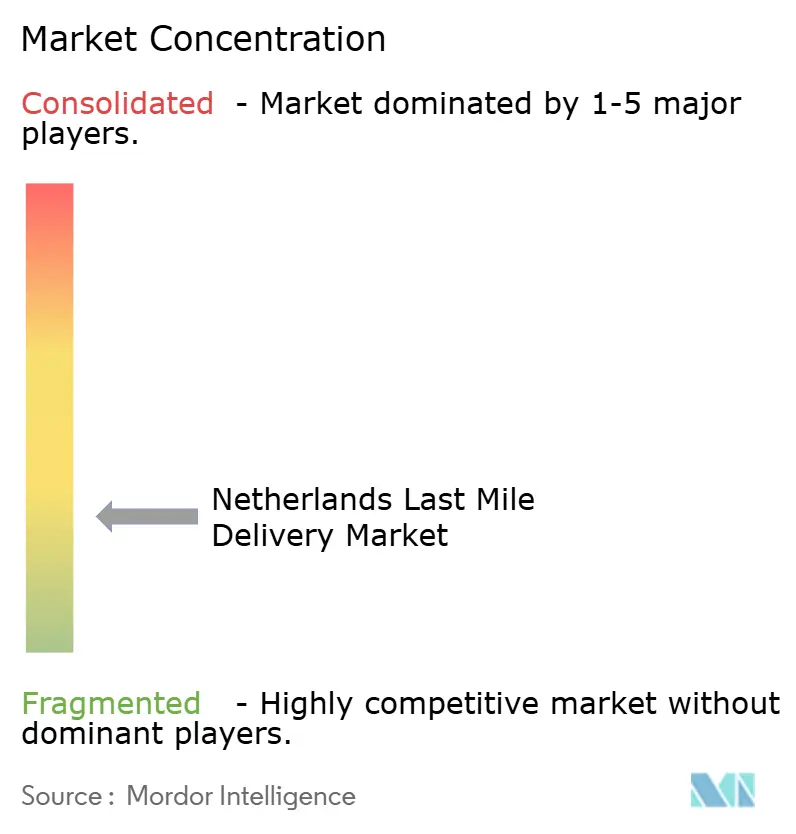
| Market Concentration | Low |
Major Players *Disclaimer: Major Players sorted in no particular order Image © Mordor Intelligence. Reuse requires attribution under CC BY 4.0. | |
Netherlands Last Mile Delivery Market Analysis by Mordor Intelligence
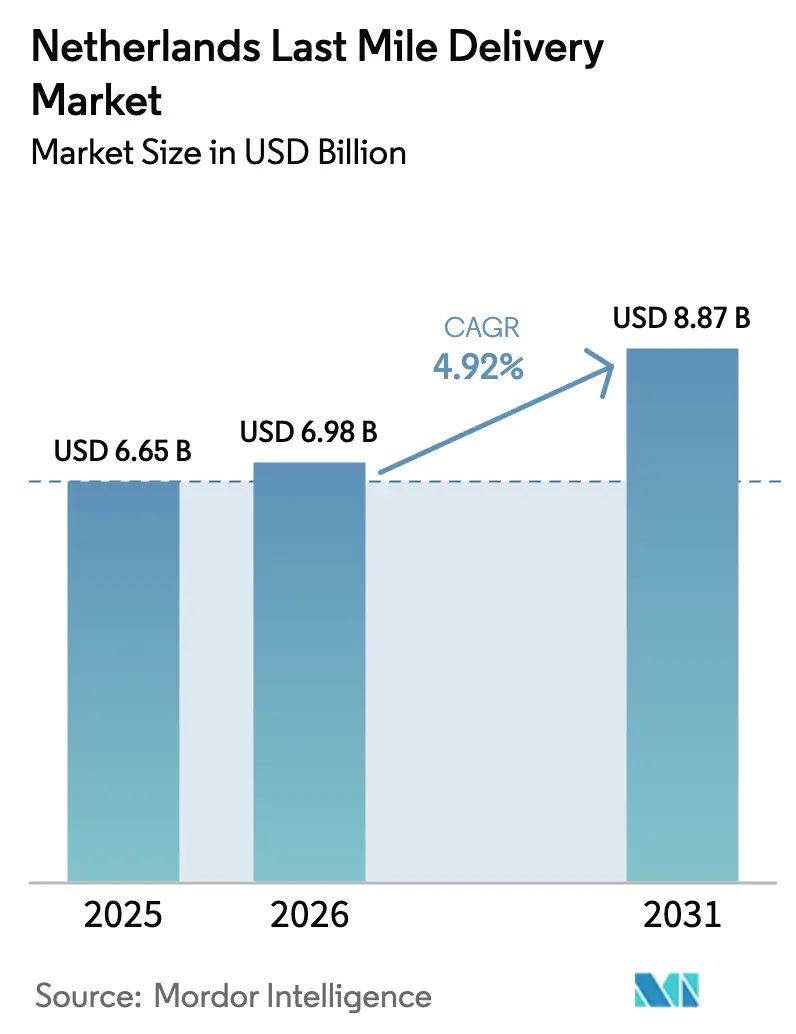
The Netherlands last mile market size was valued at USD 6.65 billion in 2025 and estimated to grow from USD 6.98 billion in 2026 to reach USD 8.87 billion by 2031, at a CAGR of 4.92% during the forecast period (2026-2031). This steady trajectory reflects a maturing delivery ecosystem shaped by emission-free-zone mandates, e-commerce scale effects, and intensifying labor constraints. Operators able to absorb electrification costs, implement route-optimization software, and secure scarce labor are positioned to protect margins while others face structural headwinds. Demand remains volume-dense in the Randstad, yet secondary regions attract new distribution centers because real-estate costs are lower and highway connectivity is strong. A measured rise in higher-value segments such as healthcare logistics signals a pivot from commoditized parcel flows toward premium niches that defend yields.
Key Report Takeaways
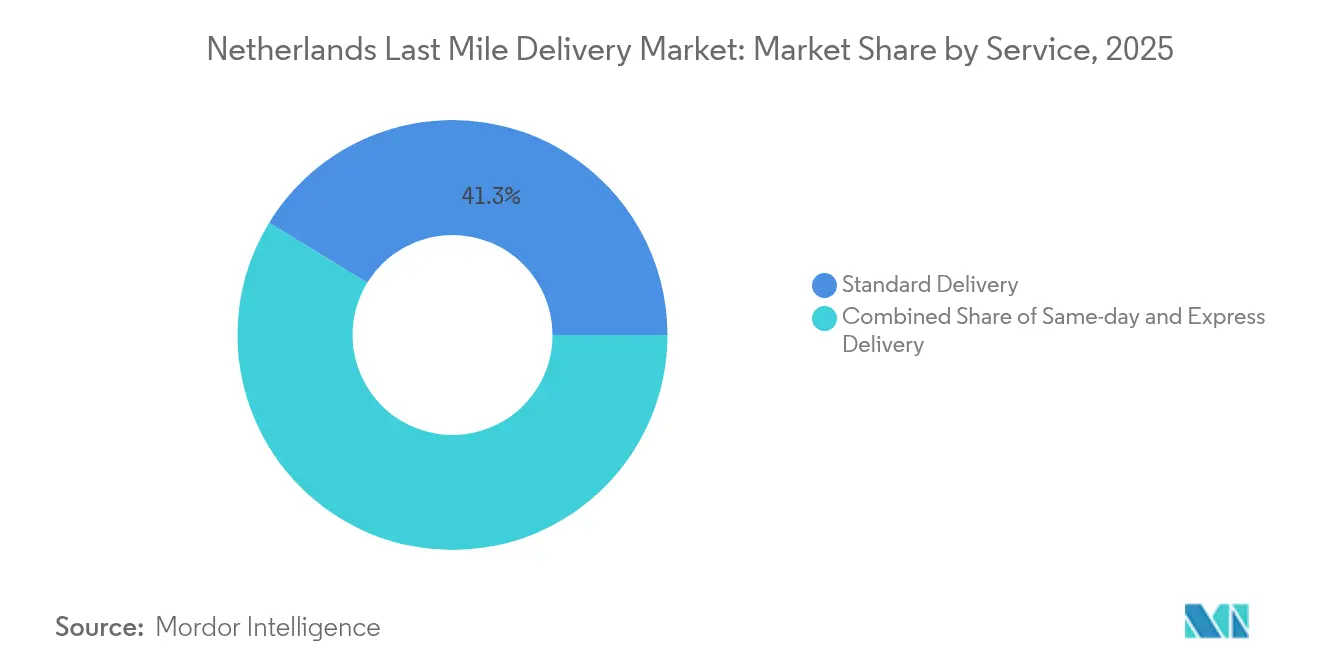
- By service, standard delivery held 41.25% of the Netherlands last mile market share in 2025; same-day delivery is forecast to post a 4.02% CAGR through 2031.
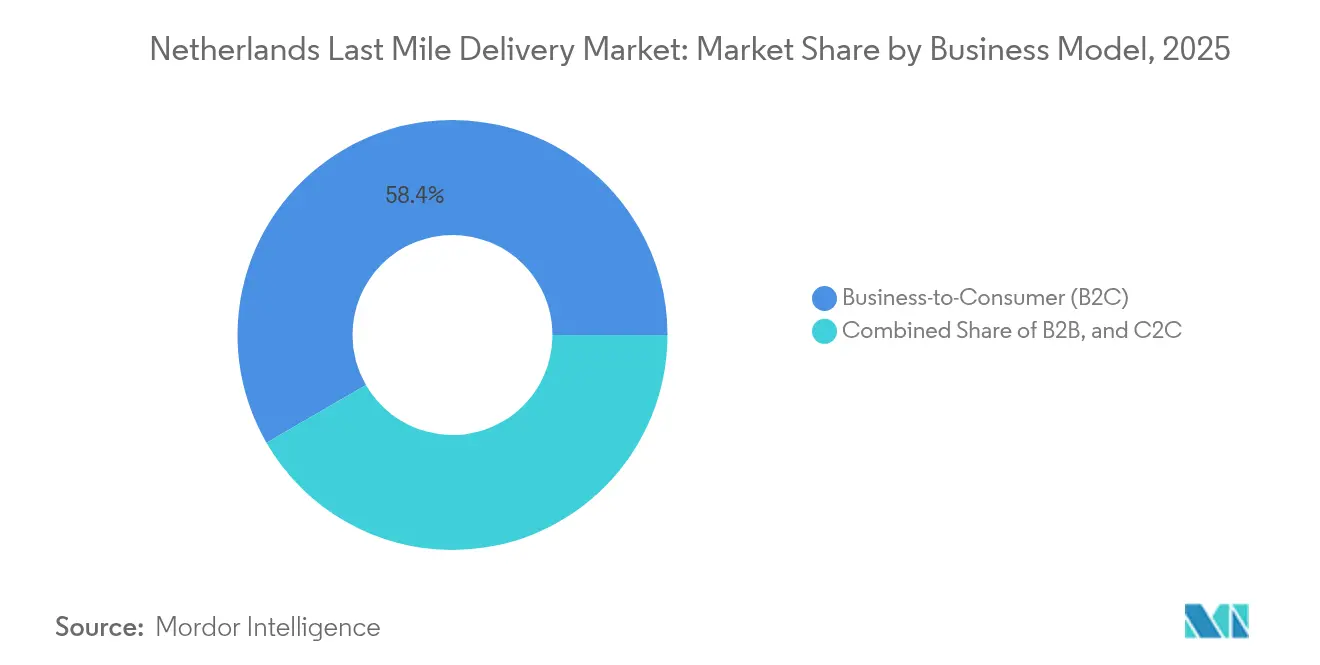
- By business model, the B2C segment commanded 58.35% of the Netherlands last mile market size in 2025, while C2C operations are projected to expand at a 3.78% CAGR between 2026-2031.
- By end-user industry, healthcare & medical supplies accounted for a 4.42% CAGR-the fastest within the Netherlands last mile market over the forecast horizon.
- By region, the Randstad retained a dominant 57.35% revenue position in 2025, but East Netherlands is projected to grow at 4.61% CAGR to 2031.
Note: Market size and forecast figures in this report are generated using Mordor Intelligence’s proprietary estimation framework, updated with the latest available data and insights as of 2026.
Netherlands Last Mile Delivery Market Trends and Insights
Drivers Impact Analysis*
| Driver | (~) % Impact on CAGR Forecast | Geographic Relevance | Impact Timeline |
|---|---|---|---|
| Growing online grocery penetration | +0.8% | National, concentrated in Randstad urban areas | Medium term (2-4 years) |
| Explosive e-commerce parcel volumes | +1.2% | National, with spillover to cross-border flows | Short term (≤2 years) |
| Same-day delivery culture among consumers | +0.6% | Amsterdam, Rotterdam, Utrecht, The Hague | Short term (≤2 years) |
| Government-mandated zero-emission zones | +0.9% | 16 municipalities, rising to 31 by end-2025 | Medium term (2-4 years) |
| Micro-fulfillment & dark-store expansion | +0.5% | Dense urban areas, chiefly Randstad | Long term (≥4 years) |
| Automation to counter rising labor scarcity | +0.7% | National, early pilots in major hubs | Long term (≥4 years) |
| Source: Mordor Intelligence | |||
Growing Online Grocery Penetration
Online grocery’s rapid adoption reshapes fulfillment patterns as Dutch households increasingly include bulky items such as beverages and cleaning supplies in digital baskets. Albert Heijn’s leadership in scheduled home delivery yields parcel density that lowers unit costs for contracted carriers, yet the rise of marketplaces like Amazon and Bol.com fragments routes by adding alternative pick-up addresses. Last-mile providers answer by re-routing electric vans toward micro-hubs near supermarkets and expanding insulated-box capacity to mitigate load-mix challenges. A mid-term lift in revenue stems from recurring weekly food orders that stabilize demand profiles across seasons while strengthening contractual lock-ins with retailers[1].
Explosive E-commerce Parcel Volumes
Dutch online spending reached EUR 36 billion (USD 39.73 billion) in 2024, translating into 345 million transactions even after a modest decline in order count. Higher ticket values improve stop density, allowing vans to average more parcels per drive and improving fuel-adjusted margins. Cross-border demand worth EUR 4.4 billion (USD 4.85 billion) requires harmonized customs pre-clearance, a capability large integrators already possess. Out-of-home channels such as parcel lockers multiplied 1.5× year on year, yet 70-90% of shoppers still insist on doorstep service. Providers therefore couple dynamic routing with predictive demand tools to balance consumer convenience against traffic bottlenecks in dense urban cores.
Same-day Delivery Culture Among Dutch Consumers
Delivery speed is now inseparable from brand perception: 91% of shoppers weigh convenience in purchase decisions, while 75% attach similar importance to speed. The challenge surfaces because willingness to pay premiums lags expectations, compressing yield per stop. Larger operators therefore refine city-hub models that concentrate late-evening cut-offs, letting pick-waves reach 22:00 while maintaining early-morning delivery windows. CityHub sites processing 10,000 + parcels daily offer fixed-route advantages that smaller couriers struggle to replicate[2].
Government-Mandated Zero-Emission City Logistics Zones
Zero-emission zones effective from January 2025 impose EUR 120 fines on non-compliant vans and EUR 310 on trucks once grace periods lapse. PostNL and DHL pre-emptively electrified large shares of fleets, translating regulatory risk into competitive moat. Vehicle turnover accelerates as BPM purchase tax was scrapped on the same date, making once-costly battery vans more attainable. Operators yet to modernize face capital expenditure surges that elevate barriers to entry and catalyze industry consolidation[3].
Restraints Impact Analysis*
| Restraint | (~) % Impact on CAGR Forecast | Geographic Relevance | Impact Timeline |
|---|---|---|---|
| Persistent delivery-cost inflation | -1.1% | National, strongest in large metros | Short term (≤2 years) |
| Urban congestion & curb-space restrictions | -0.6% | Amsterdam, Rotterdam, Utrecht, The Hague | Medium term (2-4 years) |
| Stringent working-hour rules for couriers | -0.4% | National | Long term (≥4 years) |
| Fragmented micro-hub real-estate availability | -0.3% | High-density urban zones | Long term (≥4 years) |
| Source: Mordor Intelligence | |||
Persistent Delivery-Cost Inflation
Fuel volatility, driver wage hikes, and compliance outlays have pushed average European last-mile costs up to 90% since 2023; 35% of Dutch retailers passed fees to shoppers whereas another 35% uplifted product prices. The Dutch postal regulator raised the 2025 universal-service tariff ceiling to EUR 2.9084, underscoring a pass-through mechanism yet highlighting capped upside for parcel rates. Operators with diversified locker networks mitigate home-delivery surcharges, but universal preference for doorstep service limits large-scale migration to cheaper modes.
Urban Congestion and Curb-Space Restrictions
Major Dutch cities enforce timed access windows and vehicle-class bans to mitigate congestion. Couriers respond with cargo bikes and sidewalk robots, yet deployment scales slowly given limited curb allocation and uncertain consumer adoption. Each restriction compresses routing flexibility, forcing denser load consolidation that lengthens cycle times and risks same-day SLAs. Operators owning proprietary locker grids secure partial relief, while smaller firms reliant on on-street stops face schedule slippage and rising parking penalties.
*Our forecasts treat driver/restraint impacts as directional, not additive. The impact forecasts reflect baseline growth, mix effects, and variable interactions.
Segment Analysis
By Service: Standard Delivery Retains the Bulk of Demand
Standard delivery captured 41.25% revenue share in 2025, anchored by predictable two-day expectations and favorable vehicle utilization rates. The Netherlands last mile market size for this tier eclipses that of faster segments by monetizing wide urban and rural coverage without premium surcharges. Same-day demand is ramping at a 4.02% CAGR on the back of urban consumer impatience, yet operators protect profitability by slotting these parcels into end-of-run consolidation waves. Express delivery maintains a stable mid-single-digit slice, primarily serving B2B time-critical flows where service guarantees justify higher fees.
Operators leaning on standard delivery optimize asset turns through consolidated milk-run routing, often integrating parcel lockers that cut failed-delivery rates below 4%. Meanwhile, growth in same-day is funneled through city-hubs equipped with electric vans and cargo bikes that navigate zero-emission zones seamlessly. The twin-track approach enables carriers to hedge margin dilution risk while maintaining competitive parity on service speed.

By Business Model: B2C Dominance Faces Platform-Economy Upstarts
B2C flows accounted for 58.35% of 2025 revenue as large online retailers lock in multi-year capacity deals that underpin network investments. The Netherlands last mile market share advantage here pays for upgrading depots with automated sorters and AI-powered dispatch. Simultaneously, C2C volumes are growing fastest at 3.78% CAGR, fueled by peer-to-peer resale platforms that rely on pick-up-drop-off points more than doorstep handovers. B2B traffic, while mature, still supports above-average yields because business clients demand fixed delivery windows.
Traditional carriers now test hybrid networks whereby a single van collects C2C return parcels during B2C rounds, trimming empty-run kilometers. Gig-platform partnerships expand off-peak capacity and provide variable-cost labor, a hedge against seasonality. Over 2026-2027, C2C density improvements could narrow cost gaps, prompting incumbents to integrate API-based booking directly into resale platforms to secure volume before agile micro-couriers enter the race.
By End-User Industry: Healthcare Leads Premium Shift
E-commerce retail held 26.85% share, underpinning volume stability, yet healthcare & medical supplies grew at the fastest 4.42% CAGR on specialized cold-chain requirements. The Netherlands last mile market size opportunity in healthcare commands premium per-parcel pricing that can be 2-3× higher than general merchandise, offsetting costs of GDP-compliant packaging and temperature-controlled vans. Fashion, electronics, and beauty segments fill idle capacity across seasons, contributing to balanced fleet utilization.
Specialized operators such as PharmaSwap coordinate medicine redistribution under strict traceability, partnering with temperature-controlled fleets operated by UPS Healthcare. The barrier to entry created by compliance audits shields margins from commoditization. For general carriers, strategic alliances with pharmaceutical wholesalers provide a springboard into this resilient niche without diluting network efficiency.
Geography Analysis
The Randstad remains the nerve center of the Netherlands last mile market, capturing 57.35% of 2025 turnover owing to dense household clusters and robust purchasing power. Zero-emission-zone enforcement from 2025 increases capital intensity but also entrenches incumbents that already electrified vans and installed parcel lockers at supermarkets and rail stations. Consumer behavior underscores high service expectations: 91% rate convenient delivery as essential, while 70% demand multiple option choices, pushing carriers to blend cargo-bike loops with evening locker drops.
East Netherlands is poised for the strongest 4.61% CAGR, supported by province-backed logistics parks and proximity to the German consumer base. Facilities like UPS’s Roermond megacenter and Eindhoven campus attract overflow from crowded Randstad depots, reducing land costs per square meter by up to 25%. Cross-border flows amplify parcel counts, enabling carriers to spread fixed costs across larger volumes and accelerate payback on automation.
North and South Netherlands function as balancing nodes for nationwide line-haul, providing redundancy against Randstad bottlenecks. Southern provinces benefit from deep-water port access, connecting to Antwerp and Rotterdam for inbound containers. Northern provinces supply lower-cost land for secondary sort centers, ensuring carriers can stage overflow during holiday peaks. Collectively, these regions reinforce a multi-hub network that sustains service-level agreements even under urban access constraints.
Regulatory Landscape
The Netherlands last-mile delivery sector is being reshaped by city logistics rules and transport pricing measures. Zero-emission (ZE) zones began taking effect in January 2025, with tighter access rules for newly registered vans (registered on or after January 1, 2025) that must be zero-emission to enter designated ZE zones. Access transition periods for Euro 5 and Euro 6 vans extend through December 31, 2026 and December 31, 2027, respectively, across a broad municipal footprint. These local restrictions sit alongside national oversight elements affecting postal and parcel networks, including the Autoriteit Consument and Markt (ACM) role in assessing changes to the Postwet 2009, which is under review for universal postal service continuity and access to the national network.
Cost and compliance dynamics also shift with road-user charging. A truck toll (vrachtwagenheffing) for vehicles above 3,500 kg starts July 1, 2026, covering highways and selected provincial/municipal roads, adding a measurable cost lever to trunk and urban replenishment legs that feed last-mile operations. In May 2026, the Ministerie van Infrastructuur en Waterstaat approved a temporary lower toll-rate decision effective September 1, 2026 through December 31, 2026, reflecting political attention to transport-sector cost pressure while keeping the direction toward pay-per-use road charging.
Value Chain Analysis
The Netherlands last-mile value chain typically follows a collect-sort-deliver operating model: shipments are injected from e-commerce retailers, marketplaces, grocers, and B2B shippers into carrier networks for collection, line-haul to depots, sorting, and final delivery to homes, businesses, or out-of-home points, such as retail pick-up points and automated parcel locations. In dense Randstad corridors, operators increasingly structure flows around city hubs near ZE-zone boundaries, where freight is transferred from heavier vehicles to light electric vans, cargo bikes, or other low-emission modes to complete inner-city drops under access restrictions.
Network utilization and failed-delivery reduction are key value-creation levers. PostNL has positioned its parcel locker network as shared infrastructure by opening access to other carriers (2024), supporting higher drop density and fewer re-attempts as consumer preference still skews toward convenient delivery options. Service design is also moving from a pure next-day mindset toward more flexible best-day planning to protect margins, using routing software, time-window management, and out-of-home delivery integration to balance labor constraints, congestion, and ZE-zone compliance.
Competitive Landscape
PostNL controls around 60% of domestic volume through its universal-service mandate and dense locker grid. DHL follows with roughly 35%, leveraging its international road feeder network and AI-augmented CityHub model to achieve late cut-offs. DPD secures about 5%, leaning on cross-border e-commerce lanes into Germany and France. Market leaders convert early electrification into a durable edge, as smaller couriers face steep capital outlays to acquire compliant fleets.
Industry consolidation is noteworthy: 2024 saw major Benelux logistics M&A deals at 10.4× EBITDA multiples, underscoring investor appetite for dense last-mile networks. Technology adoption is a focal point-DHL’s 2025 roadmap integrates computer vision and audio AI, while emerging players like Trunkrs deploy adaptive sortation that scales for peak events without full-time labor. Niche entrants target healthcare logistics, cold-chain food, and C2C returns, areas where agility and specialization can justify premium pricing.
Competition increasingly revolves around out-of-home coverage, data-driven route orchestration, and regulatory preparedness. Firms able to deliver on all three fronts secure long-term contracts with large retailers, stabilizing cash flows and funding continuous fleet upgrades. Those lagging risk attrition as retailers migrate to carriers offering transparent carbon reporting and service diversity.
Netherlands Last Mile Delivery Industry Leaders
-
PostNL
-
DPD
-
UPS
-
DHL Express
-
FedEx
- *Disclaimer: Major Players sorted in no particular order
Market Opportunities and Future Outlook
Regulatory and public-program funding creates near-term whitespace around compliance-efficient urban delivery models and data-enabled orchestration. The government Impulsprogramma Goederenvervoer allocates EUR 79 million for 2026-2028 for logistics measures, including modal shift and digital infrastructure, and includes EUR 43 million earmarked for truck-parking realization. Together, these initiatives support operational resilience for carriers by improving upstream staging capacity and enabling cleaner, better-planned replenishment into city-periphery hubs. As ZE-zone rules tighten for newly registered vans from 2025, demand concentrates around fleet electrification, depot charging, and transfer-hub operations that reduce non-compliant kilometers in city centers.
Interoperability in out-of-home and digital handover processes also offers a practical scale advantage, particularly where shared networks matter more than proprietary footprints alone. PostNL's decision to open its parcel locker network to other carriers (2024), along with subsequent moves to expand shared locker infrastructure with large municipalities, points to an industry shift toward open-access drop points and standardized operating processes across dense urban areas. In parallel, the Groeifonds program focus on Digitale Infrastructuur Logistiek provides an anchor for data-exchange standards between private and public stakeholders, supporting routing, curb/zone compliance, and proof-of-delivery processes that reduce friction in multi-carrier delivery ecosystems.
Recent Industry Developments
- July 2026: PostNL transitions to delivering standard letterbox mail within two delivery days (effective July 12, 2026). The revision raises service speed expectations in the Netherlands last mile and reshapes city-coverage planning. It also pressures peers to close speed gaps and improve reliability.
- July 2026: PostNL transitions to delivering standard letterbox mail within two delivery days, down from previous standards, effective July 12, 2026. The updated benchmark changes city coverage planning and puts additional emphasis on speed and reliability across the local network. Incumbents adjust operations to maintain comparable performance levels.
- February 2026: PostNL signs a sustainable parcel logistics agreement with the four largest Dutch municipalities to expand shared parcel locker networks. The deal expands urban last-mile infrastructure and increases locker utilization, supporting more consistent out-of-home delivery. It also reinforces city logistics logic compliance and improves network efficiency.
Research Methodology Framework and Report Scope
Market Definition and Coverage
This market covers the value of last mile delivery services within the Netherlands, meaning transport and handover from a local distribution point to the final receiver at home, work, or a pickup location.
Scope exclusions: International linehaul, cross-border forwarding, and long-haul middle mile transport are excluded from this market sizing.
Segmentation Overview
- By Service
- Standard Delivery
- Same-day
- Express Delivery
- By Business Model
- Business-to-Business (B2B)
- Business-to-Consumer (B2C)
- Customer-to-Consumer (C2C)
- By End-user Industry
- E-commerce Retail
- Fashion and Lifestyle
- Beauty, Wellness and Personal Care
- Home and Furniture
- Consumer Electronics and Appliances
- Healthcare and Medical Supplies
- Others
- By Region (Value)
- Randstad
- North Netherlands
- East Netherlands
- South Netherlands
Data Sources, Market Sizing, and Validation
Desk Research
Desk work sets the base for our model by clarifying demand signals, operating conditions, and how the Netherlands delivery network is evolving. We relied on public, non-paywalled sources such as Statistics Netherlands (CBS) for population and economic indicators, Eurostat for cross-checking macro series, and the European Commission for policy direction that influences urban access and emissions.
On the logistics side, we referenced sources such as the Netherlands Enterprise Agency (RVO) for sustainability programs and Dutch government publications for mobility and city logistics measures. We also used peer-reviewed transport and urban logistics research to anchor typical route and delivery patterns. Company annual reports, investor decks, and reputable press were used to track capacity moves and service positioning, and selective paid subscriptions for company financials and news helped standardize time series and confirm ownership changes. This list is not exhaustive, and we used additional sources to collect data, validate assumptions, and clarify open questions during research.
Primary Interviews and Surveys
Primary work was used to pressure-test what desk sources cannot fully show, especially observed pricing behavior, delivery density differences, and how the service mix is shifting between standard, express, and same-day options. We spoke with operators, shippers, and retail and e-commerce logistics managers, plus local experts across major demand centers and secondary towns. Where respondent views differed, we reconciled the inputs so the final model stays realistic.
Distribution of primary research fieldwork respondents
| Company type | Respondent position |
|---|---|
| Top tier: 33% | CXOs: 12% |
| Mid tier: 53% | Functional/Unit leaders: 41% |
| Smaller Players: 14% | Managers: 47% |
Market-Sizing & Forecasting
Sizing starts from a top-down build where the delivery demand pool is reconstructed using Netherlands e-commerce activity and shipment intensity. We then adjust for service mix and typical spend per delivery. Finally, we check the results through selective bottom-up approximations using sampled operator revenues, channel checks on average delivery fees, and volume-to-value conversions, so totals do not drift away from what the market can practically bill.
Key inputs in the model include parcel and consignment volumes, household online shopping penetration, urban delivery density (which affects drops per route), fuel and labor cost direction, and the adoption pace of low-emission delivery solutions in cities. Where company-level reporting is incomplete, we handle gaps using peer benchmarks and scaling factors that we validate in interviews, then apply them consistently across similar operator types.
For forecasting, we use scenario analysis to reflect how growth changes under different assumptions for e-commerce order growth, labor availability, and policy-driven access limits in city centers. After expert feedback is consolidated, we select a central case. Yearly projections are kept in USD using consistent conversion timing, and price progression is aligned with what shippers and operators described as acceptable pass-through under typical contract cycles.
Data Validation & Update Cycle
Validation is done by triangulating model outputs against independent signals such as macro consumption trends, logistics activity indicators, and observed pricing direction, then checking whether implied revenue per delivery looks reasonable. We review outliers in a second pass, and if a variance cannot be explained by service mix or geography, we trigger follow-up calls to re-check the assumption.
Before sign-off, the model is reviewed in steps so inputs, calculations, and narrative conclusions stay aligned, and so the same logic can be repeated when new data comes in. Reports refresh annually, with interim updates when material events occur, and a final pre-delivery review is completed so clients receive the latest updated view.
Mordor Intelligence's Netherlands Last Mile Delivery Market Size Compared With Other Published Estimates
Published market sizes for last mile delivery in the Netherlands often vary because each publisher sets a slightly different service boundary, uses different price assumptions, and updates inputs at different times. We highlight these gaps so readers can map each number back to what is actually being counted.
International linehaul and cross-border forwarding are often blended into some published totals, but they sit outside Mordor Intelligence's scope for this last mile view. That choice keeps the value tied to in-country final-leg delivery activity. Differences also come from how express and same-day surcharges are averaged, whether returns and redelivery attempts are valued separately, and whether the estimate reflects a central scenario versus an aggressive e-commerce growth case.
Benchmark comparison
| Source | Market Size | Gaps in Research Methodology |
|---|---|---|
| Mordor Intelligence | USD 6.65 B (2025) | |
| Industry Association A | USD 7.30 B (2025) | Uses a wider logistics spend lens that can pull in non-last-mile legs and broader handling charges, which increases the total versus a final-leg-only service definition. |
| Global Consultancy B | USD 6.10 B (2025) | Applies conservative price per stop assumptions and assumes faster productivity gains (more drops per route), which compresses value even when shipment volumes are similar. |
The spread across sources mainly comes from what is counted as last mile activity and how delivery pricing is converted from volume to value. By keeping the build traceable to the demand pool, service mix, and realistic revenue per delivery checks, the estimate stays balanced and repeatable even when individual inputs move year to year.
Key Questions Answered in the Report
How big is the Netherlands last mile segment in 2026?
The Netherlands last mile market size is USD 6.98 billion in 2026 with a forecast to reach USD 8.87 billion by 2031.
What growth rate is expected through 2031?
The market is projected to expand at a 4.92% CAGR.
Which service tier is expanding fastest?
Same-day delivery is growing at a 4.02% CAGR, driven by urban consumer expectations for rapid fulfillment.
Which end-user industry shows the strongest upside?
Healthcare & medical supplies leads with a 4.42% CAGR due to temperature-controlled and compliance-dependent deliveries.
How will zero-emission zones influence carrier strategies?
Early fleet electrification gives incumbents an advantage while late adopters face fines and accelerated capital expenditure to comply with 2025 regulations.
What region outside the Randstad offers notable growth?
East Netherlands is forecast to register a 4.61% CAGR, supported by lower land costs and proximity to Germany.