
Market Overview
| Study Period | 2019 - 2031 |
|---|---|
| Market Size (2026) | USD 15.44 Billion |
| Market Size (2031) | USD 23.23 Billion |
| Growth Rate (2026 - 2031) | 8.51 % |
| Fastest Growing Market | Asia Pacific |
| Largest Market | North America |
| Market Concentration | Medium |
Major Players *Disclaimer: Major Players sorted in no particular order Image © Mordor Intelligence. Reuse requires attribution under CC BY 4.0. | |
Motor Home Market Analysis by Mordor Intelligence
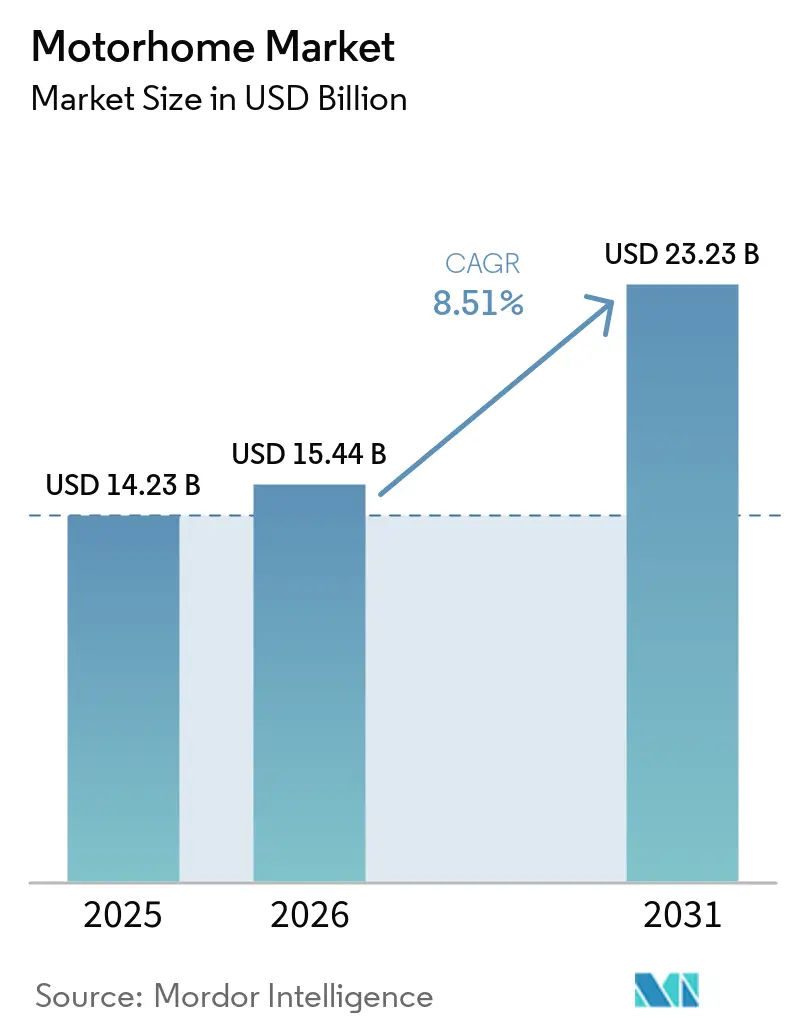
The Motor Home Market size is expected to grow from USD 14.23 billion in 2025 to USD 15.44 billion in 2026 and is forecast to reach USD 23.23 billion by 2031 at an 8.51% CAGR over 2026–2031. This growth rests on three structural pillars: flexible remote-work policies that enable longer leisure trips, aging households with sizable nest eggs, and a lasting preference for private lodging following the pandemic. North America remains a significant contributor to global revenue. However, the Asia-Pacific region is driving growth, supported by increased campground construction in China and regulatory changes in Japan that favor longer vehicles. Diesel propulsion continues to dominate the market, but electric drivetrains are rapidly gaining traction as battery pack prices decline and approach cost parity with internal combustion models. OEMs are optimizing inventory levels, leading to lower dealer stock levels in the United States. This approach has helped stabilize wholesale shipments and maintain margin discipline.
Key Report Takeaways
- By motorhome class, Class C units led with 46.26% global share in 2025, while luxury Class A models are projected to post a 9.32% CAGR through 2031.
- By end user, individual owners commanded 60.28% of the 2025 demand, whereas rental fleets are expected to expand at a 9.09% CAGR through 2031.
- By propulsion, diesel engines retained 72.16% of the 2025 total, yet electric powertrains are growing at an 18.20% CAGR through 2031.
- By price range, mid-range units accounted for 49.31% of 2025 sales, while premium models posted a 10.28% CAGR over the forecast period.
- By geography, North America accounted for 47.71% of 2025 revenue, but the Asia-Pacific region is growing at an 8.72% CAGR toward 2031.
Note: Market size and forecast figures in this report are generated using Mordor Intelligence’s proprietary estimation framework, updated with the latest available data and insights as of January 2026.
Market Trends and Insights
Drivers Impact Analysis of Motor Home Market*
| Driver | (~) % Impact on CAGR Forecast | Geographic Relevance | Impact Timeline |
|---|---|---|---|
| Remote Van-Life Trend | +1.8% | North America and Europe core; spill-over to Asia-Pacific | Short term (≤ 2 years) |
| Private Travel Preference | +1.5% | Global; strongest in developed markets | Short term (≤ 2 years) |
| Boomer RV Demand | +1.4% | North America and Europe; emerging in Asia-Pacific | Long term (≥ 4 years) |
| RV Tourism Growth | +1.2% | Global; early gains in North America and Europe | Medium term (2-4 years) |
| EV Chassis Cost Parity | +1.1% | Global; led by North America and Europe | Medium term (2-4 years) |
| RV-as-a-Service Models | +0.9% | North America and Europe; expanding to Asia-Pacific cities | Medium term (2-4 years) |
| Source: Mordor Intelligence | |||
Growing RV-Centric Tourism Ecosystems
Private operators and public agencies are enhancing amenities such as electrical hookups, Wi-Fi, and dump stations to meet the growing demand for RV vacations. Kampgrounds of America has observed a notable increase in baby-boomer campers, with this demographic now representing a significant portion of all guests [1]. Germany has seen a surge in registrations, driven by the continued opening of new parks in popular regions. In Japan, regulatory changes have allowed larger coaches on expressways, facilitating the import of premium RV models. Improved amenities have shortened campground payback periods in high-traffic corridors, creating a cycle that drives further infrastructure development.
Rising Adoption of Remote-Work Van-Life Lifestyles
The number of digital nomads has significantly increased, with a notable rise in RV households featuring at least one full-time remote worker. Younger professionals are driving demand for features such as ergonomic desks, cellular boosters, and large lithium battery banks. Starlink's antenna and monthly plan have become common additions, ensuring reliable video conferencing even in remote locations [2]. With living costs substantially lower than those in major cities, the lifestyle offers a strong financial appeal. In response, OEMs are integrating advanced systems, solar roofs, and slide-out workstations, effectively transforming RVs into mobile offices.
Post-Pandemic Preference for Private Travel Modes
A significant portion of campers are choosing RV journeys, with first-time owners forming a growing share of the fleet compared to previous years. Motorhome rentals are experiencing steady growth, driven by peer-to-peer marketplaces that make entry into the market more accessible. The number of households showing interest in RV ownership is notably higher than the current ownership base, indicating strong future demand as financing conditions improve. Entry-level Class C units, designed with simplified layouts and factory-installed solar systems, cater to these potential buyers by reducing initial ownership challenges.
OEM Electrified Chassis Platforms Hitting Cost Parity
Lithium-iron-phosphate cells have become more cost-effective, with ongoing efforts to further reduce prices. Thor Industries and Harbinger Motors introduced a prototype chassis with promising advancements in range per charge. LFP chemistry offers high cycle life and enhanced safety by mitigating fire risks, although its energy density still lags behind the target set for diesel equivalency. Public–private programs aim to expand charging infrastructure along Interstate corridors, addressing concerns about range anxiety.
Restraints Impact Analysis of Motor Home Market*
| Restraint | (~) % Impact on CAGR Forecast | Geographic Relevance | Impact Timeline |
|---|---|---|---|
| High RV Prices and Financing Sensitivity | -1.8% | Global; most acute in North America and Europe | Short term (≤ 2 years) |
| Service Gaps in Emerging Regions | -1.2% | Asia-Pacific emerging markets; Middle East and Africa; South America | Medium term (2-4 years) |
| Battery Range vs. Weight Trade-Offs | -0.9% | Global; early electric-adoption regions | Medium term (2-4 years) |
| Stricter Campsite Emission Rules | -0.7% | North America and Europe; spreading to Asia-Pacific | Long term (≥ 4 years) |
| Source: Mordor Intelligence | |||
High Retail Prices and Interest-Rate Sensitive Financing
Motorhome loans often come with long-term commitments and significant down payments, leaving buyers exposed to fluctuations in Federal Reserve rate policies. An increase in interest rates can substantially raise monthly payments, making it challenging for price-sensitive households to afford these loans. Prime lending primarily favors individuals with strong credit scores, while subprime borrowers face higher annual percentage rates, further widening the affordability gap. Dealers are addressing this by extending loan terms for luxury coaches, but this strategy increases the risk of negative equity for owners who trade in before the loan term ends. Entry-level Class C units are being simplified by removing non-essential features to maintain affordability and ensure eligibility for conventional RV financing.
Service-Infrastructure Shortages Outside Developed Regions
In India and Brazil, the lack of authorized repair networks outside North America and Western Europe is driving down resale values. A battery pack can constitute a significant portion of a vehicle's gross weight, thereby reducing its payload capacity. While solid-state cells show promise, widespread adoption remains a challenge. Generator curfews, like those in Washington State Parks that limit usage to specific time frames, are becoming more common. These curfews effectively push for the adoption of lithium house batteries and solar roofs [3]. In Yosemite, certain sites have outright bans on generators, a move echoed by European preserves, leading to increased compliance costs for traditional owners.
*Our forecasts treat driver/restraint impacts as directional, not additive. The impact forecasts reflect baseline growth, mix effects, and variable interactions.
Motor Home Market Segment Analysis
By Motorhome Class:
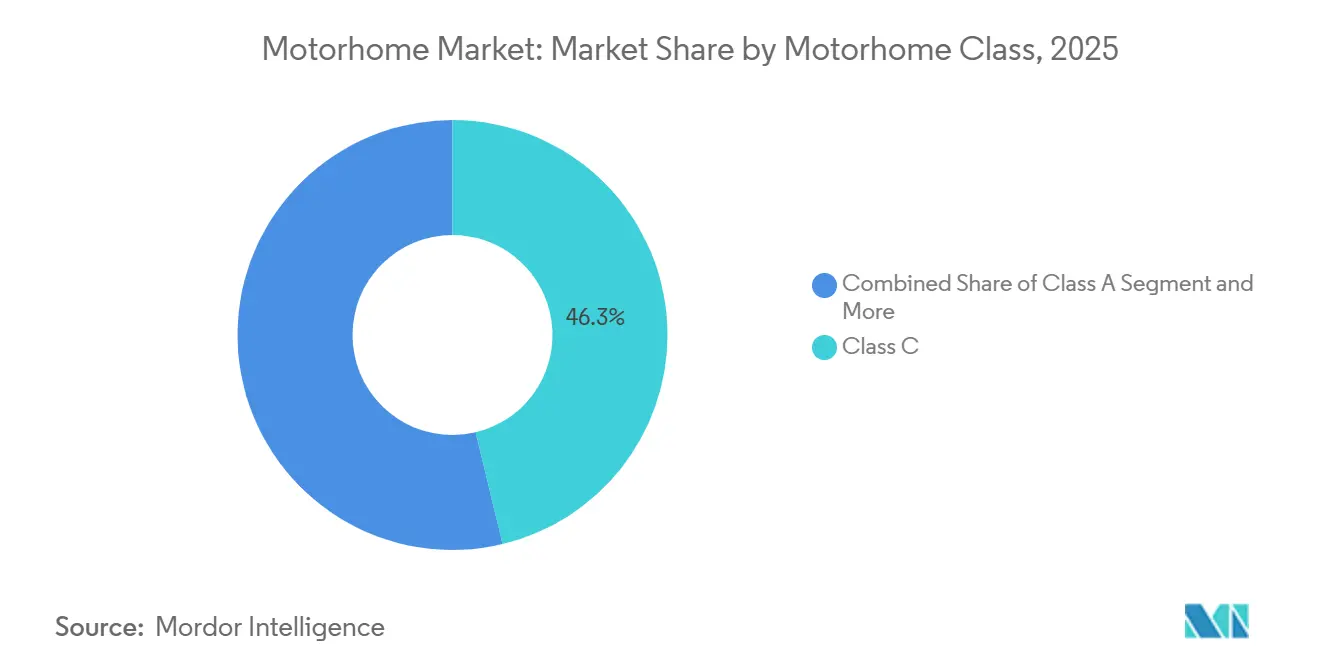
Luxury Drives Premium GrowthClass C units commanded a 46.26% share of global deliveries in 2025, underpinned by 6- to 8-berth layouts that easily navigate 35-foot park limits. This slice of the Motor Home Market is favored by families seeking maneuverability and acceptable insurance premiums. Luxury Class A coaches, while smaller in volume, are projected to grow at a 9.32% CAGR as affluent retirees upgrade from towables. Manufacturers are enhancing differentiation with advanced systems and solar arrays, enabling the off-grid operation of rooftop air conditioners in response to tightening generator regulations. While Compact Class B vans cater to urban buyers seeking stealth parking and daily usability, their high pricing limits broader market penetration.
Developments in the second row are equally significant. Class C builders are now standardizing on innovative house batteries, reducing weight and extending autonomy. Meanwhile, Class B converters introduce pop-top roofs and slide-out galley areas, boosting headroom while staying within parking garage height limits. Luxury Class A models, equipped with smart-home suites that integrate with virtual assistants, not only echo home comfort standards but also maintain their premium pricing amidst ongoing economic challenges.

By End User:
Individual Ownership Dominates, Rentals SurgeRetail buyers accounted for 60.28% of the 2025 volume, reflecting cultural preferences for customization and flexible travel schedules. Yet rental fleets are expanding faster, tracking a 9.09% CAGR through 2031 as digital marketplaces mainstream short-term access to high-ticket assets. The motorhome rental market is experiencing significant growth, driven by increased platform-provided liability coverage that reassures owners and high daily utilization rates, which enhance fleet ROI.
First-time buyers now account for a substantial portion of new registrations, with a younger demographic emerging compared to repeat purchasers. A large number of households expressing interest in motorhomes are expected to convert as financial conditions become more favorable. To address this demand, OEMs are offering features such as plug-and-play solar systems, video tutorials, and simplified plumbing layouts to reduce the learning curve. Fleet operators are also leveraging bulk discounts on large orders of Class C motorhomes, targeting corporate events and film crews, thereby maintaining consistent production levels.
By Propulsion Type:
Diesel Dominance Erodes as Electric Gains TractionDiesel power held 72.16% of the 2025 units due to its torque and long-haul efficiency; however, electric drivetrains are advancing at an 18.20% CAGR through 2031. Battery prices are steadily declining, and the expansion of public charging infrastructure remains a critical driver for market growth. A prototype chassis demonstrates significant range potential, and advancements in fast-charging technology are expected to further boost adoption. Gasoline engines continue to appeal to entry-level Class C buyers due to their affordability and widespread availability of service. However, they face limitations due to lower fuel efficiency and stricter emissions regulations.
Weight remains a significant challenge, as heavy battery packs can substantially reduce payload capacity, necessitating compromises between range and cargo capacity. Solid-state technology holds the potential to significantly enhance energy density; however, its commercial viability is not expected within the current forecast period. Diesel vehicles are under increasing regulatory pressure, with stricter standards diminishing their cost advantages over time.

By Price Range:
Mid-Range Volume, Premium GrowthMid-tier vehicles, priced at USD 100,000–200,000, accounted for 49.31% of 2025 sales, representing the economic center of gravity for the Motor Home Market. Premium models above USD 200,000, however, are expanding at a 10.28% CAGR as downsizing homeowners channel property gains into luxury rolling residences. First-time buyers and rental fleets are drawn to economy variants. However, these budget-friendly options often skimp on cabinetry and insulation, leading to faster depreciation.
Technology plays a pivotal role in differentiating market tiers. Premium coaches, equipped with voice-activated lighting, residential-grade appliances, and multiplex wiring systems, command higher price tags. Mid-range models are now standardizing lithium house batteries, rendering AGM units nearly obsolete. To maintain affordability, entry-level models forgo slide-outs and decorative trims.
Geography Analysis
North America Motor Home Market
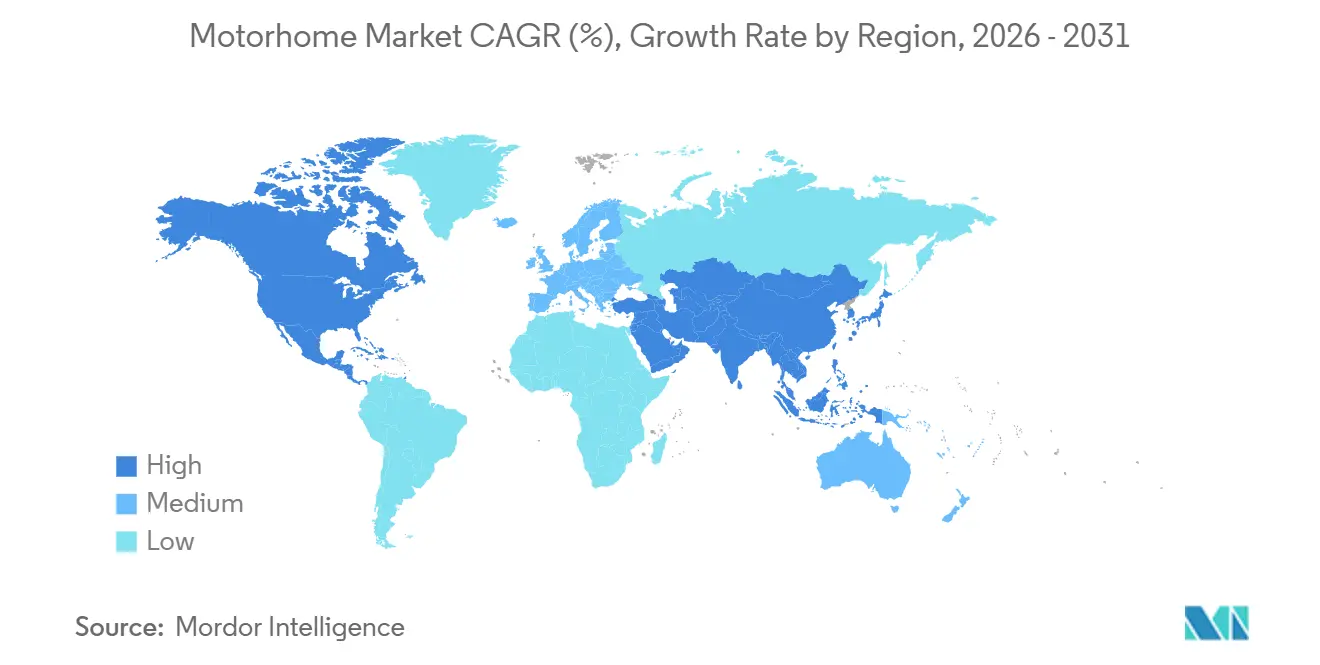
North America accounted for 47.71% of 2025 revenue from U.S. wholesale shipments, which have declined due to inventory corrections. However, retail demand is stabilizing, supported by steady financing and an increasing number of younger, first-time buyers. With a significant number of RV-owning households and numerous campgrounds nationwide, the U.S. market remains strong. In Canada, regions like British Columbia and Alberta are enhancing amenities such as hookups and dump stations to attract retirees relocating from urban areas.
APAC Motor Home Market
The Asia-Pacific region is the fastest-growing, with an 8.72% CAGR. Japan's reform allowing longer coaches on expressways has prompted local manufacturers, such as Annex, to increase production. Meanwhile, China's State Council has allocated subsidies to campgrounds in key regions, positioning RV tourism as a significant leisure focus. In India, the market is still developing, but a growing middle class and improved highway infrastructure are expected to drive future demand.
Europe Motor Home Market
Europe remains a mature yet dynamic market, with Germany leading due to the opening of new year-round parks in popular regions. Low-emission zones in major cities like London and Paris are encouraging buyers to opt for compact Class B vans, which are better suited for urban environments. Coastal tourism is driving rental-fleet growth in Italy and Spain, while Eastern Europe benefits from lower shipping costs enabled by new manufacturing facilities in the region.
South America, Middle East and Turkey Motor Home Market
South America and the Middle East are still in the early stages of market development. In Brazil, import tariffs continue to drive up prices, but local producers are offering more affordable entry-level models. The United Arab Emirates and Saudi Arabia are investing in desert campgrounds to diversify their tourism offerings. Turkey is attracting OEMs with favorable tax policies, aiming to position itself as a key export hub for Europe.
Competitive Landscape
Market concentration remains moderate. The top five OEMs - Thor, Winnebago, Forest River, REV Group, and Erwin Hymer - command a significant share of the capacity in North America and Europe, creating opportunities for regional specialists. Thor has experienced a decline in sales, but dealer inventory normalization suggests an improvement in sell-through. Winnebago has also faced revenue challenges. However, its recent expansion is set to enhance production capacity and introduce advanced assembly lines.
Vertical integration is a dominant trend, as major players are acquiring chassis and component suppliers to mitigate supply risks that had previously inflated costs. Thor’s collaboration with Harbinger positions it as a frontrunner in the emerging electric segment. Simultaneously, Winnebago is integrating lithium and smart-home systems as standard features to reclaim market share. Outdoorsy’s recent funding highlights a significant capital shift towards asset-light rental models. This trend is nudging OEMs to develop their own proprietary subscription services. Meanwhile, disruptors like Harbinger Motors are advocating for swappable battery modules. At the same time, Leisure Travel Vans is carving out a niche in urban-friendly Class B vehicles, underscoring the ongoing fragmentation beyond the industry's top tier.
Motor Home Industry Leaders
-
Thor Industries, Inc.
-
Winnebago Industries, Inc.
-
Forest River, Inc.
-
BÜRSTNER GMBH & CO. KG
-
REV Group
- *Disclaimer: Major Players sorted in no particular order

Motor Home Market Companies Covered in this Report
- Thor Industries Inc.
- Winnebago Industries Inc.
- Forest River Inc.
- REV Group
- Erwin Hymer Group
- Jayco Inc.
- Tiffin Motorhomes Inc.
- Coachmen RV
- Newmar Corporation
- Leisure Travel Vans
- Dethleffs GmbH
- Hobby-Wohnwagenwerk
- Burstner GmbH & Co. KG
- Trigano S.A.
- Knaus Tabbert AG
Recent Industry Developments in Motor Home Market
- July 2025: Uber has expanded its Intercity service to include over 3,000 routes nationwide. In a parallel move, the company has introduced exclusive Motorhomes in the Delhi NCR region. These initiatives aim to enhance comfort and convenience for long-distance travelers, underscoring Uber's commitment to pioneering tech-driven road-travel solutions.
- July 2025: Renault and Ahorn unveil a fresh lineup of campervans and camping cars, all rooted in the Master model. Ahorn Camp takes the lead, exclusively crafting its entire product range on the newly launched Renault Master. This production is in collaboration with the Erwin Hymer Group, a trailblazer in the motorhome industry, ensuring large-scale series manufacturing. These vehicles reach customers through Ahorn Camp's own outlets and a strong network of Renault Pro+ dealers across Europe.
Global Motor Home Market Report Scope
A motorhome is a large motor vehicle designed for living while traveling. It has all the basic amenities, like cooking equipment, one or more beds, and often even a toilet.
The Motor Home Market has been segmented by Type (Class A, Class B, and Class C), End-User (Fleet Owners and Direct Buyers), and Geography (North America (United States, Canada, and Rest of North America), Europe (Germany, United Kingdom, France, Italy, and Rest of Europe), Asia-Pacific (India, China, Japan, South Korea, and Rest of Asia-Pacific), South America (Brazil, Argentina, and Rest of South America), and Middle-East and Africa (United Arab Emirates, Saudi Arabia, South Africa, and Rest of Middle-East and Africa )). The report offers market size and forecast for all the above segments in Value (USD) and Volume (Units).
Segmentation Overview
By Motorhome Class
| Class A (Luxury) |
| Class B (Compact) |
| Class C (Mid-size) |
By End User
| Individual Buyers |
| Rental Companies |
| Fleet Operators |
By Propulsion Type
| Diesel |
| Gasoline |
| Electric |
By Price Range
| Economy |
| Mid-Range |
| Premium |
By Geography
| North America | United States |
| Canada | |
| Rest of North America | |
| South America | Brazil |
| Argentina | |
| Rest of South America | |
| Europe | Germany |
| United Kingdom | |
| France | |
| Italy | |
| Spain | |
| Rest of Europe | |
| Asia-Pacific | China |
| India | |
| Japan | |
| South Korea | |
| Rest of Asia-Pacific | |
| Middle East and Africa | United Arab Emirates |
| Saudi Arabia | |
| South Africa | |
| Turkey | |
| Rest of Middle East and Africa |
| By Motorhome Class | Class A (Luxury) | |
| Class B (Compact) | ||
| Class C (Mid-size) | ||
| By End User | Individual Buyers | |
| Rental Companies | ||
| Fleet Operators | ||
| By Propulsion Type | Diesel | |
| Gasoline | ||
| Electric | ||
| By Price Range | Economy | |
| Mid-Range | ||
| Premium | ||
| By Geography | North America | United States |
| Canada | ||
| Rest of North America | ||
| South America | Brazil | |
| Argentina | ||
| Rest of South America | ||
| Europe | Germany | |
| United Kingdom | ||
| France | ||
| Italy | ||
| Spain | ||
| Rest of Europe | ||
| Asia-Pacific | China | |
| India | ||
| Japan | ||
| South Korea | ||
| Rest of Asia-Pacific | ||
| Middle East and Africa | United Arab Emirates | |
| Saudi Arabia | ||
| South Africa | ||
| Turkey | ||
| Rest of Middle East and Africa | ||
Key Questions Answered in the Report
How large is the global Motor Home Market in 2026?
The Motor Home Market size reached USD 15.44 billion in 2026 and is projected to approach USD 23.23 billion by 2031.
Which region is growing fastest for motorhomes?
Asia-Pacific leads with an 8.72% forecast CAGR, fueled by campground expansion in China and regulatory easing in Japan.
How are subscription services affecting demand?
Peer-to-peer platforms such as Outdoorsy enable owners to monetize idle vehicles and are helping rental fleets grow at a 9.09% CAGR.
Which region has the biggest share in Motor Home Market?
North America accounted for 47.71% of the Motor Home Market revenue in 2025.