
Market Overview
| Study Period | 2019 - 2031 |
|---|---|
| Forecast Data Period | 2026 - 2031 |
| Base Year Market Size (2025) | USD 4.29 Billion |
| Market Size (2026) | USD 4.76 Billion |
| Market Size (2031) | USD 8.45 Billion |
| Growth Rate (2026 - 2031) | 12.15 % |
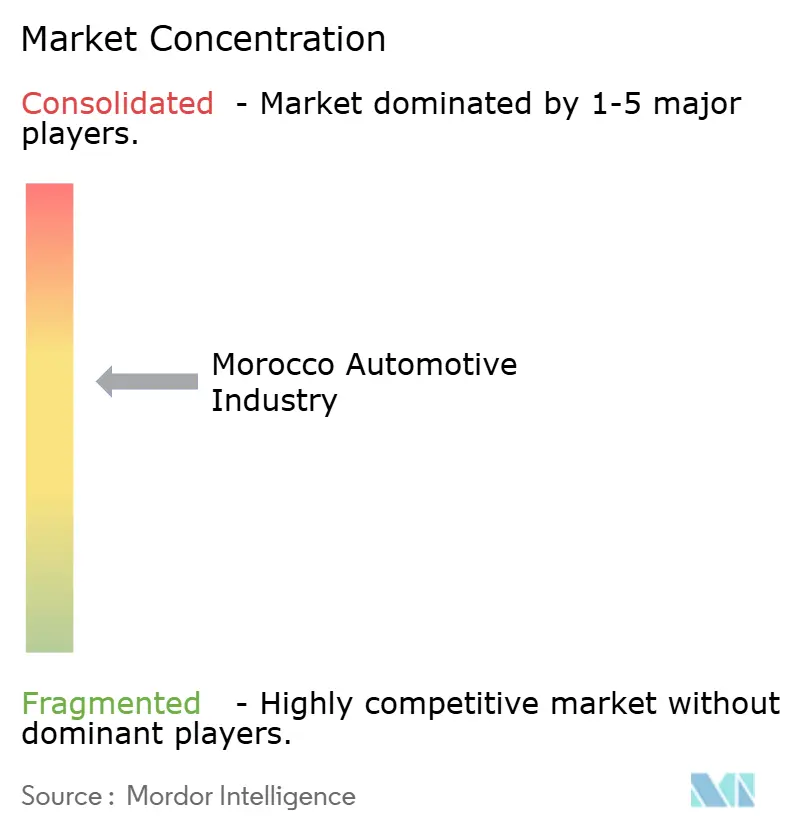
| Market Concentration | Medium |
Major Players *Disclaimer: Major Players sorted in no particular order Image © Mordor Intelligence. Reuse requires attribution under CC BY 4.0. | |
Morocco Automotive Industry Analysis by Mordor Intelligence
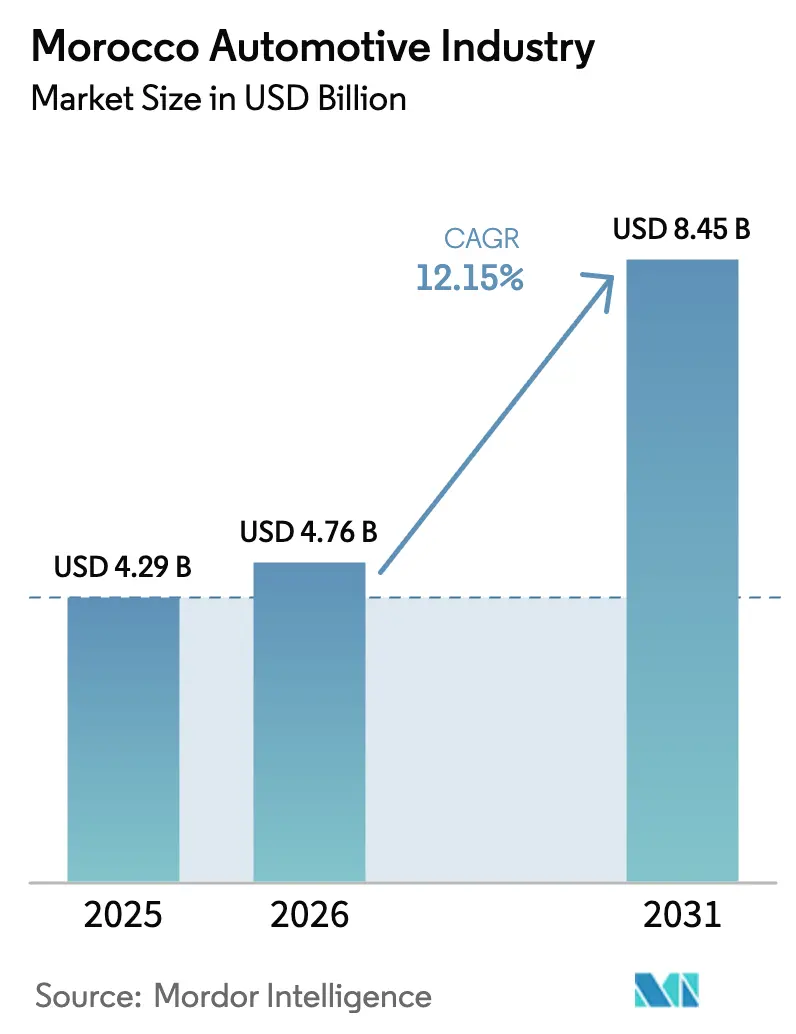
The Moroccan automotive industry size was valued at USD 4.29 billion in 2025 and estimated to grow from USD 4.76 billion in 2026 to reach USD 8.45 billion by 2031, at a CAGR of 12.15% during the forecast period (2026-2031). European manufacturers are increasingly turning to Morocco as their go-to near-shoring hub, drawn by the kingdom's promise of resilient and cost-effective supply chains. Stellantis is expanding its capacity in Kenitra, while Renault is making moves in both Tangier and Casablanca. These expansions, coupled with enticing incentives from free zones and a rapidly maturing supplier base, are propelling the Moroccan automotive market to new heights. Notably, Morocco's export revenues have already eclipsed pre-pandemic figures, establishing the nation as the European Union's top non-EU supplier of vehicles. This achievement is further bolstered by rising urban incomes, which amplify domestic demand. Meanwhile, battery-electric initiatives are luring in Chinese giants from the battery materials sector. Government policies promoting electrification are opening doors in areas like charging infrastructure, fleet renewals, and the production of tier-two components. As competition heats up, early-moving OEMs are leveraging vertically integrated dealer networks, enjoying significant cost advantages compared to their Western European counterparts.
Key Report Takeaways
- By vehicle type, Passenger Vehicles led with 76.27% revenue share in 2025; Commercial Vehicles are forecast to expand at a 12.17% CAGR through 2031.
- By drive type, Battery Electric Vehicles captured 36.71% of the Moroccan automotive market share in 2025 and are projected to grow at a 12.25% CAGR to 2031.
- By fuel type, gasoline-powered models accounted for 67.73% of the Moroccan automotive market size in 2025 and will advance at the quickest 12.27% CAGR during the outlook period.
- By end-use, Personal Use dominated with a 74.36% share in 2025, while Corporate and Government Fleets are expected to record a 12.19% CAGR to 2031.
- By sales channel, OEM-authorized dealerships held 83.25% of 2025 sales and should rise at a 12.28% CAGR, supported by Stellantis’s acquisition of Sopriam.
- By city, Rabat commanded 47.77% of purchases in 2025, whereas Casablanca will log the fastest 12.22% CAGR through 2031.
Note: Market size and forecast figures in this report are generated using Mordor Intelligence’s proprietary estimation framework, updated with the latest available data and insights as of January 2026.
Morocco Automotive Industry Trends and Insights
Drivers Impact Analysis*
| Driver | (~) % Impact on Market CAGR | Geographic Relevance | Impact Timeline |
|---|---|---|---|
| OEMs Expand Manufacturing Capacity | +2.8% | National, concentrated in Tangier, Kenitra, Casablanca | Medium term (2-4 years) |
| European OEMs Pivot to Nearshoring | +2.5% | National, spillover to Maghreb region | Long term (≥ 4 years) |
| Government Incentives and Free Zone Logistics | +2.1% | National, with early gains in Tangier Med, Atlantic Free Zone (Kenitra) | Short term (≤ 2 years) |
| Urban Middle Class Fuels Rising Demand | +1.6% | Urban centers: Casablanca, Rabat, Marrakesh, Fes | Medium term (2-4 years) |
| EV Policies Accelerate, Charging Infrastructure | +1.4% | National, urban rollout priority | Medium term (2-4 years) |
| North African Automotive Clusters Unite | +0.9% | Regional: Morocco, Tunisia, Algeria cross-border corridors | Long term (≥ 4 years) |
| Source: Mordor Intelligence | |||
Original Equipment Manufacturers Expand Manufacturing Capacity with an Export Focus
In mid-2025, Stellantis significantly increased Kenitra's production capacity, enabling the facility to manufacture a substantial number of vehicles and engines annually. This expansion highlights Morocco's growing importance as a cost-efficient export hub. According to Stellantis' investor insights, the company achieves notable production cost savings compared to Western Europe, aligning with competitive global cost structures while avoiding geopolitical risks. At the same time, Renault entered into a long-term agreement that includes the creation of thousands of jobs and the establishment of a research and development center, marking a shift from basic assembly operations to more advanced engineering activities. By 2024, Morocco's national production capacity had reached a significant milestone, with ambitious goals set for further growth in the near future. However, achieving these targets depends on the successful expansion of facilities like Kenitra and the potential entry of new market players. A large majority of Morocco's automotive output is exported, leaving the sector heavily reliant on external demand, particularly from Europe, despite increasing domestic production levels [1].
European OEMs Pivot to Near-shoring in a Post-Pandemic World
Morocco, with a high score for labor costs on Fitch’s Autos Risk/Reward Index, significantly outperforms its counterparts in Central and Eastern Europe. Stellantis and Renault view Morocco not just as a market, but as a strategic hub, helping them cut down on freight emissions and sidestep carbon-border taxes. Its closeness to Spain allows for a swift and efficient shipping window. Moreover, with numerous bilateral investment treaties in place, the kingdom effectively mitigates sovereign risks. As the EU tightens its CO₂ targets, there's a noticeable surge in near-shoring activities. This influx of capital into Moroccan plants not only boosts their operations but also strengthens the long-haul competitiveness of Morocco's automotive market [2].
Government Incentives and Free Zone Logistics Boost Appeal
Multi-year tax holidays, duty-free inputs, and streamlined customs are granted by the Investment Charter through the PortNet single-window platform. Africa’s largest port, Tangier Med, ranks among the world’s top twenty and is pivotal for just-in-time flows for original equipment manufacturers. The Atlantic Free Zone, home to major automotive and industrial players, bolsters its supplier base with a recently announced significant wiring-systems program. Free-zone rules, incorporating quality mandates like ISO 9001 and ISO 14001, guarantee export-grade processes. With a frontier-technology readiness score above the global average, Morocco demonstrates its preparedness for IoT-enabled smart manufacturing [3].
Urban Middle Class Fuels Rising Demand for Passenger Cars
Urban income recoveries drove a significant increase in new-car registrations in Q1 2025, reflecting strong market growth. Dacia experienced substantial growth in March 2025, capturing a notable portion of the market. Meanwhile, BMW outperformed Mercedes-Benz in the premium segment, highlighting fluctuations in brand performance. Urban centers benefit from concentrated dealership networks and accessible financing, while rural areas face challenges due to infrastructure limitations, resulting in slower demand. Although used-vehicle imports from Europe are impacting new-car sales, the Moroccan automotive market continues to expand, supported by rising disposable incomes, particularly in the entry and mid-range segments.
Restraints Impact Analysis*
| Restraint | (~) % Impact on Market CAGR | Geographic Relevance | Impact Timeline |
|---|---|---|---|
| Local Tier-2/3 Supplier Ecosystem Remains Limited | -1.2% | National, acute in electronics and precision components | Medium term (2-4 years) |
| FX Volatility Heightens Dependence on Imported Components | -0.8% | National, exposure to EUR and USD fluctuations | Short term (≤ 2 years) |
| Shortage of Skilled EV Technicians and STEM Talent | -0.7% | National, urban concentration in training centers | Medium term (2-4 years) |
| Fragmented Used-Car Market Undermines New Sales | -0.6% | Urban centers: Casablanca, Rabat, Tangier | Short term (≤ 2 years) |
| Source: Mordor Intelligence | |||
Local Tier-2/3 Supplier Ecosystem Remains Limited
Morocco hosts several suppliers, but still relies on Europe and Asia for essential electronics and machined parts. Tier-one positions are predominantly held by Valeo, Lear, and Yazaki, sidelining local small and medium enterprises that find themselves reliant on expensive imports. These SMEs face hurdles in scaling up due to financing constraints and a lack of robust supply-chain finance programs. The significant foreign value-added content not only limits local gains but also jeopardizes Stellantis's ambitious localization target set for the next decade [4].
FX Volatility Heightens Dependence on Imported Components
While the dirham's peg to the euro and dollar stabilizes headline rates, it also subjects assemblers to fluctuations in the currency basket. This volatility inflates costs for semiconductors and specialty materials. Furthermore, limited liquidity in the forward market amplifies hedging premiums, thereby tightening margins and complicating Stellantis's pursuit of "Chinese-cost" targets. The absence of large-scale domestic production in semiconductor fabrication and battery cells leaves the Moroccan automotive industry vulnerable to currency shocks, which in turn disrupt assembly schedules and influence consumer prices.
*Our forecasts treat driver/restraint impacts as directional, not additive. The impact forecasts reflect baseline growth, mix effects, and variable interactions.
Segment Analysis
By Vehicle Type: Commercial Segment Gains Traction
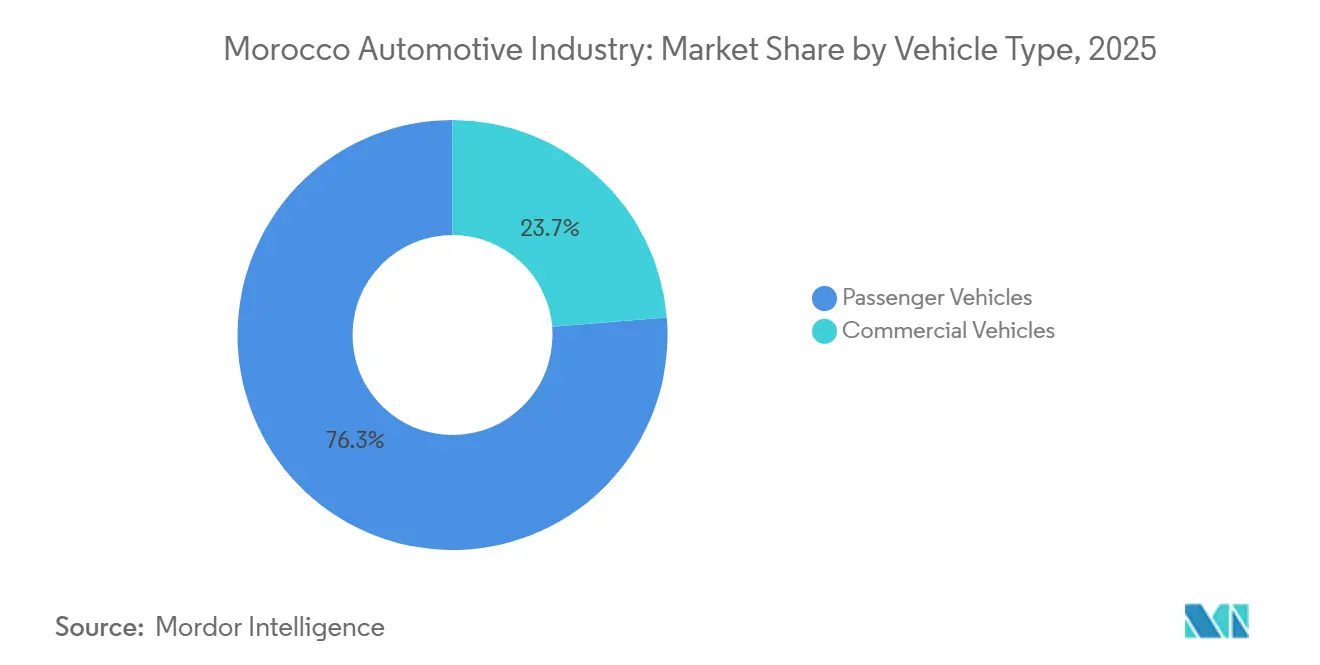
Passenger models held 76.27% share in 2025, yet commercial units will rise at a 12.17% CAGR through 2031 as e-commerce and infrastructure projects swell logistics fleets. Leoni’s Agadir wiring-system plant targets truck and off-road harnesses. Light commercial vans benefit from Renault’s robust segment share, while medium and heavy trucks pick up momentum from construction and mining.
Passenger models still dominate showroom traffic, but used-car inflows and financing limits keep volume growth moderate. Hybrids such as the locally built Dacia Jogger address fuel-efficiency concerns and bridge the infrastructure gap to full electrification, sustaining the Moroccan automotive market in both retail and fleet channels.
By Drive Type: BEV Dominance Masks Hybrid Pragmatism
Battery electric vehicles claimed 36.71% of 2025 registrations and will grow at a 12.25% CAGR, propelled by fleet mandates and export programs. Internal-combustion variants remain essential in rural regions, while hybrids gain traction as a transitional choice. The Moroccan automotive market enjoys policy momentum toward electrification, yet only 290–1,000 public chargers are in service, well shy of the 25,000-unit 2035 target.
BYD’s six-model rollout broadens options, though the firm’s plant plans are still pending. Hybrids provide immediate fuel savings without range anxiety, and Renault’s Jogger line demonstrates local capability in this bridge technology.
By Fuel Type: Gasoline Holds Steady Amid Electrification
Gasoline powertrains retained 67.73% share in 2025 and will notch the swiftest 12.27% CAGR due to hybrid configurations that combine internal combustion and electric assist. Diesel’s footprint shrinks as emissions rules tighten, while CNG and LPG stay niche due to refueling gaps.
Stellantis’s Kenitra engine line adds gasoline, diesel, and hybrid units, signposting the diversity that will characterize the Moroccan automotive market through mid-decade. Alternative fuels could gain if subsidies materialize, yet policy clarity remains thin.
By End-Use Sector: Fleet Procurement Accelerates
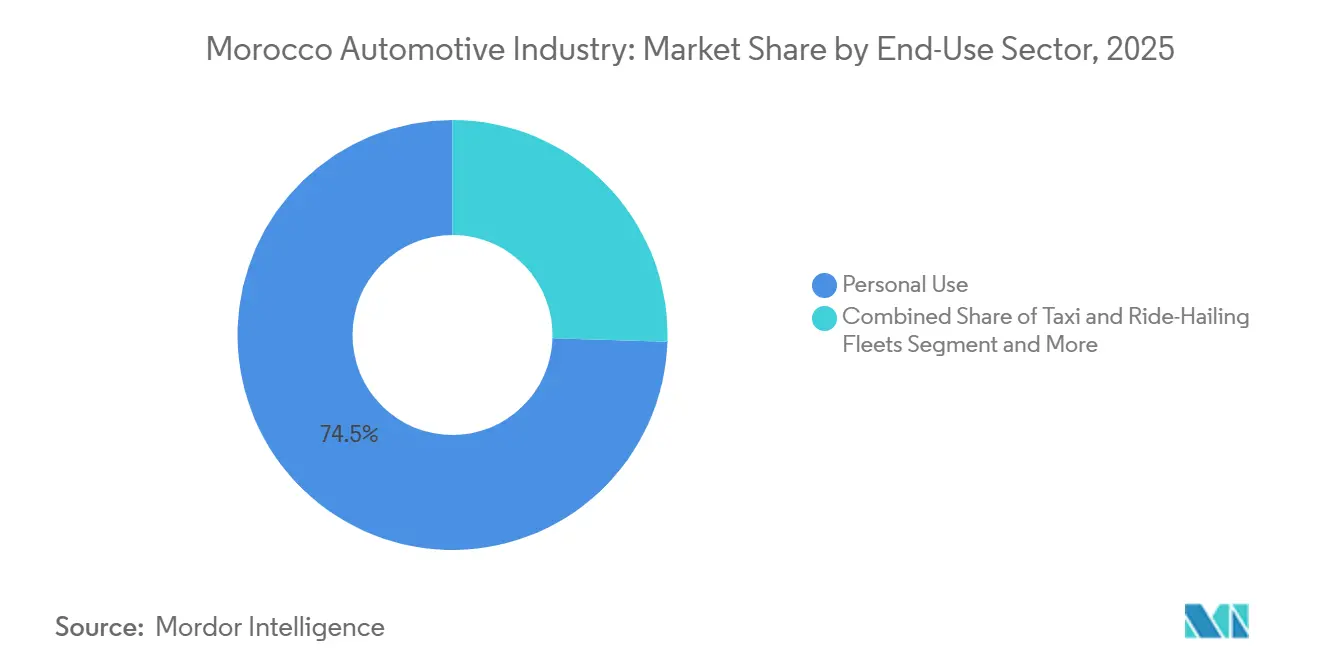
Personal buyers represented 74.36% of 2025 deliveries, but corporate and government fleets will accelerate at 12.19% CAGR as electrification mandates and total-cost-of-ownership calculations favor newer vehicles. Government tenders centered in Rabat assure volume for OEMs meeting local-content rules.
Taxi and ride-hailing operators explore electric sedans to trim operating costs, though charging gaps in secondary cities temper rollout speed. Fleet demand thus injects stability into the Moroccan automotive market during consumer down-cycles.

By Sales Channel: OEM Dealerships Tighten Control
OEM-authorized outlets captured 83.25% of sales in 2025 and will rise at a 12.28% CAGR. Stellantis’s full takeover of Sopriam deepens vertical integration and enables bundled financing, after-sales, and certified pre-owned programs that undercut informal players.
Independent lots survive in rural areas through gray-market imports, but inventory constraints and warranty gaps erode their share. Online direct sales remain small, though BYD’s digital approach hints at gradual channel diversification.
Geography Analysis
Morocco’s coastal corridor, stretching from Tangier to Casablanca, anchors most assembly and supplier investment. Rabat’s outsized market share in 2025 reflects public-sector fleet cycles and the Salé seating plant, which is now under construction. Casablanca edges ahead as the fastest-growing hub, with a projected growth rate of 12.22% through 2031, driven by the combined output of SOMACA, dense dealer networks, and a concentration of corporate headquarters.
Tangier’s supplier ecosystem, amplified by the ZF LIFETEC steering-wheel and Lear connection-systems plants, benefits from sub-48-hour door-to-door trucking into Spain. Fes-Meknes leverages a 35,000-strong industrial workforce cultivated under the 2014–2018 acceleration plan and hosts Delphi, Yazaki, and Yura in four parks.
Interior and southern cities add nuanced demand drivers. Marrakesh caters to tourism fleets, while Agadir’s EUR 20 million Leoni facility focuses on truck harnesses for mining and agriculture. Oujda and El Jadida maintain modest showrooms but large used-vehicle lots, illustrating the dual structure of the Moroccan automotive market. Planned motorway upgrades promise to shave transit time between Tangier and Saidia, enhancing inland logistics. As coastal zones fill, policy shifts encourage investment in Fes-Meknes and Agadir to spread employment gains and reduce regional disparities.
Regulatory Landscape
Morocco's automotive regulatory framework combines industrial policy with product safety and conformity rules overseen by the Ministry of Industry and Trade (MCINET), alongside vehicle approval and road-safety controls led by transport and road-safety authorities. Imported vehicles require mandatory homologation prior to registration, while imported automotive parts are subject to Morocco's Verification of Conformity (VoC) requirements against Moroccan Standards (NM) published through the national standardization system.
On the industrial-policy side, incentives under the Investment Charter and business-environment reforms influence plant location and supplier decisions, especially for export-oriented free zones linked to platforms such as PortNet for trade facilitation. In May 2026, MCINET communications around sustainable mobility and deeper industrial engineering signaled a shift in policy emphasis from assembly toward higher-value activities such as process design, local engineering, and electrification-related capabilities, reinforcing compliance and localization priorities for both OEMs and suppliers.
Value Chain Analysis
Morocco's automotive value chain is anchored by export-focused vehicle assembly concentrated along the coastal corridor, with major hubs in Tangier (Renault), Kenitra (Stellantis), and Casablanca (SOMACA). Upstream, industrial ecosystems cover cabling and wiring, metal stamping, interiors and seating, engines and transmission, and a growing battery-materials and EV-component base tied to industrial platforms such as Tanger Tech and the Atlantic Free Zone. Morocco has raised local integration to around 60% by 2025, but key electronics, precision components, and several EV-critical inputs still rely on imports, keeping foreign value-added content elevated.
Midstream capability is reinforced by quality and testing infrastructure, as well as workforce-development programs including public-private vocational training institutes dedicated to automotive skills (IFMIA). Downstream, exports move through logistics nodes centered on Tangier Med, while the domestic market is served primarily through OEM-authorized dealer networks that combine financing and after-sales support. The main constraints remain limited depth in Tier-2/3 suppliers, skills gaps in advanced EV and electronics roles, and exposure to currency-linked costs for imported components.
Competitive Landscape
While Renault-Nissan and Stellantis dominate in assembly capacity, the dealer and used-car markets remain fragmented. Dacia secured a leading position with a significant market share through mid-2024, followed closely by Renault and Hyundai. Meanwhile, BYD is currently dependent on imports and digital channels, awaiting the commencement of its local production.
Stellantis has set its sights on capturing a substantial market share by the end of the decade, leveraging Sopriam's control and output from Kenitra's micromobility division. Meanwhile, Laraki's high-end Grace hyper-EV and NamX's hydrogen SUV showcase the industry's engineering aspirations, though they may not significantly sway overall market volumes.
As investment inflows surge, they amplify the demand for skilled labor and supplier capabilities, intensifying competition for both human and industrial resources. Original Equipment Manufacturers (OEMs) are capitalizing on advantages by utilizing ISO-certified plants, embracing automation, and benefiting from reduced logistics costs. In contrast, smaller market entrants grapple with challenges related to capital intensity, after-sales service coverage, and adherence to policy regulations.
Morocco Automotive Market Leaders
-
Toyota Motor Corporation
-
Volkswagen AG
-
Hyundai Motor Company
-
Ford Motor Company
-
Renault Group
- *Disclaimer: Major Players sorted in no particular order
Market Opportunities and Future Outlook
Near-shoring demand from Europe and Morocco's free-zone platforms continue to pull in incremental component manufacturing that widens the local supplier mix beyond harnesses and trim into chassis, safety, and electrification-adjacent parts. A concrete 2026 proof point is the ramp-up of new supplier footprints in Kenitra's Atlantic Free Zone, including BENTELER's new plant for structural and chassis-related parts and LEONI's move to add advanced automotive cable capacity, tightening local availability for higher-spec wiring and underbody components used in export programs.
Electrification-linked upstream investments also open a second opportunity lane around battery materials and related processing, anchored by projects at Mohammed VI City of Tanger Tech where cathode-material capacity has been scheduled for a phased start. This creates whitespace for local and regional suppliers in chemicals, industrial utilities, quality testing, and compliant logistics, while increasing demand for engineering services and specialized technicians needed for EV-grade manufacturing standards. At the same time, the relatively limited public charging base cited in-market points to opportunities for fleet-focused charging deployments in major cities and for OEM-aligned charging partnerships that connect vehicle sales to usable infrastructure without relying on fragmented retail buildouts.
Recent Industry Developments
- July 2026: BENTELER opened a new automotive plant in the Atlantic Free Zone in Kenitra to manufacture components such as bumpers, axles, suspension arms, and impact protection beams. The added local capacity strengthens Morocco's Tier-1 base for export programs and increases the share of value-added components produced near OEM assembly sites.
- July 2025: Stellantis inaugurated a major expansion at its Kenitra facility backed by a EUR 1.2 billion investment, with a stated pathway to 535,000 vehicles of annual capacity by 2030. The project reinforces Morocco's role as a near-shore manufacturing hub for Europe and pulls additional demand for locally sourced components, logistics, and trained labor.
- April 2024: Renault's Tangier plant started producing the Dacia Jogger hybrid, marking the first hybrid vehicle produced in Morocco. Local hybrid production broadened Morocco's powertrain mix beyond conventional ICE assembly and pushed suppliers and workforce programs toward electrification-compatible parts and skills.
Research Methodology Framework and Report Scope
Market Definition and Coverage
For this outlook, the market is defined as the value generated in Morocco from designing, assembling, and selling new passenger cars and light, medium, and heavy commercial vehicles, captured as factory-gate revenue plus domestic dealer turnover.
Scope exclusions: Motorcycles, used-vehicle trade, standalone parts exports, and aftermarket services are kept outside this market value.
Segmentation Overview
- By Vehicle Type
- Passenger Vehicles
- Commercial Vehicles
- Light Commercial Vehicles
- Medium and Heavy Commercial Vehicles
- By Drive Type
- Internal Combustion Engine (ICE)
- Hybrid Electric Vehicles (HEV)
- Plug-In Hybrid Electric Vehicles (PHEV)
- Battery Electric Vehicles (BEV)
- Fuel Cell Electric Vehicles (FCEV)
- By Fuel Type
- Gasoline
- Diesel
- Alternative Fuels (CNG/LPG/Biofuels)
- By End-Use Sector
- Personal Use
- Taxi & Ride-Hailing Fleets
- Corporate & Government Fleets
- By Sales Channel
- OEM-Authorized Dealerships
- Independent Dealers
- Online Direct Sales
- By City
- Rabat
- Casablanca
- Fes
- Tangier
- Meknes
- Agadir
- Marrakesh
- Oujda
- El Jadida
- Rest of Morocco
Data Sources, Market Sizing, and Validation
Desk Research
Desk work starts with building the Morocco vehicle demand and supply picture from public series, before numbers are put into a model. We typically refer to sources such as Morocco customs and trade statistics, the High Commission for Planning (HCP) macro indicators, World Bank and IMF country data, UN Comtrade trade flows, and UNIDO industrial statistics for manufacturing context.
On top of this, we review company annual reports, investor presentations, official port and free zone updates, and reputed local and global press to understand capacity changes and model launches. Where needed, we also use paid subscriptions for company financials and intelligence, shipment-level import/export checks, and patent databases to validate technology direction. These examples are not exhaustive, and many other public sources are also referenced to collect data, confirm ranges, and clarify open points.
Primary Interviews and Surveys
Interviews and surveys with manufacturers, suppliers, dealers, distributors, regulators, and automotive service professionals in Morocco clarify production plans, vehicle pricing, channel movement, and demand conditions. Respondents also help explain differences between registration data, factory output, and reported trade flows that public sources do not fully resolve. Follow-up checks are used to reconcile conflicting inputs.
Distribution of primary research fieldwork respondents
| Company type | Respondent position |
|---|---|
| Top tier: 27% | CXOs: 22% |
| Mid tier: 48% | Functional/Unit leaders: 30% |
| Smaller Players: 25% | Managers: 48% |
Market-Sizing & Forecasting
Sizing is built using a top-down approach where production, registration, and trade signals are reconstructed into a revenue pool for new vehicles, and then adjusted for price and channel structure in Morocco. To keep the totals realistic, results are corroborated with selective bottom-up approximations, such as sample price by model class multiplied by implied unit volumes, plus targeted channel checks with importers and dealer networks.
Key inputs that move the model include new passenger and commercial vehicle registrations, local assembly and capacity utilization updates, import and export vehicle flows, average selling price movement by vehicle class, and the mix shift across ICE, hybrid, plug-in hybrid, battery-electric, and fuel-cell offerings. Where a variable is only partially visible, for example informal discounting or delayed deliveries, we treat it as a range and tighten it using interview feedback and consistency checks against trade and registration patterns.
Forecasting is handled through scenario analysis, with a base case supported by primary feedback on capacity ramp timing, demand elasticity to financing conditions, and expected model-cycle refreshes. Alternative cases are also run to reflect shocks in export demand, currency moves that affect imported vehicle pricing, and policy-related changes tied to electrification.
Data Validation & Update Cycle
Outputs are tested against independent signals so large swings are questioned before they are accepted, including unit trends, trade values, and implied price per vehicle movements. If a variance looks too wide, the assumptions are revisited, and follow-up calls are triggered to confirm whether it is a data timing issue, a one-off shipment spike, or a real demand shift.
Before sign-off, the model goes through step-by-step analyst reviews that check arithmetic integrity, year-on-year logic, and whether the narrative matches the numbers. Reports are refreshed annually, and interim updates are made when material events occur, such as capacity announcements, policy changes, or major demand shocks. Right before delivery, a fresh pass is completed so clients receive the most current view available.
Mordor Intelligence's Morocco Automotive Industry Outlook Market Size Compared Against Other Published Estimates
Published market sizes for Morocco automotive can differ more than people expect because each publisher chooses its own definition of what counts as the market, which year is treated as the base, and how prices are translated into a single USD value. Differences also come from whether the estimate is anchored on domestic sales only or mixed with export production value.
A common driver of the spread is scope, where some sources blend used vehicles, motorcycles, or broader ecosystem revenue into the same total, and then apply aggressive or conservative price progression without checking it against registrations and trade flows. Another gap driver is timing, because currency conversion points and refresh cadence can shift the reported USD figure, especially when import-heavy price points are moving. For that reason, the model here sticks to new vehicle factory-gate revenue plus domestic dealer turnover, and it excludes used trade, a scope choice applied by Mordor Intelligence.
Benchmark comparison
| Source | Market Size | Gaps in Research Methodology |
|---|---|---|
| Mordor Intelligence | USD 4.29 B (2025) | |
| Global Consultancy A | USD 5.00 B (2025) | Often folds used-vehicle transactions and broader auto ecosystem revenue into the same total, and may not separate domestic turnover from export-linked production value, which can inflate the addressable market for new vehicles. |
| Regional Consultancy B | USD 5.00 B (2024) | Uses a different base year and may rely on high-level revenue framing without clear checks against registrations, import/export flows, and implied average selling price movements, making year-to-year comparability harder. |
The comparison shows that most of the difference is explained by what is included and when the conversion and base year are set. By keeping the market tied to measurable vehicle signals and by making the inclusion rules explicit, the estimate stays easier to replicate and simpler to use for planning across production, imports, and retail demand.
Key Questions Answered in the Report
How large is the Moroccan automotive market in 2026?
The Moroccan automotive market size is USD 4.76 billion in 2026 and is projected to reach USD 8.44 billion by 2031.
Which segment is growing fastest in Morocco?
Commercial Vehicles record the quickest growth at a 12.17% CAGR through 2031 due to logistics demand and infrastructure projects.
What share do Battery Electric Vehicles hold in Morocco?
Battery Electric Vehicles captured 36.71% of 2025 sales and are projected to grow at a 12.25% CAGR.
Why are OEM-authorized dealerships dominant in Morocco?
OEM outlets account for 83.25% of sales because manufacturers integrate distribution, financing, and certified pre-owned programs that outcompete independent dealers.
Which city will lead growth in Moroccan auto sales?
Casablanca is forecast to post the fastest 12.22% CAGR to 2031, driven by SOMACA production and the city’s economic scale.
What is the outlook for gasoline vehicles in Morocco?
Gasoline models, including hybrids, retain 67.73% share in 2025 and are expected to grow at 12.27% CAGR as hybrids pair fuel efficiency with familiar refueling convenience.