
Mongolia Telecom MNO Market Size and Share
Market Overview
| Study Period | 2020 - 2031 |
|---|---|
| Forecast Data Period | 2026 - 2031 |
| Base Year Market Size (2025) | USD 719.93 Million |
| Market Size (2026) | USD 755.13 Million |
| Market Size (2031) | USD 958.86 Million |
| Growth Rate (2026 - 2031) | 4.89 % |
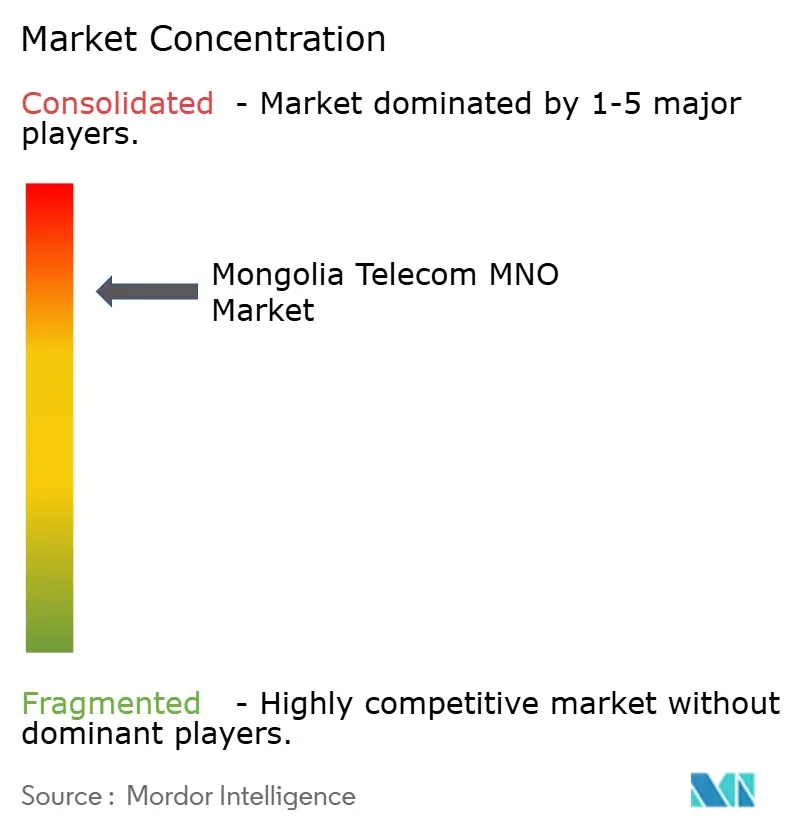
| Market Concentration | High |
Major Players *Disclaimer: Major Players sorted in no particular order Image © Mordor Intelligence. Reuse requires attribution under CC BY 4.0. | |
Mongolia Telecom MNO Market Analysis by Mordor Intelligence
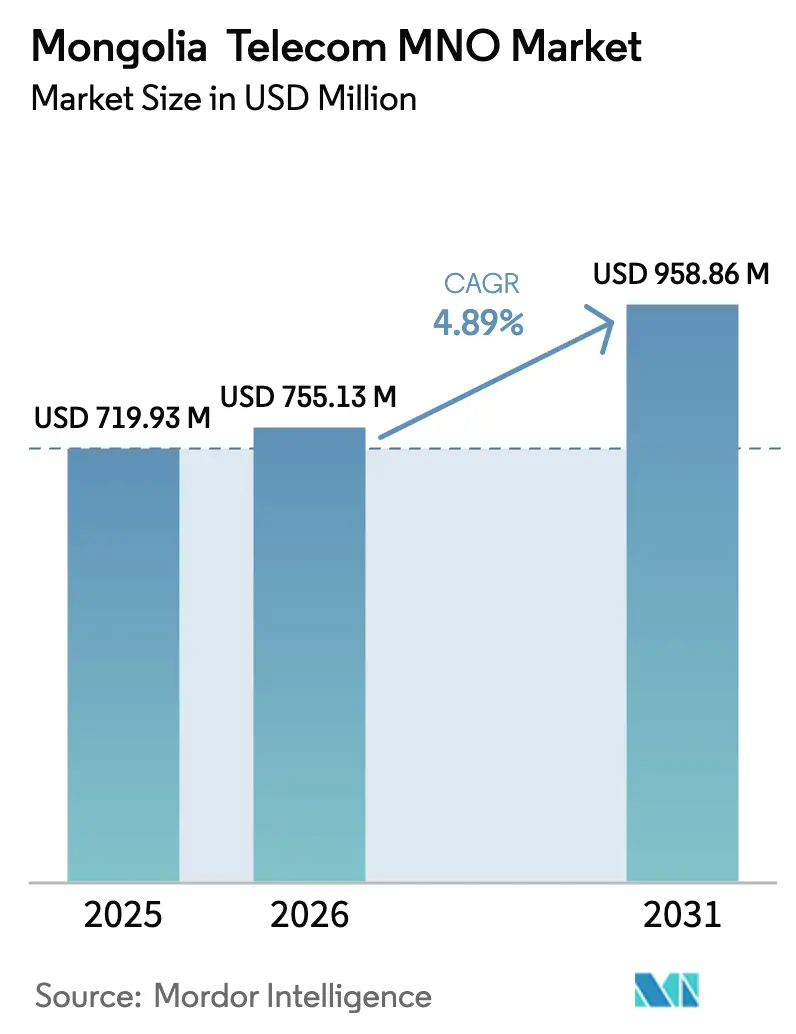
The Mongolia Telecom MNO Market size was valued at USD 719.93 million in 2025 and estimated to grow from USD 755.13 million in 2026 to reach USD 958.86 million by 2031, at a CAGR of 4.89% during the forecast period (2026-2031).
Mongolia’s landlocked geography makes mobile connectivity the country’s primary digital lifeline, and the market’s expansion is powered by fiber corridors to Russia and China, the government’s Digital Nation program, and a surge in affordable Android smartphones. Operators have achieved 95% territorial coverage, serving nomadic herders and urban residents alike while sustaining data-driven ARPU growth. At the same time, cybersecurity incidents topped 1.6 million in 2024, currency volatility lifted network-equipment costs, and ultra-low population density forced operators to innovate with tower-sharing, private LTE and emerging satellite IoT to keep margins intact.
Key Report Takeaways
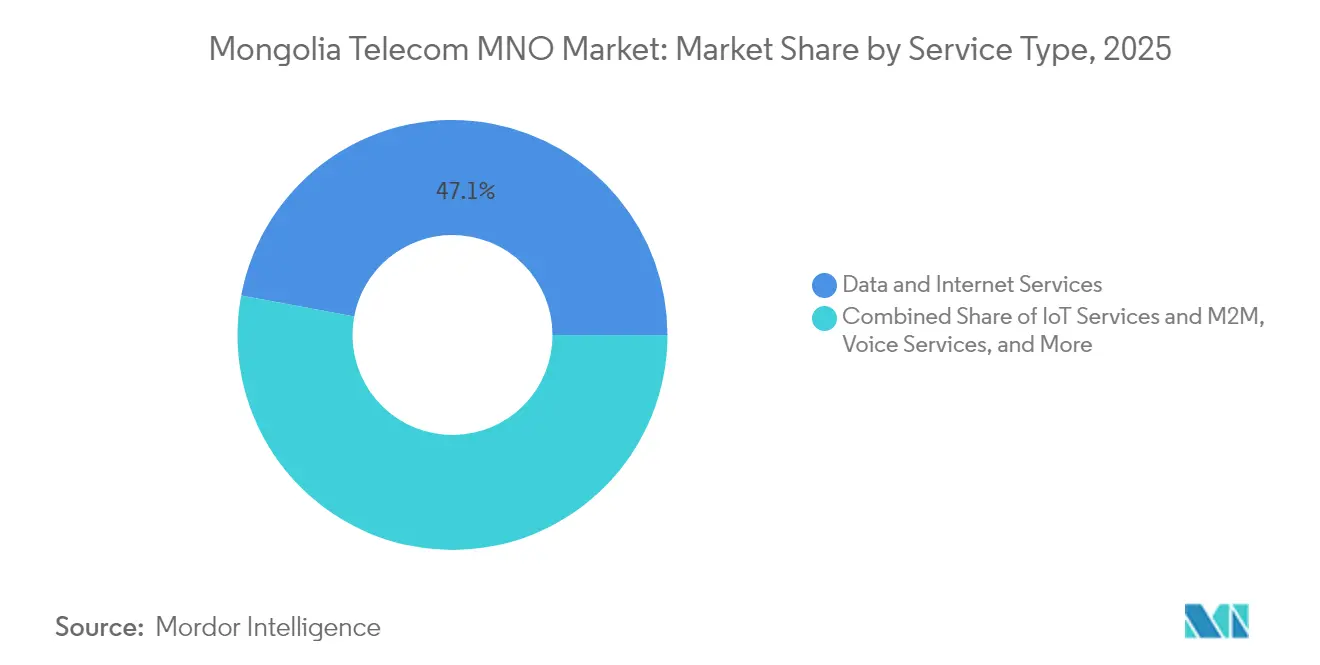
- By service type, data services led with 47.05% of Mongolia telecom MNO market share in 2025, while IoT services are projected to grow at a 5.16% CAGR to 2031.
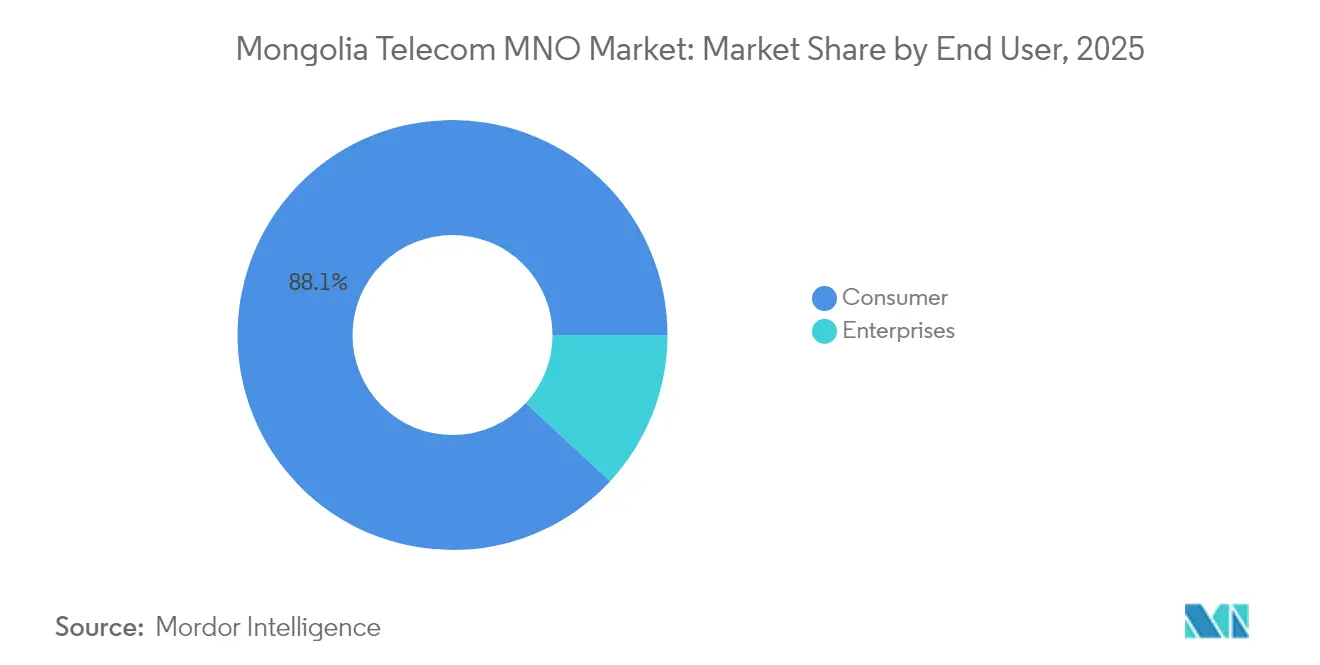
- By end user, the consumer segment accounted for 88.10% share of the Mongolia telecom MNO market size in 2025 and the enterprise segment is advancing at a 5.72% CAGR through 2031.
Note: Market size and forecast figures in this report are generated using Mordor Intelligence’s proprietary estimation framework, updated with the latest available data and insights as of 2026.
Mongolia Telecom MNO Market Trends and Insights
Drivers Impact Analysis*
| Driver | (~) % Impact on CAGR Forecast | Geographic Relevance | Impact Timeline |
|---|---|---|---|
| Exploding mobile-data usage from affordable Android smartphones | +1.2% | Urban hubs and aimag centers | Short term (≤ 2 years) |
| Digital Nation fiber-backbone program | +0.8% | Nationwide rural focus | Medium term (2-4 years) |
| 5G spectrum awards to all tier-1 MNOs | +1.1% | Capital city and mining belts | Medium term (2-4 years) |
| Cross-border fiber to Russia/China | +0.7% | Whole country | Long term (≥ 4 years) |
| Gobi mining private-LTE and IoT networks | +0.6% | Gobi desert | Long term (≥ 4 years) |
| Rural tower-sharing co-operatives | +0.4% | Remote aimags | Medium term (2-4 years) |
| Source: Mordor Intelligence | |||
Exploding Mobile-Data Usage Driven by Affordable Android Smartphones
Smartphone penetration jumped from 43% to 85% of the population between 2021-2024, triggering a structural pivot from voice to data revenue and lifting mobile services above 50% of total telecom receipts [1]MONTSAME National News Agency, “Mobile Internet Usage Soars,” montsame.gov.mn Nomadic households now stream video lessons and sell cashmere on online marketplaces via Huawei–Unitel Ger Internet kits, which connected 50,000 rural homes over 4G.[2]Huawei, “Ger Internet Case Study,” huawei.com Internet users climbed 10.1% to 2.65 million after 4G expansions across steppe provinces. This mass adoption anchors long-run ARPU uplift and sets the commercial runway for 5G-enabled premium tiers in the Mongolia telecom MNO market.
Government “Digital Nation” Program Accelerating National Fibre Backbone Roll-out
The Digital Nation blueprint aims to digitize 90% of government services by 2024, compelling a rapid extension of the fiber backbone into provinces historically dependent on microwave or satellite backhaul. The e-Mongolia portal already links more than 1,000 public services, and ministries now bundle fiber projects with school, clinic and logistics corridors. With 82% of households still lacking fixed broadband, state-funded optical links are reducing tower backhaul costs for all operators, particularly in sparsely populated aimags, while preparing the Mongolia telecom MNO market for cloud, AI and e-commerce scale-up.
5G Spectrum Awards to All Three Tier-1 MNOs Enabling Premium ARPU Uplift
Regulators confirmed that 5G licenses will be distributed equally among MobiCom, Unitel and Skytel by late-2025, a decision that maintains competitive symmetry and averts a winner-takes-all outcome.Initial 5G clusters will launch in Ulaanbaatar and Oyu Tolgoi mining camps, where latency-sensitive automation and MMTC (massive machine-type communications) justify premium service fees. Enterprise presales show willingness to pay double current LTE rates for guaranteed throughput, supporting blended ARPU expansion within the Mongolia telecom MNO market.
Cross-Border Fibre Routes to Russia & China Slashing Wholesale IP Transit Costs
The 11,500 km ERMC terrestrial system provides Mongolia with a 40 Gbit/s ring, upgradable to 400 Gbit/s, cutting international transit prices versus legacy satellite paths. Redundant ingress points in the north and south have raised route diversity and positioned Mongolia as a potential digital bridge between Europe and Asia. Lower IP costs enable competitive roaming bundles, facilitate local content-delivery nodes and attract regional data-center pilots, underpinning long-term bandwidth demand in the Mongolia telecom MNO market.
Restraints Impact Analysis*
| Restraint | (~) % Impact on CAGR Forecast | Geographic Relevance | Impact Timeline |
|---|---|---|---|
| Ultra-low population density inflating RAN & backhaul cost per subscriber | −0.9% | Rural aimags | Long term (≥ 4 years) |
| Tugrug currency volatility inflating imported equipment costs | −0.5% | Nationwide | Short term (≤ 2 years) |
| Rising cyberattacks amid 84% internet penetration | −0.4% | Nationwide | Medium term (2-4 years) |
| Political exposure to Russian transit infrastructure | −0.3% | International gateways | Long term (≥ 4 years) |
| Source: Mordor Intelligence | |||
Ultra-Low Population Density Inflating RAN & Backhaul Cost Per Subscriber
With only 1.9 persons/km², Mongolia faces deployment economics where a rural base-station can cost 300-500% more per connected user than in Ulaanbaatar. Operators offset capex through tower-sharing co-ops, diesel-solar hybrids and selective satellite backhaul, yet ROI horizons remain long. These cost burdens slow 5G rollouts outside high-traffic corridors and cap margin expansion across the Mongolia telecom MNO market.
Tugrug Currency Volatility Raising Prices of Imported Network Equipment
Routers, antennas and OSS software are priced in USD or EUR, exposing operators to exchange swings that reached double-digit levels during 2024 budget-deficit pressures. Smaller carriers postpone upgrades when the tugrug slides, delaying rural coverage or 5G trials. Currency-adjusted contracts and local assembly initiatives ease but do not neutralize this restraint on Mongolia telecom MNO market growth. [3]Mongolia Weekly, “Macro-Economic Outlook and Tugrug Volatility,” mongoliaweekly.mn
*Our forecasts treat driver/restraint impacts as directional, not additive. The impact forecasts reflect baseline growth, mix effects, and variable interactions.
Segment Analysis
By Service Type: Data and Internet Services Drive Revenue Growth
Data traffic accounted for 47.05% of Mongolia telecom MNO market share in 2025, outstripping voice and messaging amid surging smartphone penetration. The Mongolia telecom MNO market size for data plans is projected to rise at a 4.96% CAGR through 2031, supported by 4G densification and the upcoming 5G overlay. IoT subscriptions—tracking mine vehicles, livestock and remote assets—are the fastest-growing niche at 5.16% CAGR, aided by ONDO’s satellite packets that cover districts without cellular reach. Operators bundle voice and SMS into flat-rate data packs to preserve retention, while OTT chat apps erode traditional messaging volumes. Pay-TV and gaming are hindered by rural bandwidth ceilings but show upside once fiber backhaul reaches more base-stations. Wholesale and roaming revenues diversify cashflows as cross-border fiber lowers cost bases, making Mongolia an attractive transit node for East-West traffic and reinforcing monetization levers inside the Mongolia telecom MNO market.
Data services earned 50% of the Mongolia telecom MNO market size within Ulaanbaatar in 2025 and command 60% of traffic in Gobi mining zones, where tablets stream geospatial dashboards. Video compresses 63% of mobile downlink volume, spurring operator partnerships with CDN providers to cache content locally. SMS endures as a fallback for e-government notifications, especially where data connectivity is intermittent during winter power outages. The service-mix outlook underscores a decisive tilt toward IP-centric revenues that align with Digital Nation goals and enterprise digitalization.



By End User: Enterprise Growth Accelerate
Consumers represented 88.10% of Mongolia telecom MNO market size in 2025 as virtually every household carries multiple SIMs for price arbitration and coverage diversity. Although base consumption remains consumer-driven, enterprise lines are set to climb at 5.72% CAGR, lifting their share of Mongolia telecom MNO market revenue to 14.8% by 2031. Mining conglomerates are already provisioning private LTE at Oyu Tolgoi and Tavan Tolgoi, creating ultra-reliable links for autonomous haul-trucks that run 24/7 in −40 °C winters. Banks, insurers and logistics houses migrate to cloud and need MPLS, SD-WAN and secure IoT gateways, while provincial governments integrate M2M smart-metering into school and clinic projects.
Rural SMEs adopt mobile POS and e-commerce storefronts to reach urban buyers, further widening enterprise addressable-market depth. MobiCom now offers an “Office-in-a-Box” that bundles 4G router, VPN and Azure stack access, cutting branch rollout times to one day. As fiber pushes deeper, enterprises shift from best-effort to SLA-backed circuits, enabling differentiated tariffs that raise blended ARPU and diversify Mongolia telecom MNO market revenue profiles beyond mass-market bundles.
Geography Analysis
The Mongolia telecom MNO market must cover 1.56 million km² of steppe, desert and mountains where 55% of citizens live outside cities and 40% practice nomadic herding. Ulaanbaatar houses two-thirds of the population and generates 70% of sector turnover, benefiting from dense LTE-Advanced grids that already post 225 Mbps peak downloads. These urban nodes will host the inaugural 5G clusters, leveraging existing fiber rings and high spectral efficiency to handle video-heavy demand. Secondary cities such as Darkhan and Erdenet see rising smartphone usage as Digital Nation services reach district kiosks, spurring incremental backhaul investments.
The Gobi desert forms a distinct enterprise pocket where copper-gold mines deploy private LTE, LEO satellite links and edge servers for autonomous drilling and predictive maintenance. This cluster attracts bespoke SLAs that yield premium margins within the Mongolia telecom MNO market. Northern border provinces depend on the ERMC fiber loop for transit diversity; outages on the Russian segment during 2024 diplomatic tensions prompted operators to acquire additional wavelengths on the Chinese leg, illustrating geopolitical dependency costs.
Rural aimags rely on tower-sharing co-ops supported by public-private subsidies to stretch 3G/4G footprints across valleys where population can dip below 0.5 person/km². Diesel-solar hybrids stabilize power feeds at base-stations, and VSAT backup maintains critical coverage during ice storms. Nomadic camps receive portable CPE kits that tether to 4G or forthcoming Starlink beams, ensuring livestock-health telemetry and e-learning continuity. The geographic fabric therefore forces a multi-modal access blueprint—terrestrial, satellite and soon 5G-FWA—that underscores the ingenuity underpinning Mongolia telecom MNO market expansion.
Competitive Landscape
Five principal operators shape a moderately concentrated Mongolia telecom MNO market. MobiCom commands roughly 38% subscriber share through its early 4G rollouts (2016) and bundled fixed-mobile offers. Unitel follows with about 33% share, leveraging its all-local ownership image and tri-band LTE network (700/1800/2300 MHz) that extends service to 363 regional areas via LTE-Advanced Carrier Aggregation. Skytel and G-Mobile collectively hold near-26%, focusing on youth pricing, rural bundles and CDMA fallback in fringe zones. ONDO Space, the newest entrant, launched two CubeSats in 2024 for low-bit-rate IoT, giving it a niche but potentially disruptive reach in livestock and logistics telemetry.
Recent strategic moves highlight technology and partnership jockeying rather than tariff wars. In 2025 MobiCom signed an MoU with Huawei to virtualize its core network on a cloud-native platform, preparing for network slicing. Unitel integrated Microsoft Azure Stack to sell edge AI-as-a-service to mining firms. Skytel entered a power-purchase agreement for solar micro-grids to cut diesel reliance at 120 rural towers. ONDO inked a launch contract with SpaceX to expand to eight satellites by 2026, intensifying convergence between satellite and terrestrial domains in the Mongolia telecom MNO market.
Competitive intensity is tempered by geographic specialization. MobiCom saturates Ulaanbaatar apartment basements with indoor DAS, while G-Mobile concentrates on west-aimag coverage using 450 MHz LTE for extended range. Exclusive government contracts for e-Mongolia SMS alerts rotate annually, ensuring revenue spread and regulatory balance. With spectrum parity promised for 5G, differentiation will pivot on enterprise vertical solutions, content bundling and cyber-resilience offerings rather than pure coverage bragging rights.
Mongolia Telecom MNO Industry Leaders
Unitel LLC
MobiCom Corporation LLC
Skytel LLC
G-Mobile LLC
ONDO (IN Mobile)
- *Disclaimer: Major Players sorted in no particular order

Recent Industry Developments
- February 2025: The Ministry of Digital Development and UNDP launched Mongolia’s National Artificial Intelligence Vision and Strategy to embed AI readiness and cybersecurity in Vision 2050 goals.
- July 2024: SpaceX confirmed plans to roll out Starlink internet across Mongolia, broadening connectivity options for remote districts.
- June 2024: ONDO Space completed in-orbit demonstrations of its first two CubeSats and opened commercial IoT services for livestock tracking, announcing a 176-satellite roadmap by 2027.
- January 2024: Unitel upgraded its Toki super-app, letting users monitor data-bundle balances and renewal dates in real time.


Mongolia Telecom MNO Market Report Scope
| Voice Services |
| Data and Internet Services |
| Messaging Services |
| IoT and M2M Services |
| OTT and PayTV Services |
| Other Services (VAS, Roaming and International Services, Enterprise and Wholesale Services, etc.) |
| Enterprises |
| Consumer |
| Service Type | Voice Services |
| Data and Internet Services | |
| Messaging Services | |
| IoT and M2M Services | |
| OTT and PayTV Services | |
| Other Services (VAS, Roaming and International Services, Enterprise and Wholesale Services, etc.) | |
| End-User | Enterprises |
| Consumer |


Key Questions Answered in the Report
How large is the Mongolia telecom MNO market in 2026?
It is valued at USD 755.13 million and is projected to reach USD 958.86 million by 2031 at a 4.89% CAGR during the forecast period (2026-2031).
Which service type generates the most revenue?
Data and internet is the largest service, claiming 47.05% market share in 2025 and benefiting from 85% smartphone penetration.
What drives enterprise demand for telecom services
Private LTE deployments in copper-gold mines, cloud adoption by banks, and Digital Nation e-government platforms are lifting enterprise lines at a 5.72% CAGR.
How will 5G affect operators’ revenue?
Equal 5G spectrum awards in 2025 will enable premium low-latency plans, supporting ARPU uplift especially in mining and urban segments.
What are the main restraints on network expansion?
Ultra-low population density inflates rural capex, and tugrug currency swings raise equipment import costs, both squeezing ROI on new sites.
Which new technologies are emerging in Mongolia’s telecom sector?
Atellite IoT constellations from ONDO and Starlink, plus fiber corridors to Russia and China, are diversifying access and transit options across the country.
Page last updated on:


 Your data is secure and never sold or shared.


