
Europe Light Commercial Vehicle Trailer Market Size and Share
Market Overview
| Study Period | 2020 - 2031 |
|---|---|
| Forecast Data Period | 2026 - 2031 |
| Base Year Market Size (2025) | USD 3.84 Billion |
| Market Size (2026) | USD 3.98 Billion |
| Market Size (2031) | USD 4.73 Billion |
| Growth Rate (2026 - 2031) | 3.54 % |
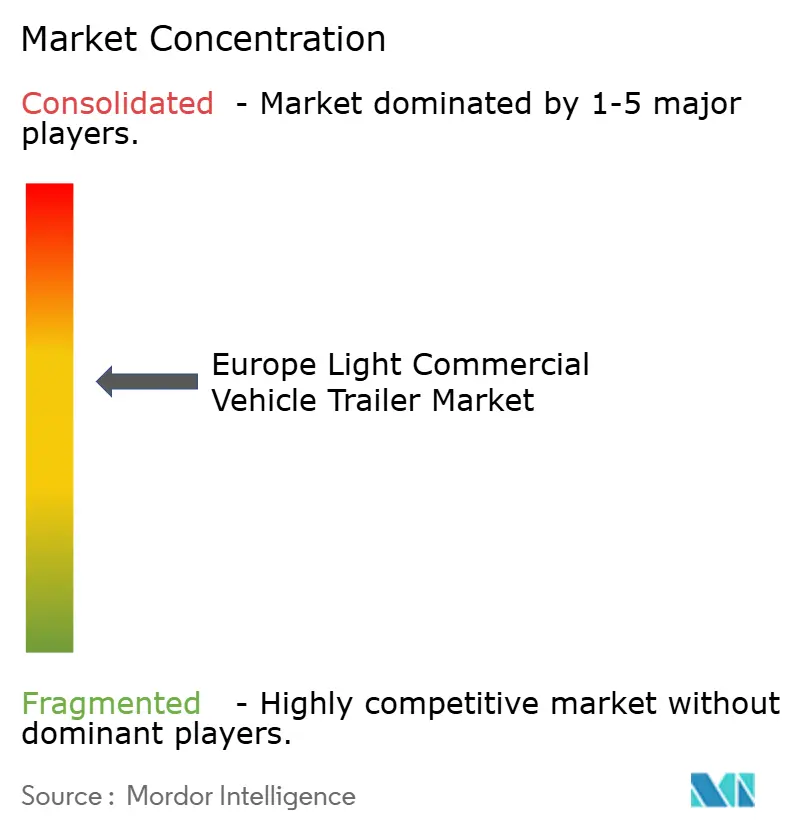
| Market Concentration | Medium |
Major Players *Disclaimer: Major Players sorted in no particular order Image © Mordor Intelligence. Reuse requires attribution under CC BY 4.0. | |
Europe Light Commercial Vehicle Trailer Market Analysis by Mordor Intelligence
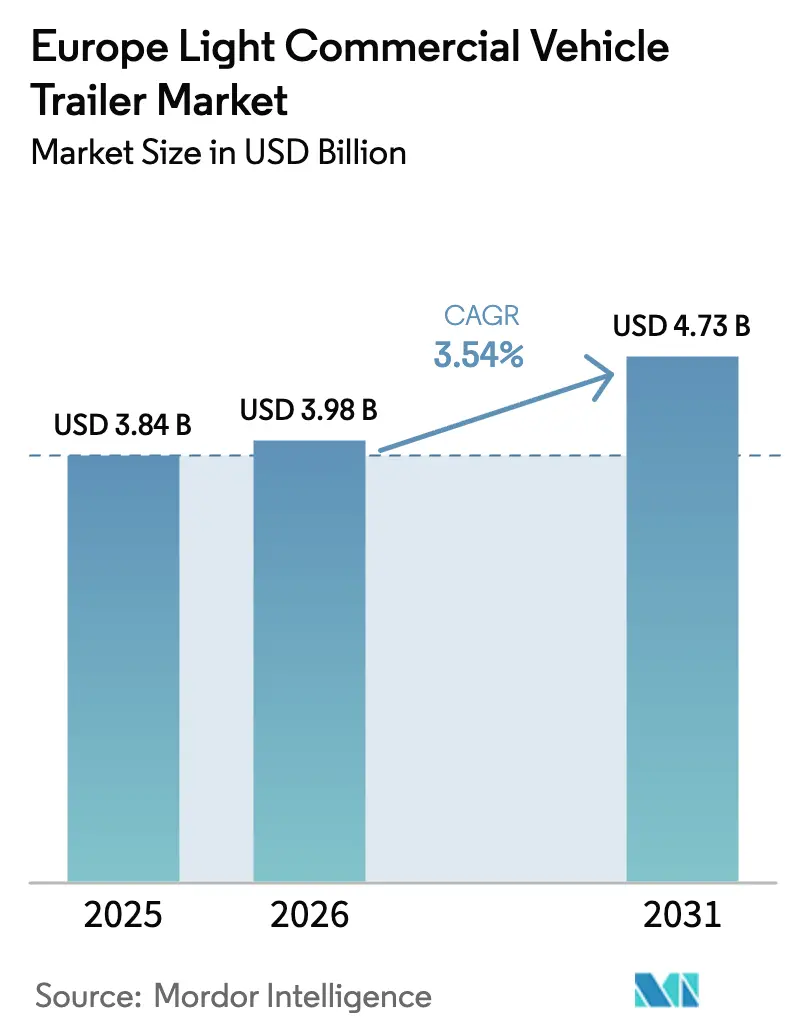
Europe light commercial vehicle trailer market size in 2026 is estimated at USD 3.98 billion, growing from 2025 value of USD 3.84 billion with 2031 projections showing USD 4.73 billion, growing at 3.54% CAGR over 2026-2031. Growth rests on the steady expansion of e-commerce fulfillment networks, tighter CO₂ targets that reward lightweight construction, and urban access rules that push fleet operators toward compact, highly maneuverable trailer formats. Structural upgrades in pan-European micro-fulfillment logistics, rapid cold-chain expansion for pharmaceuticals and perishables, and rising adoption of telematics-enabled fleet management tools deepen market penetration. At the same time, material cost volatility and diesel price swings constrain margins and lengthen replacement cycles, leading many operators to favor leasing over outright purchases. Competitive focus is shifting from basic manufacturing efficiency to integrated digital services and regulatory compliance features that reduce the total cost of ownership.
Key Report Takeaways
- By application, Dry Box held 36.78% of the Europe light commercial vehicle trailer market share in 2025, while Refrigeration is accelerating at a 7.68% CAGR through 2031.
- By trailer GVWR, units up to 3.5 t captured a 51.85% share of the Europe light commercial vehicle trailer market in 2025 and are projected to grow at a 6.25% CAGR to 2031.
- By axle configuration, tandem-axle designs led with 41.72% of the Europe light commercial vehicle trailer market in 2025, whereas single-axle models recorded the highest projected CAGR of 5.78% through 2031.
- By ownership model, fleet-owned assets accounted for 61.74% of the Europe light commercial vehicle trailer market in 2025; leased or rental fleets showed the fastest expansion at 5.21% CAGR to 2031.
- By end-user industry, parcel and logistics operators secured 33.88% of the Europe light commercial vehicle trailer market in 2025; food and beverage demand is set to rise at a 5.28% CAGR through 2031.
- By country, Germany retained 25.10% of the Europe light commercial vehicle trailer market in 2025, while Spain is forecast to climb at a 6.37% CAGR over the forecast period.
Note: Market size and forecast figures in this report are generated using Mordor Intelligence’s proprietary estimation framework, updated with the latest available data and insights as of 2026.
Europe Light Commercial Vehicle Trailer Market Trends and Insights
Drivers Impact Analysis*
| Driver | (~) % Impact on CAGR Forecast | Geographic Relevance | Impact Timeline |
|---|---|---|---|
| E-Commerce Parcel Boom | +0.8% | Global, with concentration in Germany, Netherlands, United Kindom | Medium term (2-4 years) |
| CO₂ Standards Pushing Lightweight | +0.6% | Europe-wide, strongest in Germany, France, Netherlands | Long term (≥ 4 years) |
| Urban Access Rules Favoring Small Trailers | +0.5% | Major Europe cities, early adoption in London, Paris, Amsterdam | Short term (≤ 2 years) |
| LCV Fleet Electrification Requiring Lightweight Solutions | +0.4% | Northern Europe, Netherlands, Norway, Germany | Long term (≥ 4 years) |
| Pan-EU Micro-Fulfilment Networks Expanding Rapidly | +0.3% | Core Europe markets, spill-over to Eastern Europe | Medium term (2-4 years) |
| OEM-Agnostic Telematics Bundling Trailers | +0.2% | Germany, United Kingdom, France with expansion to Southern Europe | Medium term (2-4 years) |
| Source: Mordor Intelligence | |||
E-Commerce Parcel-Volume Boom
Surging online sales radically reshape route density and shipment profiles across Europe. Parcel networks now value maneuverability and rapid load-unload capability more than bulk cubic capacity, so fleet managers shift toward curtain-sided and short dry-box formats that fit narrow urban corridors. Micro-fulfillment nodes inside metro areas drive demand for small trailers capable of multiple daily turns. Operators also favor telematics subscriptions that streamline route planning and location-based maintenance, reinforcing the need for digitally enabled trailer platforms.
Tightening CO₂ standards driving lightweight materials
EU Regulation 2019/1242 obliges manufacturers to cut fleetwide CO₂ emissions 15% by 2025 and 30% by 2030 against 2019 baselines[1]“Regulation 2019/1242 on CO₂ Standards,”, European Parliament, europarl.europa.eu. Compliance drives fast adoption of aluminum skins, high-tensile steels, and composite panels that shave 200-300 kg from typical curb weights. Aluminum producer price indices are increasing, sustaining cost pressure even as demand rises. Weight savings also cut toll charges under the revised Eurovignette directive, making lightweight trailers financially attractive despite higher material costs. Ongoing policy discussions to achieve a 90% emission reduction by 2040 further secure the long-run case for lightweight construction.
Urban Delivery-Access Regulations Favoring Small Trailers
Dozens of European cities enforce low-emission or zero-emission zones with weight restrictions limiting heavy rig access. London’s expanded ULEZ and Paris’ ZFE-m rules exemplify this tilt toward lighter equipment. Under Directive 96/53/EC amendments, electric delivery combinations may exceed standard gross weights by 1-2 t without losing urban privileges, encouraging sub-3.5 t trailers matched to electric vans. As cities tighten curfews and loading-bay windows, small trailers able to turn rapidly and park within tight confines offer a tangible operational edge.
Electrification of LCV Fleets Requiring Lightweight Trailer Solutions
Battery packs reduce towing capacity by 200-400 kg relative to diesel counterparts, so fleets migrating toward electric vans require ultra-light, aerodynamically efficient trailers. The International Council on Clean Transportation projects total cost-of-ownership parity for battery-electric urban delivery trucks between 2025 and 2028 in most major EU cities, making electrified fleets commercially viable[2]“Battery-Electric Urban Delivery Trucks TCO Outlook,”, International Council on Clean Transportation, theicct.org. Trailer builders respond with insulated body shells under 800 kg, low-rolling-resistance axles, and integrated power systems for refrigeration or liftgates. Some OEMs also embed charge-through cabling to share grid connections between tractor and trailer, aligning with the Alternative Fuels Infrastructure Regulation that mandates public chargers at 60 km intervals on core TEN-T corridors.
Restraints Impact Analysis*
| Restraint | (~) % Impact on CAGR Forecast | Geographic Relevance | Impact Timeline |
|---|---|---|---|
| Aluminum and Steel Price Surge | -0.4% | Europe-wide, strongest impact in manufacturing hubs Germany, Italy | Short term (≤ 2 years) |
| Volatile Diesel Prices Reducing Fleet CAPEX | -0.3% | Europe-wide, varying by national fuel taxation policies | Short term (≤ 2 years) |
| Supply-Chain Disruptions and Chassis Shortages Persist | -0.2% | Germany, Eastern Europe production corridors | Medium term (2-4 years) |
| Insurance Premiums Rising for Articulated LCV | -0.15% | United Kingdom, Netherlands, high-density urban markets | Short term (≤ 2 years) |
| Source: Mordor Intelligence | |||
Soaring Aluminum and Steel Prices
Trailer manufacturers grapple with aluminum price swings, tightening margins, and complicating procurement. As raw material costs rise, producers have slightly hiked list prices. Yet, diminished purchasing power among smaller fleet operators curtails the extent of these price hikes, exerting pressure throughout the value chain. Geopolitical events, notably European sanctions on Russian aluminum, have heightened supply constraints. In response, manufacturers are pursuing long-term contracts and diversifying their sourcing, albeit at the cost of added logistical challenges.
Volatile Diesel Costs Reducing Fleet CAPEX
Road freight operators across Central Europe grapple with mounting financial pressures due to fuel price volatility and escalating toll charges. Diesel prices have seen wide fluctuations, influenced by changes in global crude benchmarks and national tax policies. Given that fuel constitutes a significant portion of operating expenses, unexpected price surges compel many carriers to prolong the use of their current vehicles and postpone purchases of new trailers.
In Austria, introducing new toll surcharges and sharp hikes in CO₂-based fees have further squeezed profit margins. Smaller operators, often with limited financial leeway, are increasingly opting for rental models rather than capital-intensive purchases. Without clearer visibility on fuel costs, the sector's investment enthusiasm will likely remain tepid.
*Our forecasts treat driver/restraint impacts as directional, not additive. The impact forecasts reflect baseline growth, mix effects, and variable interactions.
Segment Analysis
By Application: Cold Chain Drives Premium Growth
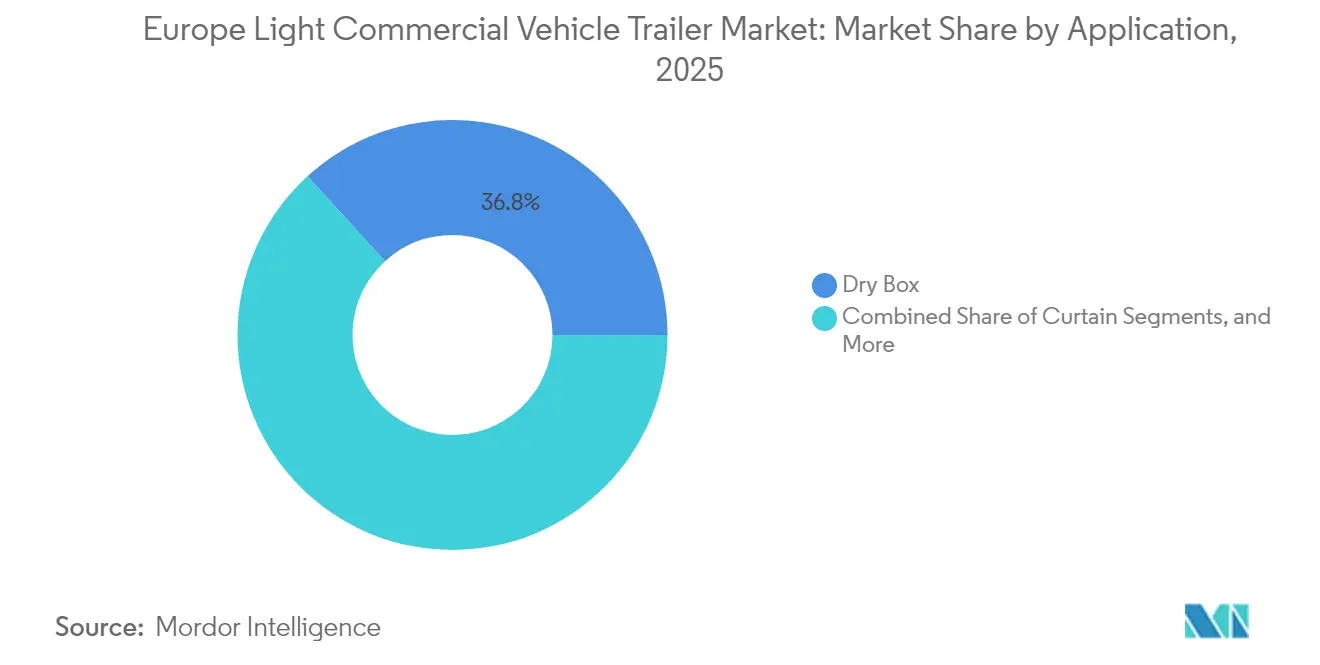
Dry Box bodies retained their workhorse status, holding 36.78% of the Europe light commercial vehicle trailers market share in 2025 and serving general freight from parcel hubs to industrial intermediaries. Curtain-siders remain popular in multipurpose operations demanding side loading, whereas platform and car-carrier variants address niche needs tied to construction and automotive logistics. The premium pricing power of refrigerated trailers offsets higher production costs, making the sub-segment a profit pool for builders with cold-chain expertise.
Refrigeration units contributed the fastest expansion to the European light commercial vehicle trailers market, rising at a 7.68% CAGR through 2031 on the back of booming pharmaceutical and fresh-food demand. The segment benefits from direct-to-consumer grocery platforms and stricter Good Distribution Practice guidelines that specify temperature validation and real-time tracking. New designs such as Schmitz Cargobull’s S.Ko COOL integrate battery-electric refrigeration and solar-assisted chargers, reflecting the convergence of cold-chain requirements with electrification imperatives.



By Trailer GVWR: Urban Access Favors Light Category
Units up to 3.5 t commanded 51.85% of the Europe light commercial vehicle trailers market share in 2025 and are projected to grow at a 6.25% CAGR to 2031, reflecting the strong regulatory push for lighter combinations in congestion-charging zones. These trailers align perfectly with electric vans whose homologated towing limits rarely exceed 1.6 t, and they qualify for lower MAUT distance charges in Germany. Mid-weight trailers between 3.5-7 t maintain balanced payload and volume for regional deliveries, while heavy-duty models above 7 t serve construction and cross-border bulk freight.
Growing metropolitan zero-emission corridors intensify the business case for sub-3.5 t rigs. Fleets also appreciate lower insurance premiums and simpler driver licensing, since many EU states exempt lighter combinations from Class C qualification. Builders offer modular chassis that can be re-rated upward when used outside restricted zones, adding resale flexibility.
By Axle Configuration: Single-Axle Gains Urban Advantage
Tandem-axle bodies hold 41.72 % of the Europe light commercial vehicle trailers market share in 2025. Yet, single-axle trailers notch the highest growth rate at 5.78% through 2031, as city operations require tight turning circles. A single axle cuts tare weight by 120-150 kg, freeing extra payload for parcels or chilled goods. Cost advantages extend to tire wear and brake-service intervals, bringing total ownership savings close to 8% over a five-year lease cycle. New Dutch regulations allow night-time delivery only with noise-optimized equipment, and single-axle designs meet these criteria more easily because of reduced brake and suspension mass.
Multi-axle variants still serve high-density loads like construction panels or modular homes where weight distribution matters. However, tolling schemes that charge per axle further tilt economics toward lighter layouts in general freight.
By Ownership Model: Leasing Flexibility Accelerates
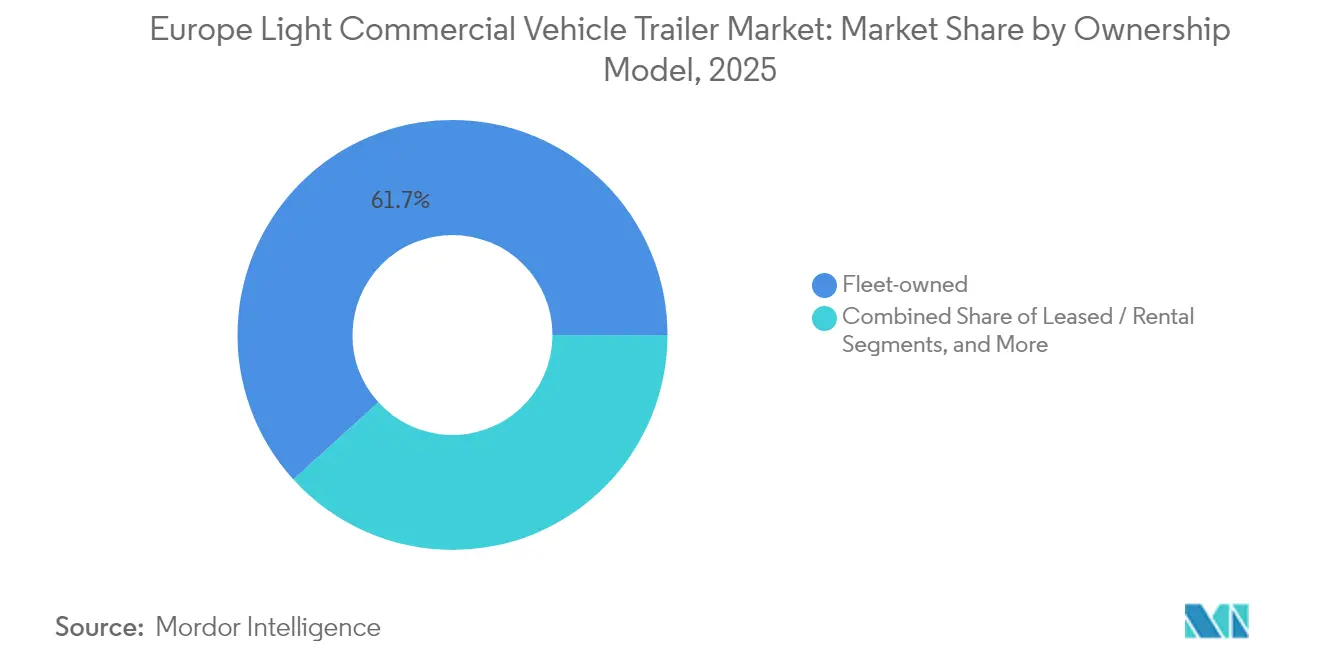
Fleet-owned assets dominated in 2025 with 61.74% of the Europe light commercial vehicle trailers market, but leasing’s 5.21% CAGR through 2031 underscores rising uncertainty over material prices and regulatory trajectories. Long-term leases bundle preventive maintenance, tire replacement, and telematics subscriptions, converting unpredictable costs into fixed monthly fees. Manufacturers also deploy buy-back clauses that guarantee residual values, mitigating depreciation risk when regulations evolve. Large 3PLs now negotiate five-year master leases covering thousands of trailers with shared data dashboards, allowing fine-grained asset rotation between depots.
Rental uptake thrives among seasonal operators in agriculture and retail peaks and small carriers hedging against fuel price volatility. As lightweight composite bodies carry higher up-front prices, capital-intensive ownership gives way to OPEX-oriented leasing that spreads cash obligations.
By End-User Industry: Food Sector Leads Growth
Parcel and logistics networks accounted for 33.88% of the Europe light commercial vehicle trailers market share in 2025, mirroring shopper preferences for next-day delivery and returns processing. However, the food and beverage segment logs the fastest trajectory at 5.28% CAGR through 2031, as grocers and meal-kit providers roll out temperature-certified micro-hubs. Pharmaceutical wholesalers deepen their GDP compliance by adding redundant cooling systems and real-time temperature logs, translating into higher-value equipment orders.
Construction material shippers maintain a solid baseline thanks to public works spending under national recovery plans, while agriculture shows cyclical swings tied to harvest intensity. Retail and FMCG fleets pivot toward omnichannel replenishment, blending store delivery with e-commerce collection points that favor smaller, more frequent loads.
Geography Analysis
Germany anchored 25.10% of the Europe light commercial vehicle trailers market share in 2025, leveraging dense autobahn links and a mature supplier base centered in North Rhine-Westphalia. Facing financial pressures and uncertain operating costs, Haulers are delaying fleet renewals, which softens domestic demand for semitrailers. Registration data highlights a pronounced downward trend, underscoring a widespread trend of postponing replacements. This is especially evident among smaller operators grappling with fuel volatility and narrow profit margins.
Spain is the fastest-growing geography, charting a 6.37% CAGR to 2031. Investments in Mediterranean port logistics and cross-border trade routes with North Africa expand trailer turnover, while EU cohesion funds modernize road links into Castilla-La Mancha and Aragón. Spanish cold-chain warehouses also multiply near Valencia and Barcelona, stimulating refrigerated trailer demand.
Despite a notable rise in business insolvencies in late 2024, France's road transport sector has shown resilience, maintaining stable freight activity. On the other hand, the UK is still wrestling with the administrative challenges posed by Brexit, which have severely limited international logistics. Yet, a boom in domestic parcel deliveries has provided some relief, helping to mitigate the downturn in cross-border trade.
Collectively, the rest of Europe—led by Poland, Czechia, and the Baltics—is capturing growing assembly investment as OEMs diversify away from high-energy-cost Western plants.
Regulatory Landscape
EU type-approval and safety compliance shape trailer design and market access across Europe, anchored by Regulation (EU) 2019/2144 (General Safety Regulation 2) and UNECE WP.29 regulations that are incorporated into EU technical requirements. These rules affect trailer categories O, including trailer equipment and fitment requirements, and push manufacturers to embed compliant hardware and documentation into standard builds rather than relying on market-specific adaptations.
Decarbonization-related obligations are tightening in parallel through Regulation (EU) 2019/1242 (and its updates), alongside the expansion of CO2-related monitoring and simulation frameworks that link trailer performance to combination energy use. Operational compliance is also building through enforcement milestones, including the July 2026 registration-related technical specification deadlines for certain trailer categories and the July 2026 extension of smart tachograph requirements to light commercial vehicles in international carriage, which feed into specification choices and cross-border utilization.
Value Chain Analysis
The value chain covers raw materials (steel, aluminum, composites, insulation panels), axles and braking systems, couplers, body fabrication and assembly, and finishing (including coatings aligned with REACH-related chemical restrictions), before moving into distribution through dealer networks and direct sales to fleets, leasing companies, and rental operators. Volatility in aluminum and steel, plus intermittent chassis and component constraints, has increased the importance of multi-sourcing and longer-term supply agreements. At the same time, lightweighting and aerodynamic packages are shifting from optional upgrades to core engineering priorities as CO2 accounting frameworks tighten.
Downstream, procurement and utilization are moving toward service-led models, with large fleet and leasing buyers bundling trailers with telematics, maintenance, and uptime commitments. This increases the influence of digital platforms and aftermarket support on purchasing decisions. On the manufacturing and supplier side, VECTO-based trailer CO2 treatment has become a recurring industry topic, with public positions from major European trailer OEM groups (including Schmitz Cargobull and KRONE peers) highlighting the growing weight of compliance engineering, validation data, and software integration alongside fabrication scale.
Competitive Landscape
Competitive intensity remains moderate. Schmitz Cargobull, riding on its robust production legacy and cutting-edge digital solutions, maintains a significant position in the regional semitrailer market. The company has rolled out integrated telematics solutions by collaborating with platforms such as Webfleet and Frotcom. These innovations boost fleet visibility and operational efficiency and deepen customer loyalty. Furthermore, Schmitz Cargobull's achievement of producing two million axles is a testament to its manufacturing prowess and trustworthiness[3]“Annual Report 2024,”, Schmitz Cargobull, cargobull.com.
KRONE reinforces its position via a telematics alliance with RIO, a subsidiary of Traton, granting live data feeds to joint customers across Germany and Austria. Schwarzmüller invests in its SWIT digital suite, rolling out predictive maintenance algorithms that cut downtime. Medium-sized firms such as Ifor Williams, which gain turnover through livestock and plant trailers specialization, are the least affected by long-haul freight cycles.
Mergers focus on capability expansion: OEMs increasingly view digital services as profit multipliers, so many acquire niche telematics firms to secure recurring revenue streams. The competitive field thus tilts toward a blend of hardware excellence and software ecosystems that lock in customers over multiyear lease contracts.
Europe Light Commercial Vehicle Trailer Industry Leaders
Böckmann Fahrzeugwerke GmbH
Debon Trailers
Humbaur GmbH
Indespension Ltd.
Ifor Williams Trailers Ltd
- *Disclaimer: Major Players sorted in no particular order

Market Opportunities and Future Outlook
Efficiency requirements tied to regulation create a practical opportunity for trailer designs that reduce energy use in combinations, which is shifting demand toward lightweight structures, improved aerodynamics, and performance attributes that can be verified digitally. The introduction of trailer CO2 targets under Regulation (EU) 2024/1610 (starting 2030 for new trailers, assessed via VECTO-Trailer) provides a specific compliance anchor, strengthening product differentiation for low-weight bodies and axle and rolling-resistance optimization, including connected configurations that can document usage and maintenance history for TCO-focused buyers.
Electrification-linked trailer innovation is moving beyond concept through type-approval progress and visible product pipelines, including e-trailers with onboard batteries, e-axles, and regenerative functions, as discussed in industry roadmaps (ERTRAC, April 2026), alongside company plans such as Trailer Dynamics adding an eCurtainsider and an electric refrigerated trailer to its eBox offering in 2H 2026. Meanwhile, cold-chain and pharma distribution needs keep refrigeration upgrades high on the agenda, with demand also building for integrated energy management, including battery-electric refrigeration concepts already visible in European offerings. With more activity shifting to operating leases and rental fleets, buyers increasingly look for standardized telematics, fast parts availability, and warranty-backed uptime, which benefits manufacturers that can pair hardware with scalable digital and aftermarket service capability.
Recent Industry Developments
- July 2026: Boeckmann Fahrzeugwerke GmbH re-launched its Champion trailer series, including the Champion C and Champion R models. The update refreshes a high-volume product line with current configurations, helping dealers standardize spec selection and supporting faster order conversion in retail and light commercial use cases.
- September 2025: Sono Solar (Sono Group N.V.) and Mitsubishi Heavy Industries Thermal Transport Europe (MTTE) launched a solar-powered system for electric trailer refrigeration units, combining MTTE's TEF1500 eTRU and battery pack with Sono Solar photovoltaic modules and charge control. The integration targets reduced grid dependency and improved operating autonomy for temperature-controlled operations, aligning cold-chain trailer specifications with electrified fleet strategies.
- July 2024: Regulation (EU) 2024/1610 was adopted, establishing CO2 reduction targets for new trailers from 2030 using the VECTO-Trailer simulation approach. The policy milestone accelerates OEM focus on aerodynamic and lightweight technologies and raises the value of validated efficiency features in trailer sourcing decisions.


Research Methodology Framework and Report Scope
Market Definition and Coverage
This market covers revenue earned from trailers used with light commercial vehicles across Europe, counted at the point of sale for the trailer itself, including new trailers used for cargo, service, and specialized transport needs.
Scope exclusions: We exclude heavy truck focused semi-trailers, passenger car caravans, and downstream services such as financing, insurance, and routine repair labor.
Segmentation Overview
- By Application
- Curtain
- Refrigeration
- Dry Box
- Flat-bed / Platform
- Tippers
- Car Transporter
- Other Applications
- By Trailer GVWR
- Up to 3.5 t
- 3.5 - 7 t
- Above 7 t
- By Axle Configuration
- Single-axle
- Tandem-axle
- Multi-axle
- By Ownership Model
- Fleet-owned
- Leased / Rental
- Private / Owner-operator
- By End-user Industry
- Parcel and Logistics
- Construction and Building Materials
- Food and Beverage
- Retail and FMCG
- Agriculture and Livestock
- Others
- By Country
- United Kingdom
- Germany
- France
- Italy
- Spain
- Russia
- Sweden
- Denmark
- Estonia
- Rest of Europe
Data Sources, Market Sizing, and Validation
Desk Research
Desk research starts with building a clean fact base on trailer production and demand signals across Europe, and then mapping how these signals translate into LCV trailer shipments and prices. Public sources are used to anchor definitions and time series, such as Eurostat manufacturing and trade data, national vehicle registration authorities, European Commission transport and road safety publications, and UNECE vehicle regulation documents. We also review customs and trade classifications where relevant, and we cross-check with association publications (for example, trailer or bodywork associations) plus company annual reports, product catalogs, and investor presentations.
To reduce missed players and keep country splits realistic, we also use paid subscriptions for company financials and intelligence, plus news and financials, and then compare them with reported capacity moves and product mix changes. Where gaps show up in publicly available statistics (for example, where trailer categories are broader than LCV needs), those assumptions are flagged for primary validation. The sources listed above are illustrative only, and many other public and paid sources were also used to collect data, validate it, and clarify open points.
Primary Interviews and Surveys
Primary work focuses on speaking with trailer manufacturers, distributors and dealers, fleet operators, rental and leasing participants, and end users in sectors like parcel delivery and construction. We use these discussions to validate average selling prices, country level demand shifts, the share of specialized bodies (such as refrigerated and curtain), and how regulations and payload needs are influencing replacement cycles. Because the scope is Europe, we balance feedback across major Western markets and faster changing Central and Eastern markets, so the model reflects purchasing behavior in each region rather than only production location.
Distribution of primary research fieldwork respondents
| Company type | Respondent position |
|---|---|
| Top tier: 29% | CXOs: 13% |
| Mid tier: 51% | Functional/Unit leaders: 38% |
| Smaller Players: 20% | Managers: 49% |
Market-Sizing & Forecasting
Sizing starts with a top-down build where production, trade flows, and country demand signals are used to reconstruct an addressable trailer pool linked to LCV usage. Those totals are then checked using selective bottom-up approximations, such as sampling high frequency trailer categories, applying typical price bands by application, and doing channel checks on shipment direction and inventory turns. Where countries have limited public splits between trailer sub-types, we fill the gap using a small set of harmonized ratios that are validated through interviews and then stress-tested against registration and trade movements.
Inputs used in the model include light commercial vehicle parc and new registrations, logistics and last mile activity indicators, construction and small business operating trends, the mix shift between box, curtain, tipper and refrigerated bodies, and observed steel and component cost direction that influences price progression. Forecasting uses scenario analysis supported by exponential smoothing on country demand series, and the final path is adjusted only when interview feedback indicates structural changes such as regulation driven weight limits or a sustained change in replacement timing. This keeps the forecast practical and traceable to observable variables that can be refreshed each year.
Data Validation & Update Cycle
Validation is done through repeated cross-checks, where market totals are compared with independent signals such as manufacturing output, import and export direction, and country level registration or parc movement proxies. If any country shows a sudden step change that cannot be explained by trade or demand indicators, the assumption is reopened and respondents are re-contacted to confirm if it was a one-time contract, a price spike, or a classification issue. Before sign-off, the model goes through multi-step analyst review so arithmetic, unit consistency, and currency conversions are checked in a consistent way.
The report is refreshed on an annual cycle, and interim updates are made when material events occur, such as regulatory changes, supply constraints, or major capacity additions that impact shipments or pricing. Right before delivery, we run a fresh pass on key inputs so clients receive an updated view aligned with the latest public releases and verified market feedback.
Mordor Intelligence's Europe Light Commercial Vehicle Trailer Market Sizing Compared With Other Published Estimates
Published market values for Europe LCV trailers often do not match because firms choose different year anchors, trailer definitions, and price build-ups, and these choices can shift the final number more than the growth rate. Differences also appear when some sources blend light and heavy trailer categories, or when they treat trade values and end-market sales values as the same thing.
Some published figures lean on a broad trailer and semi-trailer definition and then apply a single average price assumption across vehicle classes. In Mordor Intelligence, the count is limited to light commercial vehicle trailer revenue in Europe, and the pricing is built by application mix and country realities, which reduces inflation from heavy-duty products and non-comparable value layers.
Benchmark comparison
| Source | Market Size | Gaps in Research Methodology |
|---|---|---|
| Mordor Intelligence | USD 3.98 B (2026) | |
| Global Consultancy A | USD 4.50 B (2024) | Uses an earlier base year and tends to apply a higher growth profile into the outer years, with limited transparency on how trailer application mix and country price bands were handled. |
| Trade Data Publisher B | USD 97.90 B (2035) | Tracks trailers and semi-trailers as a broad goods transport category, and the value is presented in nominal terms, which makes it not directly comparable to an LCV-trailer-only revenue model. |
Looking across the figures, the spread is mainly explained by product scope and the value layer being measured, and then by which year is chosen for the starting point. By keeping the model tied to observable demand signals, application-level pricing, and repeatable country checks, the estimate stays easier to reconcile and to update when new data comes out.


Key Questions Answered in the Report
What is the current value of the European light commercial vehicle trailers market?
The European light commercial vehicle trailers market is valued at USD 3.98 billion in 2026 and is forecast to reach USD 4.73 billion by 2031.
Which application segment is growing fastest?
Refrigerated trailers lead growth with a 7.68% CAGR thanks to expanding cold-chain needs in pharmaceuticals and fresh food.
How do EU CO₂ rules influence trailer design?
Regulation 2019/1242 and VECTO measurement link tolls and fleet targets to trailer weight, driving rapid adoption of lightweight materials.
What factors are driving trailer leasing demand?
Material price volatility, electrification uncertainties, and the need for telematics upgrades encourage operators to favor flexible lease arrangements.
Which country offers the highest growth outlook?
Spain shows the highest CAGR at 6.37% through 2031, underscored by port logistics investments and expanding Mediterranean trade flows.
Page last updated on:





