
Market Overview
| Study Period | 2021 - 2031 |
|---|---|
| Forecast Data Period | 2026 - 2031 |
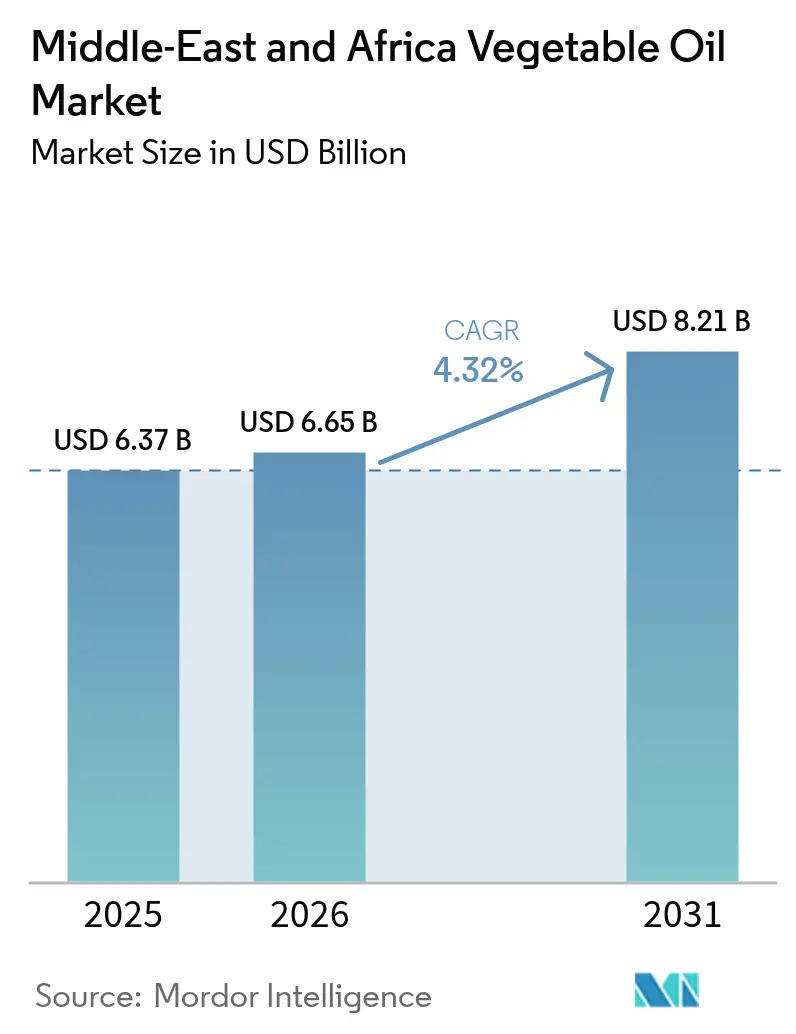
| Base Year Market Size (2025) | USD 6.37 Billion |
| Market Size (2026) | USD 6.65 Billion |
| Market Size (2031) | USD 8.21 Billion |
| Growth Rate (2026 - 2031) | 4.32 % |
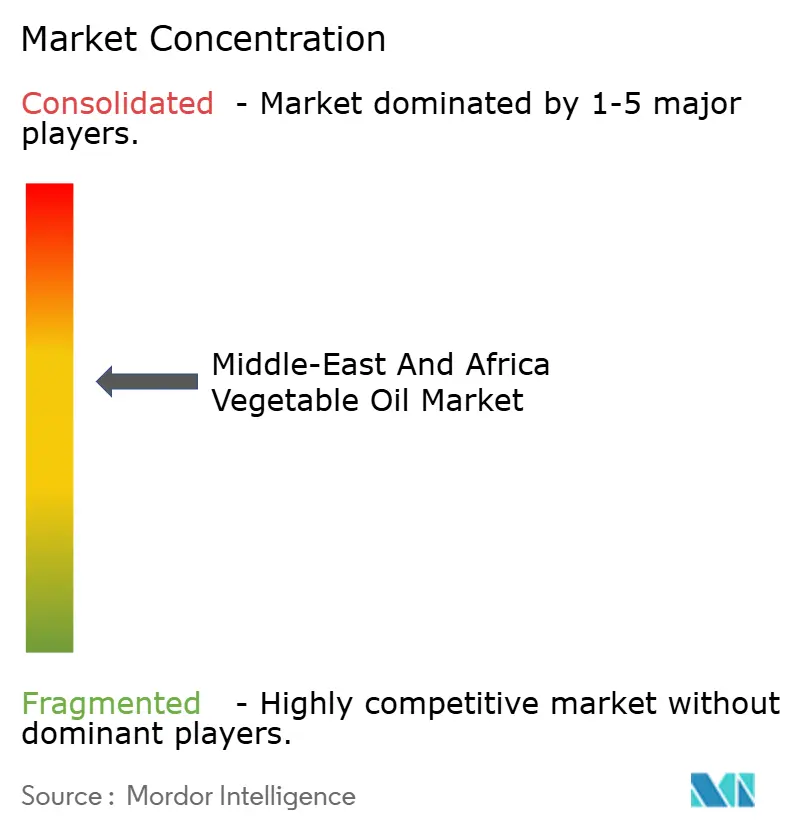
| Market Concentration | Medium |
Major Players *Disclaimer: Major Players sorted in no particular order Image © Mordor Intelligence. Reuse requires attribution under CC BY 4.0. | |
Middle-East And Africa Vegetable Oil Market Analysis by Mordor Intelligence
Middle East and Africa vegetable oil market size in 2026 is estimated at USD 6.65 billion, growing from 2025 value of USD 6.37 billion with 2031 projections showing USD 8.21 billion, growing at 4.32% CAGR over 2026-2031. Robust urban population growth, a widening middle-income base, and the region’s role as a strategic transit corridor for global vegetable oil shipments continue to propel demand. Government food-security agendas, most visibly in Saudi Arabia, the UAE, and Egypt, encourage domestic crushing and refining projects that shorten supply chains and soften currency-driven import pressures. Momentum is reinforced by quick-service restaurant expansion, surging biofuel mandates, and stepped-up investment in alternative logistics corridors that mitigate Red Sea risks. Layered on top is a marked consumer tilt toward oils with favorable fatty-acid profiles, a shift that is elevating sunflower oil without dislodging price-advantaged palm oil from its leading position.
Key Report Takeaways
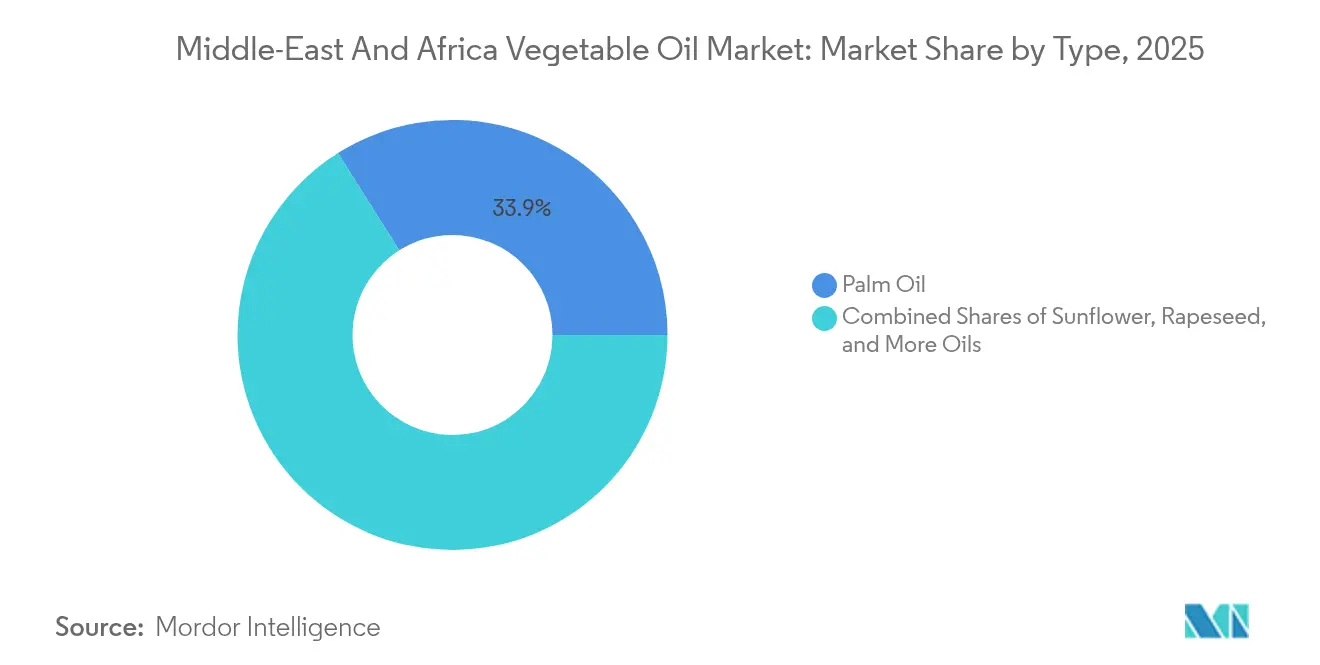
- By type, palm oil captured 33.94% of the Middle East and Africa vegetable oil market share in 2025, and sunflower oil is projected to achieve a 5.27% CAGR to 2031.
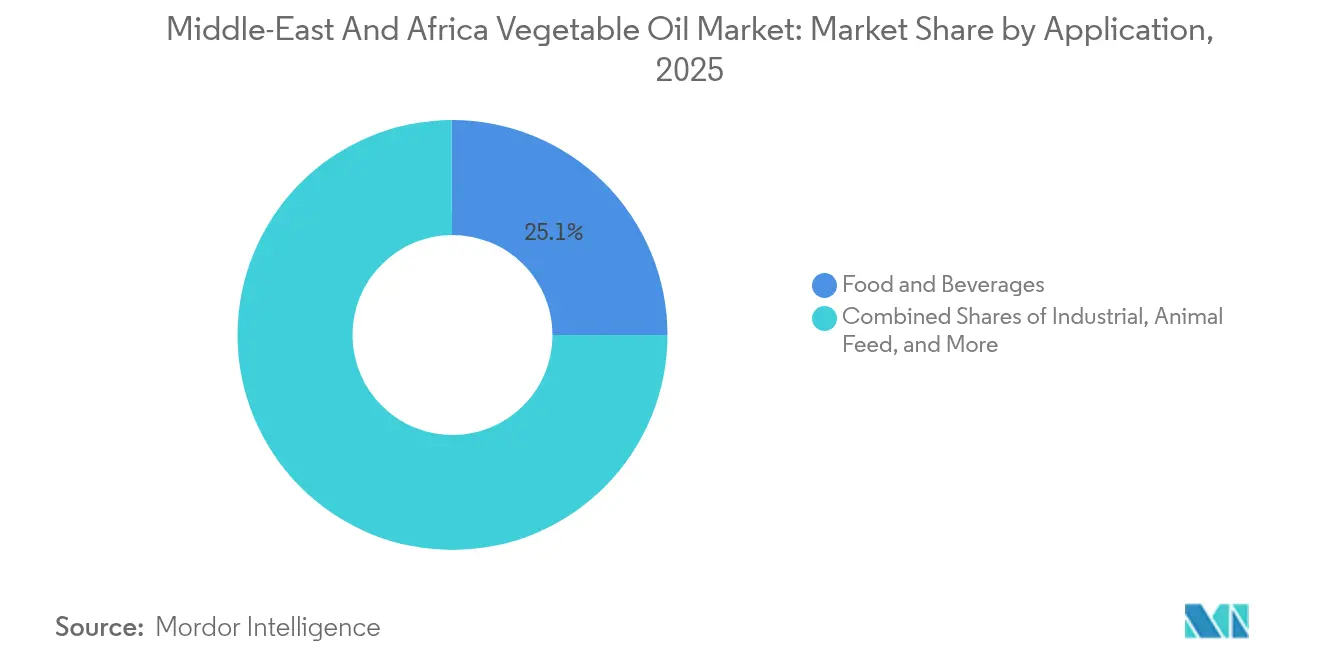
- By application, food and beverages accounted for 25.08% of the Middle East and Africa vegetable oil market share in 2025, whereas the industrial segment is advancing at a 5.92% CAGR through 2031.
- By geography, South Africa led with 34.05% market share in 2025, while Nigeria is on track for the fastest 6.66% CAGR through 2031.
Note: Market size and forecast figures in this report are generated using Mordor Intelligence’s proprietary estimation framework, updated with the latest available data and insights as of 2026.
Market Trends and Insights
Drivers Impact Analysis of Middle-East And Africa Vegetable Oil Market*
| Drivers | (~) % Impact on CAGR Forecasts | Geographic Relevance | Impact Timeline |
|---|---|---|---|
| Increasing demand for cooking oils and processed foods | +1.2% | Global, with highest impact in Nigeria, Egypt, Saudi Arabia | Medium term (2-4 years) |
| Government initiatives supporting local production | +0.8% | Saudi Arabia, UAE, Egypt, Nigeria | Long term (≥ 4 years) |
| Expansion of food service and hospitality industries | +0.7% | UAE, Saudi Arabia, South Africa, Turkey | Short term (≤ 2 years) |
| Technological advancements in refining, processing, and packaging | +0.5% | South Africa, UAE, Saudi Arabia | Medium term (2-4 years) |
| Rising applications in biofuels and other applications | +0.6% | South Africa, Nigeria, Egypt | Long term (≥ 4 years) |
| Expanding strategic trade and logistics hubs | +0.4% | UAE, Saudi Arabia, Egypt, Djibouti | Medium term (2-4 years) |
| Source: Mordor Intelligence | |||
Increasing Demand for Cooking Oils and Processed Foods
Urban populations in key markets across the Middle East and Africa have exceeded 60%, driving significant changes in consumption patterns. This shift has led to increased demand for convenience foods and premium cooking oils. Nigeria's population is expected to reach 440 million by 2050, resulting in a growing need for affordable vegetable oils. Concurrently, rising disposable incomes are creating opportunities for value-added products. In the Gulf Cooperation Council countries, the processed food sector is expanding rapidly, fueled by changing lifestyles and a large expatriate population, which is boosting demand for international cuisine ingredients and specialty oils. In Kenya, government efforts to cut cooking oil imports by 50% through enhanced local production highlight how demographic changes are shaping policy decisions and transforming supply chains, as noted by the USDA Foreign Agricultural Service[1]. These demographic trends present a dual opportunity: increased demand for basic cooking oils and a shift toward premiumization in processed food applications. This development has significant implications for refining capacities and distribution networks across the region.
Government Initiatives Supporting Local Production
Governments worldwide are addressing strategic food security concerns by significantly increasing investments in domestic vegetable oil production. This shift comes as nations confront the risks of import-dependent supply chains, highlighted by recent global disruptions. For instance, the UAE's Comprehensive Economic Partnership Agreement with Indonesia not only facilitates palm oil trade but also strengthens the UAE's domestic refining capacity, led by entities like ADVOC and supported by the UAE Ministry of Economy[2]. Similarly, Egypt is offering incentives for biodiesel production facilities to reduce import dependency while enhancing renewable energy feedstock production. In Uganda, government-backed processing infrastructure, as revealed by an edible oil industry mapping, aims to transition the country from a raw material exporter to a value-added producer, potentially altering regional trade patterns. These initiatives signify a critical shift from trade-reliant strategies to production-oriented food security approaches, creating opportunities for technology transfer partnerships and joint ventures between international stakeholders and local manufacturers. Additionally, Iran's success in reducing trans fats through domestic fractionation technology highlights how government-driven programs can achieve both health improvements and industrial advancements.
Expansion of Food Service and Hospitality Industries
Gulf states are witnessing a surge in demand for food service-grade vegetable oils as they recover from the pandemic and implement economic diversification strategies. Dubai and Riyadh are positioning themselves as global hospitality hubs, driving the need for advanced supply chain solutions. This growth is not confined to traditional tourism markets. Nigeria's expanding quick-service restaurant industry and South Africa's established food service infrastructure are fueling demand for specialized products such as high-stability frying oils and portion-controlled packaging. Similarly, Ghana's hospitality sector highlights the broader potential in West Africa, where urbanization and a growing middle class are increasing the demand for processed food inputs and cooking oils in commercial applications, as noted by the USDA Foreign Agricultural Service. These trends are particularly important as food service applications typically offer higher profit margins and require advanced supply chain capabilities. This complexity creates barriers to entry, benefiting established players with strong distribution networks.
Rising Applications in Biofuels and Other Applications
Renewable energy mandates and climate commitments across the region are significantly boosting the demand for vegetable oils as biodiesel feedstock. The UAE's initiatives in converting waste cooking oil into biodiesel highlight the sector's potential within a circular economy, as noted by the UAE Ministry of Energy and Infrastructure. Similarly, South Africa's biofuel industry development efforts and Egypt's biodiesel investment incentives reflect governmental recognition of the strategic importance of vegetable oils beyond food applications. This shift is creating new revenue opportunities for producers and processors. The industrial applications segment demonstrates increasing demand for bio-based lubricants, cosmetic ingredients, and specialty chemicals derived from vegetable oils. This trend is driven by sustainability regulations that prioritize renewable feedstocks over petroleum-based alternatives. Nigeria, with its abundant palm oil resources, is well-positioned to meet domestic biofuel demand and capitalize on export opportunities in markets with renewable fuel mandates.
Restraints Impact Analysis of Middle-East And Africa Vegetable Oil Market*
| Restraints | (~) % Impact on CAGR Forecasts | Geographic Relevance | Impact Timeline |
|---|---|---|---|
| Heavy dependence on imports exposes the market to price and supply fluctuations | -1.1% | Egypt, Nigeria, Saudi Arabia, UAE | Short term (≤ 2 years) |
| Volatility of raw material prices | -0.9% | Global, with highest impact in import-dependent markets | Short term (≤ 2 years) |
| Health concerns over certain oils high in saturated fats | -0.4% | Saudi Arabia, UAE, South Africa | Medium term (2-4 years) |
| Technological disruption with alternative edible oils or substitutes capturing market share | -0.3% | South Africa, UAE, Saudi Arabia | Long term (≥ 4 years) |
| Source: Mordor Intelligence | |||
Heavy Dependence on Imports Exposes the Market to Price and Supply Fluctuations
Egypt's recent supply crisis, caused by global export bans, highlights the region's susceptibility to external shocks due to its significant dependence on imported vegetable oils. Red Sea shipping disruptions have altered trade patterns, forcing importers to bear an additional USD 1 million per round trip for Cape of Good Hope routing and extending delivery times by 10-14 days, according to the Centre for Economic Policy Research. The concentration of global vegetable oil production in a few countries creates systemic risks. Disruptions such as Ukraine's sunflower oil supply issues and Indonesia's intermittent palm oil export restrictions demonstrate how geopolitical events can impact regional supply chains. Import-dependent markets face challenges from currency volatility and commodity price fluctuations. Local currency depreciation exacerbates the effect of global price increases on domestic consumers. To address this vulnerability, there is a growing shift toward regional sourcing and increasing domestic production. However, the substantial capital and time required for these transitions leave markets temporarily exposed to ongoing supply chain disruptions.
Volatility of Raw Material Prices
Renewable fuel mandates are driving new demand sources, with CME Group data revealing a stronger correlation between energy prices and vegetable oil futures, highlighting increased commodity price volatility. Weather-related production disruptions in major growing regions, coupled with inventory speculation and financial market activity, are causing price fluctuations that challenge traditional procurement and pricing strategies for regional processors and distributors. The financialization of commodity markets has expanded the factors influencing vegetable oil prices, moving beyond basic supply and demand to include currency fluctuations, energy prices, and macroeconomic policy decisions in leading economies. Regional processors often face margin pressures as raw material costs rise faster than they can adjust finished product prices, particularly in markets with price-sensitive consumers and limited capacity to pass on cost increases. This volatility is prompting greater investment in risk management capabilities and supply chain diversification. Simultaneously, companies with advanced forecasting and hedging expertise are capitalizing on opportunities to gain competitive advantages through more stable pricing strategies.
*Our forecasts treat driver/restraint impacts as directional, not additive. The impact forecasts reflect baseline growth, mix effects, and variable interactions.
Middle-East And Africa Vegetable Oil Market Segment Analysis
By Type:
Palm Oil Dominance Faces Sunflower ChallengeIn 2025, palm oil holds a significant 33.94% market share, driven by its cost-efficiency and adaptability across various applications, including food processing and industrial uses. However, its leading position faces growing challenges from health-conscious consumers and advocates for sustainability. Sunflower oil, although more expensive than palm oil, is projected to grow at an impressive 5.27% CAGR through 2031, reflecting a shift in consumer preferences toward oils with healthier fatty acid profiles and cleaner production processes. Soybean oil continues to see stable demand in food manufacturing, while rapeseed oil caters to niche markets, particularly in premium cooking and specialty food products.
Regulatory frameworks are playing an increasingly pivotal role in shaping competition among oil types. For example, the World Health Organization's initiative to eliminate trans fats is driving the industry away from partially hydrogenated oils and toward naturally stable alternatives. Additionally, oils such as coconut, cottonseed, and olive target specialized segments where premium positioning and distinct nutritional profiles command higher margins. However, their growth is limited by supply constraints and price sensitivity. The growing preference for sunflower oil reflects broader health-conscious trends and the influence of European dietary preferences in urban markets. This shift creates opportunities for suppliers capable of ensuring consistent quality and reliable supply chains, even amid geopolitical disruptions affecting traditional sunflower oil exporters.

By Application:
Industrial Segment Drives Future GrowthIn 2025, food and beverage applications hold a significant 25.08% market share, spanning from everyday cooking oils to specialized ingredients for processed foods. This highlights the sector's critical role in regional nutrition and food security. The industrial segment, with an impressive 5.92% CAGR, stands out as the market's fastest-growing area. This growth is driven by biofuel mandates, renewable energy initiatives, and the increasing use of bio-based chemicals and lubricants, leveraging the sustainable properties of vegetable oils. Within the food and beverage sector, categories such as dairy, bakery and confectionery, snacks, and meat products have distinct requirements for oil functionality and quality.
Personal care and cosmetics are benefiting from rising consumer interest in natural ingredients and sustainability. At the same time, the animal feed sector provides a consistent demand base, mitigating the impact of production fluctuations and price volatility. The industrial segment's growth is further supported by government policies promoting renewable energy and circular economy principles. Efforts like waste cooking oil collection and biodiesel production not only support sustainability but also create new value streams within the vegetable oil supply chain, as noted by the UAE Ministry of Energy and Infrastructure. Furthermore, technical and specialty applications are emerging as promising areas for innovation, enabling the development of unique value propositions and premium pricing opportunities.
Geography Analysis
Africa Vegetable Oil Market
In 2025, South Africa holds a leading 34.05% market share, driven by its advanced refining infrastructure and well-established distribution networks. These networks support both domestic consumption and exports across sub-Saharan Africa. The country's strong regulatory framework and high-quality standards attract international partnerships and technology transfers. Additionally, South Africa's diversified economy ensures consistent demand across food service, retail, and industrial sectors. Nigeria, Africa's most populous nation, is experiencing a notable 6.66% CAGR projected through 2031. This growth is propelled by urbanization rates exceeding 50% and a growing middle class, which is fueling significant demand for processed foods and cooking oils. Nigeria's abundant palm oil resources and government initiatives promoting local production create opportunities for import substitution and value-added processing. However, market participants face challenges related to infrastructure limitations and regulatory complexities.
EMEA Vegetable Oil Market
Turkey's strategic location, bridging European and Middle Eastern markets, positions it as both a processing hub and a distribution center for regional vegetable oil flows. This advantage is supported by Turkey's advanced manufacturing capabilities and favorable trade agreements. Egypt, with its large domestic market, also serves as a key distribution hub for North African markets. However, recent supply chain disruptions have exposed vulnerabilities associated with import-dependent strategies. In Saudi Arabia and the UAE, premium markets are characterized by health-conscious consumers and a sophisticated food service sector, driving demand for specialty oils and value-added products. At the same time, government-led food security initiatives are fostering investments in domestic production and processing. The broader Middle East and Africa region features diverse markets, ranging from Morocco's established olive oil traditions to Kenya's emerging processing capabilities. Each market offers unique opportunities and challenges, requiring localized strategies and partnerships. Disruptions in Red Sea shipping have accelerated the development of alternative trade routes and regional processing capabilities. These changes are reshaping traditional supply chain dynamics and introducing new competitive landscapes. The region's collective growth reflects broader economic progress, infrastructure development, and regulatory harmonization efforts, which are creating more integrated and efficient vegetable oil markets that extend beyond traditional geographic boundaries.
Regulatory Landscape
Regulation in the Middle East and Africa vegetable oil market is shaped by health-driven composition rules, fortification mandates, and labeling requirements that vary by country while drawing on regional standards bodies. In the GCC, the Saudi Food and Drug Authority (SFDA) enforces Gulf standards such as GSO 2483 for trans fatty acids, which prohibits partially hydrogenated oils (PHOs), alongside GSO 2233 requirements for nutritional labeling. Together, these rules influence formulation choices and push refiners toward naturally stable alternatives.
Several large African markets add country-specific compliance anchors that affect product design and quality control. Nigeria, through NAFDAC, requires mandatory Vitamin A fortification for vegetable oils (minimum 20,000 IU/kg) under its Fats and Oils Regulations 2019, making premix procurement and verification integral to importing and local packing. In Southern Africa, DALRRD oversight under the Agricultural Product Standards Act (No. 119 of 1990) supports grading and marking controls, and South Africa also moved forward with draft regulations for edible vegetable oils (public consultation circulated in January 2025). North Africa tightened frying-oil quality parameters as Morocco issued an implementation decree in December 2025 updating quality, safety, and labeling rules for vegetable oils and fats (excluding olive and argan), including a 25% polar compound limit for frying oils.
Value Chain Analysis
The value chain starts with upstream oilseed and oil-bearing feedstocks sourced through imports and domestic farming (notably palm in West Africa and oilseeds such as soybean and sunflower in parts of Eastern and Southern Africa), followed by primary aggregation, crushing, refining, fractionation, and packaging. Large multinational and regional groups (including Cargill, Wilmar, ADVOC, Savola, and IFFCO) span trading, refining, and branded or industrial distribution, while food manufacturers, QSR chains, and industrial users (biofuels, oleochemicals, personal care) anchor demand. Port-based logistics and storage infrastructure remain central to throughput in import-dependent markets, and deep-water corridors and industrial zones support bulk handling that feeds local refining and packing.
Midstream processing capacity expansion and partnership-led market access shape how value is captured, particularly where governments push food-security-linked local production. Eni’s entry into certified vegetable oil supply chains in Africa highlights an industrial channel tied to biofuel feedstock security: in June 2025, Eni inaugurated a vegetable oil extraction plant in Loudima (Republic of the Congo) with 30,000 metric tons per year capacity and also announced industrial-scale export of vegetable oil from Côte d’Ivoire produced from rubber tree residues. In the Middle East, Dubai continues to function as a relationship and distribution hub for agribusinesses, reinforced by Golden Agri-Resources establishing a Dubai office in 2024 to build regional partnerships. Upstream bottlenecks persist around smallholder productivity, collection economics, and last-mile transport, which is why enabling infrastructure programs such as Uganda’s National Oilseeds Project road rehabilitation initiative are positioned to reduce farm-to-crusher friction and improve feedstock reliability for processors.
Competitive Landscape
The vegetable oil market in the Middle East and Africa is moderately concentrated, offering opportunities for consolidation and strategic alliances. Global players compete with established regional leaders to expand market share and strengthen supply chain control. Companies like Cargill, Wilmar, and Bunge utilize their global sourcing expertise and advanced processing technologies to serve large-scale customers. In contrast, regional players such as ADVOC, Savola Group, and IFFCO Group leverage their deep understanding of local markets, extensive distribution networks, and strong government relationships.
A growing trend is the focus on vertical integration and enhancing supply chain resilience. Firms are investing in upstream production, improving logistics infrastructure, and exploring alternative sourcing strategies to mitigate risks exposed by recent global disruptions. Technology adoption is becoming a key competitive factor in the industry. Leading companies are investing in advanced refining technologies, automated packaging systems, and digital supply chain management tools to enhance efficiency, improve product quality, and reduce operational costs.
White-space opportunities are emerging in specialized segments such as biofuels, cosmetic ingredients, and premium cooking oils, where innovation and product development can drive unique value propositions and premium pricing. Bunge's integrated approach, spanning sourcing to refining, reflects this shift. Their sustainability initiatives, including achieving 100% traceability of soy in priority Brazilian regions by the end of 2024, illustrate how regulatory compliance and ESG commitments are evolving into competitive advantages. Additionally, alternative protein companies and biotechnology firms are developing novel oil sources, but their impact remains limited in the short term due to challenges related to scale and cost.
Middle-East And Africa Vegetable Oil Industry Leaders
-
Cargill, Incorporated
-
Sime Darby Plantation Berhad
-
Wilmar International Limited
-
ADVOC (ABU DHABI VEGETABLE OIL COMPANY)
-
Savola Group
- *Disclaimer: Major Players sorted in no particular order
Middle-East And Africa Vegetable Oil Market Companies Covered in this Report
- Cargill Incorporated
- Wilmar International
- ADVOC (Abu Dhabi Vegetable Oil Company)
- Sime Darby Plantation Berhad
- Amira Nature Foods Ltd
- Omani Vegetable Oils & Derivatives Co. LLC
- AJWA Group
- Archer Daniels Midland Co. (ADM)
- Savola Group
- IFFCO Group
- Bunge Limited
- Louis Dreyfus Company (LDC)
- Olam International Limited
- Golden Agri-Resources Ltd
- Rafael Salgado S.A.
- Near East Olive Product
- Al Reef for Vegetable Oils
- United Foods Company
- Al Ghurair
- Fuji Oil Co. Holdings
Read Analysis of Middle-East And Africa Vegetable Oil Companies
Market Opportunities and Future Outlook
Local refining and crushing investments are creating whitespace in import-substitution and industrial oil supply across the region, especially where food-security agendas and industrial feedstock needs intersect. West Africa is seeing commissioning activity tied to edible oil self-sufficiency: in January 2026, Mavamar Industries SA commissioned a 600 ton-per-day vegetable oil refinery in Sendou, Senegal (reported investment of USD 109.5 million), and in April 2026, Olam Agri commissioned a USD 50 million soybean crushing and feed milling facility in Kwara State, Nigeria, with annual capacity cited at 250,000 to 350,000 metric tonnes. These projects widen local availability of refined oils and oil meals, and they increase demand for refining technology, packaging formats suited to retail and food service, and structured procurement models to secure consistent oilseed supply.
Policy-led incentives and tighter quality rules also open opportunities for compliant formulations and higher-spec supply chains rather than purely commodity trading. Tanzania’s 2026/2027 budget measures, including VAT exemptions for locally produced edible oil and a 10% customs duty on crude edible oil imports, signal support for domestic value addition and can shift economics toward local refining. On the demand side, health and safety compliance requirements (including PHO prohibitions under GCC-aligned standards and Morocco’s updated frying-oil quality parameters issued in December 2025) support higher-stability frying oils, improved labeling, and stronger QC and traceability at refineries and packers. For suppliers and processors, near-term opportunity concentrates on (i) port-proximate refining and storage, (ii) premium and specialty fats and oils for food manufacturing and food service, and (iii) industrial applications where waste-oil collection and biodiesel incentives create additional offtake channels.
Recent Industry Developments in Middle-East And Africa Vegetable Oil Market
- July 2026: The UAE Ministry of Economy and Tourism reviewed production and distribution operations at Abu Dhabi Vegetable Oil Company (ADVOC), underscoring its role in national food supply readiness. The update highlighted ADVOC’s operational scale, including annual capacity exceeding 200,000 metric tonnes and storage capacity exceeding 40,000 metric tonnes. Continued public-sector engagement reinforces the importance of large local refiners and packers in buffering import disruptions and supporting regional distribution.
- May 2026: IHC Food Holding acquired a 75% controlling stake in Abu Dhabi Vegetable Oil Company (ADVOC) for AED 91 million (about USD 24.7 million) as part of a settlement agreement involving Dubai Islamic Bank. The transaction consolidates ownership around a strategic UAE edible oil platform with established refining, packing, and distribution footprint. It also signals continued corporate restructuring and capital rotation in the Gulf’s food manufacturing base.
- May 2024: Wilmar Edible Oil Refineries completed the first phase of its edible oils refining plant (Wilmar Processing SA) in the Richards Bay Industrial Development Zone (RBIDZ) Special Economic Zone, South Africa. The site benefits from Richards Bay’s deep-water port connectivity, including direct pipeline linkage to a tank farm for efficient receipt of imported crude oils. This investment strengthens South Africa’s role as a regional processing and redistribution hub and supports higher-throughput, lower-friction logistics for refined oil supply.
Middle-East And Africa Vegetable Oil Market Report Scope and Research Methodology
Market Definition and Coverage
For this study, the market is defined as the value of vegetable oils sold for food and non-food uses across Middle East countries, counted at the point where oils enter commercial channels through producers, refiners, or importers.
Scope exclusions: It excludes non-vegetable fats and oils, and it also excludes informal and household-level oil production that is not sold through recorded trade or organized retail.
Segments Covered in This Report
- Type
- Palm Oil
- Soybean Oil
- Rapeseed Oil
- Sunflower Oil
- Other Oil Types (Cottonseed Oil, Olive Oil, Coconut Oil)
- Application
- Food and Beverages
- Dairy products
- Bakery and Confectionery
- Snacks and Savory Products
- Meat Products
- Other Types
- Personal Care and Cosmetics
- Animal Feed
- Industrial
- Other Applications
- Food and Beverages
- Geography
- Saudi Arabia
- South Africa
- Turkey
- Nigeria
- Egypt
- Rest of Middle East and Africa
Data Sources, Market Sizing, and Validation
Desk Research
Desk research was used to build the fact base around supply, trade, and end-use demand signals that move vegetable oil volumes in the Middle East. We relied on public sources such as FAOSTAT and UN Comtrade for production and import patterns, the USDA Oilseeds: World Markets and Trade release for oilseed and oil balances, and OECD-FAO Agricultural Outlook tables for direction on consumption and food-use trends. Where national level clarity was needed, government customs dashboards, central bank trade statistics, and food security or agriculture ministry publications were reviewed (depending on what each country publishes in English or Arabic).
To connect these macro signals to company activity, annual reports and investor presentations from major listed processors and distributors were checked, along with association websites and reputable press for capacity expansions, refinery starts, and policy changes like tariffs or subsidy revisions. We also used paid databases for company financials and news screening, plus a shipment-level import/export database to sanity-check major trade routes and product codes when public tables were delayed. The desk sources mentioned here are illustrative only, and many other public documents and datasets were also reviewed for data collection, cross-checking, and clarification.
Primary Interviews and Surveys
Primary work was used to pressure-test pricing, channel margins, substitution patterns between oil types, and the pace of demand shifts in foodservice versus packaged foods. We spoke with a mix of refiners, importers, distributors, large buyers, and industry advisers across key consuming and trading hubs in the Middle East, and then used follow-up questions to close gaps found in secondary data. Insights from these conversations were applied to validate assumptions on utilization, average selling prices, and how quickly policy and currency moves are reflected in local market prices.
Distribution of primary research fieldwork respondents
| Company type | Respondent position |
|---|---|
| Top tier: 37% | CXOs: 13% |
| Mid tier: 48% | Functional/Unit leaders: 27% |
| Smaller Players: 15% | Managers: 60% |
Market-Sizing & Forecasting
Sizing starts with a top-down build where trade and domestic supply signals are reconstructed into an addressable consumption pool by country, and then translated into value using observed price levels for major oil types. We set the country totals first, and only then distributed them across the main oils and applications to keep the model anchored to what can be validated externally.
Key inputs used in the model include import volumes by oil type, local refining and crushing capacity additions, apparent consumption signals (supply minus exports), population and per-capita edible oil availability trends, and price indicators that reflect crude vegetable oil and refined oil spreads. When pricing is volatile, our model uses a blended average selling price approach that reflects product mix and timing, instead of applying one flat price across the year. Results are corroborated with selective bottom-up checks such as sampled supplier revenue ranges, channel markups shared by distributors, and application splits validated by large buyers.
For forecasting, scenario analysis is used because demand and prices are shaped by policy moves, freight and currency swings, and substitution between palm, sunflower, soybean, and olive oils. Expert feedback is used to set realistic ranges for penetration shifts, trade flows, and expected price normalization, and then the forecast is rolled forward year by year with those drivers. Where bottom-up inputs are missing for smaller countries, we fill gaps through proxy indicators like import dependency, consumption per capita, and similarity to peer markets, and then the totals are rechecked against regional aggregates.
Data Validation & Update Cycle
Validation is done by comparing the model outputs with independent signals such as trade totals, capacity announcements, and price movements observed in public statistics and market commentary. Outliers are flagged when country totals move faster than what imports, refinery runs, or demand indicators can support, and those areas are reviewed again before final sign-off.
We also run consistency checks across oil types so substitution effects remain realistic, especially in years with large sunflower or palm price swings. If large variances are found, follow-up calls are triggered with industry contacts to confirm whether the change is structural or timing-related. Reports are refreshed annually, and interim updates are made when major events materially affect supply, pricing, or policy, followed by a final pre-delivery review to keep the numbers current.
Mordor Intelligence's Middle East Vegetable Oil Market Size Versus Other Published Estimates
Published market sizes for vegetable oil in the Middle East often do not match because the boundaries are not identical, and the pricing assumptions can vary across sources. Differences usually show up in whether the scope is limited to edible oils, how the region is defined, and which conversion and averaging rules are used for USD values.
Non-edible vegetable oils used mainly in industrial or feed applications are sometimes folded into the total, but they sit outside Mordor Intelligence's scope in this report, which keeps the number tied to the commercially traded vegetable oil pool tracked through imports, domestic supply, and application-level demand checks. Gaps also come from the year used for pricing, whether exchange rates are averaged or taken at a point in time, and how quickly a publisher refreshes assumptions after policy shifts or freight changes.
Benchmark comparison
| Source | Market Size | Gaps in Research Methodology |
|---|---|---|
| Mordor Intelligence | USD 6.37 B (2025) | |
| Industry Association A | USD 5.90 B (2025) | Uses a narrower product list focused on staple edible oils and applies conservative pricing that dampens the value impact of premium oils and branded retail mixes. |
| Trade Journal B | USD 7.10 B (2025) | Broadens the scope to include additional non-edible and industrial-grade vegetable oil uses, and it applies higher average prices without clearly showing country-level mix or timing. |
The spread in the table is mainly explained by what is included in the product and application scope, and by how the average price is constructed for the year. By keeping inputs traceable to trade-linked volumes, realistic mix splits, and confirmable price logic, the model produces a practical number that can be repeated and stress-tested as new data is released.
Key Questions Answered in the Report
What is the 2026 value of the Middle East and Africa vegetable oil market?
The market is valued at USD 6.65 billion in 2026.
Which country currently leads regional share?
South Africa leads with a 34.05% share in 2025.
Which oil type is growing fastest?
Sunflower oil shows a forecast 5.27% CAGR through 2031.
Why are logistics hubs important?
New hubs in Djibouti, Saudi Arabia, and Egypt shorten lead times, diversify routes, and enable value-added processing.