
Microscopy Device Market Size and Share
Market Overview
| Study Period | 2020 - 2031 |
|---|---|
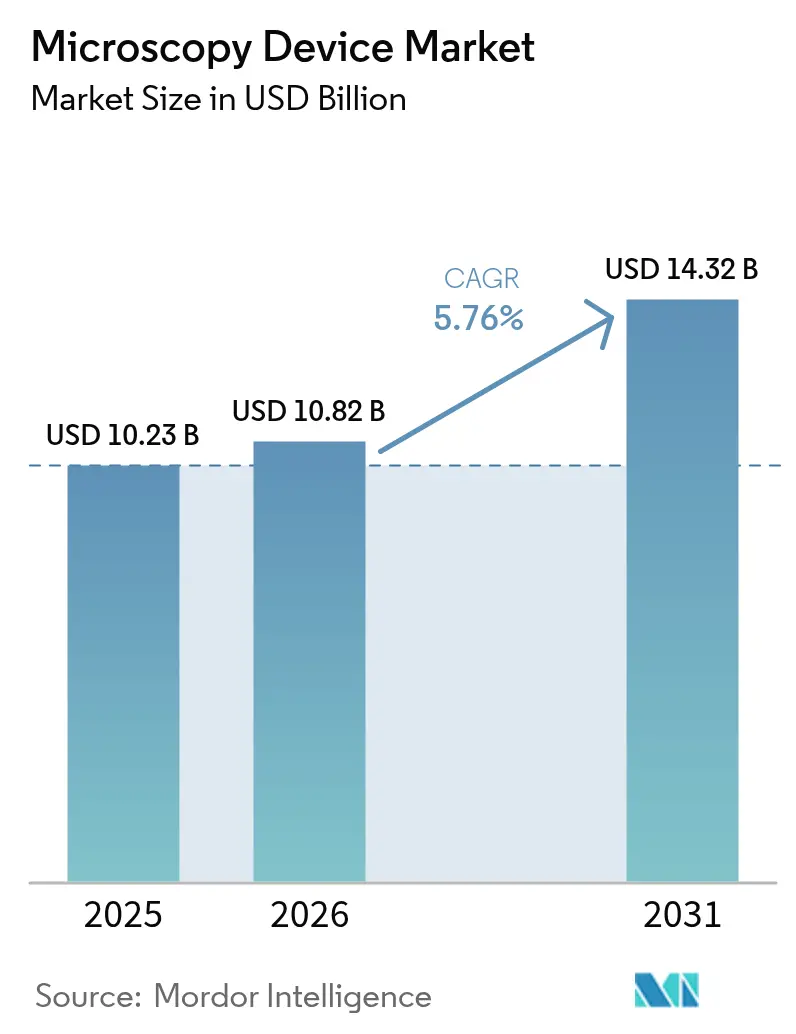
| Market Size (2026) | USD 10.82 Billion |
| Market Size (2031) | USD 14.32 Billion |
| Growth Rate (2026 - 2031) | 5.76 % |
| Fastest Growing Market | Asia-Pacific |
| Largest Market | North America |
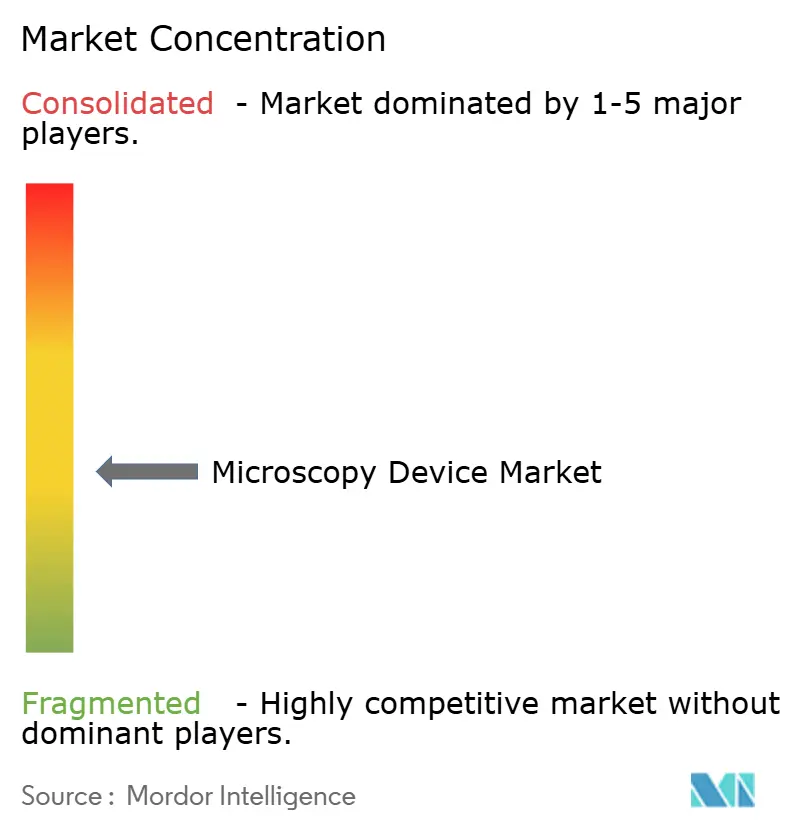
| Market Concentration | Medium |
Major Players *Disclaimer: Major Players sorted in no particular order Image © Mordor Intelligence. Reuse requires attribution under CC BY 4.0. | |
Microscopy Device Market Analysis by Mordor Intelligence
The Microscopy Device Market size is projected to be USD 10.23 billion in 2025, USD 10.82 billion in 2026, and reach USD 14.32 billion by 2031, growing at a CAGR of 5.76% from 2026 to 2031.
Growth reflects three linked shifts, including gate-all-around transistor roadmaps that demand sub-nanometer metrology in semiconductor fabs, the spread of desktop cryogenic electron microscopy for structure-based drug discovery, and AI-augmented digital pathology replacing manual slide reading in hospitals and labs. On the product front, optical systems maintained the most extensive installed base due to clinical and educational volumes, while electron microscopy is gaining share as lower-priced cryo-EM systems reach mid-tier institutions. Competitive intensity remains high as leading vendors integrate software and consumables to lock in workflows while specialist players target high-value niches.
Key Report Takeaways
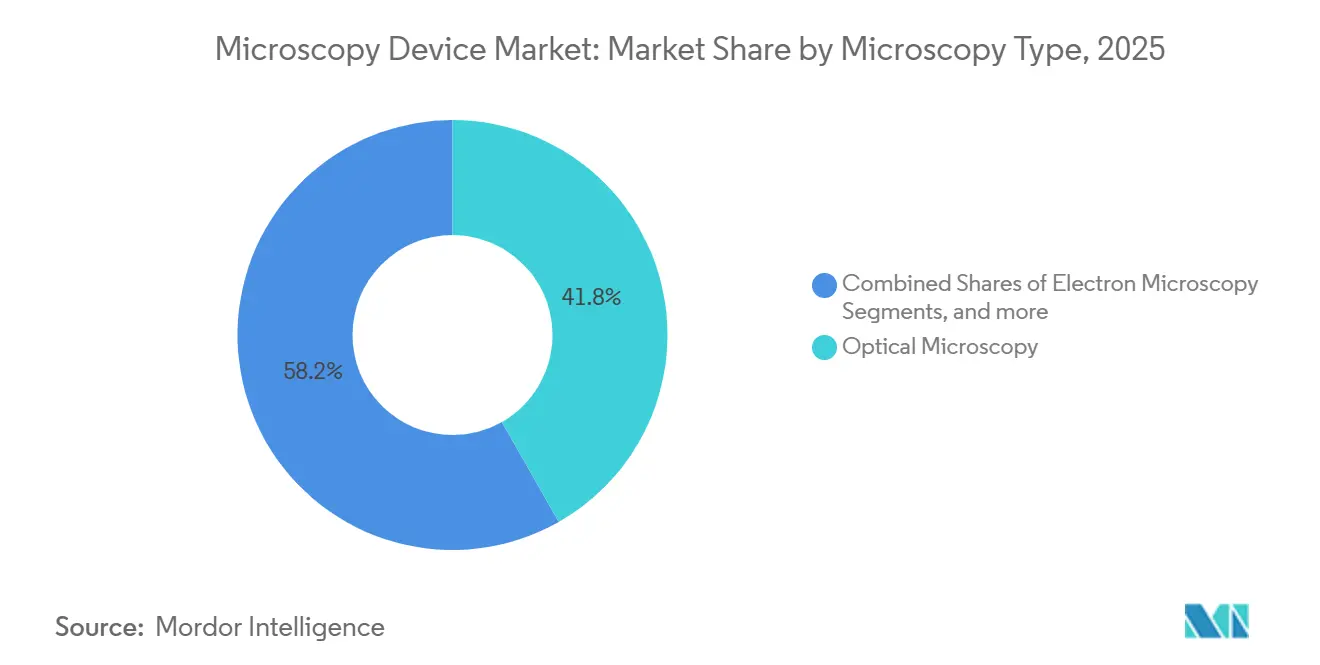
- By microscopy type, optical microscopy led with 41.78% revenue share in 2025; electron microscopy is forecast to expand at a 6.56% CAGR to 2031.
- By application, life science accounted for a 34.08% share in 2025; nanotechnology research is projected to grow at a 6.59% CAGR through 2031.
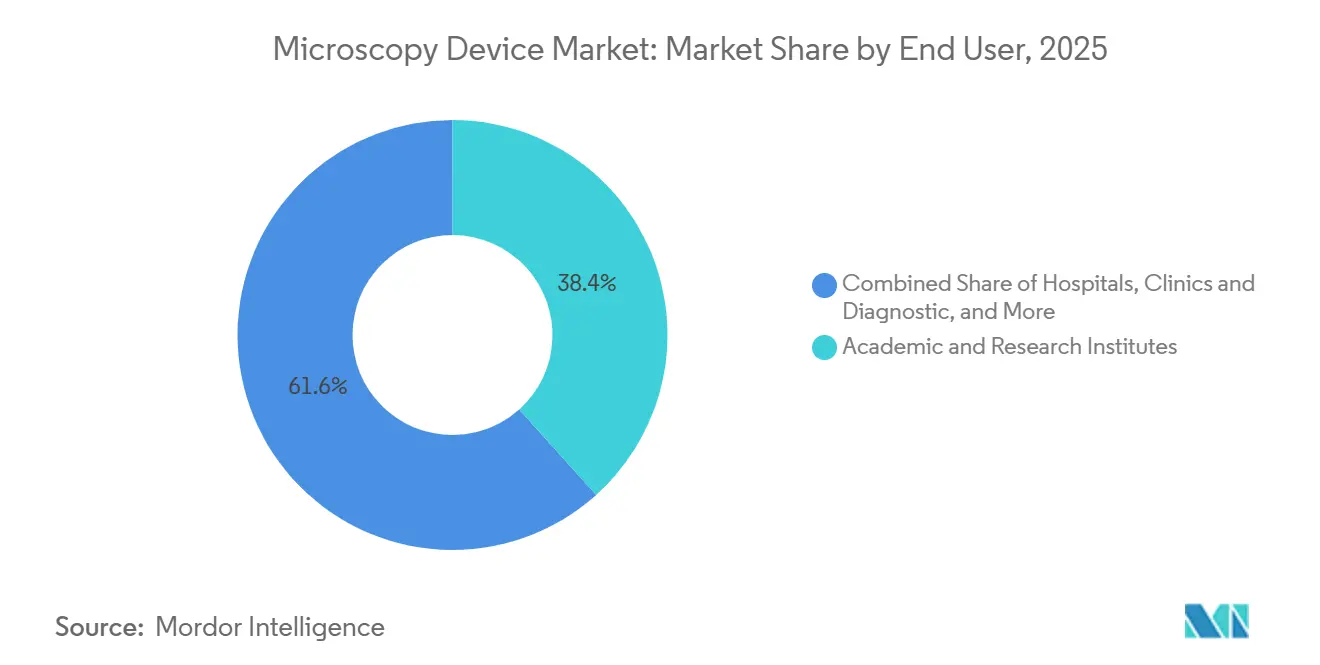
- By end user, academic and research institutes accounted for 38.35% of revenue in 2025; hospitals, clinics, and diagnostic labs are set to record the highest CAGR of 6.60% through 2031.
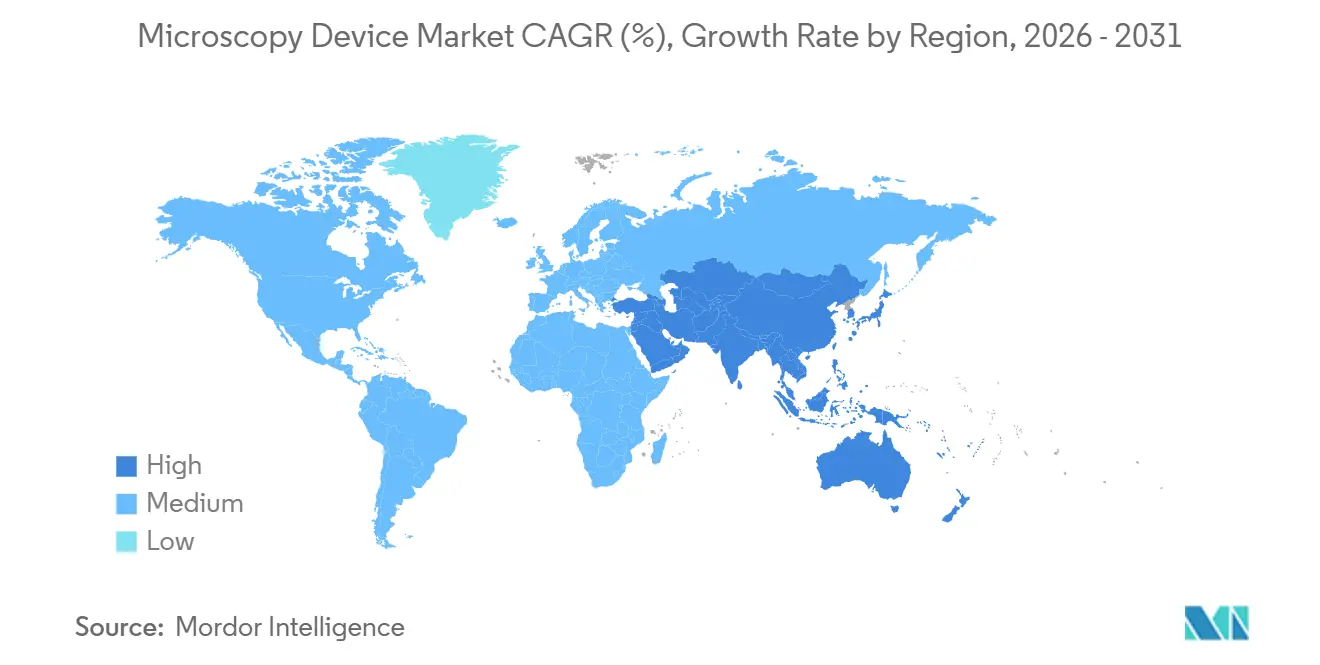
- By geography, North America held a 39.25% revenue share in 2025; Asia-Pacific is forecast to grow at a 6.74% CAGR through 2031.
Note: Market size and forecast figures in this report are generated using Mordor Intelligence’s proprietary estimation framework, updated with the latest available data and insights as of 2026.
Market Trends and Insights
Drivers Impact Analysis of Microscopy Device Market*
| DRIVER | (~) % IMPACT ON CAGR FORECAST | GEOGRAPHIC RELEVANCE | IMPACT TIMELINE |
|---|---|---|---|
| Technological advancements in super-resolution optics & quantum sensing | +1.2% | Global, with early adoption in North America & Europe | Medium term (2-4 years) |
| AI-driven automated digital pathology adoption | +1.4% | North America & Europe, expanding to APAC | Short term (≤ 2 years) |
| Government nanotech & life-science R&D funding surge | +1.0% | Global, concentrated in U.S., EU, China | Long term (≥ 4 years) |
| Semiconductor gate-all-around node miniaturization needs | +0.9% | APAC core (Taiwan, South Korea), spill-over to North America | Medium term (2-4 years) |
| Desktop cryo-em democratizing structure-based drug design | +0.7% | North America & Europe, emerging in APAC | Medium term (2-4 years) |
| Sustainability push for energy-efficient, modular microscopes | +0.4% | Europe & North America, regulatory-driven | Long term (≥ 4 years) |
| Source: Mordor Intelligence | |||


Technological Advancements in Super-Resolution Optics & Quantum Sensing
Super-resolution techniques like STED, SIM, and PALM are breaking the diffraction barrier to reveal structures below 50 nanometers, which strengthens single-cell and neurodegeneration research as labs push to quantify protein interactions in living systems. Early adopters are layering quantum sensing based on nitrogen-vacancy centers in diamond to image magnetic fields, detect nanoscale defects in semiconductor wafers, and capture single-molecule events in biophysics. The microscopy device market is benefiting as buyers seek hybrid platforms that switch among widefield, confocal, and super-resolution modes within the same workflow to maximize throughput. Academic consortia and pharmaceutical companies in North America and Europe are leading purchases due to pipeline demands for target validation and high-content screening. Complexity in optical alignment and reliance on specific fluorophores still slow routine clinical use, creating a service and training opportunity for vendors with robust application support.
AI-Driven Automated Digital Pathology Adoption
Pathology networks are moving from manual microscopy to whole-slide imaging combined with convolutional neural networks that classify tissue, quantify biomarkers, and flag anomalies, and several models now show sensitivities exceeding 95% in indications with strong ground truth. In January 2026, the Central Silk Board in India highlighted an AI-enabled microscope initiative that helps farmers detect silkworm disease earlier, underscoring how applied AI microscopy is expanding beyond clinical settings into production environments. Oncology workloads are a catalyst because tumor microenvironment analysis requires quantifying immune infiltrates and vascular structures across gigapixel images at scale. The European Union’s In Vitro Diagnostic Regulation mandates CE marking for AI-based diagnostic software, prompting vendors to run prospective clinical validation studies to align model performance with clinical endpoints.[1]European Commission, “In Vitro Diagnostic Regulation Overview,” European Commission, ec.europa.eu Hospitals and diagnostic labs are the fastest-growing end-user segment at a 6.60% CAGR through 2031, driven by pathologist labor constraints and the need to standardize multi-site interpretations to reduce variability in care
Government Nanotech & Life-Science R&D Funding Surge
Public investment rose to record levels in 2025, as the U.S. National Institutes of Health budgeted USD 47.5 billion, including line items for structural biology and advanced imaging, which supported upgrades across national centers and university cores. The U.S. National Science Foundation’s Mid-scale Research Infrastructure programs fund equipment in the USD 4 million to USD 100 million range, which supports regional cryo-EM hubs and multi-user facilities that pool operating budgets.[2]National Institutes of Health, “NIH Budget FY2025,” NIH, nih.gov
The European Research Council’s Synergy Grants, funded in 2025, supported 66 projects focused on quantum biology and single-molecule science, with awards up to EUR 10 million (USD 10.7 million) over six years, thereby expanding procurement of top-end optical and electron platforms.[3]European Research Council, “Synergy Grants 2025 Results,” ERC, erc.europa.eu These flows reinforced the position of academic and research institutes, which held the largest end-user share in 2025 and continued to influence instrument specification roadmaps for next-generation systems. The long-run effect depends on continuity in grant cycles and refresh intervals as agencies weigh distributed funding against a few flagship facilities.
Semiconductor Gate-All-Around Node Miniaturization Needs
Gate-all-around transistor architectures at and below the 2-nanometer node intensify demand for high-resolution TEM and SEM to resolve inner spacer voids and nanosheet thickness variations that optical metrology misses. Samsung reported using dozens of inline SEMs and metrology upgrades for process development, suggesting rising tool counts and higher utilization rates for electron-beam inspection. The microscopy device market benefits as fabs extend metrology coverage to more layers and increase sampling to control yield in logic and memory ramps. Asia-Pacific manufacturers lead capacity additions, with metrology fleets scaled to support domestic logic production and materials qualification. 18-angstrom class nodes ramp, device makers need atomic-column resolution and lattice-strain mapping, which favors aberration-corrected platforms that command premium pricing.
Restraints Impact Analysis of Microscopy Device Market*
| RESTRAINT | (~) % IMPACT ON CAGR FORECAST | GEOGRAPHIC RELEVANCE | IMPACT TIMELINE |
|---|---|---|---|
| High capital & operating costs of devices | -0.9% | Global, acute in emerging markets | Short term (≤ 2 years) |
| Global shortage of hybrid optics-software talent | -0.6% | North America & Europe, spreading to APAC | Medium term (2-4 years) |
| Precision-optic supply-chain bottlenecks (germanium, gallium) | -0.5% | Global, concentrated impact on electron microscopy | Short term (≤ 2 years) |
| Escalating IP-litigation risks in cross-border tech transfer | -0.3% | U.S.-China corridor, EU-Asia trade lanes | Long term (≥ 4 years) |
| Source: Mordor Intelligence | |||
High Capital & Operating Costs of Devices
The upfront cost of high-end cryo-EM suites remains in the USD 5 million to USD 7 million range once facilities, shielding, and vibration isolation are included, and this delays access for many centers that depend on pooled grants. Annual operating expenses for aberration-corrected TEMs can reach USD 200,000, including maintenance, cryogens, and cleanroom utilities, which limits broader adoption even when equipment is partially subsidized. Shared-facility and leasing models soften the barrier, but scheduling, maintenance windows, and variable uptime add coordination costs for multi-institution use. For hospitals and diagnostic labs, budget ceilings slow digital pathology deployments even where throughput and standardization gains support a clear business case. The microscopy device market reflects these capital constraints in emerging economies, where currency risk and import duties add further headwinds to large-ticket equipment purchases.
Global Shortage of Hybrid Optics-Software Talent
Vendors and labs need engineers fluent in photonics, control systems, and machine learning to deploy real-time reconstruction, adaptive optics, and automated experiment design, yet the training pipeline remains thin. The talent shortfall pushes companies to stagger feature releases and rely on incremental software updates rather than large architectural jumps that need cross-functional teams. ZEISS reported onboarding 272 apprentices and dual-study students across its German sites in 2024, underscoring the scale of internal training required as vendors expand mechatronics and software capabilities. Offshoring development introduces complexity, from intellectual property protection to longer feedback loops, which can slow iteration cycles for core algorithms. Smaller firms may license third-party models to cover gaps, compressing margins and reducing technical differentiation in competitive bids.
*Our forecasts treat driver/restraint impacts as directional, not additive. The impact forecasts reflect baseline growth, mix effects, and variable interactions.
Microscopy Device Market Segment Analysis
By Microscopy Type:
Electron Systems Gain on Cryo-EM DemocratizationElectron microscopy is forecast to grow at 6.56% annually from 2026 to 2031, outpacing the broader microscopy device market, driven by compact cryo-EM systems. Adoption rises when structure-based drug design workflows require higher throughput and local control over sample preparation and data processing to shorten iteration cycles. In parallel, semiconductor fabs are increasing TEM and SEM tool counts to inspect nanosheet stacks, spacers, and hidden defects that are not visible with optical metrology at 2-nanometer-class nodes. Aberration-corrected optics and advanced detectors remain the differentiators for lattice-strain mapping and atomic-column resolution during logic and memory ramps. These factors are pushing electron platforms into a larger role across both process development and failure analysis as fabs seek greater statistical coverage and reliability in metrology.
Optical microscopy commanded 41.80% of % microscopy device market share in 2025, given its ubiquity in clinical workflows, teaching labs, and quality control environments that value ease of use and lower service overheads.


By Application:
Nanotechnology Research Accelerates on Quantum and 2D MaterialsNanotechnology research is projected to advance at a 6.59% CAGR from 2026 to 2031, driven by quantum information science, two-dimensional materials, and advanced batteries, which demand atomic-scale imaging for defect engineering and performance gains. China’s National Natural Science Foundation channeled funding toward nanomaterials in 2025, where AFM and STM remain cornerstone tools for probing graphene and transition-metal dichalcogenides. The U.S. National Quantum Initiative invested in 2025 programs that fund cryo-EM and scanning probe systems to map defects in superconducting qubits and related device structures. The Graphene Flagship’s multi-year extension sustains European demand for high-resolution TEM with the capability to resolve single-atom dopants and grain boundaries at scale. Life science accounted for a 34.08% share of the microscopy device market in 2025, anchored by pharma R&D, academic cell biology, and clinical diagnostics, as digital pathology gains clearer regulatory and payment pathways.
By End User:
Hospitals Surge on Digital Pathology ReimbursementAcademic and research institutes represented 38.40% of revenue in 2025, consistent with national and regional funding cycles that refresh microscopy cores and establish open-access facilities for shared use. The United States NIH budgeted USD 47.5 billion in 2025 with lines for structural biology and imaging, and the NSF’s mid-scale programs supported regional cryo-EM facilities that lower barriers for universities without on-site electron suites. These centers serve diverse user groups, from life science labs to materials and engineering programs, and they drive vendor engagement for training, service contracts, and workflow upgrades. Hospitals, clinics, and diagnostic labs are set to grow at a 6.60% CAGR through 2031 as AI-validated digital pathology tools gain regulatory traction and new reimbursement codes normalize adoption in oncology and other high-throughput services. This transition is changing purchasing priorities, with cloud integration, audit trails, and interoperability with lab information systems now at the top of RFP checklists.
Geography Analysis
North America Microscopy Device Market
North America commanded 39.25% of the microscopy device market share in 2025, as pharma R&D, academic research output, and semiconductor investments supported sustained procurement of optical and electron microscopy platforms. The CHIPS and Science Act allocates USD 52.7 billion across manufacturing incentives and research programs, which elevates demand for advanced metrology fleets at Intel and other operators building new lines in Arizona and Ohio. University labs in the United States and Canada continue to purchase cryo-EM and super-resolution systems with support from national programs that expanded in 2025, including Canada’s Strategic Innovation Fund, which allocated CAD 450 million (USD 335 million) to research infrastructure. These factors anchor a stable replacement cycle and add new first-time buyers as hospitals scale digital pathology and standardize across networks. The microscopy device market in North America also benefits from a strong service ecosystem and vendor presence, which accelerates training and validation for regulated workflows.
Europe Microscopy Device Market
Europe sustains a mature installed base shaped by public funding and harmonized regulations that emphasize clinical validation and sustainability. Horizon Europe committed EUR 95.5 billion (USD 102 billion) through 2027 for research and innovation, and dedicated photonics and nanomedicine streams continue to support procurement of high-end imaging platforms across universities and clinical centers.
APAC, MEA and LATAM Microscopy Device Market
Asia-Pacific remains the fastest-growing region, with a projected 6.74% CAGR, and the microscopy device market aligns with government programs that prioritize domestic semiconductor and life sciences capabilities. China’s policy support helps local research centers and industrial labs scale adoption of electron platforms for logic, memory, and advanced materials, thereby generating consistent orders for TEM, SEM, and related accessories. Outside these hubs, the Middle East and Africa are scaling research infrastructure as part of diversification strategies. At the same time, Latin America faces budget headwinds that temper near-term growth despite active research communities.

Regulatory Landscape
Regulation of microscopy devices varies by use case, with clinical and diagnostic instruments governed as medical devices while many research-grade systems sit outside patient-facing requirements. In the United States, the FDA classifies certain microscopy products as Class I (for example, inverted stage tissue culture microscopes) and others as Class II (for example, automated digital image manual interpretation microscopes). Market access is therefore tied to device classification, labeling, and controls, alongside quality system requirements.
In 2026, compliance programs tightened in key regions through updates that affect quality management and conformity assessment readiness. In the United States, the FDA Quality Management System Regulation (QMSR) became effective in February 2026, changing how manufacturers align quality systems and prepare for inspections. In the European Union, medical microscopy devices and AI-enabled digital pathology components used with diagnostics must navigate Regulation (EU) 2017/745 (MDR) and IVDR updates, including the June 2026 Official Journal publications that updated harmonized standards lists and the May 2026 Implementing Regulation (EU) 2026/977 that set uniform quality management and procedural requirements for notified-body conformity assessment activities. Internationally, ISO 10934:2025 and ISO 18221:2025 provide technical and vocabulary anchors for light microscopy and digital imaging display microscopes.
Competitive Landscape
Market leadership remains moderately concentrated, as Thermo Fisher Scientific, Carl Zeiss, and Danaher invest in AI, robotics, and cloud analytics to protect their moats. Thermo Fisher’s Vulcan Automated Lab pairs robot arms with atomic-scale TEM to boost semiconductor sample throughput by 10x, setting new productivity benchmarks. Oxford Instruments’ BEX technology fuses backscattered electrons and X-ray signals, delivering 100-fold throughput gains that appeal to battery and metals labs.
Rather than commoditize price, rivals seek ecosystem stickiness. Hitachi extended its Roche partnership to co-develop diagnostics that integrate sample prep, imaging, and cloud AI, while CrestOptics joined Leica to advance spinning-disk modules. Dense patent portfolios create defensive walls; the average nanotechnology filing grew 35% yearly, which favors incumbents yet also spurs cross-licensing deals that keep the microscopy devices market innovative without destructive litigation. Thermo Fisher announced a USD 450 million manufacturing expansion in Brno in January 2026 to double cryo-TEM capacity by 2028, signaling confidence in sustained demand across the pharma and academic sectors.
Microscopy Device Industry Leaders
Bruker Corporation
Carl Zeiss
Thermo Fisher Scientific
Olympus Corporation
Danaher Corporation (Leica Microsystems GmBH)
- *Disclaimer: Major Players sorted in no particular order
Microscopy Device Market Companies Covered in this Report
- Ametek (Cameca)
- Andor Technology Ltd.
- Bruker
- Carl Zeiss
- Cytovale Inc.
- Danaher
- Delong Instruments
- Euromex Microscopes
- Hitachi
- JEOL Ltd.
- Keyence Corporation
- Labomed Inc.
- Motic Microscopes
- Nikon
- NTMDT
- Olympus
- Oxford Instruments (Asylum Research)
- Oxford Instruments
- Park Systems Corp.
- Tescan Orsay Holding
- Thermo Fisher Scientific

Market Opportunities and Future Outlook
Hospitals and diagnostic labs are shifting from manual microscopy toward digitized, AI-augmented workflows, which creates demand for vendors that combine imaging hardware with regulated software, audit trails, and interoperability. A clear commercialization signal is Scopio Labs obtaining EU IVDR certification in February 2026 for its AI-powered digital morphology platforms (X100 and X100HT). This supports laboratory procurement for compliant, validated solutions rather than research-use-only systems. At the same time, R&D progress in stain-free and slide-free pathology, including silicon-slide approaches reporting high agreement with conventional pathology and AI-enabled slide-free imaging systems in large-scale clinical trials, points to microscopy platforms that reduce sample preparation steps and place more value on integrated imaging plus computational analysis.
On the industrial side, semiconductor gate-all-around roadmaps and atomic-scale defect control keep electron microscopy and metrology ecosystems central, while vendor investments expand supply capacity and service footprints. Thermo Fisher Scientific's January 2026 announcement of a USD 450 million expansion of its Brno electron microscopy manufacturing facility, targeting doubled cryo-TEM production capacity by 2028, underscores active buildout tied to cryo-EM adoption and high-end instrument demand from pharmaceutical and academic customers. In Europe, mid-2026 MDR/IVDR changes, including May 2026 notified-body procedural requirements and June 2026 updates to harmonized standards lists, encourage manufacturers to refresh technical files, align to updated standards, and offer compliance-ready upgrades, which can accelerate replacement and software modernization cycles for installed bases in regulated clinical microscopy workflows.
Recent Industry Developments in Microscopy Device Market
- June 2026: Leica Microsystems expanded the Viventis Deep dual-view light sheet microscope, enabling both live and cleared sample imaging on a single platform. The update broadens addressable use cases from dynamic biology to 3D tissue context without forcing labs to maintain separate systems, supporting consolidation of workflows in core facilities.
- July 2025: ZEISS acquired all equity shares of Pi Imaging Technology SA in Switzerland. The acquisition strengthens ZEISS capabilities in imaging technology and supports deeper integration of advanced imaging components into its microscopy platforms, reinforcing differentiation through system performance and software-hardware co-development.
- October 2024: Leica Microsystems released SpectraPlex for the STELLARIS confocal platform to enable high-plex spatial phenotyping. By increasing multiplexing capability on an installed confocal base, the launch supports higher-information-content experiments in immunology and oncology research and helps vendors capture recurring demand tied to expanded assay workflows.


Microscopy Device Market Report Scope and Research Methodology
Market Definition and Coverage
This market covers microscopes and related device systems used to visualize and analyze biological and non-biological samples at micro to nanoscale, covering lab, clinical, and industrial use cases. Revenues are counted in value terms and tracked across major microscopy technologies and end-use demand pools.
Scope exclusions: We exclude standalone lab consumables and routine reagents that are not sold as part of a microscopy device or system.
Segments Covered in This Report
- By Microscopy Type
- Electron Microscopy
- Transmission Electron Microscopy (TEM)
- Scanning Electron Microscopy (SEM)
- Cryogenic Electron Microscopy (Cryo-EM)
- Optical Microscopy
- Bright-field & Phase-contrast
- Fluorescence & Confocal
- Super-resolution (STED, SIM, PALM)
- Scanning Probe Microscopy
- Atomic Force Microscopy (AFM)
- Scanning Tunneling Microscopy (STM)
- Other Technologies
- Electron Microscopy
- By Application
- Life Science
- Nanotechnology Research
- Semiconductor & Electronics
- Materials Science & Metallurgy
- Other Applications
- By End User
- Academic & Research Institutes
- Hospitals, Clinics & Diagnostic Labs
- Pharmaceutical & Biotechnology Companies
- Semiconductor & Electronics Manufacturers
- Others
- By Geography
- North America
- United States
- Canada
- Mexico
- Europe
- Germany
- United Kingdom
- France
- Italy
- Spain
- Rest of Europe
- Asia-Pacific
- China
- India
- Japan
- Australia
- South Korea
- Rest of Asia-Pacific
- Middle East and Africa
- GCC
- South Africa
- Rest of Middle East and Africa
- South America
- Brazil
- Argentina
- Rest of South America
- North America
Data Sources, Market Sizing, and Validation
Desk Research
Desk work started by mapping demand-side drivers that shift microscopy equipment purchases year to year, then aligning those signals to the revenue definitions used in this study. We relied on public sources such as US FDA device databases (where applicable to clinical-use systems), World Bank and OECD indicators for R&D intensity, and UNESCO Institute for Statistics for broad research activity proxies.
To keep the model grounded, we also used sources like UN Comtrade for trade direction checks on high-value instruments, peer-reviewed journals for adoption trends (for example, in electron and scanning probe workflows), and association or standards pages that describe technique usage and performance thresholds. Company filings, investor presentations, and reputable press were used to sanity check product mix changes and pricing direction, while a paid subscription for company financials and patent databases helped us validate revenue scale and innovation cycles. These sources are not exhaustive, and we used additional public and paid references to collect, cross-check, and clarify specific data points.
Primary Interviews and Surveys
Primary work focused on filling gaps that desk sources do not answer well, including how buying cycles vary by end user and how average selling prices move with automation, imaging performance, and bundled configurations. We spoke with a mix of manufacturers, distributors, lab procurement teams, and domain experts across the Americas, EMEA, and APAC, so assumptions on utilization, replacements, and new installations could be pressure tested before finalizing the model.
Distribution of primary research fieldwork respondents
| Company type | Respondent position | Region |
|---|---|---|
| Top tier: 33% | CXOs: 12% | APAC: 41% |
| Mid tier: 49% | Functional/Unit leaders: 38% | EMEA: 36% |
| Smaller Players: 18% | Managers: 50% | Americas: 23% |
Market-Sizing & Forecasting
The sizing logic starts from a top-down reconstruction where R&D spending signals, lab and industrial capex direction, and instrument trade flows are combined to build the addressable demand pool for microscopy devices by region, and then that pool is allocated across main microscopy technologies. Once the high-level totals were set, selective bottom-up checks were used to keep the numbers realistic, such as supplier revenue splits, sampled ASP multiplied by likely shipment ranges, and channel conversations about mix changes.
Inputs that mattered most included installed base replacement timing, funding cycles in academic and public research, semiconductor and electronics investment intensity, and the rate of automation adoption in high-throughput labs. Pricing was handled through ASP ladders reflecting shifts toward higher-resolution platforms and more integrated systems, and then currency conversions were aligned to the year being modeled to avoid artificial jumps. Forecasts were produced using scenario analysis linked to a small set of drivers that interviewees consistently referenced, and gaps in any one region or technique were handled by using proxy indicators (for example, adjacent instrument categories and import patterns) before results were reconciled back to the overall market.
Data Validation & Update Cycle
Validation was done through triangulation across independent signals, with model outputs compared against trade movement, R&D and healthcare spending direction, and observed pricing behavior from the field. When results looked off, we checked for anomalies such as step changes in ASP, unrealistic replacement rates, or region shares that did not align with known demand centers, and then re-contacted sources when the variance remained material.
Before sign-off, the work goes through multi-step internal reviews to ensure assumptions, calculations, and logic are consistent across sections and geographies. The report is refreshed annually, and interim updates are made when large events shift demand, supply, or pricing materially. Right before delivery, a final analyst pass is done so clients receive the most current view available at that time.
Mordor Intelligence's Microscopy Devices Market Market Sizing Compared With Other Published Estimates
Published market values for microscopy devices can differ even when they appear to cover the same product space, because scope, the year used as the starting point, and the pricing logic are often not aligned. Differences also come from how firms treat system bundles, how they translate adoption trends into revenue, and how frequently the underlying inputs are refreshed.
The main gap is whether adjacent spend such as standalone accessories, software-only licenses, and lab consumables is rolled into the total. Mordor Intelligence counts only device and system revenues directly tied to microscopy hardware purchases and validated replacement cycles. Other gaps typically show up in how ASP progression is handled for higher-end electron and scanning probe platforms, and whether the forecast assumes a base case funding environment or builds in a more aggressive step-up in semiconductor and life science investment.
Benchmark comparison
| Source | Market Size | Gaps in Research Methodology |
|---|---|---|
| Mordor Intelligence | USD 10.23 B (2025) | |
| Trade Journal A | USD 7.12 B (2024) | Uses an earlier base year and a different segmentation roll-up, and the scope description is broad enough that some device categories and pricing assumptions may be treated more conservatively in the base value. |
| Regional Consultancy B | USD 9.00 B (2024) | Starts from a 2024 value and applies a higher growth curve, and it does not clearly separate microscopy devices from adjacent spending like software-enabled add-ons or bundled configurations, which can shift totals. |
Looking across the table, the spread is mostly explained by scope inclusion choices and base-year alignment, then amplified by how pricing and adoption are carried forward into the forecast. By keeping the model tied to clear demand signals such as replacements, new installations, and technology mix shifts, the final size stays traceable to steps a buyer can sanity check and repeat.


Key Questions Answered in the Report
What is the current size of the microscopy devices market?
The microscopy devices market size stood at USD 10.82 billion in 2026 and is projected to reach USD 14.32 billion by 2031.
Which microscopy segment is expanding the fastest?
Electron Microscopy is forecast to grow at a 6.56% CAGR through 2031, propelled by cryo-EM adoption in drug discovery and semiconductor metrology.
Why is Asia-Pacific expected to outpace other regions?
Japan’s chip-tool roadmap, China’s optics localization and South Korea’s foundry investments collectively drive a 6.74% CAGR for the region.
How are AI technologies influencing the microscopy devices industry?
Artificial intelligence accelerates image analysis, automates pathology workflows and improves predictive maintenance, making AI-ready microscopes a key purchase criterion.
What are the main restraints slowing growth?
High capital expenditures, operating costs and a global shortage of skilled microscopists remain the chief obstacles, subtracting a combined 1.6 percentage points from CAGR forecasts.
Which end-user segment shows the strongest growth outlook?
Hospitals, Clinics and Diagnostic Labs will expand fastest at a 6.60% CAGR due to rising adoption of digital pathology and AI-powered diagnostic workflows.
Page last updated on:


 Your data is secure and never sold or shared.


