
MEMS Energy Harvesting Devices Market Size and Share
Market Overview
| Study Period | 2020 - 2031 |
|---|---|
| Market Size (2026) | USD 465.52 Million |
| Market Size (2031) | USD 688.10 Million |
| Growth Rate (2026 - 2031) | 8.13 % |
| Fastest Growing Market | Asia Pacific |
| Largest Market | North America |
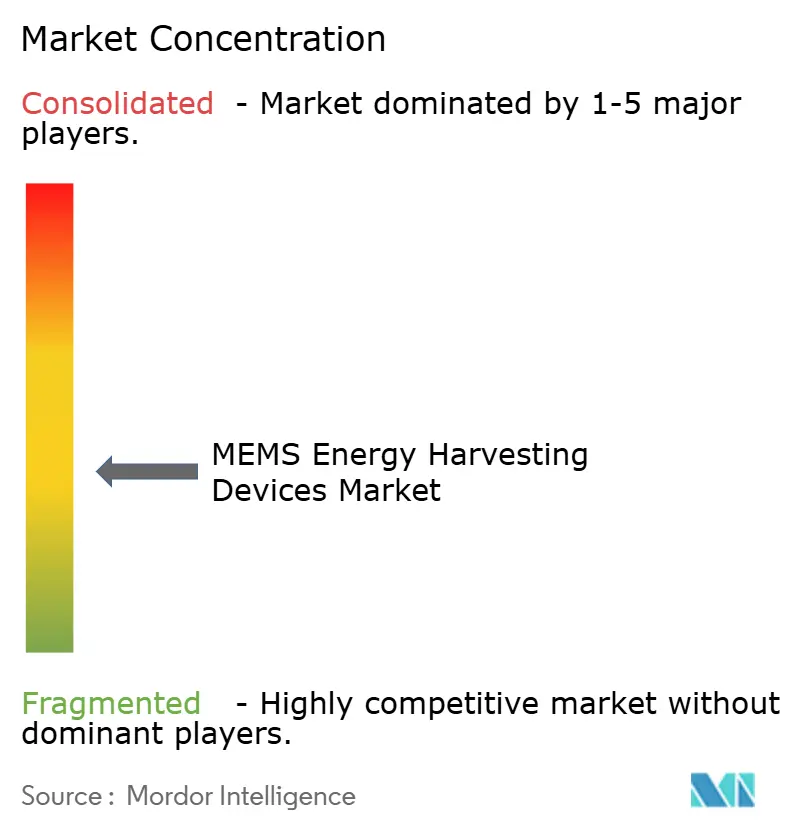
| Market Concentration | Medium |
Major Players *Disclaimer: Major Players sorted in no particular order Image © Mordor Intelligence. Reuse requires attribution under CC BY 4.0. | |
MEMS Energy Harvesting Devices Market Analysis by Mordor Intelligence
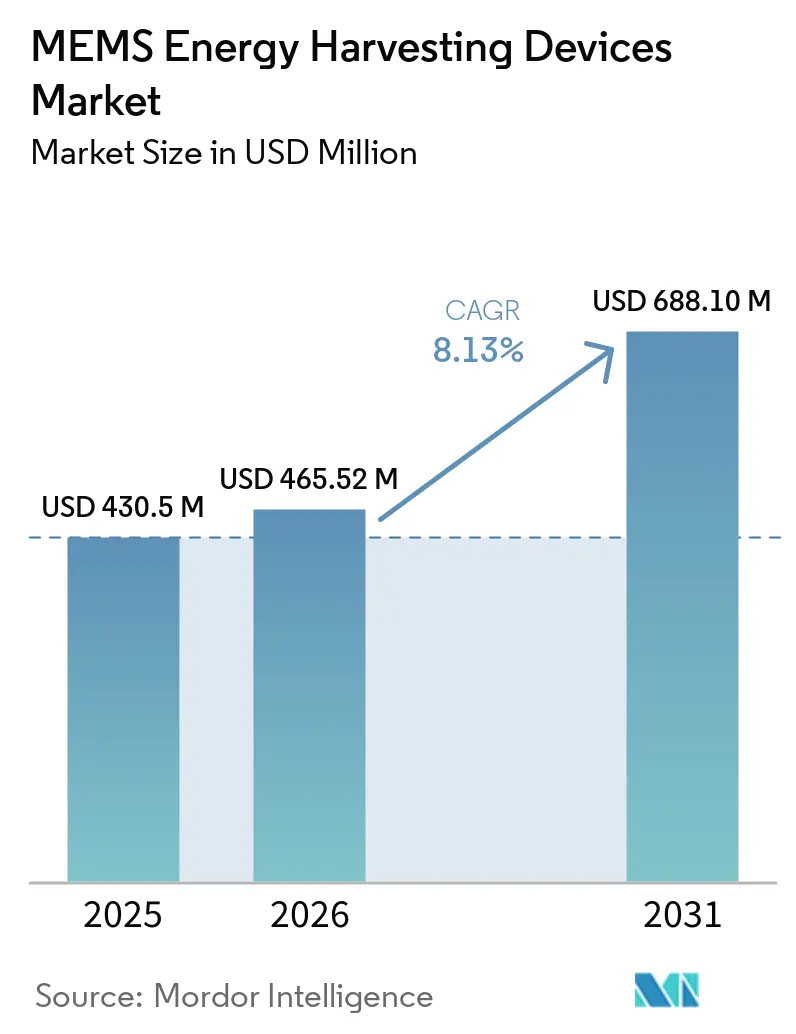
The MEMS energy harvesting devices market size is expected to grow from USD 430.50 million in 2025 to USD 465.52 million in 2026 and is forecast to reach USD 688.10 million by 2031 at 8.13% CAGR over 2026-2031. The MEMS energy harvesting devices market is moving away from disposable batteries and toward ambient energy scavenging as a default power model for edge sensors. Smaller PMICs, maturing sub-milliwatt wireless protocols, and rising policy pressure on single-use battery waste are strengthening adoption across industrial, commercial, and consumer settings. The MEMS energy harvesting devices market is also benefiting from a shift in customer behavior, because self-powered sensor networks are now being placed into mainstream building management and industrial automation systems instead of staying in pilot programs. This deployment-at-scale phase is widening the value of maintenance-free sensing, especially where wiring and battery replacement both raise operating costs. Competitive conditions remain moderate, but technical limits in cold-start performance and resonance matching, along with the PZT compliance horizon in Europe, continue to shape supplier planning and product design.
Key Report Takeaways
- By technology, vibration and piezoelectric energy harvesting led with 44.23% share of the MEMS energy harvesting devices market in 2025, while radio frequency energy harvesting is projected to expand at 8.78% CAGR through 2031.
- By deployment type, wireless systems held 72.45% share of the MEMS energy harvesting devices market in 2025 and are also the fastest-growing category at 9.23% CAGR through 2031.
- By powering range, low-power devices accounted for 75.89% share in 2025, while medium-to-high power devices are forecast to grow at 9.12% CAGR through 2031.
- By end-user industry, industrial and manufacturing held 35.90% share of the MEMS energy harvesting devices market in 2025, while building and home automation is set to grow at 8.72% CAGR through 2031.
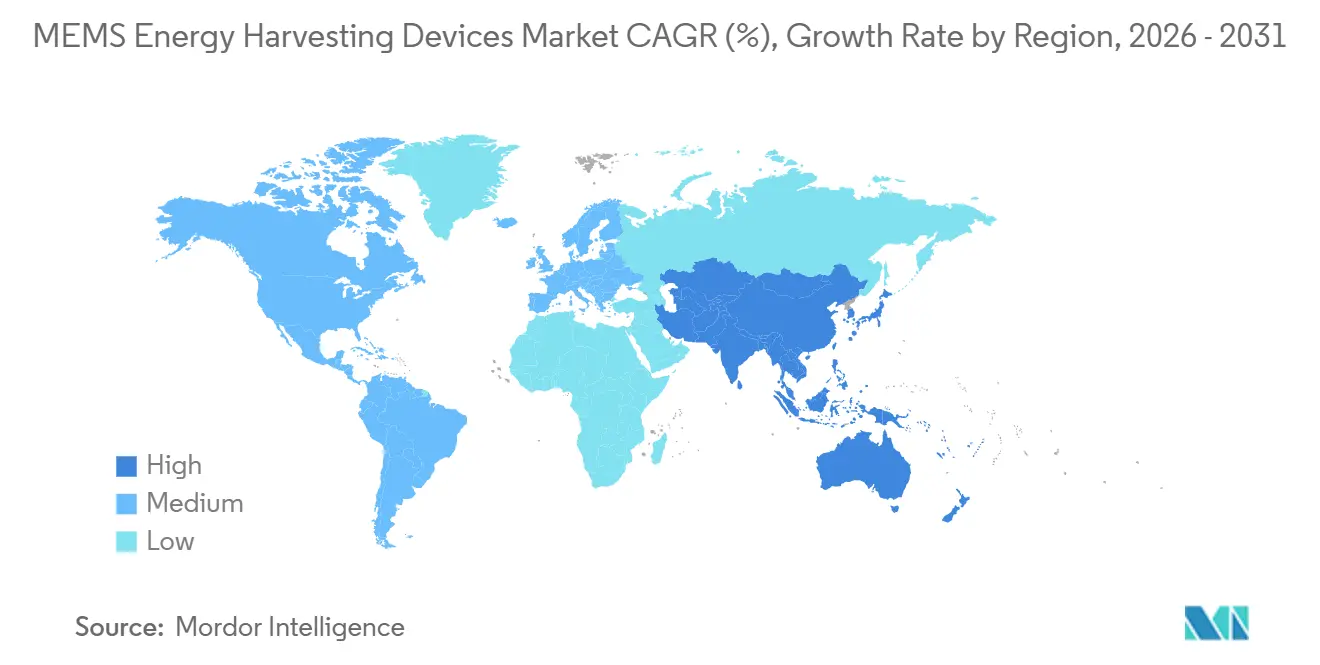
- By geography, North America retained 32.78% share in 2025, while Asia-Pacific is projected to record the fastest regional CAGR of 8.94% through 2031.
Note: Market size and forecast figures in this report are generated using Mordor Intelligence’s proprietary estimation framework, updated with the latest available data and insights as of January 2026.
Global MEMS Energy Harvesting Devices Market Trends and Insights
Drivers Impact Analysis*
| Driver | (~) % Impact on CAGR Forecast | Geographic Relevance | Impact Timeline |
|---|---|---|---|
| Rising Adoption of Battery-Free Wireless Sensor Networks | +2.3% | Global, with highest intensity in North America and Western Europe | Medium term (2-4 years) |
| Growth in Industrial Condition Monitoring and Predictive Maintenance | +1.6% | North America, Europe, and APAC industrial clusters | Medium term (2-4 years) |
| Expansion of Smart Buildings and Retrofit Building Controls | +1.4% | North America, Europe, East Asia | Medium term (2-4 years) |
| Advances in Ultra-Low-Power PMICs and Wireless SoCs | +1.1% | Global | Short term (≤ 2 years) |
| Ambient IoT Protocol Standardization Opening Certified Self-Powered Device Classes | +0.6% | Global, with early gains in North America and Europe | Long term (≥ 4 years) |
| Need to Eliminate Battery Truck Rolls in Hard-To-Reach Rotating Assets | +0.4% | Industrial regions in North America, Europe, and APAC | Long term (≥ 4 years) |
| Source: Mordor Intelligence | |||


Rising Adoption of Battery-Free Wireless Sensor Networks
The MEMS energy harvesting devices market has been pushed most directly by the wider rollout of battery-free wireless sensor networks. Battery replacement at scale remains a hidden operating burden because even modest industrial sites spend large amounts of staff time servicing sensor nodes that are wireless in communication but still dependent on stored chemical energy. Ambient IoT architectures address this issue by pairing energy harvesting with low-duty-cycle communication so nodes can transmit without carrying a conventional battery. A 2026 study showed that energy-harvesting wireless sensor nodes using adaptive data allocation transmitted a 128-bit packet with 12 µJ of energy, which was 88% lower than continuously active nodes.[1]Xinyue Du et al., “Error Recovery Using Cooperative ARQ in Energy-Harvesting Wireless Sensor Networks with Data Allocation,” Sensors, doi.org Standardization work around ambient power communication in IEEE 802.11 TGbp is creating clearer certification pathways for battery-free endpoints, which supports broader ecosystem formation for the MEMS energy harvesting devices market.[2]IEEE 802.11 Task Group bp, “AMbient Power (AMP) Communication,” IEEE, ieee.org That shift matters because the MEMS energy harvesting devices market now has a clearer route from limited pilots to repeatable fleet deployments in buildings, factories, and infrastructure.
Growth in Industrial Condition Monitoring and Predictive Maintenance
The MEMS energy harvesting devices market also gains from industrial condition monitoring, where the business case is easier to measure. Rotating assets such as motors, pumps, gearboxes, and compressors generate usable vibration while also carrying high downtime risk, which makes self-powered sensing attractive. The core advantage is not only cost avoidance, but also richer data capture, because battery-free nodes can support higher duty cycles than battery-managed nodes designed around long replacement intervals. A 2025 Micromachines study validated a piezoelectric transducer ring-based MEMS system for shaft bearing monitoring and recorded 0.8 V maximum DC output with 44 µW root mean square power within 128 seconds. The same work aligned autonomous wireless transmission with ISO 10816 vibration monitoring practice, which strengthens the practical case for deployment on rotating equipment. As industrial users place more value on continuous machine data, the MEMS energy harvesting devices market is gaining from a demand pattern that favors maintenance-free sensing over periodic manual checks.
Expansion of Smart Buildings and Retrofit Building Controls
The MEMS energy harvesting devices market is also supported by the expansion of smart buildings and retrofit control projects. Existing building stock cannot be rewired economically at scale, so battery-free sensors hold a clear advantage where power wiring and ceiling access are limited. EnOcean reported a smart heating retrofit at a hotel property that reduced heating energy use by 30% with battery-free energy-harvesting controls. EnOcean also introduced the TCM 600 transceiver in January 2026, with more than 40% lower power consumption than its predecessor, which supports wider integration into cloud-connected building management systems. Building codes in North America and Europe increasingly require occupancy-responsive HVAC and lighting, which aligns well with the commercial case for maintenance-free wireless sensing. This is widening retrofit demand for the MEMS energy harvesting devices market, especially in buildings where conventional wired controls would raise labor and disruption costs.
Advances In Ultra-Low-Power PMICs and Wireless SoCs
Advances in PMICs and wireless SoCs are lowering the minimum energy threshold required for useful node operation in the MEMS energy harvesting devices market. Cold-start voltage, quiescent current, and maximum power point tracking efficiency remain the main variables that decide whether a harvester can power a practical device under real ambient conditions. In December 2025, e-peas launched the AEM15820 as a single-chip PMIC for hybrid indoor-outdoor photovoltaic cells with a 5 µW cold start at 275 mV and configurable output from 0.6 V to 3.3 V.[3]e-peas S.A., “AEM15820 PMIC Enables Seamless Energy Harvesting from Both Indoor and Outdoor Light Sources,” e-peas, e-peas.com Atmosic states that its ATM33e and ATM34e families combine BLE radios with on-chip RF energy harvesting, which removes external harvesting circuitry and reduces component count. These chip-level gains make product development easier for new entrants and for application teams that do not want to design a custom power chain from scratch. As a result, the MEMS energy harvesting devices market is expanding into use cases that were previously uneconomic at the module level.
Restraints Impact Analysis*
| Restraint | (~) % Impact on CAGR Forecast | Geographic Relevance | Impact Timeline |
|---|---|---|---|
| Limited Power Output and Dependence on Intermittent Ambient Energy | -1.8% | Global | Long term (≥ 4 years) |
| Narrow Bandwidth and Resonance Mismatch in Piezoelectric MEMS Design | -1.2% | Global, particularly industrial and aerospace end-uses | Long term (≥ 4 years) |
| Leakage Losses and Cold-Start Bottlenecks in Micro-Power Storage Paths | -0.9% | Global | Medium term (2-4 years) |
| RoHS Lead-Exemption Uncertainty For Piezoelectric Ceramics | -0.7% | Europe primarily, with spill-over to global supply chains | Short term (≤ 2 years) |
| Source: Mordor Intelligence | |||
Limited Power Output and Dependence on Intermittent Ambient Energy
Limited power output remains the most binding restraint on the MEMS energy harvesting devices market. Typical ambient harvesters in industrial settings generate tens to hundreds of microwatts, which supports periodic low-data-rate transmission but not sustained compute-heavy operation. The problem becomes harder when ambient energy disappears, because indoor light drops at night, thermal gradients collapse when equipment stops, and vibration harvesting pauses during machine downtime. Designers can respond with hybrid harvesting or larger storage buffers, but both options add cost, system volume, and design complexity. That makes full battery elimination difficult in applications that require reliable performance across variable operating conditions. Until energy availability can be predicted and buffered with greater consistency, the MEMS energy harvesting devices market will remain strongest in low-duty-cycle use cases rather than continuous high-load operation.
Narrow Bandwidth and Resonance Mismatch in Piezoelectric MEMS Designs
Narrow bandwidth and resonance mismatch continue to slow the MEMS energy harvesting devices market, especially in vibration harvesting designs. Resonant piezoelectric MEMS devices work best near a narrow mechanical frequency, while real industrial and aerospace environments are usually broadband and time-variant. A 2026 "Microsystems and Nanoengineering" study reported that efficient broadband operation requires the K²Qm product to exceed 10, which is more than 10 times higher than current designs generally achieve. This gap is especially relevant in multi-axis or low-frequency environments where single-resonance cantilever designs capture only a small part of available energy. Lead-free alternatives such as KNN and BNT remain under development, but they have not yet matched PZT across the temperature and frequency ranges needed for demanding industrial use. That mismatch reduces confidence in real-world output performance and slows adoption in the parts of the MEMS energy harvesting devices market that demand predictable field behavior.
*Our forecasts treat driver/restraint impacts as directional, not additive. The impact forecasts reflect baseline growth, mix effects, and variable interactions.
Segment Analysis
By Technology: Piezoelectric Leadership Meets Faster RF Expansion
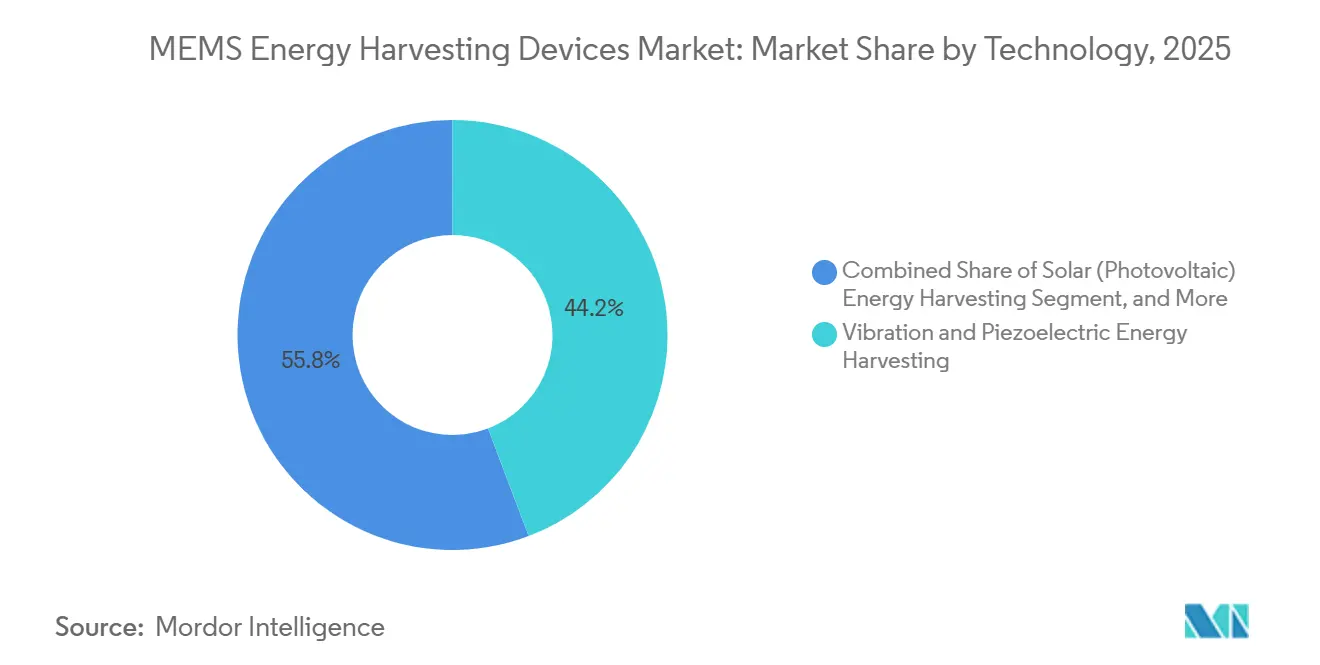
Vibration and piezoelectric energy harvesting held 44.23% of the MEMS energy harvesting devices market size in 2025, making it the largest technology segment. This lead arose from the large installed base of machines that generate usable mechanical energy and from the strong fit between piezoelectric conversion and rotating asset monitoring. A 2025 study in “Smart Materials and Structures” showed that variable-section multimodal piezoelectric harvesters improved broadband capture through structural optimization, directly addressing real deployment limits caused by resonance mismatch. Solar harvesting remained the main secondary technology path, and Dracula Technologies stated in January 2026 that its LAYER V2.0 organic photovoltaic platform delivered a 30% performance increase over the prior generation for indoor applications.
Thermal harvesting served a smaller but strategically important niche where stable temperature differentials existed around heat-intensive equipment. RF energy harvesting is the fastest-growing technology segment in the MEMS energy harvesting devices market and is projected to expand at 8.78% through 2031 as ambient IoT tags draw power from existing wireless infrastructure. Wiliot stated in January 2026 that its Gen3 IoT Pixel uses a dual-band architecture across 2.4 GHz and sub-1 GHz to improve harvesting efficiency and energizing range over the prior generation.[4]Wiliot, “Wiliot Unveils Next-Generation IoT Pixel, Powering the Data Layer Behind Physical AI,” Wiliot, wiliot.com A 2026 “Micromachines” paper also demonstrated an RF energy-harvesting IoT network architecture using a BQ25504-based power path, while IEEE 802.11 TGbp continues to build a certified ambient power communications framework.


By Deployment Type: Wireless Becomes the Practical Default
Wireless systems held 72.45% of the deployment type segment in 2025 and are also the fastest-growing category at 9.23% through 2031. That lead shows that removing battery maintenance is most valuable when the same design also removes power and data cabling. In the MEMS energy harvesting devices market, this makes wireless deployment the practical default for large sensor fleets in buildings and distributed industrial settings. Atmosic states that its platform supports ultra-low-power connectivity with integrated energy harvesting and IEEE 802.15.4 capability, which reduces integration burden for system developers.
Wired systems kept a meaningful role where latency, bandwidth, or electromagnetic interference limits made wireless less suitable. Some industrial environments still separate power and communication functions, using harvested energy at the sensor while keeping a wired data path for reliability. This portion of the MEMS energy harvesting devices market remains stable because the application requirements are specific rather than broad. The result is a two-speed structure where wireless captures most new installations while wired designs remain in a narrower set of performance-sensitive deployments.
By Powering Range: Low-Power Leadership with Higher-Power Ambition Rising
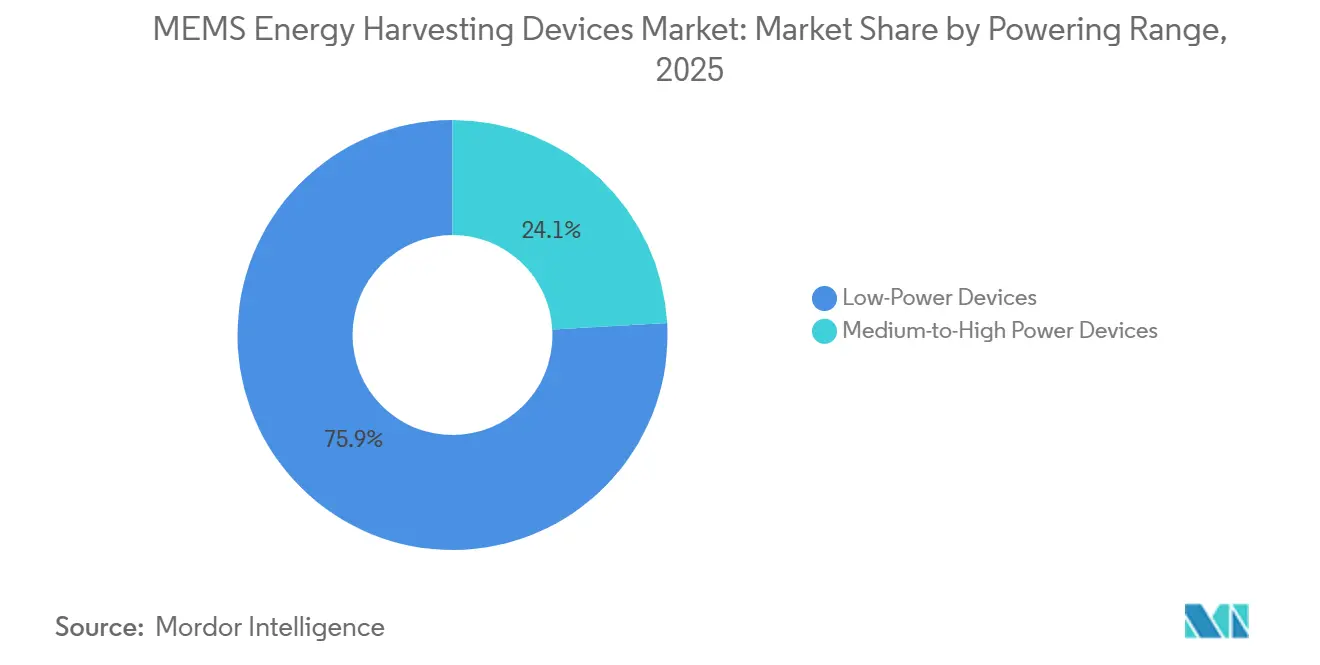
Low-power devices accounted for 75.89% in 2025, which matched the dominant use case of sub-milliwatt wireless nodes for temperature, humidity, occupancy, and vibration monitoring. The segment's scale reflects the natural operating zone of most harvesters, because low duty cycles and small energy budgets are easier to sustain from ambient sources. ReVibe Energy positions its VS1 as a permanently deployed self-powered vibration sensor for vibrating screens and feeders, which illustrates how the low-power class fits real industrial monitoring needs. In practical terms, this keeps the largest part of the MEMS energy harvesting devices market tied to periodic sensing rather than continuous compute.
Medium-to-high power devices are the fastest-growing powering range segment and are forecast to expand at 9.12% through 2031. That growth points to rising expectations that harvesters will support edge AI inference, richer sensing, and multi-sensor fusion within one node enclosure. Powercast introduced its EDGE platform in 2026 as wireless power infrastructure for AI-driven edge data collection, with partnerships spanning Dracula Technologies, e-peas, and InPlay. Even so, compliance with RF exposure and spectrum rules still sets practical limits on how far over-the-air power delivery can scale in this part of the MEMS energy harvesting devices market.
By End-User Industry: Industrial Base Leads While Building Controls Accelerate
Industrial and manufacturing held 35.90% of the MEMS energy harvesting devices market share in 2025, which made it the leading end-user group. The segment led because factories combine abundant kinetic and thermal energy sources with a strong need to reduce downtime and manual maintenance. Powercast said in May 2025 that its battery-free RFID sensor condition monitoring system for data center racks, developed with Asset Vue, won Best New Product at RFID Journal LIVE! 2025. Consumer electronics, transportation, and logistics are also gaining attention as ambient IoT tags become cheaper and more useful for physical asset visibility.
Building and home automation is the fastest-growing end-user segment in the MEMS energy harvesting devices market and is projected to advance at 8.72% through 2031. Retrofit projects are the main growth engine because existing structures can adopt battery-free controls without disruptive rewiring. EnOcean's expanding EMDC line and broader building automation focus show how vendors are aiming squarely at large-scale commercial deployment in occupied buildings. A 2025 review in Micromachines also showed active work on harvesting body heat and motion for medical wearables and implants, which keeps healthcare as a strategic long-term opportunity.
Geography Analysis
North America retained 32.78% of the MEMS energy harvesting devices market share in 2025, which kept it in the leading regional position. The United States remained the main revenue center because industrial condition monitoring, smart building retrofits, and data center sensing all reached earlier commercial maturity than in many other regions. EnOcean stated in 2025 that its energy-harvesting solutions achieved listing on the DesignLights Consortium Qualified Products List, which opened a pathway for utility rebate access in the United States. Canada and Mexico stayed smaller within the region, but both supported demand through mining, oil and gas, and manufacturing use cases that align well with vibration-based sensing. For the MEMS energy harvesting devices market, this regional lead rested on both installed digital infrastructure and a regulatory setting that rewarded efficient wireless building controls.
Europe remained a substantial regional market led by Germany, the United Kingdom, France, Italy, and Spain. Demand in Europe is closely tied to energy efficiency and industrial compliance rules, which favor low-maintenance sensor deployments in both buildings and process environments. The European Commission adopted Directive (EU) 2025/2363 in November 2025 and created exemption 7(c)-VI for lead in piezoelectric PZT ceramics until December 31, 2027, which gave suppliers a defined planning window while pushing lead-free substitution work. Sweden also emerged as a notable photovoltaic harvesting center after the Swedish Energy Agency awarded Exeger SEK 130 million, or USD 12.2 million, in 2025 to scale indoor solar cell technology. South America and Middle East, and Africa remained smaller, but mining sites and smart city programs created targeted openings for maintenance-free sensing.
Asia-Pacific is the fastest-growing region in the MEMS energy harvesting devices market and is forecast to expand at 8.94% through 2031. China's large IoT infrastructure buildout, Japan's strength in piezoelectric materials, South Korea's PMIC ecosystem, and India's rising building and manufacturing digitalization are supporting this growth pattern. A 2026 study indexed by CiNii Research described wireless power transfer for building management sensor modules through glass surfaces, which fits Japan's preference for low-disruption retrofit design. ASEAN countries such as Singapore, Malaysia, and Thailand are also moving from pilots toward production-scale ambient IoT sensing in logistics and manufacturing settings.

Competitive Landscape
The MEMS energy harvesting devices market remains moderately fragmented, with no vendor controlling a dominant position across all technologies and end uses. Competition separates into module specialists such as MicroGen Systems, 8power, and ReVibe Energy, PMIC and SoC players such as e-peas, Atmosic, and Cymbet, and platform providers such as EnOcean, Wiliot, Powercast, and Everactive. Each layer competes on a different basis, ranging from harvester performance and form factor to cold-start efficiency, connectivity integration, cloud compatibility, and installed cost. This structure keeps the MEMS energy harvesting devices market active across multiple tiers rather than pushing it toward one dominant hardware standard.
Strategic activity over the last 12 months shows that vendors increasingly prefer partner ecosystems over single-technology stacks. Powercast's 2026 EDGE platform combined wireless power infrastructure with contributions from Dracula Technologies, e-peas, and InPlay, which showed how multi-source harvesting and connectivity are being packaged together. Avery Dennison announced a USD 75 million strategic investment in Wiliot in April 2026 and named Wiliot its preferred commercial partner, which signaled mainstream interest from a major materials and labeling company. Wiliot and Tageos also moved in January 2026 to launch the EOS-654 BLE G3 inlay, extending battery-free sensing into larger retail and logistics volumes. These moves suggest that scale in the MEMS energy harvesting devices market increasingly depends on ecosystem fit, certification readiness, and application software access rather than only on harvester efficiency.
White-space opportunities still exist in aerospace structural health monitoring, implantable medical devices, and maritime or offshore monitoring, where battery service is costly or impractical. Smaller contenders such as EH4 GmbH, Enervibe, and Pyro-E are pursuing these narrower spaces with application-specific designs, while larger vendors stay focused on building, retail, and industrial volumes. Patents, certification history, and compliance with frameworks such as FCC Part 15, IEC 62368, and ISO 10816 continue to function as real entry barriers for new suppliers. The MEMS energy harvesting devices market also faces a growing security requirement, because self-powered endpoints still need hardware-based protection as IoT cybersecurity rules tighten across 2025-2027.
MEMS Energy Harvesting Devices Industry Leaders
EnOcean GmbH
e-peas S.A.
8power Limited
Powercast Corporation
Smart Material Corporation
- *Disclaimer: Major Players sorted in no particular order

Recent Industry Developments
- May 2026: Powercast launched the EDGE Platform at Sensors Converge 2026, positioning wireless RF power as foundational infrastructure for scalable AI-driven edge data collection. The platform integrates partnerships with Dracula Technologies, LAYER OPV modules, e-peas, PMIC, and InPlay, BLE connectivity, enabling hybrid multi-source energy harvesting within a single node architecture. Powercast was simultaneously named a finalist for the Best Smart Infrastructure Solution Award at the event.
- April 2026: Avery Dennison Corporation announced a USD 75 million strategic minority investment in Wiliot, establishing Avery Dennison as Wiliot's preferred commercial partner. The deal combines Avery Dennison's RFID expertise with Wiliot's battery-free BLE sensing to scale Physical AI deployments across retail, logistics, and food supply chains.
- March 2026: EnOcean expanded its EMDC energy-autonomous sensor family scheduled for Q2 2026 release, offering expanded corridor and desk occupancy detection through a new snap-in masking interface. The EMDC sensors operate without batteries using energy harvesting from ambient light and motion and are positioned for large-scale commercial building deployments.
- February 2026: ReVibe Energy launched the Anura SB1 Sensor Bridge, enabling plug-and-play integration of its self-powered VS1 vibration sensors directly into industrial SCADA and PLC systems via Modbus TCP/IP. The product solves the "SCADA black hole" problem by delivering continuous, maintenance-free vibration data from vibrating screens and feeders into existing automation infrastructure.


Global MEMS Energy Harvesting Devices Market Report Scope
The MEMS Energy Harvesting Devices Report is Segmented by Technology (Solar (Photovoltaic) Energy Harvesting, Vibration and Piezoelectric Energy Harvesting, Thermal Energy Harvesting, and Radio Frequency Energy Harvesting), Deployment Type (Wired Systems, and Wireless Systems), Powering Range (Low-Power Devices, and Medium-to-High Power Devices), End-User Industry (Building and Home Automation, Industrial and Manufacturing, Consumer Electronics, Transportation and Logistics, Healthcare and Medical Devices, and Aerospace and Defense), and Geography (North America, South America, Europe, Asia-Pacific, and Middle East and Africa). The Market Forecasts are Provided in Terms of Value (USD).
| Solar (Photovoltaic) Energy Harvesting |
| Vibration and Piezoelectric Energy Harvesting |
| Thermal Energy Harvesting |
| Radio Frequency Energy Harvesting |
| Wired Systems |
| Wireless Systems |
| Low-Power Devices |
| Medium-to-High Power Devices |
| Building and Home Automation |
| Industrial and Manufacturing |
| Consumer Electronics |
| Transportation and Logistics |
| Healthcare and Medical Devices |
| Aerospace and Defense |
| North America | United States | |
| Canada | ||
| Mexico | ||
| South America | Brazil | |
| Argentina | ||
| Rest of South America | ||
| Europe | Germany | |
| United Kingdom | ||
| France | ||
| Italy | ||
| Spain | ||
| Rest of Europe | ||
| Asia-Pacific | China | |
| Japan | ||
| India | ||
| South Korea | ||
| ASEAN | ||
| Rest of Asia-Pacific | ||
| Middle East and Africa | Middle East | Saudi Arabia |
| United Arab Emirates | ||
| Turkey | ||
| Rest of the Middle East | ||
| Africa | South Africa | |
| Nigeria | ||
| Rest of Africa | ||
| By Technology | Solar (Photovoltaic) Energy Harvesting | ||
| Vibration and Piezoelectric Energy Harvesting | |||
| Thermal Energy Harvesting | |||
| Radio Frequency Energy Harvesting | |||
| By Deployment Type | Wired Systems | ||
| Wireless Systems | |||
| By Powering Range | Low-Power Devices | ||
| Medium-to-High Power Devices | |||
| By End-User Industry | Building and Home Automation | ||
| Industrial and Manufacturing | |||
| Consumer Electronics | |||
| Transportation and Logistics | |||
| Healthcare and Medical Devices | |||
| Aerospace and Defense | |||
| By Geography | North America | United States | |
| Canada | |||
| Mexico | |||
| South America | Brazil | ||
| Argentina | |||
| Rest of South America | |||
| Europe | Germany | ||
| United Kingdom | |||
| France | |||
| Italy | |||
| Spain | |||
| Rest of Europe | |||
| Asia-Pacific | China | ||
| Japan | |||
| India | |||
| South Korea | |||
| ASEAN | |||
| Rest of Asia-Pacific | |||
| Middle East and Africa | Middle East | Saudi Arabia | |
| United Arab Emirates | |||
| Turkey | |||
| Rest of the Middle East | |||
| Africa | South Africa | ||
| Nigeria | |||
| Rest of Africa | |||


Key Questions Answered in the Report
What is the current and forecast value of MEMS energy harvesting devices?
The MEMS energy harvesting devices market stood at USD 430.50 million in 2025 and is projected to reach USD 688.10 million by 2031 at an 8.13% CAGR.
Which technology type leads demand today?
Vibration and piezoelectric energy harvesting led in 2025 with a 44.23% share, supported by rotating asset monitoring and industrial sensing needs.
Which technology is expanding the fastest through 2031?
RF energy harvesting is projected to grow the fastest at 8.78% CAGR, driven by ambient IoT tags and power capture from existing wireless infrastructure.
Why are wireless deployments gaining more traction than wired designs?
Wireless systems held 72.45% share in 2025 and are growing fastest because they remove both battery servicing and power cabling from sensor economics.
Which end-user group creates the strongest near-term demand?
Industrial and manufacturing led with 35.90% share in 2025, while building and home automation is the fastest-growing end-user segment at 8.72% CAGR.
Which region offers the strongest growth outlook?
Asia-Pacific is projected to record the fastest growth at 8.94% CAGR, supported by large IoT rollouts, strong materials expertise, and rising building digitization.
Page last updated on:





