
Artificial Pancreas Device System Market Size and Share
Market Overview
| Study Period | 2020 - 2031 |
|---|---|
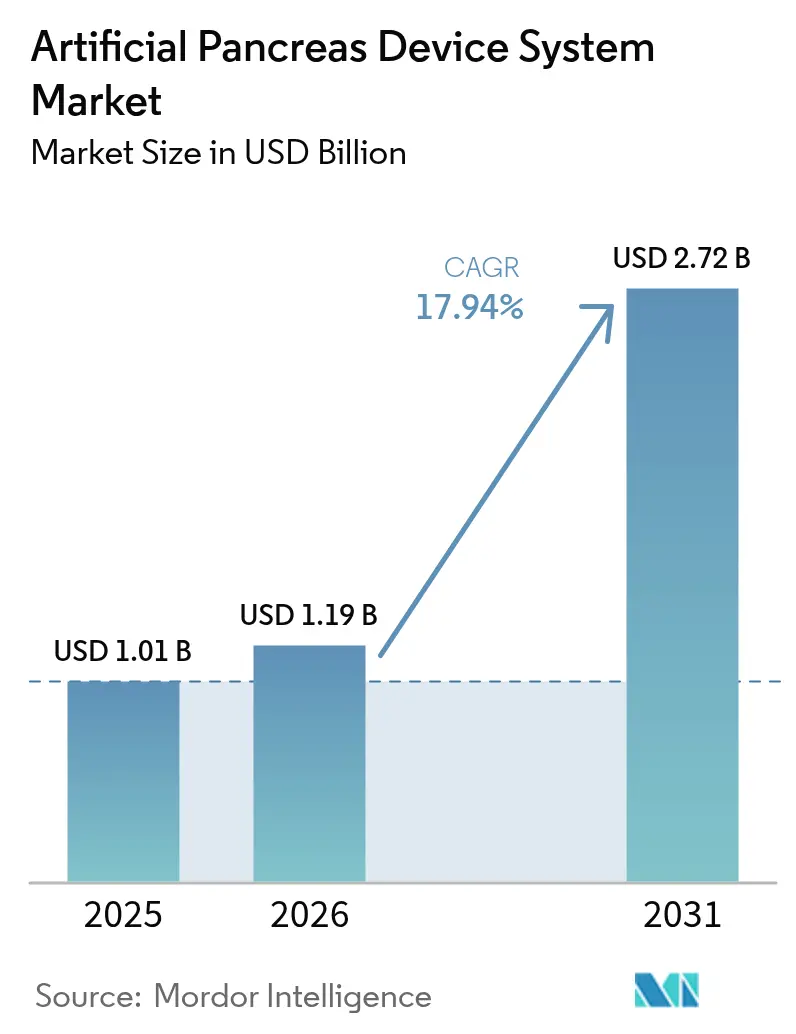
| Market Size (2026) | USD 1.19 Billion |
| Market Size (2031) | USD 2.72 Billion |
| Growth Rate (2026 - 2031) | 17.94 % |
| Fastest Growing Market | Asia Pacific |
| Largest Market | North America |
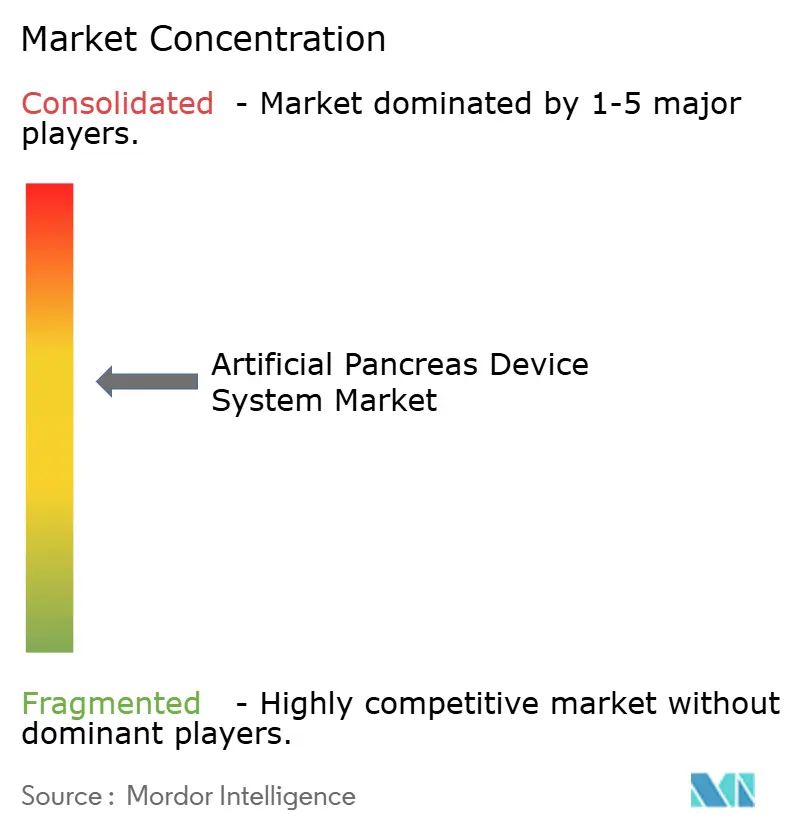
| Market Concentration | Medium |
Major Players *Disclaimer: Major Players sorted in no particular order Image © Mordor Intelligence. Reuse requires attribution under CC BY 4.0. | |
Artificial Pancreas Device System Market Analysis by Mordor Intelligence
The artificial pancreas device system market size is expected to grow from USD 1.01 billion in 2025 to USD 1.19 billion in 2026 and is forecast to reach USD 2.72 billion by 2031 at 17.94% CAGR over 2026-2031. Demand is propelled by rising insulin-dependent diabetes prevalence, rapid gains in continuous glucose monitoring (CGM) accuracy, and the shift toward home-based connected chronic-care models that ease the burden of manual insulin dosing. Integrated automated insulin delivery (AID) platforms now combine CGM, insulin pumps, and AI-driven control algorithms, improving time-in-range outcomes while reducing hypoglycemia risk. Venture-capital inflows and strategic alliances between device makers and sensor specialists are accelerating product pipelines and expanding geographic reach. However, high total cost of ownership, uneven insurance coverage outside high-income countries, and cybersecurity concerns around cloud-connected devices temper adoption, especially in emerging economies.
Key Report Takeaways
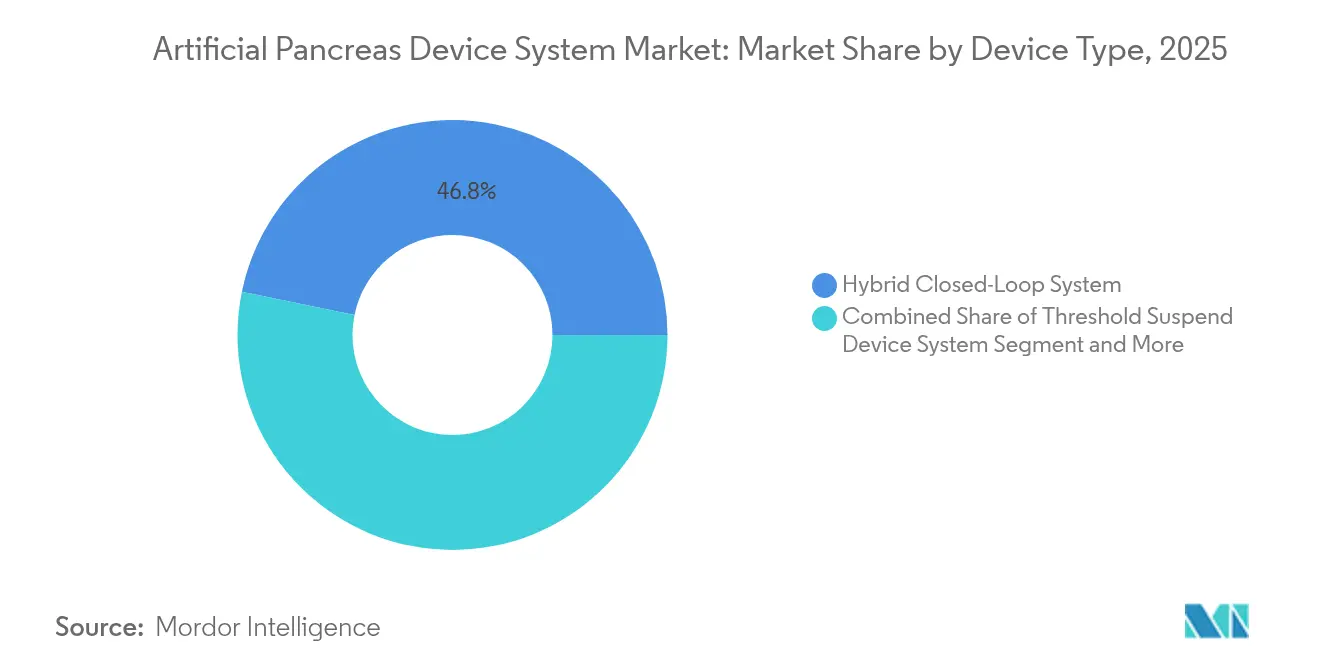
- By device type, Control-to-Target/Hybrid Closed-Loop platforms led with 46.78% revenue in 2025; Fully Automated Closed-Loop/Bionic Pancreas systems are projected to expand at a 23.85% CAGR through 2031.
- By component, insulin pumps held 49.92% of the artificial pancreas device system market share in 2025, while control algorithm/software is advancing at a 25.14% CAGR between 2026-2031.
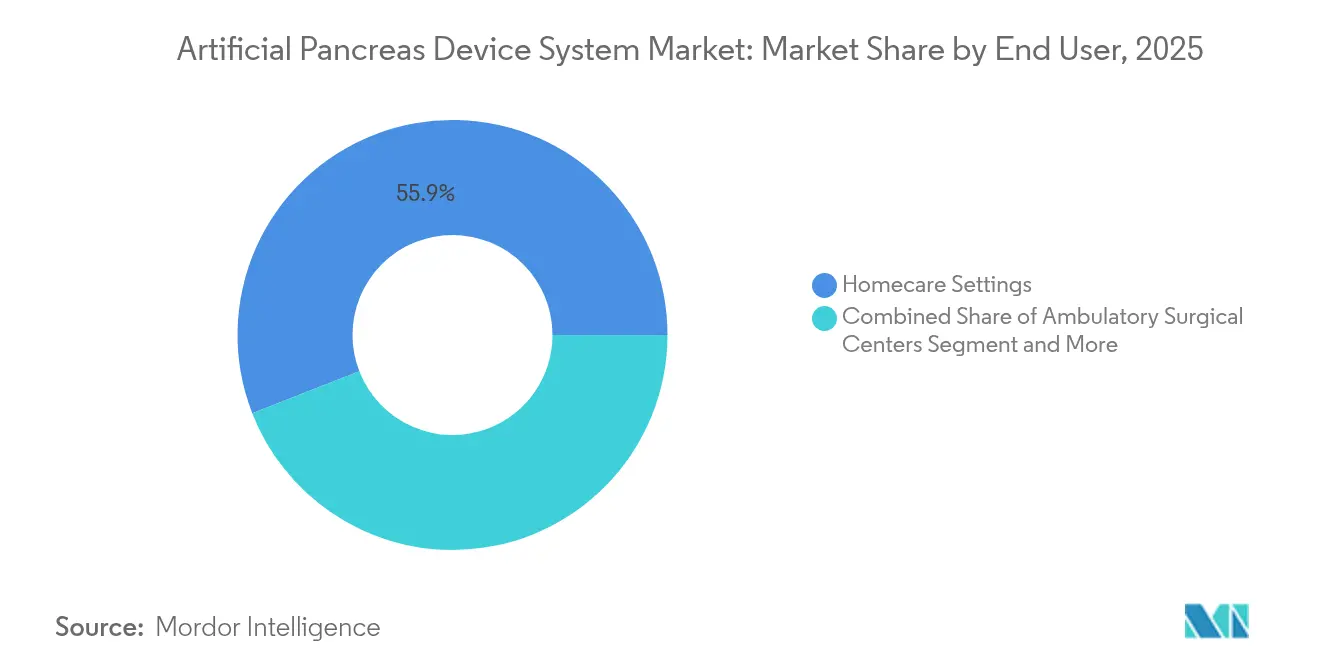
- By end user, homecare settings captured 55.92% of the artificial pancreas device system market size in 2025; ambulatory surgical centers are forecast to grow at 18.74% CAGR to 2031.
- By patient age, adults accounted for 70.10% share of the artificial pancreas device system market size in 2025 and the pediatric cohort is expanding at a 20.98% CAGR through 2031.
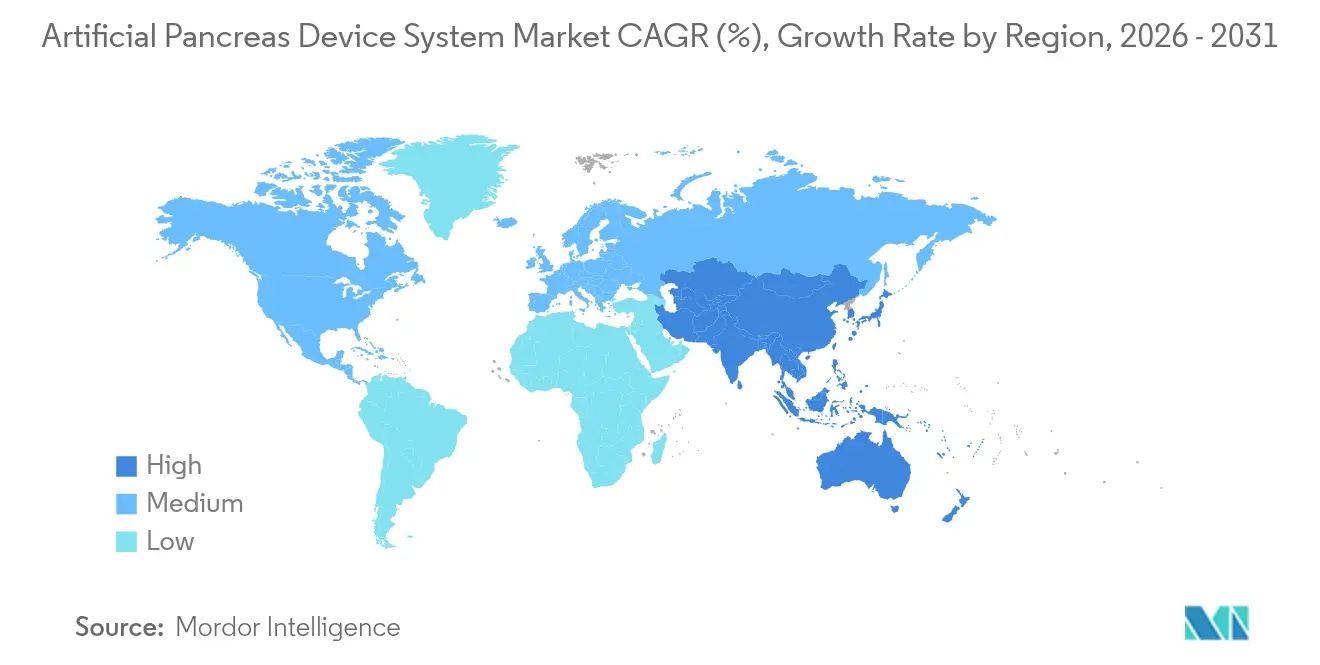
- By geography, North America dominated with 42.98% revenue in 2025; Asia-Pacific records the fastest regional CAGR at 18.88% during 2026-2031.
Note: Market size and forecast figures in this report are generated using Mordor Intelligence’s proprietary estimation framework, updated with the latest available data and insights as of 2026.
Market Trends and Insights
Drivers Impact Analysis of Artificial Pancreas Device System Market*
| Driver | (~) % Impact on CAGR Forecast | Geographic Relevance | Impact Timeline |
|---|---|---|---|
| Escalating Global Incidence of Insulin-Dependent Diabetes Requiring Automated Glycemic Control | +5.2% | Global, with higher impact in North America and Europe | Long term (≥ 4 years) |
| Accuracy & Wearability Advances in Continuous Glucose Monitoring Sensors | +4.8% | Global, with early adoption in North America and Europe | Medium term (2-4 years) |
| Shift Toward Home-Based, Connected Chronic Care Driving Adoption of Wearable AID Devices | +3.7% | North America, Europe, and urban centers in Asia-Pacific | Medium term (2-4 years) |
| Med-tech–Digital Health Convergence Enabling Integrated Artificial Pancreas Ecosystems | +3.1% | North America, Europe, and advanced healthcare markets in Asia-Pacific | Medium term (2-4 years) |
| Robust VC & Strategic Funding Fueling R&D and Commercial Scale-Up | +2.4% | Global, with concentration in North America | Short term (≤ 2 years) |
| Source: Mordor Intelligence | |||
Escalating Global Incidence of Insulin-Dependent Diabetes Requiring Automated Glycemic Control
Diabetes affects 422 million people worldwide and could reach 629 million by 2045, heightening demand for technology that eases daily insulin management. Healthcare systems seek cost-effective methods to curb complications, and artificial pancreas platforms improve time in target glucose range by 12.59% versus conventional pumps, lowering hospitalization risk. Insurers increasingly classify these systems as long-term cost savers despite high upfront prices, facilitating uptake across high-income markets and gradually in price-sensitive regions.
Accuracy & Wearability Advances in Continuous Glucose Monitoring Sensors
Smaller, more precise CGM sensors such as Dexcom G7 and Abbott’s dual-analyte devices extend wear duration and reduce calibration needs, strengthening the value proposition of artificial pancreas solutions. FDA approval of over-the-counter CGM in 2024 broadened access, while longer-wear sensors like Eversense 365 support a full-year implant cycle[1]Senseonics Holdings, “Eversense 365 Sensor Update,” senseonics.com. Improved comfort and reliability drive higher patient adherence, directly boosting automated insulin delivery performance.
Shift Toward Home-Based, Connected Chronic Care Driving Adoption of Wearable AID Devices
Homecare captures 56.5% of 2024 revenues as patients embrace self-management supported by telehealth monitoring. COVID-19 accelerated remote-care workflows, making cloud-linked artificial pancreas platforms mainstream in chronic disease programs. Pediatric users benefit from remote caregiver oversight, which reduces family stress and enhances adherence, encouraging faster adoption among children.
Med-Tech–Digital Health Convergence Enabling Integrated Artificial Pancreas Ecosystems
Partnerships that link CGM sensors, insulin pumps, and AI software create holistic ecosystems addressing exercise, sleep, and meal variability. Digital twin simulations developed at the University of Virginia personalize algorithm parameters, improving glycemic stability without extensive in-clinic testing. Converged platforms enhance user experience and data visibility for clinicians, driving competitive differentiation.
Restraints Impact Analysis of Artificial Pancreas Device System Market*
| Restraint | (~) % Impact on CAGR Forecast | Geographic Relevance | Impact Timeline |
|---|---|---|---|
| High Total Cost of Ownership and Patchy Insurance Coverage in Emerging Economies | -3.6% | Global, with higher impact in emerging markets and developing economies | Medium term (2-4 years) |
| Cyber-Security, Data Privacy & Interoperability Risks in Connected AID Platforms | -2.1% | Global, with higher impact in regions with stringent data protection regulations | Medium term (2-4 years) |
| Limited Long-Term Real-World Evidence Across Diverse Patient Cohorts | -1.5% | Global, with higher impact in regions with conservative regulatory approaches | Short term (≤ 2 years) |
| Source: Mordor Intelligence | |||
High Total Cost of Ownership and Patchy Insurance Coverage in Emerging Economies
Acquisition costs can exceed USD 7,000, with annual consumables adding thousands more, challenging affordability where reimbursement is limited[2]Centers for Medicare & Medicaid Services, “Glucose Monitor Policy,” cms.gov. Payer decisions vary by clinical evidence and budget impact, resulting in unequal access between insured and uninsured groups. In middle-income countries, public insurance rarely covers advanced diabetes tech, slowing artificial pancreas adoption despite large patient pools.
Cyber-Security, Data Privacy & Interoperability Risks in Connected AID Platforms
Smartphone-linked pumps and cloud analytics expand attack surfaces, raising concerns over unauthorized dose adjustments. Regulators now demand secure-by-design architectures, elongating approval timelines. GDPR requirements in Europe compel data-minimization features, while device-to-device incompatibilities can constrain user choice and integration into electronic health records, dampening perceived benefits.
*Our forecasts treat driver/restraint impacts as directional, not additive. The impact forecasts reflect baseline growth, mix effects, and variable interactions.
Artificial Pancreas Device System Market Segment Analysis
By Device Type:
Hybrid Systems Dominate, Bionic Pancreas AcceleratesHybrid closed-loop platforms generated 46.78% of 2025 revenue, serving as a transitional step toward full automation while preserving manual bolus discretion. They command much of today’s artificial pancreas device system market owing to clinician familiarity and incremental cost over legacy pumps. Fully automated/bionic solutions are projected to grow at 23.85% CAGR, fueled by AI-driven dual-hormone algorithms that deliver an 80% average time-in-range and markedly reduce hypoglycemia. Threshold-suspend and control-to-range models retain niche roles for users prioritizing simplicity or cost, but their share will decline as algorithmic sophistication becomes mainstream.
Second-generation bionic pancreases leverage neural-network-based pattern recognition to auto-adjust basal and bolus doses based on sensed metabolic trends, removing the need for carb counting in many scenarios. Manufacturers pair these systems with interoperable CGM to attract do-it-yourself (DIY) communities transitioning toward regulated products. Regulatory bodies now provide modular clearances for pumps and sensors, encouraging competitive mix-and-match ecosystems that expand patient choice within the artificial pancreas device system market.



By Component:
Pumps Lead, Algorithms SurgeInsulin pumps represented 49.92% of 2025 component revenue and remain foundational to every deployment. Miniaturized tubeless formats such as Tandem Mobi enhance discretion, while smartphone-controlled models like Medtronic’s MiniMed 8-Series streamline daily routines. Algorithms/software exhibit the fastest 25.14% CAGR because deep-reinforcement learning enables highly personalized insulin titration, boosting median time-in-range to 87.45%. This growth underpins expanding demand for upgradable firmware licenses, a recurring-revenue layer inside the artificial pancreas device system market.
CGM sensors form the second-largest value pool, and upgrades to one-year implants reduce service burden. Disposable sets and sensor consumables provide steady annuity streams for manufacturers. Component-level interoperability designations from the FDA accelerate multi-vendor pairing, positioning software innovators to capture value without owning hardware.
By End User:
Homecare Dominates, Ambulatory Centers AccelerateHome settings held 55.92% revenue in 2025, reflecting consumer desire for autonomy and supportive reimbursement for remote monitoring. Telehealth integration lets clinicians titrate settings off-site, enhancing glycemic outcomes while cutting clinic visits. Ambulatory surgical centers will expand usage at 18.74% CAGR as perioperative protocols embed automated insulin delivery to stabilize glucose and avoid complications.
Hospitals remain vital for training and managing complex cases, and AI-assisted inpatient titration systems now rival senior endocrinologist performance, keeping mean glucose in range 76.4% of the time. Seamless transitions between care sites reduce glycemic variability during discharge, underscoring ecosystem value.
By Patient Age Group:
Adults Predominate, Pediatrics AccelerateAdults accounted for 70.10% of 2025 uptake because of higher disease prevalence and disposable income. Clinical trials confirm glycated hemoglobin improvements from 7.9% to 7.3% with bionic pancreas use, reinforcing clinician confidence. Pediatric demand, rising at 20.98% CAGR, benefits from caregiver desire for overnight safety and reduced regimen complexity; children aged 2-6 gained 2.8 extra hours in-range daily in University of Virginia studies.
Manufacturers design age-specific user interfaces and remote-monitoring dashboards, balancing independence for adolescents with parental oversight. As early adoption demonstrates lifelong complication reduction, payers are beginning to reimburse pediatric systems, widening artificial pancreas device system market penetration.
Geography Analysis
North America Artificial Pancreas Device System Market
North America captured 42.98% revenue in 2025, leveraging high type 1 diabetes prevalence, broad private insurance coverage for AID, and an active VC ecosystem. FDA approval of over-the-counter CGM broadened candidate pools and lowered entry hurdles. Beta Bionics’ USD 206 million IPO in 2025 exemplified investor conviction and funded U.S. commercial scale-up.
Europe Artificial Pancreas Device System Market
Europe ranks second by revenue, backed by robust universal healthcare and supportive clinical guidelines. The U.K.’s National Health Service began national rollout of artificial pancreases in 2024, setting a cost-effectiveness precedent for other public payers. Data-privacy regulation spurs manufacturers to implement advanced cybersecurity, potentially offering European patients higher trust in connected ecosystems.
APAC Artificial Pancreas Device System Market
Asia-Pacific is the fastest-growing region at 18.88% CAGR through 2031. Urbanizing lifestyles have lifted regional diabetes incidence, and rising household income supports uptake of premium devices. China and India house large patient pools; tiered pricing and local manufacturing alliances help mitigate affordability constraints. Japan’s aging demographics and favorable reimbursement drive high per-capita device density. Regional digital-health infrastructure allows smartphone-centric artificial pancreas deployments to integrate seamlessly with national telemedicine platforms, propelling further expansion.

Competitive Landscape
Market concentration is moderate with established device companies leveraging installed pump and CGM bases. Medtronic, Tandem Diabetes Care, Insulet, and Dexcom lead portfolio breadth and geographic reach. Strategic alliances such as Abbott-Medtronic integrate top-tier sensors with next-generation pumps, shortening innovation cycles.
Beta Bionics disrupts with the iLet platform that requires only body-weight input, simplifying onboarding and appealing to first-time users. Firms emphasize interoperability to win DIY users seeking flexible components. Open-source AID communities, estimated at 10,000 users, push commercial vendors to accelerate software updates and transparency.
Regulatory clearance speed and payer evidence dossiers are crucial competitive levers. Leaders invest heavily in large-scale real-world evidence to secure coverage expansion, while start-ups rely on breakthrough-device designations to fast-track approvals. Continuous software-as-a-medical-device updates create recurring revenue and lock-in users, intensifying rivalry within the artificial pancreas device system market.
Artificial Pancreas Device System Industry Leaders
Medtronic plc
Tandem Diabetes Care, Inc
Insulet Corporation
Defymed
DexCom Inc.
- *Disclaimer: Major Players sorted in no particular order
Artificial Pancreas Device System Market Companies Covered in this Report
- Medtronic
- Tandem Diabetes Care
- Insulet
- Dexcom
- Beta Bionics Inc.
- Abbott Laboratories
- Bigfoot Biomedical Inc.
- Johnson & Johnson (Animas legacy)
- Roche
- Ypsomed
- Admetsys
- Pancreum Inc.
- Defymed
- Eli Lilly and Company
- MicroTech Medical Co. Ltd.
- SOOIL Development
- DreaMed Diabetes
Read Analysis of Artificial Pancreas Device System Companies

Market Opportunities and Future Outlook
White-space in the artificial pancreas device system market is increasingly defined by indication expansion and deeper automation. In 2026, Tandem Diabetes Care secured FDA clearance of Control-IQ+ for pregnancy complicated by type 1 diabetes, and also obtained a CE mark for its automated insulin delivery (AID) systems for people with type 1 diabetes during pregnancy as well as adults with type 2 diabetes. These broadened labels extend prescribing pathways beyond the traditional type 1 diabetes cohort and raise the need for evidence packages, training workflows, and reimbursement alignment tailored to pregnancy and type 2 populations.
Another opportunity area is ecosystem interoperability and multi-vendor component pairing, where commercial momentum is visible in 2026 product and commercialization moves. MiniMed (Medtronic) launched the MiniMed Flex system in the United States with app control and the Simplera Sync sensor, and also published study results indicating comparable glycemic outcomes for MiniMed 780G across two integrated sensor options (Simplera Sync and Abbott Instinct). In Europe, Diabeloop opened prescription access in Germany for its DBLG2 AID system integrated with the ViCentra Kaleido patch pump and Dexcom G7 CGM, reinforcing demand for modular configurations that fit local preferences and procurement models. In parallel, clinical work showcased at ADA 2026 on fully closed-loop approaches, including investigational multi-hormone combinations (insulin lispro plus pramlintide), points to additional whitespace for next-generation control algorithms that reduce user burden and expand to new therapy paradigms.
Recent Industry Developments in Artificial Pancreas Device System Market
- June 2026: MiniMed (Medtronic) launched the MiniMed Flex system in the United States as its smallest app-controlled insulin pump paired with the Simplera Sync sensor. The launch strengthens Medtronic’s position in smartphone-centric automated insulin delivery workflows and supports broader adoption in homecare settings where discreet, connected form factors are prioritized.
- May 2026: MiniMed (Medtronic) reported results from a randomized crossover study showing glycemic outcomes were virtually identical when the MiniMed 780G system was used with either the Simplera Sync sensor or the Abbott Instinct sensor. The data supports a more flexible, multi-sensor interoperability approach, which can reduce switching friction and improve continuity for users navigating sensor availability, preference, or payer constraints.
- April 2026: Tandem Diabetes Care received FDA clearance for Control-IQ+ automated insulin delivery technology for use in pregnancy complicated by type 1 diabetes. The expanded indication creates a clinically distinct segment that often requires tighter glycemic targets and can accelerate payer and provider engagement around specialized AID protocols.


Artificial Pancreas Device System Market Report Scope and Research Methodology
Market Definition and Coverage
For this study, the artificial pancreas device system market covers integrated solutions that combine continuous glucose monitoring with insulin delivery and an automated control algorithm that adjusts insulin dosing based on glucose readings.
Scope exclusions: We exclude insulin pens, standard insulin pumps sold without an automated closed-loop algorithm, and stand-alone CGM devices that do not drive automated insulin delivery.
Segments Covered in This Report
- By Device Type
- Threshold Suspend Device System
- Control-to-Range (CTR) System
- Control-to-Target / Hybrid Closed-Loop System
- Fully Automated Closed-Loop / Bionic Pancreas
- By Component
- Insulin Pump
- Continuous Glucose Monitor
- Control Algorithm / Software
- Disposable Infusion Sets & Sensors
- By End User
- Hospitals & Clinics
- Homecare Settings
- Ambulatory Surgical Centers
- By Patient Age Group
- Pediatric (Less Than 18 Years)
- Adult (Greater Than 18 Years)
- By Geography
- North America
- United States
- Canada
- Mexico
- Europe
- Germany
- United Kingdom
- France
- Italy
- Spain
- Rest of Europe
- Asia-Pacific
- China
- Japan
- India
- South Korea
- Australia
- Rest of Asia-Pacific
- Middle East and Africa
- GCC
- South Africa
- Rest of Middle East and Africa
- South America
- Brazil
- Argentina
- Rest of South America
- North America
Data Sources, Market Sizing, and Validation
Desk Research
Desk work starts by building the demand pool and care pathway in each major region, and then mapping which device-system configurations are cleared and used in routine care. We rely on reputable public sources such as the US FDA device databases and safety communications, CDC diabetes statistics, WHO diabetes fact sheets, and OECD health expenditure indicators to keep prevalence, access, and treatment setting assumptions grounded.
To translate clinical use into market value, we review supporting evidence from peer-reviewed journals (including time-in-range outcomes and adoption trends) and reimbursement or coding references where available. We also use import or customs category signals to cross-check device flow at a high level. General secondary materials like company filings, investor presentations, and credible press coverage are used to time major launches and product refreshes, followed by selective use of paid subscriptions for company financials and patent activity to confirm momentum. The sources listed here are illustrative, and other public references were used for data collection, validation, and clarification during the work.
Primary Interviews and Surveys
Primary discussions were used to confirm how often closed-loop features are activated in real-world use, how hospital initiation differs from home adoption, and how reimbursement shapes patient access in each region. We spoke with a mix of device-side experts, diabetes clinicians, and channel-facing stakeholders, so pricing, replacement cycles, and utilization assumptions could be refined where desk inputs were uncertain.
Distribution of primary research fieldwork respondents
| Company type | Respondent position | Region |
|---|---|---|
| Top tier: 38% | CXOs: 12% | APAC: 45% |
| Mid tier: 45% | Functional/Unit leaders: 34% | EMEA: 32% |
| Smaller Players: 17% | Managers: 54% | Americas: 23% |
Market-Sizing & Forecasting
Our sizing begins with a top-down demand build that links the insulin-dependent diabetes population to the addressable cohort that is clinically eligible and practically covered for automated insulin delivery. Once that pool is formed, value is derived using a small set of reproducible inputs, including closed-loop adoption rates, active user share versus trial users, typical device replacement cycles, and average selling price progression for system components.
To keep the model grounded, the totals are corroborated using selective bottom-up checks, such as supplier revenue roll-ups for automated delivery portfolios, sampled price points by geography, and channel feedback on unit movement. Where data gaps appear, we apply conservative fill rules that are documented, typically by using nearby-market analogs for uptake and then adjusting using interview feedback.
For forecasting, we use scenario analysis supported by short-cycle indicators that tend to move this market, including new regulatory clearances, reimbursement expansions, CGM accuracy improvements that enable tighter control targets, and patient preference shifts toward home-based management. The final projection is selected only after assumptions are checked against what practitioners and channel experts say is feasible over the next refresh cycle.
Data Validation & Update Cycle
Before sign-off, outputs are checked against independent signals like diabetes prevalence and treated population ranges, plus a reasonableness review of implied per-user annual spending by region. If a region shows an outlier jump, we re-check the adoption curve, pricing steps, and replacement timing, and we re-contact experts when the gap cannot be explained by a documented event.
Each report goes through a multi-step internal review where assumptions, units, and currency conversions are re-verified, followed by a final analyst pass right before delivery. We refresh the study annually, and interim updates are made when material events occur, such as major approvals, safety actions, or reimbursement policy changes that shift demand.
Mordor Intelligence's Artificial Pancreas Device System Market Sizing Compared With Other Published Estimates
Published numbers for artificial pancreas device systems often do not line up because the boundary of what counts as a system is not consistent, and the same is true for pricing logic and the year that is treated as current. Differences also come from how much weight is placed on real-world activation of closed-loop features versus shipments or headline user counts.
FDA clearance tracking and a cross-check on the insulin-dependent diabetes demand pool are the evidence points that keep Mordor Intelligence tied to systems that actually operate with automated control, rather than broader diabetes devices that sit adjacent to the category.
Benchmark comparison
| Source | Market Size | Gaps in Research Methodology |
|---|---|---|
| Mordor Intelligence | USD 1.19 B (2026) | |
| Industry Data Publisher A | USD 0.34 B (2024) | This estimate appears to anchor the market to a narrower revenue view and an earlier base year, which can exclude higher-priced integrated system configurations and later-stage adoption seen in recent launches. |
| Market Intelligence Publisher B | USD 0.28 B (2024) | The figure likely reflects a tighter definition of device-system revenue and may undercount active closed-loop users by using conservative access assumptions, which keeps value lower even if long-term CAGR is high. |
The spread across sources is mainly explained by scope boundaries and the choice of current year, and not by one single growth assumption. By anchoring the sizing to a defined eligible user pool and then testing pricing and replacement timing through interviews, the final value stays traceable to a few clear inputs that can be rechecked during each update.


Key Questions Answered in the Report
How large is the artificial pancreas device system market in 2026?
The artificial pancreas device system market size is USD 1.19 billion in 2026.
What is the expected growth rate for artificial pancreas solutions through 2031?
Global revenue is projected to rise at an 17.94% CAGR between 2026 and 2031.
Which region is growing fastest for automated insulin delivery platforms?
Asia-Pacific records the highest forecast CAGR at 18.88% during 2026-2031.
Which device type is gaining share most quickly?
Fully automated closed-loop/bionic pancreas systems are advancing at 23.85% CAGR.
What main obstacle limits uptake in emerging markets?
High total cost of ownership and inconsistent insurance coverage remain primary barriers.
Page last updated on:





