
Medical Footwear Market Size and Share
Market Overview
| Study Period | 2020 - 2031 |
|---|---|
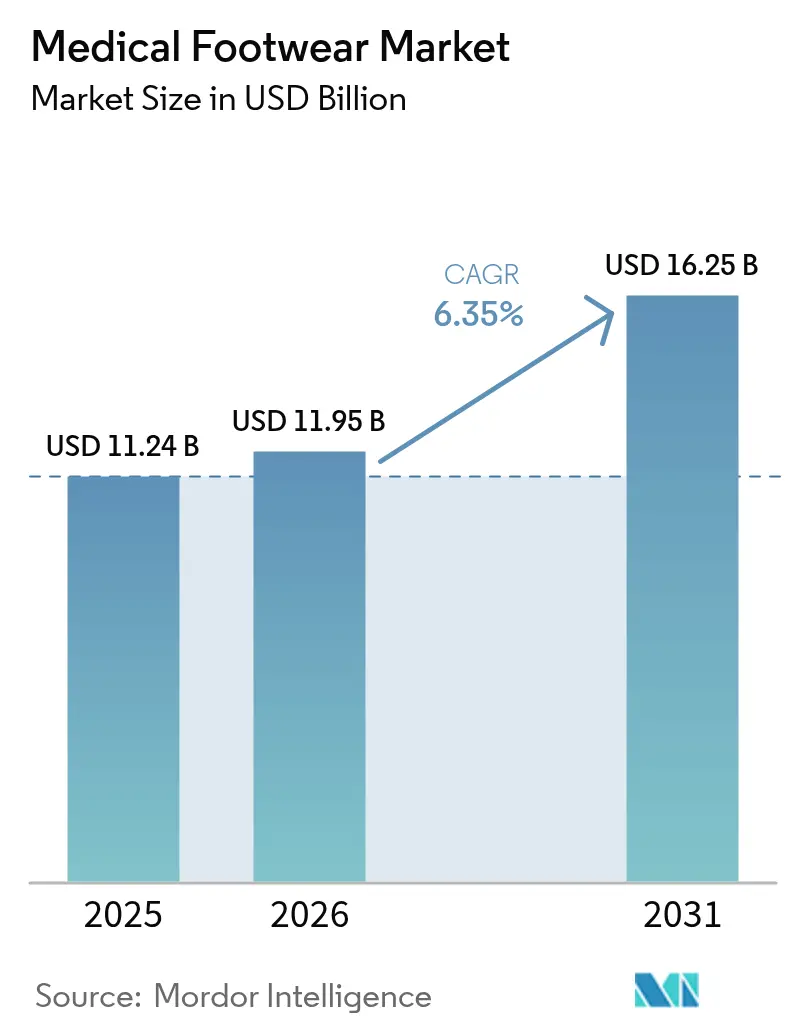
| Market Size (2026) | USD 11.95 Billion |
| Market Size (2031) | USD 16.25 Billion |
| Growth Rate (2026 - 2031) | 6.35 % |
| Fastest Growing Market | Asia-Pacific |
| Largest Market | North America |
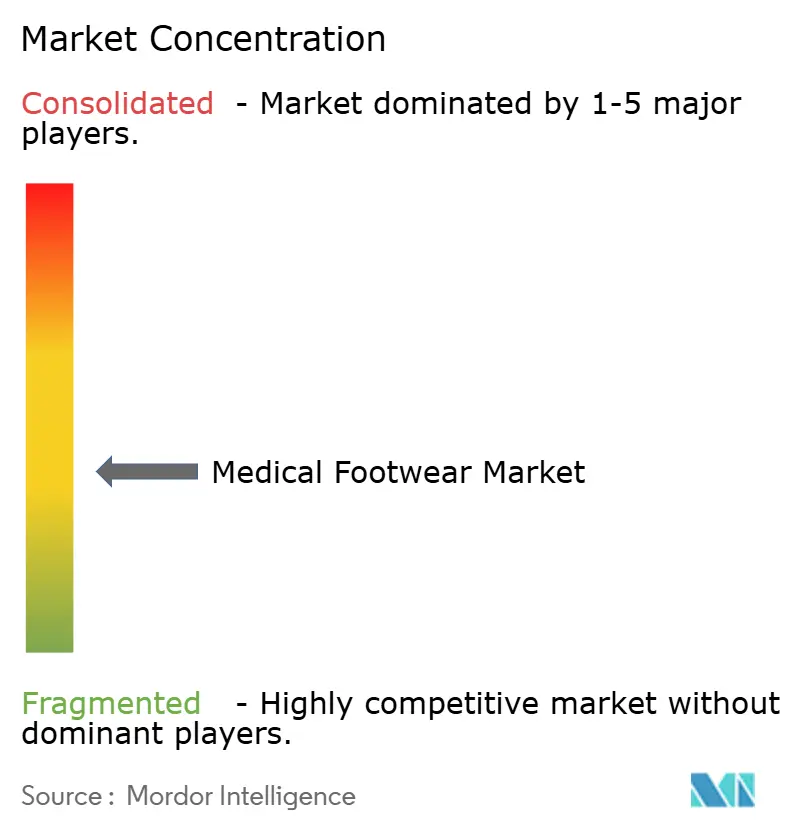
| Market Concentration | Medium |
Major Players *Disclaimer: Major Players sorted in no particular order Image © Mordor Intelligence. Reuse requires attribution under CC BY 4.0. | |
Medical Footwear Market Analysis by Mordor Intelligence
The medical footwear market size was valued at USD 11.24 billion in 2025 and estimated to grow from USD 11.95 billion in 2026 to reach USD 16.25 billion by 2031, at a CAGR of 6.35% during the forecast period (2026-2031). Growth rests on three pillars: the continuing rise in diabetes cases, rapid gains in additive manufacturing, and wider insurance recognition of therapeutic shoes as preventive devices. In 2024, North America held the lead thanks to insurance coverage for diabetic shoes, while Asia-Pacific delivered the quickest expansion as urbanization and e-commerce improved access. Manufacturers are also benefiting from improved FDA guidance that accelerates product approvals and fuels global export opportunities. At the same time, smart-sensor insoles and bio-based antimicrobial materials are elevating performance expectations for clinicians and consumers alike.
Key Report Takeaways
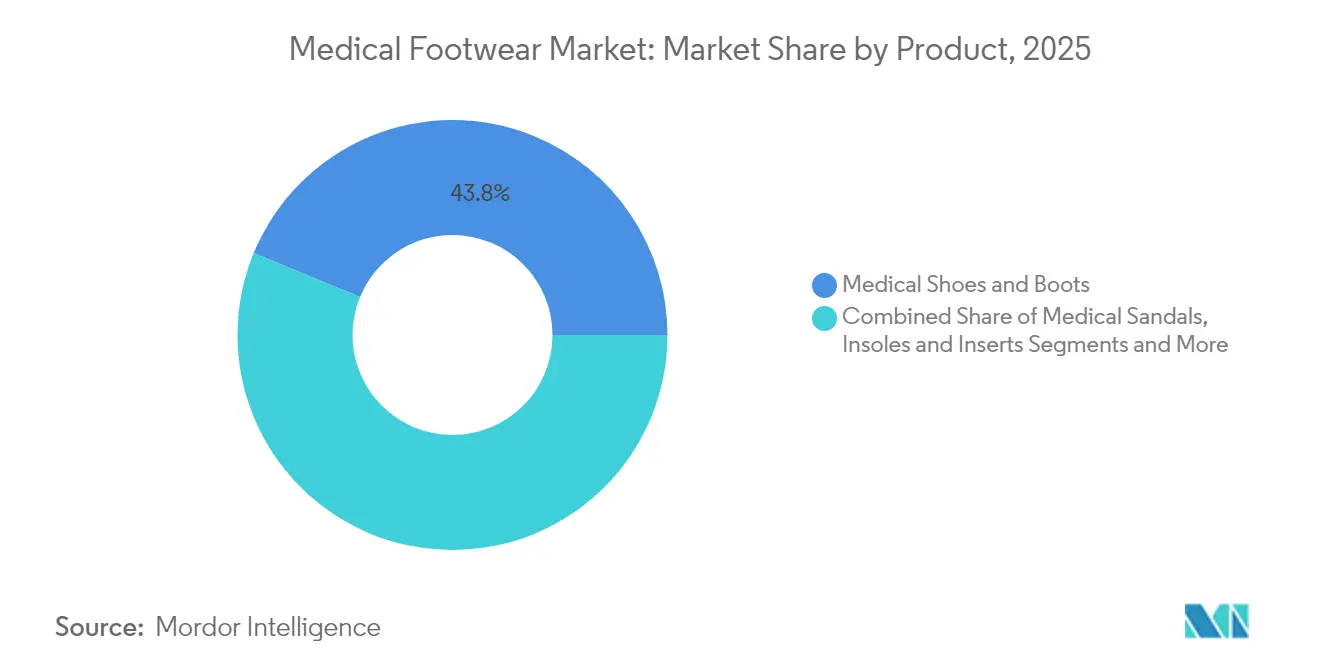
- By product category, medical shoes and boots led with 43.78% revenue share in 2025; insoles and inserts are projected to expand at a 9.54% CAGR to 2031.
- By medical condition, diabetes accounted for 67.72% of the medical footwear market share in 2025, while plantar fasciitis treatments record the highest projected CAGR at 7.28% through 2031.
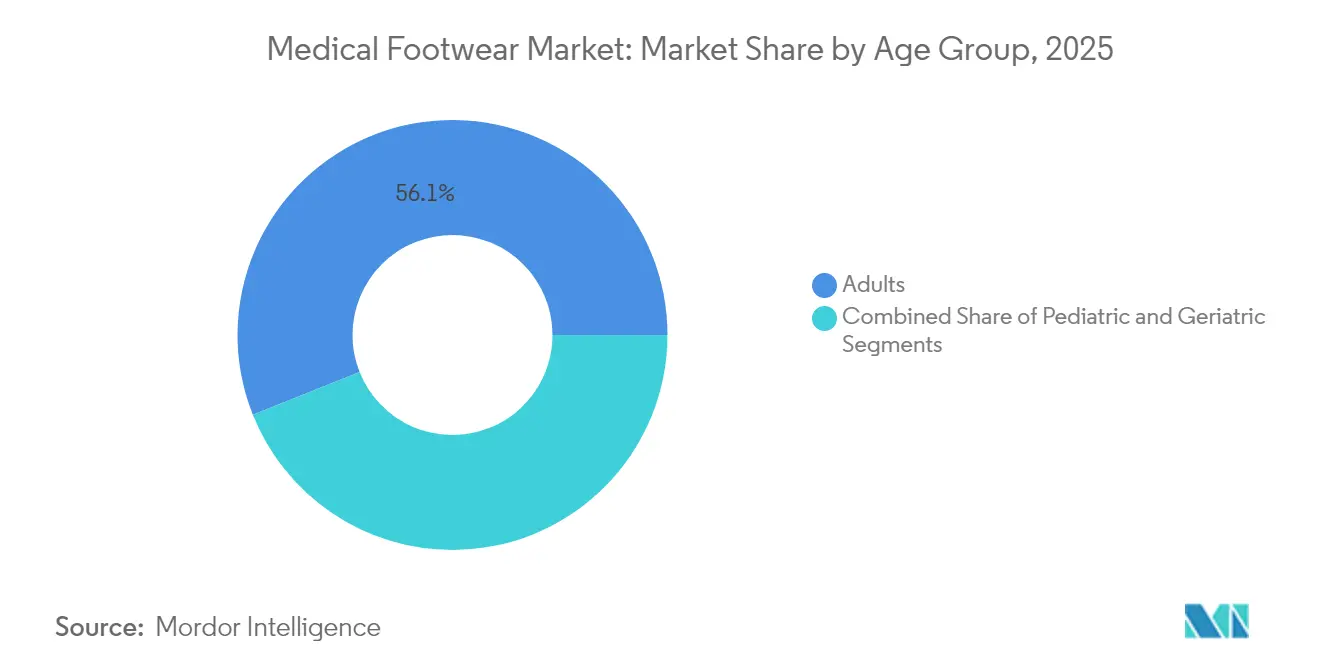
- By age group, adults 18-60 captured 56.05% share of the medical footwear market size in 2025; the geriatric population is advancing at a 8.86% CAGR through 2031.
- By distribution channel, specialty stores and clinics held 60.12% share in 2025, whereas online platforms are set to grow at a 10.19% CAGR to 2031.
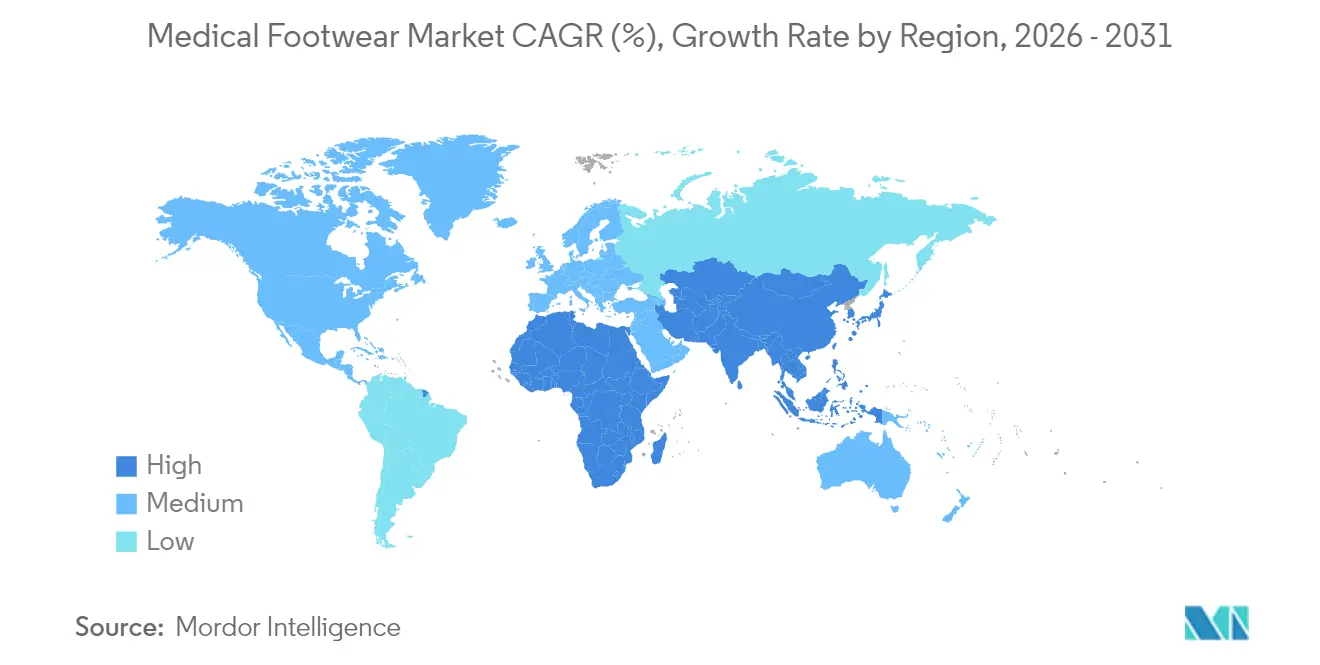
- By geography, North America commanded 33.08% share in 2025; Asia-Pacific is forecast to accelerate at an 8.67% CAGR through 2031.
Note: Market size and forecast figures in this report are generated using Mordor Intelligence’s proprietary estimation framework, updated with the latest available data and insights as of 2026.
Global Medical Footwear Market Trends and Insights
Drivers Impact Analysis*
| Driver | (~) % Impact on CAGR Forecast | Geographic Relevance | Impact Timeline |
|---|---|---|---|
| Rising Prevalence Of Diabetes & Foot-Related Disorders | +1.8% | Global, with highest impact in North America & APAC | Long term (≥ 4 years) |
| Ageing Population Driving Orthopaedic Needs | +1.5% | Global, concentrated in developed markets | Long term (≥ 4 years) |
| Technological Advances In Custom 3-D Printed Orthotics | +1.2% | North America & Europe, expanding to APAC | Medium term (2-4 years) |
| E-Commerce Expansion Improving Product Accessibility | +0.9% | Global, with early gains in North America & Europe | Short term (≤ 2 years) |
| Integration Of Smart Sensors For Remote Patient Monitoring | +0.7% | Developed markets, pilot programs in emerging economies | Medium term (2-4 years) |
| Bio-Based Antimicrobial Materials Boosting Sustainability | +0.4% | Europe & North America, spreading globally | Long term (≥ 4 years) |
| Source: Mordor Intelligence | |||
Rising Prevalence of Diabetes and Foot Disorders
The accelerating diabetes burden keeps the medical footwear market at the center of preventive care strategies. Worldwide, diabetic foot ulcers affect 6.3% of patients and cost the U.K. NHS USD 7,800 per ulcer case.[1]Ahmad H. Alghadir, “Prevalence of Peripheral Neuropathy, Amputation, and Quality of Life in Patients with Diabetes Mellitus,” nature.com Evidence shows that 44.4% of patients have peripheral neuropathy and 21.7% progress to amputation, establishing clear clinical benefits for protective footwear. U.S. researchers created a pressure-alternating insole that improves blood flow, directly tackling ulcer risk for 39 million Americans.[2]Muthu B. J. Wijesundara, “Shoe Technology Reduces Risk of Diabetic Foot Ulcers,” sciencedaily.com Ill-fitting shoes raise ulcer odds by more than 10 times, while studies confirm 50-80% of infections are preventable with proper footwear wjgnet.com. As insurers focus on cost offsets, therapeutic shoes move from discretionary purchase to essential medical device within the medical footwear market.
Ageing Population Driving Orthopaedic Needs
Population ageing is amplifying demand for orthopedic footwear across all developed regions. In 2024, 81% of Americans reported foot pain, reflecting both lifestyle shifts and longer lifespans. Colombia expects 39,270 lower-limb arthroplasty procedures by 2050, with women requiring roughly twice as many surgeries as men—a signal that gender-specific designs have a clear audience. Older adults face purchase barriers such as travel costs and complex insurance coding, creating space for mobile fitting services and subscription models. Design studies on fall prevention highlight wider heels, low profiles, and firm midsoles as critical for stability. These findings guide suppliers as they tailor ranges for seniors within the medical footwear market.
Technological Advances in Custom 3-D Printed Orthotics
Additive manufacturing is redefining speed and scope of customization. Engineers now 3-D print ankle braces for Charcot-Marie-Tooth patients, producing precise fits that conventional molding cannot match.[3]Difei Lu, “Insoles Treated with Bacteria-Killing Nanotechnology Bio-Kil Reduce Bacterial Burden,” ncbi.nlm.nih.gov A new spacer technique delivers insoles with gradual stiffness zones and scan-to-print workflows, cutting cost and production time. Embedded sensors track force and center of pressure with error rates below 9%, rivaling laboratory equipment at a fraction of the price. These innovations shorten design cycles and widen access, especially in emerging markets that lack extensive orthotic labs. The result is a faster-moving, high-specification medical footwear market.
E-Commerce Expansion Improving Product Accessibility
Digital commerce is breaking geographic barriers for the medical footwear market. FDA programs launched in 2024 reduce approval timelines for connected devices, positioning U.S. innovators for global reach. Direct-to-consumer websites bundle educational videos, virtual size guides, and tele-podiatry consults, reducing reliance on physical store visits. Consumer surveys show that 88% of Americans now shop with foot-pain relief in mind, spending USD 228 per month on associated care. COVID-19 turbo-charged online adoption, making e-commerce a permanent fixture in device procurement. Consequently, digital channels will exert outsized influence on pricing transparency and brand loyalty.
Restraints Impact Analysis*
| Restraint | (~) % Impact on CAGR Forecast | Geographic Relevance | Impact Timeline |
|---|---|---|---|
| High Cost Of Specialised Medical Footwear | -1.1% | Global, most pronounced in emerging economies | Short term (≤ 2 years) |
| Limited Reimbursement In Emerging Economies | -0.8% | APAC, Latin America, MEA | Medium term (2-4 years) |
| Proliferation Of Counterfeit / Grey-Market Orthotics | -0.5% | Global, concentrated in unregulated markets | Long term (≥ 4 years) |
| Supply-Chain Bottlenecks For Medical-Grade Materials | -0.4% | Global, with regional variations | Short term (≤ 2 years) |
| Source: Mordor Intelligence | |||
High Cost of Specialised Medical Footwear
Affordability remains a headwind, particularly where households pay most healthcare costs. Indian studies show diabetic patients shoulder substantial out-of-pocket expenses, making price the deciding factor in shoe adoption. The Medicare coding maze inflates U.S. dispensing costs, as extra documentation raises clinic overheads. Therapeutic pairs can cost 300-500% more than regular shoes, limiting reach beyond insured or affluent demographics. As a result, lower-priced local brands and leasing models are gaining ground. Without cost relief, the medical footwear market risks leaving vast segments unserved.
Limited Reimbursement in Emerging Economies
Governments in many developing countries have not yet integrated preventive footwear into insurance packages. Complex billing codes for custom orthotics deter doctors from prescribing them, particularly when clinic administrators lack the capacity to process claims. Prediabetic adults, who account for over one-third of the population in some regions, rarely qualify for coverage despite clear prevention benefits. Adoption, therefore, hinges on donor programs, tiered pricing, or public-private partnerships. Until reimbursement frameworks mature, growth in the medical footwear market could trail clinical need.
*Our forecasts treat driver/restraint impacts as directional, not additive. The impact forecasts reflect baseline growth, mix effects, and variable interactions.
Segment Analysis
By Product: Insoles Extend Innovation Frontiers
The medical footwear market size for shoes and boots stood at 43.78% revenue share in 2025, confirming their role as the default solution for complex pathologies. Demand remains stable among diabetics and post-surgical patients who require full-foot protection. Meanwhile, insoles and inserts show the fastest clip at a 9.54% CAGR, propelled by 3-D printed models that disperse plantar pressure and integrate force sensors. Research highlights insoles that combine 22 sensors with solar charging to warn wearers of loading anomalies. Antimicrobial nanocoatings such as Bio-Kil further differentiate premium inserts by lowering infection risk for ulcer-prone users.
Orthopaedic and post-operative shoes maintain a solid base linked to growing joint-replacement volumes and hospital protocols that specify rigid-sole footwear during recovery. Medical sandals gain traction in warm climates for low-level wound care and edema management. Slippers round out the line for at-home use during lengthy therapy cycles. As customization costs fall, suppliers can offer modular kits where insoles, uppers, and fastening systems match specific gait profiles, broadening consumer choice within the medical footwear market.



By Medical Condition: Plantar Fasciitis Gains Momentum
Diabetes continues to anchor demand, holding 67.72% share in 2025 on the strength of robust clinical guidelines that mandate protected footwear. Preventive shoes lower amputation risk, trimming expensive hospital stays and securing payer support. Yet plantar fasciitis is closing the gap with a 7.28% CAGR as awareness rises that 25% of sufferers experience severe pain and 61% report daily discomfort. Endoscopic plantar fasciotomy delivers 95% pain-free outcomes in six months, elevating the need for supportive shoes during rehabilitation.
Arthritis and osteoporosis shoes gain incremental volume as population ageing accelerates, with orthopaedists recommending designs featuring wide toe boxes and targeted cushioning. Sports injury footwear appeals to a growing cohort of amateur athletes who seek quick returns to activity and value integrated sensor feedback. Wound-care footwear remains a niche but vital category tied directly to surgical throughput. The diversification of conditions served enhances resilience in the medical footwear market.
By Age Group: Seniors Propel Future Uptake
Adults aged 18-60 remain the core buyers, accounting for 56.05% of 2025 revenue. Workplace standing and fitness routines drive prophylactic purchases. Health plans that emphasize preventive orthotics further sustain this cohort’s spending. However, the geriatric segment posts 8.86% CAGR to 2031, outpacing all others as longevity rises. Studies prove that stability-focused shoe designs cut fall risk among older adults, prompting caregivers to budget for high-traction outsoles and firm heel counters.
Pediatric demand is modest but strategic. Custom braces for conditions like Charcot-Marie-Tooth disease illustrate how 3-D printing yields lightweight, child-friendly designs. Across all ages, the focus shifts from passive cushioning to dynamic support that adapts as body weight and biomechanics change. This life-stage approach broadens the addressable audience for the medical footwear market.
By Distribution Channel: Digital Models Re-Shape Access
Specialty stores and clinics retained 60.12% of sales in 2025, supported by in-house gait labs and podiatry partnerships that validate fit. These outlets handle complex prescriptions and provide ongoing adjustments, sustaining their relevance despite higher costs. Online channels, however, are projected to post a 10.19% CAGR, reflecting consumer comfort with telehealth and virtual try-ons. Interactive measurement apps and AI size engines reduce return rates while widening geographic reach. Pharmacies and orthotic centers bridge the gap between clinical oversight and convenience, especially for ready-made inserts.
COVID-19 taught health systems to value remote solutions, and suppliers now integrate click-to-consult links on product pages. As insurers reimburse virtual visits, online sales will attract first-time users in rural and low-mobility populations. Diversified distribution safeguards revenue streams and helps companies meet the varied service expectations within the medical footwear market.
Geography Analysis
North America’s 33.08% stake in the medical footwear market reflects mature insurance coverage and deeply embedded diabetes management protocols. In the United States alone, 39 million people live with diabetes, many qualifying for Medicare-funded therapeutic shoes. Canadian public health data reveal that 80% of diabetes-related leg amputations are preventable through proper footwear, a statistic that underpins provincial funding schemes. Mexico’s expanding middle class is beginning to prioritize preventive shoe purchases, especially as private insurers widen podiatry benefits.
Asia-Pacific is the growth engine, charting an 8.67% CAGR through 2031. India’s large diabetic population and improving e-commerce logistics are unlocking latent demand despite reimbursement gaps. China and Japan leverage aging demographics and strong orthopaedic traditions to stimulate uptake of smart insoles and custom sandals. Regulatory harmonization under the ASEAN Medical Device Directive promises smoother entry for foreign brands, provided they adapt to local price points. Innovative offloading devices such as the Mandakini system demonstrate how indigenous solutions can flourish when global designs remain unaffordable.
Europe delivers steady gains anchored by universal healthcare and long-standing orthopaedic craft. Germany and the United Kingdom lead clinical research on sensorized footwear, while France and Italy expand geriatric fall-prevention programs that recommend stable shoes. Sustainability regulations create a conducive environment for bio-based uppers and recyclable midsoles. In contrast, the Middle East and Africa record modest but rising volumes as governments boost healthcare budgets and awareness campaigns emphasize diabetic foot care. Collectively these trends strengthen the worldwide footprint of the medical footwear market.

Regulatory Landscape
Medical footwear is regulated primarily as a medical device when therapeutic claims are made, such as pressure offloading for diabetic foot risk. In the United States, the FDA product classification lists orthopedic footwear (Product Code KNP) and medical insoles (21 CFR 880.6280) as Class I devices that are generally 510(k) exempt, but still subject to applicable controls including complaint handling and Medical Device Reporting requirements (21 CFR Part 803). A compliance update for manufacturers is the FDA Quality Management System Regulation (QMSR), effective February 2026, which aligns US quality system requirements more closely with ISO 13485:2016, tightening expectations for documented design and manufacturing controls even for lower-risk device categories.
In Europe, medical footwear placed on the market under Regulation (EU) 2017/745 (EU MDR) requires CE marking and a quality management system aligned to MDR requirements, with clinical evaluation and post-market surveillance obligations scaling with device claims and risk class. Trade policy also affects globally sourced components and finished goods, because the US Department of Commerce initiated a Section 232 investigation covering imports of medical devices and consumables in 2025. This keeps tariffs and sourcing strategies in focus through 2026 for medical device supply chains that include therapeutic footwear and orthotic inserts.
Value Chain Analysis
The value chain starts with raw-material inputs (specialty polymers and foams such as EVA and microcellular polymers, textiles, antimicrobial treatments, and fastening components) and digital-enablement inputs, including foot scanning, CAD, and pressure-mapping systems. Manufacturing covers standard extra-depth footwear lines as well as customized orthoses and insoles using milling and additive manufacturing. It then moves through finishing, quality checks, and documentation used to meet medical device compliance requirements, commonly aligned to ISO 13485:2016 and risk management practices for medical devices. Upstream, clinical specialists such as podiatrists and pedorthists influence product outcomes by prescribing and validating fit and offloading performance, which then feeds into dispensing and adjustment services.
Downstream, distribution is anchored in specialty stores and clinics for prescribed or higher-acuity needs, while pharmacies/orthotic centers and online channels expand access for repeat purchases and lower-complexity products. Supply-chain bottlenecks and cost pressures are linked to medical-grade material availability and globally distributed production networks, supporting nearshoring and reshoring moves in the broader orthopedic manufacturing ecosystem. Standardization is also changing workflows: in January 2026, Australia released Version 1 of the Pedorthic Footwear Standards, reinforcing consistent terminology and minimum requirements that affect how clinics specify products and how manufacturers document design intent and performance claims.
Competitive Landscape
The medical footwear market is moderately fragmented, with a mix of heritage orthopaedic brands, specialty diabetic-shoe makers, and tech-driven newcomers. Enovis Corporation’s EUR 800 million acquisition of LimaCorporate created a USD 1 billion platform that blends reconstructive surgery know-how with rehabilitation footwear, signalling a tilt toward integrated care offerings. Similar tie-ups could follow as firms chase economies of scale in R&D and distribution.
Technology remains the decisive differentiation lever. Companies that master 3-D printing and sensor fusion can deliver custom, data-rich products at consumer-friendly price points. FDA efforts to streamline premarket approvals encourage early adoption of smart insoles and antimicrobial fabrics. Yet market share still hinges on clinician endorsement, making evidence-backed performance claims crucial.
Direct-to-consumer startups leverage social media and subscription models to bypass clinic mark-ups, but they must invest heavily in clinical trials to satisfy regulators and insurers. Meanwhile, established players shore up margins with tiered product families and localized manufacturing to dodge supply-chain disruptions. Competition is expected to intensify as payers move toward outcomes-based contracts that reward devices proven to cut ulcer incidence and hospital stays. All told, the medical footwear industry is set for dynamic consolidation and innovation in equal measure.
Medical Footwear Industry Leaders
Drewshoe, Incorporated
Orthofeet Inc.
Enovis (Dr. Comfort)
DARCO International, Inc.
Clearwell Mobility Ltd
- *Disclaimer: Major Players sorted in no particular order

Market Opportunities and Future Outlook
One major opportunity is compressing the custom-orthotic cycle from multi-week lab turnaround to near-real-time, clinic-adjacent production. In June 2026, Moxxis AG began in-store custom insole production in Switzerland using an integrated workflow of AI foot scanning and onsite 3D printing, with pairs completed in under an hour. This supports a point-of-care service model that shifts value from centralized labs to retail and clinical settings. Technology providers are pointing in the same direction for rehabilitation providers: in July 2026, TPM3D launched the HPDM Digital Orthotic Design System (Asia edition), an AI-assisted cloud platform for mobile 3D scanning to 3D printing workflows that broadens tool availability for providers pursuing scalable customization.
A second whitespace area is evidence generation and compliance support for therapeutic claims, particularly under EU MDR clinical evaluation and post-market surveillance expectations for pressure reduction and offloading performance. Manufacturers and providers can capture this opportunity by pairing digital design with standardized outcome documentation, including pressure mapping, gait metrics, and wearability feedback, to support reimbursement discussions and procurement requirements. Progress in automated production chains for diabetic 3D-printed insoles, shown in an April 2026 feasibility study, also supports higher-volume customization when functional comparability to conventional methods is validated and traceability requirements are met.
Recent Industry Developments
- July 2026: Drew Shoes expanded its reach by launching exclusive distribution across India through Diabetic Shoe (An Ortho Shoes Company), targeting diabetic, orthopedic, and chronic foot conditions. The move broadens access to branded therapeutic footwear in a large, underpenetrated patient base where affordability and channel availability shape adoption.
- February 2026: Drew Shoe Corporation named National Shoe Specialties Ltd. as its exclusive distributor in Canada, effective March 1, 2026. This strengthens local availability and after-sales support for prescription-driven footwear needs across clinics and specialty retail networks.
- October 2025: Enovis Corporation completed the sale of its Dr. Comfort footcare solutions business to Promus Equity Partners for up to USD 60 million. The divestment reshaped competitive positioning by removing a major therapeutic footwear brand from Enovis while creating a standalone owner with incentives to reinvest in portfolio and channel expansion.


Research Methodology Framework and Report Scope
Market Definition and Coverage
This market covers medically beneficial footwear designed to support, protect, or accommodate the foot, ankle, and lower leg for specific clinical needs. It is sized as the value of products sold through offline and online channels across major regions.
Scope exclusions: Regular comfort footwear without a medical purpose, purely cosmetic shoes, and non-footwear care items are excluded from this market sizing.
Segmentation Overview
- By Product
- Diabetic Shoes & Boots
- Orthopaedic/Post-Op Shoes
- Medical Sandals
- Insoles & Inserts
- Other Products (Slippers, Flip-flops, etc.)
- By Medical Condition
- Diabetes
- Arthritis & Osteoporosis
- Plantar Fasciitis
- Sports Injuries
- Post-Operative / Wound-Care
- Others (e.g., Neuropathy)
- By Age Group
- Pediatric (<18)
- Adult (18-60)
- Geriatric (>60)
- By Distribution Channel
- Specialty Stores & Clinics
- Pharmacies & Orthotic Centres
- Online
- By Geography
- North America
- United States
- Canada
- Mexico
- Europe
- Germany
- United Kingdom
- France
- Italy
- Spain
- Rest of Europe
- Asia-Pacific
- China
- Japan
- India
- Australia
- South Korea
- Rest of Asia-Pacific
- Middle East and Africa
- GCC
- South Africa
- Rest of Middle East and Africa
- South America
- Brazil
- Argentina
- Rest of South America
- North America
Data Sources, Market Sizing, and Validation
Desk Research
Desk research was used to anchor the demand pool and the healthcare context that drives medical footwear uptake, then we moved into country and channel level assumptions. We relied on non-paywalled sources such as WHO, CDC, NIH publications, and national health ministries for prevalence trends linked to diabetes and musculoskeletal issues, which act as key usage triggers.
We also used trade and classification resources such as USITC and UN Comtrade to get directional signals on related footwear categories, and we referenced FDA device guidance where relevant to support product claim boundaries.
To convert these signals into a workable market model, we reviewed annual reports, investor presentations, and press releases to understand product mix and route-to-market patterns, and we cross-checked reported developments using reputable business press. In parallel, we used paid subscriptions for company financials and intelligence, plus patent databases, to identify where new designs and materials were being emphasized.
The specific desk sources listed here are illustrative only, and many other public and paid references were used for data collection, validation, and clarification during the study.
Primary Interviews and Surveys
Primary work focused on confirming how prescriptions, reimbursements, and retail recommendations translate into actual purchasing, and how product types differ in pricing and replacement cycles. We spoke with a mix of manufacturers, distributors, specialty retailers, orthotic and podiatry-linked stakeholders, and clinicians in APAC, EMEA, and the Americas to fill data gaps and stress-test assumptions that were first built from desk inputs.
Distribution of primary research fieldwork respondents
| Company type | Respondent position | Region |
|---|---|---|
| Top tier: 33% | CXOs: 20% | APAC: 43% |
| Mid tier: 47% | Functional/Unit leaders: 25% | EMEA: 30% |
| Smaller Players: 20% | Managers: 55% | Americas: 27% |
Market-Sizing & Forecasting
Sizing started with a top-down build that links medical condition prevalence and treated populations to likely medical footwear users, then adjusts by access factors such as reimbursement coverage and specialist availability by country. After the demand pool was shaped, revenues were estimated using a practical price and volume structure, where replacement frequency and channel mix help translate users into annual purchases.
To keep totals realistic, we corroborated the results with selective bottom-up checks such as sampled average selling price ranges from specialty clinics and retail listings, plus supplier and distributor channel checks on typical order patterns. Key inputs used (as illustrative examples) included diabetes and geriatric population trends, diagnosis and treatment rates for foot and ankle conditions, reimbursement and coverage breadth for therapeutic shoes, online share movement in footwear purchasing, and observed price spreads between post-op shoes, diabetic shoes, and orthopedic footwear.
Where direct volume signals were not available for a country, we used proxy ratios based on comparable healthcare access and income brackets, then re-checked the resulting assumptions in interviews.
For forecasting, scenario analysis was used because coverage policies, adoption of customized fitting, and e-commerce access can shift differently by region. Growth paths were adjusted using expert feedback on how quickly prescriptions and preventive foot care behaviors are expected to expand, before the final CAGR-consistent projections were locked in.
Data Validation & Update Cycle
Validation was done through multiple passes that compare model outputs against independent market signals, then resolve variances before sign-off. We checked for anomalies such as sudden price jumps, unrealistic penetration rates, or region totals that conflict with known healthcare spending and demographic patterns, and these were sent back for analyst review.
When a variance could not be explained by public data alone, re-contact was triggered with interviewees to confirm whether it reflected a pricing change, a coverage shift, or a channel mix effect. Reports are refreshed annually, with interim updates when material events occur that can shift demand or pricing. Before delivery, the analyst team runs a fresh review so clients receive the latest updated view of market size and outlook.
Mordor Intelligence's Medical Footwear Market Estimate Compared With Other Published Estimates
Published market sizes for medical footwear can look far apart because each publisher makes different calls on what counts as "medical," the years used as the base, and how pricing is converted across regions. Differences also come from the weight placed on reimbursement-driven demand versus general comfort and wellness buying.
Some estimates widen the scope by folding in adjacent foot-care items such as orthotic insoles and inserts, and they may also mix retail comfort products that are marketed as supportive. In the Mordor Intelligence estimate, the market is counted only for medically beneficial footwear sold as shoes, boots, sandals, and related medical footwear products, and adjacent non-footwear items are not added into the total.
Benchmark comparison
| Source | Market Size | Gaps in Research Methodology |
|---|---|---|
| Mordor Intelligence | USD 11.95 B (2026) | |
| Industry Association A | USD 13.60 B (2026) | Uses a broader basket that can include orthotic inserts and foot-care accessories, and it often applies blended average prices that are not separated by condition-driven footwear types. |
| Global Consultancy B | USD 10.80 B (2026) | Leans on conservative adoption rates tied to reimbursed prescriptions only, and it can undercount out-of-pocket purchases through online and specialty retail channels in faster-growing countries. |
The comparison shows that the spread is mainly explained by scope choices and how pricing and channel coverage are treated. By keeping the included product set explicit and then checking penetration and pricing against practical demand signals, our estimate remains easier to trace back to clear drivers and repeatable steps.


Key Questions Answered in the Report
What is the current value of the medical footwear market?
The market is valued at USD 11.95 billion in 2026.
Which region leads the medical footwear market?
North America holds the top spot with 33.08% revenue share in 2025.
Which product segment is expanding the fastest?
Insoles and inserts are growing at a 9.54% CAGR through 2031.
Why is plantar fasciitis a key growth area?
Rising awareness and high pain prevalence are driving a 7.28% CAGR for plantar fasciitis footwear solutions.
How are smart sensors changing medical footwear?
Embedded electronics provide real-time gait analysis, enabling earlier intervention and better clinical outcomes.
Page last updated on:


 Your data is secure and never sold or shared.


