
Matcha Market Size and Share
Matcha Market Analysis by Mordor Intelligence
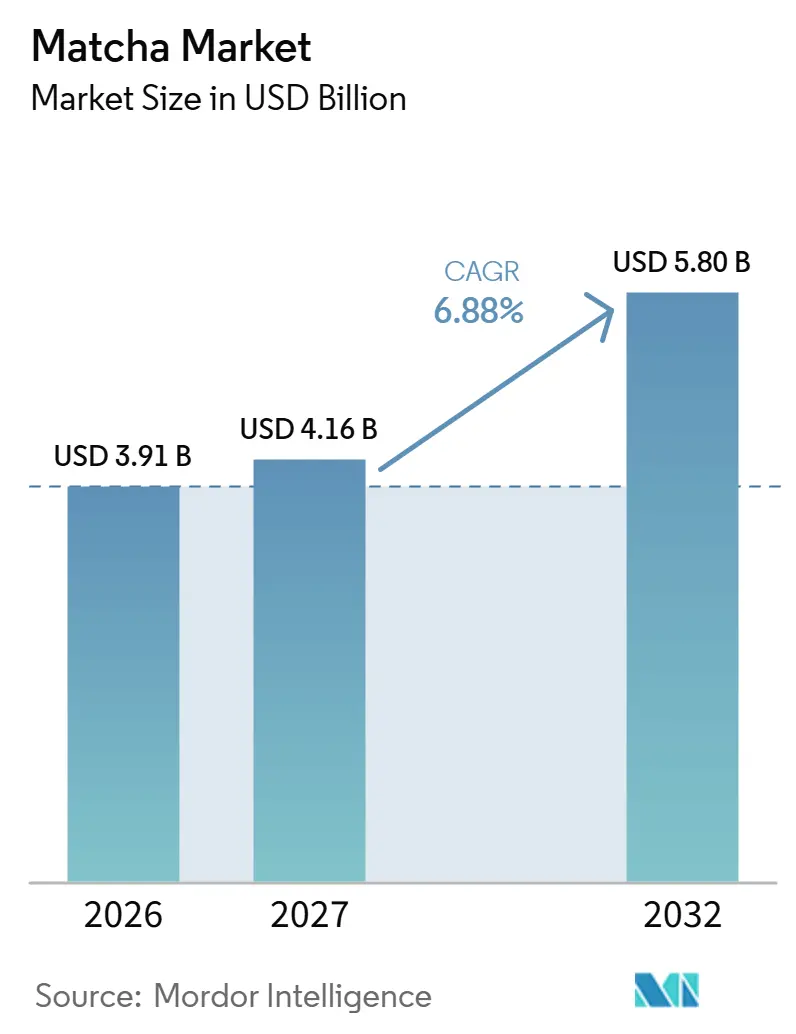
The matcha market size is projected to expand from USD 3.91 billion in 2026 and USD 4.16 billion in 2027 to USD 5.8 billion by 2032, registering a CAGR of 6.88% between 2027 and 2032.
Demand in the United States is widening the commercial setting for matcha, linking benefit-led beverage choices with applications in drinks, frozen desserts and bakery recipes. Powder offers room for recipe development, while portable liquid formats move part of final preparation into the package. Competitive responses combine processing expansion with origin and organic positioning, giving ingredient availability and premium differentiation separate roles in serving that demand. Broad application demand gives accessible offers several routes to customers, while premium ceremonial products face a tighter limit on acceptable serving prices.
Key Report Takeaways
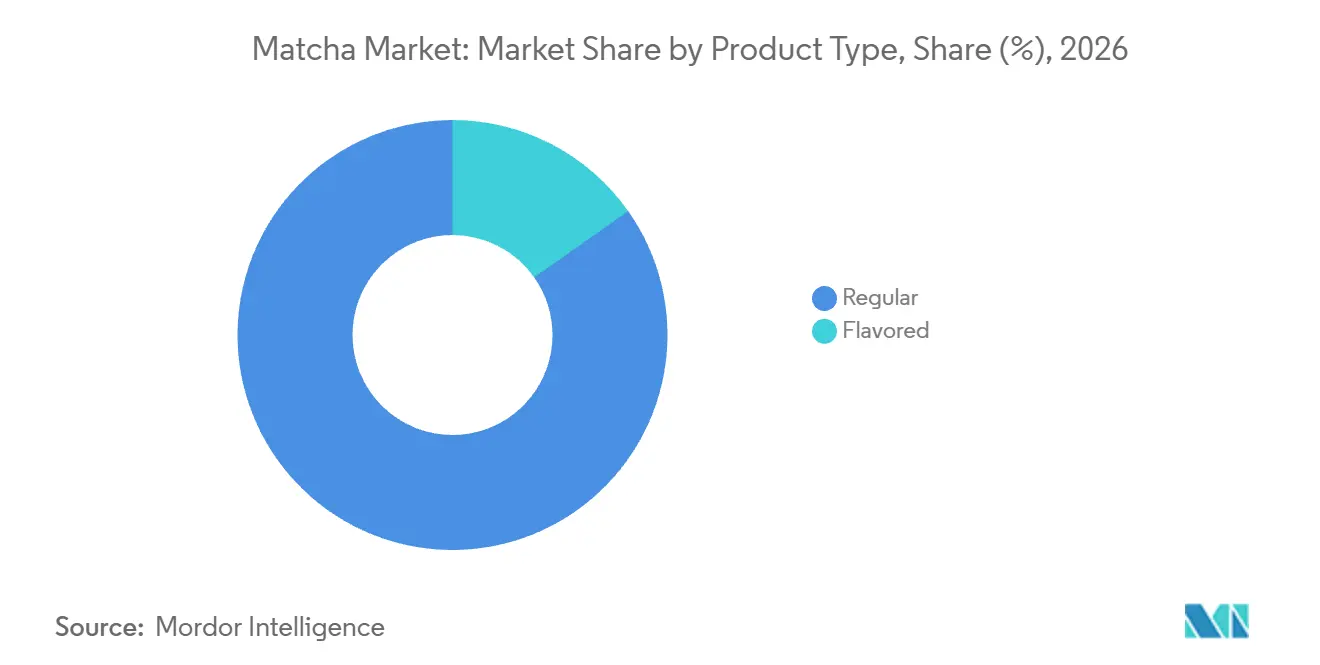
- By product type, regular matcha led with an 84.78% matcha market share in 2026, and flavored matcha is forecast to grow fastest at a CAGR of 7.58% between 2027 and 2032.
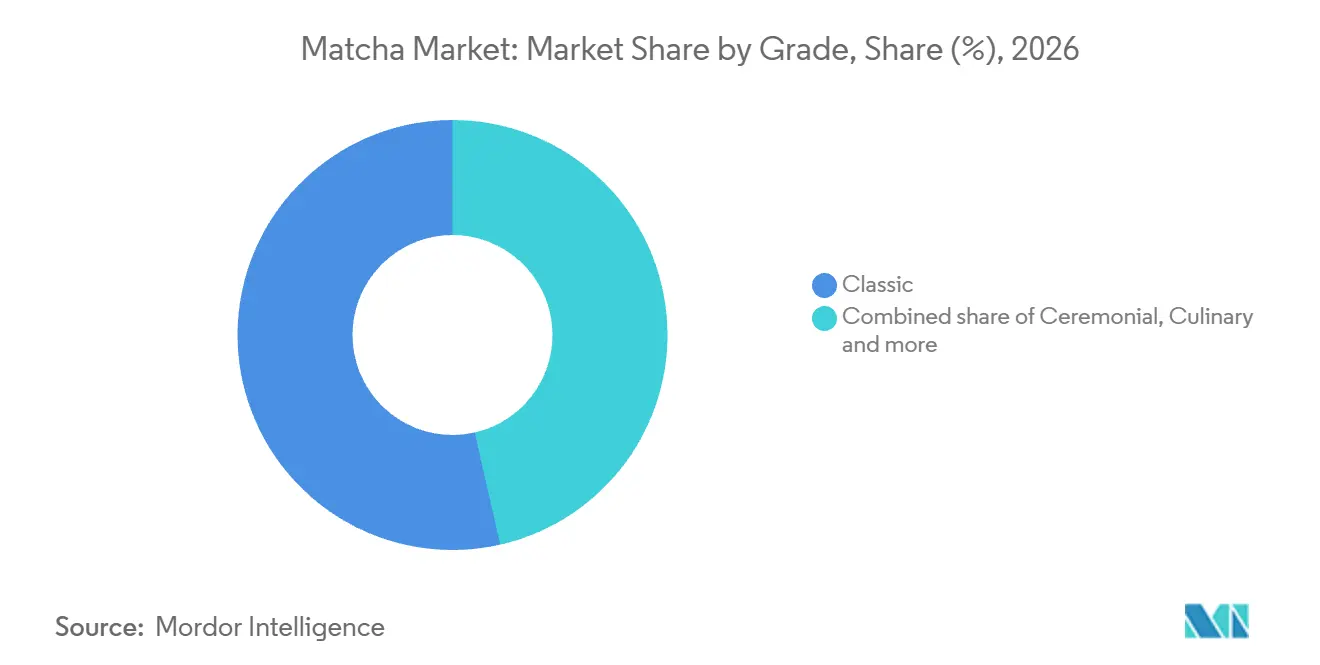
- Among grades, classic matcha held a 53.56% share of the matcha market size in 2026, while ceremonial matcha is projected to be the fastest-growing segment at a CAGR of 8.3% between 2027 and 2032.
- By form, powder led with a 56.72% share in 2026, and liquid matcha is forecast to grow fastest at a CAGR of 8.7% between 2027 and 2032.
- Retail led distribution channels with a 71.77% share in 2026, while foodservice is projected to grow fastest at a CAGR of 7.75% between 2027 and 2032.
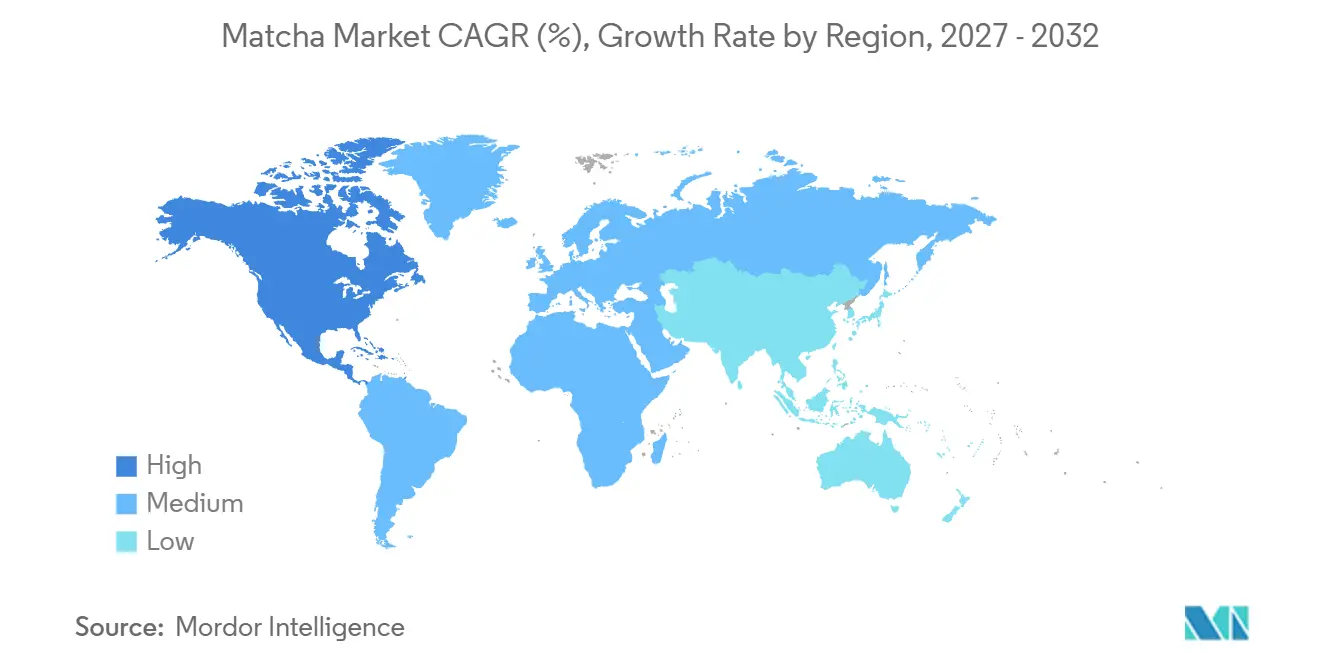
- Geographically, Asia Pacific held the largest share at 44.3% in 2026, and North America is forecast to grow fastest at a CAGR of 7.95% between 2027 and 2032.
Note: Market numbers in this report are based on Mordor Intelligence's proprietary estimation framework, which combines nine months of actuals with Q4 projections for base year 2026.
Market Trends and Insights
Drivers Impact Analysis of Matcha Market*
| Driver | (~) % Impact on CAGR Forecast | Geographic Relevance | Impact Timeline |
|---|---|---|---|
| Popularity of functional foods and beverages | +2.8% | United States and United Kingdom | Medium term (2-4 years) |
| Expansion of plant-based and vegan diets | +1.6% | North America (United States) | Medium term (2-4 years) |
| Growth in e-commerce and online retail | +1.9% | Europe (United Kingdom) | Short term (≤ 2 years) |
| Increasing Product Innovation | +1.7% | North America (United States) | Short term (≤ 2 years) |
| Increasing Demand for Premium Beverages | +1.1% | Asia Pacific (Japan) | Medium term (2-4 years) |
| Geographic expansion beyond Asia | +0.9% | Europe (United Kingdom) | Long term (≥ 4 years) |
| Source: Mordor Intelligence | |||
Popularity of functional foods and beverages
Demand for beverages with a defined wellness purpose creates an opening for matcha beyond flavor alone. In May 2026, 41% of US adults said they were seeking foods or beverages with hydration benefits more than a year earlier. Ocado Retail reported that Ocado.com health-drink sales rose 54% year over year in the comparison period ending April 23, 2025, across products from kombucha to prebiotic sodas. That wider category spending gives matcha suppliers a commercial reason to address health-oriented beverage occasions. US hydration interest and UK health-drink spending support testing a shared wellness message in both countries, while tailoring the specific beverage benefit to each offer.
Expansion of plant-based and vegan diets
Plant-based beverage growth gives matcha suppliers a way to serve convenience demand through formulations that can fit dairy-free product development. US retail sales and unit sales of ready-to-drink plant-based beverages grew by double digits in 2025, according to the Good Food Institute. The institute linked sales gains to distribution growth and consumer demand for convenient ready-to-drink beverages, including coffee and tea drinks. In October 2025, Green Beans Coffee introduced a matcha latte at its US cafés. Its ceremonial-grade matcha powder was described as naturally vegan, a formulation attribute relevant to developers selecting the beverage base. A developer can carry that powder into dairy-free recipes, but the other ingredients determine whether the finished beverage serves the plant-based occasion.
Growth in e-commerce and online retail
Online retail can turn interest in beverage alternatives into purchases of matcha for preparation outside a café. Ocado Retail reported that Ocado.com matcha sales rose 67% year over year in comparison periods ending April 23, 2025. Ocado attributed the increase to the search for lower-caffeine alternatives. For suppliers, this offers a merchandising proposition built around an identified consumer preference, with an online retailer providing access to the shopper. For an online supplier, the opportunity is to win a place among beverage substitutes, extending its potential customer base beyond shoppers seeking matcha specifically.
Increasing Product Innovation
Product development can turn matcha into an ingredient platform for restaurant formats that serve different consumption occasions. In February 2026, Jack in the Box made a matcha iced latte and an Oreo matcha shake available at its locations nationwide in the United States. The latte combined matcha with sweetened cream and vanilla, creating a beverage application within the restaurant operation. The shake used matcha with vanilla ice cream, Oreo cookie crumbles and whipped topping, extending the ingredient into a dessert preparation. Serving both applications would let a matcha supplier participate in a restaurant's beverage and dessert menus through the same customer relationship.
Restraints Impact Analysis of Matcha Market*
| Restraint | (~) % Impact on CAGR Forecast | Geographic Relevance | Impact Timeline |
|---|---|---|---|
| Competition from alternative superfoods | -1.2% | United States and United Kingdom | Medium term (2-4 years) |
| Price sensitivity in emerging markets | -0.9% | Southeast Asia (Indonesia) | Medium term (2-4 years) |
| Flavor and cultural acceptance barriers | -0.6% | Asia Pacific, North America and Europe | Long term (≥ 4 years) |
| Adulteration and quality inconsistency | -0.4% | Germany and China | Short term (≤ 2 years) |
| Source: Mordor Intelligence | |||
Competition from alternative superfoods
Competing superfoods can satisfy a broad wellness-drink occasion when the buyer has no preference for matcha itself. Taste, preparation requirements and price then become reasons to consider replacing the ingredient. This makes an offer based only on a general health promise more exposed than a recipe whose identity depends on matcha. A supplier can reduce that exposure by connecting its product to a distinctive matcha use occasion. Even then, wellness-led trial may require repeated selling effort before it becomes dependable ingredient demand, increasing the commercial cost of pursuing buyers who do not specifically seek matcha.
Price sensitivity in emerging markets
Premium positioning faces a price ceiling even among Indonesian matcha drinkers willing to consider higher-quality products. In a May 2025 YouGov survey, 54% of Indonesian matcha drinkers open to paying a premium for high-quality ceremonial matcha said they would pay up to USD 3 per serving.[1] Only 12% of that group would pay more than USD 5 per serving. A premium-only offer would therefore address a smaller willing-to-pay audience than a range with accessible serving prices. In December 2025, ITO EN presented a matcha lineup spanning high-end products and more affordable options. Entry tiers may widen participation, but ceremonial suppliers cannot treat premium interest as permission for unrestricted price increases.
*Our forecasts treat driver/restraint impacts as directional, not additive. The impact forecasts reflect baseline growth, mix effects, and variable interactions.
Matcha Market Segment Analysis
By Product Type:
Customization Anchors Regular Demand as Flavored Formats Simplify PreparationRegular matcha accounted for an 84.78% share of the matcha market size in 2026. For a buyer developing several recipes, an unflavored base leaves the choice of added flavors in the buyer's hands. That flexibility can make a single matcha input useful across multiple formulations, provided it meets each recipe's required flavor and handling characteristics. Customization can then occur during final formulation, letting suppliers focus on the base matcha specification while application developers combine it with the other ingredients required by each finished recipe.
Flavored matcha is the fastest-growing segment, with a projected CAGR of 7.58% between 2027 and 2032. Shinzo Matcha launched naturally flavored powdered matcha latte stick packs in September 2025. The pre-portioned format was designed for addition to the consumer's milk of choice, removing the need to measure out matcha. For the brand, flavoring and portioning become part of the supplied matcha product, while the consumer supplies the final beverage base. This creates a supplier proposition in which flavored matcha carries part of the recipe, linking product differentiation to preparation convenience.

By Grade:
Routine Application Fit Supports Classic While Premium Labels Need DefinitionClassic matcha represented a 53.56% matcha market share in 2026. For a café developing a repeatable house matcha drink, a grade positioned for routine preparation can be judged by performance in that specific recipe. A supplier can define the matcha character and serving application clearly enough to let the operator keep the house drink recognizable over successive preparations. Once a café fixes its house recipe around a classic matcha specification, changing that specification can force the operator to reformulate the drink.
Ceremonial matcha is the fastest-growing segment, with a projected CAGR of 8.3% between 2027 and 2032. In June 2026, Moku Matcha co-owner Ryan Conching described customer demand for top-grade matcha he called ceremonial in Hawaii. Ceremonial was the retailer's grade description in a product category with no official grading system. For premium buyers, supplier-specific product descriptions therefore need to carry more weight than the grade name alone. The growth opportunity can favor suppliers that make premium distinctions intelligible, because a shared label does not by itself establish a common product standard.
By Form:
Processing Scale Supports Powder as Bottle Design Extends Liquid UsePowder was the largest segment, accounting for 56.72% of matcha sales in 2026. ITO EN doubled its matcha production lines from November 2025 as it worked to establish a stable supply system in Japan. Additional processing lines can support finished-ingredient supply to buyers that prepare their own drinks or foods. Control over final preparation stays with the ingredient customer, while the processor must translate added equipment into a repeatable finished-product flow. The factory expansion addresses the manufacturing side of powder availability, with commercial value realized when usable product reaches ingredient customers.
Liquid matcha is the fastest-growing segment, with a projected CAGR of 8.7% between 2027 and 2032. On September 24, 2026, ITO EN announced nationwide Japanese releases of matcha LOVE Matcha Coffee Latte and Matcha Mont Blanc Latte for October 5, 2026.[3] Both canned beverages use 100% Japanese-grown matcha, with package sizes of 0.28 liters and 170 grams, respectively. These blends place flavor combination within the manufactured beverage, leaving the consumer with a packaged serving. For manufacturers, the proposition involves coordinating the matcha ingredient, its flavor pairing and the container within a single finished product.
By Distribution Channels:
Retail Serves Home Use as Foodservice Builds Beverage ApplicationsRetail was the largest segment, holding a 71.77% share in 2026. NIQ data cited by Fresh Cup show US retail sales of matcha rose 86% from 2022 to 2025. For household buyers, a packaged matcha product can support several preparation occasions, placing the ingredient within the consumer's own routine instead of a single café visit. This creates a commercial role for retailers that connects finished matcha products with home beverage and recipe use while preserving the buyer's control over each preparation. Retail gives suppliers access to those home uses without requiring them to operate the cafés that prepare individual servings.
Foodservice is the fastest-growing segment, with a projected CAGR of 7.75% between 2027 and 2032. Caffè Nero UK's iced-drink sales rose 52% for the year to May 31, 2026, with matcha accounting for a significant amount of the increase. The result illustrates prepared drinks as a commercial use for matcha within an operator's wider beverage business. For ingredient suppliers, an operator's matcha menu can create a recurring use case across many individual drink orders. For a supplier, retaining a place in the café's iced-drink recipe matters more than securing a one-time menu introduction.
Geography Analysis
Asia Pacific Matcha Market
Asia Pacific accounted for a 44.3% matcha market share in 2026, making it the largest region. Japan produced more than 6,200 metric tons of tencha, the leaf used to make matcha, in 2025, roughly triple its production about a decade earlier. An expanding tencha crop can support a greater pool of raw material for matcha processors, linking the region's agricultural base to its finished-product business. The commercial opportunity is to add processing value close to that crop, so regional suppliers can sell finished matcha instead of relying only on leaf transactions.
North America Matcha Market
North America is the fastest-growing region, with a projected CAGR of 7.95% between 2027 and 2032. Square reported that US matcha order counts among its sellers rose 36.5% year over year in Q3 2025. Canadian sellers using Square's platform recorded a 114% increase in matcha order counts from April 2024 to April 2025. Prepared-drink channels can expose more customers to matcha without requiring them to purchase powder or manage its preparation at home. For suppliers, this creates a route to sell matcha through operators whose ingredient requirements can expand with beverage orders, connecting consumer convenience to business-to-business demand.
Square transaction data showed 30% quarter-on-quarter sales growth for matcha items among food-and-beverage purchases across UK merchants in Q1 2026. In Brazil, Namu supplies matcha to cafeterias and recorded a 600% one-year increase in foodservice sales, as reported in January 2026. Emmi Group launched its lactose-free, ready-to-drink Matcha Latte made with Swiss milk in March 2026, with availability in Switzerland, Germany, Austria, Spain and Belgium reported by August 19, 2026. In Middle East and Africa, Riyadh-based WeGo offered made-to-order matcha drinks through home pickup in June 2026, combining the beverage with a Saudi hospitality experience. Hospitality positioning gives a Riyadh home-pickup venture such as WeGo a distinct matcha occasion to sell, adding a service dimension to the ingredient's commercial reach.
Regulatory Framework and Outlook
Selected jurisdictions are compared from the perspective of a commercial matcha importer, focusing on food-safety duties, residue controls and import procedures. Canada's framework generally requires importer licensing, preventive controls and traceability, with a written preventive control plan required in applicable cases. Japan prohibits selling or importing food that exceeds its applicable pesticide residue limits. These controls make both product compliance and the importer's documentation relevant to the route into each country.
Regulatory Table of Matcha Market
| Decision factor | Canada | Japan | Germany | Brazil |
|---|---|---|---|---|
| Primary authority | Canadian Food Inspection Agency | Ministry of Health, Labour and Welfare quarantine stations; Consumer Affairs Agency | Member-state food-control authorities | Anvisa |
| Key instruments or direction | Safe Food for Canadians Regulations | Food Sanitation Act residue controls; FY2026 import monitoring plan | Regulation (EU) 2026/742 tea nicotine limit; EU residue framework | RDC 722/2022; IN 160/2022; single import declaration (DUIMP) mandatory from April 27, 2026, for covered imports |
| Commercial effect | Licensing generally required; preventive controls and traceability; written plans where applicable | Import notification checks and applicable residue compliance | Residue compliance with processing adjustments | Contaminant compliance and complete filings for covered imports |
| Current policy attractiveness | Medium | Medium | Medium | Medium |
| Future direction of policy attractiveness | No change | No change | No change | No change |
| Source: Mordor Intelligence | ||||
Canada's Medium and No change ratings reflect SFCR licensing, preventive-control and traceability duties with applicable exceptions, the September 19, 2025 amendment baseline, and no matcha-relevant importer transition in CFIA's June 16, 2026 forward plan. Japan's standing residue prohibition and general food-import notification checks support Medium and No change under the April 1, 2026, to March 31, 2027 plan, allowing review with no announced replacement or changed importer duty. Germany's Medium rating reflects residue compliance, while retention of the temporary 0.5 mg/kg tea nicotine ceiling through February 22, 2030, supports No change. Brazil's Medium rating and No change direction reflect contaminant duties and the operative DUIMP framework, where incomplete or inconsistent risk information can trigger additional review and longer clearance.
Value Chain Stages
The value chain compares control of cultivation, conversion into finished powder, and access to the consumer. H&T Trading exports organic matcha from Iga through an integrated operation based on its parent farm, Futaba-En. Aiya mills refined tencha, inspects and packages matcha, and distributes finished products in Japan and overseas. These arrangements make integration commercially relevant because control of the crop and control of finished-product release sit at different operational points.
Value Chain Analysis Table of Matcha Market
| Primary activity | Key participants | Value capture | Bottleneck | Resilience response |
|---|---|---|---|---|
| Cultivation and tencha preparation | Integrated farm producers such as Futaba-En, parent farm of H&T Trading | Sales of farm-produced organic matcha through integrated supply | Dependence on qualified organic leaf supply | Qualify additional organic growing sources |
| Milling, inspection and wholesale | Processors and wholesalers such as Aiya Co., Ltd.; exporters and wholesalers such as H&T Trading | Processed matcha wholesale sales | Milling and final inspection capacity | Coordinate milling schedules with product-release checks |
| Consumer retail | Tea retailers such as Ippodo Tea Co Ltd | Packaged matcha retail sales | Reliance on a direct consumer route | Develop additional qualified retail routes |
| Source: Mordor Intelligence | ||||
Ippodo sells matcha through its global online shop, placing the consumer transaction downstream from cultivation and processing. Integration can retain crop and processing earnings within one group, while retail access creates a separate route to capture finished-product revenue. Aiya says one tea mill produces 40 grams of high-class tea-ceremony matcha per hour. At that stated rate, larger orders require more mill-hours, tying expansion of this grade's wholesale supply to processing resources.
Competitive Landscape
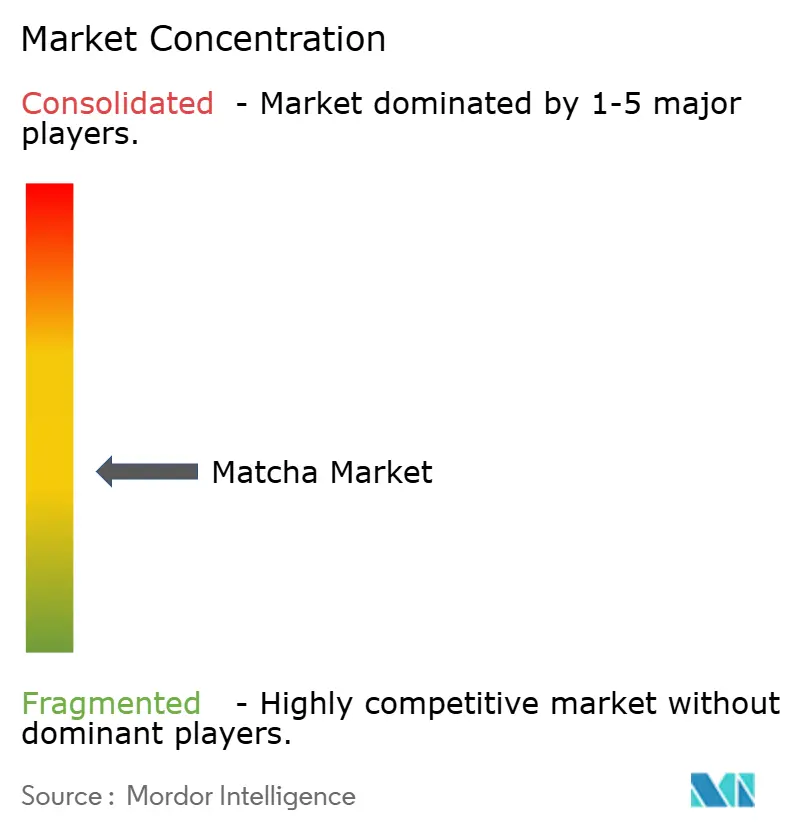
Competition is divided among specialist ingredient suppliers and branded sellers, creating a mixed structure with several distinct routes to the buyer. AOI Tea Company supplies wholesale, bulk and private-label matcha, while AIYA America Inc. offers organic and conventional ingredient grades for food and beverage applications. Pique sells branded matcha, while ITO EN Ltd. reported 41% year-over-year growth in matcha product sales from May 2025 through April 2026. Midori Spring offers wholesale matcha to cafés, shops and retailers, while excluding e-commerce businesses and home-based cafés from applications and not guaranteeing approval. The competitive divide spans ingredient service and branded-product ownership, so scale and differentiation need not come from the same commercial activity.
Brand strategies can make a matcha offer recognizable through product identity, while a quantified sales base gives challengers a separate route to commercial credibility. Branded matcha seller MATCHA DNA reported sales of more than 222,000 units in 2025. Pique positions Sun Goddess Matcha as 100% organic, ceremonial-grade first-harvest matcha from Kagoshima, Japan, tying its branded offer to origin and grade claims. These strategies can help a supplier compete for a consumer-facing product relationship, with business scale and origin-based positioning supplying different reasons for a retailer or shopper to consider the brand.
Competitive direction links manufacturing response with the need to make product quality claims useful to commercial buyers. On February 26, 2026, ITO EN's procurement department head said the Shizuoka Factory in Makinohara City, Japan, was stone-milling matcha around the clock because of high demand, yet still could not fill all matcha orders despite doubling production. Midori Spring describes its ceremonial and culinary matcha as USDA Organic and EU Organic through equivalency agreements with Japan, and JAS Organic-certified by OCIA. For wholesale buyers, that shortfall makes delivery capability a separate selection test alongside the organic positioning Midori Spring documents.
Matcha Industry Leaders
-
AOI Tea Company
-
AIYA America Inc.
-
Pique
-
ITO EN Ltd.
-
Midori Spring
- *Disclaimer: Major Players sorted in no particular order
Matcha Market Companies Covered in this Report
- AOI Tea Company
- AIYA America Inc.
- ITO EN Ltd.
- Marukyu Koyamaen
- PepsiCo Inc.
- Starbucks Corp.
- Breakaway Matcha LLC
- Matcha Maiden
- Mizuba Tea Co.
- DoMatcha
- Pique
- Midori Spring
- Ippodo Tea Co Ltd
- Cha Cha Matcha
- The AOI TEA Company
- Aiya America Inc
- Clearspring Ltd.
- Matcha.com
- MATCHA DNA
- Tenzo Tea
Key Opportunities for Market Participants
The opportunities compare ingredient matcha offers for café drinks, frozen desserts and bakery recipes. In Square's US seller data, orders for matcha-flavored menu items rose 47.5% at ice cream shops and 40% at bakeries year over year in Q3 2025.[2] Ingredient offers can therefore focus on the preparation task that connects each buyer's menu demand with repeat matcha use.
Market Opportunities Table of Matcha Market
| Opportunity | Why now | Buyer / lead segment | Recommended play | Main barrier | Likely beneficiaries |
|---|---|---|---|---|---|
| Matcha supply with drink-preparation support | Matcha order growth among Square's US sellers in 2025 | Café operators | Pair ingredient supply with a defined serving protocol | Achieving repeatable drink preparation | Ingredient suppliers with café application support |
| Matcha ingredients for frozen desserts | Growth in matcha-flavored orders at US ice cream shops in 2025 | Ice cream shop operators | Qualify matcha in the buyer's dessert base | Maintaining a recognizable matcha profile in the finished dessert | Matcha processors serving dessert makers |
| Application-specific bakery matcha supply | Growth in matcha-flavored orders at US bakeries in 2025 | Bakery operators | Develop a recipe specification linked to repeat ingredient supply | Matching the matcha dose to the finished recipe's cost | Matcha wholesalers serving bakeries |
| Source: Mordor Intelligence | |||||
The strongest play is to qualify matcha in the buyer's finished recipe and use that specification as the basis for recurring supply. Ice cream and bakery demand broadens the buyer set beyond cafés, giving application support a commercial role alongside ingredient availability. The return depends on converting a finished-menu preference into an ingredient relationship that extends beyond the initial product trial.
Recent Industry Developments in Matcha Market
- Oct 2026: ITO EN released its matcha LOVE Matcha Coffee Latte nationwide in Japan, made with 100% Japanese-grown matcha.
- Sep 2026: Chobani launched La Colombe's Everyday, Strawberry and Vanilla Matcha Lattes, a ready-to-drink line made with Japanese single-origin matcha for online and nationwide retail sale in the United States.
- Aug 2026: Fairtrade Original introduced its 100% pure, organic ceremonial-grade matcha powder exclusively at Albert Heijn in the Netherlands.
Matcha Market Report Scope and Research Methodology
Market Definition and Coverage
The matcha market measures annual sales value of matcha products sold for consumption globally. It covers powder and liquid matcha products used in beverages, foods, and other applications.
Scope exclusions: Conventional green tea products that are not matcha, non-tea caffeine substitutes marketed as matcha-like, separately sold tencha or other tea leaves used to make matcha, and finished foods or beverages sold as products in their own right with matcha as an ingredient are excluded.
Segments Covered in This Report
- By Product Type
- Regular
- Flavored
- By Grade
- Ceremonial
- Classic
- Culinary
- By Form
- Powder
- Liquid
- By Distribution Channels
- Foodservice
- Retail
- Supermarket/Hypermarkets
- Specialty Stores
- Online Stores
- Other Distribution Channels
- By Geography
- North America
- United States
- Canada
- Mexico
- Rest of North America
- Europe
- United Kingdom
- Germany
- Spain
- France
- Italy
- Russia
- Rest of Europe
- Asia Pacific
- China
- India
- Japan
- Australia
- Rest of Asia Pacific
- South America
- Brazil
- Argentina
- Rest of South America
- Middle East and Africa
- Saudi Arabia
- South Africa
- Rest of Middle East and Africa
- North America
Data Sources, Market Sizing, and Validation
Desk Research
Secondary research would combine official production and trade evidence with product and market context. Sources such as Japan's Ministry of Agriculture, Forestry and Fisheries, the Food and Agriculture Organization's Intergovernmental Group on Tea, the Good Food Institute's retail market data, and peer-reviewed matcha research help assess supply, trade, adjacent beverage patterns, product uses, and formulation constraints.
Company filings, investor materials, product announcements, and reputable reporting would add evidence on capacity, launches, route to market, and input prices, while customs and agricultural series would be checked for whether they identify matcha or only broader tea categories. These named sources are illustrative rather than exhaustive, and further sources inform collection, validation and clarification.
Primary Interviews and Surveys
Interviews and structured surveys would target matcha producers and processors, branded product suppliers, retail and online buyers, foodservice operators, and food and beverage manufacturers across APAC, EMEA, and the Americas. Respondents would be asked to check secondary evidence on realized selling prices, product mix, channel routes, supply constraints, and regional demand, while gaps would be recorded by product, grade, form, channel, and geography and reconciled against independent company, trade, and buyer signals.
Distribution of primary research fieldwork respondents
| Company type | Respondent position | Region |
|---|---|---|
| Top tier: 30% | CXOs: 15% | APAC: 44% |
| Mid tier: 52% | Functional/Unit leaders: 40% | EMEA: 32% |
| Smaller Players: 18% | Managers: 45% | Americas: 24% |
Market-Sizing & Forecasting
The model starts with a top-down estimate of annual global sales of finished matcha products, then checks selected totals against supplier revenue roll-ups and sampled selling price times volume where evidence permits. It would track matcha-specific production and export indicators, company sales and capacity, retail and foodservice demand, channel expansion, and selling-price and product-mix changes. Broader tea trade totals would be used only as context because they do not isolate matcha. Historical sales and these demand and supply indicators would inform a multivariate regression forecast, with scenario analysis used where crop availability, input prices, or channel adoption could materially change the path. Product, grade, form, channel, and regional shares would be built from published splits and company or buyer evidence and reconciled to the global total. Analysts would flag missing or overlapping supplier coverage, avoid extrapolating tea totals into matcha, and use buyer and supplier interviews to challenge variable-level forecasts and selectively checked roll-ups before finalizing assumptions.
Data Validation & Update Cycle
Analysts would triangulate reported sales against company disclosures, trade and production signals, channel evidence, and buyer or supplier checks, then investigate outliers, inconsistent units, overlaps, and material variance from prior periods before sign-off. A second analyst would review source scope, calculations, and reconciliations, with re-contact triggered by unexplained changes in price, volume, supply availability, or channel mix. The data would be refreshed annually, reviewed between cycles after material events, and given a fresh pre-delivery validation pass.
Mordor Intelligence's Matcha Market Size Compared Against Other Published Estimates
Published estimates can differ in the transactions and products they count and the inputs used to model demand. The matcha market measures annual sales value of matcha products sold for consumption globally.
Key Gap Drivers include the study's defined coverage and market-specific modeling choices. Historical sales and these demand and supply indicators would inform a multivariate regression forecast, with scenario analysis used where crop availability, input prices, or channel adoption could materially change the path.
Benchmark comparison
| Source | Market Size | Gaps in Research Methodology |
|---|---|---|
| Mordor Intelligence | USD 4.16 B (2027) | |
| Global Consultancy A | USD 5.1 B (2025) | At its 2025 base, this estimate is 22.6% above this report's 2027 value of USD 4.16 B, 2 years later. Broader application coverage includes personal care sales alongside matcha beverages and food. |
| Regional Consultancy B | USD 4.8 B (2026) | At its 2026 base, this estimate is 15.4% above this report's 2027 value of USD 4.16 B, 1 year later. Broader application coverage includes nutraceutical and supplement products and cosmetics. |
Mordor Intelligence's analysts would triangulate reported sales against company disclosures, trade and production signals, channel evidence, and buyer or supplier checks, then investigate outliers, inconsistent units, overlaps, and material variance from prior periods before sign-off.
Key Questions Answered in the Report
What is the matcha market size and growth outlook?
The size is projected to reach USD 4.16 billion in 2027 and USD 5.8 billion by 2032, with a CAGR of 6.88% between 2027 and 2032.
Which forces are increasing demand for matcha products?
Functional beverages, plant-based formulations, online retail and product innovation support demand. Jack in the Box deployed matcha drinks nationwide in the United States in February 2026.
Which product type leads matcha sales?
Regular matcha held an 84.78% share in 2026. Flavored matcha is projected to grow fastest at a CAGR of 7.58% between 2027 and 2032.
Which companies are prominent in the matcha industry?
Prominent participants include AOI Tea Company, AIYA America Inc., Pique, ITO EN Ltd. and Midori Spring.
What could restrict adoption of premium matcha?
In a May 2025 survey, 54% of Indonesian matcha drinkers open to paying a premium for high-quality ceremonial matcha said they would pay up to USD 3 per serving.
Which regions lead matcha demand and forecast growth?
Asia Pacific held the largest share at 44.3% in 2026. North America is forecast to grow fastest at a CAGR of 7.95% between 2027 and 2032.