
Landscaping And Gardening Service Market Size and Share
Market Overview
| Study Period | 2021 - 2031 |
|---|---|
| Market Size (2026) | USD 125.77 Billion |
| Market Size (2031) | USD 169.36 Billion |
| Growth Rate (2026 - 2031) | 6.13 % |
| Fastest Growing Market | Asia Pacific |
| Largest Market | North America |
| Market Concentration | Low |
Major Players *Disclaimer: Major Players sorted in no particular order Image © Mordor Intelligence. Reuse requires attribution under CC BY 4.0. | |
Landscaping And Gardening Service Market Analysis by Mordor Intelligence
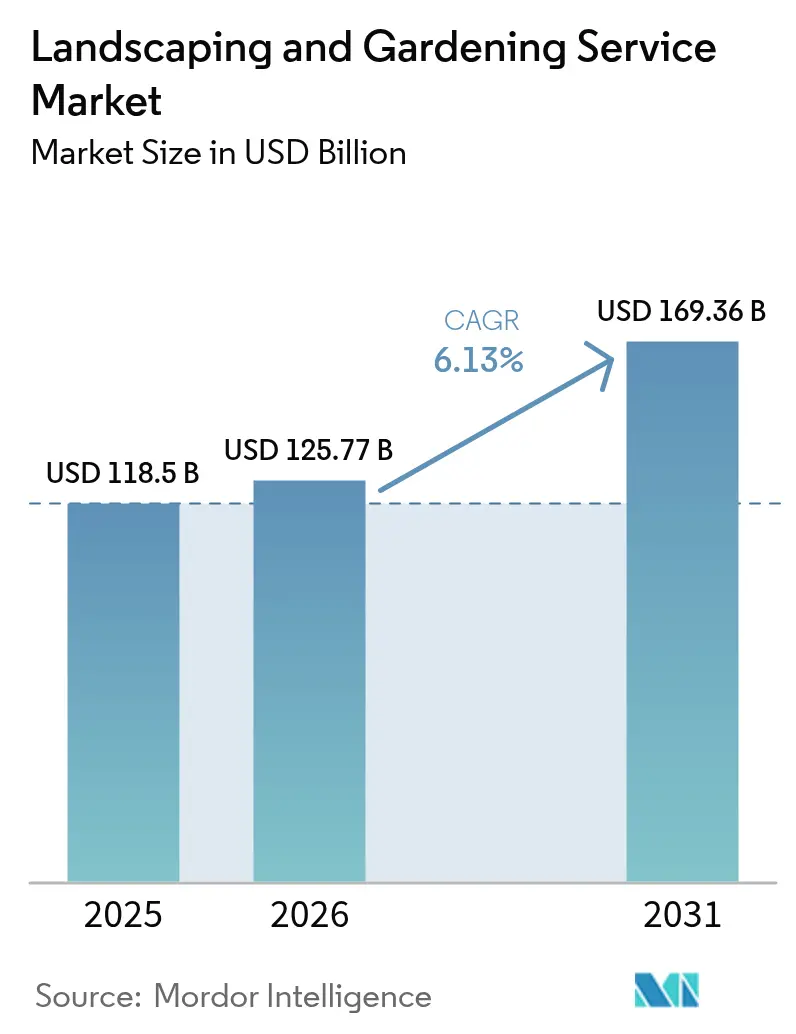
The landscaping and gardening service market size is expected to grow from USD 118.5 billion in 2025 to USD 125.77 billion in 2026 and is forecast to reach USD 169.36 billion by 2031 at 6.13% CAGR over 2026-2031. Steady demand from corporate sustainability programs, aging-in-place residential upgrades, and rapid urbanization in the Asia-Pacific anchor this momentum. Contractors are amplifying revenue through integrated design-build-maintain models, technology-enabled labor savings, and premium enhancement offerings. North America retains its spending leadership, while the Asia-Pacific region delivers the fastest volume growth, as large-scale infrastructure projects are stipulated to include green space quotas. Competitive intensity remains fragmented because most operators are local or regional, and private-equity roll-ups and supplier alliances are accelerating scale advantages and service diversification. This fragmentation creates acquisition opportunities for private equity firms, with Verde Equity Partners and Wind Point Partners actively consolidating regional players to achieve operational scale and geographic diversification.
Key Report Takeaways
- By Type, landscape and garden maintenance commands 41.08% of the landscaping and gardening services market size in 2025, while landscape and garden enhancements emerge as the fastest-growing segment, expanding at a CAGR of 8.32% from 2026 to 2031.
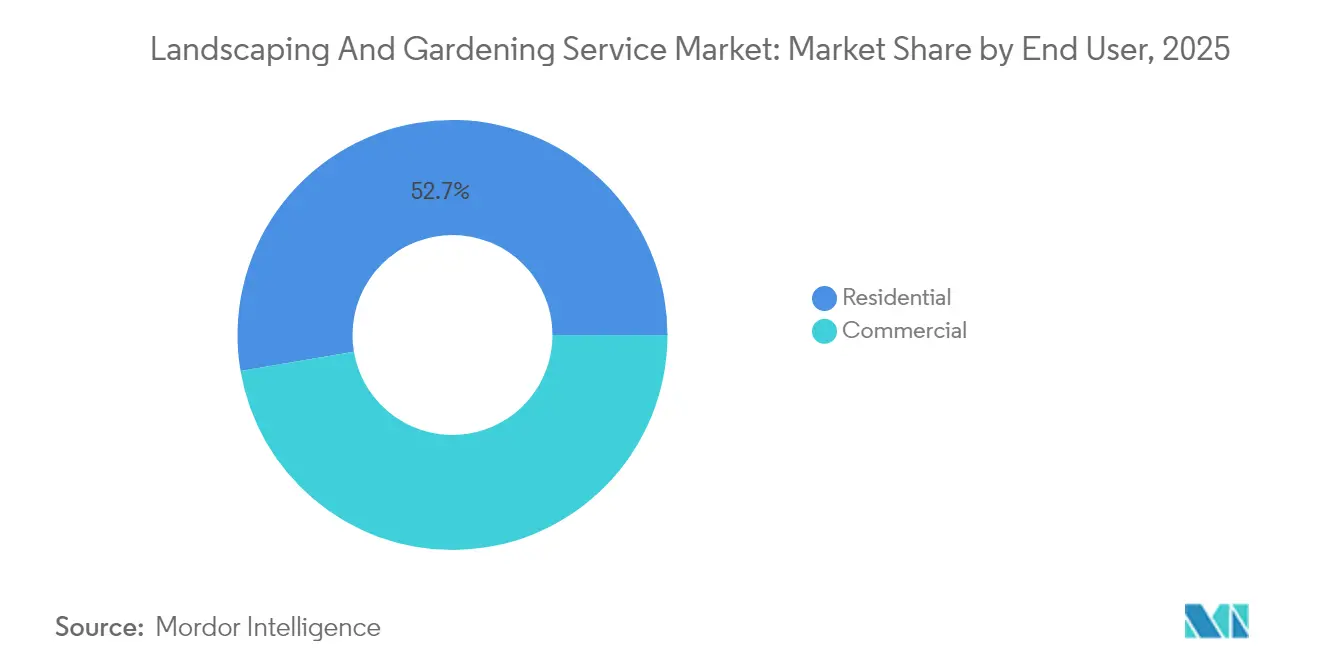
- By End User, the residential segment accounted for 52.68% of the landscaping and gardening services market share in 2025, while the commercial segment experiencing faster growth at a CAGR of 7.76% from 2026 to 2031.
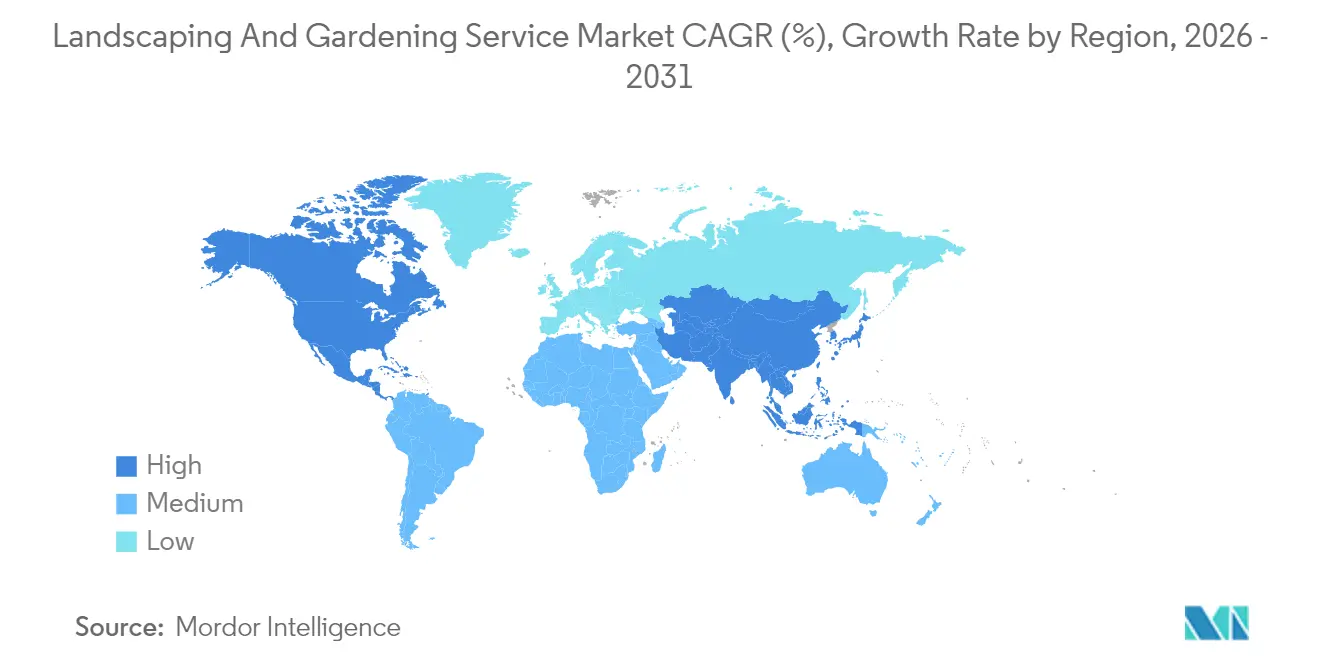
- By Geography, North America commands the largest market share at 39.42% in 2025, while the Asia-Pacific region emerges as the fastest-growing, expanding at a CAGR of 7.28% from 2026 to 2031.
Note: Market size and forecast figures in this report are generated using Mordor Intelligence’s proprietary estimation framework, updated with the latest available data and insights as of 2026.
Market Trends and Insights
Drivers Impact Analysis of Landscaping And Gardening Service Market*
| Driver | (~) % Impact on CAGR Forecast | Geographic Relevance | Impact Timeline |
|---|---|---|---|
| Aging-in-place demand boosts residential landscaping | +1.2% | North America and Europe, spillover to Australia | Medium term (2-4 years) |
| Corporate net-zero commitments require green campuses | +1.5% | Global, strongest in developed economies | Long term (≥ 4 years) |
| Increasing demand for outdoor aesthetics and recreational spaces | +1.8% | High-income urban centers worldwide | Short term (≤ 2 years) |
| Rising urbanization and infrastructure development | +2.1% | Asia-Pacific core, Middle East and Africa | Long term (≥ 4 years) |
| Growing environmental awareness and sustainability trends | +1.3% | Europe and North America lead | Medium term (2-4 years) |
| AI-enabled robotic mowers cut labor costs and spur adoption | +0.9% | North America and Europe, early Asia-Pacific | Medium term (2-4 years) |
| Source: Mordor Intelligence | |||
Aging-In-Place Demand Boosts Residential Landscaping
In the United States, 40% of households headed by individuals aged 65 and above now plan to implement accessibility upgrades that include outdoor areas. This has led to increased spending on barrier-free pathways, native plantings, and automated irrigation systems [1]. Baby-boom migration into smaller rural towns is raising local service needs and enlarging contractor addressable markets [2]. This trend is particularly pronounced in suburban markets where aging homeowners prefer to retrofit existing properties rather than relocate to assisted living facilities. Similarly, safety-oriented landscaping preferences are emerging in Hong Kong, confirming global relevance. Research from Hong Kong demonstrates that older adults prioritize landscape elements providing comfort, safety, and protection from severe weather, creating demand for specialized design services that integrate therapeutic horticulture principles with universal design standards.
Corporate Net-Zero Commitments Require Green Campuses
Microsoft’s water-positive and carbon-negative pledges demonstrate how large enterprises incorporate biodiversity corridors, rain gardens, and habitat restoration into their master planning. Europe’s Nature Restoration Law, effective August 2024, mandates ecosystem renewal across 20% of Europe Union land and sea, compelling facility owners to procure specialized ecological landscaping. Universities are adopting similar strategies, signaling a broad institutional demand. These corporate commitments create demand for specialized services, including carbon footprint assessments, biodiversity monitoring, and ecosystem service quantification, which command premium pricing compared to traditional maintenance contracts.
Increasing Demand for Outdoor Aesthetics and Recreational Spaces
Consumer preferences have shifted decisively toward elaborate outdoor living spaces that function as extensions of interior environments, driven by remote work adoption and increased time spent at home following the pandemic. 73% of United States contractors bought new equipment in 2024 as homeowners sought multifunctional patios, edible gardens, and smart-lighting landscapes that merge indoor and outdoor living. Commercial landlords are mirroring this emphasis by adding wellness gardens and meeting zones to reinforce tenant retention. Design-build contractors are responding by offering integrated services that combine hardscaping, irrigation, lighting, and smart home technology integration to create seamless indoor-outdoor living environments. The emphasis on outdoor aesthetics is particularly strong in high-income urban areas where property values justify premium investments in custom landscape design and ongoing maintenance services.
Rising Urbanization and Infrastructure Development
Global urbanization patterns are creating a sustained demand for landscaping services, as new construction projects integrate green infrastructure requirements from the initial planning stages rather than as afterthoughts. China’s five-year action plan targets 70% urban residency by 2029 and allocates CNY 60 billion (approximately USD 9 billion) for sponge-city drainage upgrades, as well as CNY 140 billion (approximately USD 21 billion) for flood control greenways[3]. India’s Smart Cities Mission has completed 7,504 projects valued at INR 150,306 crore (approximately USD 18.0 billion), many of which include park and streetscape contracts. Saudi Arabia’s USD 500 billion NEOM project highlights the opportunities in the Middle East. These mega-projects create opportunities for international landscaping firms to establish regional operations and develop expertise in climate-adaptive design principles. These mega-projects create opportunities for international landscaping firms to establish regional operations and develop expertise in climate-adaptive design principles.
Restraints Impact Analysis of Landscaping And Gardening Service Market*
| Restraint | (~) % Impact on CAGR Forecast | Geographic Relevance | Impact Timeline |
|---|---|---|---|
| Acute shortage of skilled horticultural labor | −1.8% | Most acute in North America and Europe | Short term (≤ 2 years) |
| High installation and maintenance costs | −1.2% | Global, strongest in price-sensitive areas | Medium term (2-4 years) |
| Seasonal and weather-dependent nature of services | −0.8% | Temperate regions and northern climates | Short term (≤ 2 years) |
| Water-use restrictions in drought-prone regions | −1.4% | Western North America, Mediterranean Europe, Australia | Long term (≥ 4 years) |
| Source: Mordor Intelligence | |||
Acute Shortage of Skilled Horticultural Labor
The landscaping industry confronts an unprecedented labor crisis that threatens service capacity and drives operational costs beyond sustainable levels for many contractors. Landscaping accounted for 31.3% of all H-2B visas in 2023, yet the statutory cap remains 66,000, forcing companies to raise wages 6.8% on average while absorbing new compliance costs. DHS (United States Department of Homeland Security) added 64,716 extra permits for 2025, but demand still exceeds supply. Automation adoption partially offsets these gaps but requires an upfront capital investment. The aging domestic workforce and declining interest among younger Americans in physically demanding outdoor work exacerbate these shortages, forcing companies to increase wages, improve benefits, and invest in retention programs that compress profit margins. Compliance with the new H-2 Final Rule introduces additional administrative costs and enhanced worker protection requirements that further strain operational budgets.
Water-Use Restrictions in Drought-Prone Regions
Regulatory frameworks governing water usage are fundamentally constraining traditional landscaping practices, particularly in drought-prone regions, where outdoor irrigation accounts for 50-70% of household water consumption. California’s 2025 conservation framework obliges urban suppliers to cut consumption up to 40%, and Assembly Bill 1572 ends potable irrigation of decorative turf at businesses from 2027. The Model Water-Efficient Landscape Ordinance tightens design standards, encouraging contractors to use drought-tolerant plants and smart controllers. Compliance generates new service revenue yet curtails traditional high-water landscapes. These regulations create compliance costs for contractors while simultaneously generating demand for specialized services including drought-tolerant design, smart irrigation installation, and turf conversion projects.
*Our forecasts treat driver/restraint impacts as directional, not additive. The impact forecasts reflect baseline growth, mix effects, and variable interactions.
Landscaping And Gardening Service Market Segment Analysis
By Type:
Maintenance volume dominates as enhancements lead growthLandscape and garden maintenance accounted for the largest 41.08% of the landscaping and gardening service market share in 2025, primarily due to subscription-style lawn care, pruning, and seasonal cleanup contracts that ensure a steady monthly income. Construction and Landscape Management revenues track public and private infrastructure cycles, especially in the Asia-Pacific region, where new city districts often specify green roofs and bioswales from the outset. Design services are consolidating into integrated design-build portfolios, enabling single-source accountability and accelerating project timelines. Recurring maintenance cash flows underpin contractor valuations, a key driver behind private-equity roll-ups that aim to blend predictable earnings with higher-margin enhancements. BrightView derived most of its USD 2.767 billion in 2024 revenue from maintenance routes, yet reported a double-digit margin premium on enhancements tied to smart-technology upgrades.
Landscape and garden enhancement services are projected to deliver the fastest 8.32% CAGR through 2031, as homeowners and facility managers invest in premium features such as outdoor kitchens, low-voltage lighting, and app-controlled irrigation. Landscape and Garden Design services are experiencing consolidation as clients increasingly prefer design-build contractors who can manage projects from conception through installation and ongoing maintenance, reducing coordination complexity and ensuring design intent preservation. As robotic mowers and sensor-based irrigation systems gain traction, contractors are integrating hardware leasing and data analytics into their maintenance plans, further enhancing customer lifetime value and differentiating service bundles within the landscaping and gardening services market.


By End User:
Residential scale meets commercial accelerationThe residential segment generated 52.68% of 2025 revenue, driven by the aging-in-place boom and remote work lifestyles that have elevated outdoor spaces to essential living areas. Residential projects now emphasize low-maintenance native plants, permeable hardscapes, and multipurpose entertainment zones, reducing weekly upkeep but increasing design complexity and ticket size. On the commercial side, ESG ( Environmental, Social, and Governance) reporting obligations oblige property owners to quantify biodiversity lift and water savings, spurring demand for contractors skilled in monitoring, verification, and ISO (International Organization for Standardization) compliant documentation. These drivers collectively reinforce long-term expansion of the landscaping and gardening services market size while creating distinct solution sets for each end-user tier.
Commercial properties are projected to record the highest 7.76% CAGR to 2031 as employers seek wellness amenities, carbon-offset programs, and stormwater compliance solutions that demand professional expertise. Government and institutional buyers add demand stability through multiyear contracts but require stringent bidding credentials. Commercial clients are increasingly sophisticated in their requirements, demanding measurable outcomes including carbon sequestration, stormwater management, and biodiversity enhancement that align with environmental reporting obligations and stakeholder expectations. The Europe Union Nature Restoration Law mandates corporate compliance with ecosystem restoration targets, creating demand for specialized services that can document and verify environmental performance metrics.
Geography Analysis
North America Landscaping and Gardening Service Market
North America retained the largest share of 39.42% in the landscaping and gardening services market in 2025, driven by mature maintenance penetration, robust discretionary spending, and early adoption of labor-saving robotics. Growth nevertheless moderates relative to emerging regions because baseline coverage is already high. The region benefits from favorable demographic trends, including aging-in-place preferences and corporate sustainability investments that drive consistent demand for both maintenance and enhancement services.
APAC and Europe Landscaping and Gardening Service Market
The Asia-Pacific region is forecast to record the fastest growth at a 7.28% CAGR, driven by China’s massive urban infrastructure pipeline and India's smart city programs, which mandate rooftop gardens, public parks, and roadside tree canopies. Major developers award bundled design-build-maintain contracts to global and domestic specialists capable of meeting strict environmental guidelines, driving rapid revenue scaling. Europe advances steadily on the back of the Nature Restoration Law and widening municipal bans on pesticide and water use. Contractors possessing biodiversity assessment skills and ISO (International Organization for Standardization) 14001 certification secure premium fees.
MEA and South America Landscaping and Gardening Service Market
The Middle East, led by Saudi Arabia’s NEOM and UAE (United Arab Emirates) eco-districts, delivers high-value but technically challenging projects requiring desert-adapted planting palettes and desalinated water irrigation. Africa and South America remain nascent yet show upside as urban centers prioritize green infrastructure to mitigate heat-island effects. Africa shows emerging potential driven by urbanization trends and infrastructure development, though market development remains constrained by economic conditions and limited access to specialized equipment and materials in many regions.
Regulatory Landscape
Regulation affecting landscaping and gardening services increasingly centers on worker safety, environmental permitting, chemical handling, and water conservation, with requirements varying by task and jurisdiction. In the United States, contractors must align work practices with OSHA standards, typically applying 29 CFR 1910 for maintenance activities and 29 CFR 1926 when work falls under construction-related scopes, which increases training and documentation needs for multi-service operators.
Environmental compliance has tightened around pesticide use and runoff-related discharges, alongside broader project permitting requirements. The US EPA issued the 2026 Pesticide General Permit (PGP), effective October 31, 2026 through October 30, 2031, governing point source discharges of biological and chemical pesticides to US waters. This raises the importance of application records, thresholds, and authorization management for commercial and municipal accounts. Separately, USDA finalized a National Environmental Policy Act (NEPA) regulatory reform effective April 3, 2026, consolidating agency-specific procedures into a single framework that can affect permitting workflows tied to public-land, conservation, and infrastructure-linked landscaping scopes. Chemical storage and reporting obligations also remain relevant where facilities fall under SARA Title III inventory reporting timelines (annual submissions by March 1).
Competitive Landscape
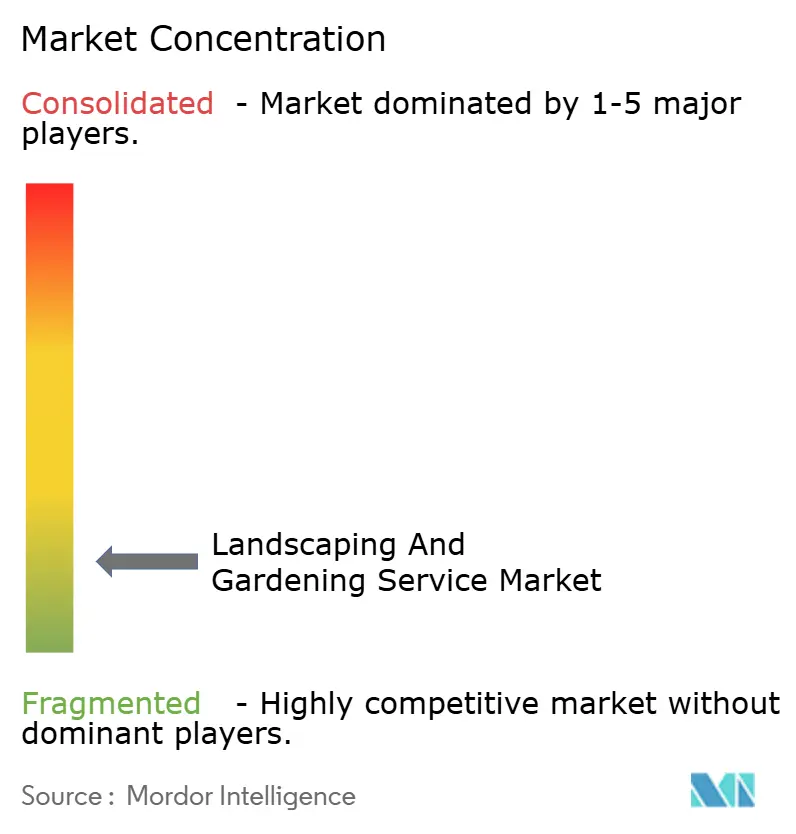
The landscaping and gardening services market is highly fragmented, with top players including BrightView Holdings, Inc., The Davey Tree Expert Company, TruGreen Limited, Yellowstone Landscape Group, Inc., and Ruppert Landscape Management, Inc. This fragmentation reflects the industry's local service delivery requirements, regulatory variations across markets, and the prevalence of family-owned businesses that have historically resisted consolidation efforts.
Technology adoption emerges as a key differentiator, with leading contractors investing in AI-powered irrigation systems, robotic mowers, and fleet management software to address labor shortages and improve operational efficiency. Electric Sheep's deployment of AI-powered outdoor robots, including the Verdie system, demonstrates how technology integration can transform traditional labor-intensive operations into scalable, automated service delivery models.
The integration of IoT sensors, satellite imagery, and predictive analytics creates opportunities for contractors to offer data-driven maintenance optimization and performance reporting services that command premium pricing compared to traditional reactive maintenance approaches.
Landscaping And Gardening Service Industry Leaders
-
BrightView Holdings, Inc.
-
Davey Tree Expert Company
-
TruGreen Limited
-
Yellowstone Landscape Group, Inc.,
-
Ruppert Landscape Management, Inc.
- *Disclaimer: Major Players sorted in no particular order
Landscaping And Gardening Service Market Companies Covered in this Report
- BrightView Holdings, Inc.
- idverde Group
- The Davey Tree Expert Company
- TruGreen Limited
- Yellowstone Landscape Group, Inc.
- Park West Companies, Inc
- Ruppert Landscape Management, Inc
- Gothic Landscape, Inc.
- LandCare USA, LLC
- Juniper Landscaping of Florida, LLC
- Pacific Landscape Management, LLC
- Denison Landscaping, Inc.
- Chapel Valley Landscape Company, Inc.
- The F.A. Bartlett Tree Expert Company
- Asia Flora and Landscape Sdn Bhd
Read Analysis of Landscaping And Gardening Service Companies
Market Opportunities and Future Outlook
Water-efficiency and compliance-driven retrofits create actionable whitespace for contractors that can package drought-tolerant redesign, smart irrigation installation, and ongoing verification into multi-year service agreements, especially in drought-prone markets facing restrictions and turf conversion mandates. Corporate sustainability programs and ecosystem restoration requirements also push commercial buyers toward providers that can document biodiversity, water savings, and stormwater outcomes, supporting demand for higher-value enhancement work alongside recurring maintenance.
Labor scarcity continues to shift competitive advantage toward technology-enabled delivery models that increase output per crew. Commercial autonomous mowing and digital workflow adoption are moving from pilot concepts toward purchasable systems, highlighted by Kress announcing its EyePilot line of wire-free commercial autonomous mowers in July 2026 using AI vision and RTK navigation, which aligns with contractor efforts to reduce labor dependence on large sites. Separately, data-driven planting tools are expanding through field applications such as RootIQ Labs Pvt. Ltd.'s WhereToPlant system supporting tree-plantation site selection and survival prediction in Himachal Pradesh following 2025 pilots, indicating how planning and risk-management outputs can carry into municipal and infrastructure greening programs.
Recent Industry Developments in Landscaping And Gardening Service Market
- May 2026: Hartney Greymont, a division of The Davey Tree Expert Company, added Green Trees Arborcare of Wrentham, Massachusetts, to its regional team. This addition increases local density in a high-value Northeast market and supports cross-selling across plant health care, pruning, and related arboricultural services.
- January 2025: Wind Point Partners acquired ExperiGreen Lawn Care to continue building scale through private-equity-backed consolidation in landscaping services. The acquisition supports platform expansion in recurring lawn care routes and can accelerate professionalization in pricing, routing, and procurement across regional operations.
- September 2024: Bregal-backed Juniper Landscaping expanded in Florida with the acquisition of Landscape Maintenance Professionals (LMP), a commercial landscaping company operating on Florida's west coast. This extended Juniper's geographic coverage and customer access in a market where multi-site commercial contracts reward route density and broader service capabilities.
Landscaping And Gardening Service Market Report Scope and Research Methodology
Market Definition and Coverage
This market covers paid services delivered to plan, build, maintain, and improve outdoor green and hardscape areas for homes, businesses, and public sites. It is sized as service revenue generated by providers for landscaping and gardening work, reported in USD.
Scope exclusions: Sales of landscaping tools, equipment, plants, fertilizers, and other retail products are excluded when they are not billed as part of a service job.
Segments Covered in This Report
- By Type
- Landscape and Garden Design
- Construction and Landscape Management
- Landscape and Garden Maintenance
- Landscape and Garden Enhancements
- Other Types
- By End User
- Commercial
- Residential
- Other End Users
- By Geography
- North America
- United States
- Canada
- Mexico
- Rest of North America
- South America
- Brazil
- Argentina
- Rest of South America
- Europe
- Germany
- United Kingdom
- France
- Italy
- Spain
- Netherlands
- Denmark
- Rest of Europe
- Asia-Pacific
- China
- India
- Australia
- Malaysia
- South Korea
- Rest of Asia-Pacific
- Middle East
- Saudi Arabia
- United Arab Emirates
- Turkey
- Rest of Middle East
- Africa
- South Africa
- Egypt
- Rest of Africa
- North America
Data Sources, Market Sizing, and Validation
Desk Research
Desk research starts by mapping the service economy around landscaping using public statistics and structured industry definitions. We refer to sources such as the US Census Bureau (economic and business data), US Bureau of Labor Statistics (employment and wage trends), Eurostat (services indicators), and the World Bank and IMF (macro variables and exchange rates) to anchor demand cycles and keep regional comparisons consistent.
After the macro layer is set, service industry bodies and regulators are used to understand how work is packaged and priced. This includes industry associations for landscape contractors and horticulture, municipal procurement portals, and published building and renovation indicators. Company annual reports, investor presentations, and reputable business press are also used to validate service mix, regional exposure, and margin drivers. Where disclosures are limited, a paid subscription for company financials and news is used selectively. This list is illustrative, and many other public and paid sources were reviewed for data collection, cross-checking, and clarification.
Primary Interviews and Surveys
Primary work is used to pressure-test service definitions, pricing, and volume assumptions that desk research cannot reliably standardize across regions. We speak with contractors, franchise operators, commercial facilities buyers, residential service aggregators, and local procurement stakeholders across the Americas, EMEA, and APAC, so the model reflects real job mix, seasonality, and contract structures seen in the field.
Distribution of primary research fieldwork respondents
| Company type | Respondent position | Region |
|---|---|---|
| Top tier: 36% | CXOs: 15% | APAC: 42% |
| Mid tier: 44% | Functional/Unit leaders: 31% | EMEA: 33% |
| Smaller Players: 20% | Managers: 54% | Americas: 25% |
Market-Sizing & Forecasting
Sizing begins with a top-down build where labor and service output signals are reconstructed into a revenue pool by region, then converted into landscaping and gardening service demand using penetration and spend share checks. To keep totals realistic, we corroborate with selective bottom-up approximations, such as sampled pricing for common job types multiplied by estimated job counts, plus supplier and channel checks from contractor networks, and then adjust for gaps.
Key inputs in the model include the installed base of residential and commercial properties, construction and renovation activity, local wage rates for grounds crews, seasonal service patterns, and typical contract mix between recurring maintenance and one-time enhancement work. Where primary inputs show uneven reporting, such as informal providers and cash work in some markets, we apply ranges and normalize before arriving at the final value.
For forecasting, scenario analysis is used and anchored to a simple multivariate regression that links service demand to construction activity, household and business spending signals, and wage inflation. Assumptions are reviewed with industry respondents so the forward curve reflects how pricing resets and labor availability typically move through the year.
Data Validation & Update Cycle
Validation is done by comparing modeled revenue against independent signals, including employment intensity, wage bills, construction and renovation trends, and observed price changes for common service bundles. Outliers are investigated, and if a region shows a swing not supported by labor, construction, or pricing evidence, assumptions are revisited and selected interviews are repeated to confirm the interpretation.
Before sign-off, the work is reviewed in multiple steps, including checks on currency conversion timing, growth math, and cross-region reasonability. Reports are refreshed annually, and interim updates are made when material events occur, such as policy shifts, labor shocks, or sudden construction slowdowns. Before delivery, an analyst performs a fresh pass so clients receive the latest updated view.
Mordor Intelligence's Landscaping and Gardening Service Market Size Versus Other Published Estimates
Published market sizes for landscaping and gardening services can differ substantially because the starting scope and the revenue counted are not always aligned. Differences also show up when one estimate is tied to reported service revenue, while another leans more heavily on broader household or property spending proxies.
Snow removal and related winter services are a common point of confusion, and they sit outside Mordor Intelligence's scope even though many contractors offer them under the same brand. The spread can also come from how recurring maintenance contracts are annualized, how informal providers are treated in emerging markets, and whether exchange rates are taken at a single point in time or averaged across the year.
Benchmark comparison
| Source | Market Size | Gaps in Research Methodology |
|---|---|---|
| Mordor Intelligence | USD 125.77 B (2026) | |
| Industry Database A | USD 113.62 B (2026) | Uses a narrower revenue capture in several regions and appears to undercount enhancement and construction-linked landscaping work, which lowers the service pool in the base year. |
| Trade Journal B | USD 176.70 B (2026) | Represents a single-country industry revenue view and can include adjacent services and reseller pass-throughs that inflate totals when compared with a global, services-only definition. |
Overall, the table shows that the biggest drivers are geography coverage and what is treated as true service revenue versus adjacent, bundled, or country-only measures. By keeping inputs tied to property activity, labor economics, and observed pricing, the final number stays traceable to repeatable steps that can be rechecked as conditions change.
Key Questions Answered in the Report
How large is the landscaping and gardening services market in 2026?
The landscaping and gardening services market size is USD 125.77 billion in 2026, with expectations to reach USD 169.36 billion by 2031.
What is the forecast CAGR for landscaping and gardening services through 2031?
The sector is projected to advance at a 6.13% CAGR during 2026-2031.
Which service type grows fastest over the next five years?
Landscape and Garden Enhancements lead growth with an 8.32% CAGR owing to demand for premium outdoor features and smart-technology installations.
Which region offers the highest growth opportunity?
Asia-Pacific delivers the quickest regional expansion at a 7.28% CAGR, driven by large-scale urbanization and infrastructure programs requiring green spaces.