
Market Overview
| Study Period | 2021 - 2031 |
|---|---|
| Forecast Data Period | 2026 - 2031 |
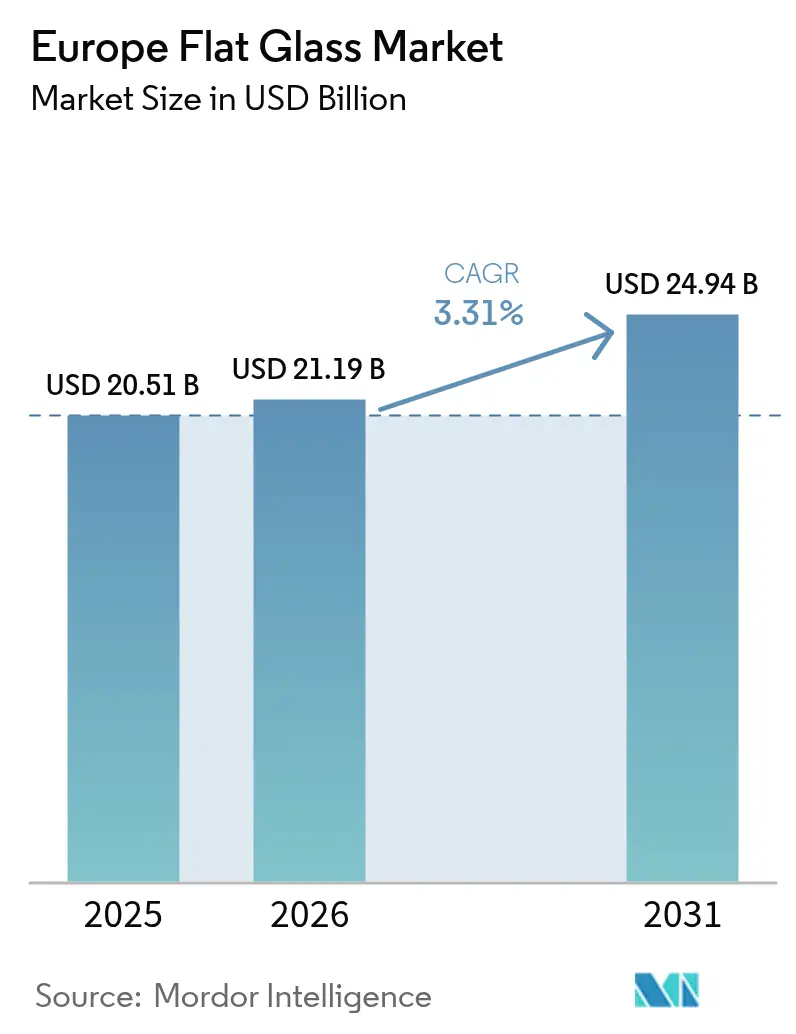
| Base Year Market Size (2025) | USD 20.51 Billion |
| Market Size (2026) | USD 21.19 Billion |
| Market Size (2031) | USD 24.94 Billion |
| Growth Rate (2026 - 2031) | 3.31 % |
| Market Concentration | High |
Major Players *Disclaimer: Major Players sorted in no particular order Image © Mordor Intelligence. Reuse requires attribution under CC BY 4.0. | |
Europe Flat Glass Market Analysis by Mordor Intelligence
The Europe Flat Glass Market size was valued at USD 20.51 billion in 2025 and is estimated to grow from USD 21.19 billion in 2026 to reach USD 24.94 billion by 2031, at a CAGR of 3.31% during the forecast period (2026-2031). In Europe, the flat glass market is undergoing a transformation driven by rising energy-performance standards, an expansion in solar-PV installations, and a shift toward electric vehicles. While annealed glass continues to lead in volume, processed variants - particularly insulated, laminated, and tempered substrates - are reaping higher margins as building codes become more stringent. Carbon costs have surged, leading to initiatives like furnace electrification and green-hydrogen trials. Meanwhile, the European Union's "Renovation Wave" subsidy programs are increasing the adoption of triple-pane and vacuum-insulated glazing. Today, competitive advantages are increasingly determined by coating capabilities, access to high-purity cullet, and the ability to secure long-term contracts for renewable power.
Key Report Takeaways
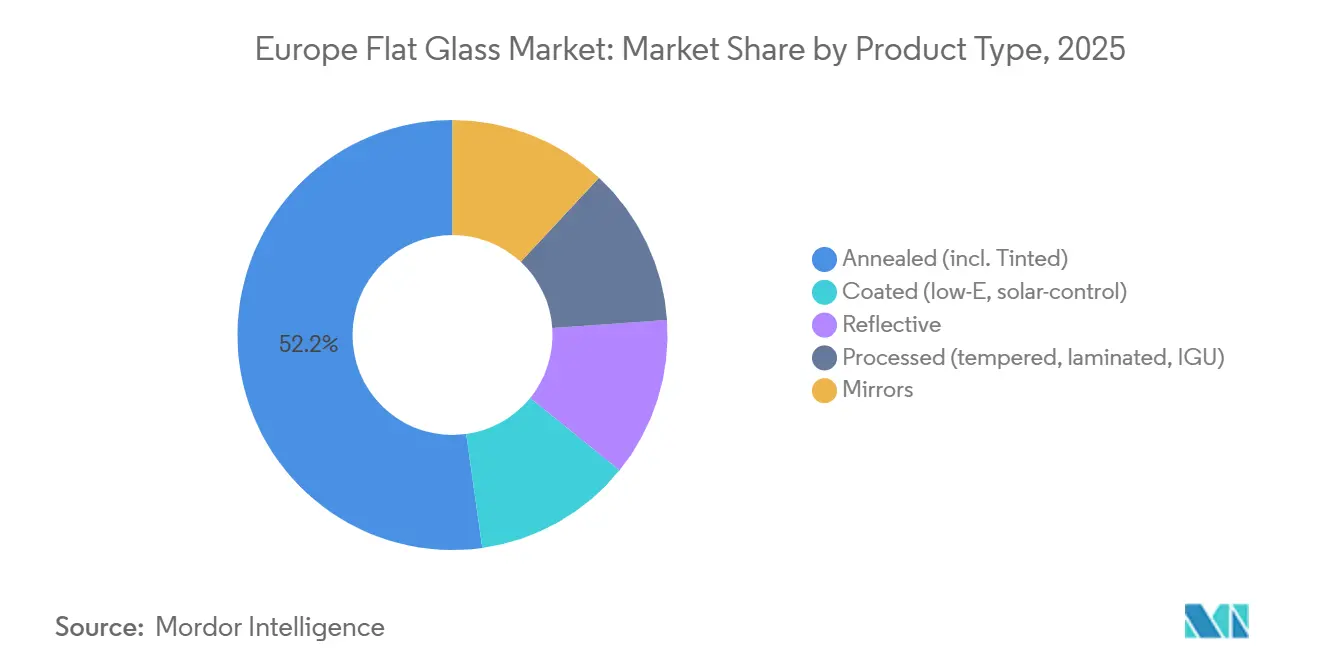
- By product type, annealed glass led with 52.21% of the Europe flat glass market share in 2025; processed glass is advancing at a 3.61% CAGR through 2031.
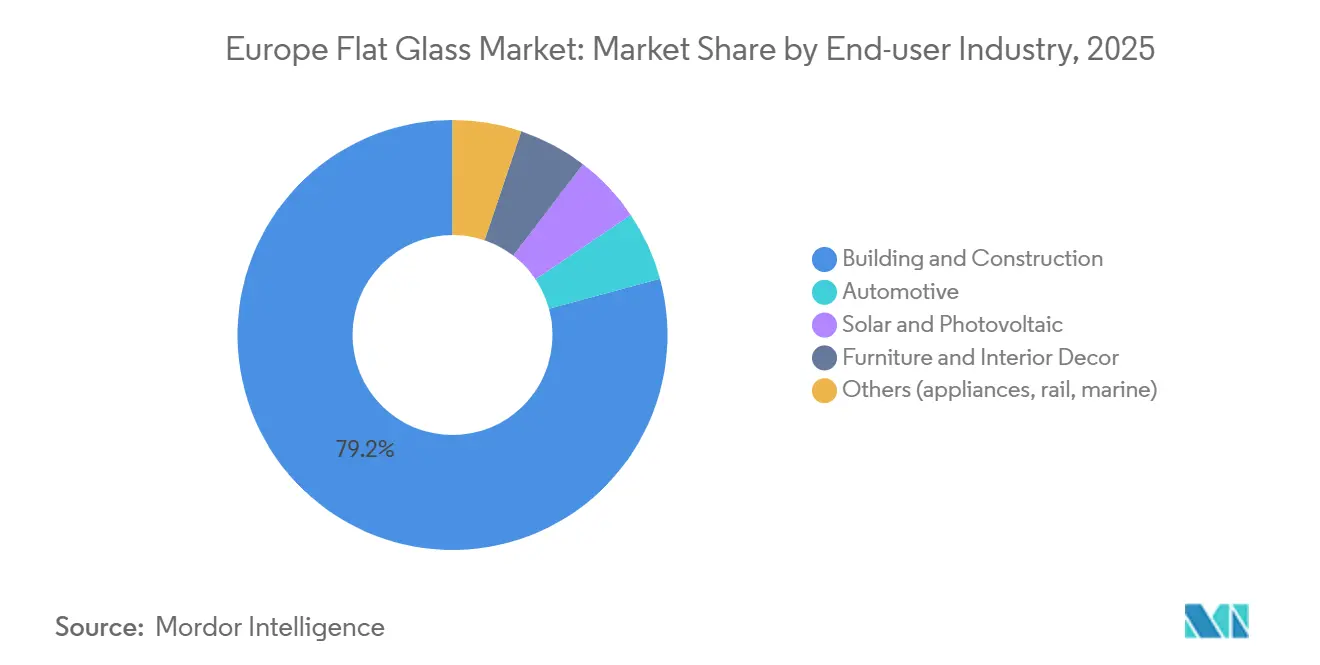
- By end-user industry, building and construction accounted for 79.22% of the Europe flat glass market size in 2025, while solar and photovoltaic applications are projected to expand at a 3.82% CAGR between 2026-2031.
- By geography, Germany held 28.63% revenue share of the Europe flat glass market in 2025 and is forecast to record the fastest 3.42% CAGR to 2031.
Note: Market size and forecast figures in this report are generated using Mordor Intelligence’s proprietary estimation framework, updated with the latest available data and insights as of 2026.
Europe Flat Glass Market Trends and Insights
Drivers Impact Analysis*
| Driver | (~) % Impact on CAGR Forecast | Geographic Relevance | Impact Timeline |
|---|---|---|---|
| Automotive lightweighting and panoramic glazing | +0.60% | Germany, France, Spain, Czech Republic, Slovakia | Medium term (2-4 years) |
| Solar-PV build-out boosting pattern and solar glass | +0.70% | Germany, Spain, Italy, Poland, Portugal, Greece | Long term (≥ 4 years) |
| EU “Renovation Wave” subsidies for low-E and VIG | +0.90% | Germany, France, Netherlands, Belgium, Nordics | Short term (≤ 2 years) |
| Green-hydrogen-ready float lines lowering Scope 3 emissions | +0.40% | Spain, Germany, France, Turkey (pilot) | Long term (≥ 4 years) |
| Biodiversity rules spurring bird-friendly patterned glazing | +0.20% | Germany, Austria, Finland, Switzerland | Medium term (2-4 years) |
| Source: Mordor Intelligence | |||
Automotive Lightweighting And Panoramic Glazing
During 2025, European automakers were increasing the use of larger glazing areas in premium launches as a strategy to counterbalance battery weight and enhance the range of battery electric vehicles (BEVs). Laminated, infrared-reflective roof glass improves cabin comfort without relying on air conditioning, while head-up display windshields are driving investments in sub-micron coatings. Although only a limited number of vehicles feature integrated photovoltaic (PV) roofs in 2025, the licensing of Sono Motors' technology indicates a trend toward wider adoption by 2028. Germany and France host a significant portion of the region's automotive glass fabrication, leaving suppliers in Eastern regions reliant on toll-coating contracts, which, in turn, compress their profit margins.
Solar-PV Build-Out Boosting Pattern And Solar Glass
The European Union's REPowerEU initiative sets a solar target of 600 GW, which implies an annual demand for 240 million m² of patterned and coated substrates. This demand represents a 35% increase over the current production capacity. Şişecam's new 6 million m² production line in Bulgaria, commissioned in January 2026, focuses on ultra-clear bifacial-module glass. Spain and Italy collectively install 18 GW of solar capacity per year but continue to import low-iron float glass from Turkey and Egypt, where energy costs are 40% lower. Only three European furnaces are equipped with roll-coating technology to texture patterned glass at production speed. Data released by Fraunhofer in 2025 indicated that anti-reflective coatings extend the lifespan of solar modules by mitigating thermal cycling effects, encouraging developers to adopt premium substrates.
EU “Renovation Wave” Subsidies For Low-E And VIG
In 2025, member-state programs allocated significant funding for high-performance window replacements. This investment led to a notable surge in orders for AGC's Fineo Vacuum Insulated Glazing (VIG) in the first quarter of 2026. Vacuum-insulated glazing (VIG) now holds a small share in residential retrofits, thanks to its micro-pillar architecture achieving impressive U-values in slim profiles. In Northern Europe, low-emissivity (low-E) coatings are applied to a majority of new windows. In contrast, Southern Europe lags behind with less adoption, a discrepancy attributed to the region's milder climate. However, the industry faces challenges: only a portion of installers possess certification for handling VIG. This gap in expertise raises concerns, as improper handling can lead to edge-seal fractures.
Green-Hydrogen-Ready Float Lines Lowering Scope 3 Emissions
In Bilbao, a consortium comprising Şişecam, Sidenor, and Tecnalia retrofitted a furnace with a capacity of 400 tons per day (tpd) to operate on a hydrogen blend, achieving a reduction in CO₂ emissions. The consortium secured funding from the EU Innovation Fund, with an ambitious goal to transition to full hydrogen use by 2028. Meanwhile, NSG is set to implement submerged electrodes at its St. Helens facility by late 2026, harnessing them for a portion of the melting energy. This move not only underscores NSG's commitment to innovation but also avoids potential costs associated with hydrogen infrastructure.
Restraints Impact Analysis*
| Restraint | (~) % Impact on CAGR Forecast | Geographic Relevance | Impact Timeline |
|---|---|---|---|
| EU-ETS Phase IV carbon-price escalation | -0.80% | EU-27, acute in Poland, Czechia, Germany | Short term (≤ 2 years) |
| Shortage of cullet meeting EU End-of-Waste purity thresholds | -0.50% | France, Germany, Italy, Benelux | Medium term (2-4 years) |
| Skill gap for installation of jumbo-sized IGUs | -0.30% | United Kingdom, Germany, France, Spain | Medium term (2-4 years) |
| Source: Mordor Intelligence | |||
EU-ETS Phase IV Carbon-Price Escalation
In early 2026, allowance prices rose, increasing carbon costs for annealed glass to a significant percentage of its selling price. Producers operating in coal-dominant grids faced heightened penalties, as utilities transferred Scope 2 charges. While imports are expected to incur similar levies under the Carbon Border Adjustment Mechanism (CBAM), a transshipment loophole enabled a substantial volume of underpriced float glass to enter the bloc in 2025. In 2025, Saint-Gobain experienced a margin squeeze due to rapid electrification and Power Purchase Agreements (PPAs).
Shortage Of Cullet Meeting EU End-Of-Waste Purity Thresholds
In 2025, a significant portion of recovered glass did not meet the required purity standards. Because of the lower quality of mixed-color bins in the Southern Europe region, furnaces were compelled to reduce cullet content and increase gas consumption. Although several EU plants specialize in delaminating PVB from laminated automotive glass, this has resulted in regional supply gaps. NSG's optical-sorting line in Poland achieves high purity rates but faces a lengthy payback period under current cullet pricing.
*Our forecasts treat driver/restraint impacts as directional, not additive. The impact forecasts reflect baseline growth, mix effects, and variable interactions.
Segment Analysis
By Product Type: Processed Glass Captures Margin Premium
Annealed glass delivered 52.21% of the 2025 volume, yet processed variants are projected to grow at a CAGR of 3.61% during the forecast period of 2026-2031 as safety codes and energy mandates advance. Tempered glass, which is priced higher than annealed glass, is mandated for balustrades and side windows. Meanwhile, laminated panels cater to security and acoustic demands. Insulated glass units, the fastest-growing processed category, are enhancing their offerings with low-E coatings, noble-gas fills, and warm-edge spacers to align with Passive House standards. Fineo VIG, with a reduced unit thickness, simplifies retrofitting in heritage frames. While Germany and France dominate with a majority of the IGU capacity, Spain and Poland depend on annealed exports for their downstream processing. In Germany, France, and the Netherlands, triple-silver low-E coatings are the key to unlocking maximum renovation subsidies, pushing coat-line utilization rates to high levels. Consequently, as builders increasingly recognize lifecycle energy savings, the market share of annealed glass in Europe is anticipated to decline by 2031.



By End-User Industry: Solar And Photovoltaic Applications Accelerate
In 2025, the building and construction sector accounted for 79.22% of total revenue. Residential retrofits, spurred by a subsidy in Germany and audit mandates in France, primarily drove these shipments. Non-residential demand grew at a more subdued pace, largely due to the rise of remote work, which limited new office establishments. However, the construction of data centers stood out as a significant contributor, consuming a substantial portion of fire-rated glazing.
Solar and photovoltaic sectors led the market with a robust 3.82% CAGR projected through the forecast period of 2026-2031, driven by the ambitious installation targets set by REPowerEU. In the automotive sector, while volumes aligned with steady vehicle production, the glass content for battery electric vehicles (BEVs) increased, effectively offsetting any potential dips in unit sales. The hospitality industry, supported by rising hotel occupancy rates in 2025, witnessed a significant surge in refurbishments, particularly in mirrors and interior decor, signaling a robust industry recovery.
Geography Analysis
In 2025, Germany secured 28.63% of the revenue and is projected to grow at an annual rate of 3.42% during the forecast period of 2026-2031. In Bavaria, Saint-Gobain's acquisition of a coating facility ensures a local supply of double-silver low-E substrates. France, holding the second position, expects a significant boost in its construction output, driven by the implementation of mandatory home energy audits.
After two consecutive years of decline, the United Kingdom experienced a resurgence in the first half of 2025, with increased shipments attributed to stabilizing mortgage rates. NSG is piloting a project in St Helens, targeting a shift to electrified melting energy by 2026. Both Italy and Spain are on a growth trajectory, fueled by investments in solar-PV and infrastructure, with Spain also hosting the HyGlass hydrogen furnace retrofit.
Poland, recovering after a dip in 2024, is leading Eastern Europe's rebound, supported by renewed Cohesion-Fund flows. In the Benelux region, vacuum-insulated glass (VIG) is witnessing early adoption, with Fineo capturing a share of the Dutch retrofit market. The Nordic countries lead in per-capita consumption, driven by stringent U-value codes set below 0.6 W/m²K. Lastly, Greece, benefiting from a tourism-driven hotel boom, specified a substantial amount of glazing in 2025.
Competitive Landscape
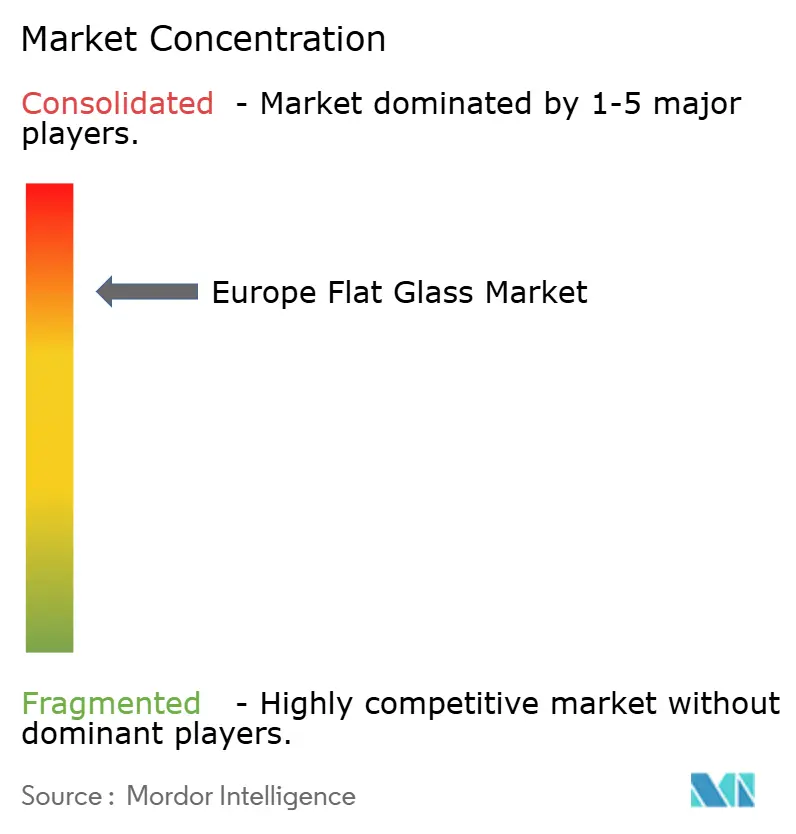
The Europe flat glass market is consolidated. Saint-Gobain, NSG Group, Şişecam, and AGC, command a significant portion of the float capacity. However, a multitude of independent coaters and IGU fabricators contribute to a fragmented downstream landscape. In March 2025, Saint-Gobain tightened its grip on premium low-E coatings with its takeover of Glass Service. Meanwhile, Guardian Glass exited Luxembourg in 2024, reducing merchant supply but bolstering its automotive contracts[1].
Carbon costs under the EU-ETS impacted Saint-Gobain's margins. This prompted the company to pivot towards electrification and Power Purchase Agreements (PPAs). Investments by Şişecam in Bulgaria and Spain are poised to harness solar-glass and hydrogen-ready capacities. Concurrently, NSG has been channeling resources into a Polish coat line, eyeing Central European retrofits.
Innovation has been on the rise: In 2025, the EPO awarded several glass patents, with many focusing on thinner silver layers that reduce material costs[2]European Patent Office, “Glass Technology Patents 2025,” epo.org . AGC’s Fineo VIG and Pilkington’s AviSafe are capitalizing on premium niches, achieving notable price uplifts. Additionally, Press Glass has automated jumbo IGU cutting, reducing on-site labor and streamlining facade schedules.
Europe Flat Glass Industry Leaders
Saint-Gobain
AGC Inc.
Şişecam
Koch Industries
Nippon Sheet Glass Co., Ltd.
- *Disclaimer: Major Players sorted in no particular order

Recent Industry Developments
- February 2025: AGC Inc. has announced the launch of a modernized flat glass production line at its AGC Barevka plant in Teplice, operated by its subsidiary, AGC Glass Europe S.A. Known as the “Volta research and development Project,” this initiative, developed in collaboration with Saint-Gobain, incorporates a pilot furnace utilizing an innovative flat glass production technology, marking a global milestone.
- September 2024: AGC Glass Europe, a subsidiary of the global AGC Inc., has formed a strategic partnership with ROSI, one of the leading companies specializing in the recovery and recycling of high-value raw materials from the photovoltaic industry. This collaboration aims to enhance the recycling and reuse of photovoltaic glass for flat glass production.


Europe Flat Glass Market Report Scope
Flat glass, often called sheet or plate glass, is frequently used to create solar panels, windows, mirrors, and doors. Sand, silica, limestone, and soda ash are melted to create the liquid, which is then cooled to create the product of the required thickness.
The Europe flat glass market report is segmented by product type, end-user industry, and geography. By product type, the market is segmented into annealed, coated, reflective, processed and mirrors. By end-user industry, the market is segmented into building and construction, automotive, solar and photovoltaic, furniture and interior decor, and others. The report also covers the market size and forecasts for flat glass in 6 countries across major European regions. For each segment, the market sizing and forecasts have been done on the basis of value (USD).
By Product Type
| Annealed (Incl. Tinted) |
| Coated (Low-E, Solar-control) |
| Reflective |
| Processed (Tempered, Laminated, IGU) |
| Mirrors |
By End-user Industry
| Building and Construction |
| Automotive |
| Solar and Photovoltaic |
| Furniture and Interior Decor |
| Others (Appliances, Rail, Marine) |
By Geography
| Germany |
| United Kingdom |
| France |
| Italy |
| Spain |
| Poland |
| Benelux |
| Nordics (Sweden, Norway, Denmark, Finland) |
| Rest of Europe |
| By Product Type | Annealed (Incl. Tinted) |
| Coated (Low-E, Solar-control) | |
| Reflective | |
| Processed (Tempered, Laminated, IGU) | |
| Mirrors | |
| By End-user Industry | Building and Construction |
| Automotive | |
| Solar and Photovoltaic | |
| Furniture and Interior Decor | |
| Others (Appliances, Rail, Marine) | |
| By Geography | Germany |
| United Kingdom | |
| France | |
| Italy | |
| Spain | |
| Poland | |
| Benelux | |
| Nordics (Sweden, Norway, Denmark, Finland) | |
| Rest of Europe |


Key Questions Answered in the Report
How large is the Europe flat glass market in 2026?
The Europe flat glass market size stands at USD 21.19 billion in 2026, and it is projected to reach USD 24.94 billion by 2031 at a 3.31% CAGR.
Which product segment is expanding fastest?
Processed variants such as tempered, laminated, and insulated units are growing at 3.61% per year.
Why is solar glass demand rising?
The REPowerEU plan targets 600 GW of solar capacity by 2030, driving annual need for 240 million m² of pattern and coated substrates.
How are carbon prices affecting producers?
EU-ETS allowances at EUR 85 t CO₂ now add roughly 8% to annealed glass costs, accelerating decarbonization investments.
Which country leads regional revenue?
Germany contributes 28.63% of revenue, supported by a EUR 14 billion window-replacement subsidy and strict energy codes.
Page last updated on:





