
Market Overview
| Study Period | 2021 - 2031 |
|---|---|
| Forecast Data Period | 2026 - 2031 |
| Historical Data Period | 2021 - 2024 |
| Growth Rate | 12.08 % |
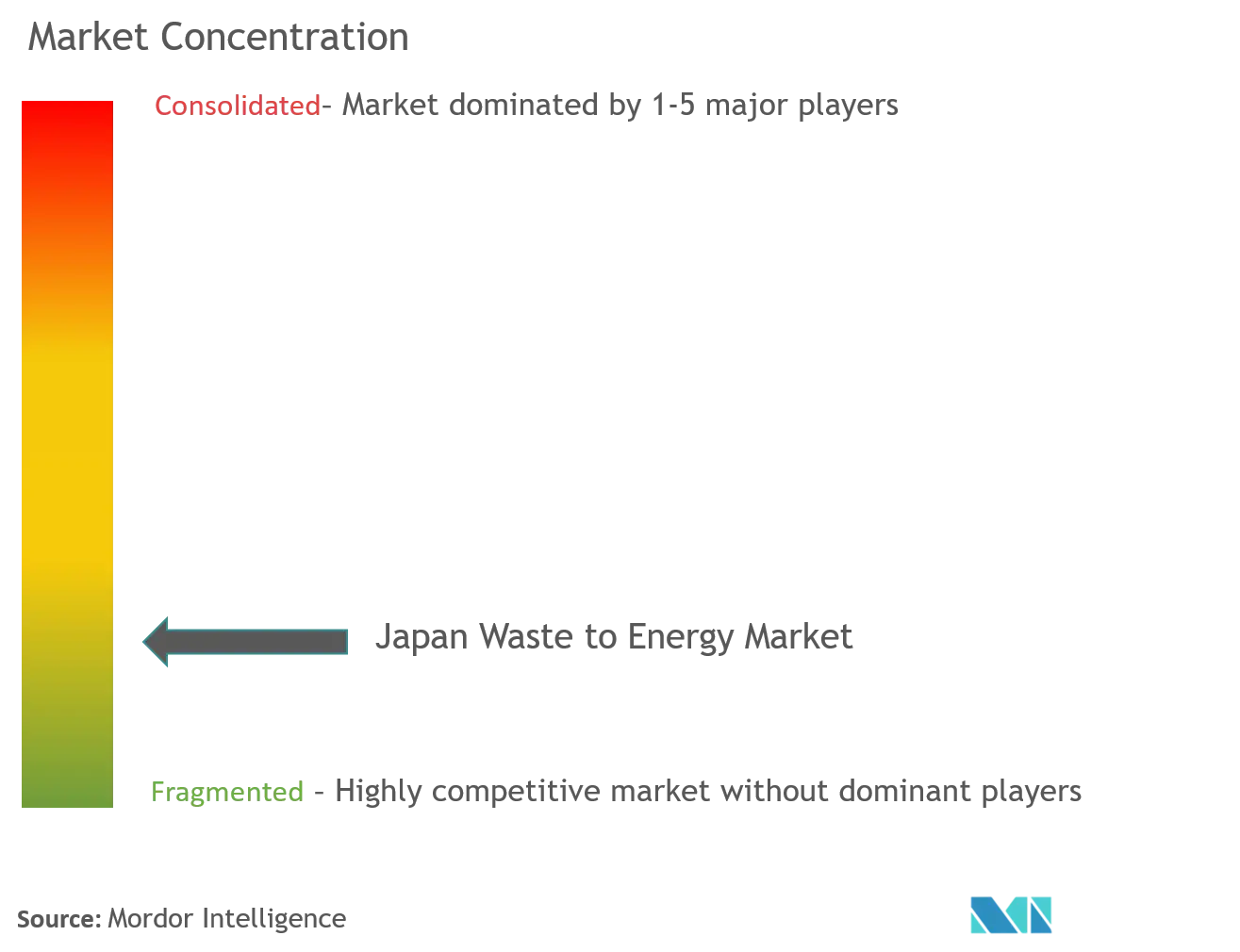
| Market Concentration | Medium |
Major Players *Disclaimer: Major Players sorted in no particular order Image © Mordor Intelligence. Reuse requires attribution under CC BY 4.0. | |
Japan Waste To Energy Market Analysis by Mordor Intelligence
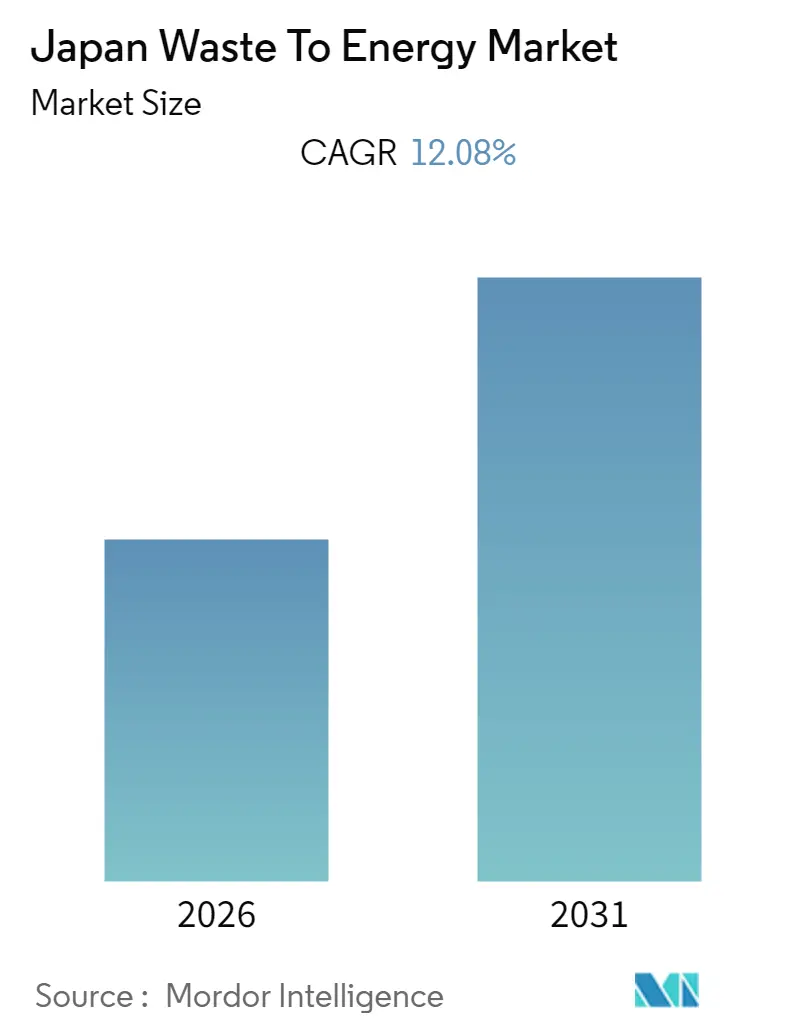
The Japan Waste to Energy Market size is expected to register a CAGR of greater than 12.08% during the forecast period.
- Thermal technology is expected to dominate the waste-to-energy market, owing to the increasing development in incineration, gasification technologies, and the growing amount of waste generated.
- Increasing investments in aerobic and anaerobic digestion-related R&D activities to ensure reliability in terms of environmental effects are expected to provide lucrative opportunities for the market's growth in the future.
- Japan is focusing on improving its incineration technologies to reduce harmful emissions from waste to energy conversion, which is expected to drive the market during the forecast period.
Note: Market size and forecast figures in this report are generated using Mordor Intelligence’s proprietary estimation framework, updated with the latest available data and insights as of 2026.
Market Trends and Insights
Thermal Technology to Dominate the Market
- Japan is a leading country with the most modern types of thermal treatment plants capable of processing millions of tons of waste every year. As of 2020, Japan was one of the leading countries worldwide in terms of the percentage of waste utilized in waste-to-energy (WTE) facilities, burning more than 80% of its MSW in energy recovery systems.
- The country has focused on thermal-based WTE technology since the 1960s. The WTE industry has thrived in Japan because there is little room for landfills, and burning waste has been considered a better solution.
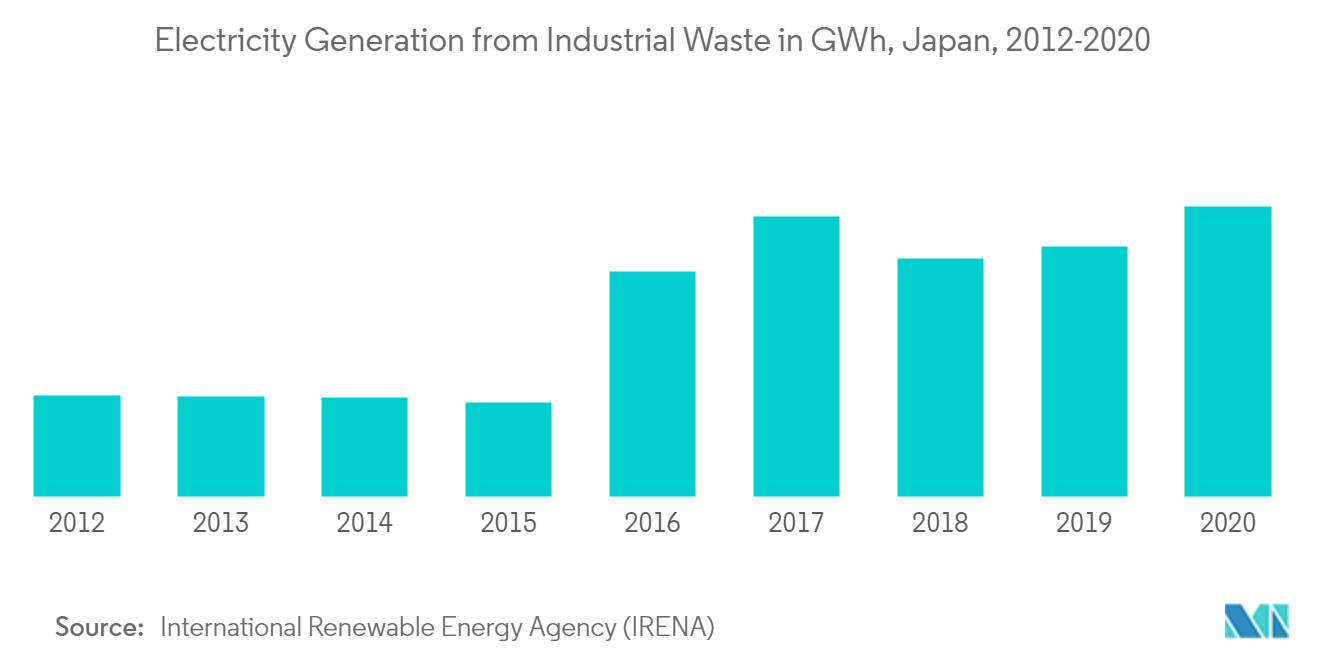
- As of 2020, the electricity generated from industrial waste (18522 GWh) was comparatively higher than that of electricity generated from municipal waste (1824 GWh), thus making industrial waste much more useful to produce energy.
- Moreover, in December 2020, Mitsubishi Heavy Industries Environmental & Chemical Engineering Co. Ltd (MHIEC) won a contract with the Kashima Regional Administration Association to design and build a thermal-based waste-to-heat management facility planned for construction in Kamisu city in Ibaraki Prefecture. The contract is valued at JPY 13.59 billion, with completion scheduled for the end of March 2024.
- Factors such as industrialization and economic development also contribute toward MSW generation, which is further expected to influence the growth of the thermal-based waste to energy market in Japan.
New Incineration Technologies for Reduction of Harmful Emissions Driving the Market Demand
- The incineration plants for solid waste generate harmful emissions, like dioxins, carbon dioxide, sulfur oxide, and nitrogen oxide. Technologies related to high-efficiency power generation and safe operation, such as automatic incineration devices and automatic cranes, have been developed to reduce the harmful emissions in this process.
- The Japanese stocker furnace technology is a low-air incineration method that aims for high-efficiency power generation, reduced harmful emissions, removed acidic gas, and recycled incinerated ash. The technologies applied to reduce dioxin generation are exhaust cooling, bag filters, and activated coal that absorbs and eliminates dioxin.
- The conventional stoker furnace's highly efficient technology enables electrical generation from recovered heat waste and makes it an effective measure against greenhouse emissions.
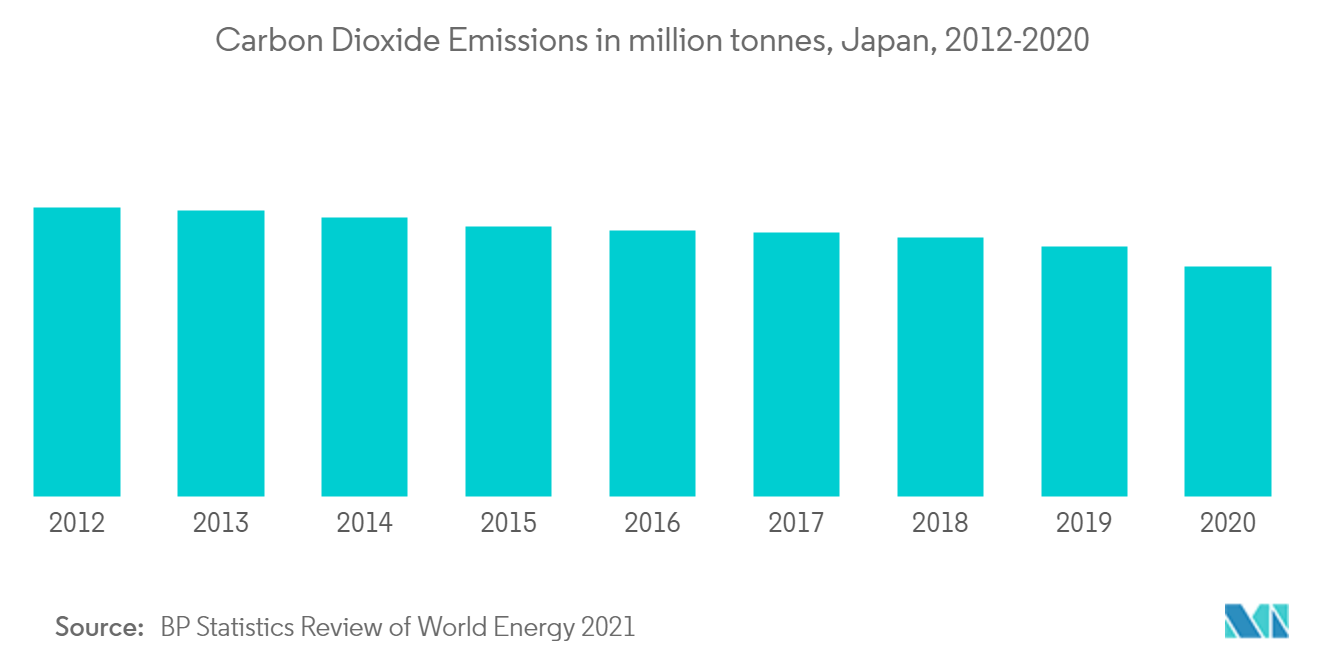
- An increase in the new incineration technologies in Japan has reduced CO2 emissions. However, Japan's overall carbon dioxide emissions decreased from 1158.4 million metric ton in 2018 to 1027.0 million metric ton in 2020.
- Hence, increasing investments and advancements in the new incineration technologies across Japan are expected to drive the waste to energy market during the forecast period.
Regulatory Landscape
Japan's waste-to-energy activity sits primarily under the Waste Management and Public Cleansing Law (Law No. 137 of 1970), administered by the Ministry of the Environment (MOE), alongside environmental controls under frameworks such as the Air Pollution Control Act. Municipalities are required to prepare waste management plans, and waste-to-energy facilities must meet stringent emission and environmental-load requirements (including controls for soot/dust and dioxins) as part of permitting and ongoing compliance.
Project development and upgrades are implemented through local installation permits and reviews by the relevant prefecture or city government, with MOE guidance influencing technology selection and performance thresholds. Policy support is linked to higher-efficiency energy recovery and CO2 reduction, including MOE subsidy programs that target high-efficiency equipment and FY2026 (Reiwa 8) demonstrations for advanced waste-heat recovery and utilization (such as thermal energy storage and off-site heat transport). This reinforces a regulatory tilt toward retrofit-led modernization and broader heat use beyond power-only generation.
Value Chain Analysis
Japan's waste-to-energy value chain begins with municipal and industrial waste collection and pre-processing (segregation, sizing, and handling), followed by conversion in thermal systems (dominant, including stoker incineration and gasification) and, to a smaller extent, biological routes such as anaerobic digestion for food and organic waste streams. Upstream equipment and engineering are supplied by Japan-based OEMs and EPC/DBO contractors (for example, Mitsubishi Heavy Industries Environmental & Chemical Engineering, JFE Engineering, Takuma, Hitachi Zosen, and Kawasaki Heavy Industries). Typical scopes include furnace/boiler islands, flue-gas treatment, turbines and generators, and plant control systems designed to stabilize combustion and reduce emissions.
Downstream, plants monetize electricity and, increasingly, heat supplied to public facilities or local industry. Residues (bottom ash and fly ash) require compliant treatment, transport, and recycling or disposal pathways under municipal oversight. Procurement and service models focus on long-life asset management, including refurbishment, performance upgrades, and DBO-type contracts that bundle construction with extended operations and maintenance; examples include MHIEC refurbishment activity (orders and completions in 2025 with projects running into 2026) and Takuma's July 2025 DBO award for a municipal facility in Numazu City. Government and industry bodies, including the MOE and the Waste-3R Research Foundation, reinforce the chain via demonstration programs and regional energy-creation initiatives that emphasize high-efficiency power generation, heat recovery, and resilience-linked plant upgrades.
Competitive Landscape
The Japanese waste to energy market is moderately fragmented. Some key players include Hitachi Zosen Corp., Mitsubishi Heavy Industries Ltd, JFE Engineering Corporation, TAKUMA Co. Ltd, and Kawasaki Heavy Industries Ltd.
Japan Waste To Energy Industry Leaders
-
Mitsubishi Heavy Industries Ltd
-
JFE Engineering Corporation
-
TAKUMA Co. Ltd
-
Hitachi Zosen Corporation
-
Kawasaki Heavy Industries Ltd
- *Disclaimer: Major Players sorted in no particular order
Japan Waste To Energy Market Companies Covered in this Report
- Hitachi Zosen Corporation
- Mitsubishi Heavy Industries Ltd
- JFE Engineering Corporation
- Kawasaki Heavy Industries Ltd
- Doosan Lentjes GmbH
- TAKUMA Co. Ltd
- CR-POWER LLC
Market Opportunities and Future Outlook
Aging municipal incineration assets and policy emphasis on higher-efficiency energy recovery are creating a sustained pipeline for retrofit and rebuild work, particularly for turbine upgrades, boiler and heat-recovery improvements, and advanced combustion and flue-gas control. MOE planning and targets in the 2023-2027 window, to raise incineration power generation efficiency (from 20% to 22%) and increase the share of facilities supplying energy externally (from 41% to 46%), also increases the commercial value of projects that add district heat, steam supply, and other off-site utilization alongside electricity.
Near-term opportunity is centered on advanced heat utilization and decarbonization add-ons that can be deployed at existing sites without the siting constraints faced by greenfield projects. This includes thermal energy storage, heat transport, and pathways that position plants as regional energy hubs. Market signals include municipal-scale upgrades completed by MHIEC in 2026, such as the Kagoshima Hokubu plant renovation and the Nagasaki East plant rebuild with heat supply elements, as well as the MOE FY2026 demonstration agenda for advanced heat recovery and utilization. Technology development is also supporting higher-value outputs and emissions mitigation (for example, gasification-based resource recovery systems and the integration of CO2 reduction measures), which aligns with tightening environmental performance expectations and encourages suppliers to differentiate through efficiency, heat integration, and verified environmental performance.
Recent Industry Developments in Japan Waste To Energy Market
- May 2026: Mitsubishi Heavy Industries Environmental & Chemical Engineering (MHIEC) received a Technical Verification Report from the Japan Environmental Sanitation Center for its fluidized bed-type gasification and reforming system that converts municipal solid waste into syngas for ethanol production. The verification supports broader adoption of waste-to-chemicals configurations, expanding the addressable market beyond power and heat into higher-value fuels and chemicals.
- April 2026: MHIEC completed a renovation of Kagoshima Citys Hokubu Waste-to-Energy plant, upgrading the steam turbine output to 10,005 kW and reporting a reduction in annual CO2 emissions of about 33.1%. The project highlights the scale of efficiency-led retrofits in Japan, where plant life-extension and performance upgrades are used to raise energy recovery without relying on new landfill capacity.
- June 2024: Mitsubishi Heavy Industries announced progress on municipal waste-to-energy facility development activity in Japan, reinforcing the continued flow of upgrade and rebuild work tied to local-government procurement cycles. The update underscored how major OEMs combine engineering, equipment supply, and long-duration service capabilities to compete for multi-year municipal programs.
Japan Waste To Energy Market Report Scope and Research Methodology
Market Definition and Coverage
For this study, the Japan waste-to-energy market is defined as the value generated from facilities that convert municipal and similar solid wastes into usable energy, mainly electricity and recoverable heat, within Japan.
Scope exclusions: We exclude conventional landfilling, stand-alone recycling and composting without energy recovery, and pure waste collection and hauling services.
Segments Covered in This Report
- Technology
- Physical
- Thermal
- Biological
Data Sources, Market Sizing, and Validation
Desk Research
Desk research was used to build the basic demand and supply picture for Japan, and then to cross-check assumptions used in the model. We relied on public datasets such as Japan Ministry of the Environment publications on municipal waste treatment, METI energy statistics, national and local government plant and tender disclosures, and OECD waste indicators, followed by academic articles that track incineration efficiency and emissions performance.
To translate those signals into market value, we also reviewed utility and municipal operator annual reports, project announcements, and audited financial statements where available. Select paid subscriptions were used for company financials and news screening, and an import and export shipment-level database was used selectively when equipment delivery timing needed confirmation. The sources listed above are illustrative only, and other public references were also used for data collection, validation, and clarification.
Primary Interviews and Surveys
Primary work focused on confirming how revenues are earned across Japan waste-to-energy projects, and on validating utilization, tipping fee practices, and typical contract structures. We spoke with plant operators, EPC and technology teams, utilities and offtake-facing roles, and local ecosystem experts. Respondent input was then used to fill gaps left by public datasets and to test our assumptions before finalizing the model.
Distribution of primary research fieldwork respondents
| Company type | Respondent position |
|---|---|
| Top tier: 27% | CXOs: 18% |
| Mid tier: 51% | Functional/Unit leaders: 23% |
| Smaller Players: 22% | Managers: 59% |
Market-Sizing & Forecasting
Sizing starts with a top-down reconstruction built from Japan waste generation and treatment splits, energy recovery rates, and plant throughput signals, which are then converted into value using typical revenue drivers (tipping fees, power and heat offtake, and service and O&M receipts). Because public reporting can be uneven by prefecture and plant, the totals are then checked using selective bottom-up approximations such as sampled plant capacity multiplied by utilization, plus reasonable price ranges gathered from interviews.
Key model inputs include municipal solid waste volumes treated by incineration with energy recovery, number of operating plants and major refurbishments, average net electricity output per ton, tariff or offtake price ranges, and utilization patterns tied to maintenance cycles. Where plant-level data is missing, we apply conservative fill factors and then re-check the results against known project pipelines and public procurement activity.
For forecasting, scenario analysis is used so that policy changes, retrofit cycles, and commissioning delays can be reflected cleanly. Assumptions are anchored on expert views of how waste volumes, efficiency upgrades, and power pricing could move, and then we run the scenarios through the same revenue logic to keep the forecast traceable.
Data Validation & Update Cycle
Outputs are validated by comparing the model against independent signals such as announced plant upgrades, procurement awards, and reported waste treatment totals. When a value looks out of line, we re-check the driver assumptions, and then the variance is reviewed by another analyst before sign-off.
The report is refreshed on an annual cycle, and interim updates are done when material events occur such as major policy revisions, large project awards, or notable shutdowns. Before delivery, a fresh review pass is completed so clients receive the latest updated view that still matches the stated scope and definitions.
Mordor Intelligence's Japan Waste to Energy Market Size Compared Against Other Published Estimates
Published estimates for Japan waste-to-energy do not always match because the market can be measured in different units, and because some studies mix energy output, installed capacity, and revenue into one headline number. Differences also come from whether municipal-only plants are counted, how tipping fees and power offtake are treated, and whether the timeline uses calendar years or fiscal years.
By tracking plant throughput and utilization first, and then refreshing key pricing inputs with Japan-specific interviews, Mordor Intelligence sits closer to a revenue view of waste-to-energy, while some published sources lean toward fiscal-year accounting or energy-volume reporting that cannot be compared one-to-one.
Benchmark comparison
| Source | Market Size | Gaps in Research Methodology |
|---|---|---|
| Mordor Intelligence | USD 0.00 B (2024) | |
| Industry Data Publisher A | USD 8.88 B (2024) | Uses a fiscal-year framing and a broader market boundary that can include adjacent waste management revenue pools, which inflates totals versus an energy-recovery-only revenue model. |
| Industry Research Publisher B | USD 0.00 B (2025) | Reports market size in TWh (energy output) rather than USD revenue, so the number is not directly comparable unless an electricity price and revenue capture assumptions are added. |
The comparison mainly shows that unit choices and boundary choices drive most of the spread, not just forecasting optimism. Our approach stays repeatable because each step ties back to observable plant activity, utilization, and pricing checks, which makes the final number easier to validate and update over time.
Key Questions Answered in the Report
What is the current Japan Waste to Energy Market size?
The Japan Waste to Energy Market is projected to register a CAGR of 12.08% during the forecast period (2026-2031)
Who are the key players in Japan Waste to Energy Market?
Mitsubishi Heavy Industries Ltd, JFE Engineering Corporation, TAKUMA Co. Ltd, Hitachi Zosen Corporation and Kawasaki Heavy Industries Ltd are the major companies operating in the Japan Waste to Energy Market.
What years does this Japan Waste to Energy Market cover?
The report covers the Japan Waste to Energy Market historical market size for years: 2020, 2021, 2022, 2023 and 2024. The report also forecasts the Japan Waste to Energy Market size for years: 2026, 2027, 2028, 2029, 2030 and 2031.