
International Contractor Payments Platform Market Size and Share
Market Overview
| Study Period | 2020 - 2031 |
|---|---|
| Market Size (2026) | USD 3.89 Billion |
| Market Size (2031) | USD 7.38 Billion |
| Growth Rate (2026 - 2031) | 13.67 % |
| Fastest Growing Market | Asia-Pacific |
| Largest Market | North America |
| Market Concentration | Low |
Major Players *Disclaimer: Major Players sorted in no particular order Image © Mordor Intelligence. Reuse requires attribution under CC BY 4.0. | |
International Contractor Payments Platform Market Analysis by Mordor Intelligence
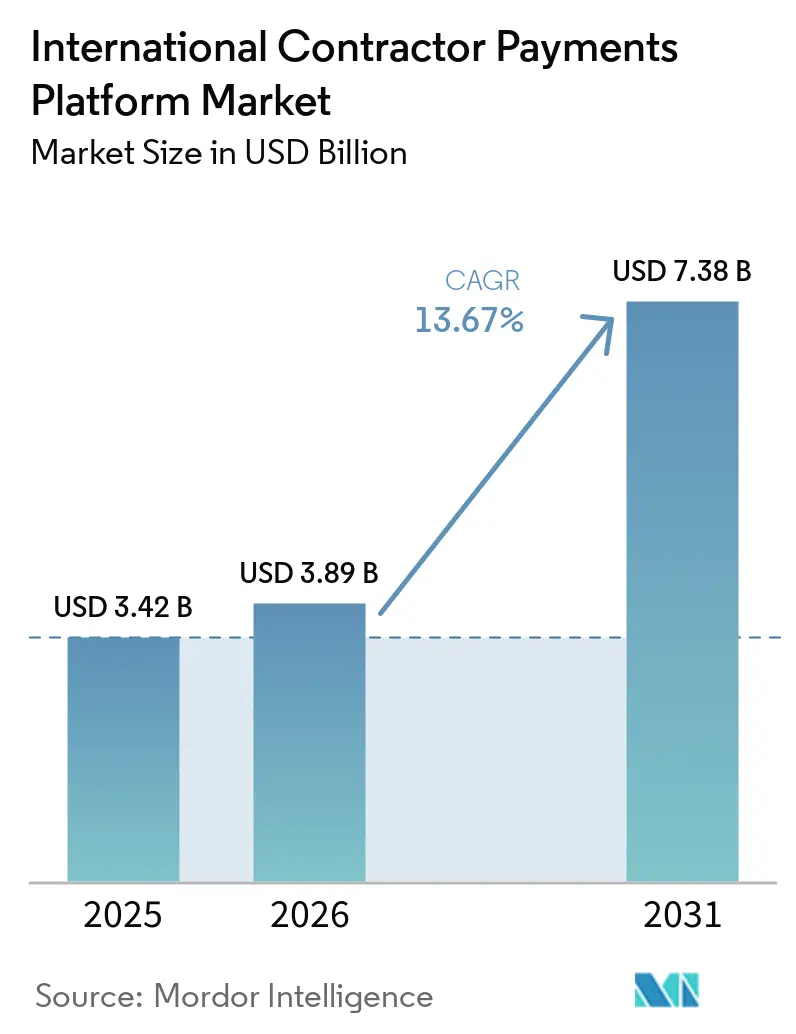
The international contractor payments platform market size is expected to increase from USD 3.42 billion in 2025 to USD 3.89 billion in 2026 and reach USD 7.38 billion by 2031, growing at a CAGR of 13.67% over 2026-2031. Independent work accounted for 47% of the global workforce in 2024, and 79% of business leaders said contractors and freelancers had become a more critical part of their strategy, which kept demand strong for platforms built around cross-border engagement. The international contractor payments platform market is also benefiting from a clear shift toward single-platform operating models that combine contractor onboarding, cross-border payouts, tax compliance, treasury workflows, and audit-ready records in one system. That consolidation is lowering the total cost of managing international contractors because enterprises no longer need separate local tools for payments, compliance monitoring, and lifecycle administration. Competitive positioning is moving away from basic payment reach and toward compliance intelligence, because platforms that can document contractor independence and maintain jurisdiction-specific controls are becoming more valuable than vendors that only move money. Procurement cycles are still facing delays in some cases because contractor classification rules are changing at the same time across the EU, the United States, and key Asia-Pacific markets, but the underlying demand trend remains firmly positive.
Key Report Takeaways
- By component, software/platform held 73.18% of revenue in 2025, while services is projected to expand at a 15.02% CAGR through 2031.
- By deployment mode, cloud accounted for 75.42% of revenue in 2025, and cloud is also projected to record the fastest growth at a 14.18% CAGR through 2031.
- By application, payroll management accounted for 28.96% of the international contractor payments platform market size in 2025, while treasury and FX management is projected to expand at a 16.82% CAGR through 2031.
- By organization size, large enterprises held 66.84% of revenue in 2025, while SMEs are projected to grow at a 14.74% CAGR through 2031.
- By industry vertical, IT and telecom accounted for 23.92% of revenue in 2025, while BFSI is projected to expand at a 15.96% CAGR through 2031.
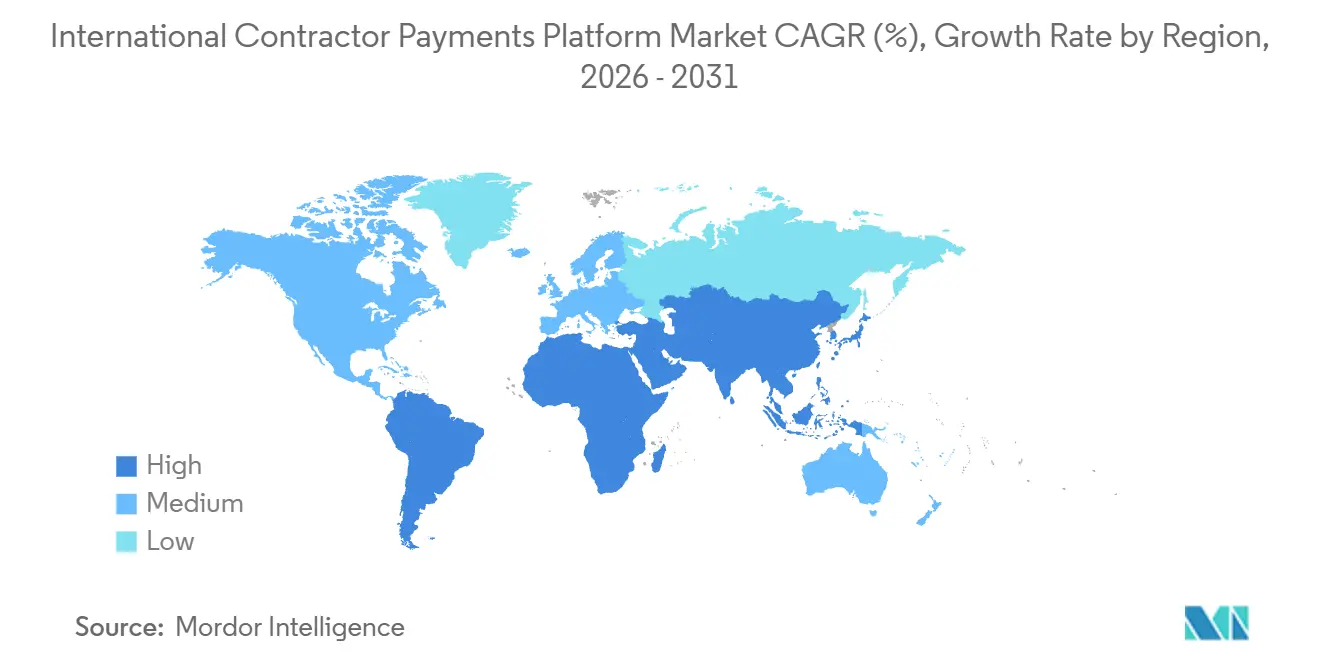
- By geography, North America held 37.86% of the international contractor payments platform market share in 2025, while Asia-Pacific is projected to expand at a 16.88% CAGR through 2031.
Note: Market size and forecast figures in this report are generated using Mordor Intelligence’s proprietary estimation framework, updated with the latest available data and insights as of January 2026.
Market Trends and Insights
Drivers Impact Analysis of International Contractor Payments Platform Market*
| Driver | (~) % Impact on CAGR Forecast | Geographic Relevance | Impact Timeline |
|---|---|---|---|
| Distributed Workforce Expansion and Global Contractor Adoption | +3.8% | Global | Short term (≤ 2 years) |
| AI-Led Payroll and Contractor Workflow Automation | +2.5% | Global, with early gains in North America and Western Europe | Medium term (2-4 years) |
| Rising Multi-Jurisdiction Compliance Burden | +2.0% | EU, North America, Asia-Pacific core | Medium term (2-4 years) |
| Finance Demand for Unified Workforce Payment Visibility | +1.8% | North America and EU | Short term (≤ 2 years) |
| Real-Time Tax and Labor Reporting Infrastructure | +1.2% | North America, EU, Australia | Medium term (2-4 years) |
| Licensed Payment Rails and Stable-Settlement Innovation | +1.0% | Global, with early gains in South America, Asia-Pacific, and MEA | Long term (≥ 4 years) |
| Source: Mordor Intelligence | |||
Distributed Workforce Expansion and Global Contractor Adoption
The move toward distributed talent models has become part of core workforce planning rather than a temporary response to labor shortages. Remote reported that more than half of companies hiring internationally expected new hires to be international by 2026, and 48% of global CEOs planned to hire contractors in 2025.[1] As contractor supply broadens across Southeast Asia, Eastern Europe, and Sub-Saharan Africa, a single enterprise now has to handle many more legal, tax, and payout combinations than before. That makes manual workflows hard to sustain because each new country adds another layer of document handling, payment routing, and classification review. In the international contractor payments platform market, vendors that can support volatile currency corridors and faster local settlement are gaining an edge because reliable payout timing matters to contractor retention as much as compliance accuracy. The result is that payment speed is no longer just an operations metric, and it is increasingly part of the employer value proposition in global contractor hiring.
AI-Led Payroll and Contractor Workflow Automation
AI automation is changing the economics of contractor payroll administration at a faster pace than earlier payroll software upgrades did. ADP introduced an AI Assist payroll agent in April 2026 that identifies payroll variances and suggests remediation steps before errors occur across more than 40 countries. SAP also released 4 specialized payroll agents in its 2026 updates, covering payroll explanations, alert resolution, rule creation, and data integration. For the international contractor payments platform market, this matters because weekly and milestone-based contractor runs leave little room for processing delays or post-cycle corrections. Platforms that combine AI with proprietary compliance data can reduce payroll close times, improve reconciliation, and lower audit exposure at the same time. That creates a durable product advantage because payment-only vendors cannot easily match classification and rule-based intelligence without equivalent regulatory datasets.
Rising Multi-Jurisdiction Compliance Burden
Compliance fragmentation has become a board-level operating issue because contractor classification rules are changing across several major labor markets at the same time. The European Labour Authority highlighted that the EU Platform Work Directive introduced a rebuttable presumption of employment for platform workers and set a December 2026 deadline for member-state transposition.[2] Enterprises with contractor populations spanning 20 or more countries now face overlapping and sometimes conflicting tests for independence, documentation, and employer control. In the international contractor payments platform market, there is an increasing demand for systems that keep jurisdiction-specific rule libraries current and embed evidence trails directly into onboarding and payment flows. Vendors that can surface classification safeguards at the data layer are converting what used to be episodic legal review into recurring subscription revenue. At the same time, the need for constant legal refresh is raising the cost of maintaining these products, which is pushing smaller vendors toward narrower geographic coverage or partnership-led models.
Finance Demand for Unified Workforce Payment Visibility
Buying decisions are shifting from HR administration teams toward finance and treasury teams because international contractor payments now affect cash visibility, FX control, and entity-level reconciliation. Recent platform releases have centered on end-to-end payroll funding, FX conversion, and multi-country disbursement, which shows how product design is moving toward treasury orchestration rather than stand-alone payroll processing. That shift matters because a finance-led purchase usually involves deeper ERP and HCM integrations, wider approval workflows, and a larger contract footprint across legal entities. Platforms that provide real-time views of contractor liabilities, currency exposure, and upcoming settlement needs are helping CFO teams treat contractor payouts as a managed treasury variable instead of a fragmented back-office task. In the international contractor payments platform market, these finance integrations also raise switching costs because links into SAP, Workday, and Oracle NetSuite are harder to unwind than basic onboarding workflows. Once those systems are connected, renewal patterns tend to improve because the platform becomes part of daily cash and control processes rather than a peripheral HR tool.
Restraints Impact Analysis of International Contractor Payments Platform Market*
| Restraint | (~) % Impact on CAGR Forecast | Geographic Relevance | Impact Timeline |
|---|---|---|---|
| Worker Misclassification Rule Volatility | -1.8% | EU, North America, Asia-Pacific core | Medium term (2-4 years) |
| Data Residency and Cross-Border Privacy Fragmentation | -1.4% | EU, China, Russia, Southeast Asia | Long term (≥ 4 years) |
| ERP and HCM Integration Complexity | -1.1% | Global | Medium term (2-4 years) |
| Hidden FX Leakage and Withdrawal Friction | -0.8% | South America, MEA, Southeast Asia | Short term (≤ 2 years) |
| Source: Mordor Intelligence | |||
Worker Misclassification Rule Volatility
Rule volatility creates a clear tension for vendors because regulatory complexity pushes demand up, but changing rules also makes buyers more cautious. The European Labour Authority noted that the EU Platform Work Directive set a December 2026 transposition deadline, which means implementation timing still differs across member states in 2026. Enterprises that operate a pan-European contractor model, therefore, have to prepare for several local interpretations before the framework is fully embedded. In the international contractor payments platform market, this delays some procurement decisions because buyers want flexibility in workflow design, document capture, and audit logic before committing to long rollouts. The same problem appears outside Europe whenever labor agencies alter enforcement posture or place more emphasis on behavioral control and economic dependence tests. Vendors must then refresh rulebooks, templates, and product logic quickly, which raises operating costs even while demand remains strong.
Data Residency And Cross-Border Privacy Fragmentation
Data localization is becoming a heavier operating burden because contractor platforms handle sensitive payroll records, tax identifiers, contracts, and bank details across many jurisdictions. Graham Greenleaf reported that 172 countries had enacted data privacy laws by 2025, and each regime brought its own transfer, storage, and compliance requirements. That level of fragmentation forces vendors to choose between maintaining regional data silos or investing continuously in transfer mechanisms and legal controls. Both paths create cost pressure because duplicated infrastructure, extra review steps, and country-specific hosting rules can slow product launches and reduce scale efficiency. The international contractor payments platform market depends on a unified compliance view, so forced data separation can weaken one of the product's main value propositions. Smaller vendors are the most exposed because they often lack the capital needed to build parallel infrastructure across several regions at once.
*Our forecasts treat driver/restraint impacts as directional, not additive. The impact forecasts reflect baseline growth, mix effects, and variable interactions.
International Contractor Payments Platform Market Segment Analysis
By Component:
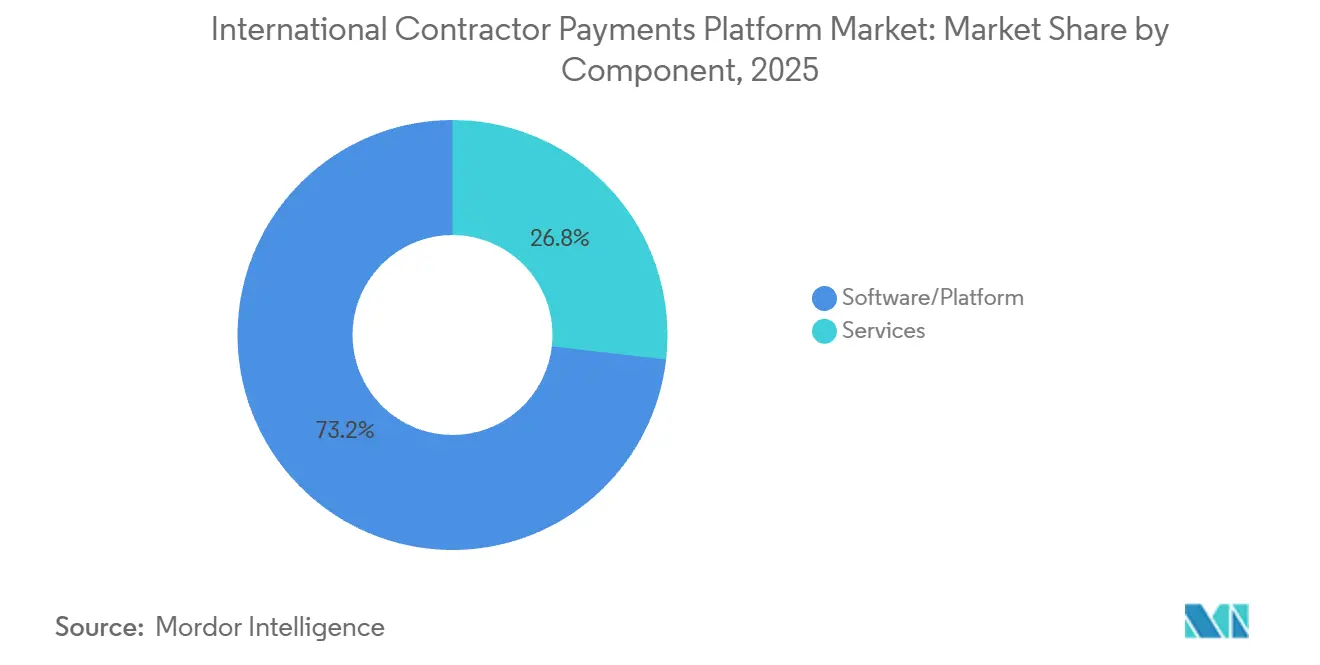
Software Leadership Still Leaves Room for Services GrowthSoftware/platform accounted for 73.18% of revenue in 2025, which shows that most buyers still prefer automated systems over fully managed operating models. In the international contractor payments platform market, software remains the default entry point because enterprises want audit trails, API connectivity, and repeatable controls that can scale across large contractor populations. A platform-led model also helps finance and compliance teams standardize payments, approvals, and tax documentation without adding headcount at the same pace as contractor volumes. That fit is especially strong in organizations that already run ERP and HCM systems and want contractor workflows to sit inside those existing technology stacks.
Services is still the faster-growing component, with a projected CAGR of 15.02% through 2031, because software alone does not fully solve local filing complexity in higher-risk jurisdictions. Enterprises expanding into the Middle East, Southeast Asia, and parts of Africa often need local support for statutory filings, labor authority interactions, dispute handling, and edge-case classification reviews. That is why bundled models are becoming more common, with vendors packaging software and expert services under jurisdiction-based or usage-based contracts. SAP's 2026 payroll agent rollout also showed how automation is starting to absorb tasks that once sat with managed-service teams, including alert resolution and rule creation. The practical effect is not a collapse in services demand, but a shift toward higher-value advisory and jurisdiction handling rather than routine processing.
By Deployment Mode:
Cloud Keeps Expanding While On-Premises Holds a Strategic NicheCloud accounted for 75.42% of revenue in 2025, reflecting how dependent the category is on continuous rule updates and distributed access across many countries. The international contractor payments platform market still favors cloud delivery because static installations are harder to maintain when tax logic, contractor classification standards, and payout workflows change often. Multi-tenant architecture also gives vendors a cost advantage because infrastructure and product upgrades can be spread across a broad customer base. This matters in a category where customers expect current compliance content and do not want to manage software maintenance internally.
Cloud is also the fastest-growing deployment model, with a projected CAGR of 14.18% through 2031, which shows that migration is still active rather than complete. Even so, on-premises and private-cloud options continue to matter in financial services, government contracting, and data-sovereignty-sensitive use cases where security rules limit public-cloud adoption. These deployments tend to be smaller in volume but higher in contract value because buyers need tailored infrastructure, stricter control settings, and support for local hosting requirements. ADP and SAP both continue to develop globally connected payroll automation, reinforcing the direction of travel toward centrally updated systems even when deployment structures differ by client need. Vendors that can serve both cloud-first buyers and controlled-environment buyers are therefore positioned to capture a wider range of enterprise demand than cloud-only competitors.
By Application:
Payroll Provides the Core, While Treasury and FX Drive Premium GrowthPayroll management held 28.96% of revenue in 2025, making it the largest application because it is usually the first problem enterprises try to solve when contractor volumes rise across borders. That lead position reflects the fact that payment timing, recordkeeping, and approval control are foundational to every other workflow in the stack. Once payroll is integrated, the same system often expands into invoice processing and billing management, tax documentation and compliance management, and contractor onboarding and lifecycle management. In this way, payroll acts as the anchor application that creates switching costs and opens the door for broader platform adoption.
Treasury and FX management is the fastest-growing application, with a projected CAGR of 16.82% through 2031, as finance teams increasingly focus on recoverable cross-border payment costs. SWIFT also said in 2026 that more banks were rolling out a framework intended to accelerate retail cross-border payments, supporting the broader push toward faster and more transparent settlement expectations.[3] In the international contractor payments platform market size discussion at the application level, this means payroll may still lead the installed base, but treasury functionality is where vendors can justify higher value per client. Contractor onboarding and lifecycle tools are also gaining importance because documentation quality now has a direct effect on classification defensibility and tax readiness.
By Organization Size:
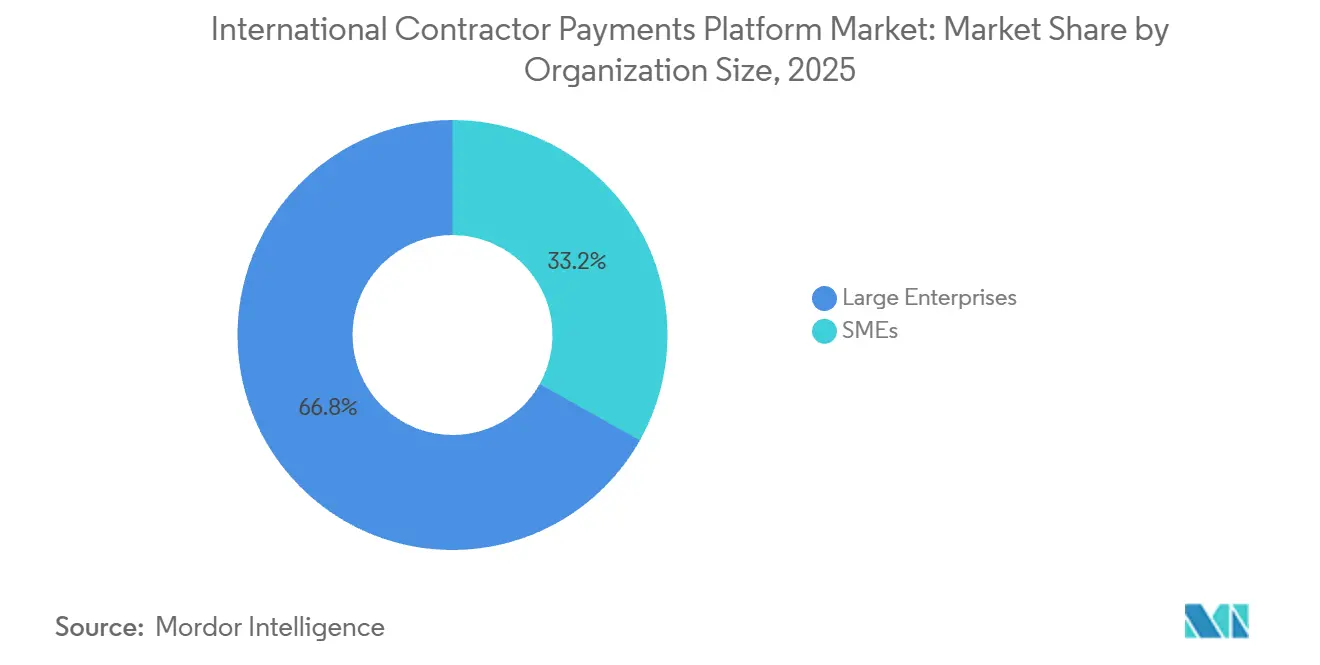
Large Enterprises Lead Revenue While SMEs Open the Next WaveLarge enterprises accounted for 66.84% of revenue in 2025 because they operate across more countries, manage larger contractor pools, and have higher compliance exposure. In the international contractor payments platform market, these buyers usually require deep integration with ERP, HCM, identity, and approval systems before they can standardize contractor workflows. They also place a higher premium on auditability, centralized controls, and consistent payout governance across legal entities. That naturally favors vendors with global rule libraries, enterprise implementation support, and the capacity to support complex deployment environments.
SMEs are the fastest-growing segment, with a projected CAGR of 14.74% through 2031, because subscription-based products have lowered the operational threshold for managing international contractors. Atlas HXM reported in 2026 that 54% of organizations now use or plan to use an employer of record partner, compared with 48% using fully owned foreign entities, which points to more flexible international workforce models for growing companies. That shift expands the reachable customer base for platforms that can support both contractor payments and adjacent workforce models from a single interface. Smaller companies are especially drawn to products that combine onboarding, contracts, payouts, and compliance without requiring a dedicated international HR or treasury team. As a result, the international contractor payments platform market is widening below the enterprise tier even while large organizations continue to supply most current revenue.
By Industry Vertical:
Technology Demand Leads While BFSI Adds Compliance-Led GrowthIT and telecom accounted for 23.92% of revenue in 2025 because the sector depends heavily on project-based specialists in software engineering, cybersecurity, cloud operations, and network infrastructure. The international contractor payments platform market has a natural fit in this vertical because technology firms already hire across borders and need fast onboarding for specialized roles. These companies also feel the benefit of platform-mediated payments quickly because contractor projects often run on short delivery cycles and frequent milestone releases. That combination of speed, technical specialization, and cross-border hiring keeps IT and telecom at the front of demand.
BFSI is the fastest-growing vertical, with a projected CAGR of 15.96% through 2031, because financial institutions are using specialist contractors in data science, quantitative analysis, and regulatory technology across several jurisdictions. This creates a dual burden because payroll and contractor management must align with labor rules while also fitting AML and KYC expectations tied to regulated operating environments. Healthcare and life sciences continue to add demand through cross-border clinical trial staffing and research operations, while manufacturing relies on engineering and supply-chain contractors spread across Asia-Pacific and Eastern Europe. Retail and e-commerce also remain active users as fulfillment, digital operations, and regional expansion programs depend on flexible external talent. Government and public sector adoption is still early, but the direction is positive as digital procurement reforms broaden the role of compliant fintech-based workforce payment tools.
Geography Analysis
North America and Europe International Contractor Payments Platform Market
North America held 37.86% of the international contractor payments platform market share in 2025, which kept it as the largest regional revenue base. The region benefits from a mature platform ecosystem and from enterprise familiarity with platform-mediated contractor payments as a standard operating tool rather than a niche solution. The United States continues to generate steady demand because contractor reporting, classification management, and finance controls remain difficult to handle manually at scale. Europe remained the second-largest geography, supported by GDPR-related controls, dense contractor economies, and the EU Platform Work Directive timetable that is pushing enterprises to improve documentation and audit readiness. In the international contractor payments platform market size by region, North America still leads in current revenue, but Europe sustains premium pricing because classification risk is harder to manage without embedded regulatory expertise.
APAC and South America International Contractor Payments Platform Market
Asia-Pacific is the fastest-growing region, with a projected CAGR of 16.88% through 2031, driven by India's contractor expansion, Australia's professional contractor base, and Southeast Asia's payment infrastructure upgrades. Nium described APAC in 2026 as a region shaped by new outsourcing hubs, real-time payment rails, fragmented regulation, stablecoin adoption, and leaner payroll teams, all of which support stronger platform demand.[4] SWIFT's 2026 push to accelerate consumer cross-border payment frameworks also supports the wider regional shift toward faster settlement expectations. South America is also becoming more important as a contractor supply region for North American companies, and currency volatility is making stable-value payout options more attractive in markets such as Brazil and Argentina.
EMEA International Contractor Payments Platform Market
The Middle East and Africa are the fastest-emerging parts of the international contractor payments platform market, but each sub-region is following a different path. The UAE and Saudi Arabia are expanding the use of contractors as part of broader digital-economy goals, which is widening the opportunity for compliant platform-led engagement models. Africa is moving onto more vendor roadmaps as fintech infrastructure improves and professional contractor bases deepen in markets such as South Africa, Nigeria, and Egypt. The Pan-African Payment and Settlement System was operating in 15 countries in 2025, which supports better local-currency settlement conditions for platforms serving African contractor payments. Turkey also remains an important gateway market because its outsourcing links and payment corridors connect Europe and the Middle East in a way that supports cross-border contractor engagement.
Competitive Landscape
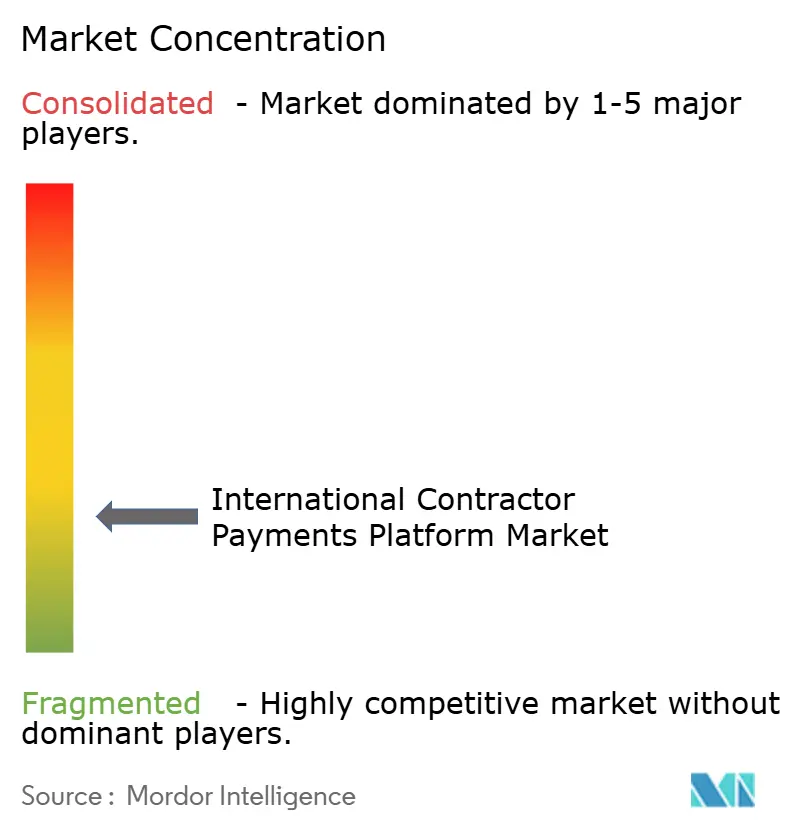
The international contractor payments platform market remains fragmented at the payment-infrastructure layer, but it is consolidating at the application layer as vendors try to own more of the contractor lifecycle. A clear split has emerged between compliance-first workforce platforms that are expanding into payments and payment specialists that are adding compliance, onboarding, and payroll controls. Deel is one of the clearest examples of the first path, with USD 1.4 billion in ARR and a USD 300 million Series E round in October 2025 at a USD 17.3 billion valuation to support broader payroll and AI expansion. Remote is also scaling quickly, saying in May 2026 that its payroll business had grown more than 300% year over year and surpassed USD 300 million in ARR. These moves show that scale, compliance data, and embedded payroll capability are becoming more important than broad payment reach alone.
Payment specialists are responding by building a stronger workforce layer around their settlement networks. Nium's April 2026 partnership with Coinbase to support USDC-to-fiat flows showed how stablecoin-enabled settlement is moving closer to production infrastructure for cross-border workforce payouts. Payoneer and Upwork also renewed their long-running payout partnership in May 2026 and extended the relationship into stablecoin design work for freelancers in emerging markets. Multiplier's April 2026 launch of global payroll payments with Navro pointed in the same direction, with calculation, FX conversion, disbursement, and filings bundled into one operating flow. The competitive message is clear because buyers increasingly prefer full-stack workflow coverage over point solutions that require extra reconciliation.
There is still open space in the mid-market, especially for companies operating across 5 to 20 countries that need more control than SME tools provide but do not want the cost and deployment burden of heavy enterprise rollouts. Regulated verticals such as BFSI and healthcare also leave room for vendors that can package sector-specific controls instead of generic cross-border payroll features. Vistra and Oyster's April 2026 partnership showed another route to expansion by linking agile hiring capability with entity management, payroll, and advisory services in one commercial relationship.[5] The international contractor payments platform market is, therefore, still open to new entrants, but licensing depth, compliance intelligence, and integration breadth are making entry much harder for sub-scale regional vendors.
International Contractor Payments Platform Industry Leaders
-
Deel, Inc.
-
Remote Technology, Inc.
-
Papaya Global Ltd.
-
Globalization Partners LLC
-
Multiplier Technologies Pte. Ltd.
- *Disclaimer: Major Players sorted in no particular order
International Contractor Payments Platform Market Companies Covered in this Report
- Deel, Inc.
- Remote Technology, Inc.
- Papaya Global Ltd.
- Globalization Partners LLC
- Multiplier Technologies Pte. Ltd.
- Velocity Global, LLC
- Oyster HR, Inc.
- WorkMotion Software GmbH
- Atlas Technology Solutions, Inc.
- Omnipresent Group Limited
- Lano Software GmbH
- RemotePass Inc.
- Remofirst Inc.
- Payoneer Inc.
- Wise Payments Limited
- Airwallex Pty Ltd
- Nium, Inc.
- Trolley Inc.
- Tipalti, Inc.
- Veem Payments Inc.
- MANGOPAY S.A.
- Native Teams Limited
- Mercans General Trading LLC
Recent Industry Developments in International Contractor Payments Platform Market
- May 2026: Payoneer and Upwork renewed their 15-year cross-border payout partnership, with Upwork joining as a Design Partner for Payoneer's stablecoin payout exploration targeting freelancers in South America and other emerging markets. The renewal covers Payoneer's reach across 190 countries and territories.
- May 2026: Remote announced that its payroll business grew more than 300% year over year, surpassing USD 300 million in ARR and reaching cash-flow positive status. The company also launched Remote MCP, providing AI agents with a live, secure connection to Remote's payroll, contracts, and compliance data with no custom integrations required.
- April 2026: Multiplier launched Global Payroll Payments in partnership with Navro, completing its Global Exchange for Work infrastructure with end-to-end payroll calculation, FX conversion at wholesale rates, multi-country disbursement, and statutory filings. The platform processed USD 2 billion in cross-border wages annually at launch and targeted USD 4.5 billion by year-end.
- April 2026: Nium partnered with Coinbase to enable USDC stablecoin-to-fiat payout flows, allowing clients to send and receive stablecoins and convert to local-currency payouts through Nium's global payment network in a unified fiat-and-digital-asset infrastructure.
Global International Contractor Payments Platform Market Report Scope
The international contractor payments platform market comprises software platforms and integrated financial technology solutions that enable organizations to manage, automate, and optimize cross-border payments, compliance workflows, invoicing, tax documentation, and payout operations for independent contractors, freelancers, consultants, and globally distributed contingent workers. These platforms support compliant international contractor engagement by facilitating multi-currency payment processing, contractor onboarding, workforce payment orchestration, foreign exchange management, and regulatory compliance across multiple jurisdictions.
The International Contractor Payments Platform Market Report is Segmented by Component (Software/Platform, and Services), Deployment Mode (Cloud, and On-Premises), Application (Payroll Management, Invoice Processing and Billing Management, Tax Documentation and Compliance Management, Contractor Onboarding and Lifecycle Management, Treasury and FX Management, and Other Applications), Organization Size (SMEs, and Large Enterprises), Industry Vertical (IT and Telecom, BFSI, Healthcare and Life Sciences, Manufacturing, Retail and E-commerce, Government and Public Sector, and Other End-user Industries), and Geography (North America, South America, Europe, Asia-Pacific, Middle East, and Africa). The Market Forecasts are Provided in Terms of Value (USD).
Segmentation Overview
| Software/Platform |
| Services |
| Cloud |
| On-Premises |
| Payroll Management |
| Invoice Processing and Billing Management |
| Tax Documentation and Compliance Management |
| Contractor Onboarding and Lifecycle Management |
| Treasury and FX Management |
| Other Applications |
| SMEs |
| Large Enterprises |
| IT and Telecom |
| BFSI |
| Healthcare and Life Sciences |
| Manufacturing |
| Retail and E-commerce |
| Government and Public Sector |
| Other End-user Industries |
| North America | United States |
| Canada | |
| Mexico | |
| South America | Brazil |
| Argentina | |
| Chile | |
| Rest of South America | |
| Europe | Germany |
| United Kingdom | |
| France | |
| Italy | |
| Spain | |
| Russia | |
| Rest of Europe | |
| Asia-Pacific | China |
| Japan | |
| India | |
| South Korea | |
| Australia and New Zealand | |
| Rest of Asia-Pacific | |
| Middle East | Saudi Arabia |
| United Arab Emirates | |
| Turkey | |
| Rest of Middle East | |
| Africa | South Africa |
| Egypt | |
| Nigeria | |
| Rest of Africa |
| By Component | Software/Platform | |
| Services | ||
| By Deployment Mode | Cloud | |
| On-Premises | ||
| By Application | Payroll Management | |
| Invoice Processing and Billing Management | ||
| Tax Documentation and Compliance Management | ||
| Contractor Onboarding and Lifecycle Management | ||
| Treasury and FX Management | ||
| Other Applications | ||
| By Organization Size | SMEs | |
| Large Enterprises | ||
| By Industry Vertical | IT and Telecom | |
| BFSI | ||
| Healthcare and Life Sciences | ||
| Manufacturing | ||
| Retail and E-commerce | ||
| Government and Public Sector | ||
| Other End-user Industries | ||
| By Geography | North America | United States |
| Canada | ||
| Mexico | ||
| South America | Brazil | |
| Argentina | ||
| Chile | ||
| Rest of South America | ||
| Europe | Germany | |
| United Kingdom | ||
| France | ||
| Italy | ||
| Spain | ||
| Russia | ||
| Rest of Europe | ||
| Asia-Pacific | China | |
| Japan | ||
| India | ||
| South Korea | ||
| Australia and New Zealand | ||
| Rest of Asia-Pacific | ||
| Middle East | Saudi Arabia | |
| United Arab Emirates | ||
| Turkey | ||
| Rest of Middle East | ||
| Africa | South Africa | |
| Egypt | ||
| Nigeria | ||
| Rest of Africa | ||
Key Questions Answered in the Report
What is the size of the international contractor payments platform market?
The international contractor payments platform market size was USD 3.42 billion in 2025, is estimated at USD 3.89 billion in 2026, and is projected to reach USD 7.38 billion by 2031 at a 13.67% CAGR.
What is driving demand for international contractor payment platforms?
Demand is rising because enterprises are using more distributed contractors, facing more cross-border compliance work, and looking for one platform to manage onboarding, payouts, tax records, and treasury visibility.
Which application area is growing the fastest?
Treasury and FX management is the fastest-growing application, with a projected CAGR of 16.82% through 2031, as finance teams focus more on hidden FX costs and payout transparency.
Which companies and customer groups are shaping platform competition?
Competition is being shaped by workforce platforms such as Deel, Remote, Multiplier, and Oyster, and by payment specialists such as Payoneer, Nium, and Wise. Large enterprises still account for 66.84% of current revenue, but SMEs are growing faster.
Which region leads today and which one is expanding fastest?
North America led with 37.86% of revenue in 2025, while Asia-Pacific is projected to grow the fastest at a 16.88% CAGR through 2031.
Why are compliance capabilities becoming more important than payment reach alone?
Enterprises now need auditable contractor classification, tax documentation, and jurisdiction-specific controls across many countries. That is making compliance intelligence a stronger differentiator than simple access to payment rails.