
Canada Payment Gateway Market Size and Share
Market Overview
| Study Period | 2020 - 2031 |
|---|---|
| Forecast Data Period | 2026 - 2031 |
| Historical Data Period | 2020 - 2024 |
| Market Size (2026) | USD 2.68 Billion |
| Market Size (2031) | USD 7.48 Billion |
| Growth Rate (2026 - 2031) | 22.75 % |
| Market Concentration | Medium |
Major Players *Disclaimer: Major Players sorted in no particular order Image © Mordor Intelligence. Reuse requires attribution under CC BY 4.0. | |

Canada Payment Gateway Market Analysis by Mordor Intelligence
The Canada payment gateway market size reached USD 2.68 billion in 2026 and is projected to climb to USD 7.48 billion by 2031, reflecting a 22.75% CAGR over the forecast period. The upcoming Real-Time Rail for instant account-to-account settlement, the shift toward Consumer-Driven Banking that formalizes open-banking APIs, and the continued scale of Interac e-Transfer as a mainstream retail rail are steering spend away from traditional card rails, lowering merchant acceptance costs, and raising demand for gateways that orchestrate real-time, API-based payments. Competitive momentum is intensifying as global processors accelerate mergers, domestic champions leverage network effects, and software platforms embed checkout into vertical SaaS stacks. The resulting landscape offers clear monetization upside for providers that combine fraud controls, compliance tooling, and working-capital services within a single integration.
Key Report Takeaways
- By host type, hosted gateways led with 55.73% revenue share in 2025, while self-hosted platforms are forecast to expand at a 23.53% CAGR to 2031.
- By enterprise size, small and medium enterprises held 64.52% of the Canada payment gateway market share in 2025, whereas large enterprises are projected to grow at a 23.78% CAGR through 2031.
- By channel, in-store point-of-sale and omnichannel transactions accounted for 62.63% of the Canada payment gateway market size in 2025; mobile in-app payments are advancing at a 23.93% CAGR between 2026 and 2031.
- By end-user industry, retail and e-commerce captured 31.75% share of the Canada payment gateway market size in 2025, and travel and hospitality is expanding at a 24.01% CAGR through 2031.
Note: Market size and forecast figures in this report are generated using Mordor Intelligence’s proprietary estimation framework, updated with the latest available data and insights as of January 2026.
Market Trends and Insights
Drivers Impact Analysis of Canada Payment Gateway Market*
| Driver | (~) % Impact on CAGR Forecast | Geographic Relevance | Impact Timeline |
|---|---|---|---|
| Launch of Real-Time Rail Accelerating Instant Settlements | +5.2% | National, early uptake in Toronto, Vancouver, Montreal financial corridors | Medium term (2-4 years) |
| Open Banking-Enabled Account-to-Account Payments | +4.8% | National, influenced by Bank of Canada and Department of Finance | Medium term (2-4 years) |
| Rising Mobile Payment Adoption Among Consumers | +4.3% | National, higher penetration in urban centers | Short term (≤ 2 years) |
| Surge in Contactless and Digital Wallet Transactions | +3.9% | National, accelerated in large metro areas | Short term (≤ 2 years) |
| Increased E-Commerce Sales and High Internet Penetration | +3.1% | National, density highest in Ontario, British Columbia, Quebec | Short term (≤ 2 years) |
| Growing Acceptance of Payment Gateways in Retail Sector | +2.4% | National, concentrated in mid-market and enterprise retail | Medium term (2-4 years) |
| Source: Mordor Intelligence | |||
Launch Of Real-Time Rail Accelerating Instant Settlements
Real-Time Rail (RTR) completed technical testing in 2025 and is expected to enter commercial service in late 2026, enabling sub-second settlement around the clock.[1] By adopting ISO 20022 messaging and centralized fraud monitoring, RTR removes the one-to-three-day lag inherent in batch Automated Clearing Settlement System files, releasing working-capital trapped in settlement delays. Merchants gain faster cash-conversion cycles, while gig-economy and marketplace platforms can disburse funds instantly, eliminating interchange fees and shifting fraud liability to the payer’s bank. Request-to-pay functionality built into RTR will let billers issue push-payment requests that consumers authorize inside mobile banking apps, mirroring use cases that now capture a fifth of recurring payments in the United Kingdom and Australia. As early adopters migrate volume from cards to account-to-account rails, payment gateways able to route traffic across RTR and legacy networks will enjoy an authorization-rate uplift and a 40-60 basis-point cost advantage.
Open Banking-Enabled Account-to-Account Payments**
Budget 2025 transferred open-banking oversight to the Bank of Canada, mandating read APIs by mid-2026 and write APIs, including payment initiation, by mid-2027. Payment gateways can therefore embed pay-by-bank checkout, variable recurring payments, and near-instant refunds without relying on cards. Interchange-free account-to-account flows lower total acceptance cost by 150-250 basis points, particularly attractive in verticals with thin margins such as grocery and fuel. Compliance alignment with ISO 27001 and statutory liability protections reduce merchant hesitation toward fraud exposure, while fintech aggregators like Flinks and Plaid already connect to 300-plus Canadian institutions, providing an API fabric that gateways can leverage without bilateral bank contracts. As regulatory milestones crystallize, pay-by-bank is poised to emerge as a mainstream tender type in bill payment, e-commerce, and subscription management.
Rising Mobile Payment Adoption Among Consumers
The Bank of Canada’s 2024 survey showed mobile wallet usage climbing to 71% of consumers, up nine percentage points in one year. NFC-enabled terminals blanket 90% of Canadian merchants, while Apple Pay and Google Pay gained mainstream acceptance in public transit, quick-service restaurants, and convenience retail. Mobile checkout shortens transaction time to under 10 seconds, boosting conversion 15-25% in app-based commerce.[2] Biometric authentication cuts account-takeover fraud, shifting consumer preference toward tokenized credentials held in secure device enclaves. Gateways that tokenize cards and support dynamic cryptograms are therefore favored in ride-hailing, food delivery, and subscription streaming, where repeat purchases dominate.
Surge In Contactless And Digital Wallet Transactions
Contactless share of in-person payments rose from 62% in 2023 to 71% in 2024.[3] Cash usage slipped to 15% of consumer payments, with the steepest decline among 18-34-year-olds, where cash now accounts for only 8%. Digital wallets generated 35% of contactless volume in 2024, up seven points year on year, signaling a migration from physical tap cards to tokenized mobile credentials. Retailers deploying self-checkout kiosks that accept tap and digital wallets report labor-cost cuts of 20-30% and basket-size lifts of 10-15%. Those economics push merchants to upgrade acceptance terminals and, by extension, the gateway APIs that manage contactless acceptance.
Restraints Impact Analysis of Canada Payment Gateway Market*
| Restraints | (~) % Impact on CAGR Forecast | Geographic Relevance | Impact Timeline |
|---|---|---|---|
| Data Privacy and Cybersecurity Concerns | -2.8% | National, heightened scrutiny from federal and provincial regulators | Short term (≤ 2 years) |
| High Merchant Service and Interchange Fees | -2.3% | National, disproportionate impact on small businesses | Medium term (2-4 years) |
| Persistent Cash Usage Among Specific Demographics | -1.6% | National, concentrated among rural and 65+ consumers | Long term (≥ 4 years) |
| Regulatory Delays Around Real-Time Payments Infrastructure | -1.4% | National, affecting providers reliant on RTR timeline | Short term (≤ 2 years) |
| Source: Mordor Intelligence | |||
Data Privacy And Cybersecurity Concerns
Payment fraud attempts climbed 22% year on year in 2024 as fraudsters shifted from card rails to real-time push payments where chargeback rights do not exist. Open-banking APIs widen the attack surface through credential stuffing and man-in-the-middle exploits. Upcoming Consumer Privacy Protection Act fines can hit 3% of global revenue, while breach-notification rules require disclosure within 72 hours. Regulatory enforcement is rising, with 14 federal compliance orders issued in 2024, up from eight the prior year. Gateways must invest in machine-learning fraud models, device fingerprinting, and behavioral biometrics that add 5-10 basis points in cost but remain critical to maintain merchant trust.
High Merchant Service And Interchange Fees
Visa and Mastercard reduced interchange to a weighted 0.95% for small businesses processing below CAD 300,000 annually in October 2024. Although limited to credit cards, the move pressured pricing across other tenders as merchants benchmarked total cost of acceptance and steered spend toward Interac Debit’s flat-fee structure. Gateways serving low-margin verticals saw margin compression of 25-35 basis points, prompting a pivot to software-subscription revenue through point-of-sale, inventory, and customer-relationship modules. Lobbying by the Canadian Federation of Independent Business for deeper caps maintains regulatory overhang. Providers unable to monetize ancillary services or reach scale above 10 billion annual transactions risk profitability headwinds.
*Our forecasts treat driver/restraint impacts as directional, not additive. The impact forecasts reflect baseline growth, mix effects, and variable interactions.
Canada Payment Gateway Market Segment Analysis
By Host Type:
Self-Hosted Architectures Gain Strategic MomentumSelf-hosted platforms accounted for a smaller share than turnkey hosted gateways in 2025, yet the segment is projected to outpace the overall Canada payment gateway market with a 23.53% CAGR to 2031. Large retailers and marketplaces view orchestration control as a route to shave 15-25 basis points from processing cost, improve authorization by 2-4 points, and capture granular payment data. The self-hosted model also accelerates Real-Time Rail and open-banking adoption because merchants can plug in new rails without waiting for vendor roadmaps.
Hosted gateways, however, retain dominance among merchants processing under CAD 10 million annually because of their PCI-DSS scope reduction, fraud-liability assumption, and 24-hour support. Turnkey platforms will therefore continue to hold a majority share even as larger merchants migrate. The Canada payment gateway market size for hosted solutions is expected to widen as micro-merchants enter digital commerce, offsetting the share gains of self-hosted systems. Leading hosted providers now expose routing-as-a-service APIs, allowing mid-market firms to test self-hosted logic without replatforming.

By Enterprise Size:
Large Enterprises Drive Digital Treasury OverhaulLarge enterprises represented a smaller slice of 2025 revenue but are on track to post a 23.78% CAGR, outpacing the 64.52% share held by small and medium enterprises. Treasury departments are consolidating multi-currency, cross-border, and instant-settlement workflows into unified platforms that cut days sales outstanding by three to seven days. Bank of America's CashPro processed over USD 3 trillion in 2024, illustrating how large organizations embed payment initiation, reconciliation, and liquidity forecasting in a single interface. ISO 20022 adoption in RTR and SWIFT networks further incentivizes upgrades, as structured remittance data eliminates 60-80% of manual payment exceptions.
Small and medium enterprises remain the revenue backbone because of their sheer number and reliance on third-party compliance, fraud protection, and working-capital programs like Shopify Capital. Yet SME growth is constrained by interchange sensitivity, limited IT budgets, and higher churn in hospitality and personal services. Large enterprises negotiate interchange 20-40 basis points below published schedules and access embedded finance such as dynamic discounting, which SMEs cannot obtain due to credit constraints. Gateways targeting enterprises differentiate through vertical modules for healthcare claims, insurance premiums, and government remittance, where switching costs exceed 12-18 months. The Canada payment gateway industry is therefore bifurcating into high-volume, low-margin SME processing and high-margin, feature-rich enterprise solutions.
By Channel:
Mobile In-App Checkout Captures Incremental ShareMobile in-app payments are forecast to expand at a 23.93% CAGR from 2026 to 2031, the fastest channel growth in the Canada payment gateway market. Apple Pay, Google Pay, and platform wallets embedded in Uber and DoorDash deliver one-tap checkout for high-frequency use cases. In-store point-of-sale and omnichannel transactions still commanded 62.63% of value in 2025, reflecting the endurance of physical retail and hybrid models like buy-online-pick-up-in-store. Yet mobile in-app is gaining ground in food delivery, ride-hailing, and digital content where transaction frequency tops 10 times per month and stored credentials remove friction.
Shopify's Tap to Pay on iPhone, launched in Canada in 2024, lets merchants accept contactless payments using only a smartphone, cutting upfront terminal costs by CAD 500-1,500. Online web-based payments remain the second-largest channel, with e-commerce penetration at 87% of internet users and annual per-capita spending of CAD 3,200. Express buttons, guest checkout, and address autofill compress checkout time to under 20 seconds, reducing cart abandonment by 15-25%. Omnichannel integration is creating unified commerce, where consumers start on mobile, pay via web, and pick up in-store, with gateways orchestrating tokenized credentials across touchpoints. As showrooming and webrooming behaviors intensify in fashion, electronics, and home goods, standalone web checkout is losing relevance to seamless mobile and omnichannel flows.


By End-User Industry:
Travel And Hospitality Lead Vertical Expansion**Travel and hospitality is projected to grow at a 24.01% CAGR from 2026 to 2031, outpacing all other end-user industries in the Canada payment gateway market. Airlines, hotels, and online travel agencies are integrating digital wallets, dynamic currency conversion, and installment options into booking flows. Retail and e-commerce held 31.75% share in 2025, driven by omnichannel integration, subscription commerce, and direct-to-consumer brands relying on gateways for global expansion. Canadian international travel spending reached CAD 42 billion in 2024, up 18% year on year, while contactless infrastructure at airports, hotels, and rental-car desks accelerated adoption. Gateways serving travel differentiate through split payments for group bookings, automated refunds, and fraud models trained on velocity and origin-destination signals.
Banking, financial services, and insurance represent a high-value segment where gateways enable premium collection, claims disbursement, and peer-to-peer transfers, with Royal Bank of Canada processing 783 million digital transactions in 2024. Media and entertainment is adopting subscription billing, usage-based pricing, and in-app purchases, with gateways providing dunning management and tax compliance. Other industries, including healthcare, professional services, and government, integrate gateways for appointment booking, invoice payment, and licensing fees, where regulations such as HIPAA compliance and municipal procurement rules favor established providers. The convergence of embedded finance and vertical SaaS lets gateways capture 30-50% of software revenue through payment monetization, a model scaled by Shopify, Stripe, and Square to multi-billion-dollar volumes. The Canada payment gateway market size across verticals is therefore expanding as software platforms embed checkout and monetize transaction flow.
Geography Analysis
The Canada payment gateway market spans all provinces, with Ontario, British Columbia, and Quebec accounting for the majority of transaction volume due to population density, e-commerce penetration, and retail infrastructure. Ontario leads in absolute terms, hosting Toronto's financial-services cluster and the headquarters of Interac, Moneris, and several fintech challengers. British Columbia benefits from high mobile-wallet adoption and a tech-savvy consumer base concentrated in Vancouver, while Quebec's bilingual regulatory environment and distinct consumer preferences create opportunities for localized gateway offerings.
Real-Time Rail deployment is national, yet early commercial adoption is expected in the Toronto, Vancouver, and Montreal financial corridors where enterprise treasury teams and fintech developers cluster. Open-banking read-access APIs launched mid-2026 apply coast to coast, but write-access rollout in mid-2027 will likely see phased adoption as regional banks and credit unions integrate payment-initiation modules. The Canada payment gateway market size for rural and remote areas lags urban centers due to lower broadband penetration and persistent cash usage among older demographics, though federal digital-infrastructure programs aim to narrow that gap.
Cross-border payment flows are significant, with Canadian merchants processing USD-denominated transactions for U.S. customers and vice versa. Gateways offering dynamic currency conversion, multi-currency settlement, and foreign-exchange hedging capture premium pricing in export-oriented verticals such as manufacturing, wholesale, and software-as-a-service. The Canada payment gateway market share for cross-border capabilities is rising as e-commerce platforms expand into U.S. and international markets, requiring gateways that manage currency risk, tax compliance, and localized payment methods.
Competitive Landscape
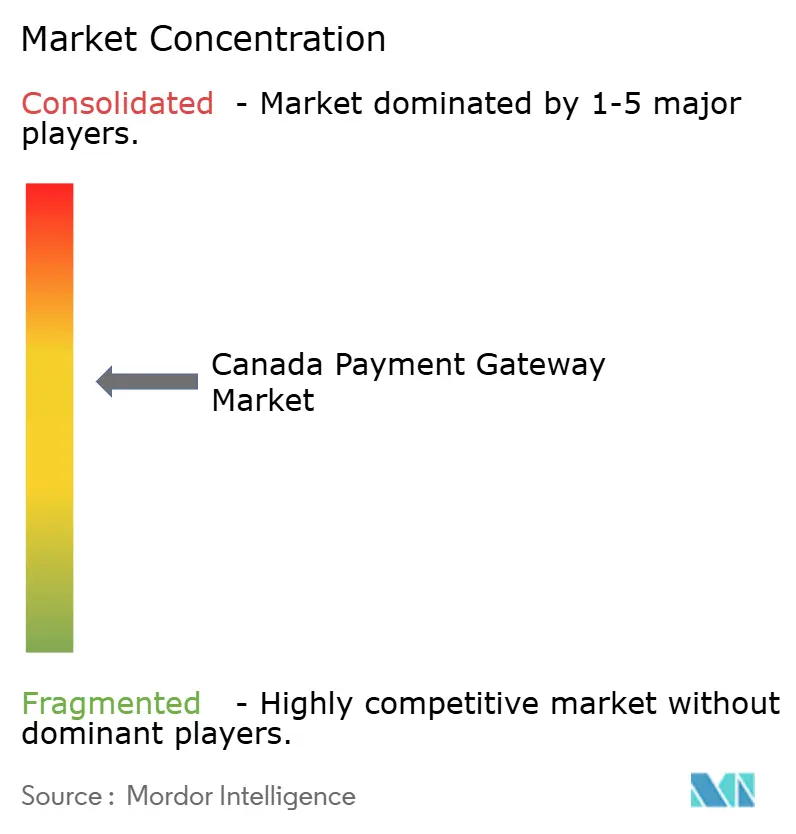
The Canada payment gateway market exhibits moderate fragmentation, with the top five players estimated to hold 45-50% combined share, leaving room for API-first disruptors and vertical specialists. Consolidation accelerated in 2025 when Global Payments announced the acquisition of Worldpay for USD 24.25 billion, creating a combined entity processing approximately 94 billion transactions annually and generating USD 3.7 trillion in payment volume across 175 countries. Fiserv completed its USD 13.5 billion purchase of Global Payments' Issuer Solutions business in January 2026, signaling a strategic pivot toward issuer-processor integration and the convergence of merchant acquiring with card issuance, loyalty programs, and digital banking. Domestic champions Interac and Moneris defend share through network effects, with Interac e-Transfer processing CAD 1.16 trillion in 2024 and Moneris operating Canada's largest merchant network with over 350,000 active terminals. Global platforms such as Stripe, Adyen, and PayPal are capturing share in e-commerce and software-as-a-service verticals by embedding payment acceptance into platforms such as Shopify, WooCommerce, and Salesforce, reducing merchant friction and enabling same-day onboarding.
Strategic differentiation centers on three vectors: embedded finance, real-time settlement, and vertical specialization. Shopify's Shop Pay reached 100 million consumer accounts in 2024 and delivers 10% higher conversion rates than guest checkout through stored credentials and accelerated address autofill. Stripe's Treasury and Capital products enable platforms to offer banking-as-a-service and working-capital financing, capturing 20-30% of payment volume through revenue-share agreements with software partners. Nuvei's acquisition of Paya for USD 1.3 billion in 2024 expanded its vertical footprint in healthcare, government, and non-profit sectors where regulatory complexity and compliance requirements create switching costs.
White-space opportunities persist in underserved verticals such as cannabis retail, which remains cash-intensive due to banking restrictions, and gig-economy platforms where instant payout and tax withholding features command 50-100 basis points in premium pricing. Regulatory compliance under the Retail Payment Activities Act, which requires registration with the Bank of Canada and adherence to operational, fraud, and incident-response standards, is raising barriers to entry and favoring incumbents with mature compliance programs.
Canada Payment Gateway Industry Leaders
-
PayPal Holdings, Inc.
-
Interac Corporation
-
Block, Inc.
-
Moneris Solutions Corp.
-
Stripe Inc.
- *Disclaimer: Major Players sorted in no particular order
Canada Payment Gateway Market Companies Covered in this Report
- PayPal Holdings Inc.
- Interac Corp.
- Stripe Inc.
- Block Inc.
- Moneris Solutions Corp.
- Nuvei Corp.
- Adyen N.V.
- Shopify Inc.
- Amazon Payments Inc.
- Chase Paymentech Solutions LLC
- Global Payments Inc.
- Elavon Inc.
- Worldpay, LLC
- Paysafe Group Limited
- Fiserv, Inc.
- Authorize.Net LLC
- Lightspeed Commerce Inc.
- BlueSnap Inc.
- Bambora (Worldline Canada)
- PayBright Inc.
Recent Industry Developments in Canada Payment Gateway Market
- January 2026: Fiserv completed the acquisition of Global Payments' Issuer Solutions business for USD 13.5 billion, integrating card issuance, digital banking, and loyalty program capabilities with its Clover and Carat merchant platforms to enable unified commerce experiences across issuing and acquiring. The transaction positions Fiserv to offer end-to-end payment orchestration for financial institutions and merchants, capturing interchange revenue on both sides of the transaction and enabling real-time settlement between issuer and acquirer systems.
- April 2025: Global Payments announced the acquisition of Worldpay for USD 24.25 billion, creating a combined entity processing approximately 94 billion transactions annually and generating USD 3.7 trillion in payment volume across 175 countries. The merger is expected to close in the first half of 2026 and will integrate Worldpay's enterprise and e-commerce gateway capabilities with Global Payments' Genius POS platform, which is planned for near-term rollout in Canada.
- April 2025: Canada’s federal Budget 2025 unveiled the Consumer-Driven Banking framework, transferring oversight from the Department of Finance to the Bank of Canada and setting deadlines for open-banking read APIs by mid-2026 and write-access payment initiation by mid-2027.
- October 2024: Visa and Mastercard implemented voluntary interchange fee reductions for small businesses processing under CAD 300,000 annually, lowering the weighted average rate to 0.95% for credit card transactions. The reduction, negotiated with the federal government, compressed acquirer margins by an estimated 15-20 basis points and accelerated merchant adoption of lower-cost payment methods such as Interac Debit and account-to-account transfers.
Canada Payment Gateway Market Report Scope
A payment gateway acts as a bridge between a buyer’s payment method (card, UPI, wallet, net banking, etc.) and the merchant’s bank, ensuring the transaction is authorized, encrypted, and completed securely.
The Canada Payment Gateway Market Report is Segmented by Host Type (Hosted, and Self-Hosted), Enterprise Size (Small and Medium Enterprises, and Large Enterprises), Channel (Online - Web, Mobile In-App, and In-Store POS - Omnichannel), and End User Industry (Retail and E-Commerce, Travel and Hospitality, Banking, Financial Services and Insurance, Media and Entertainment, and Other End-User Industries). The Market Forecasts are Provided in Terms of Value (USD).
Segmentation Overview
| Hosted |
| Self-Hosted |
| Small and Medium Enterprises |
| Large Enterprises |
| Online - Web |
| Mobile In-App |
| In-Store POS - Omnichannel |
| Retail and E-Commerce |
| Travel and Hospitality |
| Banking, Financial Services and Insurance |
| Media and Entertainment |
| Other End-User Industries |
| By Host Type | Hosted |
| Self-Hosted | |
| By Enterprise Size | Small and Medium Enterprises |
| Large Enterprises | |
| By Channel | Online - Web |
| Mobile In-App | |
| In-Store POS - Omnichannel | |
| By End User Industry | Retail and E-Commerce |
| Travel and Hospitality | |
| Banking, Financial Services and Insurance | |
| Media and Entertainment | |
| Other End-User Industries |
Key Questions Answered in the Report
What is driving the rapid expansion of Canada's payment gateway sector?
The market is expanding at a 22.75% CAGR due to Real-Time Rail infrastructure, open-banking APIs enabling account-to-account payments, and mobile wallet adoption reaching 71% of consumers in 2024. These shifts lower merchant costs, accelerate settlement, and reduce reliance on traditional card rails.
Which channel is growing fastest in the Canadian payment gateway space?
Mobile in-app payments are projected to grow at a 23.93% CAGR from 2026 to 2031, driven by Apple Pay, Google Pay, and platform wallets embedded in high-frequency use cases such as food delivery and ride-hailing.
How are large enterprises using payment gateways differently than small businesses?
Large enterprises are consolidating multi-currency, cross-border, and real-time settlement into unified platforms that cut days sales outstanding by three to seven days, while small and medium enterprises rely on third-party gateways for compliance, fraud protection, and working-capital financing.
What role does Interac e-Transfer play in the Canadian payments landscape?
Interac e-Transfer processed CAD 1.16 trillion in 2024, representing 29% year-over-year growth and serving as Canada's dominant account-to-account payment method with zero interchange fees, making it preferred for peer-to-peer transfers, small business invoicing, and rental payments.
Which end-user vertical is expanding most rapidly?
Travel and hospitality is forecast to grow at a 24.01% CAGR through 2031, fueled by post-pandemic recovery, contactless infrastructure at airports and hotels, and integration of digital wallets and installment options into booking flows.
What are the main cybersecurity challenges facing payment gateways?
Payment fraud attempts rose 22% in 2024 as fraudsters shifted to real-time rails where chargeback rights do not exist, while open-banking APIs widen the attack surface through credential stuffing and man-in-the-middle exploits, requiring investment in machine-learning fraud models and behavioral biometrics.