
Industrial Margarine Market Size and Share
Market Overview
| Study Period | 2021 - 2031 |
|---|---|
| Market Size (2026) | USD 3.66 Billion |
| Market Size (2031) | USD 4.57 Billion |
| Growth Rate (2026 - 2031) | 4.57 % |
| Fastest Growing Market | North America |
| Largest Market | Asia-Pacific |
| Market Concentration | Medium |
Major Players *Disclaimer: Major Players sorted in no particular order Image © Mordor Intelligence. Reuse requires attribution under CC BY 4.0. | |
Industrial Margarine Market Analysis by Mordor Intelligence
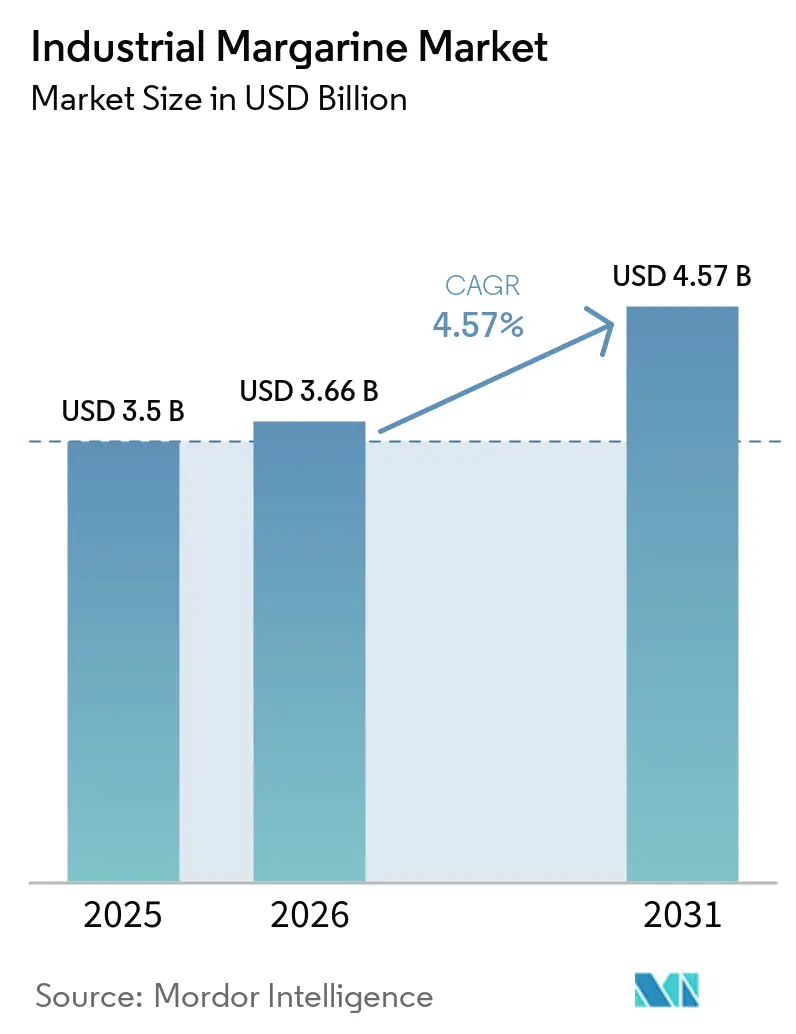
The global industrial margarine market size is expected to increase from USD 3.50 billion in 2025 to USD 3.66 billion in 2026 and reach USD 4.57 billion by 2031, growing at a CAGR of 4.57% over 2026-2031. Industrial bakeries continue to value margarine because vegetable-oil inputs can reduce exposure to dairy-fat price movements. The industrial margarine market also benefits when manufacturers need consistent texture, shelf life, and processing performance in high-volume production. Plant-based formulations are becoming more relevant to foodservice buyers that consider nutritional positioning alongside functionality. Supply-chain traceability and trans-fat compliance are becoming important factors in supplier selection, particularly for products sold into regulated markets. Acquisitions and specialty-fat investments show that scale, formulation capability, and regional production access are shaping competition in the industrial margarine market.
Key Report Takeaways
- By product type, all-purpose held a 43.56% share in 2025, while spreadable grades are forecast to grow at a 4.82% CAGR through 2031.
- By form, hard accounted for 53.05% of the industrial margarine market size in 2025, while soft is forecast to grow at a 4.91% CAGR through 2031.
- By source, Plant-based held 66.73% of the industrial margarine market share in 2025 and is forecast to grow at a 5.14% CAGR through 2031.
- By application, bakery accounted for 41.38% of the category in 2025, while convenience foods are forecast to grow at a 4.76% CAGR through 2031.
- By geography, Asia-Pacific held a 34.28% share in 2025, while North America is forecast to grow at a 4.86% CAGR through 2031.
Note: Market size and forecast figures in this report are generated using Mordor Intelligence’s proprietary estimation framework, updated with the latest available data and insights as of January 2026.
Market Trends and Insights
Drivers Impact Analysis of Industrial Margarine Market*
| Drivers | (~) % Impact on CAGR Forecasts | Geographic Relevance | Impact Timeline |
|---|---|---|---|
| Cost-Effective Butter Substitute for Industrial Baking | +1.2% | Global, with the strongest relevance in Europe and Asia-Pacific | Short term (≤ 2 years) |
| Convenience Bakery and Confectionery Demand in Emerging Economies | +1.0% | Asia-Pacific, especially China, India, Vietnam, and Indonesia, with spillover to the Middle East and Africa | Medium term (2-4 years) |
| Plant-Based, Non-Dairy Fat Demand in Foodservice | +0.9% | North America and Europe, with growing relevance in Asia-Pacific | Medium term (2-4 years) |
| Oleogelation for Trans-Fat-Free Hardstocks | +0.5% | Global, with early adoption in European and North American research pipelines | Long term (≥ 4 years) |
| Butter Price Volatility and Margin Protection | +0.6% | Europe, North America, and import-dependent Asia-Pacific markets | Short term (≤ 2 years) |
| Low-Trans-Fat Product Regulation | +0.4% | Global, with application across WHO-signatory countries | Medium term (2-4 years) |
| Source: Mordor Intelligence | |||
Cost-Effective Butter Substitute for Industrial Baking
Industrial bakers use margarine to manage the procurement risk that comes with changing dairy-fat costs. Vegetable oils such as palm, canola, and soybean oil follow different supply and pricing cycles from butter. This separation can give fixed-price bakery contracts a more stable ingredient cost base. The industrial margarine market therefore benefits when manufacturers seek a predictable fat input for longer customer commitments. A production line adjusted for margarine may require changes to crystallization temperatures, dough hydration, and mixing parameters. Those operating changes can make a return to butter less attractive after the bakery has validated margarine performance.
Convenience Bakery and Confectionery Demand in Emerging Economies
Convenience bakery and confectionery production supports bulk demand for consistent-specification fats. Quick-service restaurant expansion and packaged biscuit and cake manufacturing create larger centralized procurement requirements. These buyers need ingredients that perform consistently across repeatable production runs. The industrial margarine market can serve this need through specialized bakery, frying, filling, and spread formats. In Latin America and the Caribbean, small and medium enterprises (SMEs) make up a staggering 99.5% of the region's businesses. These SMEs are increasingly adopting margarine-based formulations, allowing them to compete with multinational giants without straining their ingredient budgets, according to OECD/CAF/SELA [1]. This shift is democratizing bakery production, with entrepreneurs in emerging markets setting up local manufacturing to cater to urban populations craving convenient food options. As a result, the adoption of margarine is accelerating.
Plant-Based, Non-Dairy Fat Demand in Foodservice
A 2025 JAMA Internal Medicine study associated replacing 10 grams of butter daily with plant-based oils with a 17% reduction in all-cause mortality and cancer mortality among 221,054 participants followed for more than 30 years. The study gives institutional catering and large foodservice operators evidence they can consider in reformulation decisions. The industrial margarine market can benefit where buyers need plant-based fats with documented nutritional characteristics. Industrial margarine market suppliers with lower-saturated-fat formulations may be better placed for foodservice requests that include nutrition declarations. This makes product selection less dependent on cost alone in North American and European accounts. It also increases the value of formulation evidence and clear ingredient documentation.
Oleogelation for Trans-Fat-Free Hardstocks
Research on trans-fat removal is widening the range of hardstock options available to the industrial margarine market. A review published in 2024 described high-voltage plasma hydrogenation, supercritical carbon dioxide interesterification, and oleogel structuring as routes to trans-fat-free margarine production. With the World Health Organization's REPLACE initiative leading the charge, 53 countries have adopted best practice policies, enhancing food safety for 3.7 billion people [2]. However, the WHO now aims for a virtual elimination of trans-fats by 2025, pushing the target due to unmet 2023 goals. Meanwhile, the FDA's December 2023 rule strips partially hydrogenated oils (PHOs) of their Generally Recognized as Safe (GRAS) status, curbing their use in margarine and other foods [3]. This move is projected to yield a USD 652 million benefit over two decades, primarily from a decline in coronary heart disease cases. Additionally, Technical Regulation GSO 2483:2024 on Trans Fats, which comes with a grace period until May 2025, imposes a 2% limit on trans fatty acids in processed foods and restricts palm oil usage in specific applications.
Restraints Impact Analysis of Industrial Margarine Market*
| Restraints | (~) % Impact on CAGR Forecasts | Geographic Relevance | Impact Timeline |
|---|---|---|---|
| Clean-Label Backlash Against Hydrogenated and Interesterified Fats | -0.8% | North America and Europe, spreading to Asia-Pacific | Medium term (2-4 years) |
| Trans-Fat Rules Raising Reformulation Costs | -0.6% | Europe and North America, with global spillover | Short term (≤ 2 years) |
| Supply-Chain Exposure to Palm-Oil Deforestation Litigation Risks | -0.4% | Global, acute in Europe markets | Long term (≥ 4 years) |
| Capacity Under-Utilisation at Retrofitted Margarine Lines Amid Shifting Consumer Trends | -0.3% | Developed markets, legacy facilities | Medium term (2-4 years) |
| Source: Mordor Intelligence | |||
Clean-Label Backlash Against Hydrogenated and Interesterified Fats
As consumers increasingly demand clean-label products, traditional margarine formulations face mounting challenges. Food manufacturers are now prioritizing natural ingredients and transparent labeling, aligning with a growing health consciousness. Starting in February 2025, the FDA's revamped definition of "healthy" introduces stricter benchmarks for added sugars, saturated fats, and sodium. However, it also permits higher levels of healthy fats. This dual approach could reshape both marketing strategies and formulation methods in the margarine sector. Concurrently, there's a rising consumer skepticism towards processed ingredients. This sentiment amplifies the pressure on margarine producers to pivot towards formulations that emphasize recognizable and minimally processed components. Yet, the path isn't straightforward. Clean-label alternatives frequently demand premium ingredients, driving up production costs. These premium ingredients can also jeopardize the functional properties crucial for industrial applications.
Trans-Fat Rules Raising Reformulation Costs
European Commission Regulation 2019/649 limits industrially produced trans fats to 2 grams per 100 grams of fat in foods sold in European Union member states. The rule required reformulation across the European margarine supply chain. A 2025 study of low-saturated, zero-trans-fat soft margarine showed that blends of enzymatically modified soybean oil and mango kernel fat can match commercial soft-margarine melting profiles. Such alternatives can involve research, validation, and production costs for manufacturers. WHO recognition of Austria, Norway, Oman, and Singapore in 2025 for validated trans-fat elimination policies also indicates that stricter compliance expectations are spreading across trade flows. Suppliers that cannot update their formulations may face a weaker position in regulated tenders.
*Our forecasts treat driver/restraint impacts as directional, not additive. The impact forecasts reflect baseline growth, mix effects, and variable interactions.
Industrial Margarine Market Segment Analysis
By Product Type:
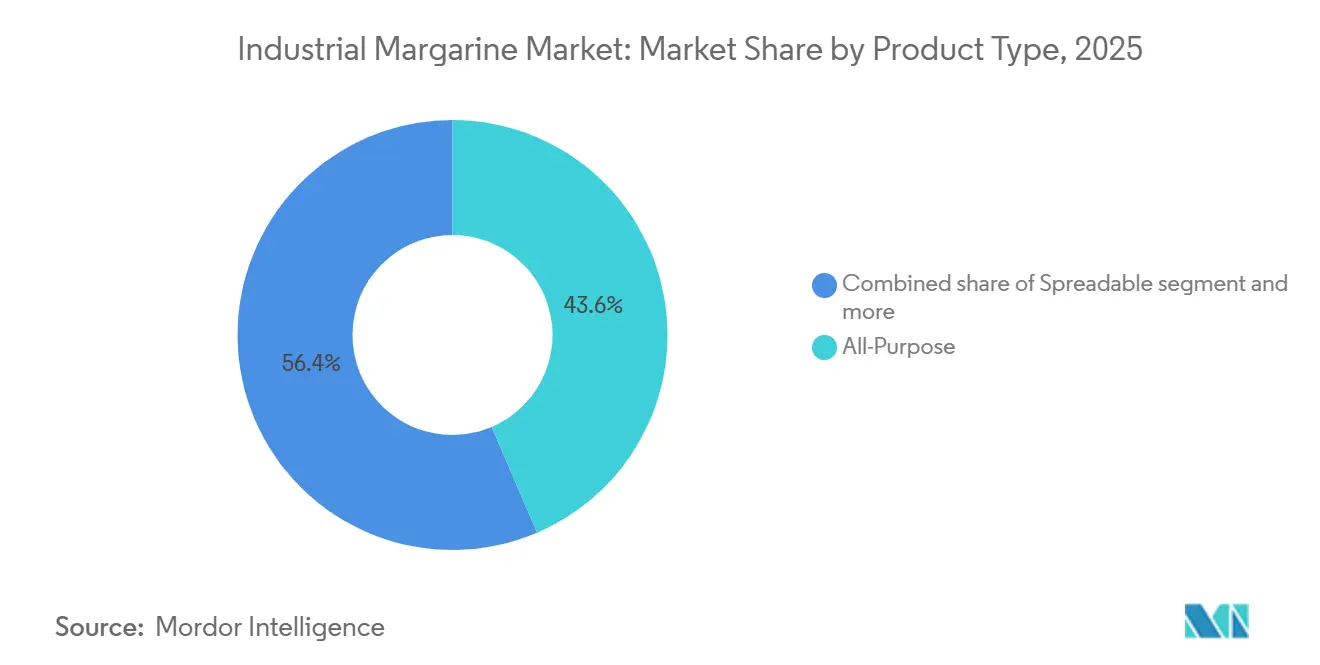
All-Purpose Sustain Broad Industrial UseAll-purpose held a 43.56% share of the industrial margarine market in 2025. Their position reflects use across laminated doughs, cream fillings, and frying operations on high-throughput bakery lines. These formats give manufacturers a single fat option for several production needs. Their broad functionality can simplify procurement and inventory planning. Spreadable grades are forecast to grow at a 4.82% CAGR through 2031. Foodservice chains and institutional caterers are using more ambient-stable spreads to reduce refrigeration needs and simplify handling.
Butter blends remain relevant for customers that want a dairy-related taste or an authenticity claim while controlling their butter exposure. This can be useful in premium packaged bakery and selected confectionery products. Wilmar Specialty Fats introduced Wilcake in September 2025 as a cholesterol-free, butter-flavored, ambient-stable margarine blend for bakeries, restaurants, and food manufacturers. The launch shows how suppliers are bringing multi-function products to food production customers. Spreadable growth does not necessarily replace all-purpose volume. It can create demand in sandwich assembly, sauce preparation, and ambient pastry operations where hard blocks are less suitable.

By Form:
Hard Margarine Retains Essential Bakery FunctionsHard margarine accounted for 53.05% of the industrial margarine market size in 2025. It remains important for croissants, Danish pastry, and puff pastry because these applications need beta-prime crystal stability and controlled solid-fat content. Soft formulations are forecast to expand at a 4.91% CAGR through 2031. Their growth is linked to convenience-food manufacturing and direct-spread use in institutional foodservice. Soft products can integrate into high-speed mixing systems without the tempering step used for hard blocks. This can reduce batch time and energy use in suitable processes.
A 2025 study (PubMed Central) found that enzymatically interesterified soybean oil and mango kernel fat blends could provide a soft-margarine melting profile with 35% saturated fat, compared with 48.47% in the cited conventional control. The same study reported no detectable trans fats in the alternative formulation. This evidence supports continued development of lower-saturated-fat soft formats. Hard products still have a defined role where laminated dough performance is central to the finished product. In European operations, non-hydrogenated and interesterified hard blends remain an accessible route to meeting the EU trans-fat requirement. The two form categories therefore address different processing requirements rather than serving as direct substitutes in every application.
By Source:
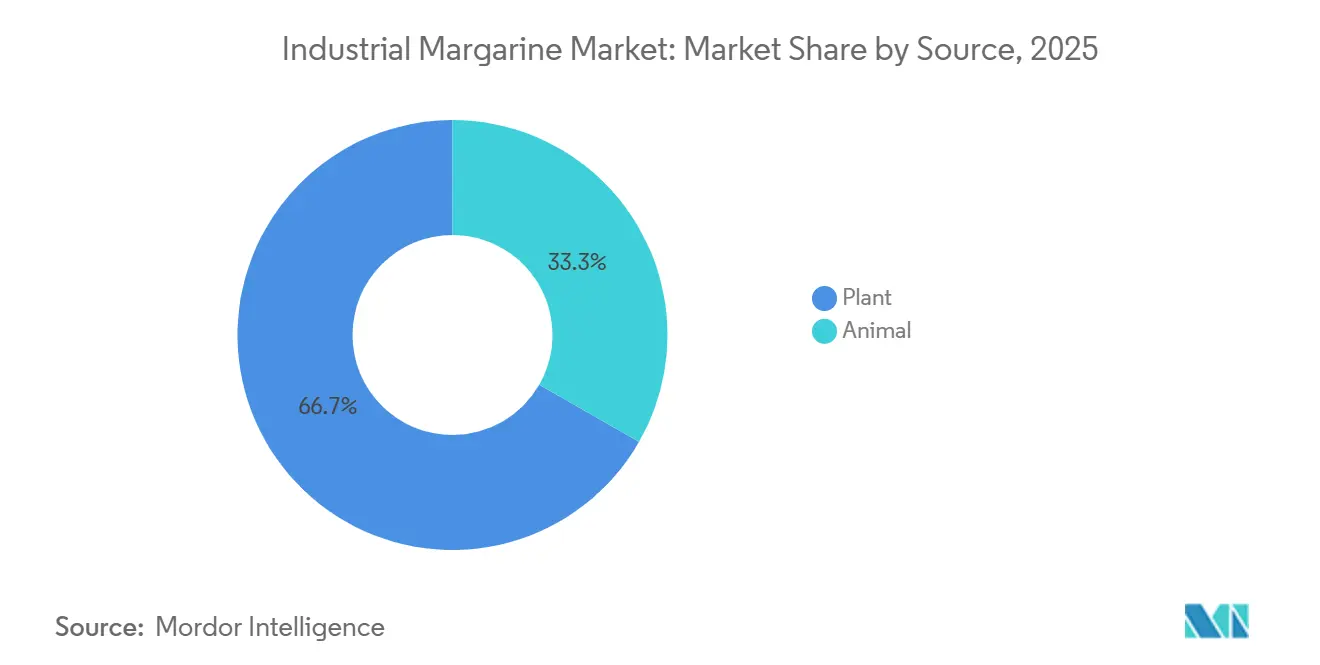
Plant-Based Lead Volume and GrowthPlant-based held 66.73% of the industrial margarine market share in 2025 and are forecast to grow at a 5.14% CAGR through 2031. This combination shows that plant-based sources lead both current use and expected expansion. Plant oils support formulations that align with non-dairy product development and nutritional procurement criteria. The 2025 JAMA study provides evidence that foodservice buyers may use when considering plant oil choices. Animal-source margarines continue to serve selected traditional confectionery and premium pastry applications. These applications remain relevant where established formulation practices and dairy-related authenticity expectations limit substitution.
Feedstock traceability is becoming a central issue inside the plant-based category. Palm-dependent suppliers face requirements to document the origin of palm-sourced ingredients for European premium customers. Johor Plantations Group and Fuji Oil Asia established JPG Fuji Sdn Bhd in February 2025 to develop an integrated sustainable palm oil complex in Malaysia. The project combines a specialty oils and fats refinery, a palm oil mill, a palm kernel plant, an animal feed mill, and a research center. Its structure illustrates how suppliers are linking specialty-fat production to traceable feedstock systems. This approach can support access to customers that require stronger sustainability documentation.
By Application:
Bakery Holds the Base While Convenience Foods ExpandBakery accounted for 41.38% of the industrial margarine market size in 2025. Margarine supports texture, shelf life, and automated processing in bread, pastry, cake, and biscuit production. Convenience foods are forecast to grow at a 4.76% CAGR through 2031. Ready meals, frozen snacks, and processed savory foods use fats in a widening set of production formats. The industrial margarine market can meet these needs through products developed for specific melting, aeration, and flavor requirements. The industrial margarine market has a larger bakery base that gives suppliers stable volume while convenience foods broaden the application range.
Confectionery remains a demanding use case because fats can affect ganache stability, cream-center structure, and coating behavior. Suppliers refine melting profiles, aeration, and cocoa-butter compatibility to meet these needs. Sauces also use margarine where a fat phase supports texture and flavor delivery. Spreads and toppings benefit from foodservice expansion and premium ambient-spread formats. Customized margarines can combine emulsifiers, flavors, and fortifying ingredients in one functional matrix. This can remove separate ingredient-addition steps for the customer and strengthen the value of application-development support.
Geography Analysis
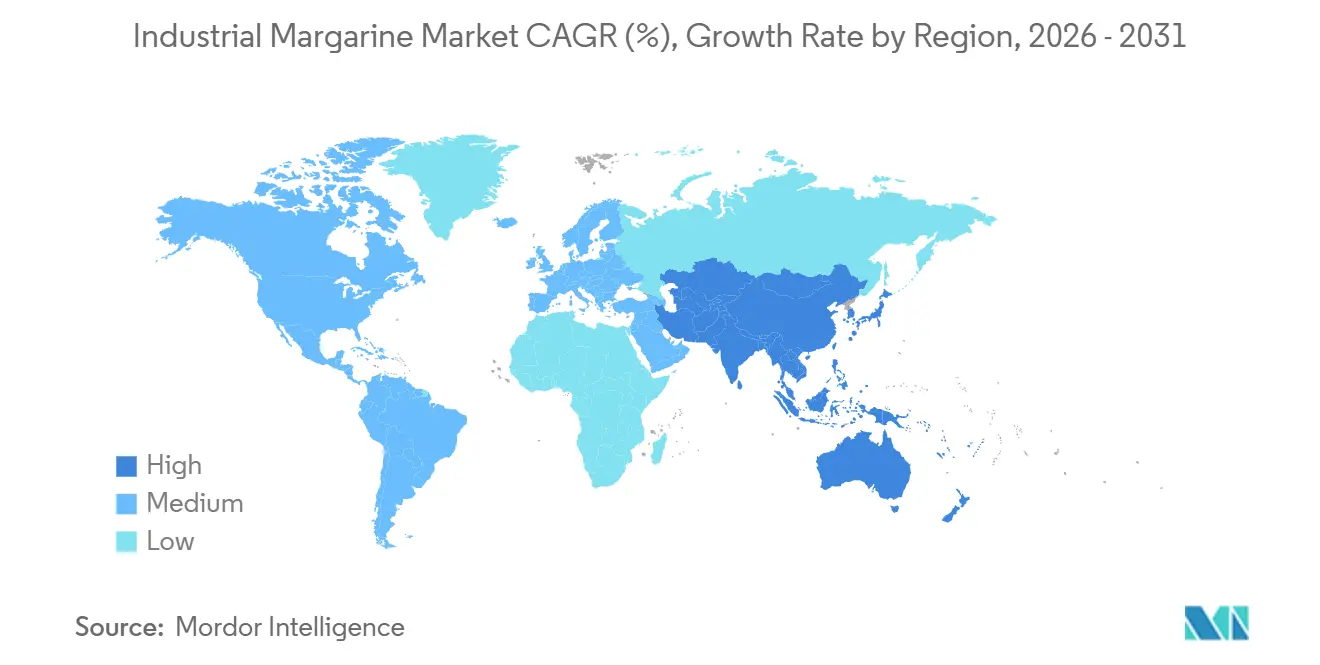
Asia-Pacific held 34.28% of the industrial margarine market in 2025. China, India, Vietnam, and Indonesia support this position through expanding bakery capacity and quick-service restaurant activity. The region has a strong need for industrial fats that perform consistently in bakery and packaged-food production. Producers with integrated palm supply chains have feedstock advantages in serving regional demand. Wilmar and Fuji Oil are examples of suppliers with relevant vegetable-oil and specialty-fat capabilities. The available company examples also show that integrated producers can extend all-purpose margarine offerings into export markets and adjacent regional food systems.
North America is forecast to record the highest regional CAGR at 4.86% through 2031. Growth in industrial and foodservice channels differs from the narrative around retail margarine use. Plant-based reformulation, non-hydrogenated alternatives, and new oil-structuring methods support the region's outlook. The U.S. regulatory environment no longer permits partially hydrogenated oils as a general food ingredient. This has increased the need for formulations that can deliver performance without industrial trans fats. Foodservice and food manufacturers can use these products in products that need consistent processing behavior.
Europe is the second-largest regional area in the industrial margarine market. Germany, France, the United Kingdom, Italy, and the Netherlands have large industrial bakery requirements across bread rolls, croissants, and frozen pastry. European Union trans-fat rules make reformulation capability important for suppliers in the region. Poland and Central Europe also remain relevant production locations for specialty fats and margarine. Vandemoortele announced an agreement in March 2025 to acquire Bunge's European margarines and spreads activities, including plants in Germany, Poland, and Finland. South America and the Middle East and Africa provide smaller but strategically relevant opportunities, particularly where foodservice growth and trans-fat policy adoption shape formulation demand.
Competitive Landscape
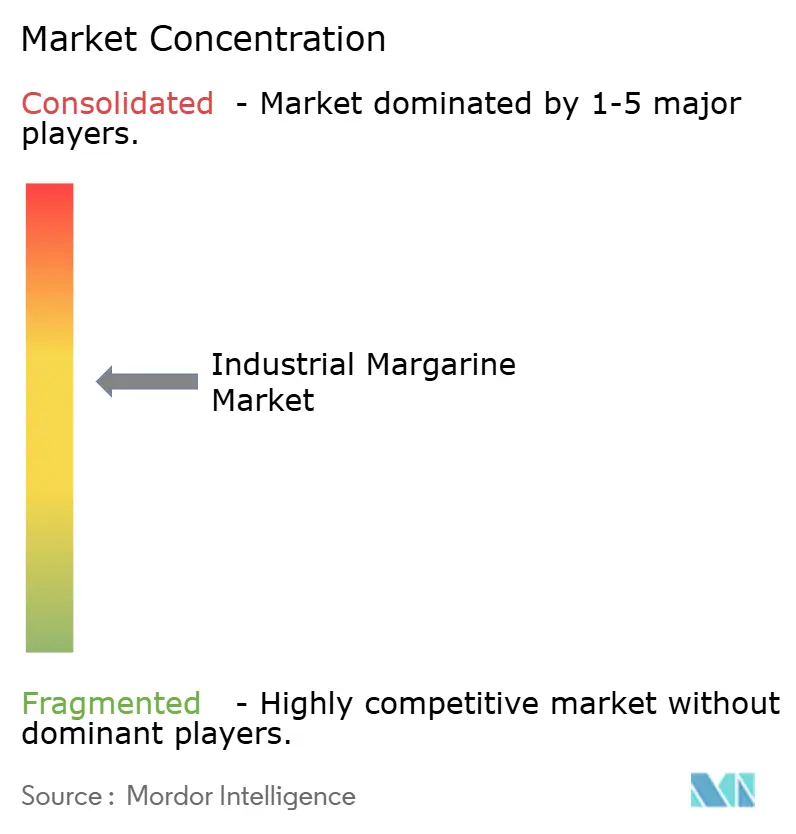
The industrial margarine market includes well-integrated global suppliers alongside regional specialty-fat producers. Wilmar International, Bunge Limited, and Vandemoortele operate with broad oil, fat, and food-ingredient capabilities. NMGK Group, EFCO Group, Puratos, and Kerry Group plc provide additional technical and regional capability. Competition centers on access to vegetable oils, palm refining, and formulation expertise. Suppliers also compete through control of melting points, fat-crystal structure, and compliance credentials. These capabilities matter because industrial customers need reproducible performance at scale.
Mergers and acquisitions are strengthening regional production platforms. Vandemoortele's March 2025 agreement for Bunge's European margarines and spreads business covered manufacturing assets in Germany, Poland, and Finland, with reported revenue exceeding EUR 450 million and more than 800 employees. In February 2026, Dragsbæk, a subsidiary of Orkla Food Ingredients, agreed to acquire Vortella GmbH to establish a German platform for butter and specialty fats. The Vortella transaction can improve customer proximity and broaden the product range available in Europe. It also shows the value placed on local production capacity for specialty fats and butter-related products.
Product development creates room for companies that can respond quickly to specialized customer requirements. Omega-3-enriched, phytosterol-fortified, and oleogel-based grades are potential areas for differentiation. Such formats can help technical suppliers compete without matching the commodity scale of the largest businesses. The industrial margarine industry also faces rising expectations around traceable palm sourcing and food-safety practices. The JPG Fuji joint venture demonstrates a supply-chain model that combines specialty-fat production with upstream palm-oil assets. Suppliers that can document compliance and provide application support can create stronger customer relationships. Moderate concentration leaves scope for regional specialists that possess clear formulation expertise or a strong local supply base.
Industrial Margarine Industry Leaders
-
Bunge Limited
-
Vandemoortele
-
Puratos Group
-
Associated British Foods
-
Wilmar International
- *Disclaimer: Major Players sorted in no particular order
Industrial Margarine Market Companies Covered in this Report
- Kerry Group plc.
- Bunge Limited
- Vandemoortele
- Puratos Group
- Conagra Brands
- Associated British Foods (AB Maurit.)
- Fuji Oil Co.
- Richardson International
- Aigremont
- NMGK Group
- EFCO Group
- Wilmar International
- Cargill, Incorporated
- Unigra S.p.a.
- Zer Group
- Royal Lacroix
- Goodman Fielder
- Pamyag Gıda San. Tic. A.S.
- Grupo Empresarial Proingra
- Upstarters Foods
Recent Industry Developments in Industrial Margarine Market
- February 2026: Dragsbæk, a subsidiary of Orkla Food Ingredients, entered into an agreement to acquire Vortella GmbH, a German specialty-fats and margarine producer with EUR 50 million in annual revenue and more than 120 years of operating history. The deal gives Dragsbæk its first German production facility and was expected to close by the end of Q1 2026.
- November 2025: Puratos Group opened a cutting-edge margarine production facility in Kragujevac, Serbia. This USD 8.22 million investment significantly enhanced its product offerings for the bakery and patisserie industries across Serbia and the Western Balkans.
- March 2025: Vandemoortele announced an agreement to acquire Bunge's European margarines and spreads business. The transaction covered plants in Germany, Poland, and Finland, with revenue exceeding EUR 450 million and more than 800 employees.
- September 2025: Wilmar Specialty Fats launched Wilcake, a cholesterol-free, butter-flavored, ambient-stable margarine blend for bakeries, restaurants, and industrial food manufacturers across Asia.
Global Industrial Margarine Market Report Scope
The Industrial Margarine Market Report is Segmented by Type (Spreadable, All-Purpose, Butter Blend), Form (Hard, Soft), Source (Plant, Animal), Application (Bakery, Confectionery, Convenience Foods, Sauces, Spreads and Toppings), and Geography (North America, Europe, Asia-Pacific, South America, Middle East and Africa). The Market Forecasts are Provided in Terms of Value (USD).
Segmentation Overview
| Spreadable |
| All-Purpose |
| Butter Blend |
| Hard |
| Soft |
| Plant-based |
| Animal |
| Bakery |
| Confectionery |
| Convenience Foods |
| Sauces |
| Spreads and Toppings |
| North America | United States |
| Canada | |
| Mexico | |
| Rest of North America | |
| Europe | Germany |
| United Kingdom | |
| Italy | |
| France | |
| Spain | |
| Netherlands | |
| Rest of Europe | |
| Asia-Pacific | China |
| India | |
| Japan | |
| Australia | |
| Rest of Asia-Pacific | |
| South America | Brazil |
| Argentina | |
| Rest of South America | |
| Middle East and Africa | South Africa |
| Saudi Arabia | |
| Rest of Middle East and Africa |
| By Type | Spreadable | |
| All-Purpose | ||
| Butter Blend | ||
| By Form | Hard | |
| Soft | ||
| By Source | Plant-based | |
| Animal | ||
| By Application | Bakery | |
| Confectionery | ||
| Convenience Foods | ||
| Sauces | ||
| Spreads and Toppings | ||
| By Geography | North America | United States |
| Canada | ||
| Mexico | ||
| Rest of North America | ||
| Europe | Germany | |
| United Kingdom | ||
| Italy | ||
| France | ||
| Spain | ||
| Netherlands | ||
| Rest of Europe | ||
| Asia-Pacific | China | |
| India | ||
| Japan | ||
| Australia | ||
| Rest of Asia-Pacific | ||
| South America | Brazil | |
| Argentina | ||
| Rest of South America | ||
| Middle East and Africa | South Africa | |
| Saudi Arabia | ||
| Rest of Middle East and Africa | ||
Key Questions Answered in the Report
What is the projected size of the global industrial margarine market by 2031?
The global industrial margarine market is forecast to reach USD 4.57 billion by 2031. It is expected to grow at a 4.57% CAGR from 2026 to 2031.
Which product type leads global industrial margarine demand?
All-purpose led product demand with 43.56% share in 2025.
Why is hard margarine important for commercial bakeries?
Hard margarine held 53.05% share in 2025. It provides the crystal stability and solid-fat control needed for laminated pastry production.
Which source category is growing fastest in industrial margarine?
Plant-based held 66.73% share in 2025 and are forecast to grow at a 5.14% CAGR through 2031.