
Margarine Market Size and Share
Market Overview
| Study Period | 2021 - 2031 |
|---|---|
| Market Size (2026) | USD 24.08 Billion |
| Market Size (2031) | USD 26.7 Billion |
| Growth Rate (2026 - 2031) | 2.10 % |
| Fastest Growing Market | Asia Pacific |
| Largest Market | Europe |
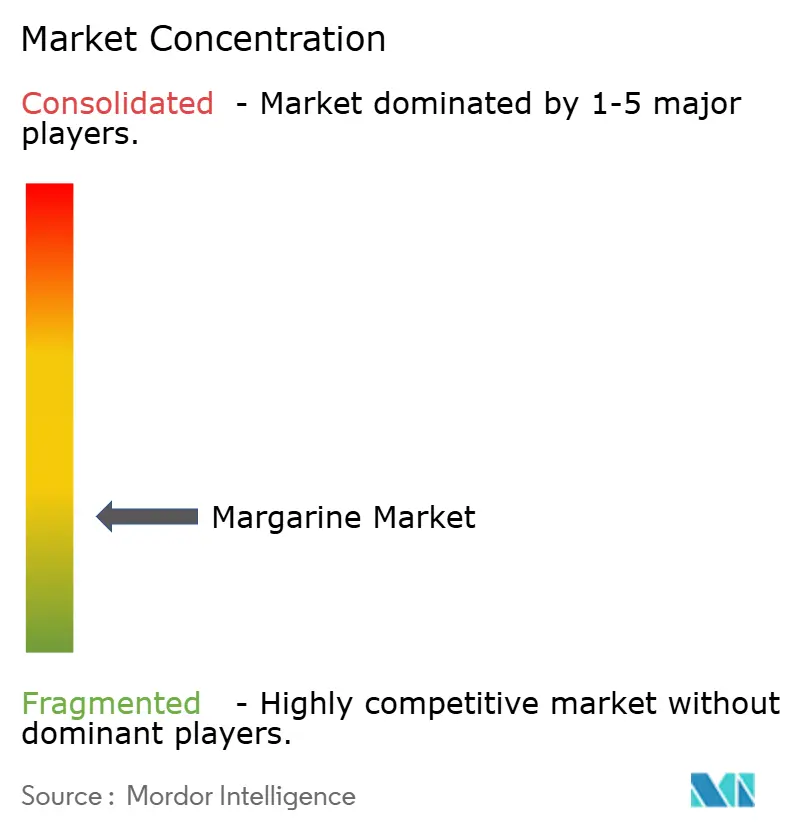
| Market Concentration | Low |
Major Players
*Disclaimer: Major Players sorted in no particular order Image © Mordor Intelligence. Reuse requires attribution under CC BY 4.0. |
|
Margarine Market Analysis by Mordor Intelligence
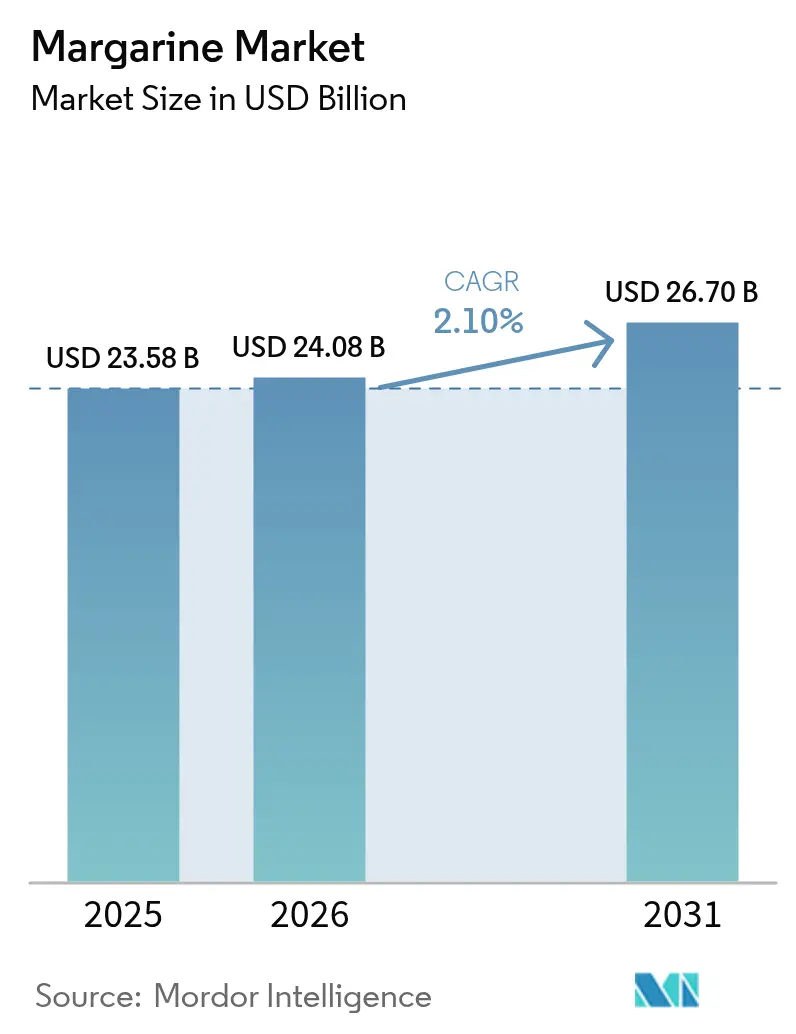
Margarine market size in 2026 is estimated at USD 24.08 billion, growing from 2025 value of USD 23.58 billion with 2031 projections showing USD 26.7 billion, growing at 2.10% CAGR over 2026-2031. The market growth reflects the industry's adaptation to trans-fat elimination regulations while benefiting from plant-based innovations, fortified products, and increased industrial demand. Regulations from the Food and Drug Administration (FDA) and World Health Organization (WHO) have driven the adoption of zero-trans processing technologies, requiring higher capital investments but enhancing consumer confidence. The shift to zero-trans processing has necessitated significant equipment upgrades and process modifications across manufacturing facilities. Enzymatic interesterification has become a standard production method due to its energy efficiency and ability to maintain product consistency. Additionally, the European Union's Deforestation-Free Regulation has prompted manufacturers to develop palm-oil-free formulations, affecting supply chain dynamics and production costs[1]. This transition has led companies to explore alternative oil sources, including sunflower, rapeseed, and soybean oils, while investing in research and development to maintain product quality and functionality.
Key Report Takeaways
- By type, soft margarine led with 54.68% of the margarine market share in 2025; liquid margarine is projected to expand at a 5.60% CAGR through 2031.
- By fat content, regular (> 80% fat) accounted for 59.72% of the margarine market size in 2025, while light (< 40% fat) is forecast to grow at 6.00% CAGR.
- By oil source, palm-oil formulations held 44.88% revenue share in 2025; soybean-oil variants are expected to record a market-leading 6.80% CAGR to 2031.
- By end user, the household segment commanded 47.95% of the global margarine market in 2025; the HoReCa channel shows the fastest growth at 6.20% CAGR.
- By packaging, tubs and cups represented 40.05% sales in 2025; sachets and pouches represent the fastest-growing format with a 6.60% CAGR.
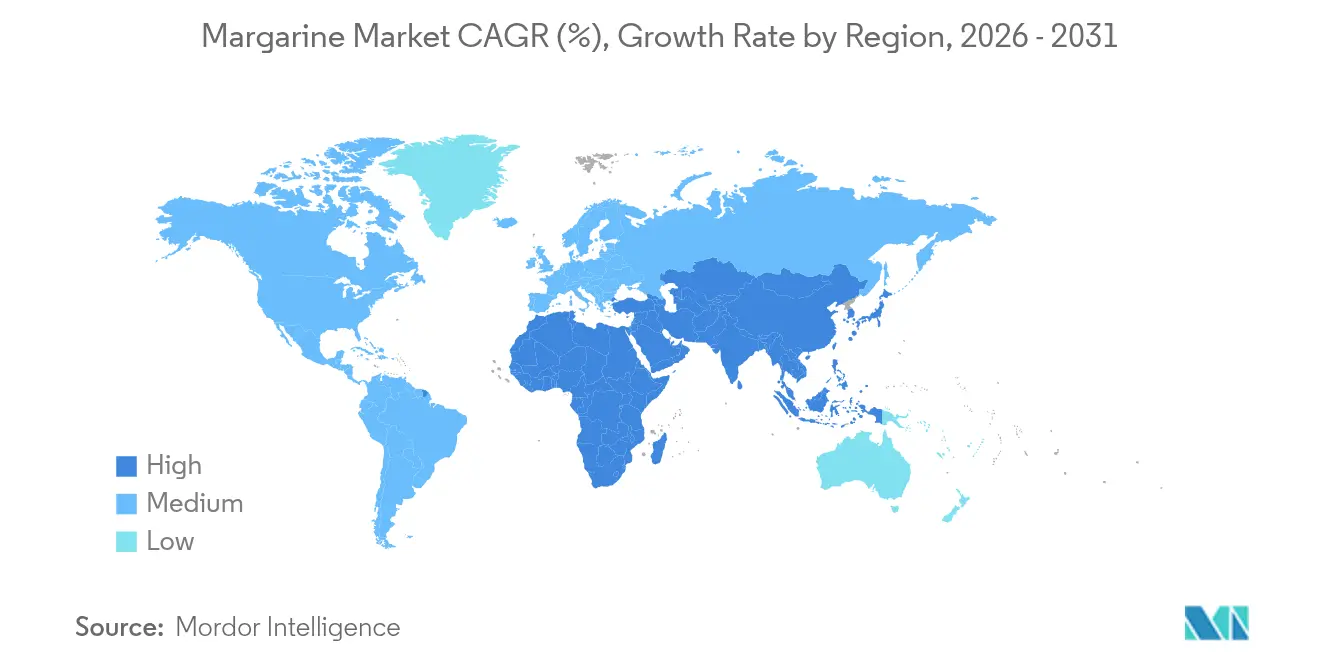
- By region, Europe retained 29.85% of the margarine market in 2025; Asia-Pacific is the fastest-growing geography with a 6.30% CAGR to 2031.
Note: Market size and forecast figures in this report are generated using Mordor Intelligence’s proprietary estimation framework, updated with the latest available data and insights as of 2026.
Market Trends and Insights
Drivers Impact Analysis of Margarine Market*
| DRIVER | (~) % IMPACT ON CAGR FORECAST | GEOGRAPHIC RELEVANCE | IMPACT TIMELINE |
|---|---|---|---|
| Premiumization of margarine through low-fat and fortified variants | +0.4% | Global, with early gains in Asia-Pacific and Latin America | Medium term (2-4 years) |
| Surge in industrial demand from frozen bakery manufacturers | +0.6% | North America and Europe, spill-over to Asia-Pacific | Short term (≤ 2 years) |
| Palm-oil-free formulations gaining traction due to sustainability regulations | +0.3% | Europe core, expanding to North America and Australia | Long term (≥ 4 years) |
| Growth of plant-based spreads | +0.5% | Global, with concentration in developed markets | Medium term (2-4 years) |
| Rising sunflower-oil supply from ukraine boosting cost competitiveness | +0.2% | Global, with primary impact in Europe and Middle East | Short term (≤ 2 years) |
| Expansion of private-label margarine in discount retail formats | +0.3% | Global, with acceleration in emerging markets | Medium term (2-4 years) |
| Source: Mordor Intelligence | |||
Premiumization of margarine through low-fat and fortified variants
The increasing focus on health and wellness among consumers worldwide has fundamentally transformed spreads from basic commodity alternatives into functional food products with targeted nutritional benefits. Fortified spreads now provide essential micronutrient benefits through carefully selected vitamins and minerals, enabling manufacturers to implement strategic premium pricing approaches that effectively manage raw material cost fluctuations in the global market. Advanced liquid formulations with significantly reduced saturated fat content successfully maintain optimal texture, consistency, and baking performance in cakes, pastries, and other baked goods. Comprehensive Vitamin A fortification programs implemented across various Asian markets have demonstrated substantial measurable improvements in retinol levels among children, directly addressing critical nutritional deficiencies in these populations. In developed markets, spreads containing specific plant sterols have consistently demonstrated robust clinical efficacy in reducing LDL cholesterol levels by significant percentages, firmly establishing their position as scientifically validated health-beneficial food products in the daily diet.
Surge in industrial demand from frozen bakery manufacturers
The industrial margarine market is experiencing growth driven by increased production from frozen bakery manufacturers responding to rising convenience food consumption. The segment benefits from specialized margarine formulations designed for automated processing and longer shelf life. CSM Ingredients' Crema facility demonstrates this expansion through new production lines that boost capacity to over 70,000 tons annually, focusing on frozen bakery applications where margarine offers improved sustainability metrics compared to animal-based alternatives. Moreover, Bunge's margarine portfolio for bakery applications showcases the technical requirements of the industry, providing specialized hardstocks that ensure consistent performance across various baking applications, from cookies to bread products. Industrial margarine's functionality in laminated products and stability during freeze-thaw cycles makes it particularly valuable for frozen bakery distribution. Manufacturers utilize advanced emulsifier technologies to produce stable food emulsions across hard, soft, and liquid margarine variants, each optimized for specific industrial requirements. The increased industrial demand aligns with the broader market shift toward processed convenience foods, where margarine's technical properties support efficient large-scale food manufacturing operations.
Palm-oil-free formulations gaining traction due to sustainability regulations
The European Union's Deforestation-Free Regulation requires complete plantation-level traceability by December 2024. This regulation is accelerating palm oil substitution efforts among suppliers, even as palm oil continues to account for 45% of 2024 inputs in the European market. The regulation mandates detailed documentation of supply chain origins, environmental impact assessments, and verification of deforestation-free practices. Companies must implement comprehensive monitoring systems and maintain records of their palm oil sources, including satellite imagery and geolocation data for plantations. While shea butter and high-oleic seeds emerge as primary alternatives, life-cycle analyses indicate that complete palm oil substitution may increase global land-use pressures. Manufacturers must balance technical feasibility, consumer preferences, and sustainability goals while navigating the evolving regulatory requirements. This includes implementing robust traceability systems, conducting regular supplier audits, developing alternative sourcing strategies, and investing in supply chain transparency technologies that align with both regulatory compliance and environmental sustainability objectives. The transition also requires significant investment in research and development to optimize alternative oil processing methods and ensure product quality consistency.
Growth of plant-based spreads
The plant-based spreads market has evolved beyond traditional margarine, as manufacturers develop sophisticated alternatives that match dairy butter's functionality while offering enhanced sustainability benefits. This evolution reflects changing consumer preferences and technological advancements in food production. Flora Food Group's transformation into Upfield exemplifies this significant market shift, with the company generating EUR 3.3 billion in net sales in 2025. The company made strategic investments in Kansas manufacturing facilities to reduce dependence on European imports and enhance its plant-based cream and cream cheese production capabilities, demonstrating its commitment to market expansion and operational efficiency. Technological advancements have enabled plant-based alternatives to achieve superior dairy-like taste and performance characteristics. Companies like Willicroft are pioneering innovative approaches, using advanced fermentation processes to create products that accurately replicate traditional butter characteristics while maintaining strict plant-based credentials. These developments represent a significant step forward in meeting consumer demands for sustainable, high-quality alternatives to dairy products.
Restraints Impact Analysis of Margarine Market*
| RESTRAINT | (~) % IMPACT ON CAGR FORECAST | GEOGRAPHIC RELEVANCE | IMPACT TIMELINE |
|---|---|---|---|
| Trans-fat ban compliance raising reformulation costs in emerging markets | -0.3% | Emerging markets, with concentration in Asia-Pacific and Latin America | Medium term (2-4 years) |
| Volatility in vegetable-oil prices linked to climate-induced yield shifts | -0.4% | Global, with primary impact in import-dependent regions | Short term (≤ 2 years) |
| Negative health perception versus butter | -0.2% | Developed markets, particularly North America and Europe | Long term (≥ 4 years) |
| Import tariff escalations on palm oil | -0.3% | Import-dependent regions, particularly Asia and Middle East | Medium term (2-4 years) |
| Source: Mordor Intelligence | |||
Trans-fat ban compliance raising reformulation costs in emerging markets
The elimination of trans-fats presents significant challenges for manufacturers in emerging markets, who must balance technological investments and product reformulation with maintaining affordable prices. These manufacturers face substantial financial pressures in upgrading their production facilities, developing new formulations, and sourcing alternative ingredients while ensuring their products remain accessible to price-sensitive consumers. Malaysia's implementation of strict trans-fat regulations from September 2025, which will prohibit food containing more than 2g/100g of fat in trans fatty acids, demonstrates the increasing regulatory requirements in emerging markets to align with WHO recommendations[2]. Thailand's trans-fat reduction program succeeded through extensive public-private collaboration, highlighting the need for institutional coordination in markets with limited regulatory capacity. India's reformulation studies indicate that while technical solutions are available, manufacturers face obstacles in maintaining product texture and managing increased palm oil costs. Small and medium-sized producers particularly struggle with the technical expertise required for reformulation and the financial implications of switching to alternative ingredients. The compliance requirements create market entry barriers and may lead to industry consolidation as smaller manufacturers struggle to meet regulations while keeping prices competitive, potentially reshaping the competitive landscape in these emerging markets.
Volatility in vegetable-oil prices linked to climate-induced yield shifts
Climate-related disruptions in agriculture have created significant instability in vegetable oil markets. This instability has compelled margarine manufacturers to implement advanced hedging strategies and adaptable formulation methods to sustain profitability during periods of fluctuating raw material costs. The Ukraine conflict highlights how geopolitical events intensify climate-related challenges, as supply chain disruptions have required manufacturers to procure oils from different regions at higher costs while meeting established product quality standards. Supply chain difficulties intensified by global events have led companies to modify their sourcing and formulation approaches. Cargill's Fatitudes research indicates that over 50% of consumers now examine fats and oils content in packaged products, increasing demand for transparency during price fluctuations. High-oleic sunflower oil contracts include quality premiums necessary for margarine production requirements, though price sensitivity remains significant as manufacturers work to balance cost control with performance requirements. These market conditions have driven strategic changes toward more diverse oil-sourcing portfolios and extended supply agreements, while potentially increasing the adoption of alternative solutions such as Savor's carbon-based fats that operate independently of traditional agricultural systems.
*Our forecasts treat driver/restraint impacts as directional, not additive. The impact forecasts reflect baseline growth, mix effects, and variable interactions.
Margarine Market Segment Analysis
By Type:
Liquid Variants Drive AutomationLiquid margarines gained market share as food manufacturers automated high-volume production lines. While soft spreads maintained 54.68% of 2025 revenue, liquid formats achieved the highest growth rate at 5.60% CAGR. Industrial bakeries prefer pumpable oils that reduce labor requirements and enhance measurement precision. The liquid margarine market is projected to reach USD 5.32 billion by 2031, driven by enzymatic structuring technologies that preserve air incorporation and crumb texture. Soft variants remain dominant in retail refrigerated sections, providing consumers versatility for cooking, baking, and spreading. Hard margarines maintain a specific segment in laminated pastry production where precise melting points are essential.
The shift toward liquid formats supports product premiumization. Reduced saturated fat content aligns with EU front-of-pack labeling requirements, which increasingly influence urban millennial purchasing decisions. Manufacturing facilities that implement continuous micro-crystallization technology report improved production efficiency and reduced energy consumption, enhancing cost effectiveness. This transition demonstrates how the margarine market is evolving its product offerings to meet industrial automation needs while maintaining traditional consumer demand.


By Fat Content:
Light Formulations AccelerateRegular spreads (>80% fat) maintain a dominant 59.72% market share in 2025, primarily due to their superior taste profile, enhanced mouthfeel, and exceptional baking performance in both domestic and commercial applications. Light variants (<40% fat) are experiencing 6.00% annual growth, driven by increasing consumer focus on calorie reduction and health-conscious dietary choices. Manufacturers are improving light spreads through advanced multilamellar emulsions that maintain structural stability during prolonged refrigeration while preserving essential nutrients, particularly vitamins A and D.
Mid-range spreads (40-80% fat) serve as an effective compromise, particularly in emerging market HoReCa segments where chefs require acceptable texture and spreadability at lower costs than butter. Current innovation focuses on sophisticated botanical flavor extracts and advanced salt micro-encapsulation techniques to achieve comparable sensory qualities with reduced fat content. These technological developments enable the margarine market to align with current dietary guidelines while maintaining the indulgent characteristics essential for consumer acceptance across various demographic segments and usage occasions.
By Oil Source:
Soybean Innovation LeadsPalm oil maintains a dominant 44.88% volume share in 2025, while increasing environmental and sustainability concerns drive food manufacturers and consumer brands to actively explore diverse feedstock alternatives. Soybean-based formulations lead market growth with a 6.80% CAGR, supported by technological advancements in processing methods. High-oleic varieties provide superior oxidative stability comparable to hydrogenated palm oil, enabling manufacturers to achieve zero-trans fat labels while meeting growing consumer demand for clean-label requirements. Rapeseed/canola oil appeals to premium market segments due to its beneficial omega-3 fatty acid content and nutritional profile, and sunflower oil remains essential in European markets because of its characteristic neutral flavor profile and versatile applications.
Enzymatic interesterification technology effectively maintains natural antioxidant compounds, significantly extending product shelf life and substantially reducing process-induced contaminants. Recent regulatory approval for stearidonic acid soybean test batches creates extensive opportunities for manufacturers to develop new functional health claims. Companies increasingly implement sophisticated blended-oils approaches to effectively manage raw material price fluctuations and supply chain uncertainties, demonstrating that feedstock flexibility has become a fundamental operational requirement for successful margarine market participants.
By End User:
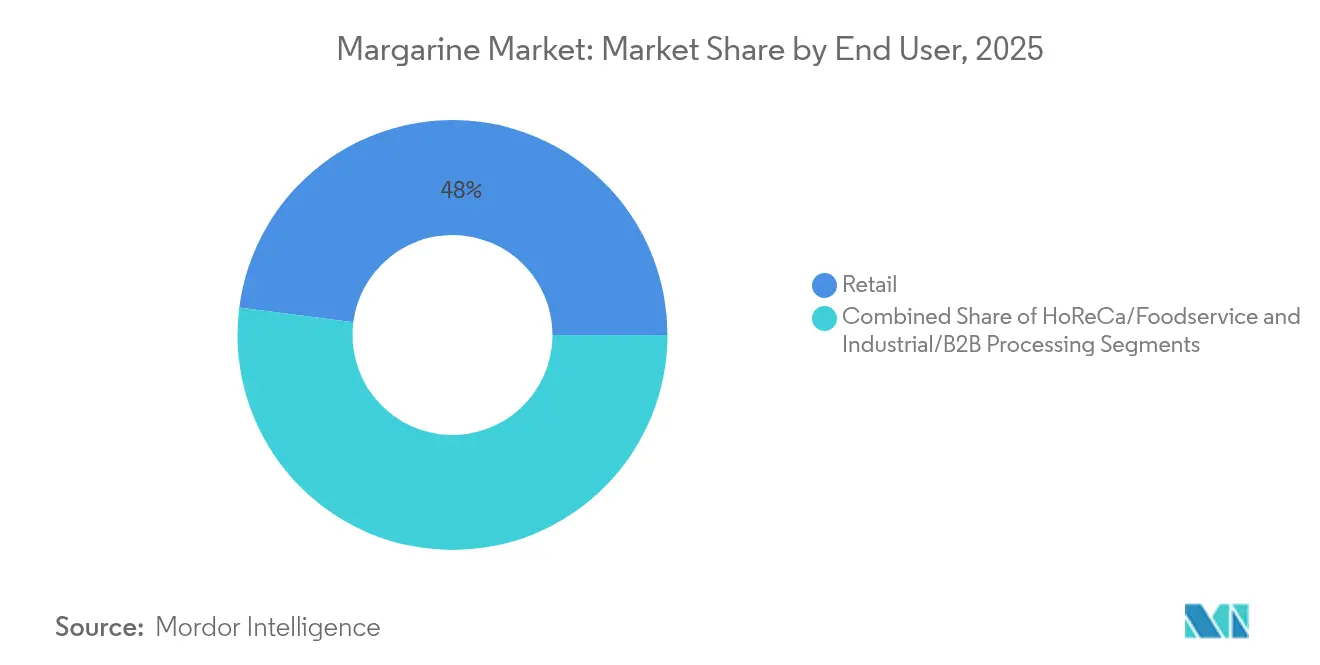
HoReCa Segment SurgesHouseholds accounted for 47.95% of the 2025 turnover, while restaurants, hotels, and catering outlets demonstrated strong growth at 6.20% CAGR. The significant rise in commodity prices prompted extensive menu-engineering initiatives to reduce operating costs, leading to a substantial decrease in butter usage across food service establishments. Commercial establishments increasingly prefer alternatives due to their higher smoke points and extended shelf life, which significantly improve kitchen efficiency and operational workflow. The widespread adoption of portion-controlled sticks and pump-dispensed liquid cartons substantially reduces waste generation and labor requirements, making them particularly attractive for high-volume operations.
Industrial food processors, particularly in frozen pizza and confectionery manufacturing, maintain comprehensive and rigorous product specifications throughout their production processes. Their specialized research and development teams work extensively with suppliers to develop sophisticated, customized fat systems that perform consistently in high-shear mixers and tunnel ovens across various production conditions. This in-depth collaborative approach significantly increases switching costs and strengthens long-term supplier relationships, creating lasting partnerships within the industry.
By Packaging Type:
Convenience Formats ExpandTubs and cups maintain a 40.05% revenue share in 2025, remaining the preferred household packaging formats due to their durability, ease of storage, and reusability features. Sachets and pouches demonstrate 6.60% CAGR by 2031, driven by emerging market retailers offering single-use portions at price points matching daily wage budgets, particularly in regions with limited refrigeration infrastructure. The foodservice sector favors sticks and blocks for pre-portioned baking needs, enabling precise measurements and reducing waste in commercial kitchens, while industrial operations primarily use 10-kg bag-in-box and drum formats for bulk processing efficiency. In Europe, compostable paper films and plastic-free molded fibers are increasing in adoption, influenced by extended producer-responsibility fees that increase traditional resin costs. These evolving packaging choices now significantly influence brand perception and consumer purchasing decisions across retail channels.
Equipment manufacturers report significant growth in high-speed vertical-form-fill-seal machinery for margarine pouches, enabled by material reduction capabilities and enhanced optical inspection systems that ensure seal quality and product freshness. The machinery improvements include advanced temperature control mechanisms, automated quality checks, and real-time monitoring systems. The convergence of sustainability requirements, user convenience, and cost considerations continues to transform margarine packaging and distribution methods from production facilities to consumer storage, with manufacturers investing in research and development to optimize packaging solutions for different market segments.
Geography Analysis
Europe Margarine Market
Europe accounted for 29.85% of global revenue in 2025, maintaining its leadership position due to established consumption patterns, broad acceptance of fortified products, and advanced palm-oil-free product development. The market shows low single-digit growth as it matures and consumers shift toward premium plant-based butter alternatives. Clear regulations on labeling and deforestation have improved supply-chain transparency, enabling brands to differentiate themselves through verified sustainable sourcing.
APAC Margarine Market
Asia-Pacific demonstrates strong growth potential with a projected 6.30% CAGR through 2031. This growth stems from urbanization, increasing disposable incomes, and expanding frozen-bakery adoption. Chinese quick-service restaurants increasingly adopt liquid margarine for cost management, while Indian refiners seek tariff adjustments to obtain competitive oil supplies.
North America, LATAM and MEA Margarine Market
North America maintains mid-single-digit growth, with zero-trans and non-GMO products becoming standard market requirements. Industrial bakeries transition to high-oleic blends, using domestic soybeans to minimize imported oil dependencies. Latin America and the Middle East/Africa represent smaller but growing markets. The expansion of discount retailers supports private label spread sales, while government-mandated vitamin-A fortification programs strengthen margarine's position in public health initiatives, especially in regions addressing micronutrient deficiencies.
Regulatory Landscape
Regulation continues to shape formulation, processing, and labeling in the margarine category, with trans fat elimination and compositional definitions as the main compliance anchors. In the United States, FDA standards of identity under 21 CFR Part 166 require products labeled as margarine/oleomargarine to meet specific compositional and labeling provisions, including a minimum fat content requirement tied to the standard of identity. Globally, many countries align to the WHO REPLACE framework by adopting best-practice policies that cap industrially produced trans fatty acids at 2 g per 100 g of total fat across foods, pushing manufacturers toward zero-trans processing pathways such as enzymatic interesterification.
Labeling and international standard-setting are also tightening the operating environment for packaged spreads and B2B ingredients. In January 2025, the US FDA proposed a mandatory front-of-package nutrition labeling approach for most packaged foods, which raises pressure on manufacturers to optimize nutrient profiles and substantiate claims across retail SKUs. At the international level, Codex Alimentarius work on fats and oils standards provides a harmonization pathway for trade, including consideration of measures consistent with trans fat limits and restrictions on partially hydrogenated oils. In Europe, rules that differentiate spreadable fats by fat content and origin continue to influence product positioning and portfolio architecture, while supply-chain requirements tied to deforestation-free sourcing add further compliance demands for palm-oil-related inputs.
Competitive Landscape
The market exhibits fragmentation, including global corporations, regional specialists, and emerging plant-based product manufacturers. Prominent players in the market include Conagra Brands Inc., Upfield BV, Bunge Limited, Wilmar International Ltd., and Vandemoortele NV. Companies are strategically realigning their portfolios. Research and development focus on technological advancements, including enzymatic interesterification, carbon-captured synthetic fats, and mycoprotein matrices that aim to match dairy performance with reduced environmental impact.
Companies with certified deforestation-free supply chains gain preferential retail placement in European and Japanese markets. Sustainable packaging innovations, including molded-fiber containers and compostable sachets, enhance brand value and meet retailer sustainability requirements. In emerging markets, companies utilize flexible manufacturing and local partnerships to access growing discount retail chains, while private-label manufacturing supports capital investment through steady revenue streams.
Market evolution and strategic opportunities include fortified spreads for children in nutritionally deficient regions and bakery margarines marketed as egg substitutes. Emerging companies developing air-based fats seek development partnerships with established manufacturers to address raw material supply risks. Traditional manufacturers must decide whether to partner with, acquire, or compete against these new entrants as the margarine market evolves into a broader plant-based fats category.
Margarine Industry Leaders
-
Conagra Brands, Inc
-
Upfield BV
-
Bunge Limited
-
Wilmar International Ltd.
-
Vandemoortele NV
- *Disclaimer: Major Players sorted in no particular order
Margarine Market Companies Covered in this Report
- Conagra Brands Inc
- Wilmar International Ltd.
- Upfield Holdings B.V.
- Vandemoortele NV
- Associated British Foods plc
- Bunge Limited
- Puratos Group
- Richardson International Limited
- Fuji Oil Holdings Inc.
- Land O'Lakes, Inc.
- Cargill, Incorporated
- Aigremont S.A.
- Royale Lacroix S.A.
- Currimjee Group
- Goodman Fielder Pty Limited
- Remia C.V.
- Lam Soon Group
- Yildiz Holding A.?.
- BRF S.A.
- AAK AB
Market Opportunities and Future Outlook
An opportunity is emerging at the intersection of capacity localization and specialty-fat functionality for bakery and foodservice, where manufacturers need consistent performance while meeting zero-trans, lower saturated fat, and sustainability constraints. Industrial investment signals this shift: in April 2026, Cargill expanded its Port Klang, Malaysia edible oils facility with a new specialty fats production line serving bakery, dairy, and confectionery applications across Asia Pacific and EMEA. Similar moves to strengthen regional supply and reduce import exposure are visible in developing, import-dependent markets, including Olivine Industries announcing a USD 14 million upgrade to its Zimbabwe margarine plant in October 2025, lifting throughput from 0.9 metric tonnes to 6 metric tonnes per hour.
Formulation opportunity is also widening beyond conventional vegetable-oil blending, as companies trial alternative structuring technologies that reduce dependence on palm oil and manage agricultural volatility. In June 2026, Perfat Technologies introduced Perfat Soft, a sunflower-oil-based oleogel positioned as a solid-fat alternative for bakery and confectionery use cases, aligning with clean-label and palm-oil-reduction objectives cited by large buyers and regulators. In July 2026, AAK and Savor entered a two-year collaboration to develop carbon-derived specialty fats for bakery and dairy applications, combining AAKs scale-up and application capabilities with Savor Carbon Crafted inputs. This creates a pathway for new ingredient platforms that can be used in margarine and spread systems as the category broadens into plant-based fats. Together, these moves support demand for premium, fortified, and application-specific margarines, including liquid formats for automated dosing, as manufacturers upgrade traceability, labeling readiness, and feedstock flexibility for multi-region portfolios.
Recent Industry Developments in Margarine Market
- March 2026: Bunge completed its acquisition of International Flavors & Fragrances, Inc. soy protein concentrate, lecithin, and soy crush businesses. The added capabilities strengthen Bunges ingredient system offering for bakery and adjacent applications where fats, emulsifiers, and proteins are formulated together. This integration supports more bundled solutions for industrial customers that also consume margarine and specialty fats.
- March 2025: Bunge agreed to sell its European Margarines and Spreads business to Vandemoortele, including brands such as Smakowita and manufacturing sites in Germany, Finland, Poland, and Hungary. The transaction reshapes competitive positions in European spreads by shifting assets toward a player with a deeper bakery and margarines focus. It also reflects portfolio realignment toward higher-priority platforms within global agribusiness and ingredients.
- September 2024: Flora Food Group announced the acquisition of a 135,000 square-foot manufacturing facility in Hugoton, Kansas, to expand production of creams and cream cheese, while continuing to operate its New Century, Kansas facility for butter and spreads. The added manufacturing footprint increases North American supply flexibility and supports faster renovation and scale-up of plant-based dairy alternatives. This investment reinforces the regions role in growth strategies for spreads portfolios and adjacent plant-based categories.
Margarine Market Report Scope and Research Methodology
Market Definition and Coverage
For this study, the market covers packaged margarine sold for household use and for professional food preparation, valued in USD at the point where it is sold into the market during the year.
Scope exclusions: Butter, ghee, and other non-margarine fats and oils are not counted in this market size.
Segments Covered in This Report
-
By Type
- Hard
- Soft
- Liquid
-
By Fat Content
- Regular (>80% Fat)
- Low-Fat (40-80% Fat)
- Light (<40% Fat)
-
By Oil Source
- Palm-Oil-Based
- Soybean-Oil-Based
- Rapeseed/Canola-Oil-Based
- Others
-
By End User
-
Retail
- Supermarkets/Hypermarkets
- Convenience and Grocery Stores
- Online Retail Stores
- Other Channels
- HoReCa/Foodservice
- Industrial/B2B Processing
-
Retail
-
By Packaging Type
- Tubs and Cups
- Sticks and Blocks
- Sachets and Pouches
- Bulk (10 kg+)
-
By Geography
-
North America
- United States
- Canada
- Mexico
-
South America
- Brazil
- Argentina
- Rest of South America
-
Europe
- United Kingdom
- Germany
- France
- Italy
- Spain
- Russia
- Rest of Europe
-
Asia-Pacific
- China
- India
- Japan
- South Korea
- Australia
- Rest of Asia-Pacific
-
Middle East and Africa
- Saudi Arabia
- United Arab Emirates
- South Africa
- Rest of Middle East and Africa
-
North America
Data Sources, Market Sizing, and Validation
Desk Research
Desk research was used to map the product definition, regulatory context, and demand indicators that explain why margarine volumes and pricing move over time. We referred to public sources such as USDA food availability and oilseed data, FAO food balance sheets, Eurostat trade and production series, UN Comtrade customs statistics, and Codex Alimentarius standards and guidance that influence product formulation.
Along with these, company annual reports, investor presentations, and credible press were used to understand capacity moves, portfolio shifts (for example, reformulation toward zero trans-fat), and packaging or channel trends. Where needed, we also used paid subscriptions for company financials and intelligence, news and financials, and shipment-level trade signals to cross-check import dependence and pricing direction. The sources listed here are illustrative, and many other public sources were also consulted to collect data, validate assumptions, and clarify open questions.
Primary Interviews and Surveys
Primary work was done through expert interviews and structured surveys with manufacturers, ingredient suppliers, distributors, retailers, and foodservice and industrial users, so we could test what was seen in desk research and fill gaps on mix and pricing. We covered major consuming and producing regions, and when a data point looked inconsistent (like an unusual price jump), we followed up to confirm if it came from oil costs, reformulation, or channel shifts.
Distribution of primary research fieldwork respondents
| Company type | Respondent position | Region |
|---|---|---|
| Top tier: 26% | CXOs: 18% | APAC: 45% |
| Mid tier: 54% | Functional/Unit leaders: 22% | EMEA: 35% |
| Smaller Players: 20% | Managers: 60% | Americas: 20% |
Market-Sizing & Forecasting
Sizing starts with a top-down build where consumption and trade signals are used to reconstruct the demand pool for margarine across regions, and then values are formed by applying realistic price levels to those demand volumes. The totals are then checked with selective bottom-up approximations, such as sampled supplier revenue splits, channel checks, and volume times average selling price calculations, which helps us adjust for underreported informal flows or overstatement in one channel.
Key inputs that move the model include edible oil input-cost trends (palm, soybean, sunflower, rapeseed), retail versus foodservice and industrial use mix, packaging mix (tubs versus sticks and blocks), reformulation intensity tied to trans-fat rules, and regional import reliance that changes landed costs. Forecasting is built using scenario analysis supported by primary feedback, where we stress-test oil price ranges, regulation-led recipe changes, and expected household demand shifts, and then select the most probable path. When a bottom-up proxy is missing for a small country or channel, the gap is handled through ratio-based allocation from comparable markets and then validated again during interviews.
Data Validation & Update Cycle
Outputs are triangulated across multiple independent signals, and we run variance checks to spot breaks that do not match oil-cost movement, trade direction, or stated capacity changes. Before sign-off, the model is reviewed in steps, starting with line-item logic checks and followed by a second analyst review focused on anomalies and country outliers.
The report is refreshed annually, and interim updates are triggered when a material event shifts demand or pricing, such as regulation changes affecting formulation or major supply disruptions. Right before delivery, we do a fresh pass on key inputs so the client receives an updated view aligned with the latest public releases and field feedback.
Mordor Intelligence's Margarine Market Estimate Compared With Other Published Estimates
Published market sizes for margarine often do not match because the product set and the selling point in the value chain are not defined the same way, and base years and currency timing can also differ. Even small differences, like counting only retail packs versus including industrial use, can move the final number by several multiples.
Shortening and blended margarine-plus-shortening totals are a common reason for spread in this space, and those adjacent fat products sit outside Mordor Intelligence's margarine scope, which keeps the total tied to margarine-only demand and pricing. Differences also come from whether values are reported at manufacturer selling price versus consumer retail value, how edible oil price pass-through is treated in ASP progression, and how frequently assumptions are refreshed after regulation-driven reformulation shifts.
Benchmark comparison
| Source | Market Size | Gaps in Research Methodology |
|---|---|---|
| Mordor Intelligence | USD 24.08 B (2026) | |
| Global Consultancy A | USD 4.12 B (2025) | This figure appears to reflect a narrower value capture, commonly closer to retail-only margarine and a shorter product list, which can exclude foodservice and industrial demand and reduce the measured price base. |
| Industry Publisher B | USD 4.18 B (2025) | This estimate is likely built on a different pricing basis and base-year timing, and it may treat commercial use through broad application buckets that miss industrial margarine volumes used in processed food and bakery supply chains. |
Across the three values, the main pattern is that scope and value-chain point drive the largest gap, followed by how pricing is carried forward from edible oil costs. By keeping inputs traceable to demand signals and by checking them with channel feedback, the sizing steps stay repeatable and easier to audit when conditions change.
Key Questions Answered in the Report
How large is the global margarine market in 2026?
The global margarine market stands at USD 24.08 billion in 2026 and is projected to grow to USD 26.7 billion by 2031.
Which region is expanding the fastest?
Asia-Pacific shows the strongest trajectory, advancing at a 6.30% CAGR thanks to rising frozen-bakery output and middle-class consumption growth.
Why are liquid margarines gaining popularity?
Liquid formats enable automated dispensing that reduces labor, deliver stable performance in industrial bakeries, and support lower saturated-fat recipes without losing functionality.
What is driving HoReCa-sector demand for margarine?
Restaurants and caterers are substituting butter with margarine to manage costs, leverage higher smoke points, and reduce operational waste, leading to a 6.20% CAGR for the channel.