
Indonesia Foodservice Market Analysis by Mordor Intelligence
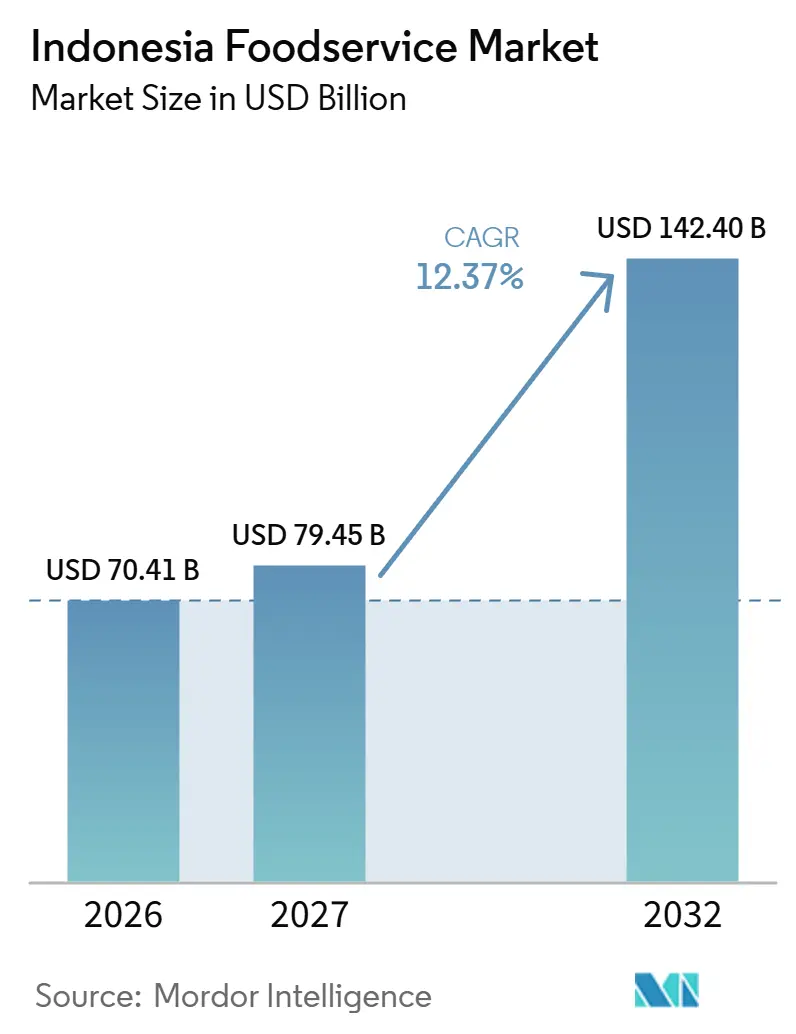
The Indonesia foodservice market size is expected to increase from USD 70.41 billion in 2026 to USD 79.45 billion in 2027 and reach USD 142.4 billion by 2032, growing at a CAGR of 12.37% over 2027-2032.
In Indonesia, coffee-chain expansion and localized chicken-meal combinations broaden access and give established restaurant brands more occasions to serve. This added reach meets a base of repeat eating-out behavior, while app-based ordering creates another route from meal choice to a prepared-food purchase. To capture these occasions, operators can combine distinctive dining formats with delivery-led preparation, tying commercial reach to the kitchen's ability to fulfill meals. Strong local-food alternatives and uneven hygiene execution can slow conversion into regular sales, making outlet productivity as important as additional locations.
Key Report Takeaways
- By foodservice type, full-service restaurants led with a 52.31% Indonesia foodservice market share in 2026, while cafés and bars are forecast to grow fastest at a CAGR of 14.8% over 2027-2032.
- In the outlet breakdown, independent outlets held a 62.1% share of the Indonesia foodservice market size in 2026, and chained outlets are forecast to lead growth at a CAGR of 13.3% during 2027-2032.
- Across locations, Sandalone represented 77.49% of Indonesian foodservice customer spending in 2026, whereas lodging is forecast to be the fastest-growing segment at a CAGR of 14.6% over 2027-2032.
- For service type, dine-in accounted for 47.77% of foodservice customer spending in Indonesia in 2026, with takeaway expected to grow fastest at a CAGR of 12.8% over 2027-2032.
Note: Market numbers in this report are based on Mordor Intelligence's proprietary estimation framework, which combines nine months of actuals with Q4 projections for base year 2026.
Indonesia Foodservice Market Trends and Insights
Drivers Impact Analysis*
| Driver | (~) % Impact on CAGR Forecast | Geographic Relevance | Impact Timeline |
|---|---|---|---|
| Rapid café culture and coffee-chain proliferation | +3.8% | Nationwide | Medium term (2-4 years) |
| Menu localization by global chains | +3.2% | Nationwide | Short term (≤ 2 years) |
| Strong 'Dine-Out' and socializing culture | +3% | Urban areas across Java | Long term (≥ 4 years) |
| Dark/cloud kitchen expansion | +2.6% | Nationwide | Medium term (2-4 years) |
| Rise of halal-assurance branding | +1.8% | Nationwide | Short term (≤ 2 years) |
| High mobile-app ordering literacy | +1.4% | Nationwide | Short term (≤ 2 years) |
| Source: Mordor Intelligence | |||
Rapid café culture and coffee-chain proliferation
Coffee-chain proliferation can increase prepared-beverage demand by bringing a repeatable café format closer to consumers outside the largest urban centers. In the first half of 2026, Fore Coffee Indonesia added more than 40 outlets, over 40% of them in Tier 2 and Tier 3 cities.[1] Its active Indonesian store base reached 363 in that period, compared with 259 in the first half of 2025. The additional locations create more selling capacity, but each must attract enough local coffee purchases to make that capacity productive. With smaller cities representing a substantial portion of additions, their demand conversion becomes central to this rollout's commercial performance.
Menu localization by global chains
New side-menu offerings, some with local flavors, give a global chain a way to broaden meal choices while keeping the signature chicken product. During 2025, PT Fast Food Indonesia Tbk introduced new side-menu offerings for KFC's signature chicken menu in Indonesia, including products with local flavors. Retaining the chicken centerpiece makes the complete meal combination the relevant commercial unit, since different sides can extend the choices built around it. Diners can vary an accompaniment within that familiar meal structure. This gives localization a route to encourage another meal occasion through a different pairing, without requiring customers to adopt a new main dish.
Strong 'Dine-Out' and socializing culture
Repeated eating-out occasions can deepen restaurant demand because the same customer may generate several prepared-meal purchases within a day. Jakpat's September 2-7, 2025 online survey covered 769 respondents aged 15-25 in 8 urban areas in Java, with a margin of error below 5%. Among those respondents, 19% reported eating out 2 to 3 times daily or more. That frequency gives operators serving this group a reason to compete for several meal occasions a day, not only the first visit. An outlet that can serve more of those occasions has a route to additional demand within its existing catchment, rather than depending entirely on reaching a different customer population.
Dark/cloud kitchen expansion
For delivery-led restaurant operators, kitchen capacity offers a route to additional meal sales without making dining-room capacity the central expansion unit. Hangry, a multi-brand virtual restaurant company serving through delivery channels, reported a network of 150 outlets across Indonesia in 2026. In October 2025, it announced USD 10.5 million in Series A5 funding intended to expand its operating network, improve production efficiency and strengthen kitchen infrastructure and equipment. These stated uses make output per site a relevant complement to outlet coverage when assessing the operator's expansion capacity. Because its announced funding targets production efficiency and kitchen equipment, the 150-outlet network's contribution to demand depends on how quickly each kitchen turns delivery orders into prepared meals.
Restraints Impact Analysis*
| Restraint | (~) % Impact on CAGR Forecast | Geographic Relevance | Impact Timeline |
|---|---|---|---|
| Intense competition from independent and street food | -1.4% | Urban areas across Java | Long term (≥ 4 years) |
| Inconsistent food safety and hygiene standards | -1% | Pondok Indah, Jakarta | Medium term (2-4 years) |
| Menu copycatting and concept fatigue | -0.6% | Nationwide | Short term (≤ 2 years) |
| Cold-chain and perishables reliability gaps | -0.4% | Panggang Island, Seribu Islands | Long term (≥ 4 years) |
| Source: Mordor Intelligence | |||
Intense competition from independent and street food
Modern restaurant operators must win dining occasions against local warungs and street vendors, which limits the demand immediately available to a new branded outlet. Radio Republik Indonesia reported a Jakpat survey conducted September 2-7, 2025, covering 995 respondents in 8 major Java cities. Local warungs were selected by 61% of respondents and street vendors by 58%, while ordinary restaurants, coffee stalls and coffee shops each drew under 30%. The strength of those alternatives means a recognizable chain name alone may be insufficient to secure the next meal occasion within this urban customer pool. With warungs and street vendors chosen by 61% and 58% of respondents, a new branded outlet in these cities has to give diners a reason to switch before its added capacity earns regular patronage.
Inconsistent food safety and hygiene standards
Inconsistent hygiene execution can constrain restaurant expansion by making safe daily service dependent on staff understanding and repeated supervision. A 2026 case study at Union Restaurant in Pondok Indah Mall, Jakarta, found that cleanliness, health, safety and environmental sustainability procedures were generally implemented effectively. However, limited training and understanding, together with inconsistent employee compliance, remained barriers to consistent daily implementation. For a restaurant manager, these staff-level obstacles create a recurring supervisory burden because a written procedure cannot itself ensure that every employee follows it. The resulting constraint is the labor and management effort needed to sustain reliable hygiene as more meals are prepared, which can make service expansion harder to execute economically.
*Our forecasts treat driver/restraint impacts as directional, not additive. The impact forecasts reflect baseline growth, mix effects, and variable interactions.
Segment Analysis
By Foodservice Type: Restaurant Scale and Coffee Sales Shape Expansion
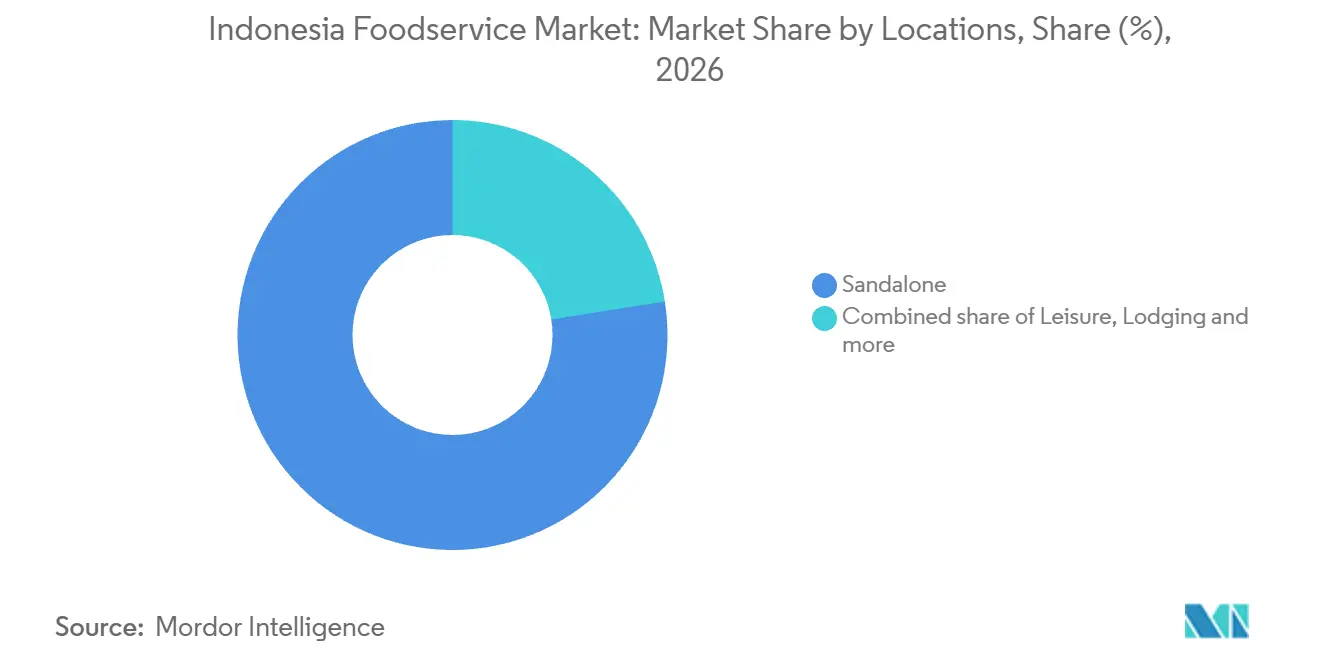
Full-service restaurants accounted for a 52.31% share of the Indonesia foodservice market size in 2026. In June 2025, Solaria had more than 200 restaurant outlets across 31 provinces and 55 major cities in Indonesia. That geographically distributed restaurant base illustrates how an operator can make a full dining offer accessible across many destinations. Serving a meal on site also ties sales capacity to coordinated kitchen and dining-room service, rather than seating alone.
Cafés and bars are the fastest-growing segment, with a forecast CAGR of 14.8% over 2027-2032. Kopi Kenangan's unaudited 2025 Indonesia results showed 40% year-over-year net revenue growth and about 15% same-store sales growth. The same-store component matters because beverage-led operators can generate additional sales from established locations alongside expanding their footprint. These complementary routes make the performance of the existing network commercially relevant to expansion, allowing a café business to pursue revenue growth through both established selling points and additional locations.

By Outlet: Local Autonomy and Repeatable Chain Formats
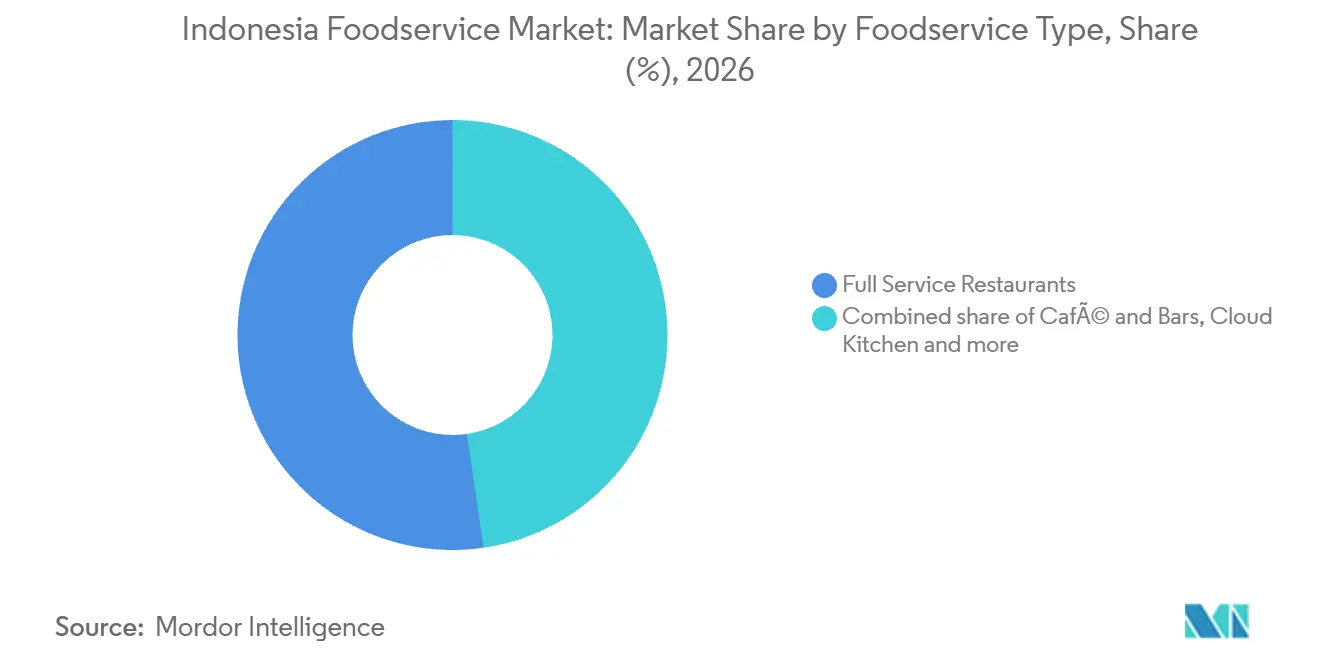
Independent outlets represented a 62.1% Indonesia foodservice market share in 2026. Indofood CBP reported that 11,097 Warmindo entrepreneurs and their families participated in its March 2025 homecoming program. Warmindo entrepreneurs operate their own food businesses, illustrating the owner-operated character of this segment. The commercial constraint is that each business must sustain its own meal quality and service routines as customer occasions change. The Warmindo example places individual entrepreneurs at the center of the operating model, making each owner's ability to sustain a local food business consequential for the segment's collective scale.
Chained outlets are forecast to be the fastest-growing segment, with a CAGR of 13.3% over 2027-2032. Richeese Factory opened its first Sentul City branch near the Shell Sentul City gas station on July 13, 2025. A branch opening places an established foodservice brand into a specific local catchment, adding a selling point through which it can serve diners. For a chain, this makes replication of the restaurant format a commercial growth mechanism, although the new site still has to attract its own customers. The expansion task is to turn a familiar concept into a locally viable outlet, so network growth depends on site execution as well as brand reach.
By Locations: Site Control and Hotel Dining Shape Capacity
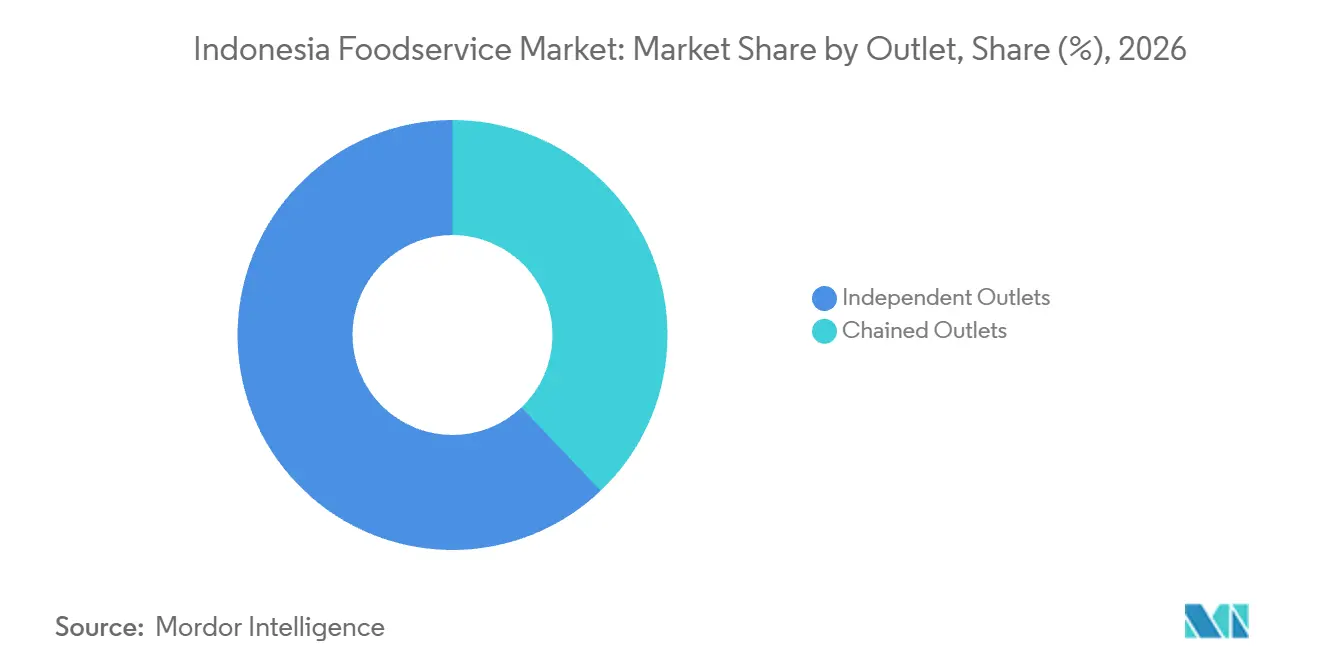
Sandalone locations held 77.49% of Indonesian foodservice customer spending in 2026, making them the largest segment. PT Fast Food Indonesia Tbk operated 178 KFC free-standing outlets in Indonesia at December 31, 2025. A free-standing format can make the restaurant the principal reason to visit the site, rather than attaching meal purchases to another venue's activity. The leading location format therefore creates capacity for destination-led foodservice, while requiring the restaurant to justify the visit through its own meal and service offer.
Lodging is the fastest-growing segment, with a forecast CAGR of 14.6% over 2027-2032. Property owner PT Gerbang Makmur Bersama and hotel operator Omega Hotel Management opened Cordela Suites Cianjur with Ramela Resto and Sky Cafe on November 22, 2025. Omega Hotel Management introduced Rasa & Co at Cordela Hotel Cirebon on June 18, 2026, serving hotel guests and the public. The Cianjur opening placed a restaurant and rooftop café inside a newly opened hotel, while Rasa & Co added a new dining brand at Cordela Hotel Cirebon that serves hotel guests and the public. Rasa & Co's public-facing format shows how a hotel operator can sell to local diners as well as guests, widening the customer pool beyond room occupancy.
By Service Type: On-Site Productivity and Off-Site Occasions
Dine-in held 47.77% of foodservice customer spending in Indonesia in 2026, making it the largest segment. Restaurant Brands Asia reported higher Burger King Indonesia dine-in average daily sales year over year for February and March 2026. That improvement gives the largest service type a recent operator example of resilient on-site spending. Because the measure isolates the dine-in channel, the gain reflects meals consumed on site at this chain rather than delivery orders.
Takeaway is forecast to be the fastest-growing segment, with a CAGR of 12.8% over 2027-2032. In April 2025, d'Roasting Indonesia opened its 12th outlet in Jayapura, serving spiced roast chicken for takeaway only.[2] Collection can serve a defined meal without seating the diner, focusing capacity on preparation and handoff. Delivery can support merchant trial or rediscovery, with Grab reporting on October 8, 2026, that more than 40% of GrabFood orders came from merchants customers had not ordered from in the preceding 12 months. Takeaway concentrates capacity on preparation and handoff, while delivery gives a new outlet a route to first orders and an established outlet a route back to customers outside its recent ordering base.
Regulatory Framework and Outlook
The selected jurisdictions compare national food-premises hygiene standards with their administration in DKI Jakarta from a restaurant or café operator's perspective. Ministry of Health Regulation 11/2025 establishes Sertifikat Laik Higiene Sanitasi (SLHS) standards for listed categories, while Jakarta's certification or labeling requirements depend on classification and scale. On October 13, 2026, Indonesia's coordinating ministry said halal certification for micro and small business food and beverage products would take effect October 18, with medium and large businesses subject since 2024. On October 9, 2026, Indonesia's halal product assurance authority (BPJPH) said certification would begin October 18 while the government prepared special provisions for certain micro and small business conditions.
Regulatory Table
| Decision factor | Indonesia | DKI Jakarta |
|---|---|---|
| Primary authority | Ministry of Health and local certification authorities | Provincial investment and one-stop-service agency issues certificates; local health offices assess applications |
| Key instruments or direction | Ministry of Health Regulation 11/2025, including food-premises SLHS standards | Pergub 7/2025 and Pergub 12/2026 govern the issuing-authority transition; 2026 health-office guidance explains applicable classifications |
| Commercial effect | Category-specific hygiene standards inform local certification | Restaurants require SLHS at all listed scales, with differing risk classes; micro cafés use hygiene-and-sanitation labeling, while other listed café sizes require SLHS |
| Current policy attractiveness | Medium | Medium |
| Future direction of policy attractiveness | No change | No change |
| Source: Mordor Intelligence | ||
The national Medium rating reflects classification-specific hygiene compliance, while Jakarta's Medium rating balances a defined issuing route with certificate or labeling requirements. The May 12, 2026 repeal of the former restaurant, eating-house and catering procedure followed the transfer of issuing authority to the provincial investment and one-stop-service agency. Both No change judgments cover hygiene certification, where the operative national standards and Jakarta's guidance support continuity after that administrative transfer. The announced halal phase-in and provisions concern product assurance alongside SLHS, so they call for a separate compliance assessment rather than changing this hygiene-specific judgment.
Value Chain Stages
The value chain compares food manufacturing, distribution, order capture and meal preparation to show where suppliers earn and operating constraints arise. PT Indofood Sukses Makmur Tbk manufactures food across processing stages and distributes its own and third-party products in Indonesia. PT Diamond Food Indonesia Tbk serves foodservice and other channels through its distribution business unit, PT Sukanda Djaya. These capabilities make upstream availability distinct from the outlet's task of turning ingredients into a customer purchase.
Value Chain Analysis Table
| Primary activity | Key participants | Value capture | Bottleneck | Resilience response |
|---|---|---|---|---|
| Food manufacturing | Food manufacturers such as PT Indofood Sukses Makmur Tbk | Food product sales | Ingredient specifications can restrict substitutions | Qualify alternative inputs against the same recipe requirements |
| Distribution to operators | Foodservice distributors such as PT Sukanda Djaya, a business unit of PT Diamond Food Indonesia Tbk | Distributed product sales | Perishable handling can limit usable delivery windows | Match delivery frequency and temperature controls to ingredient life |
| Digital order capture | Ordering marketplace providers such as PT GoTo Gojek Tokopedia Tbk through GoFood | Merchant-specific service fees on authorized net product sales excluding restaurant tax, deducted after activation; fees exclude VAT; withholding follows applicable tax and documentation rules | Platform fees reduce the outlet's net receipts per eligible order | Price channel offers against the applicable merchant fee terms |
| Meal preparation and service | Restaurant operators such as PT Fast Food Indonesia Tbk; café operators such as Fore Coffee Indonesia | Prepared-meal and beverage sales | Orders beyond kitchen capacity can extend preparation time | Align accepted order volume with preparation capacity |
| Source: Mordor Intelligence | ||||
Cold-chain infrastructure supports the handling stage that precedes the kitchen. In May 2025, the National Food Agency reported supplying reefer containers, air-blast freezers, cold storage and heat-pump dryers to 30 beneficiaries across several provinces to reduce regional price disparities. This food-logistics intervention illustrates the infrastructure layer on which perishable handling depends. For platform-originated orders, the outlet must also preserve enough of each sale after merchant fees to pay for preparation and service.
Competitive Landscape
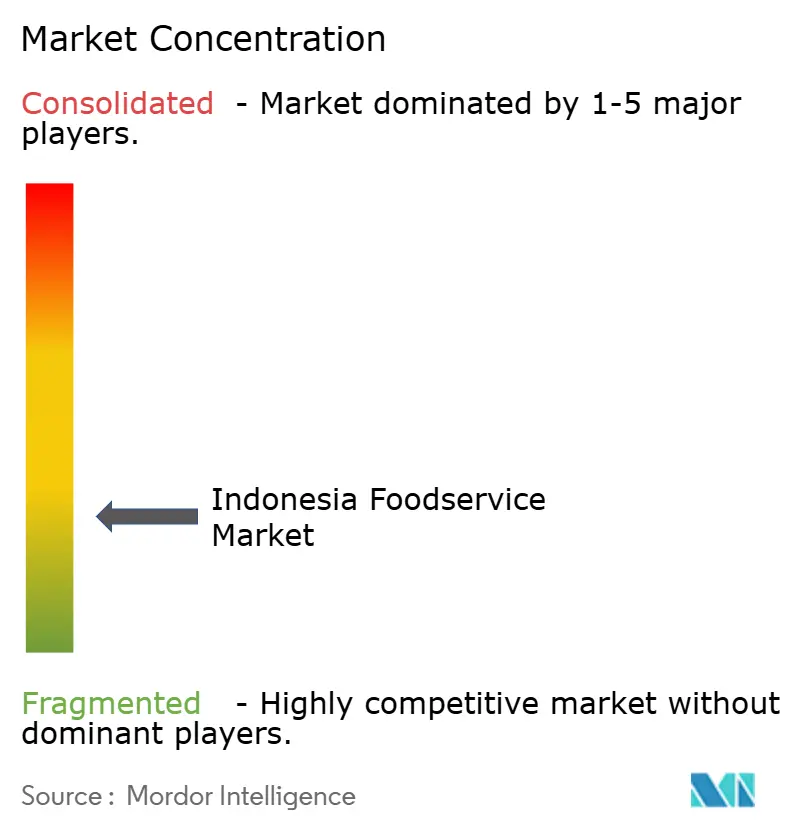
Competition is fragmented, with restaurant operators and franchised brands contesting customer occasions through individual dining locations. PT JCO Donut & Coffee operates J.CO, while Inspire Brands, Inc. owns Dunkin’. Solaria Indonesia (PT Nusa Prima Pangan) operates restaurants, Jiwa Group operates Janji Jiwa and Janji Jiwa Culture, and The Wendy’s Company franchises Wendy’s, operated locally by Trans F&B. J.CO opened a store at Plaza Malioboro in Yogyakarta on March 28, 2025. The Plaza Malioboro opening gives J.CO a point of sale in Yogyakarta, making local access a dimension of competition alongside the choice of restaurant brand.
On April 15, 2026, Dunkin’ opened a restaurant at Puri Indah Mall in West Jakarta with new franchisee PT Diamonds Donuts International.[3] It was the first restaurant with that franchisee and combined an expanded menu with a café-style setting, linking product choice with the place of consumption. Jiwa Group opened its Janji Jiwa Culture dine-in flagship in Kebon Jeruk, Jakarta, on September 10, 2025, with the Jiwa Origin Espresso menu available only at that format's outlets. These investments make format-specific experience a competitive choice, giving customers a reason to select a location beyond recognizing the parent brand.
Competitive direction is likely to turn on how consistently an operator reproduces its format across outlets, alongside what distinguishes its menu. On September 2, 2026, Indonesia's halal product assurance authority, BPJPH, urged restaurant chains to apply halal assurance consistently across outlets, covering ingredients, production processes, cleanliness and sanitation. This makes ingredient and kitchen-process control relevant to chain positioning alongside store design, because assurance depends on execution across locations. For franchise systems, separating brand ownership from local restaurant operations makes coordination over that execution a distinct competitive task. An operator combining a recognizable dining offer with repeatable food-production controls can compete on both customer experience and confidence in the meal.
Indonesia Foodservice Industry Leaders
-
PT JCO Donut & Coffee
-
Inspire Brands, Inc.
-
Solaria Indonesia
-
Jiwa Group
-
The Wendy’s Company
- *Disclaimer: Major Players sorted in no particular order
Recent Industry Developments
- Oct 2026: Indonesia's coordinating ministry said on October 13 that halal certification for micro and small business food and beverage products would take effect October 18, with medium and large businesses subject since 2024.
- Sep 2026: Ramela Resto opened its seventh outlet at The Bountie Hotel Sukabumi in Sukabumi, through a collaboration between the hotel and Omega Hotel Management.
- Jul 2026: PT Fore Kopi Indonesia Tbk reported that its Fore Donut brand received halal certification in early July.
Scope and Methodology
By Foodservice Type
| Café and Bars | By Cuisine | Bars and Pubs |
| Café | ||
| Juice/Smoothie/Desserts Bars | ||
| Specialist Coffee and Tea Shops | ||
| Cloud Kitchen | ||
| Full Service Restaurants | By Cuisine | Asian |
| European | ||
| Latin American | ||
| Middle Eastern | ||
| North American | ||
| Other FSR Cuisines | ||
| Quick Service Restaurants | By Cuisine | Bakeries |
| Burger | ||
| Ice Cream | ||
| Meat-based Cuisines | ||
| Pizza | ||
| Other QSR Cuisines |
By Outlet
| Chained Outlets |
| Independent Outlets |
By Locations
| Leisure |
| Lodging |
| Retail |
| Sandalone |
| Travel |
By Service Type
| Dine-in |
| Takeaway |
| Delivery |
| By Foodservice Type | Café and Bars | By Cuisine | Bars and Pubs |
| Café | |||
| Juice/Smoothie/Desserts Bars | |||
| Specialist Coffee and Tea Shops | |||
| Cloud Kitchen | |||
| Full Service Restaurants | By Cuisine | Asian | |
| European | |||
| Latin American | |||
| Middle Eastern | |||
| North American | |||
| Other FSR Cuisines | |||
| Quick Service Restaurants | By Cuisine | Bakeries | |
| Burger | |||
| Ice Cream | |||
| Meat-based Cuisines | |||
| Pizza | |||
| Other QSR Cuisines | |||
| By Outlet | Chained Outlets | ||
| Independent Outlets | |||
| By Locations | Leisure | ||
| Lodging | |||
| Retail | |||
| Sandalone | |||
| Travel | |||
| By Service Type | Dine-in | ||
| Takeaway | |||
| Delivery | |||
Market Definition
- FULL-SERVICE RESTAURANTS - A foodservice establishment where customers are seated at a table, give their order to a server and are served food at a table.
- QUICK SERVICE RESTAURANTS - A foodservice establishment that provides customers convenience, speed, and food offerings at lower prices. Customers usually help themselves and carry their own food to their tables.
- CAFES & BARS - A type of foodservice business that include bars and pubs that are licensed to serve alcoholic drinks for consumption, cafes that serve refreshments and light food items, as well as specialty tea and coffee shops, dessert bars, smoothie bars, and juice bars.
- CLOUD KITCHEN - A foodservice business that utilizes a commercial kitchen for the purpose of preparing food for delivery or takeout only, with no dine-in customers.
| Keyword | Definition |
|---|---|
| Albacore Tuna | It is one of the smallest species of tuna found in the six distinct stocks known globally in the Atlantic, Pacific, and Indian oceans, as well as the Mediterranean Sea. |
| Angus beef | It is beef derived from a specific breed of cattle indigenous to Scotland. It requires certification from the American Angus Association to receive the "Certified Angus Beef" quality mark. |
| Asian cuisine | It includes full-service offerings in restaurants that serve cuisines from cultures such as Chinese, Indian, Korean, Japanese, Bengali, Southeast Asian, etc. |
| Average Order Value | It is the average value of all orders made by the customers at a foodservice establishment. |
| Bacon | It is salted or smoked meat that comes from the back or sides of a pig. |
| Bars & Pubs | It is a drinking establishment that is licensed to serve alcoholic drinks for consumption on the premises. |
| Black Angus | It is beef derived from a black-hided breed of cows that don't have horns. |
| BRC | British Retail Consortium |
| Burger | It is a sandwich consisting of one or more cooked beef patties, placed inside a sliced bread roll or bun roll. |
| Café | It is a foodservice establishment serving various refreshments (mainly coffee) and light meals. |
| Cafes & Bars | It is a type of foodservice business that include bars and pubs that are licensed to serve alcoholic drinks for consumption, cafes that serve refreshments and light food items, as well as specialty tea and coffee shops, dessert bars, smoothie bars, and juice bars. |
| Cappuccino | It is an Italian coffee drink that is traditionally prepared with equal parts double espresso, steamed milk, and steamed milk foam. |
| CFIA | Canadian Food Inspection Agency |
| Chained Outlet | It refers to a foodservice establishment that shares brands, operates in several locations, has central management, and standardized business practices. |
| Chicken Tender | It refers to chicken meat prepared from the pectoralis minor muscles of a chicken bird. |
| Cloud Kitchen | It is a foodservice business that utilizes a commercial kitchen for the purpose of preparing food for delivery or takeout only, with no dine-in customers. |
| Cocktail | It is an alcoholic mixed drink made with either a single spirit or a combination of spirits, mixed with other ingredients such as juices, flavored syrups, tonic water, shrubs, and bitters. |
| Edamame | It is a Japanese dish prepared with soybeans (harvested before they ripen or harden) and cooked in its pod. |
| EFSA | European Food Safety Authority |
| ERS | Economic Research Service of the USDA |
| Espresso | It is a concentrated form of coffee, served in shots. |
| European cuisine | It includes full-service offerings in restaurants that serve cuisines from cultures such as Italian, French, German, English, Dutch, Danish, etc. |
| FDA | Food and Drug Administration |
| Fillet Mignon | It is a cut of meat taken from the smaller end of the tenderloin. |
| Flank Steak | It is a cut of beef steak taken from the flank, which lies forward of the rear quarter of a cow. |
| Foodservice | It refers to the part of the food industry which includes businesses, institutions, and companies which prepare meals outside the home. It includes restaurants, school and hospital cafeterias, catering operations, and many other formats. |
| Franks | Also known as frankfurter or Würstchen, it is a type of highly seasoned smoked sausage popular in Austria and Germany. |
| FSANZ | Food Standards Australia New Zealand |
| FSIS | Food Safety and Inspection Service |
| FSSAI | Food Safety and Standards Authority of India |
| Full service restaurant | It refers to a foodservice establishment where customers are seated at a table, give their order to a server, and are served food at a table. |
| Ghost Kitchen | It refers to a cloud kitchen. |
| GLA | Gross Leasable Area |
| Gluten | It is a family of proteins found in grains, including wheat, rye, spelt, and barley. |
| Grain-fed beef | It is beef derived from cattle that have been fed a diet supplemented with soy and corn and other additives. Grain-fed cows can also be given antibiotics and growth hormones to fatten them up more quickly. |
| Grass-fed beef | It is beef derived from cattle that have only been fed grass as feed. |
| Ham | It refers to the pork meat taken from the leg of a pig. |
| HoReCa | Hotels, Restaurants and Cafes |
| Independent Outlet | It refers to a foodservice establishment that operates with a single outlet or is structured as a small chain with no more than three locations. |
| Juice | It is a drink made from the extraction or pressing of the natural liquid contained in fruit and vegetables. |
| Latin American | It includes full-service offerings in restaurants that serve cuisines from cultures such as Mexican, Brazilian, Argentinian, Colombian, etc. |
| Latte | It is a milk-based coffee that is made up of one or two shots of espresso, steamed milk, and a thin layer of frothed milk. |
| Leisure | It refers to foodservice offered as a part of a recreation business, such as sports arenas, zoos, movie theaters, and museums. |
| Lodging | It refers to foodservice offerings at hotels, motels, guesthouses, holiday homes, etc. |
| Macchiato | It is an espresso coffee drink with a small amount of milk, usually foamed. |
| Meat-based cuisines | This inlcudes food items like fried chicken, steak, ribs, etc. where meat is the primary ingredient for the dish. |
| Middle Eastern cuisine | It includes full-service offerings in restaurants that serve cuisines from cultures such as Arabic, Lebanese, Iranian, Israeli, etc. |
| Mocktail | It is an non-alcoholic mixed drink. |
| Mortadella | It is a large Italian sausage or luncheon meat made of finely hashed or ground heat-cured pork, which incorporates at least 15% small cubes of pork fat. |
| North American | It includes full-service offerings in restaurants that serve cuisines from cultures such as American, Canadian, Caribbean, etc. |
| Pastrami | It refers to a highly seasoned smoked beef, typically served in thin slices. |
| PDO | Protected Designation of Origin: It is the name of a geographical region or specific area that is recognized by official rules to produce certain foods with special characteristics related to location. |
| Pepperoni | It is an American variety of spicy salami made from cured meat. |
| Pizza | It is a dish made typically of flattened bread dough spread with a savory mixture usually including tomatoes and cheese and often other toppings and baked. |
| Primal cuts | It refers to the major sections of the carcass. |
| Quick service restaurant | It refers to a foodservice establishment that provides customers convenience, speed, and food offerings at lower prices. Customers usually help themselves and carry their own food to their tables. |
| Retail | It refers to a foodservice outlet inside a mall. shopping complex or a commercial real estate building, where there are other businesses operating as well. |
| Salami | It is a cured sausage consisting of fermented and air-dried meat. |
| Saturated fat | It is a type of fat in which the fatty acid chains have all single bonds. It is generally considered unhealthy. |
| Sausage | It is a meat product made of finely chopped and seasoned meat, which may be fresh, smoked, or pickled and which is then usually stuffed into a casing. |
| Scallop | It is an edible shellfish that is a mollusk with a ribbed shell in two parts. |
| Seitan | It is a plant-based meat substitute made out of wheat gluten. |
| Self-service kiosk | It refers to a self-order point-of-sale (POS) system through which customers place and pay for their own orders at kiosks, enabling totally contactless and frictionless service. |
| Smoothie | It is a beverage made by placing all the ingredients in a container and processing them together, without removing the pulp. |
| Specialty coffee & tea shops | It refers to a foodservice establishment that serves only various types of tea or coffee. |
| Standalone | It refers to a restaurants that have an independent infrastructure setup and not connected to any other business. |
| Sushi | It is a Japanese dish of prepared vinegared rice, usually with some sugar and salt, accompanied by a variety of ingredients, such as seafood—often raw—and vegetables. |
| Travel | It refers to foodservice offerings such as airplane food, dining on long-distance trains, and foodservice on cruise ships. |
| Virtual Kitchen | It refers to a cloud kitchen. |
| Wagyu Beef | It is beef derived from any of four strains of a breed of black or red Japanese cattle that are valued for their highly marbled meat. |
Research Methodology
Mordor Intelligence follows a four-step methodology in all our reports.
- Step-1: Identify Key Variables: In order to build a robust forecasting methodology, the variables and factors identified in Step 1 are tested against available historical market numbers. Through an iterative process, the variables required for the market forecast are set, and the model is built on the basis of these variables.
- Step-2: Build a Market Model: Market size estimations for the forecast years are in nominal terms. Inflation is considered for average order value, and it is forecasted as per predicted inflation rates in the countries.
- Step-3: Validate and Finalize: In this important step, all market numbers, variables, and analyst calls are validated through an extensive network of primary research experts from the market studied. The respondents are selected across levels and functions to generate a holistic picture of the market studied.
- Step-4: Research Outputs: Syndicated Reports, Custom Consulting Assignments, Databases & Subscription Platforms


