
Indonesia Digital Transformation Market Size and Share
Market Overview
| Study Period | 2020 - 2031 |
|---|---|
| Forecast Data Period | 2026 - 2031 |
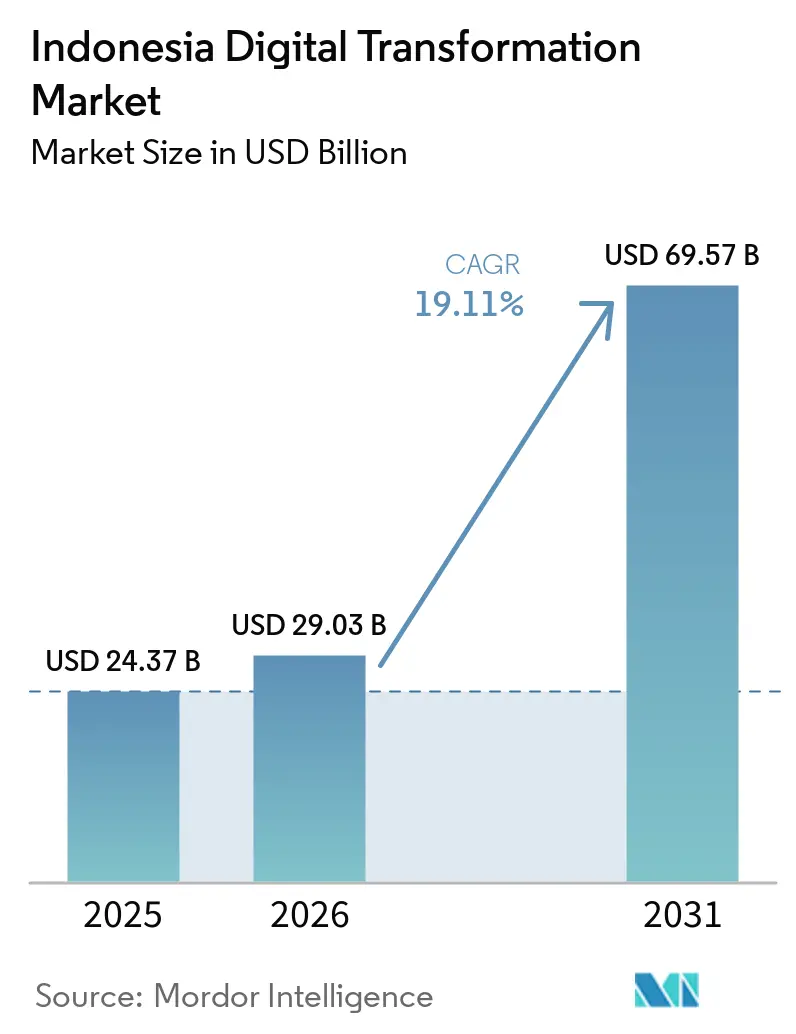
| Base Year Market Size (2025) | USD 24.37 Billion |
| Market Size (2026) | USD 29.03 Billion |
| Market Size (2031) | USD 69.57 Billion |
| Growth Rate (2026 - 2031) | 19.11 % |
| Market Concentration | Medium |
Major Players *Disclaimer: Major Players sorted in no particular order Image © Mordor Intelligence. Reuse requires attribution under CC BY 4.0. | |
Indonesia Digital Transformation Market Analysis by Mordor Intelligence
The Indonesia digital transformation market size is expected to grow from USD 24.37 billion in 2025 to USD 29.03 billion in 2026 and is forecast to reach USD 69.57 billion by 2031 at 19.11% CAGR over 2026-2031. Momentum is building as hyperscalers pour capital into sovereign cloud regions, enabling enterprises to modernize legacy systems without breaching data-sovereignty rules. Manufacturing plants are adopting industrial robots and IoT sensors to raise throughput, while telemedicine platforms and electronic health record systems are broadening access to healthcare services across the archipelago. Consolidation among telecom operators, most notably the XL Axiata-Smartfren merger, promises denser 5G coverage that supports low-latency applications and edge-computing workloads. Enterprises are shifting to hybrid deployment architectures to keep mission-critical workloads on-premises and still capture the scalability of public cloud, and small businesses are narrowing the digital gap through super-app ecosystems, e-payments, and subscription-based SaaS offerings.
Key Report Takeaways
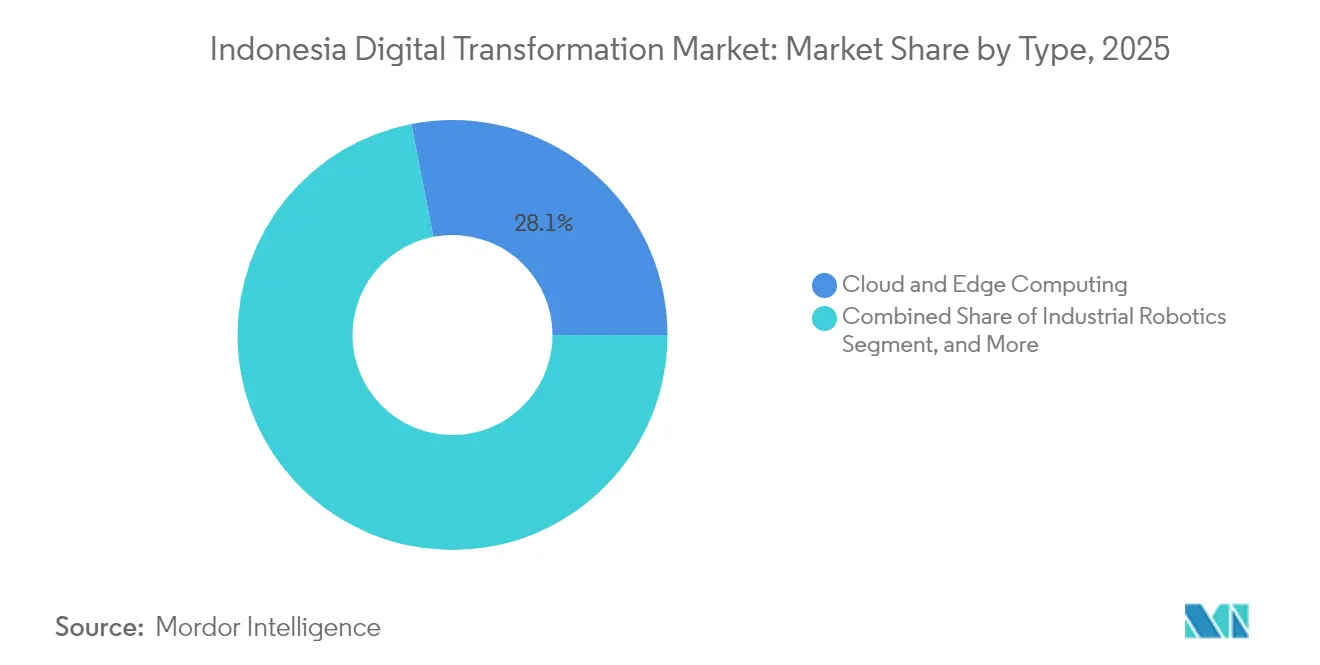
- By technology, cloud and edge computing led with 28.07% of the Indonesia digital transformation market share in 2025, while industrial robotics is forecast to advance at a 22.05% CAGR through 2031.
- By end user, manufacturing accounted for 23.78% share of the Indonesia digital transformation market size in 2025, while healthcare is projected to grow at a 23.62% CAGR to 2031.
- By deployment mode, cloud solutions captured 52.41% share of the Indonesia digital transformation market size in 2025, whereas hybrid deployments are expected to expand at a 22.74% CAGR through 2031.
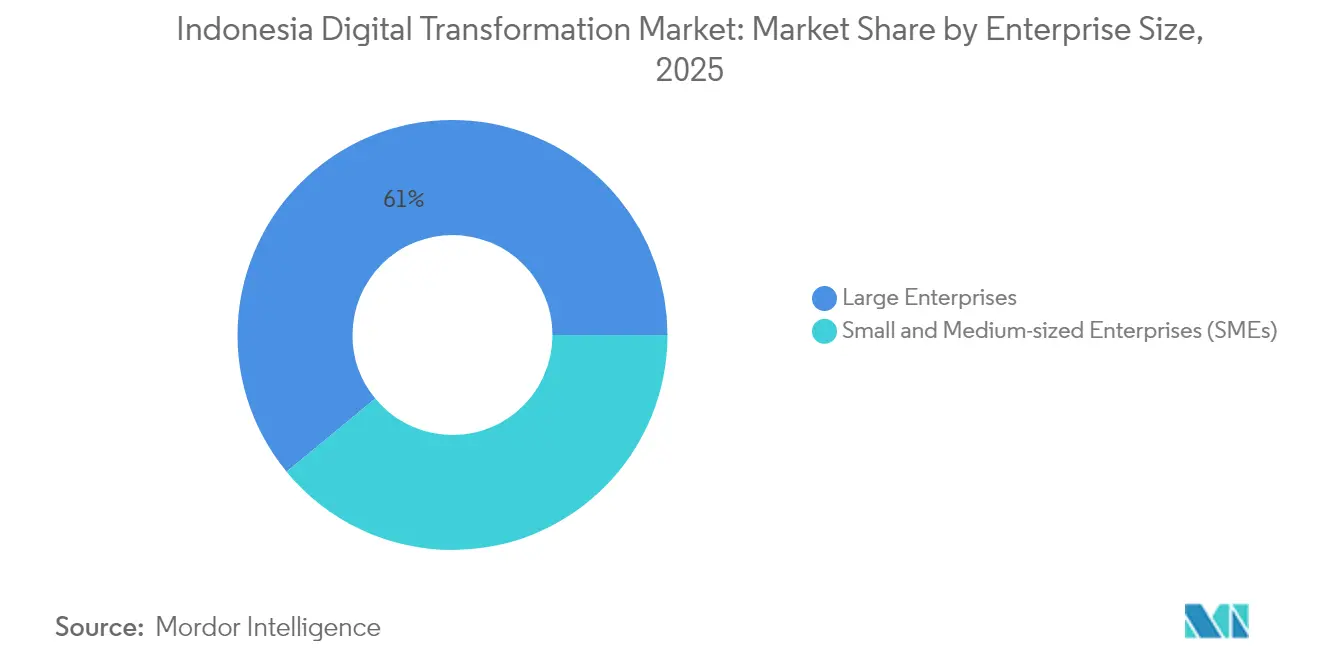
- By enterprise size, large enterprises commanded 60.96% of the Indonesia digital transformation market share in 2025, while small and medium-sized enterprises are poised to increase at a 22.09% CAGR over the same period.
- By geography, Java and Sumatra together contributed 69.84% of the Indonesia digital transformation market size in 2025, whereas Eastern Indonesia shows the fastest trajectory with a 24.86% CAGR to 2031.
Note: Market size and forecast figures in this report are generated using Mordor Intelligence’s proprietary estimation framework, updated with the latest available data and insights as of 2026.
The pace and direction of global change depend on shifts occurring across countries and regions simultaneously, not within any one of them alone. The global digital transformation (dx) market outlook research of Mordor Intelligence reflects this combined progression.
Indonesia Digital Transformation Market Trends and Insights
Drivers Impact Analysis*
| Driver | (~) % Impact on CAGR Forecast | Geographic Relevance | Impact Timeline |
|---|---|---|---|
| Accelerated cloud infrastructure roll-outs by hyperscalers | +4.20% | National, concentrated in Java and Sumatra | Medium term (2-4 years) |
| Rapid proliferation of mobile devices and super-apps | +3.80% | National, with highest penetration in urban centers | Short term (≤ 2 years) |
| Government's "Making Indonesia 4.0" incentives | +3.50% | National, prioritizing manufacturing hubs | Long term (≥ 4 years) |
| 5G and LEO-satellite backhaul for outer-island factories | +2.90% | Eastern Indonesia, remote manufacturing locations | Long term (≥ 4 years) |
| Rise of local AI-ASIC design start-ups | +2.10% | Jakarta, Bandung tech corridors | Medium term (2-4 years) |
| Millennial digital-native labour surge | +2.90% | National, concentrated in urban areas | Medium term (2-4 years) |
| Source: Mordor Intelligence | |||
Accelerated Cloud Infrastructure Rollouts by Hyperscalers
AWS has committed USD 5 billion to build data-center clusters in West Java, while Microsoft has earmarked USD 1.7 billion for additional capacity, creating localized regions that comply with the Personal Data Protection Law. These sovereign facilities satisfy data-residency rules and shorten latency for analytics, AI inference, and e-commerce workloads. Financial institutions are already capitalizing; Bank Jago moved core applications to Google Cloud, and Krom Bank migrated customer-facing services to AWS, gaining scalable computing power without compromising compliance. Edge nodes are being deployed across secondary cities so that factory-floor sensors and autonomous guided vehicles can process data in near real time. Enterprises report that the availability of local cloud zones has accelerated cloud migration velocity by roughly 40% year over year as fear of cross-border data transfer penalties subsides.
Rapid Proliferation of Mobile Devices and Super-Apps
Indonesia’s mobile-first environment has become fertile ground for digital services, with smartphone adoption climbing across both metropolitan and second-tier cities. Super-apps such as Gojek’s GoTo and regional rival Grab have evolved from ride-hailing platforms into integrated ecosystems encompassing payments, insurance, and B2B logistics. GoTo disclosed gross transaction value of 137.4 trillion rupiah in 2024, and the national QRIS system now links more than 22.4 million merchants, widening the reach of digital payments. The intertwined nature of commerce, payments, and on-demand services generates granular consumer data, enabling AI-driven segmentation that advertisers and retailers leverage for targeted campaigns. Partnerships between super-apps and cloud providers are also giving SMEs one-click access to inventory management, bookkeeping, and lending solutions embedded within familiar mobile interfaces.
Government “Making Indonesia 4.0” Incentives
The government’s Industry 4.0 roadmap offers tax holidays, import-duty exemptions, and priority lending for automation and AI projects in strategic sectors. Multinational equipment makers now co-develop digital twin pilots with local manufacturers under the program’s partnership clause. Early adopters such as Olympia Express cut prototype turnaround time by 50% after deploying cloud-based design tools, and consumer goods factories report 30% productivity gains through real-time production dashboards. Dedicated innovation hubs in West Java and East Java supply test beds for SMEs to trial machine vision or additive-manufacturing applications, accelerating diffusion beyond large enterprises. Alignment with ISO 27001 standards under the same policy umbrella ensures cybersecurity baselines that reassure foreign investors and enable integration with global value chains.
5G and LEO-Satellite Backhaul for Outer-Island Factories
Indonesia’s dispersed geography has historically constrained digital adoption outside Java. Starlink’s expanding constellation now backhauls traffic from private 5G networks that telcos are installing in Kalimantan and Sulawesi industrial parks, creating redundant paths to central data centers. The XLSmart merger is earmarking USD 300–400 million a year for network optimization, reinforcing mid-band 5G coverage that supports ultra-low-latency use cases like collaborative robotics. Subsea cables such as Bifrost and INSICA further guarantee throughput and resiliency, letting mining and plantation operators stream telemetry to cloud analytics platforms in real time. Provincial governments are bundling spectrum incentives with land-use licenses to attract manufacturers willing to digitize local facilities, fostering balanced regional development.
Restraints Impact Analysis*
| Restraint | (~) % Impact on CAGR Forecast | Geographic Relevance | Impact Timeline |
|---|---|---|---|
| Persistent cyber-security and data-sovereignty concerns | -2.30% | National, particularly financial services sector | Short term (≤ 2 years) |
| Shortage of enterprise-grade talent | -1.80% | National, acute in tier-2 cities | Medium term (2-4 years) |
| Fragmented regulatory compliance across provinces | -1.50% | Regional variations, complex in manufacturing zones | Long term (≥ 4 years) |
| Over reliance on imported industrial robotics | -1.20% | Manufacturing centers in Java and Sumatra | Medium term (2-4 years) |
| Source: Mordor Intelligence | |||
Persistent Cyber-Security and Data-Sovereignty Concerns
Full enforcement of the Personal Data Protection Law in October 2024 introduced strict breach notification timelines and extraterritorial provisions that catch subsidiaries outside Indonesia.[1] Financial institutions now require vendors to demonstrate compliance through third-party audits and localized key-management systems. Presidential Regulation 82/2022 further designates the banking, telecom, and energy sectors as vital information infrastructure and mandates periodic security assessments. While these measures mitigate systemic risk, compliance costs have risen, and enterprises face heightened scrutiny when moving sensitive workloads to the public cloud. Cyber-incident statistics from the central bank show that advanced persistent threats targeting critical sectors jumped 34.4% year over year in 2024, prompting demand for managed detection and response services tightly integrated into digital-transformation roadmaps.
Shortage of Enterprise-Grade Talent
Rapid tech adoption has outpaced the supply of cloud architects, AI engineers, and cybersecurity specialists. Metro Jakarta and Bandung retain most qualified professionals, leaving tier-2 industrial cities scrambling for expertise. Companies compensate with hybrid work models that bring in overseas specialists on project cycles, while universities fast-track micro-credential programs with hyperscalers and device vendors. Nevertheless, salary inflation for senior DevOps engineers hit double-digit growth in 2025, eroding some cost advantages of local deployment. Automation platforms and low-code tools are being adopted to offset the deficit, but complex integrations and security architecture still demand experienced personnel, slowing large-scale rollouts for SMEs.
*Our forecasts treat driver/restraint impacts as directional, not additive. The impact forecasts reflect baseline growth, mix effects, and variable interactions.
Segment Analysis
By Type: Industrial Robotics Accelerates Manufacturing Automation
Industrial robotics recorded the fastest expansion within the Indonesia digital transformation market, advancing at a 22.05% CAGR over 2026–2031 as factories adopt collaborative robots for welding, pick-and-place, and quality inspection tasks. The Indonesia digital transformation market size attributable to industrial robots is set to more than triple as automotive, consumer-goods, and electronics plants retrofit legacy lines with AI-enabled vision systems. Simultaneously, cloud and edge computing held the largest slice of technology spending at 28.07% in 2025, powered by sovereign regions that satisfy data-localization rules. IoT deployments are maturing from proof-of-concept to scaled production monitoring, especially in food-processing facilities where humidity and temperature sensors have cut spoilage rates. Additive manufacturing remains niche but is gaining interest for spare-parts on-demand production, cutting lead times for remote mining operations.
Cloud databases, container orchestration, and AI platforms serve as the digital backbone connecting these point solutions. Cybersecurity tools embed zero-trust architecture into plant networks to safeguard programmable logic controllers from ransomware threats. Extended-reality applications for remote maintenance and workforce training lower travel costs and enhance safety. Blockchain pilots tracing palm-oil supply chains are moving into consortium governance models that encourage data-sharing among competitors without exposing proprietary information. The diverse technology mix underscores how the Indonesia digital transformation market continues broadening beyond initial cloud migrations toward full-stack digitization.

By End User: Healthcare Digitization Outpaces Traditional Sectors
Manufacturing captured 23.78% of technology spend in 2025, reflecting early alignment with “Making Indonesia 4.0” productivity targets. Automated material-handling systems, digital twins, and predictive-maintenance analytics yielded tangible cost savings that justify ongoing investment. In contrast, the healthcare segment is scaling rapidly within the Indonesia connected healthcare ecosystem, with a forecast 23.62% CAGR, fuelled by telehealth reimbursement policies and hospital accreditation standards that require electronic health-record adoption. Start-ups are integrating AI chatbots into triage services, lightening the load on understaffed clinics across remote islands. Oil, gas, and utilities operators embed IoT sensors and digital twins to enhance safety and optimize asset uptime, while retail chains rely on super-app integration and cloud POS systems for omnichannel inventories.
The Indonesia digital transformation market size tied to healthcare stands to increase sharply as community health centers upgrade imaging and diagnostics. Banks and insurers apply machine-learning fraud detection to reduce claim denials, freeing budget for customer-experience automation. Public-sector agencies digitize citizen services, aligning back-office records with cloud-based workflow engines that improve transparency. Education institutions scale learning-management platforms, while media operators embrace OTT distribution and targeted advertising to monetize large subscriber bases. Each vertical is carving distinct digital roadmaps, yet all share a common dependence on reliable connectivity and secure data-handling frameworks.
By Deployment Mode: Hybrid Solutions Bridge Legacy and Cloud
Cloud deployments accounted for 52.41% of spending in 2025 as enterprises migrated customer-facing portals, analytics sandboxes, and DevOps pipelines into hyperscaler regions. However, hybrid architectures are climbing fastest at a 22.74% CAGR because they let organizations retain supervisory-control systems and sensitive ERP databases on-premises while extending analytics to cloud. The Indonesia digital transformation market size linked to hybrid models is likely to rival pure-cloud outlays by the end of the forecast period. Regulators endorse this approach, noting that sector-specific data can reside locally without sacrificing global service resilience.
Fixed-mobile-convergence strategies adopted by dominant telcos show parallel logic, combining fiber, 5G, and satellite in single-invoice packages that simplify enterprise procurement. Edge gateways process IoT traffic close to manufacturing floors, filtering data before forwarding to cloud-native data lakes, slashing bandwidth costs. Disaster-recovery planning now factors in geo-distributed zones across Java, Batam, and Singapore, maintaining compliance with continuity mandates. As capital expenditure moderates, pay-as-you-go pricing aligns with CFO demands for budget certainty. Collectively, these factors keep hybrid in pole position for workload modernization.
By Enterprise Size: SME Growth Accelerates Through Digital Finance
Large enterprises commanded 60.96% of 2025 spending because they possess internal IT teams and capital reserves to execute multi-year roadmaps. Yet SMEs are advancing at a 22.09% CAGR thanks to government grant programs that subsidize cloud subscriptions and cybersecurity audits. Digital wallets and QRIS integration simplify payments, boosting cash flow and enabling incremental investment in e-commerce storefronts and inventory software. The Indonesia digital transformation market size dedicated to SMEs is thus set to expand its share over the forecast period.
Platform providers cater to this cohort with low-code workflow builders and bundled ERP modules. Super-apps embed micro-lending services using alternative credit-scoring algorithms derived from transaction histories, easing access to working capital. Training initiatives from the Ministry of Education and corporate philanthropies provide micro-credentials in data analytics and digital marketing, addressing human-capital gaps. These combined enablers let small retailers, agri-processors, and hospitality operators participate more fully in national digitization.
By Function: Operations Optimization Drives Productivity Gains
Operations and production functions dominate investment totals, encompassing automated visual-inspection systems, AI scheduling, and predictive-maintenance alerts that reduce downtime. Customer-experience tools chatbots, sentiment analytics, and omnichannel CRM have moved beyond pilots and are integral to service differentiation in banking and retail. Finance departments implement robotic process automation for reconciliation and statutory reporting, increasing accuracy and freeing staff for value-added analysis.
Human-resources teams deploy AI-screening engines, self-service portals, and e-learning suites to manage diverse workforces while supporting remote operations. Supply-chain divisions use blockchain ledgers to track provenance of raw materials, meeting export-market sustainability stipulations. The Indonesia digital transformation market continues to evolve as companies integrate these cross-functional modules into unified data platforms, leveraging analytics to spot cost-reduction opportunities and new revenue pools.
Geography Analysis
Java and Sumatra accounted for 69.84% of 2025 spending as dense population centers, mature industrial estates, and metro fiber backbones foster early adoption of cloud and AI services. Jakarta’s Golden Triangle boasts the nation’s highest concentration of Tier III and IV data centers, making it the preferred landing zone for hyperscalers. Bandung, Surabaya, and Medan leverage university-linked innovation hubs and established manufacturing clusters to trial Industry 4.0 upgrades. Private 5G networks launched in Bekasi and Karawang industrial corridors now stream machine telemetry into cloud data lakes, reducing time-to-insight for quality teams.
Eastern Indonesia Kalimantan, Sulawesi, Maluku, and Papua show a 24.86% CAGR through 2031 as LEO-satellite backhaul and new subsea cables conquer the tyranny of distance. Mining firms in Kalimantan transmit haul-truck sensor data into Jakarta-based analytics clusters, while fishery co-operatives in North Maluku use IoT cold-chain monitors to meet export certifications. Provincial governments are rolling out e-government portals to bridge service gaps, and vocational-training centers partner with device vendors to build a local technician pool.
Cross-border digital-economy frameworks under the ASEAN Digital Masterplan are harmonizing data-flow standards, positioning Indonesia as a regional processing hub. Singapore-Jakarta latency is now sub-20 milliseconds on upgraded routes, encouraging multinational banks to host disaster-recovery nodes in Batam. Regulatory sandboxes in selected special economic zones permit fintech experimentation under relaxed rules, attracting both domestic and foreign start-ups. The geographic mosaic thus aligns infrastructure expansion, policy incentives, and private capital to ensure wide participation in the Indonesia digital transformation market.
Mordor Intelligence examines the digital transformation (dx) market across diverse other regional markets as well, including Latin America, Asia, and Europe, while also offering granular country-level perspectives for China, South Korea, Brazil, Poland, Oman, and Italy and more.
Competitive Landscape
Global hyperscalers AWS, Microsoft, and Google anchor cloud infrastructure, but partner heavily with local system integrators to navigate data-residency and procurement norms. Telkom Indonesia leverages its fiber backbone to offer bundled edge-computing and private-cloud solutions, while XLSmart’s 27% subscriber share provides a springboard for nationwide 5G-enabled digital services. Domestic IT specialists such as PT Multipolar Technology Tbk focus on vertical solutions for banking and retail, using ISO 27001 compliance as a differentiator.
Competition is intensifying as ecosystem players pursue strategic mergers and acquisitions. Mekari’s purchase of Jojonomic unified payroll, accounting, and CRM modules on a single SaaS platform for SMEs, while super-apps Grab and GoTo are in merger talks that would consolidate user bases and cross-sell financial services. Hyperscalers engage in joint investment vehicles with telcos to fund edge zones and sovereign-cloud offerings.
White-space opportunities remain in AI-fabricated semiconductors, blockchain-based commodity trading, and agtech analytics. Providers able to certify secure, low-latency connections across Indonesia’s 17,000 islands stand to win in logistics and energy verticals. Compliance expertise around the Personal Data Protection Law and sectoral standards grants a commercial advantage, forcing international vendors to localize offerings. Market participants therefore balance scale economics with tailored solutions that resonate with Indonesian policy and cultural nuances.[4]
Indonesia Digital Transformation Industry Leaders
-
Accenture PLC
-
Google LLC (alphabet Inc.)
-
Siemens AG
-
IBM Corporation
-
Microsoft Corporation
- *Disclaimer: Major Players sorted in no particular order

Recent Industry Developments
- March 2025: XL Axiata and Smartfren completed their USD 6.5 billion merger to form PT XLSmart Telecom Sejahtera Tbk, creating Indonesia’s third-largest mobile operator with 94.3 million subscribers and targeting USD 300–400 million in annual synergies.
- February 2025: Grab and GoTo entered advanced merger discussions with a combined valuation above USD 7 billion, aiming to streamline overlapping cost structures and reinforce digital-finance capabilities.
- January 2025: Axiata Group Berhad and Sinar Mas signed memoranda of understanding worth IDR 104 trillion (USD 6.7 billion) for 5G solutions, enterprise services, and fintech collaboration.
- December 2024: Bank Negara Indonesia launched digital-ecosystem partnerships in education, healthcare, and industrial estates to tap the projected USD 210–360 billion digital economies by 2030.
Indonesia Digital Transformation Market Report Scope
Digital transformation is the process of incorporating digital technologies such as artificial intelligence and machine learning, extended reality (VR & AR) for industrial applications, IoT, industrial robotics, blockchain, digital twins, 3D printing/ additive manufacturing, industrial cyber security, wireless connectivity, edge computing, smart mobility, and others across various end-user industries.
The Indonesian digital transformation market is segmented by type (analytics, artificial intelligence, and machine learning extended reality (XR), IoT, industrial robotics, blockchain, additive manufacturing/3D printing, cybersecurity, cloud and edge, computing, and other types (digital twin, mobility, and connectivity) and end users (manufacturing, oil, gas, and utilities, retail & e-commerce, transportation, and logistics, healthcare, BFSI, telecom, and IT, government and public sector, and other end users (education, media & entertainment, environment etc). The market sizes and forecasts are provided in terms of value in USD for all the above segments.
| Analytics, Artificial Intelligence and Machine Learning |
| Extended Reality (XR) |
| Internet of Things (IoT) |
| Industrial Robotics |
| Blockchain |
| Additive Manufacturing / 3D Printing |
| Cybersecurity |
| Cloud and Edge Computing |
| Other Types - Digital Twin, Mobility and Connectivity |
| Manufacturing |
| Oil, Gas and Utilities |
| Retail and E-commerce |
| Transportation and Logistics |
| Healthcare |
| Banking, Financial Services and Insurance (BFSI) |
| Telecom and IT |
| Government and Public Sector |
| Other End Users - Education, Media and Entertainment, Environment |
| On-premise |
| Cloud |
| Hybrid |
| Large Enterprises |
| Small and Medium-sized Enterprises (SMEs) |
| Operations and Production |
| Customer Experience and Front-office |
| Finance and Accounting |
| Human Resources |
| Supply Chain and Procurement |
| By Solution ype | Analytics, Artificial Intelligence and Machine Learning |
| Extended Reality (XR) | |
| Internet of Things (IoT) | |
| Industrial Robotics | |
| Blockchain | |
| Additive Manufacturing / 3D Printing | |
| Cybersecurity | |
| Cloud and Edge Computing | |
| Other Types - Digital Twin, Mobility and Connectivity | |
| By End User | Manufacturing |
| Oil, Gas and Utilities | |
| Retail and E-commerce | |
| Transportation and Logistics | |
| Healthcare | |
| Banking, Financial Services and Insurance (BFSI) | |
| Telecom and IT | |
| Government and Public Sector | |
| Other End Users - Education, Media and Entertainment, Environment | |
| By Deployment Mode | On-premise |
| Cloud | |
| Hybrid | |
| By Enterprise Size | Large Enterprises |
| Small and Medium-sized Enterprises (SMEs) | |
| By Function | Operations and Production |
| Customer Experience and Front-office | |
| Finance and Accounting | |
| Human Resources | |
| Supply Chain and Procurement |
Key Questions Answered in the Report
What is the current value of the Indonesia digital transformation market?
The Germany cloud computing market size is valued at USD 29.03 billion in 2026.
What is the expected growth rate for German cloud spending through 2031?
Aggregate spending is projected to rise at a 19.11% CAGR to USD 69.57 billion by 2031.
Which deployment model is expanding fastest among German enterprises?
Hybrid cloud leads, advancing at an 22.74% CAGR as companies blend data residency with scalable off-premises compute.
Why is healthcare adoption accelerating?
Telemedicine rollouts, electronic-health-record mandates and AI-enabled diagnostics push healthcare workloads to compliant clouds, driving an 23.62% CAGR.
How does the SAP S/4HANA deadline affect demand?
The 2027 cutoff forces firms to choose cloud-hosted ERP, creating a sizable migration wave that boosts infrastructure and services revenue.
What competitive advantage do sovereign-cloud providers claim?
They highlight BSI C5 certification, client-side encryption and in-country hosting, meeting stringent German data-sovereignty requirements.