
Market Overview
| Study Period | 2020 - 2031 |
|---|---|
| Forecast Data Period | 2026 - 2031 |
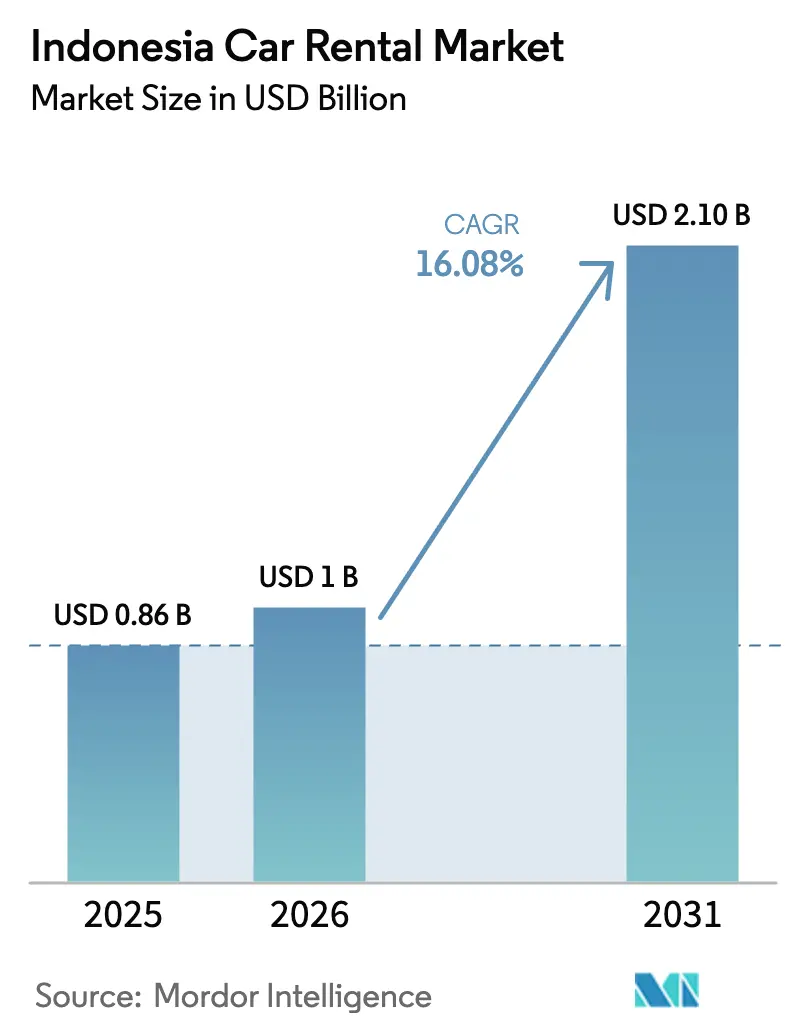
| Base Year Market Size (2025) | USD 0.86 Billion |
| Market Size (2026) | USD 1 Billion |
| Market Size (2031) | USD 2.1 Billion |
| Growth Rate (2026 - 2031) | 16.08 % |
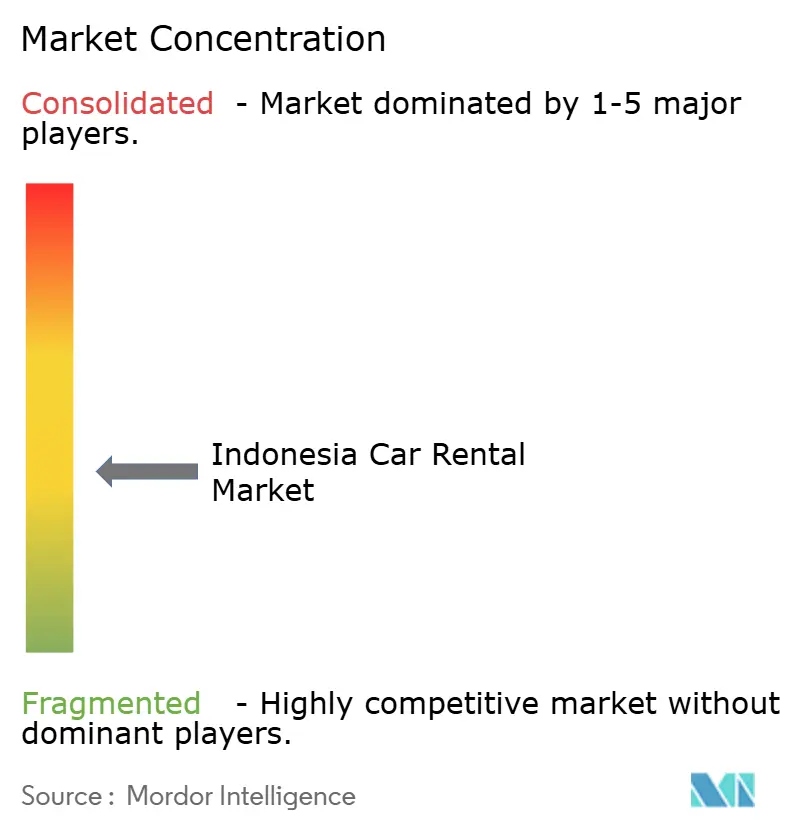
| Market Concentration | Medium |
Major Players *Disclaimer: Major Players sorted in no particular order Image © Mordor Intelligence. Reuse requires attribution under CC BY 4.0. | |
Indonesia Car Rental Market Analysis by Mordor Intelligence
The Indonesian car rental market size in 2026 is estimated at USD 1.0 billion, growing from 2025 value of USD 0.86 billion with 2031 projections showing USD 2.1 billion, growing at 16.08% CAGR over 2026-2031. Over the next five years, rising disposable incomes, expanding middle-class travel budgets, and widespread smartphone adoption set a favorable backdrop for sustained double-digit growth. The government’s target of welcoming between 14.6 and 16 million foreign visitors in 2025, up from 13.9 million in 2024, signals resilient tourism demand even as business travel rebounds on the back of Indonesia’s 5.05% GDP growth in 2024. Online platforms are redefining customer expectations around transparency, on-demand availability, and digital payments, while new incentives for battery-electric vehicles (BEVs) position electrification as a future profit pool. Competitive pressure intensifies as app-based mobility ecosystems blur the line between ride-hailing and daily rentals, prompting traditional operators to accelerate fleet modernization and data-driven pricing strategies.
Key Report Takeaways
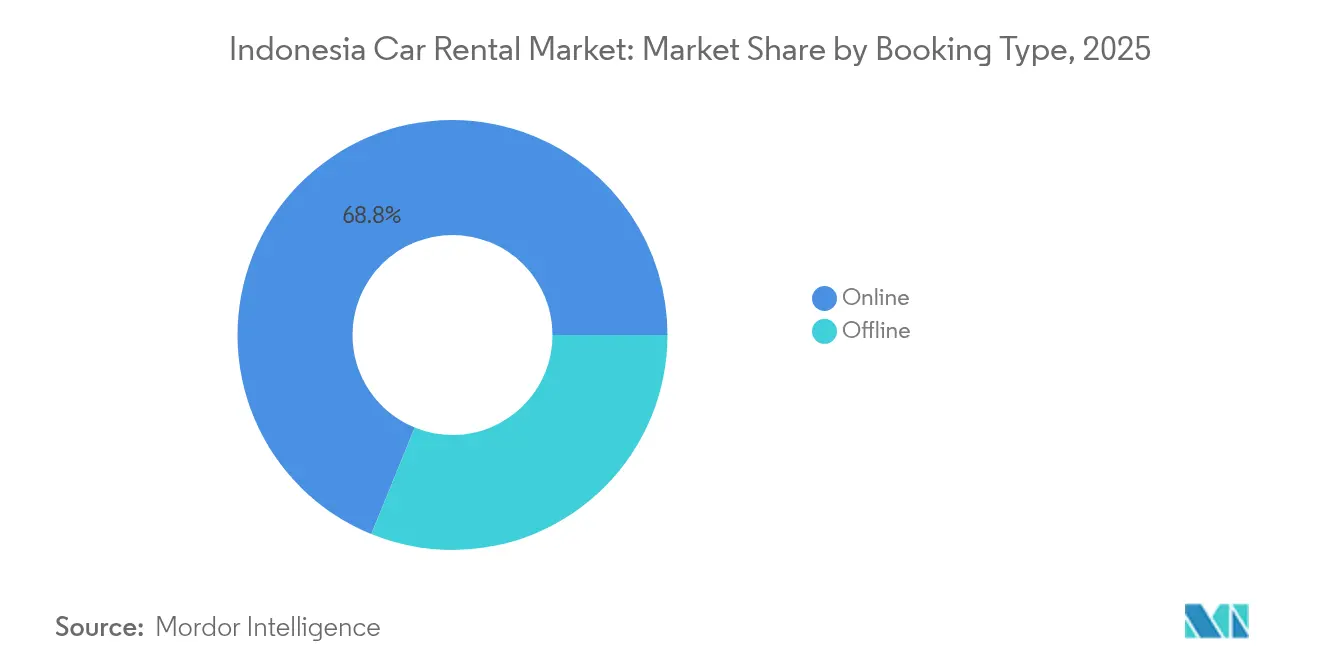
- By booking type, online channels held a 68.84% share of the Indonesia car rental market in 2025 and are expected to post the fastest growth at a 16.85% CAGR through 2031.
- By rental duration, the short-term segment captured 57.88% share of the Indonesia car rental market in 2025, yet long-term contracts are projected to accelerate at a 17.12% CAGR to 2031.
- By application, tourism and leisure dominated the Indonesia car rental market in 2025, with a 63.74% share, whereas corporate mobility is forecast to grow at an 17.62% CAGR over the same horizon.
- By vehicle type, economy and hatchback models led with 44.71% share in the Indonesia car rental market in 2025; SUVs are the fastest-growing category, expanding at a 17.38% CAGR to 2031.
- By fuel type, Petrol ICE cars accounted for 78.92% share in the Indonesia car rental market in 2025, while BEVs are projected to surge at a 18.63% CAGR.
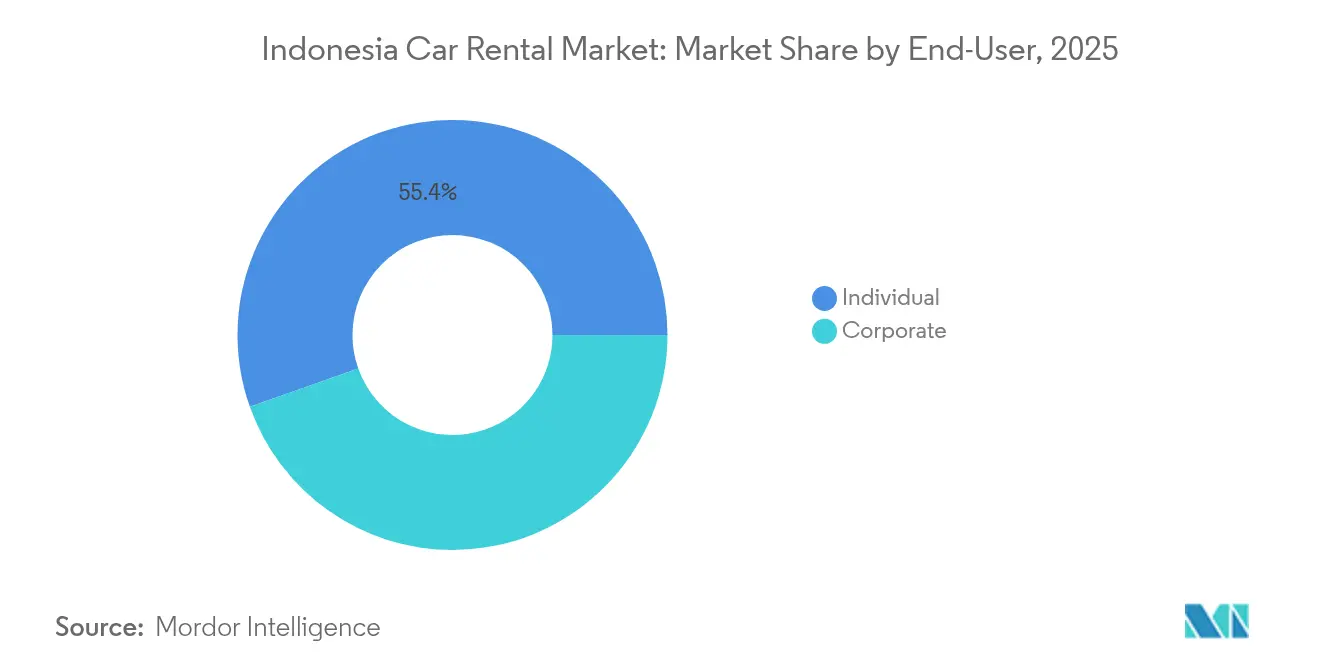
- By end-user, individuals represented 55.42% share in the Indonesia car rental market in 2025; corporate accounts will log the highest growth, rising at an 18.01% CAGR through 2031.
- By rental channel, aggregators controlled 71.85% share in the Indonesia car rental market in 2025, but super-app bundles will see the quickest lift with a 17.29% CAGR.
- By region, Java account for 61.65% share in the Indonesia car rental market in 2025; Bali and Nusa Tenggara are poised for the fastest expansion at an 18.24% CAGR through 2031.
Note: Market size and forecast figures in this report are generated using Mordor Intelligence’s proprietary estimation framework, updated with the latest available data and insights as of 2026.
Indonesia Car Rental Market Trends and Insights
Drivers Impact Analysis*
| Driver | (~) % Impact on CAGR Forecast | Geographic Relevance | Impact Timeline |
|---|---|---|---|
| Rising Tourist Arrivals | +3.2% | Java, Bali, and emerging leisure corridors | Medium term (2-4 years) |
| Digital Booking Platforms Surge | +2.8% | National, with highest penetration in major metro areas | Short term (≤2 years) |
| Firms Drive Leasing Demand | +2.5% | Jakarta, Surabaya, and secondary business hubs | Medium term (2-4 years) |
| EV Roadmap Accelerates Electrification | +2.1% | Jakarta and other provincial capitals | Long term (≥4 years) |
| Halal Packages Boost Niche Tourism | +1.9% | Nationwide, especially Islamic heritage destinations | Long term (≥4 years) |
| Airports Expanding Connectivity | +1.7% | Emerging tourism corridors around upgraded regional airports | Medium term (2-4 years) |
| Source: Mordor Intelligence | |||
Rising International and Domestic Tourist Arrivals
In 2024, Indonesia welcomed around 13.9 million international visitors and recorded over 1 billion domestic journeys, marking a swift rebound in its tourism sector following the easing of border restrictions. The Ministry of Tourism projects inbound visitors will rise to between 14.6 and 16 million in 2025, supported by visa-on-arrival expansion and marketing of the “10 New Balis” destinations. Significant capital investment in Komodo, Lombok, and other regional airports increases seat capacity and disperses travel flows beyond Java. The World Travel & Tourism Council projects the sector will contribute 4.6% to GDP in 2025[1]“Indonesia 2024 Annual Research,” World Travel & Tourism Council, wttc.org. A larger tourist base directly lifts self-drive rentals and chauffeured packages, particularly in islands where public transport is limited.
Surge in Digital-First Booking Platforms
In 2024, Indonesia's digital economy hit the USD 90 billion mark, buoyed by a surge in e-commerce transactions, with projections indicating further growth[2]“e-Commerce Statistics of Asia Pacific 2024,” Asian Development Bank, adb.org. Online rental bookings accounted for a substantial share of the overall transactions in 2024 and are growing significantly annually as consumers gravitate to super-apps offering instant price comparison, cashless payments, and loyalty rewards. Partnerships like Blue Bird taxis integrating with Gojek allow legacy fleets to unlock a nationwide customer base while cutting acquisition costs. Aggregators use rich data to fine-tune dynamic pricing, optimize fleet utilization, and upsell insurance or ancillary services in real time.
Growing Corporate Demand for Long-Term Operational Leasing
Large domestic firms and multinational subsidiaries increasingly outsource vehicle ownership to avoid capital outlays and residual-value risk. Government entities like Keerom District pioneered annual operating leases instead of purchasing official cars, citing lower lifecycle costs. Foreign direct investors, able to complete licensing within 1.5 months after the Omnibus Law reforms, require immediate fleet availability for executives and expatriates. Long-term contracts lock in predictable monthly fees while bundling insurance, preventive maintenance, and driver management, creating high-margin recurring revenue for fleet operators.
Government EV Roadmap Accelerating Fleet Electrification
Numerous manufacturers now offer various BEV models at varying price points to Indonesian car consumers. The surge in this market can be traced back to Presidential Regulation No. 55/2019, which introduced fiscal and non-fiscal incentives to bolster domestic electric vehicle production. Building on this momentum, Presidential Regulation No. 79/2023 expanded these incentives and made BEVs more wallet-friendly for consumers. Further sweetening the deal, the Ministry of Finance Regulation No.38/2023 slashed the value-added tax on new passenger electric vehicles from 11% to 1%. Due to these tax breaks, both the value-added tax reduction and the luxury tax exemption, BEV prices have seen a dip, leading to a surge in sales of battery electric passenger cars, buses, and motorcycles [3]Tenny Kristiana, “Policies to help Indonesia’s new president champion electric vehicles,” International Council on Clean Transportation, theicct.org. The national plan targets 600,000 BEVs and 2.45 million electric two-wheelers by 2030, backed by a public-charging build-out of 846 car stations and 1,401 battery-swap depots for motorcycles. Rental agencies introducing BEVs gain access to preferential parking and bus-lane exemptions in Jakarta, while corporate clients use low-emission vehicles to burnish ESG credentials and trim fuel costs.
Restraints Impact Analysis*
| Restraint | (~) % Impact on CAGR Forecast | Geographic Relevance | Impact Timeline |
|---|---|---|---|
| Short-Term Rental Market Cannibalized | -2.3% | Jakarta, Surabaya, Medan, and other large metropolitan areas | Medium term (2-4 years) |
| Competitors Wage Intense Price War | -1.8% | National, highest intensity in Java and major urban centers | Short term (≤2 years) |
| Congestion Deters Self-Driving Options | -1.5% | Jakarta metropolitan area and other densely populated cities | Long term (≥4 years) |
| Regulatory Burden Fragments Regional Markets | -1.2% | Nationwide, with variations across provincial jurisdictions | Medium term (2-4 years) |
| Source: Mordor Intelligence | |||
Ride-Hailing Super-Apps Cannibalizing Short-Term Rentals
Grab and Gojek processed a significant number of on-demand rides in Indonesia during 2024. A proposed Grab-GoTo tie-up could deepen network effects, bundling deliveries, payments, and ride-sharing into a single wallet. Urban consumers prefer door-to-door rides over self-drive rentals to avoid congestion fees and parking scarcity. Corporate travelers also book ride-hailing through expense-management dashboards, bypassing traditional airport pickup counters. To stay relevant, rental firms are exploring hourly packages, loyalty linkage with airlines, and premium SUVs to serve niches less exposed to app-based commoditization.
Intensifying Price-Led Competition Among Incumbents
Indonesia hosts hundreds of registered rental firms and many operating fleets. As online aggregators standardize price displays, operators undercut one another, weakening margins. Blue Bird Group has responded with tiered pricing and value-added chauffeur packages, but still reports downward pressure on daily rates in Jabodetabek. Smaller regional players lack scale for fleet renewal and must absorb rising VAT, which climbs to a considerable share in 2025, squeezing net profit. Consolidation is expected, with larger fleets leveraging bulk procurement discounts and telematics to extract operating efficiencies.
*Our forecasts treat driver/restraint impacts as directional, not additive. The impact forecasts reflect baseline growth, mix effects, and variable interactions.
Segment Analysis
By Booking Type: Online Penetration Redefines the Experience
Online channels generated 68.84% of the Indonesian car rental market revenue in 2025, climbing at a 16.85% CAGR. The dominance reflects deep smartphone penetration, a cashless payment boom, and consumer comfort with super-apps integrating trip planning, mapping, and digital wallets. Indonesia's car rental market size, attributed to offline travel-agency counters, remained at significant revenue in 2025 but is losing share as small operators list fleets on aggregator portals to reach price-sensitive tourists.
Super-app ecosystems combine ride-hailing, food delivery, and digital banking, encouraging cross-selling day-long rental packages. Legacy brands adopt cloud-based reservation engines, push-notification discounts, and AI-enabled customer-service chatbots to match the user experience of tech platforms. Data captured online allows segmentation by nationality, trip purpose, and spend, enabling operators to A/B test mileage caps or bundle Wi-Fi routers for incremental revenue.



By Rental Duration: Long-Term Leasing Gains Corporate Favor
Short-term bookings, defined as rentals lasting 1–30 days, held a 57.88% share in the Indonesian car rental market in 2025 due to seasonal tourism peaks. Long-term contracts surpassed the noteworthy revenue i the Indonesian car rental market in 2025 and are projected to expand at a 17.12% CAGR. Corporations adopt operating leases to preserve capital and shift maintenance responsibilities to service providers.
Long-term packages typically include driver salaries, periodic servicing, and full insurance, insulating clients from residual-value swings. Fleet managers deploy telematics to monitor fuel consumption and preventive maintenance, reducing downtime. The trend also anchors used-vehicle disposal channels, where cars aged three to five years are auctioned or sold to ride-hailing drivers, recouping capital faster than private resales.
By Application: Corporate Mobility Catches Up with Tourism
Tourism accounted for 63.74% of revenue in 2025; however, business mobility is on course to become the next growth engine, expanding at an 17.62% CAGR. Indonesia’s investment-grade rating and quick licensing approvals spur multinational relocations, raising demand for executive transfers, project-site shuttles, and expatriate family transport. Daily commuting packages for factory staff and shared vans for BPO workers also widen addressable volumes.
Tourism bookings concentrate in Bali, Yogyakarta, and Lombok, where self-drive packages include itinerary curation and GPS navigation in multiple languages. Car rental firms tailor airport meet-and-greet services, fast-track SIM card kits, and 24/7 roadside assistance, leveraging Indonesia’s archipelagic geography and limited inter-city rail. In parallel, corporate contracts diversify income, cushioning seasonality and yielding predictable fleet-utilization ratios.
By Vehicle Type: SUV Momentum Amid Economy Dominance
Economy cars and hatchbacks delivered 44.71% of revenue in 2025, due to competitive daily rates and fuel efficiency. SUVs, however, are the fastest climbers, expanding to 17.38% CAGR as middle-income families seek higher ground clearance for varied road conditions and enhanced safety features. Indonesia's car rental market held by SUVs will keep growing as domestic tourism shifts toward adventure destinations.
The rise of premium SUVs supports higher daily tariffs and bundled driver packages, widening gross margins. MPVs remain popular for group travel, while luxury sedans see niche demand from corporate executives and diplomatic missions. Fleet managers optimize model mix using demand-prediction algorithms that weigh seasonality, regional terrain, and traveler demographics.
By Fuel Type: EV Uptake Accelerating from a Small Base
Petrol ICE vehicles dominated 78.92% share of the Indonesia car rental market in 2025. Battery-electric vehicles, though still small, are ramping quickest at a 18.63% CAGR. Indonesian Jakarta’s exemption of BEVs from odd-even traffic restrictions provides a tangible consumer benefit, translating into higher weekday utilization.
Rental firms partner with utility PLN to install depot chargers and negotiate bulk electricity tariffs. Hybrids gain traction among inter-city travelers wary of charging infrastructure gaps but keen to cut fuel bills. Diesel remains relevant for high-torque commercial vans servicing logistics and plantation sites, yet government roadmaps indicate a gradual phase-down beyond 2030.
By End-User: Corporates Steer Growth
Individuals accounted for 55.42% of bookings in 2025, reflecting leisure travel dominance. Corporate rental services will expand at an 18.01% CAGR, lifted by outsourcing trends. Indonesia car rental industry leaders negotiate framework agreements that bundle multi-year leases, driver management, and roadside assistance, sparing CFOs the burden of fleet depreciation forecasting.
Expatriate demand is particularly sticky; packages include registration, driver licensing, and cultural-orientation add-ons. SMEs join pool-leasing programs offering shared access to a common fleet, trimming idle time and aligning car availability with project cycles.
By Rental Channel: Aggregators Maintain the Lead
Aggregator platforms such as Traveloka and Tiket.com aggregated 71.85% of the Indonesia car rental market revenue in 2025, projected to expand at a 16.22% CAGR, benefitting from SEO dominance and bundled flight-plus-car packages. Direct-to-consumer websites of large fleets retained a significant share, relying on brand equity and bespoke corporate portals.
Aggregators leverage user reviews, price alerts, and 24-hour cancellation to build trust, while fleet owners capture higher yields on direct channels via cross-selling insurance and GPS add-ons. The prospect of a Grab–GoTo alliance may merge ride-hailing and short-term rental inventories, prompting independent operators to differentiate through chauffeur quality, multilingual hotlines, and optional in-car Wi-Fi.
Geography Analysis
Java generated 61.65% of 2025 revenue, anchored by the Jabodetabek megapolitan, where international tourists land and a corporate headquarters cluster. Daily utilization, though, is tempered by Jakarta’s heavy congestion, odd-even license-plate restrictions, and steep parking fees, encouraging operators to rotate surplus units to Bandung or Semarang on weekends. Government efforts to boost public transport ridership have not stemmed private-vehicle dependency, ensuring steady baseline demand for rentals.
Bali and Nusa Tenggara will outpace all islands at an 18.24% CAGR through 2031. Under the “10 New Balis” initiative, new runways and terminal upgrades expand direct international connectivity, channeling tourists to Labuan Bajo, Mandalika, and Lake Toba. First movers in these locations secure airport counter exclusivity and long-term concessions for on-site charging bays, positioning fleets ahead of rivals.
Sumatra logged a significant share in 2025, driven by industrial provinces such as Riau and North Sumatra, while Kalimantan, Sulawesi, Maluku, and Papua collectively accounted for the remainder. Relocating the national capital to East Kalimantan is expected to spur corporate-fleet demand and public-sector vehicle leasing starting in 2026, though infrastructure bottlenecks and complex licensing slow immediate take-up.
Regulatory Landscape
Indonesia's car rental and leasing activities fall under KBLI 49295 (Rental Transportation), administered through the national Online Single Submission (OSS) licensing workflow. Foreign investment entities can access the process subject to prevailing national rules, along with sectoral and regional conditions. A key administrative update is the adoption of the KBLI 2025 taxonomy in OSS effective June 16, 2026, which changes how operators classify and license rental activities.
Regulation also varies by province and can affect entry and expansion decisions. For example, as of July 9, 2026, the Bali Provincial Government closed motor rental business activities to new foreign direct investment (PMA) to protect local MSMEs, reflecting the fragmented regional policy burden faced by operators managing fleets across multiple jurisdictions.
Value Chain Analysis
The Indonesia car rental value chain starts with vehicle sourcing and financing, often supported by OEM-linked groups. It then moves through fleet preparation (including telematics fitment and branding), licensing and insurance administration, and finally demand capture through aggregators, super-app bundles, and direct corporate portals. Downstream activities include dispatch, driver provisioning for chauffeured services, maintenance via workshop networks, claims handling, and end-of-life remarketing through used-vehicle channels to recover residual value.
Leading players increasingly integrate adjacent capabilities to protect margins and utilization. PT Adi Sarana Armada Tbk (ASSA) runs a multi-pillar setup spanning corporate rental, logistics, and a used-vehicle ecosystem (including auction and retail channels), which supports faster fleet rotation and internalizes remarketing. Blue Bird Group also links rental and charter services with multimodal offerings such as shuttle services and logistics, using centralized operations, 24/7 support, and app-led demand capture to improve vehicle uptime and cross-sell across customer segments.
Competitive Landscape
Indonesia’s car rental arena features a mix of national champions, regional specialists, and app-native aggregators, yielding a moderate level of fragmentation. Astra International’s TRAC division leverages exclusive Toyota distribution rights to secure volume discounts and maintain high fleet-rotation speed, while Blue Bird Group emphasizes service quality, centralized dispatch, and chauffeur professionalism in the premium segment. At the same time, International entrants like Sumitomo Mitsui Auto Service launched ventures in 2024 to tap into the accelerating long-term lease demand, banking on Japanese OEM relationships.
Technology investment differentiates winners. Fleet leaders deploy IoT devices for predictive maintenance and geofencing, cutting downtime significantly. AI-driven yield management adjusts rates hourly to match search traffic, seasonality, and competitor pricing. Smaller players unable to fund such systems risk relegation to fleet-subcontractor roles or face acquisition.
The looming Grab–GoTo consolidation threatens to forge a mobility super-app with scale advantages in data, payments, and marketing, potentially squeezing traditional rental profits unless they ally with the platform or carve out specialized niches such as halal tourism or electric minibuses. Foreign operators eyeing market entry benefit from Omnibus Law rule changes that allow a notable share of foreign equity in transportation services, provided the minimum paid-in capital of IDR 2.5 billion (~0.15 million) is met.
Indonesia Car Rental Industry Leaders
TRAC Astra Rent A Car
Blue Bird Group
Adi Sarana Armada (ASSA Rent)
Mitra Pinasthika Mustika Rent
Avis Budget Group
- *Disclaimer: Major Players sorted in no particular order

Market Opportunities and Future Outlook
Corporate mobility and long-term operating leases remain a major whitespace where scale, service consistency, and national coverage determine competitive outcomes. Evidence of this shift is visible in operator disclosures and regional momentum: Blue Bird Group cited 2025 revenue of Rp 5.7 trillion and pointed to corporate rental demand growth in Surabaya of 28% year-on-year, while ASSA reported 2025 rental revenue of about Rp 2 trillion supported by a diversified corporate client base. These signals support opportunities for providers that can bundle vehicles with drivers, maintenance, insurance administration, and reporting, particularly for multi-site companies outside Jabodetabek.
Electrification and digital distribution create additional monetization paths when they are tied to operational advantages rather than only marketing. Government incentives anchored in Presidential Regulation No. 55/2019, expanded under Presidential Regulation No. 79/2023, and supported by the Ministry of Finance Regulation No.38/2023 VAT reduction for eligible passenger BEVs can lower acquisition costs and help accelerate trial fleets for airports and premium corridors. On the demand side, app-led booking continues to take share, with online channels at 68.84% in 2025, and incumbent investment is measurable, including MyBluebird accounting for about 40% of Blue Bird transactions in 2026. That expands room for dynamic pricing, ancillary attachment (insurance and add-ons), and managed-fleet portals for corporate accounts.
Recent Industry Developments
- June 2026: Adi Sarana Armada Tbk (ASSA Rent) Annual General Meeting of Shareholders (RUPST) with final dividend for 2025 fiscal year of Rp110.7 billion. The payout signals capital returns and a prudent payout policy, which can influence investor sentiment and financing decisions in the rental sector.
- May 2026: Blue Bird Group Q1 2026 revenue reported at Rp1.45 trillion with 11.6% YoY increase and 43% growth in mobile rental availability. The update points to growth in mobility services and digital fleet access, supporting competitive differentiation in the Indonesia car rental market.
- March 2026: PT Serasi Autoraya (TRAC) achieved the highest Top Brand Index score of 41.5% in Car Rental category for 2026 (Top Brand Award 2026 announced Feb 27, 2026). The result strengthens brand equity and can support demand and pricing power as TRAC competes against other rental operators.


Research Methodology Framework and Report Scope
Market Definition and Coverage
For this study, the Indonesia car rental market is defined as revenue earned from renting passenger vehicles to individuals and organizations for a defined time period, booked through online or offline channels, and used for leisure, commuting, or business mobility.
Scope exclusions: The sizing excludes taxi and ride-hailing trip fares, as these are priced per trip and do not represent rental period revenue.
Segmentation Overview
- By Booking Type
- Online
- Offline
- By Rental Duration
- Short-term (Less than/Equals 30 days)
- Medium-term (1 to 12 months)
- Long-term (Above 12 months)
- By Application
- Tourism and Leisure
- Daily Commuting
- Corporate Fleet / Business Mobility
- Airport Transfer
- By Vehicle Type
- Economy / Hatchback
- Multi-Purpose Vehicle (MPV)
- Sports Utility Vehicle (SUV)
- Luxury / Executive
- By Fuel Type
- ICE - Petrol
- ICE - Diesel
- Hybrid-Electric
- Battery-Electric (BEV)
- By End-user
- Corporate
- Individual
- By Rental Channel
- Aggregator Platforms
- Direct-to-Consumer (Rental Co.)
- Super-App-Based Bundles
- By Region
- Java
- Greater Jakarta (Jabodetabek)
- West Java (ex-Jakarta)
- Central and East Java
- Bali and Nusa Tenggara
- Sumatra
- Kalimantan
- Sulawesi
- Papua and Maluku
- Java
Data Sources, Market Sizing, and Validation
Desk Research
Desk work starts with building a fact base on Indonesia travel demand, vehicle availability, and pricing signals that influence rentals. We rely on public sources such as Statistics Indonesia (BPS) for tourism and transport indicators, Bank Indonesia for macro trends that affect spending, and the Ministry of Transportation for road transport context and policy direction.
To ground fleet and vehicle mix assumptions, we also review sources such as the Association of Indonesian Automotive Industries (GAIKINDO), customs and trade statistics for vehicle inflows, and peer reviewed mobility and tourism studies that help validate seasonality and traveler behavior. Company filings, investor presentations, and reputable press are used to understand channel shifts toward online booking and typical use cases across leisure and corporate customers. Where needed, paid subscriptions supporting company financials and intelligence, news and financials, and shipment-level trade data are used to cross-check reported revenue ranges and import exposure. These examples are not exhaustive, and many other sources were used for data collection, validation, and clarification.
Primary Interviews and Surveys
Primary work is used to pressure test rental demand drivers and the price and utilization assumptions that a desk model cannot confirm on its own. We speak with a mix of fleet operators, corporate travel and procurement contacts, and channel-side experts, and we also validate regional patterns across key demand pockets in Indonesia where leisure and business travel behave differently.
Distribution of primary research fieldwork respondents
| Company type | Respondent position |
|---|---|
| Top tier: 38% | CXOs: 17% |
| Mid tier: 42% | Functional/Unit leaders: 37% |
| Smaller Players: 20% | Managers: 46% |
Market-Sizing & Forecasting
The model is built using a top-down approach where travel activity and mobility needs are translated into a rental demand pool, and then filtered by channel adoption and typical rental duration patterns observed in Indonesia. After that, a selective bottom-up check is run using sampled operator inputs like active fleet ranges, utilization levels, and average daily rate bands, which are then used to sanity-check the total and adjust for gaps.
Key inputs include online versus offline booking mix, average rental duration split (short, medium, and long term), vehicle type mix (such as economy cars versus MPVs and SUVs), fuel type mix that affects operating cost and pricing, and end-user split between corporate and individual customers. When data is missing for smaller cities or niche applications, the gap is handled by applying validated proxies from comparable regions, followed by a reasonableness check against tourism flows and corporate activity.
Forecasts use scenario analysis supported by simple trend models that reflect how tourism volumes, business travel recovery, and digital booking penetration are expected to move year by year. Assumptions are tightened through primary feedback on expected price changes and utilization shifts, so the forecast remains traceable to inputs that can be updated as new indicators are released.
Data Validation & Update Cycle
Outputs are validated through triangulation across independent signals, and then checked for outliers that can come from one-time events like policy changes, travel disruptions, or sharp fuel price moves. If a variance looks too large compared with travel indicators, fleet signals, or operator feedback, the assumptions are revisited and respondents may be re-contacted to confirm the direction of change.
Before sign-off, the numbers go through multi-step analyst review to confirm scope consistency, unit logic, and currency treatment across years. Reports are refreshed annually, and interim updates are made when material events can change demand or pricing. Right before delivery, an analyst performs a fresh pass so clients receive the latest updated view based on recently available data.
Mordor Intelligence's Indonesia Car Rental Market Estimate Compared With Other Published Estimates
Market size figures for Indonesia car rental can look different across publications because the boundaries are not always the same, and the inputs are not built from the same demand signals. Differences also come from how pricing is treated, which year is used as the base, and how often assumptions are refreshed.
Booking-channel splits, rental duration definitions, and whether corporate rentals are counted consistently tend to move the final number quite a lot. Some estimates also mix in ride-hailing trip value or broader mobility spending, and that typically pushes the headline size up even if the rental period revenue is unchanged.
Benchmark comparison
| Source | Market Size | Gaps in Research Methodology |
|---|---|---|
| Mordor Intelligence | USD 1.00 B (2026) | |
| Industry Association A | USD 0.92 B (2026) | Uses a narrower revenue boundary that largely follows member-reported figures, which can undercount informal operators and online-led bookings routed through intermediaries. |
| Trade Journal B | USD 1.25 B (2026) | Applies a broader mobility lens that can blend chauffeur services and adjacent transport spending into car rental, and it often assumes higher average daily rates without matching utilization checks. |
Tourism arrival trends, online booking penetration signals, and operator-level utilization checks are the anchors that keep Mordor Intelligence tied to rental-period revenue rather than wider passenger mobility spend. The spread in the table mainly comes down to what gets included as rental revenue and how pricing and utilization are validated, which is why a clearly scoped model produces a more repeatable estimate year to year.


Key Questions Answered in the Report
How big is the Indonesia car rental market in 2026?
The Indonesia car rental market size reached USD 1.0 billion in 2026 and is projected to almost double by 2031.
What is the expected growth rate of car rentals in Indonesia?
The market is forecast to post a 16.08% CAGR between 2026 and 2031, led by online bookings and corporate leasing demand.
Which booking channel is gaining the most traction?
Online aggregators dominate with a 68.84% share in 2025 and continue to outpace offline counters due to mobile-first consumer habits.
Why are long-term leases becoming popular among companies?
Operating leases transfer maintenance, depreciation, and compliance burdens to service providers, offering predictable monthly costs and fleet flexibility.
Which regions offer the highest rental growth opportunities beyond Java?
Bali and Nusa Tenggara lead with an 18.24% CAGR through 2031, buoyed by airport upgrades and government promotion of new tourism hubs.
Page last updated on:


 Your data is secure and never sold or shared.


