
India Wellness Tourism Market Analysis by Mordor Intelligence
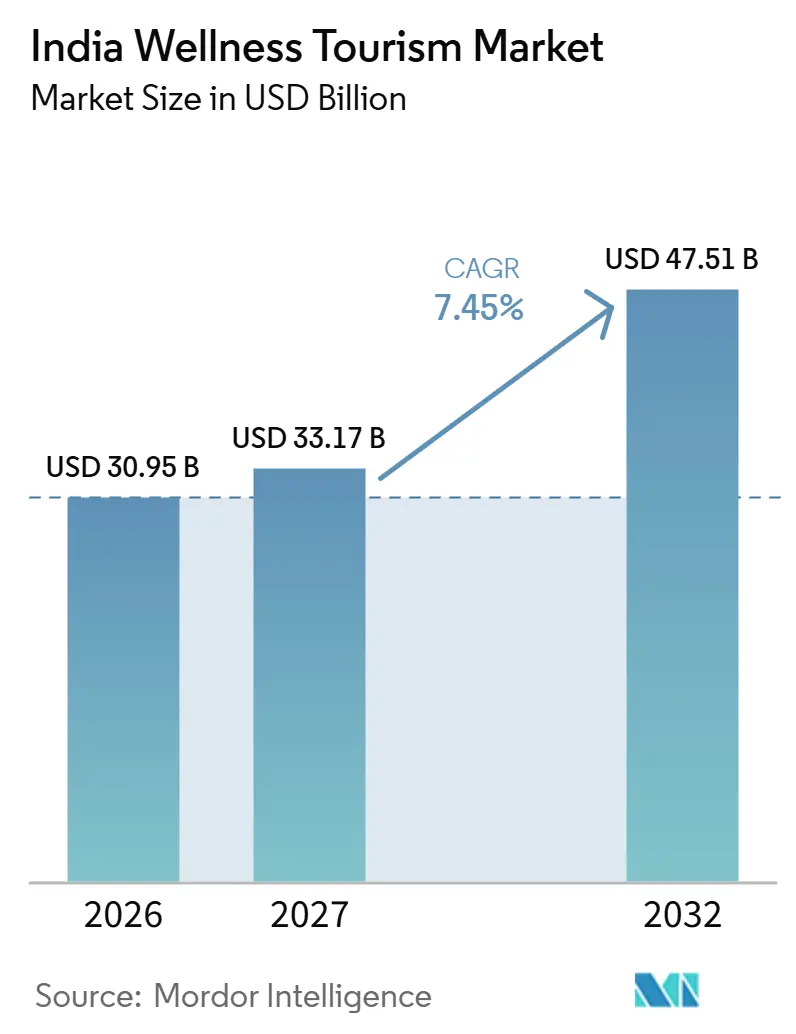
The India wellness tourism market size is expected to increase from USD 30.95 billion in 2026 to USD 33.17 billion in 2027 and reach USD 47.51 billion by 2032, growing at a CAGR of 7.45% over 2027-2032.
India's wellness travel opportunity depends on connecting credible care with accommodation that can support a coherent program. Kerala's visitor base offers a route to guests already traveling, while treatment-specific entry permissions can support qualifying inbound stays. Leadership off-sites add an organized source of multiday demand, giving resorts a corporate buyer group alongside individual wellness travelers. Quality inconsistency and covered-service taxes constrain this opportunity, favoring operators that align the stay's promise with its care delivery and cost structure.
Key Report Takeaways
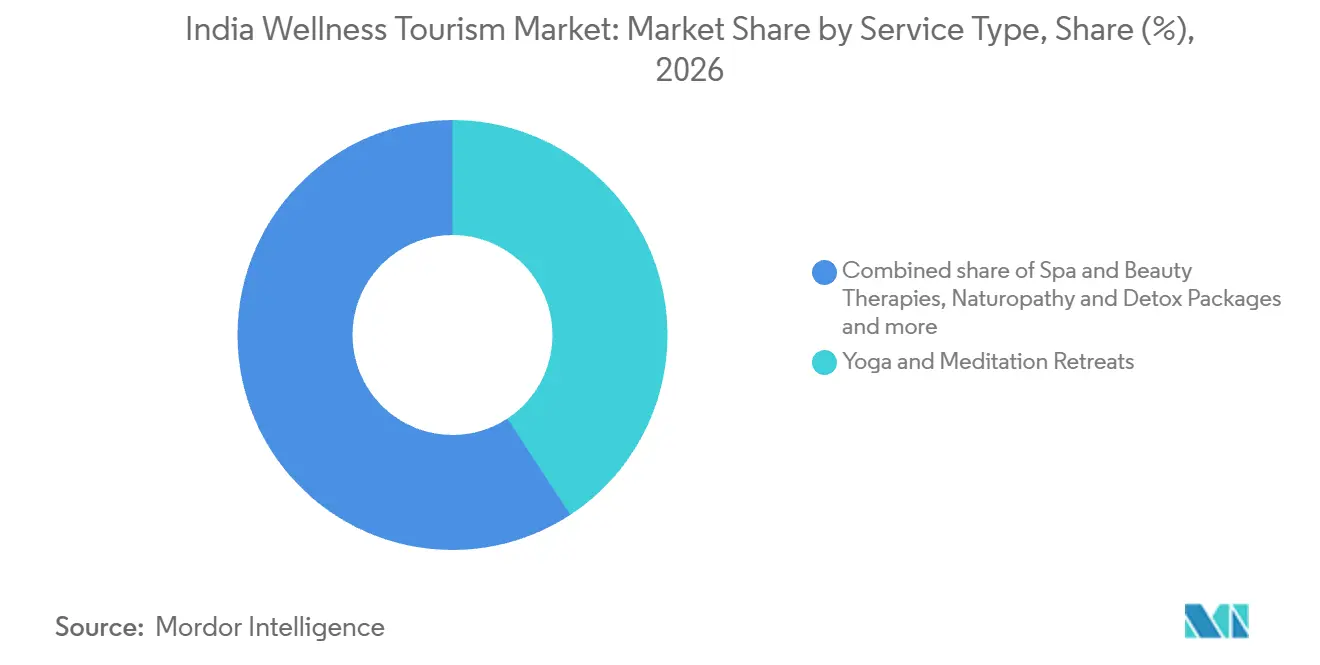
- By service type, yoga and meditation retreats held a 40.76% India wellness tourism market share in 2026, while digital-detox escapes are forecast to be the fastest-growing segment at a CAGR of 17.6% over 2027-2032.
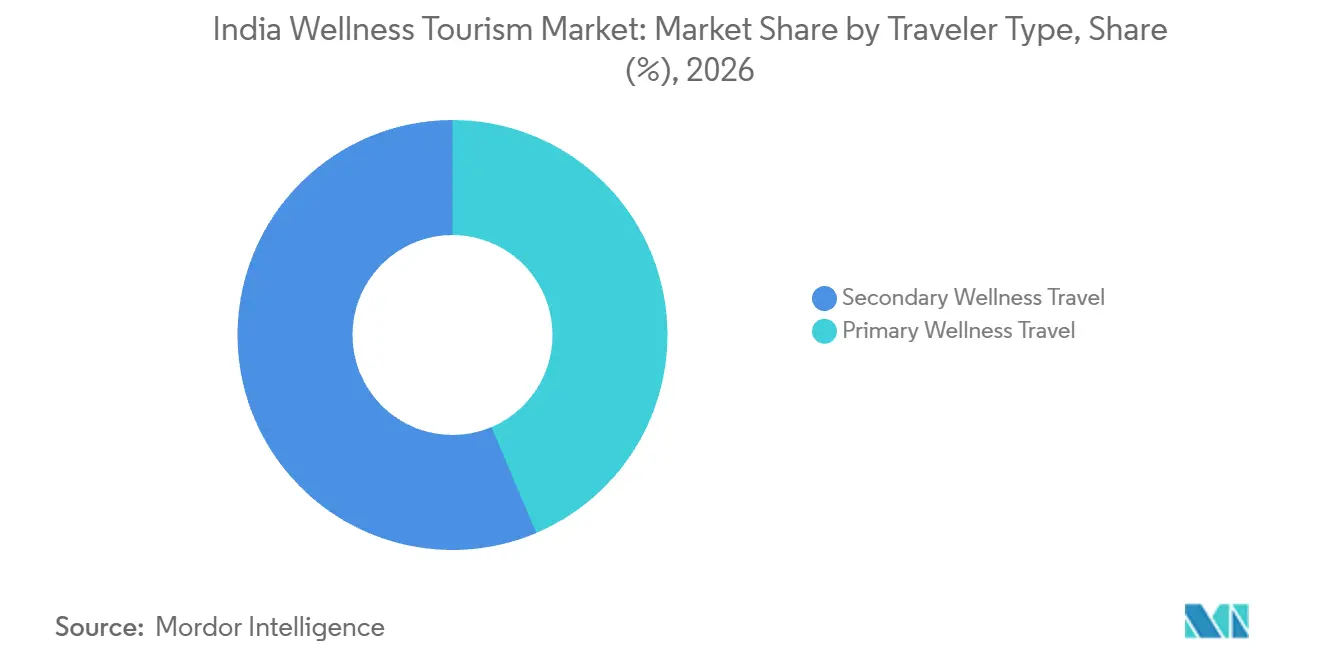
- Across traveler types, secondary wellness travel accounted for a 56.37% share of the India wellness tourism market size in 2026, with primary wellness travel projected to grow fastest at a CAGR of 16.6% over 2027-2032.
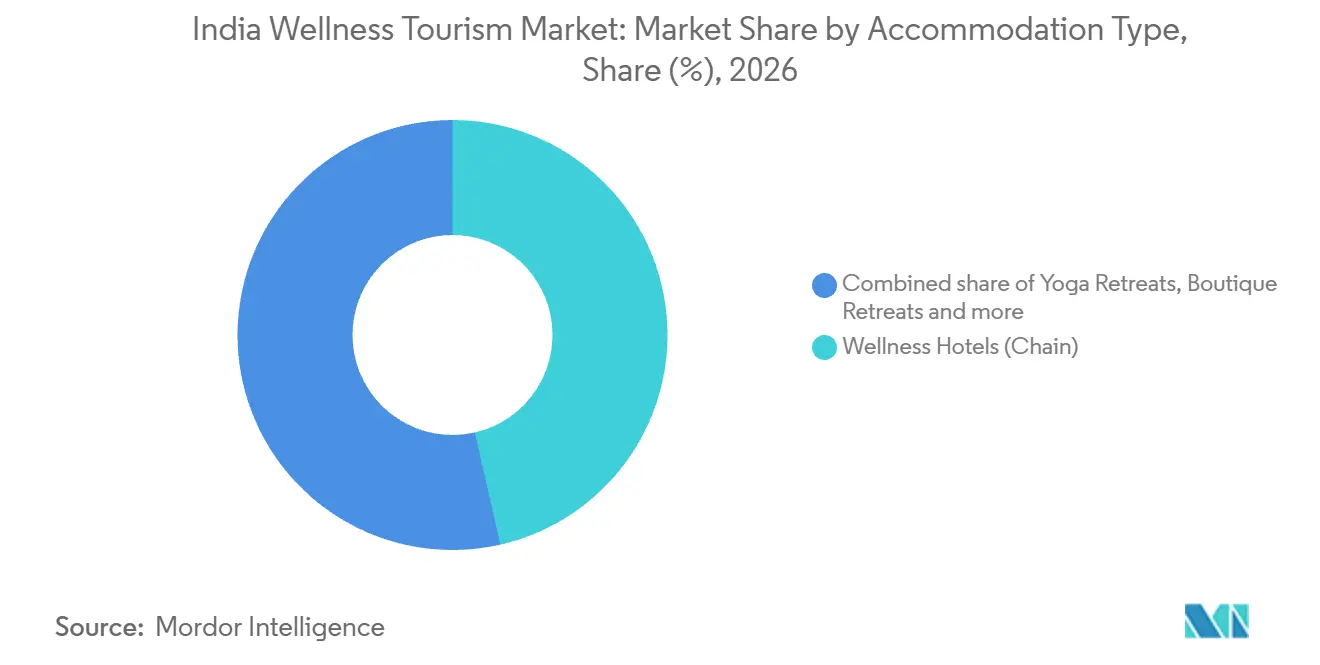
- In accommodation, chain wellness hotels led with a 46.42% share of wellness tourism spending in 2026, while eco-wellness lodges have the fastest forecast CAGR of 19.5% over 2027-2032.
- By geography, South India held a 48.38% share of wellness tourism spending in India in 2026, and North India is forecast to grow fastest at a CAGR of 18.8% over 2027-2032.
Note: Market numbers in this report are based on Mordor Intelligence's proprietary estimation framework, which combines nine months of actuals with Q4 projections for base year 2026.
Market Trends and Insights
Drivers Impact Analysis of India Wellness Tourism Market*
| Driver | (~) % Impact on CAGR Forecast | Geographic Relevance | Impact Timeline |
|---|---|---|---|
| Rapid expansion of AYUSH-certified resorts | +2.8% | Kerala, including Idukki | Long term (≥ 4 years) |
| Inclusion of wellness packages in e-Ayush Visa scheme | +2.2% | Nationwide | Medium term (2-4 years) |
| Corporate adoption of wellness off-sites for employee retention | +1.9% | Kerala, notably Kovalam | Medium term (2-4 years) |
| Digitally enabled discovery (meta-search & influencer marketing) | +1.6% | Nationwide | Short term (≤ 2 years) |
| Rising domestic disposable income in Tier-2 cities | +1.1% | Nationwide | Medium term (2-4 years) |
| Uptake of preventive health spending post-COVID-19 | +0.9% | Nationwide | Long term (≥ 4 years) |
| Source: Mordor Intelligence | |||
Rapid expansion of AYUSH-certified resorts
An accredited retreat can make a treatment-led stay easier to assess before the traveler commits to a destination. The National Accreditation Board for Hospitals & Healthcare Providers (NABH) accredited Sitaram Mountain Retreat in Kerala as an AYUSH Entry Level-Hospital effective June 10, 2025. Its certificate, valid through June 9, 2027, covers Ayurveda services including Panchakarma and yoga. The provider combines accommodation with paid Ayurveda stays, linking the clinical service scope to a destination experience. For a retreat operator, that combination provides a basis for distinguishing a defined treatment offering from a broad wellness promise. Because the certificate expires on June 9, 2027, continued use of the accreditation in selling treatment stays depends on maintaining valid certification.
Inclusion of wellness packages in e-Ayush Visa scheme
A treatment-specific entry route can make an overseas wellness stay easier to arrange when the provider meets the eligibility conditions. India's e-M3 visa covers non-Pakistani foreign nationals whose sole purpose is AYUSH treatment, including wellness. Eligible facilities are government-accredited and registered hospitals or wellness centers, or AYUSH-service hospitals accredited by NABH, the National Commission for Homeopathy, or the National Commission for Indian System of Medicine. The electronic visa permits up to 60 days from first entry and up to 3 entries, while the relevant foreigners registration authority may grant extensions up to 6 months case by case on merit. India issued 2,294 e-Ayush visas in 2025, compared with 1,102 in 2024. Qualifying operators can organize multiweek treatment stays within a defined entry window, making provider credentials part of the itinerary's feasibility.
Corporate adoption of wellness off-sites for employee retention
Wellness-led leadership off-sites can generate several nights of destination demand around a single organized stay. In June 2025, the general manager of The Westin Resort & Spa Himalayas said wellness packages lasting 3 to 7 nights were becoming a preferred choice for leadership off-sites. The general manager linked the preference to growing awareness of mental health and work-life balance. Niraamaya Retreats Surya Samudra Kovalam in Kerala reported a 10% to 12% uptick in corporate leaders opting for wellness breaks. Leader-level wellness stays reported at a Himalayan resort and a Kerala retreat show the corporate occasion being sold in more than one destination setting.
Digitally enabled discovery (meta-search & influencer marketing)
Digitally shared wellness experiences can introduce destination stays to followers already engaged with the subject. A 2025 qualitative study of 25 full-time Indian travel bloggers found that many reported increased follower engagement when discussing wellness tourism. Interviewees also emphasized authenticity and trust because this content concerns health-related experiences. One participant said collaboration required personally experiencing the place and feeling a difference in body and mind. For operators seeking collaborations of this kind, access to the stay itself becomes part of the offer to the creator, alongside program information.
Restraints Impact Analysis of India Wellness Tourism Market*
| Restraint | (~) % Impact on CAGR Forecast | Geographic Relevance | Impact Timeline |
|---|---|---|---|
| Fragmented quality standards across states | -1.2% | Nationwide | Medium term (2-4 years) |
| Higher GST on wellness services vs. exempt medical services | -0.9% | Nationwide | Short term (≤ 2 years) |
| Limited international air-seat capacity to secondary airports | -0.6% | Jolly Grant Airport, Uttarakhand | Long term (≥ 4 years) |
| Shortage of certified naturopathy & Ayurveda practitioners | -0.4% | Punjab's Ludhiana district | Medium term (2-4 years) |
| Source: Mordor Intelligence | |||
Fragmented quality standards across states
Quality uncertainty can make a destination wellness package harder to sell as a dependable therapeutic experience. In August 2026, the Parliamentary Standing Committee on Health & Family Welfare said India's private wellness and AYUSH sector was susceptible to unstandardized service quality and varying safety protocols.[1] It recommended mandatory accreditation for commercial AYUSH wellness centers and clinical spas, linked to transparent therapy tariffs. For travel organizers combining accommodation with treatment, varying safety practices complicate the promise of a dependable therapeutic package. A uniform package description cannot resolve differences in safety practice, leaving verification costs and exposure to unsuitable service delivery with the organizer and guest.
Higher GST on wellness services vs. exempt medical services
Tax classification can leave a paid wellness experience at a cost disadvantage to qualifying medical care. In India, beauty and physical-well-being services, including yoga, have attracted 5% GST without input-tax credit since September 22, 2025.[2] Qualifying care for illness, injury, deformity, abnormality, or pregnancy in a recognized medical system is exempt when provided by a clinical establishment, authorized medical practitioner, or paramedic. This distinction makes the actual service and provider important to retreat economics, rather than the wellness positioning alone. A separately sold yoga service carries a tax charge even when its purpose overlaps with the wellbeing sought through qualifying care. Covered providers face both a tax wedge against exempt care and unrecoverable input taxes, limiting the room to compete through price.
*Our forecasts treat driver/restraint impacts as directional, not additive. The impact forecasts reflect baseline growth, mix effects, and variable interactions.
India Wellness Tourism Market Segment Analysis
By Service Type:
Residential Practice and Digital Disconnection Shape StaysYoga and meditation retreats accounted for a 40.76% share of the India wellness tourism market size in 2026, making them the largest segment. A residential format can make the practice schedule the central reason for booking, with accommodation supporting repeated sessions throughout the stay. Shakti Himalaya's Prana Lodge in Kumaon hosts occasional yoga retreats with visiting practitioners, which shows residential accommodation serving as a venue for practitioner-led teaching. Because those retreats are occasional, the teaching program is an addition to a lodge stay rather than a permanent feature, so a booking for practitioner-led yoga depends on when a visiting practitioner is in residence.
Digital-detox escapes are the fastest-growing service segment, with a forecast CAGR of 17.6% over 2027-2032. In The Times of India's India Habit Index 2025 survey, 8.07% of respondents said digital detox helped them unwind during travel in 2025. The reported motivation concerns unwinding during travel, which links device disconnection to the experience of the trip itself. A retreat can respond with a stay organized around offline activities, making the itinerary its point of differentiation rather than adding another treatment appointment.

By Traveler Type:
Hotel Itineraries Support Scale While Purposeful Stays Deepen ProgramsSecondary wellness travel represented a 56.37% India wellness tourism market share in 2026, making it the largest traveler segment. In October 2025, ITC Hotels reported a significant increase in spa-related bookings compared with the prior year. An ITC Hotels area manager also said spa experiences were a must-have feature in most travelers' hotel itineraries in India. These observations illustrate how a wellness experience can be sold within an established hotel trip, giving the service access to an accommodation guest. Growing spa bookings make treatment delivery the immediate service opportunity within those hotel itineraries, without requiring guests to choose a separate retreat destination.
Primary wellness travel is the fastest-growing traveler segment, with a forecast CAGR of 16.6% over 2027-2032. Ananda in the Himalayas said in 2025 that a significant majority of its guests chose purposive wellness programs. It described stays of 2 weeks to sometimes 2 months to address long-term and chronic physical and mental health issues. Long program durations also reserve the guest's time for the retreat, shifting the commercial emphasis from a single service sale to an extended residential commitment.
By Accommodation Type:
Chain Capacity and Natural Settings Support Different Stay ModelsChain wellness hotels were the largest accommodation segment, with a 46.42% share of wellness tourism spending in 2026. Taj Lalit Bagh opened in Udaipur in October 2025 as a 155-key luxury retreat with a J Wellness Circle spa offering holistic therapies. Combining room capacity with a functioning spa can support a wellness proposition within a substantial accommodation operation, while leaving the actual service experience dependent on spa delivery. The announcement presents the spa as one amenity beside restaurants, a pool and a fitness center, which frames wellness as an add-on within a full-service chain stay rather than the reason to book.
Eco-wellness lodges are the fastest-growing accommodation segment, with a forecast CAGR of 19.5% over 2027-2032. The format can combine an overnight stay with a wellness program organized around a natural setting, making the lodge part of the experience rather than simply a base for appointments. Shakti Himalaya's solar-powered Prana Lodge in Uttarakhand's Kumaon Himalayas opened in October 2025 as the centerpiece of a multiday hiking circuit through remote villages. Guests move between village houses and the lodge, with optional yoga and meditation sessions alongside guided hikes. The circuit makes the lodge a stop within a residential journey, extending the wellness proposition across several locations instead of concentrating it in a treatment room.
Geography Analysis
South India Wellness Tourism Market
South India accounted for a 48.38% share of the India wellness tourism market size in 2026, making it the largest regional segment. Kerala recorded 25.06 million domestic tourist visits in 2025, up 12.64% from 22.25 million in 2024.[3] Separately, Somatheeram Resort in Kerala said in early 2025 that approximately 90% of its guests are international. Kerala draws a growing domestic visitor base while Somatheeram, an Ayurveda resort there, sells mainly to overseas guests, so stays in Kerala can draw on both domestic and international buyers.
North India Wellness Tourism Market
North India is the fastest-growing regional segment, with a forecast CAGR of 18.8% over 2027-2032. In October 2025, Kamat Hotels' executive director said Orchid Rishivan in Uttarakhand was frequently booked for yoga retreats by groups of 25 to 30 people. In June 2026, Dusit International signed to manage developer Atmosphere's planned mixed-use Rishikesh project, with hotel rooms, duplex villas, yoga facilities, and a clubhouse spa, for a 2031 opening. Accor's August 2026 signing for Fairmont Rishikesh, Himalayas specified a planned 220-guestroom resort with a spa in Uttarakhand's Shivpuri Range, also opening in 2031. Group yoga bookings provide an operating route to multiguest wellness stays, while the planned properties would extend that destination offering into mixed-use and luxury spa accommodation.
West India's integrated wellness format is illustrated by Atmantan in Mulshi near Pune, where doctor-prescribed programs combine Ayurveda, naturopathy, oriental medicine, and alternative sciences. This format ties the stay to a coordinated treatment program, giving program delivery a central role in the guest proposition. In East India, Odisha's 2026 policy makes qualifying healing and AYUSH wellness resorts eligible for incentives with at least 15 overnight units, NABH accreditation, applicable-rule compliance, and skilled, trained, certified staff. Unlike Atmantan's operating programs, Odisha's mechanism is an eligibility route for prospective resort development. For Odisha investors, accreditation and certified staffing belong in the development commitment because accommodation capacity alone cannot secure eligibility.
Regulatory Framework and Outlook
The comparison covers selected jurisdictions from the perspective of an accommodation operator offering AYUSH wellness stays and seeking recognized credentials. The Ayush Quality Mark, launched in India on December 19, 2025, includes wellness centers within a wider framework for AYUSH products and services. AYUSHEXCIL, an Ayush export promotion council, implements it, while Kerala's tourism classification operates alongside other required licenses for Ayurveda centers.
Regulatory Table of India Wellness Tourism Market
| Decision factor | India | Kerala |
|---|---|---|
| Primary authority | AYUSHEXCIL implements the Ayush Quality Mark | Department of Tourism |
| Key instruments or direction | Ayush Quality Mark for specified AYUSH products and services, including wellness centers | Ayurveda-center classification and therapist qualification guidance dated January 5, 2026 |
| Commercial effect | Quality-assurance framework for covered services | 3-year classification; government-approved certificates for one male and one female therapist; inspection and withdrawal exposure |
| Current policy attractiveness | Medium | High |
| Future direction of policy attractiveness | No change | No change |
| Source: Mordor Intelligence | ||
India's medium rating reflects optional AYUSHEXCIL recognition for wellness centers, requiring qualifying accreditation or certification, other program conditions, and an application with the certificate, signed agreement, and fee. Voluntary AYUSHEXCIL recognition requires valid underlying accreditation or certification, so India's No change outlook reflects an unchanged recognition route despite the committee's unadopted August 7, 2026 recommendation for mandatory accreditation linked to public therapy-price disclosure. Kerala's high rating balances its classification route and 3-year validity against inspections and government-approved certificates for one male and one female therapist under the January 5, 2026 amended guidance. The state No change outlook reflects staffing documentation within the established classification cycle, with reclassification applications due 3 months before expiry.
Value Chain Stages
The value chain compares travel intermediation, accommodation, and treatment delivery, showing where service providers earn and where coordination can limit a stay. Planning and booking connect a traveler's intended experience with a destination provider, while accommodation and treatment may be sold separately or within one package. Heal at India's booking-linked partner payment model illustrates how an intermediary can earn from bringing that transaction together.
Value Chain Analysis Table of India Wellness Tourism Market
| Primary activity | Key participants | Value capture | Bottleneck | Resilience response |
|---|---|---|---|---|
| Wellness itinerary planning and booking | Wellness travel intermediaries such as Cholan Tours and Heal at India | Heal at India partner payments when a booking comes through | Matching the intended experience to a suitable retreat | Confirm treatment scope before arranging the stay |
| Accommodation operations | Retreat operators such as Somatheeram Ayurveda Village and Kairali Ayurvedic Group | Accommodation sales, including Somatheeram room-only bookings | Coordinating lodging dates with program availability | Confirm room and program availability together |
| Guest treatment and program delivery | Ayurvedic treatment providers such as Somatheeram Ayurveda Village and Kairali Ayurvedic Group | Treatment-package sales | Coordinating personalized treatments and practitioner time | Schedule therapy sessions against available practitioner capacity |
| Source: Mordor Intelligence | ||||
Somatheeram says it manufactures the medicines used at its retreat from medicinal plants grown in its gardens. The example extends the retreat's responsibilities into cultivation and medicine production, alongside the guest services that it sells. Booking intermediaries earn from arranging the transaction, while this provider also has to manage the inputs used in delivering treatment.
Competitive Landscape
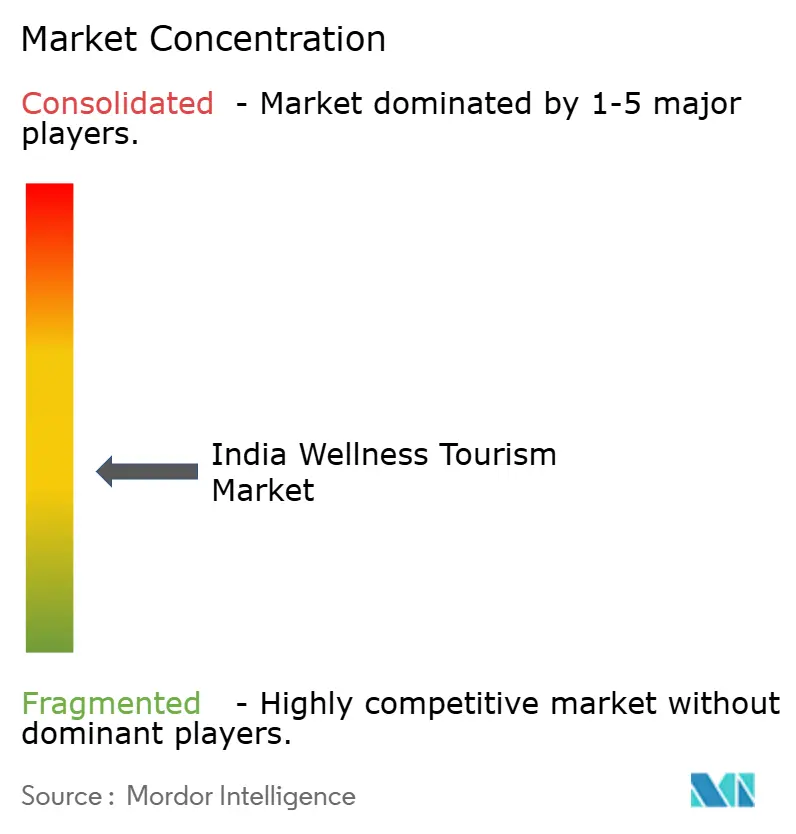
Competition is fragmented across dedicated retreats, Ayurveda businesses, and hospitality groups, creating different ways to combine accommodation with wellness delivery. Ananda in the Himalayas operates a dedicated wellness retreat, while Six Senses Vana participates through IHG's Six Senses resort portfolio. Kerala Ayurveda Ltd acquired the remaining 26% of Ayurvedagram Heritage Wellness Centre during FY2025-26, making the center wholly owned. CGH Earth Wellness (SwaSwara) operates a retreat in Gokarna, while IHCL (Taj Wellness Retreats) participates as a hospitality group with an integrated wellness destination. The structure puts retreat operators that sell defined programs alongside Ayurveda and hospitality groups that have added wellness assets through ownership.
During FY2025-26, IHCL completed its majority-stake acquisition in Atmantan, bringing an integrated wellness destination into the hospitality group's portfolio. In 2026, Ananda's 14-night program for prediabetes and Type 1 and Type 2 diabetes uses wearable monitoring to help doctors tailor nutrition and therapies. These approaches address different execution challenges, since ownership brings an existing destination under group control while monitoring supports adjustments within an individual guest's program. For guests choosing a condition-focused stay, tailored nutrition and therapies make the treatment team's capability consequential alongside the accommodation brand's reach.
Ayurvedagram Heritage Wellness Centre Private Limited reported higher turnover in FY2025-26 than in FY2024-25. In 2026, CGH Earth's SwaSwara offered a 5-day Menopause Reset with Naturopathy program combining yoga, meditation, and symptom-focused therapies. That shorter stay gives the retreat a way to define its offering around a particular life stage. SwaSwara's 5-day program built around menopause shows a route to differentiation that does not depend on acquiring destinations, while Kerala Ayurveda and IHCL both pursued ownership in FY2025-26.
India Wellness Tourism Industry Leaders
-
Ananda in the Himalayas
-
Six Senses Vana
-
Kerala Ayurveda Ltd
-
CGH Earth Wellness (SwaSwara)
-
IHCL (Taj Wellness Retreats)
- *Disclaimer: Major Players sorted in no particular order
India Wellness Tourism Market Companies Covered in this Report
- Ananda in the Himalayas
- Six Senses Vana
- Kerala Ayurveda Ltd
- Kairali Ayurvedic Group
- IHCL (Taj Wellness Retreats)
- CGH Earth Wellness (SwaSwara)
- The Leela Palaces, Hotels & Resorts
- Oberoi Hotels & Resorts (‘The Oberoi Spa’)
- Accor India (Rixos, Pullman Wellness)
- Hyatt India (‘Wellbeing at Hyatt’)
- ITC Hotels (‘Kaya Kalp Spa’)
- Jindal Naturecure Institute
- Apollo Life Wellness
- Atmantan Wellness Resort
- Soukya Holistic Health Centre
- Niraamaya Retreats
- DLF The Lodhi (‘The Lodhi Spa’)
- Marriott India (‘Quan Spa’, Westin ‘Heavenly Spa’)
- SaffronStays Wellness Villas
- Ayurooms
Key Opportunities for Market Participants
The opportunities compare an open resort concession with policy-led and destination-development routes to new wellness stays. Karnataka Tourism invited bids for the Kodikal premium wellness resort concession on October 13, 2026, with submissions due November 23, 2026. Telangana's 2025-2030 policy provides for integrated wellness zones in Special Tourism Areas, using certified graduates from AYUSH-recognized colleges in Telangana and NABH-accredited AYUSH hospitals, with tourism incentives extended as applicable.
Market Opportunities Table of India Wellness Tourism Market
| Opportunity | Why now | Buyer / lead segment | Recommended play | Main barrier | Likely beneficiaries |
|---|---|---|---|---|---|
| Develop and operate a premium wellness destination at Kodikal | Open October 2026 concession process | Premium destination wellness travelers | Bid with an integrated design, finance, operation, and maintenance plan | Financing development and sustaining resort operations | Qualified prospective resort developer-operators |
| Build integrated AYUSH wellness stays in Telangana's planned zones | 2025-2030 policy provides for wellness zones and applicable incentives | Primary wellness travelers seeking integrated AYUSH stays | Combine accommodation with qualified clinical services within the proposed zone framework | Assembling accredited hospital capability and certified staff | Prospective wellness-zone developers and AYUSH operators |
| Add paid wellness stays to a developing destination itinerary | Somasila is included in Telangana's September 2026 experience-tourism development pipeline | Travelers adding wellness to a broader destination visit | Design a wellness-stay proposition alongside the destination's broader visitor experience | Turning destination development into a viable accommodation-and-program offer | Prospective destination accommodation and wellness-program operators |
| Source: Mordor Intelligence | |||||
The clearest near-term opening connects a defined wellness stay with responsibility for the destination's operation. At Kodikal, the concession model makes development finance and ongoing maintenance part of the same commercial commitment. A credible proposal therefore needs to show how paid stays can support the whole operating model, while the Telangana pathways offer room to develop service concepts around planned destination infrastructure.
Recent Industry Developments in India Wellness Tourism Market
- Oct 2026: Karnataka Tourism invited bids for a concessionaire to develop, operate, and maintain a premium wellness resort at Kodikal under a design, build, finance, operate, and transfer model. Bids are due November 23, 2026.
- Aug 2026: Accor signed Fairmont Rishikesh, Himalayas, a planned 220-guestroom resort with a spa in Uttarakhand's Shivpuri Range. The announced opening is in 2031.
- Jun 2026: Dusit International signed to manage developer Atmosphere's planned 300-key mixed-use development near Rishikesh, with hotel rooms, luxury duplex villas, yoga facilities, and a clubhouse spa. The announced opening is in 2031.
India Wellness Tourism Market Report Scope and Research Methodology
Market Definition and Coverage
The India wellness tourism market measures annual spending in India by domestic and inbound visitors on wellness stays and paid destination wellness experiences, whether wellness is the trip's primary or secondary purpose. It counts accommodation and program spending sold separately or together.
Scope exclusions: Routine local wellness consumption with no travel or overnight stay, purely medical procedures not packaged as wellness travel, and wellness tourism spending for destinations outside India are excluded.
Segments Covered in This Report
- By Service Type
- Yoga & Meditation Retreats
- Spa & Beauty Therapies
- Naturopathy & Detox Packages
- Mental-Wellness Retreats
- Digital-Detox Escapes
- Spiritual Healing Journeys
- By Traveler Type
- Primary Wellness Travel
- Secondary Wellness Travel
- By Accommodation Type
- Yoga Retreats
- Wellness Hotels (Chain)
- Boutique Retreats
- Eco-Wellness Lodges
- Wellness Clinics with Stay
- By Geography
- North India
- West India
- South India
- East India
Data Sources, Market Sizing, and Validation
Desk Research
Public sources such as the Ministry of Tourism's India Tourism Data portal provide domestic and foreign visitor, receipt, and e-visa series for demand context, while Kerala Tourism's 2025 statistics show domestic and foreign visits by destination and origin. The Press Information Bureau's 2026 backgrounder describes India's wellness tourism policy and AYUSH travel context, and the Global Wellness Institute's wellness tourism research supplies a sector definition and trip-spending framework for interpreting the Indian evidence.
Company filings, annual reports, investor presentations, official state tourism material, reputable news coverage, and relevant published research can supplement these public indicators and cross-check provider activity, capacity, and changes in travel demand. These sources are not exhaustive, and further sources inform collection, validation, and clarification.
Primary Interviews and Surveys
Structured interviews with India-based retreat and hotel operators, wellness program providers, travel organizers, and tourism or hospitality specialists can clarify how wellness stays and paid destination programs are sold and priced. Interview guides can test secondary-source interpretations of visitor mix, package inclusions, regional demand, room and program capacity, and changes in service mix, while noting where respondents describe different transaction boundaries. Analyst follow-up can reconcile gaps against published data and compare interview evidence with provider, traveler, and destination indicators before incorporating supported assumptions into the model.
Distribution of primary research fieldwork respondents
| Company type | Respondent position | Region |
|---|---|---|
| Top tier: 30% | CXOs: 20% | |
| Mid tier: 45% | Functional/Unit leaders: 30% | |
| Smaller Players: 25% | Managers: 50% |
Market-Sizing & Forecasting
A top-down estimate starts with annual domestic and inbound visitor activity in India and isolates spending tied to wellness stays and paid destination programs, using tourism visits and receipts as demand anchors. Wellness-trip mix, visitor expenditure, accommodation supply and occupancy, and published package or treatment prices indicate how much spending belongs to primary and secondary wellness travel and how that spending divides across services, accommodation formats, and North, West, South, and East India. Segment shares follow the relative evidence on paid offerings, traveler purpose, lodging, and destination activity, with bundled stays and programs counted once at the end-user package price. A multivariate regression can relate the available demand and supply indicators to market value, with scenario analysis used where sparse or discontinuous history makes a single trend unreliable. Selective bottom-up checks multiply sampled provider prices by visitor or stay volumes to test the top-down result. Analysts can compare variable-level forecasts and boundaries with India-based operator, travel organizer, and tourism specialist evidence, investigate missing or conflicting observations against official series and reported provider information, and use the most directly supported indicators when a specific input is unavailable.
Data Validation & Update Cycle
Analysts triangulate the estimate against independent tourism visits and receipts, provider capacity and activity, and published transaction or package evidence, then investigate unusual movements and material differences between source series before sign-off. A second review checks source dates, definitions, arithmetic, segment shares, and forecast assumptions, with re-contact considered when an interview account conflicts with a material indicator or when a major policy, tax, visa, connectivity, or capacity event changes the model inputs. The dataset is refreshed annually, updated between cycles for material events, and given a fresh pre-delivery review.
Mordor Intelligence's India Wellness Tourism Market Sizing Compared With Other Published Estimates
Published estimates can differ in the transactions and products they count and the inputs used to model demand. The India wellness tourism market measures annual spending in India by domestic and inbound visitors on wellness stays and paid destination wellness experiences, whether wellness is the trip's primary or secondary purpose.
Key Gap Drivers include the study's defined coverage and market-specific modeling choices. Analysts can compare variable-level forecasts and boundaries with India-based operator, travel organizer, and tourism specialist evidence, investigate missing or conflicting observations against official series and reported provider information, and use the most directly supported indicators when a specific input is unavailable.
Benchmark comparison
| Source | Market Size | Gaps in Research Methodology |
|---|---|---|
| Mordor Intelligence | USD 33.17 B (2027) | |
| Global Research Publisher A | USD 28.3 B (2025) | At its 2025 base, this estimate is 14.7% below this report's 2027 value of USD 33.17 B, 2 years later. The earlier measurement year can contribute to a lower estimate than a later-year figure in a growing market, while the listed trip-spending categories extend beyond paid wellness stays and programs. |
| Global Research Publisher B | USD 34.92 B (2025) | At its 2025 base, this estimate is 5.3% above this report's 2027 value of USD 33.17 B, 2 years later. The estimate includes transport, lodging, food and beverage, shopping, and activities, which can add trip spending beyond the paid stays and programs counted here. |
Mordor Intelligence's analysts triangulate the estimate against independent tourism visits and receipts, provider capacity and activity, and published transaction or package evidence, then investigate unusual movements and material differences between source series before sign-off.
Key Questions Answered in the Report
What is the India wellness tourism market size and growth outlook?
The size is USD 33.17 billion in 2027 and is forecast to reach USD 47.51 billion by 2032, growing at a CAGR of 7.45% over 2027-2032.
Which factors support destination wellness travel in India?
India issued 2,294 e-Ayush visas in 2025. In June 2025, The Westin Resort & Spa Himalayas' general manager said wellness packages lasting 3 to 7 nights were becoming preferred for leadership off-sites.
Which destination wellness service leads spending in India?
Yoga and meditation retreats held a 40.76% share of wellness tourism spending in 2026.
Which companies are prominent in India's wellness travel sector?
Major participants include Ananda in the Himalayas, Six Senses Vana, Kerala Ayurveda Ltd, CGH Earth Wellness (SwaSwara), and IHCL (Taj Wellness Retreats).
What constrains the outlook for paid wellness stays in India?
Quality inconsistencies and 5% GST without input-tax credit on covered beauty and physical-well-being services, including yoga, create verification and cost burdens.
Which regions lead wellness tourism in India?
South India led with a 48.38% share of wellness tourism spending in 2026. North India is forecast to grow fastest at a CAGR of 18.8% over 2027-2032.