
Market Overview
| Study Period | 2020 - 2031 |
|---|---|
| Forecast Data Period | 2026 - 2031 |
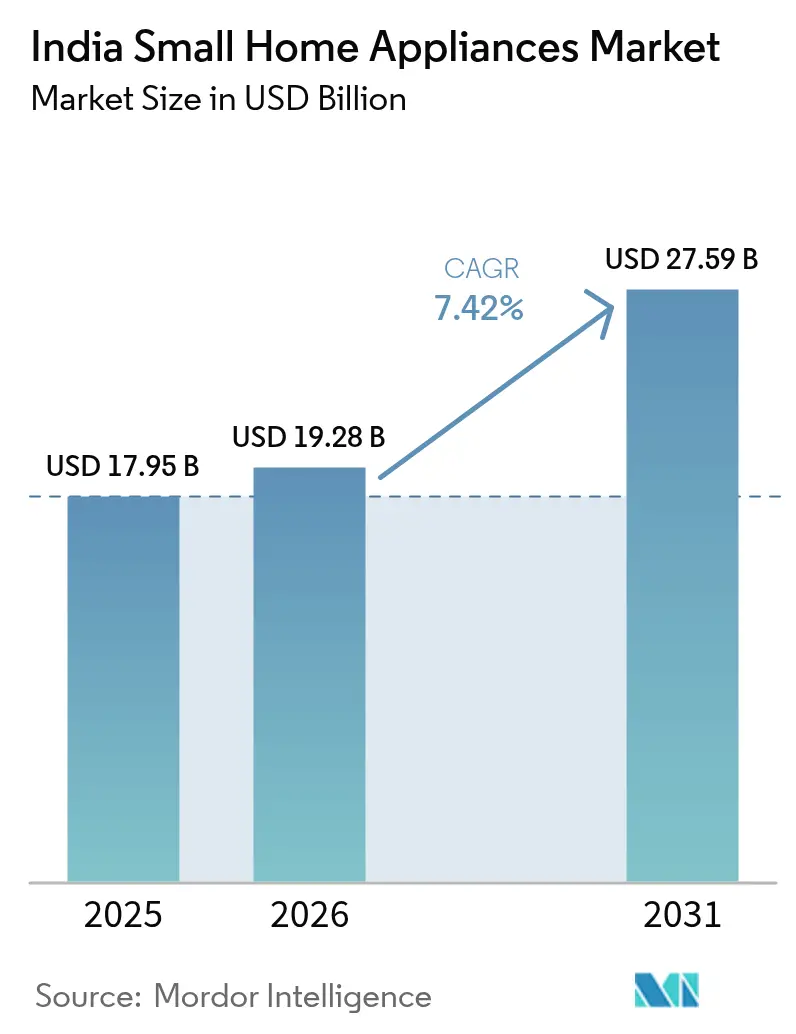
| Base Year Market Size (2025) | USD 17.95 Billion |
| Market Size (2026) | USD 19.28 Billion |
| Market Size (2031) | USD 27.59 Billion |
| Growth Rate (2026 - 2031) | 7.42 % |
| Market Concentration | Medium |
Major Players *Disclaimer: Major Players sorted in no particular order Image © Mordor Intelligence. Reuse requires attribution under CC BY 4.0. | |
India Small Home Appliances Market Analysis by Mordor Intelligence
India Small Appliance market size in 2026 is estimated at USD 19.28 billion, growing from 2025 value of USD 17.95 billion with 2031 projections showing USD 27.59 billion, growing at 7.42% CAGR over 2026-2031. This momentum reflects rapid urbanization, higher disposable incomes among Gen Z and millennial households, and strong government support through the Production Linked Incentive (PLI) scheme, which has driven INR 10,478 crore (USD 1.26 billion) of component-level investment[1]. Rising smart-home adoption, expected to expand from INR 8,000 crore (USD 976 million) in 2023 to INR 36,000 crore (USD 4.39 billion) by 2028, further augments demand for connected appliances. The India Small Appliance market benefits from evolving health-conscious cooking habits that favor air-frying and low-oil preparation, robust e-commerce growth that reaches previously underserved tier-2/3 locations, and energy-efficiency regulations that nudge consumers toward 5-star-rated models. Competition intensifies as domestic stalwarts leverage cost advantages while multinational brands differentiate through premium designs and IoT functionality. Meanwhile, anticipated GST rationalization from 28% to 15% for selected categories is poised to narrow price gaps and stimulate latent demand, mirroring the 2018 rate cut that lowered retail prices by 7–8% and lifted penetration.
Key Report Takeaways
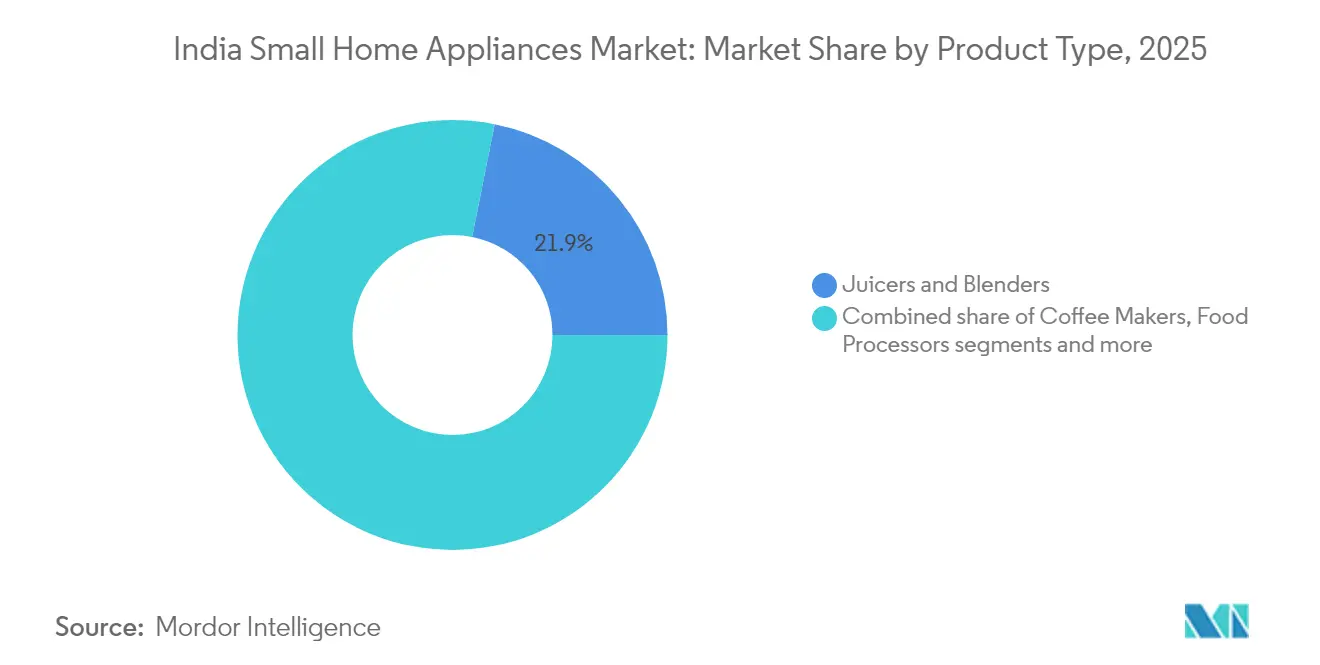
- By product type, Juicers & Blenders accounted for 21.86% of the India Small Appliance market share in 2025, and Air Fryers are forecast to expand at an 7.88% CAGR through 2031.
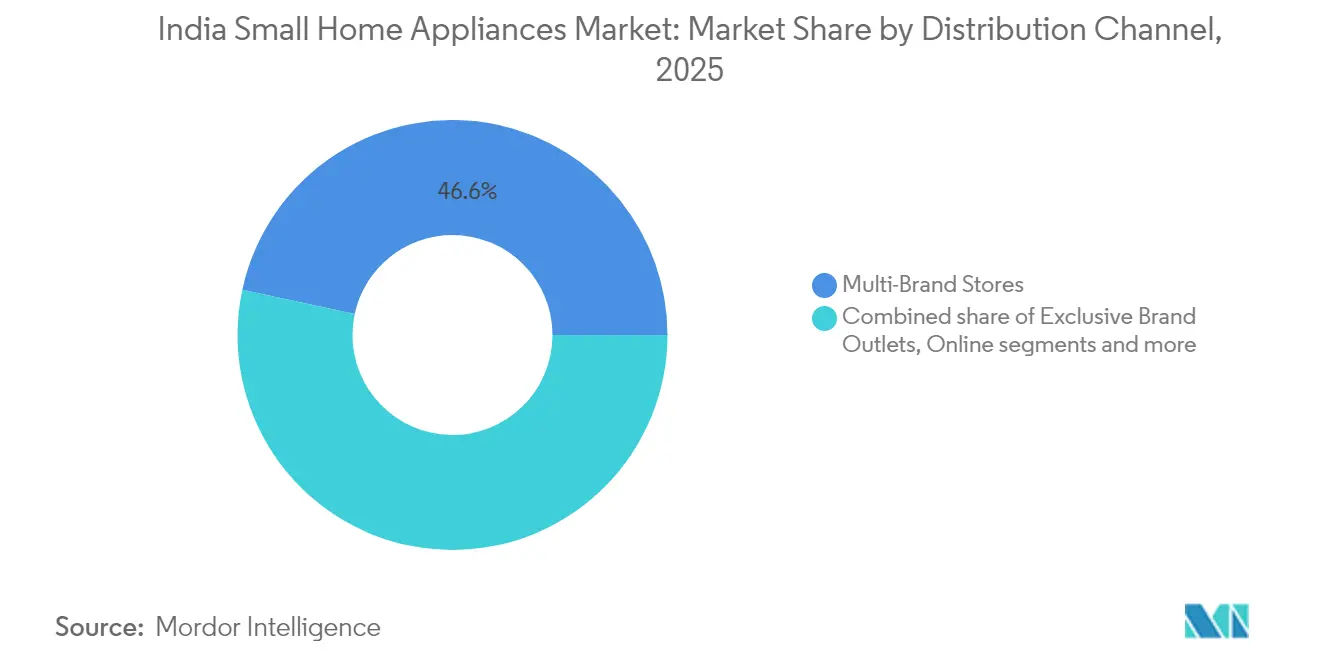
- By distribution channel, Multi-Brand Stores held 46.62% share of the India Small Appliance market size in 2025. Online retail is advancing at an 8.45% CAGR over the same period.
- By geography, South India led with 34.28% of the India Small Appliance market share in 2025, and West India is projected to register a 8.73% CAGR to 2031.
Note: Market size and forecast figures in this report are generated using Mordor Intelligence’s proprietary estimation framework, updated with the latest available data and insights as of 2026.
India Small Home Appliances Market Trends and Insights
Drivers Impact Analysis*
| Driver | (~) % Impact on CAGR Forecast | Geographic Relevance | Impact Timeline |
|---|---|---|---|
| Growing urban middle-class and disposable incomes | 2.1% | National, with concentration in metros and tier-1 cities | Medium term (2-4 years) |
| Rapid penetration of e-commerce marketplaces | 1.8% | National, with higher impact in tier-2/3 cities | Short term (≤ 2 years) |
| Efficiency regulations driving energy-saving appliances | 1.3% | National, with BEE compliance requirements | Long term (≥ 4 years) |
| PLI scheme fuelling component localisation | 1.5% | Manufacturing hubs in Gujarat, Tamil Nadu, and Karnataka | Medium term (2-4 years) |
| Anticipated 15% GST slab rationalisation | 0.9% | National, with a higher impact on price-sensitive segments | Short term (≤ 2 years) |
| Smart-home integration accelerates demand for connected appliances | 1.2% | Urban centres with high smartphone penetration | Long term (≥ 4 years) |
| Source: Mordor Intelligence | |||
Rapid Penetration of E-Commerce Marketplaces
Online platforms democratize access to premium brands, bridging logistical gaps in remote districts and boosting assortment depth well beyond what brick-and-mortar stores can display. Fintech-enabled EMI, cash-back, and buy-now-pay-later schemes ease affordability barriers, especially for first-time buyers of 5-star-rated or IoT-ready models. Direct-to-consumer (D2C) labels bypass layers of distribution mark-ups, harness first-party data, and release iterative upgrades faster than legacy incumbents bound by seasonal line-ups. Marketplace algorithms also surface hyper-localized insights, such as soaring demand for grill-roasters during the winter wedding season, which manufacturers harness for targeted, region-specific SKUs. Increasing penetration of 5G broadband and vernacular content further enlarges the addressable base, inviting shoppers from smaller towns previously omitted from after-sales networks. The feedback loop intensifies because every conversion adds ratings and reviews that strengthen online discovery for subsequent customers, reinforcing channel migration.
Efficiency Regulations Driving Energy-Saving Appliances
The Bureau of Energy Efficiency (BEE) mandatory labeling program converts efficiency compliance from a checkbox into a competitive advantage as 5-star microwaves, induction cooktops, and vacuum cleaners fetch 15–20% price premiums yet continue to command waitlists[2]. Source: Bureau of Energy Efficiency, “Energy Efficiency Standards and Labelling Programme,” beeindia.gov.in. Manufacturers now embed inverter motors, BLDC fans, and rapid-heat coils to secure top ratings, prompting suppliers to retool lines toward higher-grade copper windings and precision sensors. Retailers highlight lifetime cost savings, encouraging consumers to trade up even in price-sensitive segments. The standards undergo periodic tightening, signaling policy continuity and anchoring R&D budgets on next-gen insulation materials and low-standby-power circuitry. Efficient models also unlock export opportunities where BIS-certified appliances align with EU and ASEAN eco-design norms, thus expanding the reachable revenue base. Indian start-ups collaborate with research labs to pilot phase-change thermal storage that maintains cooking heat yet slashes overall power usage, combining green credentials with convenience. The India Small Appliance market thereby shifts from low-tech volume play to innovation-driven value capture, raising sector entry barriers for non-compliant fly-by-night outfits.
PLI Scheme Fueling Component Localization
Eighty-four approved firms have already invested INR 10,478 crore (USD 1.28 billion) in domestic production of compressors, PCB assemblies, and sophisticated motors under the white-goods PLI tranche. This spend reduces import dependence, previously at 70%, to a projected 30% by 2030, compressing lead times and volatile freight costs. Local availability of specialized components empowers design tweaks for Indian cooking habits, such as pressure cookers compatible with thicker lentil soups or mixers that withstand long grinding cycles required for idli batter. Tier-1 global brands form joint ventures with Indian SMEs to tap duty waivers and volume incentives, spurring technology transfer and workforce upskilling. Economies of scale emanate outward: tooling vendors, packaging plants, and logistics parks cluster around anchor factories in Gujarat, Tamil Nadu, and Karnataka, creating thousands of skilled jobs. PLI milestones reward incremental output, encouraging firms to front-load capital expenditure, automate weld lines, and adopt Industry 4.0 dashboards to monitor yield. Supply-chain resilience improves because pandemic-era bottlenecks taught planners the perils of single-country sourcing for PCB control boards and stepper motors. The India Small Appliance market thus achieves cost competitiveness and becomes an export staging ground for South and Southeast Asian demand.
Smart-Home Integration Accelerates Demand for Connected Appliances
India’s smart-home sector should quintuple to INR 36,000 crore (USD 4.39 billion) by 2028, spearheaded by smartphone-controlled smart plugs, voice-assisted cooking modes, and automated cleaning cycles[3]. Source: Business Standard, “India's Smart Home Market to Grow 4.5x to Rs 36,000 cr by 2028: Report,” business-standard.com. Leading vendors offer unified mobile apps enabling simultaneous control of mixers, air fryers, and robotic vacuums, thereby converting single-device use into ecosystem lock-in. Built-in Wi-Fi modules coupled with OTA firmware updates extend appliance life cycles, reducing perceived obsolescence and justifying premium pricing. Smart-usage analytics help consumers monitor energy utilization and adapt cooking routines to off-peak tariffs, bolstering adoption in states with variable electricity pricing. Integrations with smart speakers in vernacular languages further lower adoption barriers among non-English speakers. Security has also improved as device makers comply with India’s data-privacy guidelines, encrypting data at rest and in transit. Developers monetize this data via recipe curation services and filter-replacement reminders, unlocking recurring revenue streams. Consequently, connected devices occupy the fastest-growing niche within the India Small Appliance market and accelerate overall value growth.
Restraints Impact Analysis*
| Restraint | (~) % Impact on CAGR Forecast | Geographic Relevance | Impact Timeline |
|---|---|---|---|
| Persistent price-sensitive consumer base | -1.4% | National, with higher impact in rural and tier-3+ cities | Medium term (2-4 years) |
| Fragmented, unorganised manufacturing ecosystem | -0.8% | Manufacturing clusters in North and West India | Long term (≥ 4 years) |
| Weak last-mile service in tier-3/4 towns (under-radar) | -0.6% | Tier-3 and Tier-4 towns across India, especially in Eastern and Northeastern states | Medium term (2–4 years) |
| Fluctuating input costs create pricing uncertainty and curb mass-segment launches | -0.9% | Pan-India, with higher sensitivity in cost-driven North and Central regions | Short term (≤ 2 years) |
| Source: Mordor Intelligence | |||
Persistent Price-Sensitive Consumer Base
Roughly 60–70% of Indian shoppers still rank sticker price above all other purchase criteria, limiting the upsell potential of high-spec smart appliances even amid rising incomes. Organized players respond with stripped-down variants of air fryers without touchscreen displays or mixers with fewer jars to meet aggressive price points, but such trade-offs risk brand dilution if performance falters. Unbranded substitutes, often manufactured in small workshops, retain a significant foothold in rural bazaars where after-sales expectations remain modest. Economic headwinds such as monsoon shortfalls or fuel-price spikes trigger deferment of discretionary spends, elongating replacement cycles from three to five years. However, the very sensitivity that compresses margins fosters innovation in frugal engineering: companies insert multi-use blades or modular heating elements to maximize utility per rupee. Installment finance and cash-back offers partially bridge affordability gaps, yet lenders tighten eligibility during down-cycles, curtailing credit-led demand. The India Small Appliance market must therefore navigate a structural affordability ceiling even as niche premium pockets burgeon in metros.
Fragmented Unorganized Manufacturing Ecosystem
Unorganized players command a 40–45% share in certain categories, such as basic mixer-grinders, posing dual challenges of price undercutting and uneven product quality. These small outfits often bypass formal safety certifications, raising consumer-trust issues that reflect poorly on the broader industry. Organized brands must spend heavily on awareness campaigns detailing the hazards of sub-standard wiring and counterfeit safety plugs, raising overall marketing costs. Supply-chain coherence also suffers because many informal suppliers rely on manual processes that produce variable part tolerances, complicating assembly for OEMs seeking seamless automation. Policymakers now step up compliance enforcement, levying penalties for non-ISI-grade products, which gradually trims the grey market but also risks sudden shortages if legitimate alternatives are not ready. PLI program filters out non-GST-registered entities, channeling incentives exclusively to formal sector participants and accelerating shake-out. Over the long term, the India Small Appliance market gains in quality perception and export eligibility, but short-term turbulence persists while consolidation unfolds.
*Our forecasts treat driver/restraint impacts as directional, not additive. The impact forecasts reflect baseline growth, mix effects, and variable interactions.
Segment Analysis
By Product Type: Health-Conscious Cooking Drives Innovation
The India Small Appliance market size for Juicers & Blenders stood at 21.86% share, supported by versatile usage from smoothies to spice grinding. Increasing demand for cold-press technology that retains micronutrients positions premium models for 8.6% annual value growth during 2026–2031. Air Fryers, though a newer entrant, log an 7.88% CAGR, buoyed by growing awareness of cardiovascular health and social-media recipes showcasing low-oil snacks. Vendors introduce dual-zone baskets that prepare mains and sides simultaneously, raising willingness to pay among time-pressed urban professionals. Counter-top ovens and coffee makers also ride aspirational lifestyle shifts, albeit from smaller bases, as café culture proliferates in metros. Electric kettles maintain consistent volumes because they offer instant heating at one-third the energy load of stovetop boiling, matching the efficiency narrative that sweeps the India Small Appliance market. Vacuum cleaner adoption signals premiumization, especially for robotic models equipped with LiDAR mapping, but handheld variants remain popular among price-sensitive segments. Toasting and grilling appliances, once festive purchases, gain everyday relevance as changing breakfast habits boost demand for multigrain toast and grill-paneer sandwiches, and compact designs that fold vertically mitigate counter-space limitations in city apartments.
The innovation story hinges on multi-functionality to conserve space and expand utility: mixer-grinders with attachable juicer modules, air fryers doubling as dehydrators, and rice cookers that switch to yogurt-making mode capitalize on single-appliance constraints in small kitchens. Domestic manufacturers emphasize rugged motors designed for heavy-duty spice grinding typical in Indian cuisine, while multinational brands highlight intuitive touch panels and recipe memories. The India Small Appliance market size for premium SKUs priced above INR 10,000 (USD 120) grows faster than volume sales, illustrating the success of value-added differentiation. Component localization under PLI reduces the cost of high-temperature–resistant plastics and electronic control boards, narrowing price gaps between advanced and basic variants.

By Distribution Channel: Digital Commerce Reshapes Retail Landscape
Multi-Brand Stores dominated with 46.62% revenue share in 2025 by leveraging deep SKU assortments and experiential zones where shoppers compare wattage, blade material, and noise levels in person. These outlets anchor brand-building campaigns and often bundle installation plus extended-warranty packages, which justify marginally higher prices than online peers. Organized retailers adopt omni-channel strategies that offer click-and-collect as well as in-store pickup for online orders, bridging physical convenience with digital pricing transparency. Retailers in large metros allocate floor space to live-demo kitchens where chefs showcase recipe versatility, converting undecided footfalls into premium purchases. Chains negotiate exclusive launches, such as a violet colorway of a best-selling mixer, to draw traffic and differentiate from pure-play e-commerce rivals. However, rising lease rentals and mall congestion in tier-1 cities cap further store expansion, nudging chains toward franchising in tier-2/3 locations.
Online channels, though holding a modest base, post an 8.45% CAGR, the fastest among all modes, backed by smartphone penetration near 80% among urban adults and improving last-mile logistics. Same-day delivery options across the top 25 cities neutralize time-to-purchase concerns for urgent buys like replacement electric kettles. AI-driven recommendation engines match shoppers with wattage needs and family size, reducing product return rates. Influencer-led unboxing videos in regional languages amplify reach and foster trust among new-to-online users. Furthermore, e-commerce players partner with certified technicians to provide on-site installation for ovens and cooker hoods, addressing a critical gap that once favored offline stores. Exclusive Brand Outlets serve as aspirational touchpoints where brands exhibit flagship smart ranges but expand strategically to remain profitable amid rising real-estate costs. Other channels, direct institutional sales, corporate gifting, and builder alliances retain niche relevance, especially for bulk orders of induction cooktops in student hostels. The blended channel ecosystem equips the India Small Appliance market with resilience, enabling consumers to switch purchase points without dampening overall demand momentum.
Geography Analysis
South India’s 34.28% market leadership in 2025 traces to the technology hubs of Bengaluru, Chennai, and Hyderabad, where high-income households adopt premium smart appliances early in the product life cycle. Local cuisine, which requires elaborate grinding and steaming, sustains demand for rugged mixers and idli cookers even as smart features proliferate. Retail penetration is deep: organized chains blanket every district headquarters, while e-commerce enjoys strong last-mile coverage courtesy of advanced logistics corridors along the Chennai-Bengaluru industrial belt. West India, including Maharashtra and Gujarat, will expand at a 8.73% CAGR through 2031 as industrial growth lifts household incomes and port connectivity lowers landed cost for imported components, enabling competitive consumer pricing. City councils’ focus on energy efficiency drives higher uptake of BEE 5-star models, reinforcing the region’s receptivity to premium propositions.
North India, anchored by Delhi NCR, continues as a volume heavyweight despite moderating growth as the urban core reaches appliance saturation. Value-oriented consumer behavior steers purchasing toward mid-segment products that balance features and affordability. Yet GST rationalization could unlock incremental uptake of premium categories if effective post-2025. East India remains underpenetrated relative to population density, but Kolkata’s cultural emphasis on diversified cuisine fuels steady demand for food processors and electric rice cookers, particularly among dual-earning families embracing convenience. Central India’s appliance base expands with industrial clusters in Indore and Bhopal, where workforce migration from agriculture to manufacturing elevates discretionary spending. North-East India, though smallest in absolute terms, registers strong percentage growth as highway expansions and border trade with Bangladesh improve market accessibility. Demand there skews to compact, multi-use appliances that suit smaller kitchens and frequent relocations. Regional heterogeneity encourages brands to localize marketing: Malayalam-language campaigns for coconut-scraping mixer attachments in Kerala and Punjabi voice prompts for rice cookers in Ludhiana.
Regulatory Landscape
India’s small home appliances market is increasingly shaped by mandatory safety and energy-efficiency compliance. The Department for Promotion of Industry and Internal Trade (DPIIT) issued the Safety of Household, Commercial and Similar Electrical Appliances (Quality Control) Order, 2026, under the Bureau of Indian Standards Act, 2016, requiring covered electrical appliances to conform to IS 302 (Part 1): 2024 (aligned to IEC 60335-1:2020) and carry the BIS Standard Mark (ISI Mark). BIS is the sole authority for licensing and enforcement, which makes certification a market-access requirement for both imported and domestically made products sold in India.
The compliance timeline is phased, with general manufacturers required to comply by 1 October 2026, small enterprises by 1 January 2027, and micro enterprises by 1 April 2027. Exemptions include domestically manufactured goods meant for export, limited imports (up to 200 units) for R&D, and specific legacy stock provisions, but the overall direction increases testing, documentation, and supplier qualification needs across product categories within scope.
Value Chain Analysis
The value chain for small home appliances in India runs from raw materials and component sourcing (motors, heating elements, PCBs/controllers, sensors, plastics, copper, and wiring) through OEM/ODM manufacturing and assembly, testing and certification (BIS/ISI where applicable), and then into a multi-channel distribution network spanning multi-brand retail, exclusive brand outlets, and fast-growing e-commerce platforms. India still has meaningful exposure to imported parts for higher-spec electronics and control modules, which influences lead times and makes supplier qualification and alternate sourcing central to production planning.
Government programs are actively reshaping upstream localization and supplier development. DPIIT reopened the PLI Scheme for White Goods application window for 90 days starting 15 July 2024, and again for 30 days from 15 September 2025 to 14 October 2025, supporting incremental investment in domestic component capacity. On the downstream side, tightening safety rules through the BIS-led Quality Control Order framework increases the role of compliant contract manufacturers and accredited testing, encouraging brands to shift from trading/import models toward local assembly and certified supply bases to maintain continuity of supply and channel presence.
Competitive Landscape
The India Small Appliance Market exhibits moderate fragmentation with intense competition across price segments, as established domestic players like TTK Prestige, Bajaj Electricals, and Havells compete against global giants, including Samsung, LG, and Panasonic, while emerging D2C brands leverage e-commerce platforms for market entry. Global powerhouses Samsung, LG, and Panasonic focus on premium niches, bundling IoT ecosystems that integrate small appliances with refrigerators and air-conditioners. D2C insurgents disrupt legacy pricing by offering digitally native brands with fast iteration cycles, launching, for example, a smart kettle with precise temperature control within six months of concept validation through crowdfunding feedback.
Strategic thrusts centre on smart connectivity, energy efficiency, and rugged design. TTK Prestige lifted production capacity across its Karnataka and Tamil Nadu plants by 40% in 2024, aligning with PLI incentives to deepen localization[4]. Bajaj Electricals finalized its EPC business demerger to channel resources exclusively into consumer products and earmarked INR 300 crore (USD 36 million) for new lines that introduce higher wattage mixers catered to North Indian grinding needs. Panasonic scaled its Chennai factory’s capacity by 40% following an INR 150 crore (USD 18.3 million) outlay to address surging premium kitchen-appliance demand. Meanwhile, Haier and JSW set up a joint venture worth INR 1,000 crore (USD 122 million) to harness Haier’s R&D for inverter motor technology and JSW’s steel supply chain efficiencies. Technology also acts as a market equalizer: AI-driven maintenance alerts push replacement filter cartridges for smart juicers, boosting post-sale revenue.
Marketing pivots toward experiential showrooms and regional festivals: live demonstrations of air fryers preparing oil-free samosas during Navratri in Gujarat or rice cookers steaming pongal during Tamil Pongal. Partnerships with recipe-content platforms seed brand-authored dishes that require proprietary appliance accessories, masking promotions as culinary guidance. Fragmentation persists in mass-value segments, yet formalization trends suggest gradual consolidation as compliance and scale barriers rise.
India Small Home Appliances Industry Leaders
-
Philips Domestic Appliances
-
Bajaj Electricals Ltd.
-
TTK Prestige Ltd.
-
Havells India Ltd.
-
Panasonic India Pvt. Ltd.
- *Disclaimer: Major Players sorted in no particular order

Market Opportunities and Future Outlook
Policy-led localization creates whitespace in domestically made components and compliant finished goods, particularly where brands seek to reduce exposure to imported motors, controllers, and heat-transfer sub-assemblies. In January 2026, the Government of India selected five companies (Kirloskar Pneumatic, Indo Asia Copper, Godrej and Boyce, Kryon Technology, and Pranav Vikas) under the 4th round of the PLI Scheme for White Goods with committed investment of Rs 863 crore, aimed at manufacturing components such as compressors, motors, heat exchangers, and copper tubes. While the selection is anchored in AC components, it also supports adjacent supplier ecosystems (metals, copper processing, motors, and fabrication) that feed parts of the broader home-appliance manufacturing base.
Compliance-driven product refresh and channel readiness present another practical opportunity area. The Safety of Household, Commercial and Similar Electrical Appliances (Quality Control) Order, 2025 became effective in March 2026, and the QCO 2026 compliance deadlines begin from October 2026 for general manufacturers, which increases demand for BIS-aligned design validation, testing throughput, and certified bill-of-materials across covered appliance lines. At the same time, the Bureau of Energy Efficiency introduced Appliance Labeling and Compliance Regulations, 2026 (effective January 2026), expanding market surveillance and enforcement capabilities and raising the premium on verifiable efficiency performance, traceability, and after-sales documentation. Category-specific policy discussion also points to near-term product focus areas, including proposals under consideration to reduce GST on induction cooktops and adjust customs duties on components, supporting investments tied to electric cooking ecosystems (induction, kettles, and rice cookers) and localized supply chains around them.
Recent Industry Developments
- June 2026: TTK Prestige introduced the Prestige Electric OmniPot, a 1000W multi-purpose cooking appliance positioned around one-pot and multi-mode use cases. The launch reflects a shift toward compact, multifunction cooking solutions that can deliver higher value per unit in urban kitchens while extending replacement and upgrade cycles.
- May 2026: TTK Prestige inaugurated a new innovation centre in Bengaluru and upgraded its R&D centre in Hosur, with a combined investment of about Rs 15 crore. Building in-house development capability supports faster model refreshes, improved compliance readiness, and differentiated features in categories such as air fryers, cookers, and small cooking appliances.
- January 2024: Versuni (Philips Domestic Appliances) opened a state-of-the-art factory in Ahmedabad, aimed at expanding local manufacturing capacity and employment. The facility supports localization of production and supply reliability, aligning with the market’s push toward Make-in-India sourcing and shorter lead times for high-turn small appliance categories.
Research Methodology Framework and Report Scope
Market Definition and Coverage
This market covers revenue generated in India from small, portable home appliances used for everyday household tasks, typically used on countertops or carried easily. The sizing reflects product sales value across common retail and online channels within the country.
Scope exclusions: Large home appliances (such as refrigerators, washing machines, and air conditioners) are excluded from this market sizing.
Segmentation Overview
- By Product Type (Value)
- Coffee Makers
- Food Processors
- Grills & Roasters
- Electric Kettles
- Juicers & Blenders
- Air Fryers
- Vacuum Cleaners
- Electric Rice Cookers
- Toasters
- Counter-top Ovens
- Other Small Home Appliances
- By Distribution Channel (Value)
- Multi-Brand Stores
- Exclusive Brand Outlets
- Online
- Other Distribution Channels
- By Geography (Value)
- North India
- South India
- West India
- East India
- Central India
- North-East India
Data Sources, Market Sizing, and Validation
Desk Research
Desk research helps us set the starting structure for the model and map how demand is shaped in India across categories like cooking, food preparation, garment care, and floor care. We typically rely on public sources such as MOSPI national accounts and consumption indicators, RBI releases on household credit and inflation, and trade statistics from the Directorate General of Commercial Intelligence and Statistics (DGCI&S) or customs portals where available.
To keep assumptions realistic, we also review sources such as Bureau of Indian Standards (BIS) notifications, Bureau of Energy Efficiency program updates where relevant for appliance efficiency, and India Brand Equity Foundation (IBEF) sector notes for consumer durables context. These are then complemented with company annual reports, investor presentations, reputable press coverage, and channel commentary. For cross-checks like company revenue splits and product exposure, paid subscriptions for company financials and intelligence may be used, and patent databases are used selectively to see where product innovation is clustering. The examples above are illustrative, and many other sources were also referenced for data collection, validation, and research clarification.
Primary Interviews and Surveys
Primary work is used to validate what is actually selling, how prices are moving, and where channel mix is shifting in India. We speak with a mix of brand-side teams, distributors, large-format retailers, online-focused sellers, and service ecosystem participants so that assumptions on volumes, replacement cycles, and promotions can be pressure tested across major Indian regions.
Distribution of primary research fieldwork respondents
| Company type | Respondent position |
|---|---|
| Top tier: 37% | CXOs: 15% |
| Mid tier: 47% | Functional/Unit leaders: 34% |
| Smaller Players: 16% | Managers: 51% |
Market-Sizing & Forecasting
The market is sized using a top-down build that reconstructs demand from India consumer spend signals and category penetration patterns, which are then translated into appliance volumes and value using average selling prices by category. The total is subsequently checked using selective bottom-up approximations, such as supplier revenue rollups where disclosures exist, channel checks on unit run rates, and sampled ASP multiplied by estimated volumes for high-selling categories.
Key inputs used in the model include category-level penetration and replacement behavior, urbanization and household formation, disposable income trends, channel mix between offline and online, promotional intensity that influences realized ASP, and import share for categories that still rely on overseas supply. When data is patchy for smaller categories, gaps are handled by using proxy indicators from adjacent categories and then validating the implied totals through interviews.
For forecasting, scenario analysis is used to reflect different paths for inflation, consumer confidence, and channel discounting, followed by a smoothing step to avoid unrealistic jumps year to year. Assumptions are adjusted after expert feedback, especially on ASP progression and how quickly newer subcategories scale.
Data Validation & Update Cycle
Outputs are validated through multiple checks so the final number does not depend on any one source. Our team compares model results against independent signals like category growth commentary in filings, reported channel expansion, and macro indicators that typically track discretionary appliance spending.
Variance flags are reviewed, and if a category shows an unusual swing, the underlying drivers are revisited and respondents may be re-contacted to confirm what changed. Before sign-off, the work is reviewed in steps by another analyst, followed by a final pass close to delivery so clients receive the latest view. Reports are refreshed annually, and interim updates are completed when material events create a meaningful shift in demand or pricing.
Mordor Intelligence's India Small Home Appliances Market Size Compared With Other Published Estimates
Published market sizes for India small home appliances often do not match, even when the topic label sounds the same. The differences usually come from what gets counted as a small appliance, the year used for pricing and currency conversion, and how fast-growing categories are treated when the data is incomplete.
Large home appliances (such as refrigerators and washing machines) sit outside Mordor Intelligence's scope for this India sizing, and that single exclusion can change the headline value when other publishers combine small and major appliances in one total. Gaps also show up when online-led discounting is not reflected in realized ASPs, or when forecasts assume an aggressive premiumization curve without channel checks. Refresh timing also matters because import costs and festive-season sell-out trends can shift assumptions quickly.
Benchmark comparison
| Source | Market Size | Gaps in Research Methodology |
|---|---|---|
| Mordor Intelligence | USD 17.95 B (2025) | |
| Regional Consultancy A | USD 22.09 B (2025) | Often reported as a broader household appliances total, which can blend major appliances with small appliances and lift the number compared with a small-appliance-only scope. |
| Trade Journal B | USD 8.90 B (2026) | Typically uses a narrower basket focused on select small categories and may apply conservative ASP assumptions that understate value, especially when premium subcategories scale. |
The table shows that scope alignment and price realization explain most of the spread, not just different math. By keeping inclusions consistent, grounding ASPs in channel behavior, and re-checking the totals with interview feedback, results remain traceable to repeatable demand and pricing drivers.
Key Questions Answered in the Report
What is the current value of the India Small Appliance market?
The India Small Appliance market is valued at USD 19.28 billion in 2026 and is forecast to reach USD 27.59 billion by 2031.
Which product segment is growing fastest in India’s small-appliance space?
Air Fryers lead growth with an 7.88% CAGR through 2031, driven by health-focused consumer behaviour in urban centres.
How will GST rationalization affect Indian small-appliance demand?
A reduction of the GST slab from 28% to 15% for select appliances is expected to narrow price gaps, echoing 2018 rate cuts that lifted penetration by lowering retail prices 7–8%.
Why is West India projected to outpace other regions?
Industrial expansion in Maharashtra and Gujarat, combined with strong logistics infrastructure, underpins a 8.73% CAGR for West India through 2031.
How are energy-efficiency standards shaping product design?
Mandatory BEE labeling pushes manufacturers toward 5-star-rated models, spurring R&D on inverter motors and low-standby components while allowing 15–20% price premiums.
What role does e-commerce play in India’s small-appliance sales?
Online channels, advancing at an 8.45% CAGR, extend premium brand reach to tier-2/3 cities and leverage fintech options to ease affordability, making them the fastest-growing distribution mode.