
Market Overview
| Study Period | 2020 - 2031 |
|---|---|
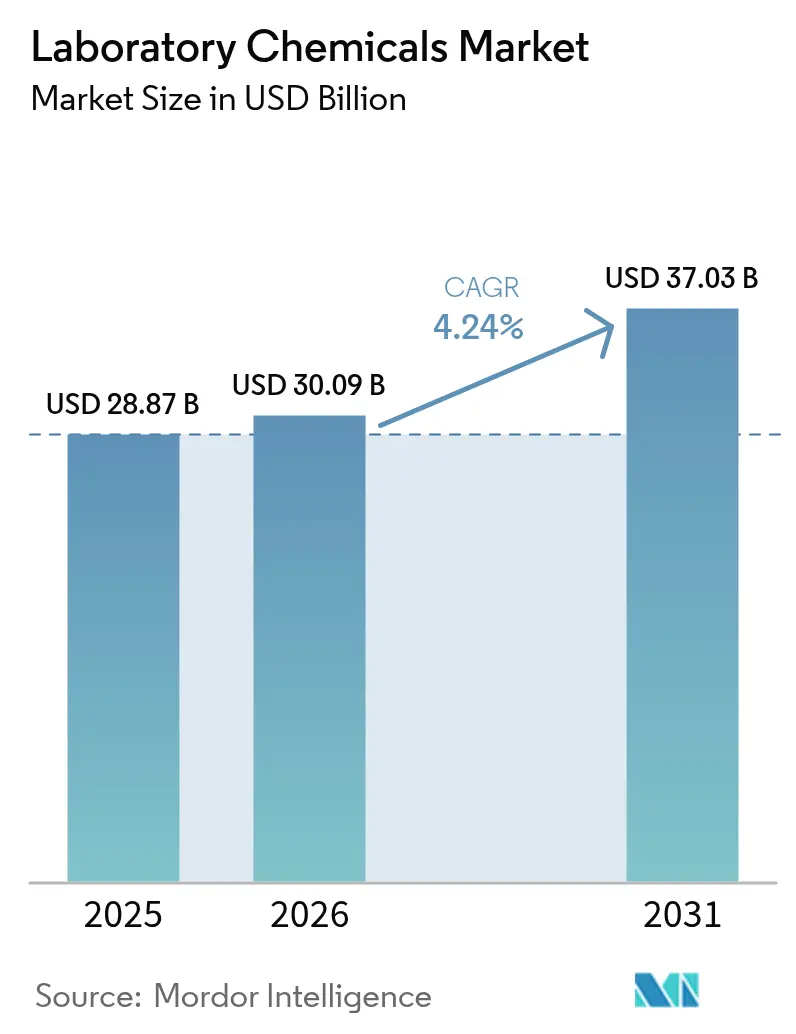
| Market Size (2026) | USD 30.09 Billion |
| Market Size (2031) | USD 37.03 Billion |
| Growth Rate (2026 - 2031) | 4.24 % |
| Fastest Growing Market | Asia Pacific |
| Largest Market | North America |
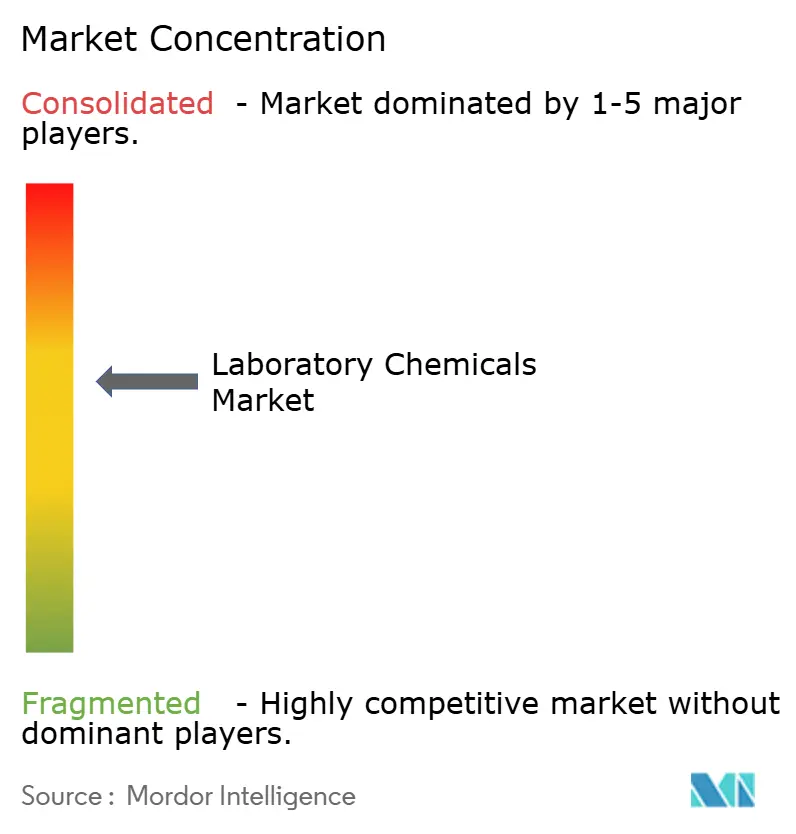
| Market Concentration | Medium |
Major Players *Disclaimer: Major Players sorted in no particular order Image © Mordor Intelligence. Reuse requires attribution under CC BY 4.0. | |
Laboratory Chemicals Market Analysis by Mordor Intelligence
The Laboratory Chemicals Market size in 2026 is estimated at USD 30.09 billion, growing from 2025 value of USD 28.87 billion with 2031 projections showing USD 37.03 billion, growing at 4.24% CAGR over 2026-2031. Sustained investment in life-science research, tighter analytical standards, and the gradual switch to greener chemistries form the bedrock of this steady trajectory. Pharmaceutical developers, now channeling more than USD 200 billion each year into R&D, remain the largest single demand node for high-purity reagents. Laboratories are also re-engineering workflows around automation, which raises consumption of pre-formatted liquid standards that cut handling steps. Parallel environmental regulations are pushing end users toward certified reference materials and bio-based solvents that meet emerging sustainability scorecards.
Key Report Takeaways
- By type, biochemistry led with 27.12% of laboratory chemicals market share in 2025 while healthcare/pharmaceutical reagents recorded the fastest 4.93% CAGR through 2031.
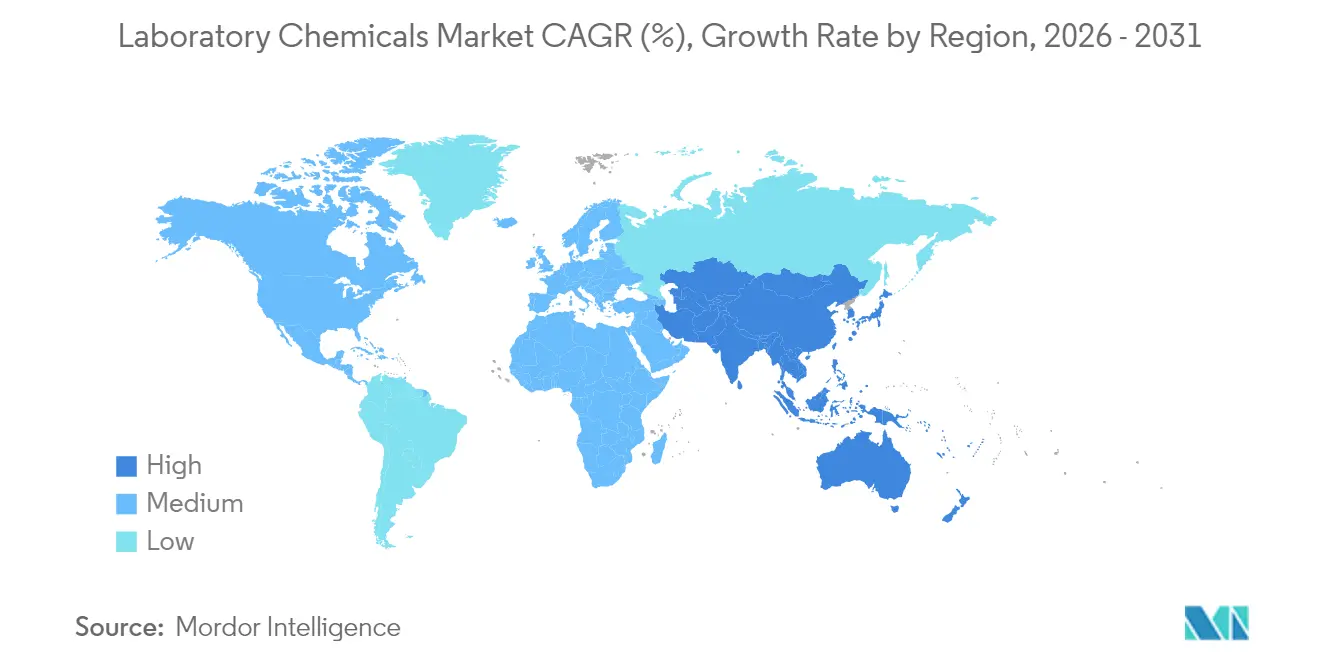
- By application, academia/educational institutions accounted for 30.66% of the laboratory chemicals market size in 2025, whereas cell/tissue culture reagents are on track for a 4.58% CAGR between 2026 and 2031.
- By geography, North America commanded 29.60% revenue in 2025; Asia-Pacific is projected to grow the quickest at a 4.66% CAGR to 2031.
Note: Market size and forecast figures in this report are generated using Mordor Intelligence’s proprietary estimation framework, updated with the latest available data and insights as of 2026.
Global Laboratory Chemicals Market Trends and Insights
Drivers Impact Analysis*
| Driver | (~) % Impact on CAGR Forecast | Geographic Relevance | Impact Timeline |
|---|---|---|---|
| Growing RandD Spending in Life-Science and Pharma Sectors | +1.2% | Global, with concentration in North America and Europe | Medium term (2-4 years) |
| Expanding Biopharmaceutical Manufacturing Capacity Worldwide | +0.9% | Global, led by Asia-Pacific and North America | Long term (≥ 4 years) |
| Rising Demand for High-Purity Reagents In Environmental and Food Testing | +0.7% | Global, with regulatory emphasis in EU and North America | Short term (≤ 2 years) |
| Digitization and AI-Enabled High-Throughput Lab-Of-The-Future Initiatives | +0.8% | North America, Europe, select Asia-Pacific markets | Medium term (2-4 years) |
| Shift Toward Sustainable/Green Solvents and Bio-Based Reagents | +0.6% | EU-led, expanding to North America and developed APAC | Long term (≥ 4 years) |
| Source: Mordor Intelligence | |||
Growing R&D Spending in Life-Science and Pharma Sectors
Major drugmakers allocated 15-20% of 2024 revenue to discovery programs, sustaining demand for chromatographic solvents, enzyme substrates, and isotope-labeled standards that underpin precision biology. Universities remain active buyers by leveraging industry alliances and foundation grants that shield research pipelines from public-funding volatility. The expansion of self-driving laboratories, built on robotic liquid handlers and AI-guided experiment design, tilts reagent consumption toward ready-to-use liquid stocks carrying bar-coded metadata. Suppliers able to deliver automation-compatible packaging and digital documentation are seeing elevated order volumes. The trend establishes a flywheel: richer data feeds better algorithms, which in turn heightens throughput and reagent requirements.
Expanding Biopharmaceutical Manufacturing Capacity Worldwide
A greater than 20% jump in global biologics capacity during 2024 opened a sizeable tailwind for process buffers, chromatography resins, and release-testing standards used in GMP environments. Contract development and manufacturing organizations rely on platform processes that multiply reagent needs across clients, cementing a predictable offtake profile. Asia-Pacific captures the lion’s share of new bricks-and-mortar investment as competitive cost structures attract multinationals and biosimilar firms alike. Continuous-manufacturing paradigms rooted in quality-by-design frameworks intensify demand for real-time analytical reagents that ensure batch integrity[1]U.S. Food & Drug Administration, “Process Analytical Technology Guidance,” fda.gov . Suppliers offering validated PAT chemistries are securing multi-year agreements tied to long-term commercial supply.
Rising Demand for High-Purity Reagents in Environmental and Food Testing
Updated U.S. EPA methods for PFAS monitoring now require ultra-trace detection limits that only premium-grade solvents and isotope-labeled standards can meet. EU drinking-water directives add further harmonization, creating a de facto global baseline that lifts purity specifications worldwide. Food-safety laboratories must support rapid screening of pesticides and mycotoxins, fueling uptake of certified multianalyte kits. Accreditation bodies under ISO/IEC 17025 mandate full traceability, favoring suppliers with complete lot-to-lot documentation and uncertainty budgets. As these standards climb, mid-tier reagents cede share to high-conformity products priced on value rather than volume.
Digitization and AI-Enabled High-Throughput "Lab-of-the-Future" Initiatives
Automation adoption accelerated in 2024 as researchers sought consistent data and relief from skilled-labor shortages. Cloud labs such as Emerald Cloud Lab centralize instrument fleets, enabling pooled procurement agreements for reagents, consumables, and calibration standards. These models prefer bottle-ready formats and validated SDS archives that interface with electronic lab notebooks via APIs. AI-driven design of experiments demands vast, well-annotated chemical libraries to train predictive models, opening niches for data-rich reagent catalogs. Vendors that integrate ordering portals with laboratory information management systems are displacing traditional distributors that rely on fragmented manual workflows.
Restraints Impact Analysis*
| Restraint | (~) % Impact on CAGR Forecast | Geographic Relevance | Impact Timeline |
|---|---|---|---|
| Volatility In Feedstock Prices for Key Solvents and Acids | -0.8% | Global, with acute impact in Asia-Pacific manufacturing | Short term (≤ 2 years) |
| Stringent Hazardous-Waste and Chemical-Safety Regulations | -0.5% | EU and North America leading, expanding globally | Medium term (2-4 years) |
| Availability of Functional Substitute Kits and Automation Platforms | -0.4% | Developed markets with high automation adoption | Long term (≥ 4 years) |
| Source: Mordor Intelligence | |||
Volatility in Feedstock Prices for Key Solvents and Acids
Sharp swings in crude-oil and naphtha benchmarks cascade into acetone, acetonitrile, and sulfuric-acid supply, destabilizing budgeting for high-consumption labs. Suppliers risk margin compression as tender-driven customers resist price pass-throughs. Geographic clustering of specialty chemical production in East Asia magnifies exposure when maritime bottlenecks or trade friction arise. Dual-sourcing strategies offset risk but incur qualification costs that stretch timelines and tie up working capital. Academic institutions, already coping with grant uncertainties, feel the pinch most acutely in the near term.
Stringent Hazardous-Waste and Chemical-Safety Regulations
The newest REACH updates expand the Substances of Very High Concern list, forcing expensive reformulation or discontinuation of longstanding reagents[2]European Chemicals Agency, “Candidate List of SVHCs,” echa.europa.eu. Waste-disposal levies are rising as local authorities reclassify previously benign mixtures into higher-fee categories. Suppliers must now furnish extensive exposure-scenario documentation, multilingual SDS, and digital traceability records that strain regulatory teams. Smaller niche manufacturers without global compliance infrastructure face exit decisions, nudging the laboratory chemicals market toward higher concentration among well-capitalized players.
*Our forecasts treat driver/restraint impacts as directional, not additive. The impact forecasts reflect baseline growth, mix effects, and variable interactions.
Segment Analysis
By Type: Biochemistry Leads Amid Proteomics Expansion
Biochemistry captured 27.12% of laboratory chemicals market share in 2025, underscoring its pivotal role in enzyme kinetics, metabolomics, and proteome-scale analyses. Proteomics labs routinely consume high-purity buffers, reducing agents, and mass-spectrometry grade solvents that command price premiums. Within this category, the laboratory chemicals market size for healthcare/pharmaceutical reagents is expected to compound at 4.93% CAGR through 2031 as drug manufacturers upscale biologics pipelines.
Molecular-biology reagents trail closely behind, buoyed by CRISPR and next-generation sequencing workflows that require fidelity-centric polymerases and nucleotide mixes. Cell/tissue-culture media are shifting toward serum-free, chemically defined formulations, aligning with regulatory guidance for advanced therapies. Environmental-testing chemicals continue steady uptake as governments widen contaminant-screening mandates. Across these subdomains, suppliers win share by offering data-rich certificates of analysis and flexible batch sizes that minimize customer inventory costs.




By Application: Academia Dominates Despite Funding Pressures
Academia/educational users retained 30.66% of the laboratory chemicals market in 2025, benefiting from diversified funding sources even as federal appropriations tightened. Bulk purchases span everything from basic acids for first-year teaching labs to high-grade reagents for cross-disciplinary research clusters. Industry buyers drive the second-largest slice of demand as in-house QC and process-development teams fortify analytical depth in response to stricter regulatory audits.
Cell/tissue culture emerged as the quickest-growing application, clocking a 4.58% CAGR from 2026 onward on the back of cell-therapy and organoid programs. Government laboratories remain stable consumers as they expand environmental-surveillance networks. The laboratory chemicals market size within healthcare/pharmaceutical applications is also expanding in lockstep with biologics capacity build-outs, cementing long-term offtake for GMP-grade consumables.
Geography Analysis
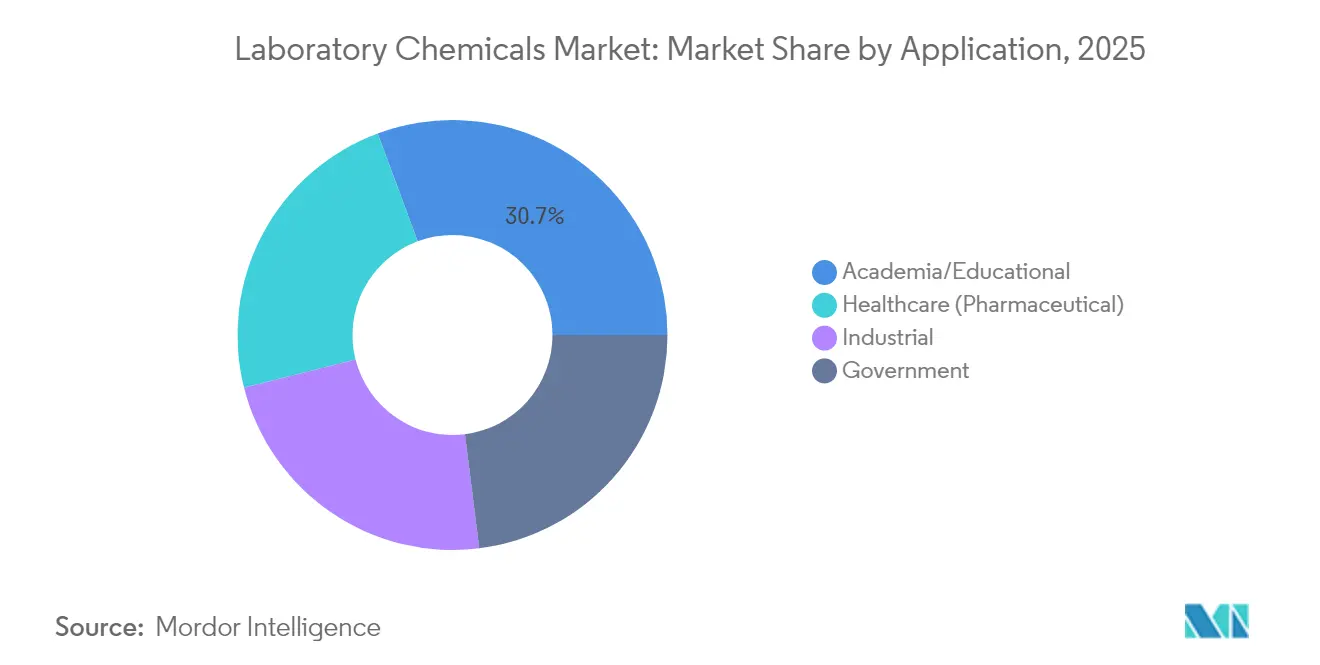
North America anchored 29.60% of 2025 revenue, fueled by GSK’s USD 30 billion and Eli Lilly’s USD 5 billion investments in U.S. manufacturing facilities. Federal bodies such as the FDA and EPA sustain consistent reagent requisitions for compliance and research mandates. Canada’s specialty-chemicals ecosystem adds regional supply resilience, further entrenching the laboratory chemicals market across the continent.
Asia-Pacific is on course for the most rapid expansion at a 4.66% CAGR. China’s push for biotech self-sufficiency spurs heavy procurement of chromatography media, cell-culture supplements, and analytical standards. India leverages its API leadership to source validation reagents domestically while exporting surplus supply worldwide. Japan and South Korea contribute high-end materials science and genomics demand, underpinning a sophisticated buyer base that prizes traceability and automation compatibility. The laboratory chemicals market size in Asia-Pacific thus benefits from both volume and value-added product mixes.
Europe retains a robust foothold underpinned by strict environmental legislation and advanced pharma clusters centered in Germany and Switzerland. Green-chemistry adoption is accelerating as public funding channels reward low-carbon lab operations. Brexit has nudged some ordering hubs from the UK to mainland EU, but trans-Atlantic and intra-European trade flows remain largely intact. Emerging regions such as South America and the Middle East and Africa are increasingly commissioning public-health labs, signaling future incremental uplift even though current shares stay modest.

Regulatory Landscape
Laboratory chemicals are subject to increasingly harmonized hazard communication and registration regimes that increase documentation and labeling requirements for suppliers serving multi-region laboratory networks. In the United States, OSHA's Hazard Communication Standard (29 CFR 1910.1200) aligns with the Globally Harmonized System and sets update timelines, with requirements for substances by January 19, 2026 and mixtures by July 19, 2027. This supports sustained demand for compliant SDS, labels, and traceable product documentation across reagent portfolios.
In Europe, CLP obligations continue to tighten alongside REACH requirements, with enforcement focus on digital channels and data transparency. Regulation (EU) 2024/2865 updates CLP for online and distance sales by requiring a supplier established in the Union for certain sales scenarios, shaping how global suppliers structure EU distribution and authorized representation. Separately, Regulation (EU) 2025/2455 establishes an ECHA-managed common data platform on chemicals, adding momentum toward centralized chemical data. UN GHS Revision 11, published in 2025, provides an updated global reference that influences downstream classification and label updates in multiple jurisdictions.
Value Chain Analysis
The laboratory chemicals value chain begins with upstream feedstocks (petrochemical and inorganic building blocks, solvents, acids, and specialty intermediates), followed by purification and formulation into lab grades, including chromatography solvents, buffers, and molecular biology reagents. For regulated workflows, certified reference materials add further requirements around traceability and uncertainty documentation. Manufacturing places emphasis on contamination control, quality systems, and batch analytics, especially for high-purity and regulated-use reagents, where lot consistency and deliverable documentation (SDS, CoA, and traceability under frameworks such as REACH Article 31) are treated as core outputs rather than add-ons.
Midstream activities include packaging (automation-compatible formats, barcoding, and digital documentation), warehousing, and temperature-controlled logistics where required. Downstream distribution covers direct sales by major suppliers and broadline distribution to academia, government, industrial, and healthcare or pharmaceutical laboratories. The chain is increasingly shaped by compliance and channel rules, including EU CLP changes for online sales that encourage EU-established supply entities. Consolidation among large life-science platforms also influences the channel structure, as suppliers integrate reagents with adjacent workflow components, reflected in Merck KGaA's June 2026 agreement to acquire Bio-Techne for approximately USD 11.3 billion to broaden its life-science tools and research reagent footprint.
Competitive Landscape
The laboratory chemicals market is moderately concentrated. Thermo Fisher Scientific’s USD 4.1 billion purchase of Solventum’s purification unit in September 2024 broadened its consumables span and fortified end-to-end workflow coverage. Merck KGaA, Agilent, and Sartorius continue to scale through targeted bolt-ons that add niche capabilities in filtration, chromatography, and bioprocess single-use systems.
Technology remains the chief battleground. Leaders are embedding AI into formulation design, enabling customers to model reagent interactions digitally before bench work. Patent filings around self-driving laboratory interfaces and smart packaging are ramping, hinting at future differentiation anchored in data services rather than commoditized chemicals.
Sustainability is the parallel axis of competition. Early movers offering carbon-accounted solvent alternatives and recyclable containers are securing preferred-supplier status on ESG-constrained tenders. New entrants include cloud labs that negotiate bundled reagent contracts, compressing margins but boosting volume visibility for accepted suppliers.
Laboratory Chemicals Industry Leaders
ITW Reagents Division
Merck KGaA
Avantor, Inc.
Thermo Fisher Scientific Inc.
Agilent Technologies
- *Disclaimer: Major Players sorted in no particular order

Market Opportunities and Future Outlook
Demand is concentrating in higher-conformity, documentation-heavy reagent categories tied to regulated testing and trace-level analytics, which creates room for suppliers that pair ultra-high purity with robust digital traceability (CoA metadata, ISO/IEC 17025-aligned documentation, and API-ready SDS archives). Updated methods for PFAS monitoring that require ultra-trace detection are already shifting purchasing criteria toward premium-grade solvents and isotope-labeled standards, and similar tightening in drinking-water and food-testing regimes increases the value of certified standards and multianalyte kits. This favors vendors that can maintain stable supply of high-purity solvents and reference materials while lowering compliance overhead for customers.
Automation-ready chemistry is another opportunity area as labs move toward higher throughput and standardized workflows. Merck KGaA's July 2025 launch of the AAW Automated Assay Workstation with Opentrons illustrates how reagent suppliers are packaging automation compatibility alongside chemicals, supporting adoption of pre-formatted liquid standards, barcoded reagents, and digitally native documentation that fits into LIMS and ELN environments. On the supply side, new investments in high-end intermediates and semiconductor-adjacent ultra-pure chemistries broaden the addressable space for lab-grade and R&D-grade offerings, particularly where impurity control and contamination analytics differentiate products from more commodity-like options.
Recent Industry Developments
- June 2026: Merck KGaA (Darmstadt, Germany) entered a definitive agreement to acquire Bio-Techne Corporation for approximately USD 11.3 billion, expanding its life science tools and research reagents footprint. The transaction strengthens portfolio breadth in research and bioprocessing workflows where recurring reagent consumption is tied to installed platforms. Integration also raises competitive pressure on mid-sized reagent specialists by enlarging bundled offerings across instruments, consumables, and chemicals.
- October 2025: Merck announced an agreement to acquire the chromatography business of JSR Life Sciences, adding Protein A and downstream purification capabilities. This move tightens control over critical chromatography consumables and supports an end-to-end workflow positioning for biopharma customers. It also links purification media more closely with associated buffers, standards, and process chemicals used in development and QC labs.
- February 2024: Thermo Fisher Scientific announced an agreement to acquire Solventum's Purification and Filtration business for approximately USD 4.1 billion. The acquisition broadens Thermo Fisher's purification and filtration offering used across bioprocessing and analytical workflows, where laboratory chemicals, buffers, and sample prep reagents are routinely co-procured. Expanded capabilities support tighter workflow bundling and can shift procurement toward fewer, larger suppliers for regulated lab environments.


Research Methodology Framework and Report Scope
Market Definition and Coverage
This market covers chemical products that are purchased and used for laboratory testing, research experiments, and routine analytical work, where the value is counted as sales revenue in USD across major regions.
Scope exclusions: Bulk commodity chemicals sold mainly for large-scale industrial processing, and lab equipment or instruments, are excluded unless they are sold as laboratory chemical products.
Segmentation Overview
- By Type
- Biochemistry
- Molecular Biology
- Cytokine and Chemokine Testing
- Carbohydrate Analysis
- Immunochemistry
- Cell/Tissue Culture
- Environmental Testing
- Other Types
- By Application
- Academia/Educational
- Industrial
- Government
- Healthcare (Pharmaceutical)
- By Geography
- Asia-Pacific
- China
- India
- Japan
- South Korea
- ASEAN Countries
- Rest of Asia-Pacific
- North America
- United States
- Canada
- Mexico
- Europe
- Germany
- United Kingdom
- France
- Italy
- Russia
- NORDIC Countries
- Rest of Europe
- South America
- Brazil
- Argentina
- Rest of South America
- Middle East and Africa
- Saudi Arabia
- South Africa
- Rest of Middle East and Africa
- Asia-Pacific
Data Sources, Market Sizing, and Validation
Desk Research
Desk work starts with building a clear demand map for laboratories across healthcare, academia, government, and industrial R&D, then aligning it with how lab chemicals are typically procured and priced. To ground this, we rely on public sources such as the US FDA, the US EPA, the National Institutes of Health, OECD indicators, and United Nations Comtrade trade statistics, which help validate activity levels and cross-border flows of relevant chemical categories.
Next, company annual reports, investor presentations, and product catalogs are reviewed to understand portfolio mix, typical pack sizes, and how price lists move over time. We also reference paid subscriptions that track company financials, patents, and shipment-level import and export records, which helps confirm production footprints and distribution intensity by region. The sources listed here are illustrative only, and many additional public documents and datasets were also used for clarification and cross-checking.
Primary Interviews and Surveys
Primary work is used to check what labs actually buy and how often they reorder, before assumptions are locked into the model. We spoke with a mix of manufacturers, distributors, and end users, including hospital labs, research institutes, and industrial labs across APAC, EMEA, and the Americas. This helped fill gaps on price movements, substitution between grades, and demand swings tied to research funding cycles.
Distribution of primary research fieldwork respondents
| Company type | Respondent position | Region |
|---|---|---|
| Top tier: 32% | CXOs: 13% | APAC: 41% |
| Mid tier: 54% | Functional/Unit leaders: 28% | EMEA: 35% |
| Smaller Players: 14% | Managers: 59% | Americas: 24% |
Market-Sizing & Forecasting
Sizing begins with a top-down reconstruction of the addressable laboratory demand pool, where research and testing activity by region is translated into recurring chemical consumption, then converted into revenue using observed price bands. The totals are corroborated with selective bottom-up approximations, such as sampled supplier and distributor revenue splits, channel checks on reorder frequency, and sanity checks using ASP times volume for common reagent baskets.
In the model, a few practical inputs do most of the work, including laboratory test volumes in healthcare settings, research spending direction and grant cycles, the mix shift between routine biochemistry and higher-value molecular workflows, import dependence for specific chemical grades, and observed pack size preferences that influence effective ASP. For forecasting, scenario analysis is used so the base case reflects normal funding and manufacturing conditions, while alternate paths capture periods of procurement tightening or faster adoption of advanced assays. Where direct volume signals are weak in smaller countries, proxy indicators are applied first and then corrected using interview feedback on local buying patterns.
Data Validation & Update Cycle
Outputs are checked against independent signals, such as trade trends, regional research intensity, and reported business mix comments from suppliers, before the numbers are finalized. Any large variance is reviewed step by step, and if it cannot be explained by scope or timing, assumptions are revisited and selected respondents are re-contacted for clarification.
A second analyst review is completed before sign-off so the logic, math, and units stay consistent across regions and years. Reports are refreshed annually, and interim updates are made when material events shift demand, pricing, or supply availability. Right before delivery, the dataset is rechecked so clients receive an updated view aligned with the latest available public data and validation notes.
Mordor Intelligence's Laboratory Chemicals Market Sizing Compared With Other Published Estimates
Published market values for laboratory chemicals can differ even when the topic sounds identical, since each publisher can pick a different base year, pricing timing, and what counts as a lab-grade chemical sale versus adjacent supplies. Differences also show up when some figures reflect list prices while others lean on realized pricing after distributor margins and contract discounts.
In this study, the refresh cadence and currency timing are treated as first-order checks, so price movements are aligned to the same year and then validated with distributor feedback on discounting and pack-size mix, a set of guardrails applied by Mordor Intelligence. When other estimates apply a broader scope, or apply faster ASP progression without matching it to procurement behavior, the market value can move up quickly even if laboratory activity is not changing at the same pace.
Benchmark comparison
| Source | Market Size | Gaps in Research Methodology |
|---|---|---|
| Mordor Intelligence | USD 30.09 B (2026) | |
| Global Consultancy A | USD 26.39 B (2025) | Uses a different base year and may apply alternate end-user boundaries, which can shift what is counted as laboratory chemical demand versus broader biotech and industrial usage. |
| Industry Publisher B | USD 30.87 B (2025) | May lean more on list-price style ASP progression and longer-horizon growth assumptions, which can lift the 2025 value if discounting and pack-size mix are not explicitly normalized. |
The table mainly shows that timing and pricing treatment can explain much of the spread, even before geography or application coverage is debated. By keeping year alignment, ASP logic, and validation steps easy to trace back to lab activity signals, the resulting market size stays repeatable and practical for planning.


Key Questions Answered in the Report
How large will the laboratory chemicals market be by 2031?
Value is projected to reach USD 37.03 billion under a 4.24% CAGR forecast.
Which product category currently holds the highest revenue share?
Biochemistry commands 27.12% of revenue thanks to its central role in proteomic and metabolomic assays.
Which application segment is expanding fastest through 2031?
Cell/tissue culture reagents are expected to post a 4.58% CAGR, reflecting growth in cell therapies.
Why is Asia-Pacific the most attractive growth region?
Why is Asia-Pacific the most attractive growth region?
Page last updated on:


 Your data is secure and never sold or shared.


