Market Overview
| Study Period | 2020 - 2031 |
|---|---|
| Forecast Data Period | 2026 - 2031 |
| Base Year Market Size (2025) | 249.14 Million Cubic meters |
| Market Volume (2026) | 266.26 Million Cubic meters |
| Market Volume (2031) | 371.16 Million Cubic meters |
| Growth Rate (2026 - 2031) | 6.87 % |
| Market Concentration | Medium |
Major Players *Disclaimer: Major Players sorted in no particular order Image © Mordor Intelligence. Reuse requires attribution under CC BY 4.0. | |
India Ready Mix Concrete Market Analysis by Mordor Intelligence
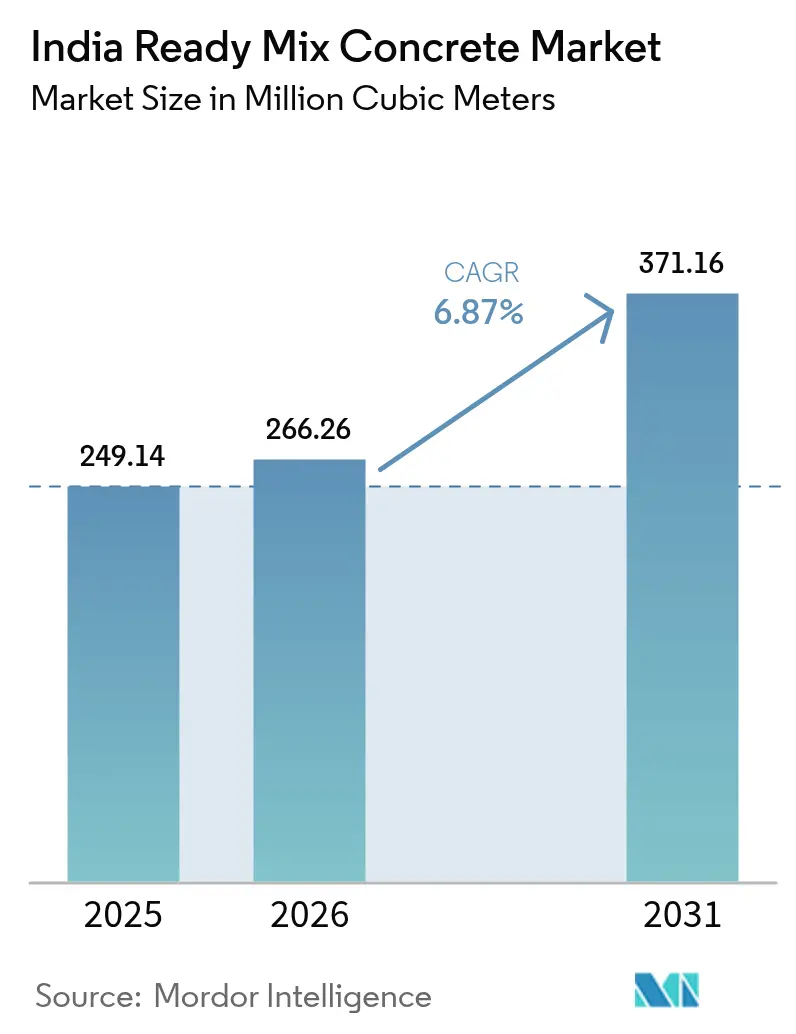
The India Ready Mix Concrete Market size is expected to grow from 249.14 million cubic meters in 2025 to 266.26 million cubic meters in 2026 and is forecast to reach 371.16 million cubic meters by 2031 at 6.87% CAGR over 2026-2031. Sustained infrastructure allocations, totaling INR 11.11 lakh crore in the 2025 Union Budget, underpin robust demand across highways, urban redevelopment, and industrial corridors. Rising adoption of mechanized batching and stringent quality norms accelerates the shift away from on-site mixing, while regulatory incentives for recycled aggregates begin to shape specification trends. The India ready mix concrete market benefits from integrated cement-to-concrete supply chains that lower raw-material risk and support competitive pricing. Digitalization of batch-plant operations—encompassing AI-driven mix optimization and IoT fleet tracking—creates measurable gains in delivery reliability, a critical differentiator for high-volume, schedule-sensitive projects.
Key Report Takeaways
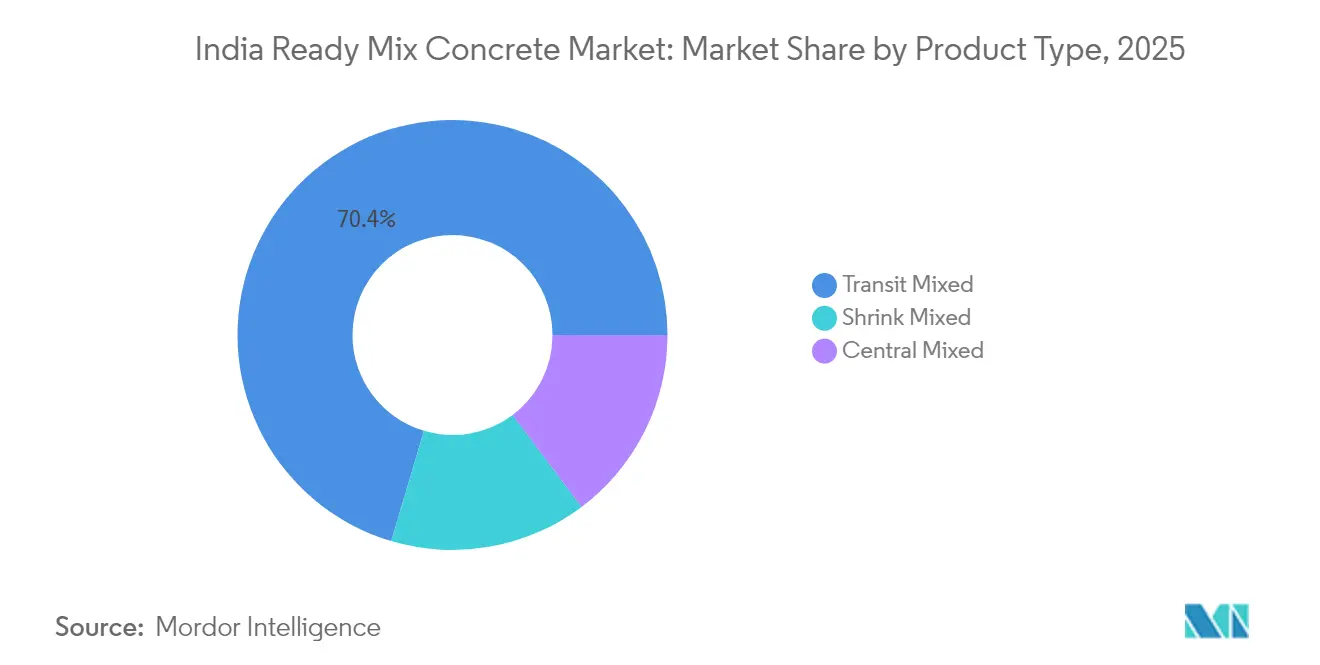
- By product type, transit mixed concrete led with 70.40% of the India ready mix concrete market share in 2025; shrink mixed concrete is projected to expand at a 6.98% CAGR through 2031.
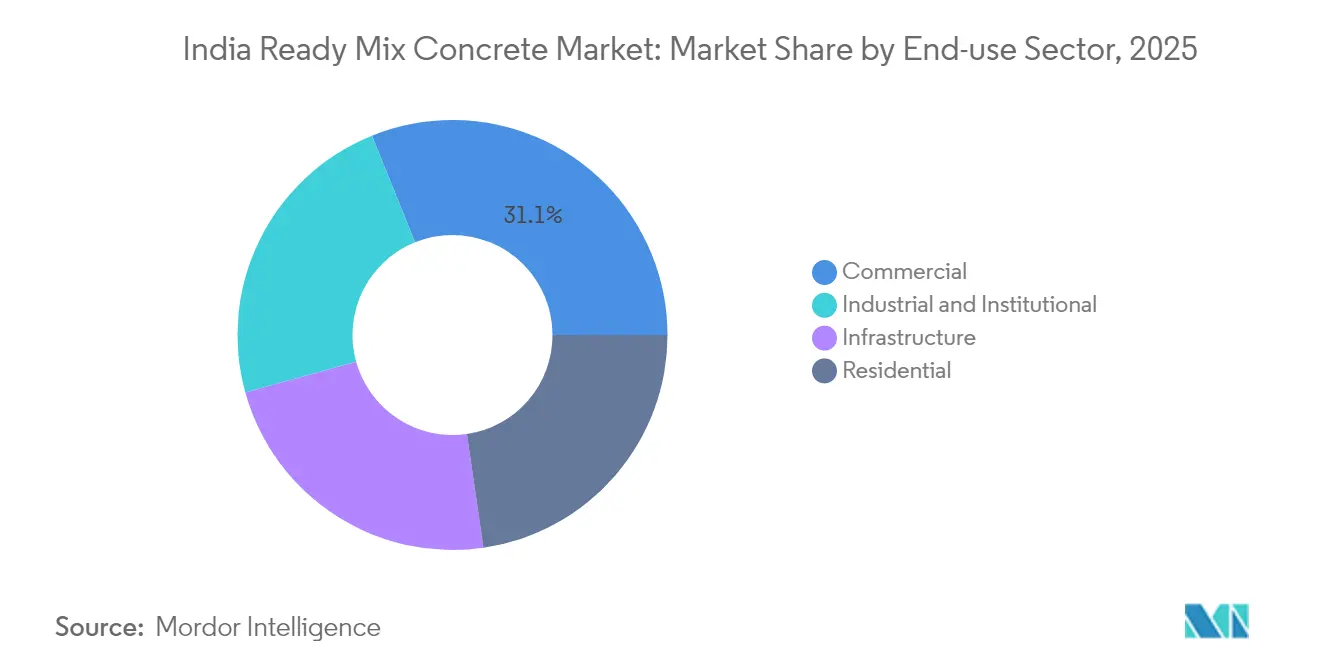
- By end-use sector, the commercial segment accounted for a 31.11% share of the India ready mix concrete market size in 2025, while industrial and institutional applications are advancing at a 7.06% CAGR to 2031.
Note: Market size and forecast figures in this report are generated using Mordor Intelligence’s proprietary estimation framework, updated with the latest available data and insights as of 2026.
India Ready Mix Concrete Market Trends and Insights
Drivers Impact Analysis*
| Driver | (~) % Impact on CAGR Forecast | Geographic Relevance | Impact Timeline |
|---|---|---|---|
| Rapid urban-infrastructure pipeline | +2.10% | Tier-1 & Tier-2 cities nationwide | Medium term (2-4 years) |
| Surge in green-rated commercial buildings | +1.80% | Mumbai, Delhi, Bangalore metros | Medium term (2-4 years) |
| National Highway development wave | +1.50% | Golden Quadrilateral & coastal corridors | Long term (≥ 4 years) |
| Automation of batch-plants (IoT/AI) | +0.90% | Large urban plants with gradual rural reach | Long term (≥ 4 years) |
| Carbon-tax exemption for low-clinker mixes | +0.60% | Industrial clusters nationwide | Short term (≤ 2 years) |
| Source: Mordor Intelligence | |||
Rapid Urban-Infrastructure Pipeline
A multi-city modernization agenda continues to expand the India ready mix concrete market. The PMAY-Urban 2.0 program channels INR 10 lakh crore into one crore affordable units, generating long-term, phased RMC offtake for residential superstructures and utility networks[1]. Fourteen transit-oriented development zones are being master-planned for populations above 3 million, demanding high-volume, night-time concrete placements where batch-plant reliability overrides cost. Smart-city upgrades require standardized mixes for integrated water, sewage, and utility trenches, pushing smaller site-mixer operators out of complex contracts. RMC producers are consequently commissioning hub-and-spoke plants on peri-urban plots to serve multiple projects within a 30-kilometer delivery radius. These hubs reinforce the India ready mix concrete market by shortening haul times and stabilizing slump consistency, even during peak summer temperatures.
Surge in Green-Rated Commercial Buildings
Sustainability mandates are reshaping procurement, positioning the India ready mix concrete market for premium low-carbon mixes. IGBC- and LEED-aligned developments now require Environmental Product Declarations, making carbon-intensity data a bid pre-requisite. Early adopters in Mumbai and Bengaluru specify blended cements with less than or equal to 350 kg CO₂-e per m³, rewarding suppliers capable of certifying clinker substitution levels above 35%. Government green-procurement guidelines stipulate recycled aggregate usage thresholds in public offices exceeding 5,000 m², accelerating demand for RMC with documented life-cycle impacts. Producers that integrate on-site reclaimed-water loops and solar-powered silos gain visibility in developer ESG dashboards, a consideration that trumps unit-cost differentials when corporate occupiers seek decarbonized supply chains. As a result, the India ready mix concrete market elevates sustainability from niche feature to mainstream contract clause.
National Highway Development Wave
PM Gati Shakti earmarks INR 15.39 lakh crore for expressway and rural-road packages, translating to more than 50,000 lane-kilometers of pavement through 2030. Highway concrete demands rapid strength gain and abrasion resistance, often calling for macro-synthetic fiber blends and low-shrinkage admixtures that ordinary site mixing cannot guarantee. RMC suppliers respond by setting up mobile plants along corridors, thus avoiding the workability losses inherent in 90-minute transport limits. Enforcing the MORTH specification for flexural strength enhances supplier differentiation, allowing premium pricing for compliant superplasticized mixes. In cold-region alignment stretches, heated-water batching and retarder dosage customization ensure 28-day strengths are attained within design windows, further deepening the India ready mix concrete market penetration into infrastructure projects.
Automation of Batch Plants (IoT/AI)
Advanced sensors now monitor aggregate moisture, ambient temperature, and real-time slump, feeding data to AI algorithms that adjust water-cement ratios within seconds. Ambuja’s 15-plant roll-out illustrates the tangible result: 12% lower rejection rates and 9% savings in cement per cubic meter. Predictive maintenance alerts minimize unplanned plant downtime, a historic pain point leading to costly site delays. IoT-based fleet scheduling raises mixer utilization from 3.5 to 5.0 trips a day, easing delivery backlogs in congested city cores. Smaller enterprises, lacking the capital for such systems, face widening service gaps that amplify the competitive moat enjoyed by data-driven operators. Consequently, the India ready mix concrete market shifts toward tech-intensive production models that scale efficiently as project volumes rise.
Restraints Impact Analysis*
| Restraint | (~) % Impact on CAGR Forecast | Geographic Relevance | Impact Timeline |
|---|---|---|---|
| Volatile fly-ash and slag availability | –1.4% | Regions distant from thermal-power clusters | Short term (≤ 2 years) |
| Rising last-mile logistics cost | –1.1% | Remote & hilly construction zones | Medium term (2-4 years) |
| SME contractor reluctance toward RMC | –0.8% | Rural & semi-urban districts | Long term (≥ 4 years) |
| Source: Mordor Intelligence | |||
Volatile Fly-Ash and Slag Availability
Coal-based power capacity fell 4% in 2024, shrinking class-F ash supply and forcing producers in eastern India to truck in material from 400 km away. Inconsistent slag output linked to steel-mill maintenance cycles disrupts binding-material blends that lower the heat of hydration for mass-pour foundations. Without reliable supplementary cementitious material, batch plants raise clinker content, inflating per-m³ cost by 5-7% and diluting carbon-reduction targets. Emerging alternatives—calcined clay, rice-husk ash—require capital-heavy processing lines and BIS standard convergence, limiting near-term uptake. Resultant margin squeeze tempers new-plant capex, slowing capacity additions that would otherwise grow the India ready mix concrete market.
Rising Last-Mile Logistics Cost
Diesel prices rose 6% in 2025, lifting mixer-truck cost per kilometer and triggering surcharges on remote-site deliveries. Regulations restricting heavy-vehicle entry during peak urban hours compress delivery windows and drive overtime labor premiums. In the Himalayan belt, gradient-induced derating slashes payload to 60%, doubling trip counts for the same pour volume. The 90-minute slump-retention limit remains a bottleneck that refrigeration units or extended-set admixtures only partially mitigate. Collectively, these factors erode profit margins and discourage producers from venturing beyond a 35-kilometer economic haul radius, capping the India ready mix concrete market’s geographic expansion potential.
*Our forecasts treat driver/restraint impacts as directional, not additive. The impact forecasts reflect baseline growth, mix effects, and variable interactions.
Segment Analysis
By Product Type: Transit Mixed Dominance Faces Specialized Competition
Transit Mixed concrete retained 70.40% India ready mix concrete market share in 2025, supplying a broad spectrum of residential floor plates, commercial columns, and infrastructure decks. Central Mixed alternatives, serve high-rise pump placements where immediate discharge at the site supports faster cycle times and reduces on-site labor idle costs. Shrink Mixed variants, comprising the balance, post a 6.98% CAGR to 2031—outpacing overall India ready mix concrete market growth—as tunnel, marine, and mass-foundation designers specify longer workability windows and reduced bleed water.
Year-round, producers tweak admixture packages to match ambient swings—from 48 °C summer highs in Rajasthan to 7 °C winter lows in NCR—demonstrating the India ready mix concrete industry’s increasing sophistication. BIS code revisions in 2025 officially recognize performance-based criteria over prescriptive w/c ratios, boosting demand for rheology-controlled mixes that shrink-mixed plants deliver consistently. Digitized moisture probes now enable second-by-second correction of water content, cutting standard deviation values and lowering the risk premium historically embedded in contract rates. Consequently, the share of Transit Mixed concrete, while still dominant, is expected to decline marginally as specialized formulations carve out high-value niches within the India ready mix concrete market size.

By End-Use Sector: Commercial Holds Leadership, Industrial-Institutional Surges Ahead
Commercial buildings held 31.11% of the India ready mix concrete market size in 2025, driven by IT campus rollouts and organized retail malls in Tier-1 metros. However, Industrial plus Institutional projects post a 7.06% CAGR to 2031, reflecting new semiconductor fabs, logistics parks, and education-healthcare complexes under public–private partnership models. Industrial demand increasingly calls for abrasion-resistant, metallic-fiber floor slabs and low-permeability tank foundations, attracting price premiums 12-15% above commodity grades.
Residential uptake remains volume-significant yet margin-thin due to SME contractors’ continued preference for site-mixed, labor-intensive methods in peri-urban plots. RERA enforcement, though, is nudging larger developers toward ISO-certified RMC suppliers to minimize warranty risk, gradually lifting the India ready mix concrete market penetration in mid-income housing. Infrastructure end-use, linked to roads, metros, and airports, secures long-cycle contracts that provide stable base loads for high-capacity plants, but extended receivable cycles stretch working capital. In sum, sector diversification balances cyclical swings and underpins sustained volume momentum for the India ready mix concrete industry.
Geography Analysis
India's ready-mix concrete market sees the highest consumption in Maharashtra, Tamil Nadu, and Karnataka, driven by the expansive growth of megacities like Mumbai, Chennai, and Bengaluru. Southern adoption rates exceed 65 m³ per capita of new-build floor plate thanks to early RMC penetration, stringent municipal quality audits, and coastal industrial clusters. Northern states, led by Delhi NCR and Uttar Pradesh, register double-digit yearly gains as elevated-road and metro packages unlock long-span bridge pours needing centralized quality control. The India ready-mix concrete market in Gujarat benefits from port-linked industrial investments, with specialty sulfate-resistant mixes contributing significantly to regional RMC dispatches.
Monsoon patterns vary by region, influencing seasonal dispatch trends. While the western coastal areas experience significant volume reductions from June to September, the rain-shadow regions of Telangana enjoy a more consistent schedule. This steadiness enables plants in Telangana to balance their annual output more effectively. Meanwhile, the eastern states of West Bengal, Odisha, and Assam are capitalizing on central-budget incentives and the establishment of new refinery complexes. These developments are leading to the creation of greenfield RMC capacities, reducing the historical dependence on site mixing. Regulatory enforcement also varies: Kerala’s mandatory EPD adoption fast-tracks low-carbon mix demand, while Madhya Pradesh still permits higher site-mix volumes, slowing RMC shift. Digital permitting under the National Building Code 2025 will harmonize standardization, likely accelerating the India ready mix concrete market in lagging geographies by reducing approval ambiguity and boosting investor confidence.
Competitive Landscape
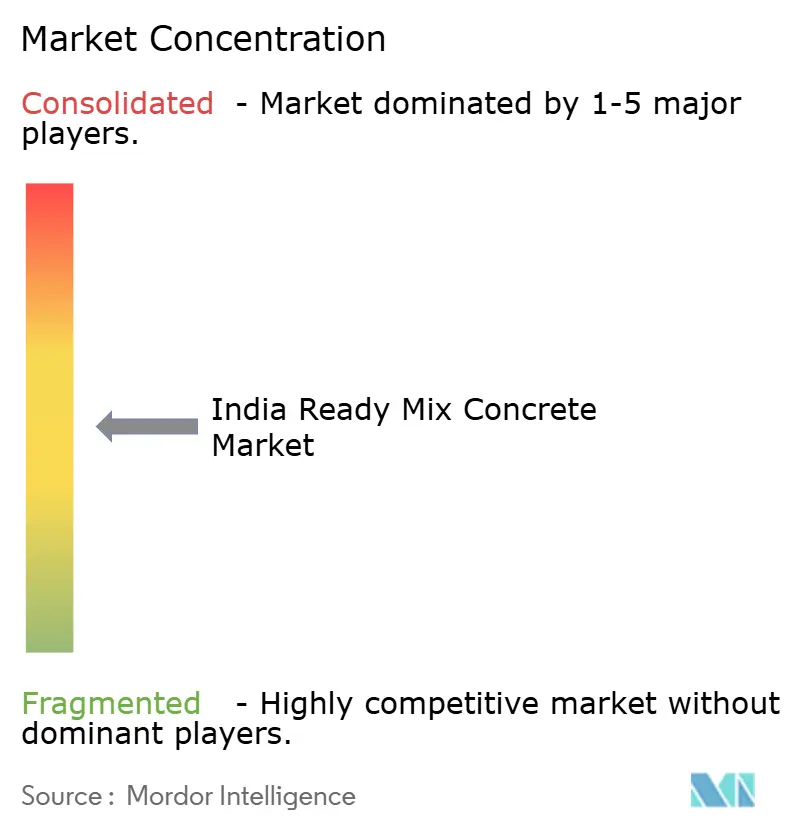
The India Ready Mix Concrete market remains moderately fragmented even as consolidation gathers pace. Integrated cement players—UltraTech, Ambuja, ACC, Dalmia, and Shree—leverage captive clinker, bulk-cement terminals, and large truck fleets to command scale benefits that independent RMC firms struggle to match. UltraTech’s 2025 acquisition of India Cements augments southern capacity by 15 million cubic meters and widens its urban pick-up radius. Ambuja’s AI-enabled command centres have trimmed cement factors by 5 kg per cubic meter across 15 plants, freeing margin headroom that finances further expansion.
Mid-tier specialists, such as RDC and Nuvoco, differentiate through value-added products—self-compacting, pervious, and lightweight concretes—garnering price premiums of 8–10% in design-led contracts. Yet compliance costs under Construction & Demolition Waste Management Rules 2024, including recycled-aggregate processing lines, disproportionately weigh on smaller operators, nudging consolidation. Regional incumbents in Gujarat and Kerala defend their share through deep local contractor ties and flexible payment terms, but risk exclusion from national tenders that prioritize documented sustainability metrics. Across the board, automation uptake serves as a strategic moat, explaining why capital-intensive, tech-savvy producers are poised to widen their slice of the India ready mix concrete market.
India Ready Mix Concrete Industry Leaders
-
Adani Group
-
Nuvoco Vistas Corp Ltd.
-
RDC Concrete (India) Limited
-
UltraTech Cement Ltd
-
Prism Johnson Limited
- *Disclaimer: Major Players sorted in no particular order
Recent Industry Developments
- June 2025: The Goa State Pollution Control Board issued location and buffer-zone guidelines for all commercial ready-mix concrete plants operating in the state.
- March 2024: Shree Cement commissioned a 90 m³/h greenfield ready-mix concrete facility in Hyderabad after acquiring five Mumbai plants from StarCrete LLP for INR 335 million.
India Ready Mix Concrete Market Report Scope
Commercial, Industrial and Institutional, Infrastructure, Residential are covered as segments by End Use Sector. Central Mixed, Shrink Mixed, Transit Mixed are covered as segments by Product. By Product Type
| Transit Mixed |
| Central Mixed |
| Shrink Mixed |
By End-Use Sector
| Residential |
| Commercial |
| Industrial and Institutional |
| Infrastructure |
| By Product Type | Transit Mixed |
| Central Mixed | |
| Shrink Mixed | |
| By End-Use Sector | Residential |
| Commercial | |
| Industrial and Institutional | |
| Infrastructure |
Market Definition
- END-USE SECTOR - Ready-mix concrete consumed in the construction sectors such as commercial, residential, industrial, institutional, and infrastructure are considered under the scope of the study.
- PRODUCT/APPLICATION - Under the scope of the study, the consumption of transit-mixed, shrink-mixed, and central-mixed ready-mix concrete are considered.
| Keyword | Definition |
|---|---|
| Accelerator | Accelerators are admixtures used to fasten the setting time of concrete by increasing the initial rate and speeding up the chemical reaction between cement and the mixing water. These are used to harden and increase the strength of concrete quickly. |
| Acrylic | This synthetic resin is a derivative of acrylic acid. It forms a smooth surface and is mainly used for various indoor applications. The material can also be used for outdoor applications with a special formulation. |
| Adhesives | Adhesives are bonding agents used to join materials by gluing. Adhesives can be used in construction for many applications, such as carpet laying, ceramic tiles, countertop lamination, etc. |
| Air Entraining Admixture | Air-entraining admixtures are used to improve the performance and durability of concrete. Once added, they create uniformly distributed small air bubbles to impart enhanced properties to the fresh and hardened concrete. |
| Alkyd | Alkyds are used in solvent-based paints such as construction and automotive paints, traffic paints, flooring resins, protective coatings for concrete, etc. Alkyd resins are formed by the reaction of an oil (fatty acid), a polyunsaturated alcohol (Polyol), and a polyunsaturated acid or anhydride. |
| Anchors and Grouts | Anchors and grouts are construction chemicals that stabilize and improve the strength and durability of foundations and structures like buildings, bridges, dams, etc. |
| Cementitious Fixing | Cementitious fixing is a process in which a cement-based grout is pumped under pressure to fill forms, voids, and cracks. It can be used in several settings, including bridges, marine applications, dams, and rock anchors. |
| Commercial Construction | Commercial construction comprises new construction of warehouses, malls, shops, offices, hotels, restaurants, cinemas, theatres, etc. |
| Concrete Admixtures | Concrete admixtures comprise water reducers, air entrainers, retarders, accelerators, superplasticizers, etc., added to concrete before or during mixing to modify its properties. |
| Concrete Protective Coatings | To provide specific protection, such as anti-carbonation or chemical resistance, a film-forming protective coat can be applied on the surface. Depending on the applications, different resins like epoxy, polyurethane, and acrylic can be used for concrete protective coatings. |
| Curing Compounds | Curing compounds are used to cure the surface of concrete structures, including columns, beams, slabs, and others. These curing compounds keep the moisture inside the concrete to give maximum strength and durability. |
| Epoxy | Epoxy is known for its strong adhesive qualities, making it a versatile product in many industries. It resists heat and chemical applications, making it an ideal product for anyone needing a stronghold under pressure. It is widely used in adhesives, electrical and electronics, paints, etc. |
| Fiber Wrapping Systems | Fiber Wrapping Systems are a part of construction repair and rehabilitation chemicals. It involves the strengthening of existing structures by wrapping structural members like beams and columns with glass or carbon fiber sheets. |
| Flooring Resins | Flooring resins are synthetic materials applied to floors to enhance their appearance, increase their resistance to wear and tear or provide protection from chemicals, moisture, and stains. Depending on the desired properties and the specific application, flooring resins are available in distinct types, such as epoxy, polyurethane, and acrylic. |
| High-Range Water Reducer (Super Plasticizer) | High-range water reducers are a type of concrete admixture that provides enhanced and improved properties when added to concrete. These are also called superplasticizers and are used to decrease the water-to-cement ratio in concrete. |
| Hot Melt Adhesives | Hot-melt adhesives are thermoplastic bonding materials applied as melts that achieve a solid state and resultant strength on cooling. They are commonly used for packaging, coatings, sanitary products, and tapes. |
| Industrial and Institutional Construction | Industrial and institutional construction includes new construction of hospitals, schools, manufacturing units, energy and power plants, etc. |
| Infrastructure Construction | Infrastructure construction includes new construction of railways, roads, seaways, airports, bridges, highways, etc. |
| Injection Grouting | The process of injecting grout into open joints, cracks, voids, or honeycombs in concrete or masonry structural members is known as injection grouting. It offers several benefits, such as strengthening a structure and preventing water infiltration. |
| Liquid-Applied Waterproofing Membranes | Liquid-Applied membrane is a monolithic, fully bonded, liquid-based coating suitable for many waterproofing applications. The coating cures to form a rubber-like elastomeric waterproof membrane and may be applied over many substrates, including asphalt, bitumen, and concrete. |
| Micro-concrete Mortars | Micro-concrete mortar is made up of cement, water-based resin, additives, mineral pigments, and polymers and can be applied on both horizontal and vertical surfaces. It can be used to refurbish residential complexes, commercial spaces, etc. |
| Modified Mortars | Modified Mortars include Portland cement and sand along with latex/polymer additives. The additives increase adhesion, strength, and shock resistance while also reducing water absorption. |
| Mold Release Agents | Mold release agents are sprayed or coated on the surface of molds to prevent a substrate from bonding to a molding surface. Several types of mold release agents, including silicone, lubricant, wax, fluorocarbons, and others, are used based on the type of substrates, including metals, steel, wood, rubber, plastic, and others. |
| Polyaspartic | Polyaspartic is a subset of polyurea. Polyaspartic floor coatings are typically two-part systems that consist of a resin and a catalyst to ease the curing process. It offers high durability and can withstand harsh environments. |
| Polyurethane | Polyurethane is a plastic material that exists in various forms. It can be tailored to be either rigid or flexible and is the material of choice for a broad range of end-user applications, such as adhesives, coatings, building insulation, etc. |
| Reactive Adhesives | A reactive adhesive is made of monomers that react in the adhesive curing process and do not evaporate from the film during use. Instead, these volatile components become chemically incorporated into the adhesive. |
| Rebar Protectors | In concrete structures, rebar is one of the important components, and its deterioration due to corrosion is a major issue that affects the safety, durability, and life span of buildings and structures. For this reason, rebar protectors are used to protect against degrading effects, especially in infrastructure and industrial construction. |
| Repair and Rehabilitation Chemicals | Repair and Rehabilitation Chemicals include repair mortars, injection grouting materials, fiber wrapping systems, micro-concrete mortars, etc., used to repair and restore existing buildings and structures. |
| Residential Construction | Residential construction involves constructing new houses or spaces like condominiums, villas, and landed homes. |
| Resin Fixing | The process of using resins like epoxy and polyurethane for grouting applications is called resin fixing. Resin fixing offers several advantages, such as high compressive and tensile strength, negligible shrinkage, and greater chemical resistance compared to cementitious fixing. |
| Retarder | Retarders are admixtures used to slow down the setting time of concrete. These are usually added with a dosage rate of around 0.2% -0.6% by weight of cement. These admixtures slow down hydration or lower the rate at which water penetrates the cement particles by making concrete workable for a long time. |
| Sealants | A sealant is a viscous material that has little or no flow qualities, which causes it to remain on surfaces where they are applied. Sealants can also be thinner, enabling penetration to a certain substance through capillary action. |
| Sheet Waterproofing Membranes | Sheet membrane systems are reliable and durable thermoplastic waterproofing solutions that are used for waterproofing applications even in the most demanding below-ground structures, including those exposed to highly aggressive ground conditions and stress. |
| Shrinkage Reducing Admixture | Shrinkage-reducing admixtures are used to reduce concrete shrinkage, whether from drying or self-desiccation. |
| Silicone | Silicone is a polymer that contains silicon combined with carbon, hydrogen, oxygen, and, in some cases, other elements. It is an inert synthetic compound that comes in various forms, such as oil, rubber, and resin. Due to its heat-resistant properties, it finds applications in sealants, adhesives, lubricants, etc. |
| Solvent-borne Adhesives | Solvent-borne adhesives are mixtures of solvents and thermoplastic or slightly cross-linked polymers such as polychloroprene, polyurethane, acrylic, silicone, and natural and synthetic rubbers. |
| Surface Treatment Chemicals | Surface treatment chemicals are chemicals used to treat concrete surfaces, including roofs, vertical surfaces, and others. They act as curing compounds, demolding agents, rust removers, and others. They are cost-effective and can be used on roadways, pavements, parking lots, and others. |
| Viscosity Modifier | Viscosity Modifiers are concrete admixtures used to change various properties of admixtures, including viscosity, workability, cohesiveness, and others. These are usually added with a dosage of around 0.01% to 0.1% by weight of cement. |
| Water Reducer | Water reducers, also called plasticizers, are a type of admixture used to decrease the water-to-cement ratio in the concrete, thereby increasing the durability and strength of concrete. Various water reducers include refined lignosulfonates, gluconates, hydroxycarboxylic acids, sugar acids, and others. |
| Water-borne Adhesives | Water-borne adhesives use water as a carrier or diluting medium to disperse resin. They are set by allowing the water to evaporate or be absorbed by the substrate. These adhesives are compounded with water as a dilutant rather than a volatile organic solvent. |
| Waterproofing Chemicals | Waterproofing chemicals are designed to protect a surface from the perils of leakage. A waterproofing chemical is a protective coating or primer applied to a structure's roof, retaining walls, or basement. |
| Waterproofing Membranes | Waterproofing membranes are liquid-applied or self-adhering layers of water-tight materials that prevent water from penetrating or damaging a structure when applied to roofs, walls, foundations, basements, bathrooms, and other areas exposed to moisture or water. |
Research Methodology
Mordor Intelligence follows a four-step methodology in all our reports.
- Step-1: Identify Key Variables: The quantifiable key variables (industry and extraneous) pertaining to the specific product segment and country are selected from a group of relevant variables & factors based on desk research & literature review; along with primary expert inputs. These variables are further confirmed through regression modeling (wherever required).
- Step-2: Build a Market Model: In order to build a robust forecasting methodology, the variables and factors identified in Step-1 are tested against available historical market numbers. Through an iterative process, the variables required for market forecast are set and the model is built on the basis of these variables.
- Step-3: Validate and Finalize: In this important step, all market numbers, variables and analyst calls are validated through an extensive network of primary research experts from the market studied. The respondents are selected across levels and functions to generate a holistic picture of the market studied.
- Step-4: Research Outputs: Syndicated Reports, Custom Consulting Assignments, Databases & Subscription Platforms