
Market Overview
| Study Period | 2020 - 2031 |
|---|---|
| Forecast Data Period | 2026 - 2031 |
| Base Year Market Size (2025) | USD 22.44 Billion |
| Market Size (2026) | USD 23.13 Billion |
| Market Size (2031) | USD 26.89 Billion |
| Growth Rate (2026 - 2031) | 3.06 % |
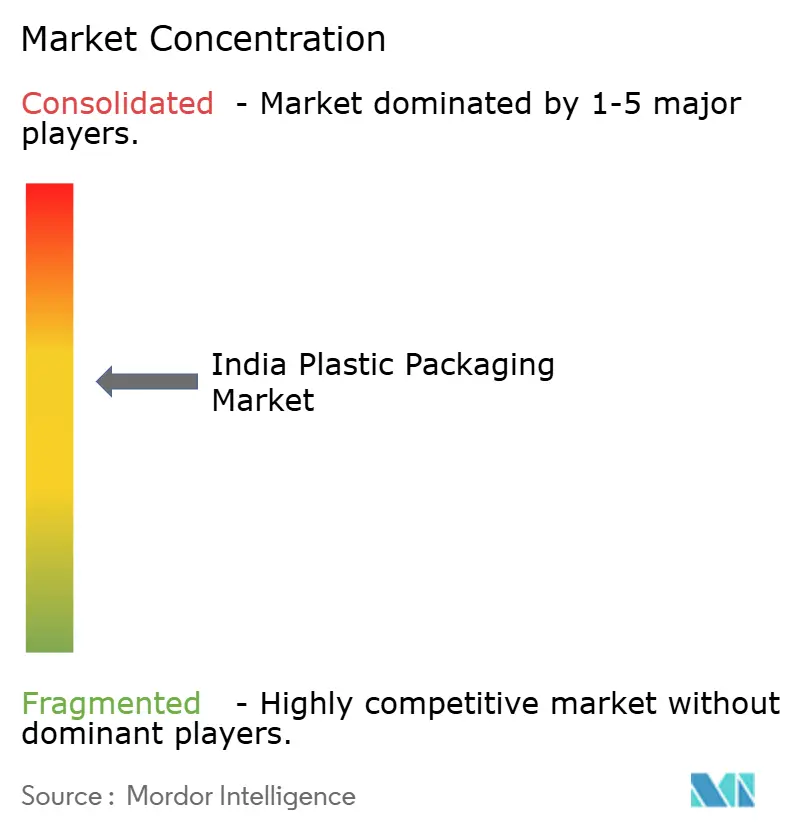
| Market Concentration | Medium |
Major Players *Disclaimer: Major Players sorted in no particular order Image © Mordor Intelligence. Reuse requires attribution under CC BY 4.0. | |
India Plastic Packaging Market Analysis by Mordor Intelligence
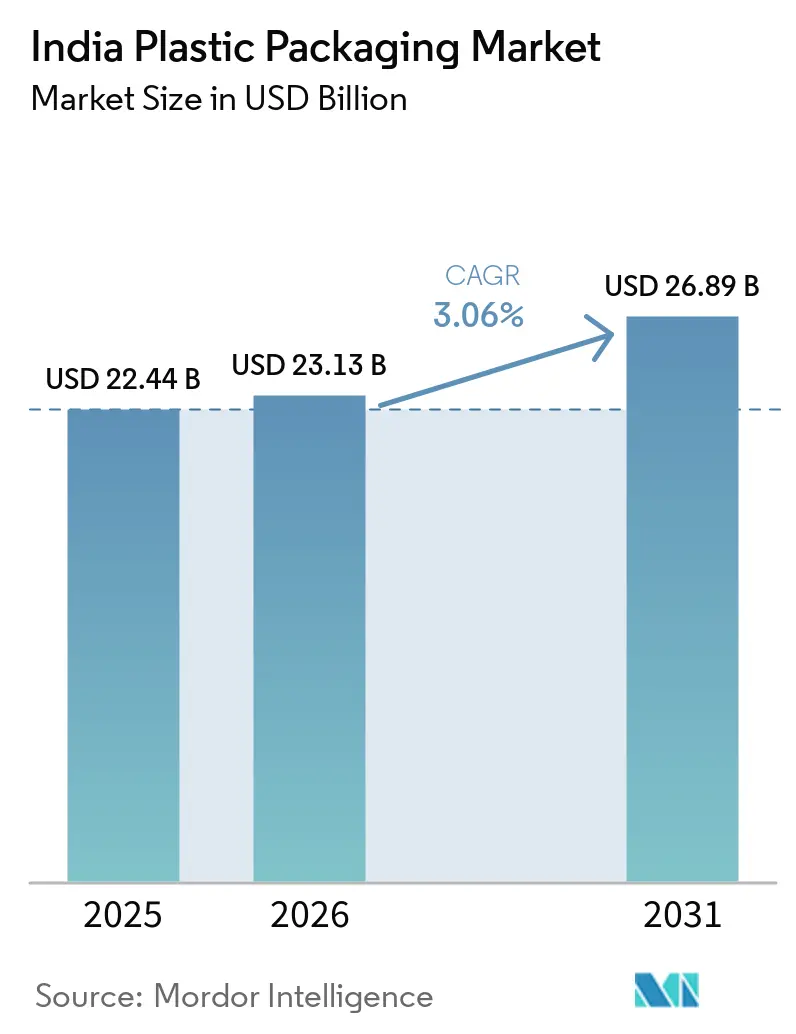
The India plastic packaging market size was valued at USD 22.44 billion in 2025 and estimated to grow from USD 23.13 billion in 2026 to reach USD 26.89 billion by 2031, at a CAGR of 3.06% during the forecast period (2026-2031).[1] Demand pivots from pure volume to value-added formats as Extended Producer Responsibility (EPR) rules enacted in 2024 place the onus of post-consumer waste on brand owners, pushing converters toward recycled-content resins and higher-margin barrier technologies. E-commerce parcel volumes surged 40% in 2024, triggering a parallel spike in secondary packaging that favors tamper-evident pouches, low-gauge stretch films, and moisture-barrier liners. The sector also benefits from pharmaceuticals shifting to single-dose packs that suit rural health outreach programs, while food and beverage multinationals localize production to serve rapid-delivery channels and comply with food-contact material rules. Regional plastic parks in Maharashtra, Gujarat, and Tamil Nadu compress supply chains, reduce logistics cost, and enable just-in-time inventory for both virgin and recycled feedstocks.
Key Report Takeaways
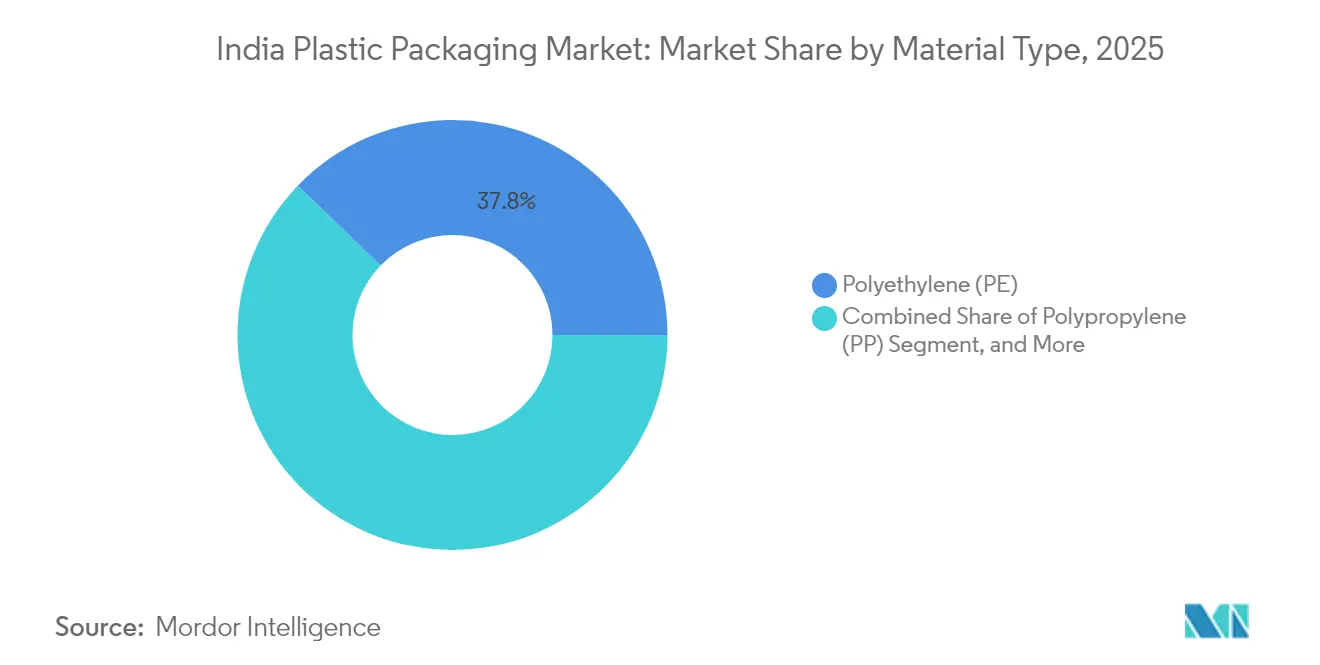
- By material type, polyethylene held 37.78% of the India plastic packaging market share in 2025, and polyethylene terephthalate is projected to advance at a 4.18% CAGR through 2031.
- By packaging type, flexible solutions accounted for 54.05% share of the India plastic packaging market size in 2025, and forecast to expand at a 4.6% CAGR through 2031.
- By product form, pouches and sachets led with 31.85% revenue share in 2025, and Films and wraps are advancing at a 4.78% CAGR through 2031.
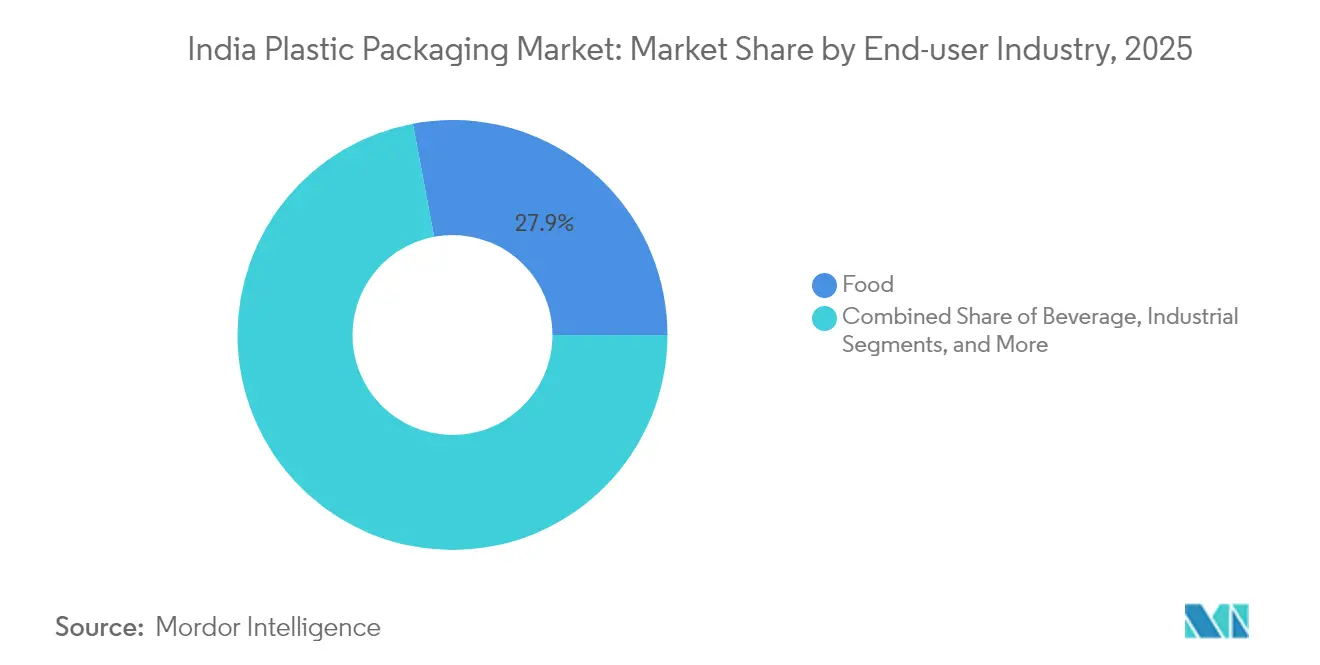
- By end-user industry, food maintained a 27.95% share of the India plastic packaging market size in 2025, and cosmetics and personal care are expected to grow at a 4.86% CAGR through 2031.
Note: Market size and forecast figures in this report are generated using Mordor Intelligence’s proprietary estimation framework, updated with the latest available data and insights as of 2026.
India Plastic Packaging Market Trends and Insights
Drivers Impact Analysis*
| Driver | (~) % Impact on CAGR Forecast | Geographic Relevance | Impact Timeline |
|---|---|---|---|
| Growing e-commerce and quick-commerce logistics boom | +0.8% | National, with early gains in Mumbai, Delhi, Bengaluru | Short term (≤ 2 years) |
| Demand for lightweight flexible formats | +1.2% | Global, concentrated in Maharashtra, Gujarat, Tamil Nadu | Medium term (2-4 years) |
| Uptake of recycled-content plastics | +0.7% | National, spill-over to neighboring countries | Long term (≥ 4 years) |
| EPR-linked rPET/rHDPE localization push | +0.9% | National, with early adoption in industrial states | Medium term (2-4 years) |
| AI-enabled converting lines for SMEs | +0.6% | Regional clusters in Maharashtra, Gujarat, Karnataka | Long term (≥ 4 years) |
| Single-dose pharma pouch surge | +0.4% | National, rural healthcare expansion focus | Short term (≤ 2 years) |
| Source: Mordor Intelligence | |||
Growing e-commerce and quick-commerce logistics boom
Package volumes from 15-minute delivery platforms grew 300% in major metros during 2024, requiring tamper-proof pouches that preserve integrity across multiple handling points. Converters that deploy automated pouch lines achieve cycle times near 200 packs per minute, shortening lead times for grocery aggregators that refresh inventory thrice daily. FMCG majors have responded by relocating filling operations closer to demand centers; for example, a leading beverage maker commissioned a plant in Assam in 2025, trimming average transit distance to 450 km and cutting secondary packaging spend by 14%. This shift concentrates demand for low-gauge stretch films that withstand vibration and thermal fluctuations common in last-mile two-wheeler delivery. Regional warehousing networks now specify moisture-barrier films with WVTR below 10 g / m² / day to avoid condensation damage during the monsoon. The India plastic packaging market, therefore, receives a rapid influx of orders for small-format, high-barrier solutions that command price premiums over legacy SKUs without eroding fill-rate economics.
Demand for lightweight flexible formats
Logistics providers levy fuel-surcharge pass-throughs that incentivize weight reduction, steering brands away from rigid packs toward mono-material laminates that are 40% lighter yet meet drop-test thresholds. Barrier-coated substrates now achieve oxygen transmission rates below 1 cc / m² / day, allowing shelf-stable food to travel farther without a cold chain. As flexible pouches replace composite cans in powdered beverage mixes, converters save up to 30% resin weight per 100 g serving, easing EPR fee liabilities that scale with grammage. Thermoforming lines that once served dairy tubs now pivot to form-fill-seal cup lidding, capturing an outsized share of premium yogurt launches. The India plastic packaging market also witnesses bi-axially oriented PE films gaining traction because they allow all-PE laminates that qualify for single-material recycling streams. Capital outlay for retrofitting lamination equipment averages USD 2 million per line; SMEs mitigate risk by forming cooperatives that share finishing assets inside government-backed plastic parks.
Uptake of recycled-content plastics
A nationwide mandate requires 30% recycled content in PET beverage bottles by 2025, spurring investments in food-grade wash lines with FDA-equivalent certification. Integrated players with captive recycling assets sell certified rPET at a 20-25% premium over virgin resin due to limited compliant capacity, currently only 15% of national recycling throughput. The India plastic packaging market thus experiences vertical mergers; resin producers acquire downstream converters to guarantee offtake for recycled flakes. Financial closure for a USD 165 million depolymerization plant announced in 2024 demonstrates investor confidence that chemical recycling will meet upcoming quality thresholds for direct food contact. Equipment suppliers report 18-month lead times for solid-state polycondensation units, compelling early movers to place orders ahead of surging demand. EPR credits now trade on emerging exchanges, with rPET certificates averaging USD 55 per tonne in Q1 2025, offering additional revenue streams for recyclers who exceed legal targets.
EPR-linked rPET / rHDPE localization push
Brand owners finance take-back systems, catalyzing regional collection hubs that feed into polymer parks where recyclers pelletize waste within 48 hours, preserving IV levels for high-end applications. Domestic supply has become strategic after 2024 geopolitical tensions disrupted 30% of specialty plastic packaging film imports. A leading multinational converter doubled planned Panipat capacity to 168,000 MTPA of post-consumer PET chips, ensuring consistent input for its barrier film lines. State incentives such as electricity rebates up to INR 2 / kWh for recycling plants shorten payback to under five years. Cross-industry tie-ups-beverage bottlers co-funding grocery chains’ reverse-vending machines-further anchor the India plastic packaging market in a localized circular economy model. Parallel standardization by the Bureau of Indian Standards (BIS) sets testing protocols for recycled resins, averting performance variability that previously deterred converters from large-scale adoption.
Restraints Impact Analysis*
| Restraint | (~) % Impact on CAGR Forecast | Geographic Relevance | Impact Timeline |
|---|---|---|---|
| Resin price volatility | -0.5% | Global impact, concentrated in import-dependent regions | Short term (≤ 2 years) |
| Single-use-plastic regulatory bans | -0.3% | National, with state-level variations | Medium term (2-4 years) |
| Scarce food-grade PCR infrastructure | -0.4% | National, concentrated in Maharashtra, Gujarat, Tamil Nadu | Long term (≥ 4 years) |
| Import-dependent hi-end film machinery CAPEX | -0.6% | National, affecting specialized converters | Medium term (2-4 years) |
| Source: Mordor Intelligence | |||
Resin price volatility
Crude swings drove PE and PP contract prices up to 30% during 2024, yet converters locked into six-month supply agreements could only reprice quarterly, compressing EBITDA margins by nearly 4 percentage points. Flexible converters carry inventory covering just 20 production days on average; sudden price hikes strain working capital facilities that already carry 11% interest. Hedging via polymer futures remains nascent, with low liquidity restricting meaningful coverage beyond 5% of monthly volume. The India plastic packaging market, therefore, sees cooperatives negotiating pooled contracts to gain bulk discounts while sharing storage depots adjacent to refinery tank farms. Government plans for a Production-Linked Incentive (PLI) scheme in petrochemicals promise duty waivers, but capacity additions will not materialize until 2028, leaving the near-term outlook vulnerable to global feedstock volatility.
Single-use-plastic regulatory bans
State rules vary: Maharashtra bans carry bags below 50 micron thickness, while Tamil Nadu targets cutlery and straws, forcing firms with national footprints to juggle 10+ SKU codes per product line.[2] Compliance redesign costs average 9% of affected SKUs’ annual revenue, including tooling and artwork changes. Biodegradable PLA substitutes remain 54% costlier than PE, limiting immediate switch viability for mass-market sachets, though a landmark 80,000-tonne PLA plant breaking ground in February 2025 aims to narrow the gap within three years. The India plastic packaging market consequently experiences an order backlog as converters await clarity on potential central harmonization of bans. Meanwhile, retailers shift to thicker reusable bags that carry a refundable deposit, slightly cushioning volume loss in banned segments but adding reverse-logistics complexity.
*Our forecasts treat driver/restraint impacts as directional, not additive. The impact forecasts reflect baseline growth, mix effects, and variable interactions.
Segment Analysis
By Material Type: PE Dominance Faces PET Innovation
Polyethylene commands the highest 37.78% share of the India plastic packaging market in 2025, underpinned by competitive resin pricing and compatibility with blown-film and injection-molding lines already installed nationwide. Its role in high-volume SKUs such as shopping bags, agricultural sheets, and detergent pouches sustains throughput that keeps average operating rates above 80% in major plants. PE also benefits from the flexible feedstock slate of domestic crackers, which maintains a steady monomer supply even during global disruptions, giving local converters stable price benchmarks against imported parity levels. However, polyethylene terephthalate is projected to grow at a 4.18% CAGR through 2031 as brands seek clarity, gloss, and superior barrier credentials for ready-to-drink beverages and condiments. PET’s recyclability advantage dovetails with EPR targets, and multiple bottle-to-bottle projects under implementation aim to lift the India plastic packaging market size for food-grade rPET flakes to more than 1 million TPA by 2027.
In spite of its growth, PET faces melt-filtration bottlenecks that raise capital intensity; integrated PET lines cost 20-25% more than equivalent PE lines due to solid-state polycondensation and higher-pressure injection stretches. Polypropylene fills specialized slots where rigidity and heat resistance matter, such as microwaveable trays and pharma caps, but supply remains tight because domestic PP capacities favor fiber and automotive grades. Polystyrene and EPS gradually decline owing to state bans on foamed tableware, though niche demand persists in appliance liners where cushioning outweighs recyclability concerns. Emerging bioplastics like PLA, backed by a USD 342 million greenfield project in Uttar Pradesh, hold potential in compostable snack packs but remain contingent on municipal composting infrastructure scaling beyond pilot units. As regulators publish draft norms to equate recycled-content thresholds across polymers, converters anticipate a multi-material portfolio balancing cost, performance, and recycle-content quotas, reshaping the India plastic packaging industry over the next decade.

By Packaging Type: Flexible Solutions Drive Innovation
Flexible formats account for 54.05% share of the India plastic packaging market size in 2025, demonstrating the clear economic edge of film-based systems that deliver 30% lower transportation cost per unit of packed weight than rigid alternatives. Multi-layer laminates engineered with EVOH or AlOx coatings extend aroma barrier life, enabling rural distribution without refrigerated trucks. Brand owners pursuing carbon-footprint disclosures favor flexible pouches because life-cycle-assessment models credit them with 60% fewer greenhouse-gas emissions per liter of beverage compared with glass bottles. Flexible packaging is forecast to expand at a 4.6% CAGR through 2031 as quick-commerce spurts heighten demand for single-serve sachets that meet impulse-buy price points. Flexible’s dominance also stems from rapid line changeovers; digital solventless lamination cures in under two hours, allowing converters to manage SKU proliferation from regional flavor launches.
Rigid plastic packaging retains relevance in cosmetics where shelf presence and tactile cues command premium price points. Extrusion-blow-molded HDPE bottles for personal-care products now feature near-infrared sortable masterbatches that ease downstream recycling, aligning rigid formats with circularity goals. Injection-stretch-blown PET jars gain share in nutraceuticals because 38-mm neck finishes accommodate induction-seal liners, preserving volatile ingredients. However, cap-and-closure resin consumption plateaus as tethered-cap EU requirements influence design globally, prompting material light-weighting of hinge bridges. The India plastic packaging market thus exhibits a nuanced co-existence: flexible growth rides on e-commerce cycles, while rigid solutions maintain foothold in premium niches that value aesthetics and reusability.
By Product Form: Pouches Lead While Films Accelerate
Pouches and sachets secure 31.85% of 2025 revenue, reflecting consumers’ affinity for portion-controlled packs priced at INR 5-10 that align with daily cash-flow patterns. Ultrasonic-sealed spouted pouches consolidate baby-food launches, reducing energy consumption by 70% compared with thermal sealing, and improving recyclability via all-PE mono-structures. Stick packs in electrolyte beverages capitalize on rural electrification programs that expand cold-chain reach but still rely on sachet convenience for on-the-go hydration. On the other hand, films and wraps are advancing at a 4.78% CAGR through 2031, buoyed by stretch-hood applications in warehouse palletization and silage films for agrarian export hubs. Specialty shrink films with anti-fog additives penetrate fresh-produce exports, where rejection rates fell to 4% in 2024 from 9% in 2023 due to improved condensation control.
Bottle and jar volumes grow moderately as rPET mandates boost collection schemes that loop clear flake back into beverage chains, with deposit-return pilots in three states retrieving 78% of bottles sold in Q2 2025. Trays and containers ride on the convenience-foods wave, using barrier-coated PP to achieve 180-day ambient shelf life for ready-to-eat curries, reducing cold storage energy load by 22 GWh annually. Bags and sacks remain integral for fertilizers and cement, but average grammage drops by 12% thanks to high-tenacity PE wovens. The “other forms” category features collapsible tubes and thermoformed clamshells incorporating up to 50% recycled PETG, widening repertoire for cosmetics aimed at eco-conscious millennials. Such diversification reinforces the India plastic packaging market as a test-bed for high-barrier yet affordable innovations.
By End-User Industry: Food Sector Stability Meets Cosmetics Growth
Food applications held 27.95% of the India plastic packaging market size in 2025, sustained by rising processed-food penetration and stricter cold-chain logistics under FSSAI guidelines that specify migration limits for multilayer structures. Retort pouches for ready-to-eat meals elevate shelf stability to 18 months, enabling military and disaster-relief tenders that demand field-ready nutrition without frozen storage. Dairy brands adopt transparent barrier cups, allowing consumers to inspect texture, increasing perceived quality and boosting repeat purchases by 7%, according to brand audits. Meanwhile, single-serve condiment sachets ride on quick-service-restaurant expansion, where hygiene concerns prohibit communal dip bowls after the pandemic. The India plastic packaging market thus sees steady base-load volume from food, anchoring factory utilization even during broader economic dips.
Cosmetics and personal care are projected to post a 4.86% CAGR through 2031, driven by premiumization as disposable income climbs among urban households. Airless pump bottles made of recyclable mono-material PP replace multi-component acrylic assemblies, marrying sustainability with upscale touchpoints. Digital-printed shrink sleeves enable limited-edition runs for influencer-led campaigns, shortening concept-to-shelf cycles to under six weeks. Beverage packaging entwines with recycled content targets; rPET bottle adoption soars as soft-drink giants pledge 50% recycled content by 2027, stimulating flake imports until domestic capacity scales. Pharmaceuticals expand unit-dose pouches for antibiotic stewardship programs, as smaller pack sizes curb misuse. Industrial packaging wrestles with resin price swings, turning toward returnable PP crates in automotive supply chains to mitigate single-use tax levies in select states. Together, these dynamics diversify demand streams, cushioning the India plastic packaging industry against shocks in any one vertical.
By Manufacturing Process: Extrusion Scale Versus Thermoforming Innovation
Extrusion processes captured 28.12% of the India plastic packaging market share in 2025, thanks to their versatility across blown film, sheet, and profile applications. Leading converters operate up-gauged three-layer co-extruders equipped with inline MDO units that impart stiffness, allowing 12-micron films to replace traditional 18-micron gauges without compromising tensile strength. Energy-recovery systems on high-output lines cut specific energy consumption to 0.36 kWh / kg, delivering cost savings that absorb resin-price shocks. Co-extrusion enables n-layer tubes with decorative barrier layers, opening export opportunities for oral-care products subject to European recycling criteria. The India plastic packaging market benefits from export-backed extruders achieving 85% capacity utilization even in domestic downturns.
Thermoforming, forecast to grow at a 5.04% CAGR through 2031, leverages precision plug-assist technology to mold thin-wall trays at denesting strengths exceeding 20 N, supporting mechanized filling lines in snacks and confectionery. High-clarity APET sheets, now containing up to 30% internal regrind, meet aesthetic demands while meeting EFSA-equivalent migration limits. Mini-batch thermoformers empower SMEs to serve regional dairy brands without investing in large molds, bolstering capacity in Tier-2 clusters. Injection molding retains niche leadership in caps, closures, and thick-wall jars, while blow molding evolves through multilayer co-ex heads that embed recycled core layers between virgin skins, satisfying food-contact rules yet delivering 25% recycled content. “Other processes,” such as digital direct-to-shape printing, emerge, enabling SKUs as small as 2,000 units for hyper-local runs. Each method addresses distinct value pools, collectively reinforcing the technological depth of the India plastic packaging market.
Geography Analysis
Manufacturing clusters in Maharashtra, Gujarat, and Tamil Nadu account for roughly 60% of organized plastic-packaging capacity, leveraging proximity to refineries, ports, and end-market consumption. Maharashtra’s complexes near Mumbai capitalize on twin-port access at Nhava Sheva and Pipavav, cutting transit times for export cartons to 14 days versus the 21-day national average. Gujarat’s plastic parks at Dahej and Dholera receive polymer directly from on-site crackers, trimming raw-material freight by 6 c / kg and allowing converters to offer price locks despite volatile crude benchmarks. Tamil Nadu’s 239-acre Polymer Industries Park in Thiruvallur, backed by INR 216 crore state funding, draws SMEs into plug-and-play plots where shared utilities shave 12% off capex for extrusion lines. These agglomerations amplify the India plastic packaging market’s regional competitiveness by clustering suppliers, toolmakers, and testing labs within a 50 km radius.
Northern states such as Uttar Pradesh, Haryana, and Punjab serve agricultural film and fertilizer sack demand, boosted by cold-chain expansion along the Delhi-Mumbai Industrial Corridor. Uttar Pradesh offers capital subsidies up to 25% for new packaging units in backward districts, encouraging decentralization from overloaded western hubs. Haryana benefits from the Kundli-Manesar-Palwal expressway that connects converters to Delhi warehouses in under two hours, accelerating just-in-time shipments for e-commerce fulfillment centers. Eastern India remains under-scaled but poised for acceleration as the National Industrial Corridor Programme earmarks multimodal hubs in Odisha and West Bengal, supplying petrochemical feedstock via Paradip and Dhamra ports. Local governments court foreign investors with land-lease holidays and SGST reimbursements aimed at diversifying the India plastic packaging market’s geographic footprint.
Raw-material logistics shape cost structures: Gujarat’s adjacency to refineries shields converters from rail bottlenecks that occasionally plague northern plants relying on distant resin shipments. Tamil Nadu’s coastal sites import high-barrier EVOH and adhesive resins within 15 days from Japan, reducing inventory-financing needs. Meanwhile, states with fragmented bans on single-use plastics compel multi-plant companies to tailor packaging specs by destination, raising tooling duplication but mitigating last-mile compliance risk. Government flagship PM GatiShakti infrastructure upgrades promise synchronized planning of highways, rail, and dry ports, expected to slice average domestic freight cost from 14% to below 10% of delivered value by 2028. As connectivity tightens, the India plastic packaging market anticipates increased intra-regional competition, rewarding plants that combine cost efficiency with regulatory agility.
Regulatory Landscape
India plastic packaging regulation is anchored in the Plastic Waste Management (PWM) Rules, 2016, administered by the Ministry of Environment, Forest and Climate Change (MoEF&CC) and implemented via the Central Pollution Control Board (CPCB) and State Pollution Control Boards (SPCBs). The PWM (Amendment) Rules notified on 31 March 2026 (G.S.R. 237(E)) tightened Extended Producer Responsibility (EPR) by updating category-wise recycling targets, introducing mandatory recycled-content thresholds for plastic packaging, and adding reuse obligations for rigid packaging, with carry-forward provisions for 2025-26 shortfalls over three years.
Operational compliance is increasingly digital and auditable. Producers, Importers, and Brand Owners (PIBOs) must register and file EPR returns through the CPCB centralized portal, and the Common EPR Portal went live on 28 June 2026, requiring companies to revalidate registrations and reporting workflows. For material requirements, recycled plastics must conform to IS 14534:2023, and food-contact applications must also align with FSSAI requirements. In the 2026 amendment, verification was broadened to allow checks via registered environmental auditors alongside regulator oversight.
Value Chain Analysis
The value chain runs from resin and recycled feedstock sourcing (virgin PE, PP, PET and post-consumer PCR streams) to compounding and additives/masterbatch supply, then conversion (extrusion blown film and cast film, BOPP/BOPET/CPP, injection and blow molding, thermoforming) and printing or lamination, before downstream distribution into FMCG, food, beverage, pharmaceuticals, cosmetics, and industrial end users. India also remains exposed to imported polymer and specialty input dependence, which links converter margins and lead times to crude-linked resin pricing and shipping disruptions, even as organized manufacturing clusters and plastic parks in states such as Maharashtra, Gujarat, and Tamil Nadu reduce lead times by colocating tooling, testing, and shared utilities.
EPR-driven circularity is changing upstream and midstream economics, with compliant supply of food-grade recycled resins and traceable recycled content becoming a key bottleneck and differentiator for converters supplying regulated end uses. This shows up in capacity additions and localization moves across rPET and higher-specification converting, including Srichakra Polyplast's expansion model announced to lift food-grade rPET processing capacity beyond 113,000 tonnes by 2026, and Knack Packaging expanding its Borisana, Gujarat facility toward 55,800 MTPA in woven sack capacity. As reporting and verification intensify under the CPCB EPR portal regime, traceability, quality certification (including BIS-linked standards for recycled plastics), and access to collection and sorting networks increasingly determine who can supply large national brand owners at scale.
Competitive Landscape
Roughly 200 organized firms operate across films, laminates, and rigid containers, yet the top 10 players control around 35% of sales, indicating moderate concentration that still leaves room for regional specialists. The November 2024 acquisition of Manjushree Technopack by PAG for nearly USD 1 billion underscores growing private-equity appetite for scalable assets in the India plastic packaging market. Consolidators prioritize vertical integration; UFlex’s 168,000 MTPA rPET chip plant in Panipat secures feedstock for its CPP and BOPET film lines, insulating margins against virgin-resin volatility. Foreign entrants like ALPLA raise competition by pledging to double domestic recycling capacity to 700,000 tonnes by 2030, leveraging global know-how and capital depth.
Technology adoption differentiates leaders. AI-enabled vision systems slash defect rates below 0.3%, boosting acceptance for high-speed sachet lines that fill 1,500 ppm in condiment plants. Patent filings around mono-material barrier structures rise 18% YoY, with Indian innovators collaborating with academic labs on plasma-coating breakthroughs that enable PE-only flexible packs to match EVOH barrier levels. Smaller firms cluster in plastic parks to share R&D and testing, pooling resources to attain BIS certification across diversified material families. Export orientation strengthens as supply-chain re-shoring in the West prompts global brands to dual-source from India; converter audits now emphasize traceability of recycled content, prompting investments in blockchain-enabled material passports. Overall, strategic plays pivot on sustainability, cost leadership, and automation, shaping a dynamic India plastic packaging market poised for selective consolidation.
India Plastic Packaging Industry Leaders
-
Amcor plc
-
UFlex Limited
-
Jindal Poly Films Limited
-
Cosmo First Limited
-
Polyplex Corporation Limited
- *Disclaimer: Major Players sorted in no particular order
Market Opportunities and Future Outlook
The March 2026 PWM amendment (G.S.R. 237(E)) set a clearer, time-bound compliance pathway for recycled content and reuse in plastic packaging, widening the addressable market for certified recycled resins and for converters able to validate material provenance under EPR filings. Whitespace remains in food-grade PCR supply, testing capacity, and audit-ready traceability systems that satisfy IS 14534:2023 requirements (along with FSSAI alignment for food-contact). These gaps support opportunities for integrated recycler-converter models, third-party quality labs, and digital material-tracking solutions linked to CPCB portal reporting.
In 2026, capital allocation points to where companies are building capacity and capabilities. UFlex announced an INR 700 crore investment to expand packaging film manufacturing in Karnataka by an additional 54,000 MTPA, supporting domestic supply of value-added films used in flexible packaging. For recycled feedstocks, Srichakra Polyplast committed INR 425 crore to expand food-grade rPET capacity (targeting over 113,000 tonnes by 2026), indicating continued investment in bottle-to-bottle and higher-clarity applications where compliant resin availability remains constrained. At the same time, Pakka Ltd initiated a large project in Ayodhya, Uttar Pradesh, and Rajshree Polypack commissioned added injection molding and sleeving capacity, reflecting active diversification across material systems and formats as brand owners balance EPR compliance, state-level single-use constraints, and performance requirements for e-commerce, food, and pharma packaging.
Recent Industry Developments
- June 2026: Amcor commissioned a new high-performance healthcare packaging production line at its Sira, Karnataka facility to serve pharmaceutical customers. The added capability increases local supply of higher-specification packs used in regulated healthcare applications, strengthening competitive intensity in value-added segments where quality systems and consistency are critical.
- October 2025: UFlex completed a debottlenecking project at its Sanand, Gujarat aseptic packaging facility, raising capacity from 7 billion to 12 billion packs per annum. The faster route to incremental output supports domestic demand for aseptic packs and improves utilization of downstream filling and distribution networks without waiting for a greenfield build cycle.
- December 2024: Loop Industries and Ester Industries formed a recycling joint venture to commercialize depolymerized DMT and MEG. The venture establishes a new capability in chemical recycling for recycled monomers in India and supports alignment with tightened EPR and recycled-content requirements.
Research Methodology Framework and Report Scope
Market Definition and Coverage
For this study, the market is defined as the value of plastic packaging sold for use in India across common packaging formats used to contain, protect, and transport products, counted at the packaging supply level in current USD.
Scope exclusions: We exclude non-plastic packaging materials (such as paper, metal, and glass) and packaging machinery and services from this market sizing.
Segmentation Overview
- By Material Type
- Polyethylene (PE)
- Polypropylene (PP)
- Polyethylene Terephthalate (PET)
- Polystyrene and EPS
- Other Material Types
- By Packaging Type
- Flexible Plastic Packaging
- Rigid Plastic Packaging
- By Product Form
- Bottles and Jars
- Trays and Containers
- Pouches and Sachets
- Bags and Sacks
- Films and Wraps
- Other Product Forms
- By End-User Industry
- Food
- Beverage
- Pharmaceuticals and Healthcare
- Cosmetics and Personal Care
- Industrial
- Other End-user Industries
- By Manufacturing Process
- Extrusion
- Injection Molding
- Blow Molding
- Thermoforming
- Other Manufacturing Processes
Data Sources, Market Sizing, and Validation
Desk Research
Desk work starts by mapping India packaging demand to publicly available indicators, and then checking if these indicators move in a sensible way across years. We typically refer to sources such as Ministry of Commerce and Industry trade statistics, Central Pollution Control Board updates on plastics and waste rules, and data releases from the Ministry of Statistics and Programme Implementation for manufacturing and consumption signals.
To keep the model grounded, we also scan association and standards sources such as packaging and plastics bodies, plus peer reviewed papers that discuss polymer use, recycling, and barrier performance for packaging. We use company annual reports, investor presentations, and reputable press to understand capacity additions and pricing commentary, and we refer to paid subscription company financials and an import-export shipment-level database to validate supplier scale and trade-linked volumes where needed. These sources are not exhaustive, and we used many other public references for cross-checks, validation, and clarification during the research.
Primary Interviews and Surveys
Primary work is used to stress-test the desk assumptions, especially around which plastic packaging formats are growing faster, where pricing is moving, and how end-use demand is shifting between food, beverages, and personal care. We spoke with a mix of converters, raw material channel participants, brand-side procurement contacts, and distribution-side experts across major Indian demand clusters to confirm volumes, utilization ranges, and realistic price bands before the model was finalized.
Distribution of primary research fieldwork respondents
| Company type | Respondent position |
|---|---|
| Top tier: 37% | CXOs: 16% |
| Mid tier: 47% | Functional/Unit leaders: 40% |
| Smaller Players: 16% | Managers: 44% |
Market-Sizing & Forecasting
Sizing is built using a top-down and bottom-up mix, where national demand is reconstructed from packaging consumption signals and polymer conversion activity, then cross-checked with selective supplier and channel roll-ups. The top-down side uses India-specific demand pools such as packaged food and beverage output trends, personal care volume growth, and pharma packing consumption, which are then translated into plastic packaging needs using realistic usage factors discussed with industry respondents.
On corroboration, we sanity-check totals using sampled average selling prices by major format, along with estimated shipment or production volumes for key packaging categories such as films, pouches, bottles, and containers. Inputs that matter in this market include resin price direction (which impacts realized packaging prices), flexible versus rigid mix shifts, lightweighting and downgauging trends, recycling and compliance costs linked to plastics rules, and changes in organized retail and e-commerce packaging needs. Forecasting is done using scenario analysis supported by short-run trend smoothing, with the base case adjusted by expected end-use growth and pricing outlook confirmed by experts. Where uncertainty remains, gaps are handled using conservative ranges that are revisited during validation.
Data Validation & Update Cycle
Outputs are checked through several rounds so the totals align with real-world signals and do not drift due to one assumption. We compare results against independent indicators such as polymer demand direction, trade flows for relevant packaging materials, and stated capacity movements, then rework outliers until the story and numbers match.
Before sign-off, a separate analyst reviews the logic, conversion factors, and year-on-year movements, and we re-contact respondents when variances look too large to explain through pricing or mix change. The report is refreshed annually, and interim updates are made when material events occur, followed by a final pre-delivery review so clients receive the latest updated view.
Mordor Intelligence's India Plastic Packaging Market Sizing Compared With Other Published Estimates
It is normal to see different market values for India plastic packaging because publishers do not always count the same products, pricing points, or time frames, even when the market name looks identical. Differences also come from how much of the value chain is included, how imports are treated, and whether the estimate is tied back to measurable demand drivers.
In this market, the biggest gaps usually come from mixing packaging material value with packaged product value, using aggressive price uplift assumptions for resin-linked packaging, or rolling in adjacent categories such as non-plastic packs and packaging services. Some sources also use a different base year and then apply a faster end-use growth curve without enough checks on format mix and conversion factors, which can widen the estimate quickly.
Benchmark comparison
| Source | Market Size | Gaps in Research Methodology |
|---|---|---|
| Mordor Intelligence | USD 22.44 B (2025) | |
| Industry Research Publisher A | USD 13.20 B (2025) | This figure appears to apply a narrower counted value, where parts of packaging conversion value and realized pricing by format can be underrepresented when the model leans more on broad category splits rather than format-level price bands. |
| Databook Publisher B | USD 37.90 B (2025) | This estimate looks higher because it likely uses a wider inclusion set and stronger pricing progression, including broader format coverage and material splits that can overlap or be counted at a later point in the value chain. |
The spread across sources mainly comes down to what gets counted as plastic packaging value, how prices are applied across flexible and rigid formats, and how overlaps are avoided. By separating format-level pricing from packaged product value and rechecking key conversion factors during interviews, the sizing stays closer to observable packaging demand signals, which is the approach applied by Mordor Intelligence.
Key Questions Answered in the Report
What is the current value of the India plastic packaging market?
The market is worth USD 23.13 billion in 2026 and is projected to reach USD 26.89 billion by 2031 at a 3.06% CAGR.
Which segment holds the highest share in Indian plastic packaging by material?
Polyethylene leads with 37.78% share, reflecting its cost and processing advantages.
How are EPR rules influencing packaging formats?
EPR mandates are steering converters toward recycled-content resins and creating captive demand for food-grade rPET and rHDPE.
Which region is emerging fastest for new packaging plants?
Tamil Nadu, backed by a state-funded polymer park, is attracting SMEs with plug-and-play plots and tax incentives.
What technology trend is improving production efficiency?
AI-enabled vision systems and predictive maintenance are lifting overall equipment effectiveness above 85% in leading plants.
Which end-use industry is growing quickest?
Cosmetics and personal care packaging is forecast to grow at a 4.86% CAGR through 2031 due to premiumization and sustainable-pack adoption.