
Market Overview
| Study Period | 2021 - 2031 |
|---|---|
| Forecast Data Period | 2026 - 2031 |
| Base Year Market Size (2025) | USD 12.65 Billion |
| Market Size (2026) | USD 13.65 Billion |
| Market Size (2031) | USD 20.71 Billion |
| Growth Rate (2026 - 2031) | 8.70 % |
| Market Concentration | High |
Major Players *Disclaimer: Major Players sorted in no particular order Image © Mordor Intelligence. Reuse requires attribution under CC BY 4.0. | |
India Gift Card and Incentive Card Market Analysis by Mordor Intelligence
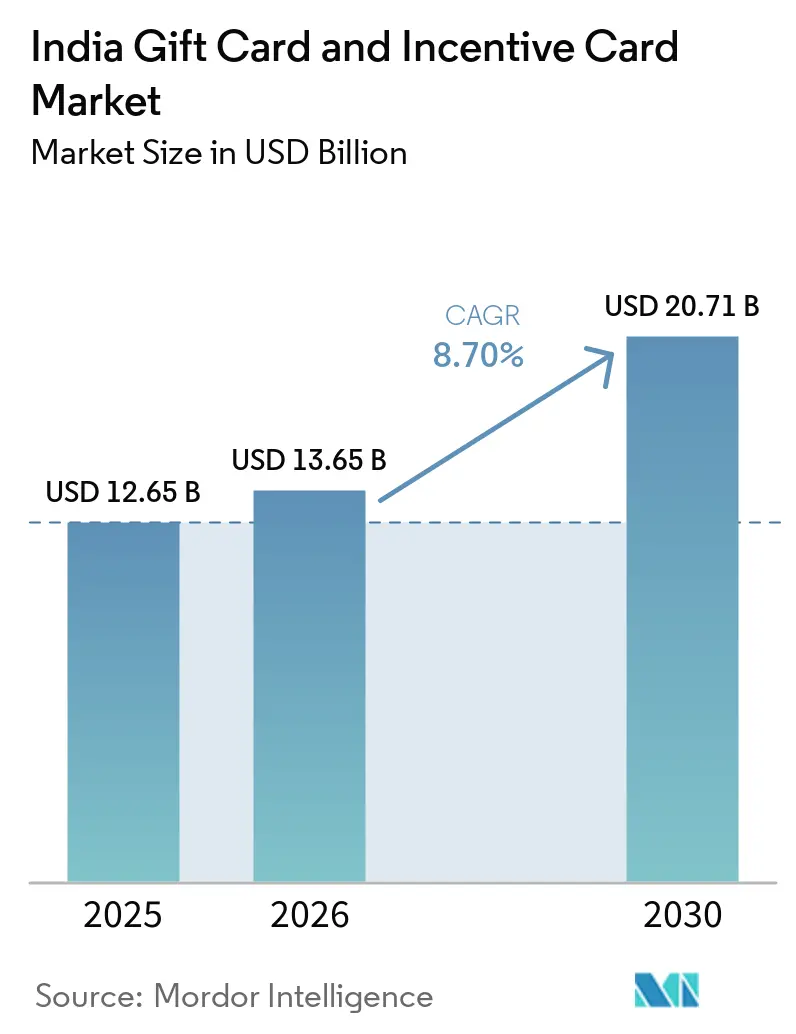
The India Gift Card And Incentive Card Market size is projected to expand from USD 12.65 billion in 2025 and USD 13.65 billion in 2026 to USD 20.71 billion by 2031, registering a CAGR of 8.70% between 2026 and 2031.
Corporate programs are scaling faster than personal gifting as enterprises standardize digital rewards for employees, channel partners, and customers. Distribution is shifting to online rails, where super-apps and bank portals embed instant vouchers into everyday checkout and points-redemption journeys. Product mix continues to tilt toward e-gift formats due to lower fulfillment costs and instant delivery. Regional growth is strongest in North India, where UPI penetration and e-commerce adoption are lifting digital redemptions in Tier-2 clusters. Market structure favors a few integrated issuer-processor and bank-powered platforms that control scale, fraud defenses, and brand catalogs.
Key Report Takeaways
- By consumer segment, the corporate segment led with a 61% share in 2025 and is projected to grow at a 19.36% CAGR through 2031.
- By distribution channel, online accounted for 70.76% of volume in 2025 and is forecast to expand at a 18.39% CAGR through 2031.
- By product, e-gift cards captured 78.37% share in 2025 and are set to advance at a 15.44% CAGR through 2031.
- By geography, South India held 29.33% of the 2025 value, while North India is projected to post the fastest growth at a 20.25% CAGR over 2026-2031.
Note: Market size and forecast figures in this report are generated using Mordor Intelligence’s proprietary estimation framework, updated with the latest available data and insights as of January 2026.
India Gift Card and Incentive Card Market Trends and Insights
Drivers Impact Analysis*
| Driver | (~) % Impact on CAGR Forecast | Geographic Relevance | Impact Timeline |
|---|---|---|---|
| E-gift migration via marketplaces and super-apps | +2.5% | Global with concentration in South India (Bengaluru, Hyderabad), West India (Mumbai, Pune), and expanding to Tier 2/3 cities | Medium term (2-4 years) |
| Corporate R&R and channel incentive digitization | +2.3% | National, with early gains in manufacturing hubs (Delhi-NCR, Pune, Bengaluru) and automotive clusters | Short term (≤ 2 years) |
| RBI-backed PPI expansion sustaining prepaid usage | +1.4% | APAC core, spill-over to urban centers, limited rural penetration due to KYC friction | Medium term (2-4 years) |
| Omnichannel issuance and distribution via POS/banks | +1.2% | National, concentrated in banked metro and Tier 1 cities | Long term (≥ 4 years) |
| UPI-enabled third-party access for full-KYC PPIs | +0.8% | National with phased rollout, higher adoption in South and West India UPI corridors | Short term (≤ 2 years) |
| ONDC Network Gift Card enabling multi-merchant acceptance | +0.3% | Experimental phase, 616+ cities with public-sector and SME focus | Long term (≥ 4 years) |
| Source: Mordor Intelligence | |||


E-gift Migration via Marketplaces and Super-apps Redefines Consumer Expectations
Marketplace integration reduced the steps between intent and delivery, boosting conversion for instant vouchers during peak events. Amazon Pay reported a 40% year-over-year increase in gift card purchases during the 2024 Great Indian Festival. It cited more than 1 billion gift cards delivered since 2014, which signals deep embeddedness at checkout and in stored payment credentials for repeat buyers[1]Amazon Pay Team, “Over a Billion Gift Cards Delivered,” Telegraph India, telegraphindia.com . Tier-2 and Tier-3 cities are contributing a growing share of digital spending, supported by smartphone adoption and broadband subscriber growth, which improve the reliability of e-voucher delivery and redemption flows. Super-apps, wallet ecosystems, and bank portals now position gift cards as multi-category liquidity spanning groceries, subscriptions, gaming credits, and travel services, broadening their appeal beyond single-brand retail. Push notifications tied to seasonal festivals and social occasions help capture last-minute gifting demand without the logistical burden. Brands that secure prominent placement within marketplace gift hubs gain share of spontaneous occasions and reduce customer acquisition costs over time.
Corporate R&R and Channel Incentive Digitization Displace Cash and Cheques
Enterprises have shifted from infrequent cash payouts to real-time digital vouchers that link rewards to verified outcomes and compress redemption cycles to minutes. Public programs validated instant e-voucher delivery at scale, which reinforced corporate confidence in performance-linked instruments for employees and channel partners. Scaled platforms reported thousands of annual programs across automotive, pharma, and consumer goods that replaced physical gifts with multi-brand e-vouchers and UPI-linked rewards, thereby improving repeat participation and reducing pilferage risk. Case studies show structured reward slabs, multiple redemption options per tier, and automated issuance from ERP-validated invoices, which together deliver faster feedback loops and better MIS visibility to program owners [2]RewardPort Editorial, “Data-Driven Dealer Incentives in 2026,” RewardPort, rewardport.in . HR-tech integrations and API-first catalogs enable plug-in deployments for mid-sized enterprises seeking enterprise-grade controls without high setup costs. Broader loyalty and total-rewards stacks now bundle gift vouchers with meal, wellness, and lifestyle benefits, thereby raising perceived value and retention among competitive talent.
RBI-Backed PPI Expansion Sustains Prepaid Usage Despite Wallet Decline
Regulatory changes in December 2024 enabled holders of full-KYC PPIs to make UPI payments via third-party UPI applications, reducing redemption friction for users who receive gift instruments from different issuers. The rule permits linking PPI balances within popular UPI apps and authenticating them with UPI credentials, thereby extending reach without issuer-specific apps. UPI volumes and values set new records in 2025 and early 2026, strengthening the underlying acceptance rail for voucher redemption across a wide merchant footprint. Wallet transaction values fell after the ban on credit-line loading, which pressured reload use cases and pushed issuers toward open-loop formats for repeat usage. Gift PPIs remain capped and non-reloadable, which limits high-value deployments and concentrates growth in digital code formats or open-loop co-branded cards. Prepaid issuance continues to expand for expense and payout use cases, helping sustain familiarity among corporate users.
ONDC Network Gift Card Pilots Multi-Merchant Acceptance for SME Ecosystems
ONDC introduced enterprise gift cards as part of its network taxonomy and partnered with a bank-led pilot to explore multi-merchant acceptance across hundreds of cities. The proposition enables loadable e-gift cards with zero delivery cost and no KYC expense for common denominations, which targets HR and admin gifting with both national and local merchant choice. Policy framing and public announcements underscore the aim of democratizing access to digital commerce for small merchants, including onboarding support under MSME initiatives. Private-sector adoption remains limited due to quality and support variability among very small merchants, as well as the need to maintain redemption service levels comparable to those of established voucher platforms. The model carries long-term inclusion potential if onboarding reaches critical mass and value-added features like group gifting and bill splitting improve utility for HR buyers. Until a broader scale is achieved, pilots are likely to remain concentrated among public-sector and policy-aligned entities.
Restraints Impact Analysis*
| Driver / Restraint (as applicable in title case) | (~) % Impact on CAGR Forecast | Geographic Relevance | Impact Timeline |
|---|---|---|---|
| Fraud/scam risk and consumer trust gaps | -1.3% | National, with elevated incidents in Tier 2/3 cities and rural areas lacking digital literacy | Short term (≤ 2 years) |
| PPI KYC, load, and validity limits for Gift PPIs | -0.9% | National, disproportionately affects individual consumers and small-ticket corporate programs | Medium term (2-4 years) |
| GST ITC restrictions on employer gifting | -0.7% | National, concentrated in organized corporate sector and large enterprises | Long term (≥ 4 years) |
| DPDP Act compliance obligations for issuers/distributors | -0.5% | National, higher compliance burden on small issuers and third-party aggregators | Long term (≥ 4 years) |
| Source: Mordor Intelligence | |||
Fraud and Scam Risk Erodes Consumer Confidence in Digital Gift Instruments
UPI-linked fraud losses rose across both value and case counts through FY2024, prompting rule changes such as removing person-to-person collect requests that were abused to mimic legitimate redemption prompts [3]PwC India Payments Team, “The Indian Payments Handbook 2025-2030,” PwC India, pwc.in . SMS and messaging scams impersonating gift support teams continue to target lower digital literacy segments, where QR code deployment is high, but user education lags. Risk controls have improved at the system level through Mule detection and verification mandates, yet pre-redemption identity checks are uneven across voucher platforms. Corporate issuers mitigate exposure by restricting redemption to known merchant catalogs and enforcing OTP on high-value instruments, while individual buyers on marketplaces receive limited security guidance at checkout. The proposed Digital Payment Intelligence Platform is under consultation and does not yet provide cross-issuer signal sharing to suppress coordinated fraud patterns.
GST ITC Blockage Turns Corporate Gift Cards Into Non-Recoverable Expense Lines
Section 17(5)(h) of the CGST Act blocks input tax credit for gifts and free samples, treating corporate gift-card allocations as non-creditable costs on procurement ledgers. Appellate rulings have reinforced that promotional items given to franchisees or distributors tied to sales targets do not qualify as taxable supplies that would enable ITC claims against these outlays. Employee gift exemptions are capped at a per-employee-per-year threshold, which is insufficient for senior recognition programs common in large enterprises and forces itemized tracking to avoid audit exposure. Clarifications that vouchers are not taxed at procurement do not change the ITC position when the underlying disbursement is categorized as a gift, which limits budget efficiency versus cash or payroll-linked awards. This taxation asymmetry leads mid-sized firms to reduce gift-card exposure or to re-route recognition into formats with clearer tax treatment.
*Our forecasts treat driver/restraint impacts as directional, not additive. The impact forecasts reflect baseline growth, mix effects, and variable interactions.
Recent Industry Developments
- June 2025: Amazon injected INR 350 crore (USD 42 million) into Amazon Pay India, extending a funding streak aimed at combating PhonePe’s dominant UPI position.
- April 2026: Pine Labs acquired Fave, a Southeast Asian consumer fintech platform, for over USD 45 million and positioned it as a distinct consumer vertical to accelerate smart-savings adoption, with hiring planned across India and Southeast Asia and an India app in advanced UPI certification.
- April 2026: GyFTR Limited published a public notice proposing to relocate its registered office from Maharashtra to Haryana and invited objections within fourteen days of publication.
- January 2026: LKP Finance acquired a 22% stake in Mufin Pay, which owns GyFTR, and announced steps to transition toward a platform-driven payments and rewards fintech ecosystem, including a proposed name change to GyFTR.
- May 2025: ICICI Bank launched its iShop portal with accelerated reward points and caps for gift voucher purchases and travel bookings, including specific value-back rates by card variant.


India Gift Card and Incentive Card Market Report Scope
A gift card refers to a prepaid card that is loaded with funds for future use and can be used to make purchases and other financial transactions. The Indian gift card and incentive card market is segmented based on card type e-gift card and physical card). By consumer type, the market is segmented by retail consumers and corporate consumers. By distribution channel, the market is broken into online and offline. The market size and forecast are provided in terms of value (USD) for all the above segments.
By Consumer
| Individual | |
| Corporate | Small-scale Enterprises |
| Mid-tier Enterprises | |
| Large Enterprises |
By Distribution Channel
| Online |
| Offline |
By Product
| E-gift Card |
| Physical Card |
By Geography
| North India |
| South India |
| East India |
| West India |
| Central India |
| Northeast India |
| By Consumer | Individual | |
| Corporate | Small-scale Enterprises | |
| Mid-tier Enterprises | ||
| Large Enterprises | ||
| By Distribution Channel | Online | |
| Offline | ||
| By Product | E-gift Card | |
| Physical Card | ||
| By Geography | North India | |
| South India | ||
| East India | ||
| West India | ||
| Central India | ||
| Northeast India | ||


Key Questions Answered in the Report
What is the current size and growth outlook for the India gift card and incentive card market?
The India gift card and incentive card market size is expected to increase from USD 13.65 billion in 2026 to USD 20.71 billion by 2031 at an 8.7% CAGR over 2026-2031.
Which buyer group drives the fastest growth in India’s gift and incentive space?
Corporate programs lead, with 61% of 2025 value and a projected 19.36% CAGR to 2031 as enterprises digitize rewards for employees, dealers, and customers.
How is distribution shifting within the India gift card and incentive card market?
Online channels held 70.76% in 2025 and are projected to grow at 18.39% CAGR, driven by super-app checkouts, wallet ecosystems, and bank rewards portals that enable instant vouchers.
What product type leads adoption across Indian gift instruments?
E-gift cards captured 78.37% of 2025 share and are set to grow at 15.44% CAGR as issuers prioritize instant delivery, lower costs, and dynamic catalogs.
Which region is set to expand the fastest in India’s gift and incentive space?
North India is projected to post the fastest regional growth with a 20.25% CAGR due to deepening UPI usage and rising e-commerce adoption in Tier-2 clusters.
What are the main risks that could slow growth for gift and incentive programs in India?
Fraud and scam risk on digital rails, GST ITC restrictions for employer gifting, PPI caps on gift instruments, and DPDP compliance costs for issuers are the key headwinds that can pressure margins and program expansion.
Page last updated on:




