
Market Overview
| Study Period | 2020 - 2031 |
|---|---|
| Forecast Data Period | 2026 - 2031 |
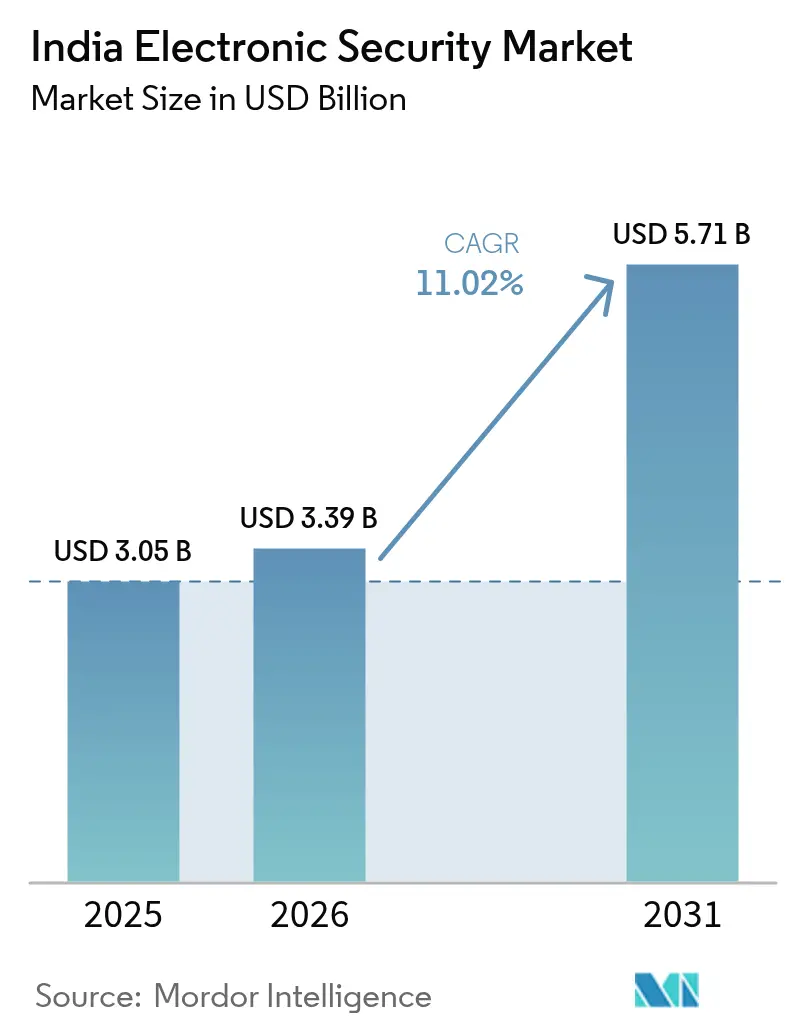
| Base Year Market Size (2025) | USD 3.05 Billion |
| Market Size (2026) | USD 3.39 Billion |
| Market Size (2031) | USD 5.71 Billion |
| Growth Rate (2026 - 2031) | 11.02 % |
| Market Concentration | Medium |
Major Players *Disclaimer: Major Players sorted in no particular order Image © Mordor Intelligence. Reuse requires attribution under CC BY 4.0. | |
India Electronic Security Market Analysis by Mordor Intelligence
India Electronic Security market size in 2026 is estimated at USD 3.39 billion, growing from 2025 value of USD 3.05 billion with 2031 projections showing USD 5.71 billion, growing at 11.02% CAGR over 2026-2031. Intensifying regulatory oversight, infrastructure modernization, and steadily declining hardware costs together accelerate adoption across public and private sectors. Mandatory Bureau of Indian Standards (BIS) certification for closed-circuit television (CCTV) equipment, effective April 2025, is reshaping supply chains in favor of compliant domestic producers. Simultaneously, Production Linked Incentive (PLI) schemes bolster local manufacturing capacity, while smart-city allocations, women’s safety programs under the Nirbhaya Fund, and National Rail modernization budgets expand procurement pipelines. Enterprises are reallocating capital from basic cameras toward AI-enabled video analytics, and the diffusion of cloud and edge architectures is unlocking demand in Tier-2 and Tier-3 cities where bandwidth and budget constraints once limited modernization.
Key Report Takeaways
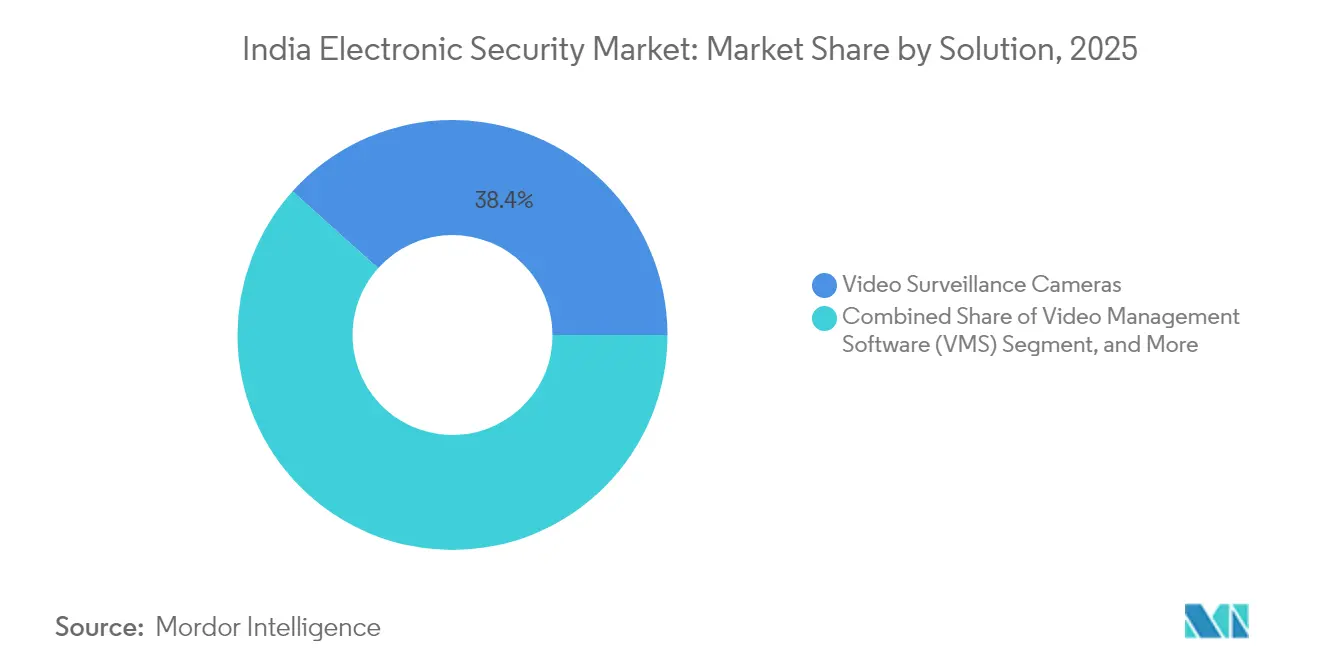
- By solution, video surveillance cameras led with 38.35% revenue share of the India Electronic Security market in 2025; video management software is projected to expand at a 12.44% CAGR through 2031.
- By services, installation and integration accounted for 48.05% share of the India Electronic Security market in 2025, while managed security services are forecast to record the fastest 12.22% CAGR to 2031.
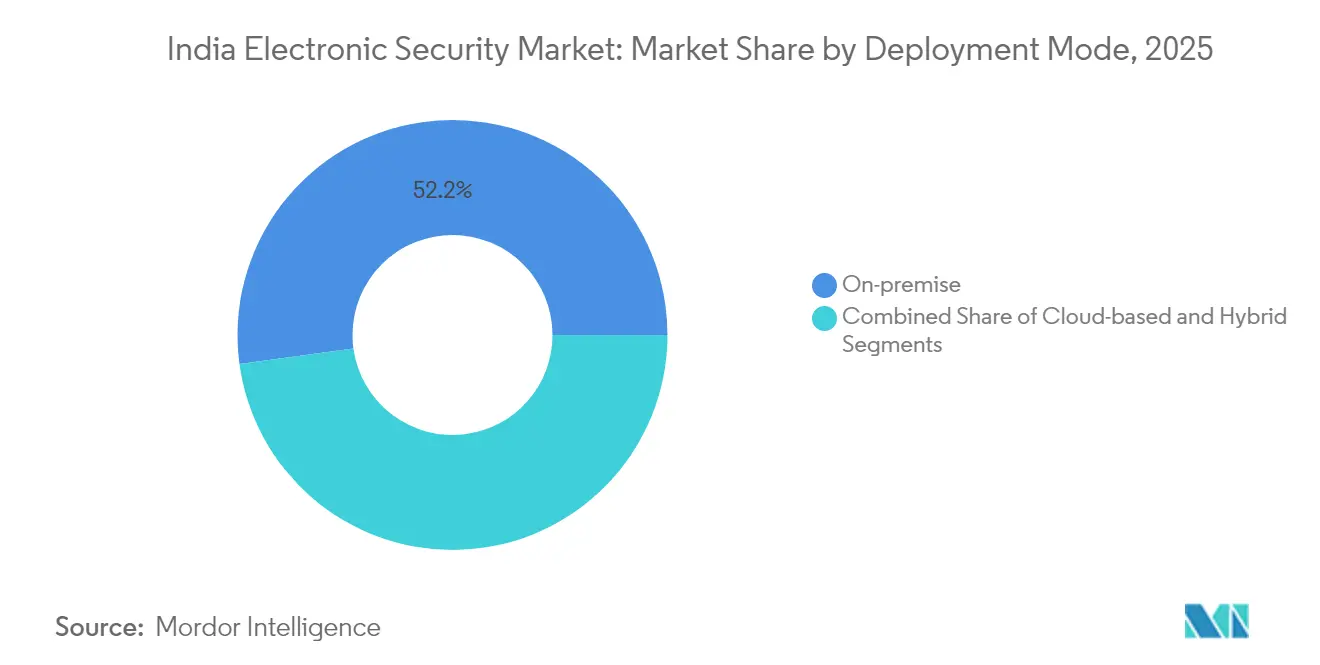
- By deployment mode, on-premise systems retained a 52.15% share of the India Electronic Security market in 2025; cloud-based deployments are expected to grow at a 11.94% CAGR through 2031.
- By component, hardware dominated with a 59.65% share of the India Electronic Security market in 2025, whereas software and analytics are set to advance at a 12.03% CAGR over the forecast period.
- By end-user vertical, government and law enforcement held a 30.85% share of the India Electronic Security market in 2025; the residential segment is poised for the quickest 12.84% CAGR to 2031.
- By geography, North India captured a 33.95% share of the India Electronic Security market in 2025, while South India is projected to be the fastest-growing region at a 12.56% CAGR through 2031.
Note: Market size and forecast figures in this report are generated using Mordor Intelligence’s proprietary estimation framework, updated with the latest available data and insights as of 2026.
India Electronic Security Market Trends and Insights
Drivers Impact Analysis*
| Driver | (~) % Impact on CAGR Forecast | Geographic Relevance | Impact Timeline |
|---|---|---|---|
| Smart-city project pipeline beyond 2027 | +2.1% | National; Tier-1 and Tier-2 cities | Long term (≥ 4 years) |
| Rising crime and terrorism concerns | +1.8% | National; urban centers | Medium term (2-4 years) |
| Mandatory BIS re-certification for CCTV (Apr 2025) | +1.5% | National | Short term (≤ 2 years) |
| AI-enabled video analytics lowering guard costs | +1.3% | National; metros and industrial hubs | Medium term (2-4 years) |
| Domestic PLI incentives for security hardware | +1.2% | Andhra Pradesh, Tamil Nadu | Medium term (2-4 years) |
| IoT-integrated building platforms in Tier-2/3 cities | +0.9% | Tier-2/3; rural spillover | Long term (≥ 4 years) |
| Source: Mordor Intelligence | |||


Smart-City Project Pipeline Beyond 2027
Government allocations under the Smart Cities Mission now span more than 300 urban centers and earmark surveillance, traffic management, and emergency response as core deliverables. Delhi International Airport Limited showcased an AI-powered airside management platform in March 2025 that cut taxi-out times while integrating with perimeter security feeds. [1]Delhi International Airport Limited, “APR 2025 Airside AI Press Release,” newdelhiairport.in Indian Railways set aside INR 2.52 lakh crore (USD 30.2 billion) in its 2024-25 capital plan, reserving funds for GPS-enabled coaches and 40,000 camera upgrades, thereby standardizing ruggedized devices across rolling stock. [2]Ministry of Railways, “Pink Book 2024-25,” indianrailways.gov.in Municipal corporations in satellite towns emulate these benchmarks to attract investment, driving cascading demand for interoperable access control and analytics software. Longer-term, proposed urban renewals in Tier-2 centers such as Jaipur and Indore embed video analytics, vehicle-to-infrastructure signaling, and connected alarm systems into master plans, supporting steady equipment refresh cycles. The cumulative multiplier effect elevates baseline specifications for private developers, which, in turn, reinforces minimum-feature expectations among residential buyers.
Rising Crime and Terrorism Concerns
National Crime Records Bureau data show persistent upticks in urban property offenses and cyber-enabled crimes, compelling city and state agencies to increase surveillance budgets. Maharashtra Police deployed the MARVEL AI platform in mid-2025, enabling real-time license-plate matching and behavioral anomaly alerts across 5,000 live streams. Private enterprises mirror these investments: Larsen & Toubro announced an INR 800 crore (USD 9.6 million) cyber-physical security program in May 2025 focused on integrated SOCs that manage both digital and perimeter assets. Women’s safety initiatives continue funneling Nirbhaya Fund grants toward CCTV networks in metro stations and smart poles fitted with emergency call buttons. Rising insurance premiums for facilities lacking certified perimeter detection further nudge industrial operators toward proactive sensor deployment.
Mandatory BIS Re-Certification for CCTV (April 2025)
The April 2025 enforcement of BIS IS 13252 standards immediately barred non-certified imports, trimming Chinese low-cost share by double digits and opening space for compliant Indian incumbents such as CP PLUS, Prama Hikvision India, and Godrej Security. The rule now extends to firmware integrity checks and local data-storage conformity, pushing system integrators to reassess bill-of-materials and documentation processes. Although only seven accredited laboratories handled initial compliance loads, BIS fast-tracked additional facilities in Hyderabad and Panchkula by August 2025 to clear backlogs. Import substitution, coupled with PLI rebates of up to 15% on value addition, is catalyzing backward integration into printed circuit board assembly and lens modules. During the transition, some public-sector projects invoked procurement extensions, yet most resumed by Q3 2025 once warehouse inventories normalized.
AI-Enabled Video Analytics Lowering Guard Costs
Enterprises calculate that a single AI-assisted control-room operator can supervise 600 cameras versus 80 under manual viewing, translating into guard cost reductions of 30-40% within two years of deployment. [3]Honeywell International, “AI Video Analytics Lower Guard Costs Case Study,” honeywell.com Chennai International Airport will commission a facial-verification immigration corridor in 2025, expected to cut passenger clearance times by 60%. To address privacy activism, several municipalities pivot toward behavior-based analytics that flag loitering or crowd surges without capturing biometric identifiers. Edge inference chipsets embedded in cameras pass metadata rather than raw video to cloud dashboards, limiting bandwidth usage and mitigating data-sovereignty concerns. Return-on-investment analyses also highlight maintenance savings as predictive algorithms forecast lens dirt and network congestion, reducing truck rolls for field technicians.
Restraints Impact Analysis*
| Restraint | (~) % Impact on CAGR Forecast | Geographic Relevance | Impact Timeline |
|---|---|---|---|
| Compliance and data-governance hurdles | -1.4% | National; government and BFSI | Medium term (2-4 years) |
| High cap-ex sensitivity of SMEs | -1.1% | Tier-2/3 cities and rural | Short term (≤ 2 years) |
| Shortage of accredited BIS test labs | -0.8% | National | Short term (≤ 2 years) |
| Privacy litigation slowing facial-ID roll-outs | -0.7% | Urban centers | Medium term (2-4 years) |
| Source: Mordor Intelligence | |||
Compliance and Data-Governance Hurdles
The absence of a finalized Personal Data Protection Bill leaves gray areas around biometric retention periods and cross-border cloud replication, prompting public agencies to default to on-premise archives. Financial institutions must reconcile Reserve Bank of India cybersecurity directives with emerging Computer Emergency Response Team advisories that mandate near-real-time incident logging. Procurement cycles lengthen while legal teams vet vendor data-processing agreements, often delaying cloud migrations by 6-9 months. Multisite operators confront the added cost of mirroring data centers across state lines to satisfy evolving data-localization drafts. Until a unified privacy statute is enacted, conservative technology adoption, especially for facial recognition, will cap upside in regulated verticals.
High Cap-Ex Sensitivity of SMEs
Micro and small enterprises form the spine of India’s manufacturing and retail sectors, yet frequently operate on thin margins, leaving limited budget for advanced analytics or multi-sensor fusion platforms. Basic four-camera kits priced between INR 10,300-20,990 (USD 123-251) remain the preferred entry point, crowding the low-value end of the channel. Although bank-led equipment-leasing programs exist, credit availability remains uneven in peri-urban regions, and owners often favor outright purchase to avoid monthly charges. Managed security services help convert cap-ex to op-ex, but subscription fatigue has emerged after a proliferation of SaaS fees for accounting, CRM, and utility payments. Consequently, SME adoption will track macro indicators such as GST filings and collateral-free loan disbursements rather than purely technology cycles.
*Our forecasts treat driver/restraint impacts as directional, not additive. The impact forecasts reflect baseline growth, mix effects, and variable interactions.
Segment Analysis
By Solution: Video Management Software Drives Innovation
Video surveillance cameras continued to represent 38.35% of 2025 revenue, signifying the foundational layer of the India Electronic Security market size for solution offerings. Nevertheless, spending is tilting toward software that extracts actionable insight from existing hardware; video management software is forecast to grow at a 12.44% CAGR as firms pursue forensic search, object classification, and incident-response automation. AI engines that deliver license-plate recognition or fall-detection analytics can be licensed per-camera, allowing incremental upgrades without forklift replacements. Perimeter security sensors such as 3D LiDAR and distributed acoustic sensing are gaining favor in critical infrastructure after trial deployments cut false alarms by 70% at oil-pipeline sites. Access control is converging with visitor-management kiosks, enabling single-credential passage from parking gate to office turnstile.
Second-generation software architectures expose open REST APIs, making them integral to facilities’ wider IoT stacks and paving the way for predictive maintenance across elevators and chillers. As cyber-attack vectors migrate to networked cameras, integrators differentiate by offering secure-boot firmware and zero-trust segmentation templates. While domestic camera assembly enjoys PLI support, high-performance video analytics often rely on imported GPU accelerators, which keeps blended margins favorable for software-heavy propositions. Consequently, multinationals are acquiring specialist analytics startups to bundle capabilities, while Indian independents leverage lower-cost development talent to undercut license fees. Competitive intensity, therefore, remains balanced between scale and specialization.


By Services: Managed Security Services Transform Operations
Installation and integration retained 48.05% share of the India Electronic Security market size in 2025 as public-sector mega-projects demanded nationwide roll-outs spanning thousands of endpoints. Yet enterprises increasingly offload daily monitoring, firmware patching, and incident triage to managed security service providers (MSSPs), driving a 12.22% CAGR for this revenue stream. MSSPs pool analysts in centralized command centers and leverage AI triage to shrink average response time to under four minutes, a performance level difficult for single-tenant setups. Training and consulting revenues climb as customers seek guidance on BIS compliance documentation, data-localization schemas, and zero-trust network architecture. Maintenance contracts are shifting toward predictive models powered by embedded health probes that forecast disk failures seven days in advance, slashing unexpected downtime.
As competition intensifies, integrators pursue mergers to widen geographic footprints and diversify vertical expertise. Pricing models evolve from flat monthly fees to outcome-based contracts pegged to incident-reduction percentages. Government tenders increasingly bundle five-year managed-service clauses, stabilizing revenue visibility for vendors while raising the bar for technical certifications. The Managed Detection and Response (MDR) sub-segment edges into physical security, analyzing badge-reader logs alongside firewall alerts to spot insider threats. Collectively, these trends move the industry toward lifecycle-centric engagement, extending customer lifetime value well beyond initial hardware deployment.
By Deployment Mode: Cloud Adoption Accelerates Despite On-Premise Dominance
On-premise systems held 52.15% of the India Electronic Security market share in 2025, reflecting data-sovereignty and latency preferences among defense entities and regulated sectors. Cloud subscriptions, however, are advancing at a 11.94% CAGR as businesses with distributed branches recognize the economics of centralized analytics and elastic storage. Hybrid topologies that combine edge gateways with regional cloud nodes resolve bandwidth constraints while enabling metadata-level replication for disaster recovery. Service providers have started offering sovereign-cloud regions hosted in Indian data centers certified under MeitY empanelment, assuaging compliance officers. Additionally, the government’s Digital Locker APIs inspire similar tokenized approaches in surveillance, allowing citizens to consent to video access for specified durations.
Capital-intensive compression and transcoding work now offloads to GPUs in the cloud, cutting local CPU needs by 40%, an attractive saving for SME budgets. Meanwhile, adaptive bitrate streaming reduces data egress fees, a traditional pain point in cloud video. Vendors bundle cybersecurity toolsets intrusion detection, anomaly scanning into subscription tiers, escalating value capture beyond mere storage sales. Even public-sector units experiment with pilot cloud nodes for non-critical areas such as parking lots to validate performance before wider adoption, signalling a gradual, measured migration path ahead.
By Component: Software and Analytics Drive Value Creation
Hardware still accounted for 59.65% of 2025 spend, yet commoditization pressures temper margin upside as low-cost IP cameras flood channels. Software and analytics, the fastest-growing bucket at 12.03% CAGR, orchestrate real-time detection, post-event forensics, and compliance audit trails, elevating the India Electronic Security market as a data-driven service platform. Camera-agnostic analytics modules extend the life of installed base assets by layering modern AI over legacy RTSP feeds. This retrofit trend particularly resonates with municipal budgets strained by multiple urban-development obligations. Service revenues benefit from complexity: each machine-learning model update or regulatory patch necessitates managed roll-outs, further embedding integrators within client operations.
Hardware vendors respond by embedding secure elements and AI accelerators on-device, slicing inference latency to sub-100 milliseconds, thereby supporting edge-only deployments in bandwidth-starved rural zones. Component ecosystems deepen as Indian PCB fabricators integrate image-signal-processor (ISP) dies locally, targeting 40% domestic value addition by 2027. Analytics dashboards increasingly interweave physical alarms with cyber telemetry, a misconfigured firewall rule surfaces alongside an unauthorized door access attempt, meeting converged security governance frameworks.
By End-User Vertical: Residential Segment Accelerates Growth
Government and law enforcement represented 30.85% of 2025 demand, anchored by Central Armed Police Forces upgrades and smart-city control rooms. Nevertheless, the residential category is accelerating at a 12.84% CAGR and is projected to outpace commercial verticals by install counts over the next five years. Falling camera prices coincide with expanding e-commerce distribution that delivers do-it-yourself kits within 24 hours in most metros. Mobile apps offering live viewing and two-way talk appeal to nuclear families with dual-income parents seeking remote oversight of children and elders. Interoperability with smart-lighting ecosystems reduces app fragmentation, supporting stickiness.
Commercial real-estate owners integrate visitor-management kiosks with access control to simplify tenant onboarding, while the BFSI sector pilots behavioral biometrics to flag coercion attempts at ATMs. Manufacturing plants deploy radar-based perimeter fencing to meet zero-incident mandates under global supply-chain audits. Healthcare facilities adopt multi-factor identity verification QR passes plus temperature screening to align with updated National Healthcare Accreditation regulations. Each vertical’s nuanced regulatory regime deepens specialization among vendors, fostering targeted product SKUs and advisory services.
Geography Analysis
North India’s dominance is anchored by massive public-sector tenders and a well-developed integrator base operating across Delhi, Haryana, and Uttar Pradesh. Smart-city control rooms in Lucknow and Kanpur generate recurring software-license income, while the National Capital Region influences specification standards such as mandatory 4K resolution that ripple into adjoining states. Federal ministries require on-premise data retention, making the region a stronghold for network video recorder sales.
South India’s growth trajectory leverages its status as a technology crucible. Bangalore International Airport’s planned DigiYatra biometric corridors and Hyderabad Metro’s cloud-based video walls illustrate the region’s appetite for innovation. The prevalence of data centers from hyperscale operators like AWS and Microsoft Azure eases compliance hurdles for cloud-hosted surveillance dashboards, shortening deployment cycles for corporates. State governments in Karnataka and Telangana foster startup collaboration through open-data sandboxes, accelerating AI solution maturation.
West India benefits from the confluence of financial services in Mumbai and manufacturing clusters in Pune and Vadodara. Strict Reserve Bank of India guidelines prompt banks to adopt redundant video retention arrays with 180-day archival mandates. Meanwhile, Gujarat’s industrial safety regulations have stimulated the adoption of perimeter intrusion detection systems at petrochemical complexes. As port expansions and dedicated freight corridors come online, demand will broaden beyond city centers, diversifying the competitive landscape inside the India Electronic Security market.
Regulatory Landscape
India’s electronic security market is increasingly shaped by mandatory product registration and security-focused procurement rules. CCTV cameras and related equipment fall under MeitY’s Electronics and IT Goods (Requirement for Compulsory Registration) Order, 2021 (CRO-2021), and are subject to conformity requirements administered through BIS/CRS processes. The report’s April 2025 enforcement milestone for CCTV certification has made compliance a prerequisite for selling into large institutional and government-led deployments.
Government procurement is also influenced by the Public Procurement (Preference to Make in India) Order, 2017 (as amended, including March-April 2024 updates for security-sensitive categories). This framework links tender eligibility to adherence with notified Essential Requirements and domestic content preferences. Assurance and cybersecurity requirements are tightening for connected devices and cryptographic components used across surveillance, access control, and command centers. MeitY’s STQC Directorate operates the IoT System Certification Scheme (IoTSCS) with multiple assurance levels for IoT devices, and related procedures for CCTV testing and evaluation, which pushes OEMs and integrators toward documented security baselines and accredited-lab testing. For systems handling encryption and key management, the Controller of Certifying Authorities (CCA) issues security requirements for crypto devices (Version 2.2, November 2024), referencing widely used standards (FIPS 140-2/3) to reinforce tamper resistance and security controls relevant to regulated end users.
Value Chain Analysis
The India electronic security value chain spans component suppliers (image sensors, chipsets, optics, storage, networking), OEM/ODM manufacturing and local assembly, software and analytics developers (VMS, AI models), system integrators, distributors and e-commerce channels (notably for residential kits), and service providers delivering installation, maintenance, monitoring, and managed security services. Regulatory compliance has become a prominent value-chain gate, with BIS/CRS registration and STQC-aligned security testing increasing documentation and test-lab dependencies. This also shifts sourcing toward traceable bill-of-materials and firmware control that can clear India’s certification and procurement checks.
Domestic manufacturing is being reinforced by India’s electronics industrial policy stack, which affects availability and cost of upstream inputs used in cameras and connected security endpoints. The Electronics Component Manufacturing Scheme (ECMS), notified April 8, 2025 with an outlay of INR 22,919 crore, targets passive components and connectors that sit upstream of PCBA and final device assembly, complementing PLI-driven localization noted in the report. On the technical governance side, standards work by bodies such as the Telecommunication Engineering Centre (TEC), including updates like TEC 49120:2025 for Unified Threat Management (UTM) systems and the November 2025 Code of Practice for securing consumer IoT, increasingly influences integrator architectures where physical security endpoints feed into converged IT-security environments.
Competitive Landscape
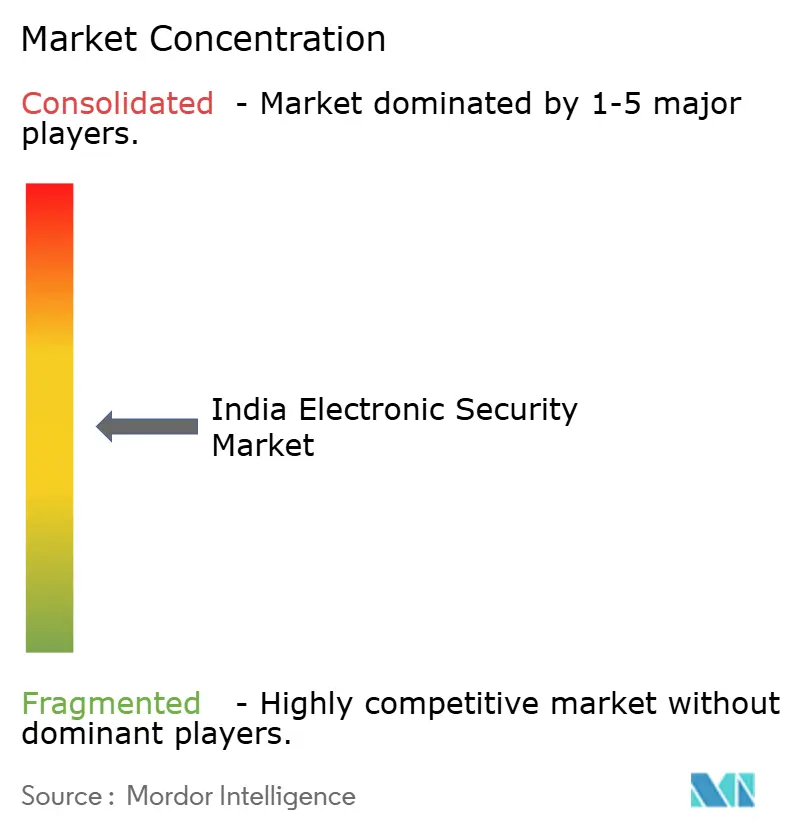
The India Electronic Security market remains moderately fragmented; the top five vendors collectively account for roughly 38% share, leaving ample opportunity for niche specialists. Domestic manufacturers such as CP PLUS, Prama Hikvision India, and Godrej Security Solutions leverage PLI incentives and proximity to BIS labs to undercut importers on both cost and compliance lead-time. Global brands Honeywell, Bosch, and Axis Communications differentiate through cyber-hardened firmware, ONVIF-conformant openness, and global service agreements appealing to multinational clients.
Technology convergence is reshaping the value curve. Camera suppliers bundle on-device analytics, while software firms embed access-control plug-ins, blurring category boundaries. System integrators increasingly offer outcome-based managed security contracts, leveraging AI triage to handle multi-sensor incident data. Strategic alliances proliferate: Honeywell’s 2024 acquisition of Carrier’s Global Access Solutions arm boosted its badge-reader portfolio, whereas Bharat Electronics Limited expanded civilian perimeter-detection products, tapping defense-grade R&D for critical-infrastructure clients.
Local channel strength is decisive in Tier-2/3 cities where procurement hinges on trust and near-instant support. Regional integrators possessing multilingual technicians win school and hospital projects, while national players focus on capex-heavy airports and rail corridors. The mandatory CCTV re-certification temporarily tilted the share toward compliant domestics, yet global incumbents are fast-tracking joint ventures to regain lost ground. In sum, capability breadth, certification agility, and service intimacy now define competitive advantage.
India Electronic Security Industry Leaders
PRAMA Hikvision India Pvt. Ltd.
Dahua Technology India Pvt. Ltd.
Aditya Infotech Ltd. (CP PLUS)
Honeywell Automation India Ltd.
Bosch Ltd.
- *Disclaimer: Major Players sorted in no particular order

Market Opportunities and Future Outlook
Public-safety modernization and city-scale command-and-control programs continue to create whitespace for AI-led platforms that unify cameras, analytics, and incident workflows across agencies and districts. Recent program-scale proof points include the May 2026 sanction in Mumbai for Phase 3 of the city surveillance project (reported as INR 2,140 crore with 15,000 AI-powered cameras) and the February 2026 launch of Phase 1 of Delhi’s Safe City Project with an AI-enabled surveillance network and C4I command center. These deployments raise baseline requirements for interoperable VMS, higher-assurance device security, and lifecycle services that keep distributed endpoints patched and compliant.
Certification and supply-chain rules are also redirecting opportunity toward compliant, India-ready product lines and local value addition, especially where government and critical-infrastructure buyers restrict procurement to certified CCTV equipment and impose Essential Requirements such as supply-chain disclosures and vulnerability checks. As sourcing diversifies away from high-risk or non-compliant hardware, system design work expands around secure device onboarding, audit-grade documentation, and hybrid architectures that balance on-premise retention preferences with cloud/edge analytics. This environment supports growth levers for domestic manufacturers that can pass accredited testing at scale and for integrators and MSSPs that can bundle compliance engineering, secure deployment templates, and ongoing monitoring into multi-year service contracts.
Recent Industry Developments
- July 2026: Videonetics completed deployment of an AI-powered Unified Video Management Platform (CCTV360) across Andhra Pradesh, integrating about 15,000 IP cameras across 28 districts for statewide, real-time governance use cases. The program-scale implementation underscores the market shift from camera rollout to unified VMS, analytics, and command-center orchestration, strengthening demand for platform integration and managed operations.
- August 2025: Aditya Infotech (CP PLUS) raised INR 1,300 crore through an IPO, with proceeds earmarked for expanding manufacturing lines. The funding supports capacity and localization moves that align with India’s certification-led procurement environment and supply-chain scrutiny around CCTV hardware.
- April 2024: The Ministry of Home Affairs issued guidance on CCTV deployment and related operating practices for public safety and security environments. This reinforced more standardized expectations for coverage, operations, and governance across government-led deployments, influencing tender specifications and integrator scope beyond hardware supply.


Research Methodology Framework and Report Scope
Market Definition and Coverage
For this study, we define the India electronic security market as revenues earned from electronic systems and related services that prevent, detect, monitor, and respond to security events across residential, commercial, industrial, and public settings in India.
Scope exclusions: We exclude purely mechanical security products and standalone civil construction work that is not tied to an electronic security system sale or service contract.
Segmentation Overview
- By Solution
- Video Surveillance Cameras
- Video Management Software (VMS)
- Access Control Systems
- Biometric Readers and Terminals
- Intrusion Detection and Alarms
- Perimeter Security Sensors
- By Services
- Installation and Integration
- Maintenance and Support
- Monitoring and Response (Command-Centre)
- Managed Security Services
- Training and Consulting
- By Deployment Mode
- On-premise
- Cloud-based
- Hybrid
- By Component
- Hardware
- Software and Analytics
- Services
- By End-user Vertical
- Government and Law-Enforcement
- Commercial Buildings
- Industrial and Manufacturing
- BFSI
- Transportation and Logistics
- Residential
- Retail and Hospitality
- Healthcare Facilities
- Other End-user Verticals
- By Region
- North India
- West India
- South India
- East and North-East India
- Central India
Data Sources, Market Sizing, and Validation
Desk Research
Desk research starts with mapping demand pools in India where electronic security spend is visible and explainable, then aligning that with supply-side signals. We rely on public sources such as government procurement portals and tender notices, publications from the Bureau of Indian Standards (including CCTV related requirements), Ministry of Home Affairs and Smart Cities Mission updates, and telecom and IT policy notes that influence cloud-connected security deployments.
To ground pricing and adoption assumptions, we also review import and export trade statistics, patent databases to track technology direction (for example, analytics and biometrics), and peer-reviewed journals for performance and compliance context. These inputs are complemented with company filings, investor presentations, and reputable press coverage for revenue mix clues and channel movements. The sources listed above are illustrative, and many other public and subscription datasets were also checked to collect data, validate assumptions, and clarify open questions during the work.
Primary Interviews and Surveys
Primary interviews and surveys were used to confirm what is actually being purchased and installed in India, how projects are priced (hardware, software, and services), and how buying cycles differ across government, commercial buildings, industry, and residential demand. We spoke with a mix of system integrators, distributors, service providers, and end-user security leaders so gaps from desk research, such as service attach rates and upgrade timing, could be closed and then cross-checked against the model outputs.
Distribution of primary research fieldwork respondents
| Company type | Respondent position |
|---|---|
| Top tier: 36% | CXOs: 14% |
| Mid tier: 48% | Functional/Unit leaders: 41% |
| Smaller Players: 16% | Managers: 45% |
Market-Sizing & Forecasting
Our sizing starts with a top-down build that reconstructs the addressable India spend by linking security adoption to the underlying build base, such as commercial floor space additions, infrastructure and smart city project activity, and industrial facility expansions, and then translating this into equipment and service demand. Once that demand pool is formed, it is split across major solution and service buckets using observed mix patterns from tenders, compliance-driven upgrades, and channel discussions.
To keep totals realistic, results are corroborated using selective bottom-up approximations, such as sampled average selling prices for cameras, access control readers, and intrusion systems multiplied by estimated shipment or installation volumes, followed by service revenue add-ons where contract structures support it. Key variables used in the model include the share of IP versus analog deployments, typical replacement cycles for installed systems, service attach rates for maintenance and monitoring, penetration of access control and biometrics in regulated premises, and the pace of analytics adoption where compute and connectivity constraints matter. For forecasting, scenario analysis is used, because policy timing, public capex cycles, and compliance enforcement can shift year-to-year, and then those scenarios are reconciled with expert expectations on price erosion and project pipelines.
Data Validation & Update Cycle
Validation is done through triangulation across at least three angles, including demand signals, supply signals, and what practitioners say is happening on the ground in India. We run variance checks on growth rates, pricing movements, and mix shifts so outliers can be traced back to a specific assumption and corrected, and then the model is reviewed in multiple analyst passes before sign-off.
The outputs are also compared with independent indicators, such as tender volumes, import trends for key product classes, and visible project announcements, and we re-contact experts when a mismatch persists. Reports are refreshed annually, and interim updates are made when material events occur, such as new compliance requirements, large program launches, or sharp currency and pricing changes. Before delivery, a final review pass is completed so clients receive the most current view available at that time.
Mordor Intelligence's India Electronic Security Market Estimate Compared With Other Published Estimates
Published market sizes for India electronic security can look far apart, even when the topic name is similar, because firms do not always count the same revenue streams and they often apply different pricing and upgrade assumptions. We kept the build traceable to visible demand pools and then used interviews to test whether the implied volumes and service shares fit what buyers and integrators see.
The main gap comes from whether ongoing services and software are counted alongside equipment, where Mordor Intelligence includes installation, integration, maintenance, and monitoring revenues only when they are directly tied to electronic security deployments in India rather than being bundled with broader facility or IT services.
Benchmark comparison
| Source | Market Size | Gaps in Research Methodology |
|---|---|---|
| Mordor Intelligence | USD 3.05 B (2025) | |
| Industry Association A | USD 2.60 B (2025) | Uses a narrower definition that emphasizes hardware sales, and it applies conservative assumptions on managed services and monitoring penetration, which reduces the counted revenue pool. |
| Trade Journal B | USD 3.80 B (2025) | Blends adjacent spending such as broader building automation and some IT security related subscriptions, and it often assumes faster upgrades to higher-value analytics packages without clear validation checks. |
The table shows that the spread mainly comes from what gets included beyond devices and how quickly price and mix are assumed to move. By keeping add-on services conditional on a clear deployment trigger and by testing pricing and replacement cycles in interviews, we arrive at a practical number that can be repeated and audited year after year.


Key Questions Answered in the Report
What is the 2026 value of the India Electronic Security market?
The market is valued at USD 3.39 billion in 2026.
Which solution segment is growing fastest?
Video management software is projected to grow at a 12.44% CAGR through 2031.
How is BIS certification affecting suppliers?
Mandatory certification, enforced in April 2025, is reducing non-compliant imports and boosting domestic manufacturers’ share.
Why is residential demand rising?
Affordable AI-enabled camera kits and mobile app control are driving a 12.84% CAGR in residential installations.
Which region will see the quickest growth to 2031?
South India is forecast to expand at a 12.56% CAGR, propelled by tech-hub investments and early adoption of cloud-based security.
What services model is gaining traction?
Managed security services that bundle monitoring, updates, and analytics are expanding at 12.22% CAGR as firms convert cap-ex to op-ex.
Page last updated on:


 Your data is secure and never sold or shared.


